词汇表

英语词汇词典 | 单词含义、定义和示例

noun
/moʊld/
模具;霉菌 (mo-er-de)

a hollow container used to give shape to molten material; fungus

"She poured chocolate into the mould to make candies."

"她把巧克力倒进模具里做糖果。" (shi po de qiao ke li jin mo ju dao zuo tang guo)
verb
/maʊnt/
安装 (anzhuang)

to climb up, rise, or fix something in place

"They plan to mount a camera on the wall."

"他们计划在墙上安装一台摄像机。" (Tamen jihua zai qiang shang anzhuang yi tai shexiangji.)
noun
/ˈmaʊntən/
(shan)

a large natural elevation of the earth’s surface

"They climbed the highest mountain in the region."

"他们爬上了该地区最高的山。" (Tāmen pá shàngle gāi dìqū zuìgāo de shān.)
noun
/ˌmaʊntəˈnɪə/
登山者 (dēng shān zhě)

A person who climbs mountains as a sport or profession.

"The mountaineer reached the summit after a long climb."

"登山者在长时间的攀登后达到了山顶。" (Dēng shān zhě zài cháng shíjiān de pān dēng hòu dádàole shāndǐng.)
adjective
/ˈmaʊntənəs/
多山的 (duō shān de)

Having many mountains; very large or huge in size.

"They traveled through a mountainous region of Nepal."

"他们穿越了尼泊尔的一个多山地区。" (Tāmen chuānyuèle Níběi'ěr de yīgè duō shān dìqū.)
noun
/ˈmaʊntɪˌbæŋk/
骗子 (pianzi)

A charlatan or trickster who deceives others, often for personal gain.

"The crowd was fooled by the mountebank’s false promises."

"人群被这个骗子的虚假承诺欺骗了。" (Renqun bei zhe ge pianzi de xujia chengnuo qipian le.)
verb
/mɔːrn/
哀悼 (āidào)

To feel or express deep sadness or grief, especially because of someone's death.

"They gathered to mourn the loss of their friend."

"他们聚集在一起,悼念他们朋友的离世。" (Tāmen jùjí zài yīqǐ, dào niàn tāmen péngyǒu de líshì.)
noun
/ˈmɔːr.nər/
哀悼者 (āi dào zhě)

a person who attends a funeral or shows grief for someone who has died

"The mourners gathered at the cemetery to pay their respects."

"哀悼者聚集在墓地,表示他们的敬意。" (āi dào zhě jùjí zài mùdì, biǎoshì tāmen de jìngyì.)
adjective
/ˈmɔːrn.fəl/
悲伤的 (bēi shāng de)

feeling, expressing, or causing sadness or grief

"The mournful song reminded her of lost loved ones."

"悲伤的歌曲让她想起了失去的亲人。" (Bēi shāng de gē qǔ ràng tā xiǎng qǐ le shī qù de qīn rén.)
noun
/ˈmɔːr.nɪŋ/
哀悼 (aidao)

the expression of deep sorrow for someone who has died

"The family is in mourning for their grandmother."

"家人为他们的祖母哀悼。" (Jia ren wei tamen de zumu aidao.)
noun
/maʊs/
老鼠 / 计算机鼠标 (laoshu / jisuanjishu biaoshu)

a small rodent with a pointed nose and long tail; also a computer input device

"The cat chased the mouse across the room."

"猫追着老鼠在房间里跑。" (Mao zhui zhe laoshu zai fangjian li pao.)
noun
/məˈstɑːʃ/
胡须 (húxū)

hair that grows on the upper lip of a man's face

"He decided to grow a moustache for the first time."

"他决定第一次留胡须。" (Tā juédìng dì yī cì liú húxū.)
noun
/maʊθ/
嘴巴 (zuǐbā)

the opening in the face used for eating, speaking, and breathing

"She covered her mouth when she yawned."

"她打哈欠时捂住了嘴巴。" (Tā dǎ hāqiàn shí wǔ zhù le zuǐbā.)
noun
/ˈmaʊθ.fʊl/
一口 (yī kǒu)

the amount of food or drink that fills the mouth, or a long and difficult word or phrase

"He took a big mouthful of water after the run."

"他在跑步后喝了一大口水。" (Tā zài pǎobù hòu hēle yī dà kǒu shuǐ.)
adjective
/ˈmuː.və.bl̩/
可移动的; 便携的; 可转移的 (ke yi dong de; bian xie de; ke zhuan yi de)

capable of being moved; not fixed in position

"The furniture is movable so we can rearrange the room easily."
"家具是可移动的,我们可以轻松地重新布置房间。" (jiaju shi ke yidong de, women keyi qingsong de chongxin buchi fangjian.)
move definition card — visual illustration of the meaning
verb
/muːv/
移动 (yidong)

To change position, place, or state.

"They decided to move to a new city."

"他们决定搬到一个新城市。" (Tāmen juédìng bān dào yīgè xīn chéngshì.)
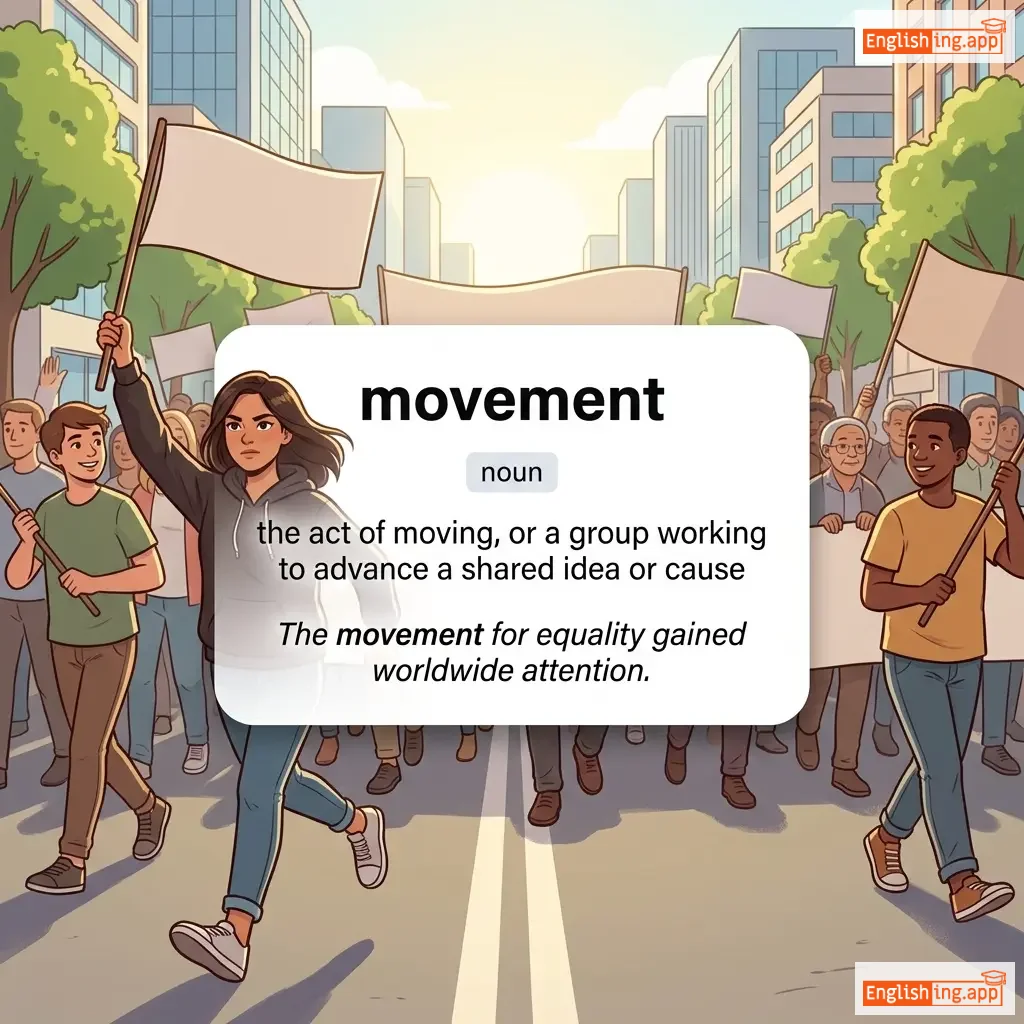
movement definition card — visual illustration of the meaning
noun
/ˈmuːv.mənt/
运动 (yundong)

the act of moving, or a group working to advance a shared idea or cause

"The movement for equality gained worldwide attention."
"平等运动引起了全球的关注。" (Pingdeng yundong yinqile quanqiu de guanzhu.)
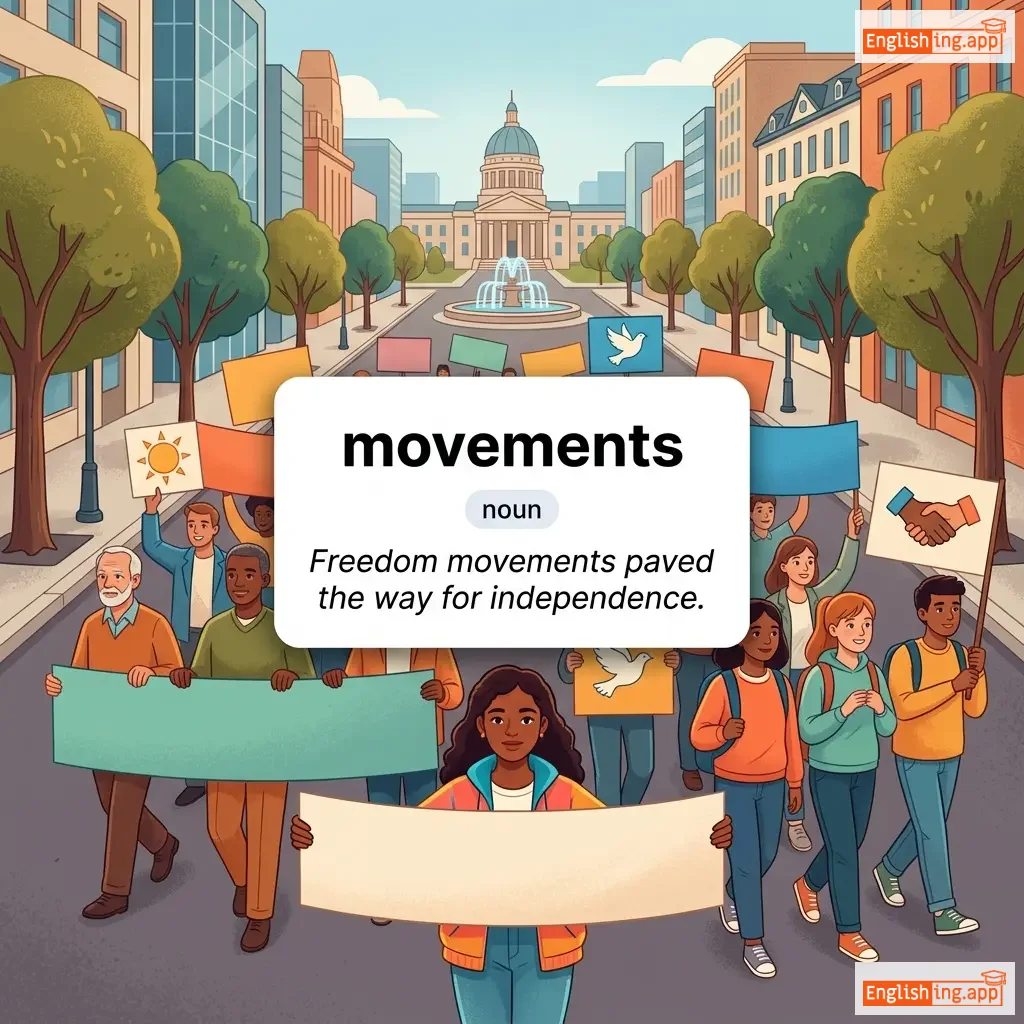
movements definition card — visual illustration of the meaning
noun
ˈmuːv.mənts
运动 (yùndòng)

Organized efforts by groups of people working together to advance their shared political, social, or artistic ideas.

"Freedom movements paved the way for independence."

"自由运动为独立铺平了道路。" (Zìyóu yùndòng wèi dúlì pūpíng le dào lù.)
noun
/ˈmuːvi/
幸福 (xìng fú)

A motion picture or film shown in a cinema or on television.

"We watched a movie together last night."

"当她获得奖项时,她无法掩饰自己的幸福。" (Dāng tā huò dé jiǎng xiàng shí, tā wú fǎ yǎn shì zì jǐ de xìng fú.)
movies definition card — visual illustration of the meaning
noun
ˈmuːviz
电影 (diànyǐng)

A story or event recorded by a camera as a set of moving images and shown in a theater or on television.

"Watching movies helps in language learning."

"看电影有助于语言学习。" (Kàn diànyǐng yǒuzhù yú yǔyán xuéxí.)
adjective
/ˈmuːvɪŋ/
感人 (gan ren)

causing strong feelings, especially of sympathy or sadness

"Her speech was so moving that everyone cried."

"她的演讲如此感人,以至于每个人都哭了。" (Ta de yanjiang ruci ganren, yi zhi yu meige ren dou ku le.)
title
/ˈmɪstər/
先生 (xiānsheng)

a title used before a man's name

"Mr. Rahman is our new teacher."

"先生拉赫曼是我们的新老师。" (Xiānsheng Rahman shì wǒmen de xīn lǎoshī.)
title
/ˈmɪsɪz/
夫人 (fūrén)

a title used before a married woman's name

"Mrs. Karim is the headmistress of the school."

"夫人卡里姆是学校的校长。" (Fūrén Kǎlǐm shì xuéxiào de xiàozhǎng.)
👩‍💼

ms (米兹)

title
/mɪz/
女士 (nüshi)

a title used before a woman's name, regardless of marital status

"Ms. Akter will give a speech at the seminar."

"阿克特女士将在研讨会上发表演讲。" (Akter nǚshì jiāng zài yántǎo huì shàng fābiǎo yǎnjiǎng.)
adjective, adverb, pronoun
/mʌtʃ/
很多 (hen duo)

a large amount or degree of something

"She doesn’t have much time to finish the project."

"她没有很多时间来完成这个项目。" (Ta meiyou henduo shijian lai wancheng zhege xiangmu.)
noun
/mʌd/
泥土 (nítǔ)

soft, wet earth or soil

"The children were playing in the mud after the rain."

"孩子们在雨后玩泥巴。" (Háizimen zài yǔhòu wán níba.)
verb
/ˈmʌd.əl/
搞乱 (gǎo luàn)

to mix things up in a confused way or to make a mess of something

"He muddled the papers and couldn’t find the report."

"他把文件搞乱了,找不到报告。" (Tā bǎ wénjiàn gǎo luàn le, zhǎo bù dào bàogào.)
adjective
/ˈmʌd.i/
泥泞的 (nínìng de)

covered in or full of mud; unclear or confused

"The children came back with muddy shoes after playing outside."

"孩子们玩耍后,穿着泥泞的鞋子回来了。" (Háizimen wánshuǎ hòu, chuānzhuó nínìng de xiézi huílái le.)
verb
/ˈmʌfəl/
压制 (yāzhì)

to make a sound quieter or less distinct; to cover or wrap something to reduce noise or warmth

"She tried to muffle her laughter with a scarf."

"她试图用围巾压制她的笑声。" (Tā shìtú yòng wéijīn yāzhì tā de xiàoshēng.)
noun
/ˈmʌflər/
消声器 (xiaoshengqi)

a device on a vehicle's exhaust to reduce noise; also a scarf worn around the neck for warmth

"The car's muffler needs to be replaced."

"汽车的消音器需要更换。" (Qìchē de xiāoyīnqì xūyào gēnghuàn.)
noun
/mʌɡ/
杯子 (bei zi)

a large cup, typically cylindrical and having a handle and used without a saucer

"She drank her morning coffee from a ceramic mug."

"她喝了早晨的咖啡,使用了一个陶瓷杯。" (Ta he le zaochen de kafei, shiyong le yi ge taoci bei.)
adjective
/ˈmʌɡi/
闷热和潮湿 (menre he chaoshi)

uncomfortably warm and humid

"It was a muggy afternoon in July."

"七月的下午非常闷热。" (Qiyue de xiawu feichang menre.)
noun
/ˈmʌɡwʌmp/
独立于党派的人 (dúlì yú dǎngpài de rén)

a person who remains independent from party politics or remains aloof from disputes

"He was called a mugwump for refusing to join either political side."

"他因为拒绝加入任何政治派别而被称为马格旺普。" (Tā yīnwèi jùjué jiārù rènhé zhèngzhì pàibié ér bèi chēng wèi mǎgéwàngpǔ.)
noun
/mjuːˈlætoʊ/
混血种人(过时且冒犯性的术语) (hunxue zhongren (guoshi qie maofenxing de shuyu))

an outdated and now offensive term historically used to describe a person of mixed white and Black ancestry

"The word 'mulatto' is now considered outdated and offensive."

"‘穆拉特’这个词现在被认为是过时的且冒犯性的。" ('Mulatto' zhege ci xianzai bei renwei shi guoshi de qie maofenxing de.)
verb
/mʌlkt/
罚款 / 欺诈 (fá kuǎn / qī zhà)

to punish by a fine or to defraud someone of money

"The corrupt official was mulcted for his misconduct."

"腐败的官员因不当行为而被罚款。" (Fǔbài de guānyuán yīn bùdàng xíngwéi ér bèi fá kuǎn.)
noun
/mjuːl/
骡子 (luózi)

the offspring of a donkey and a horse, used as a working animal

"The farmer used a mule to carry heavy loads."

"农民用骡子搬运重物。" (Nóngmín yòng luózi bānyùn zhòngwù.)
noun
/ˌmjuːlˈtɪər/
骡夫 (luófū)

a person who drives or takes care of mules

"The muleteer guided the animals safely across the mountain path."

"骡夫安全地将动物引导过山路。" (Luófū ānquán de jiāng dòngwù yǐndǎo guò shānlù.)
noun
/muˈleθi/
甘草根 (gancao gen)

licorice root, a sweet-tasting herb used in traditional medicine and cooking

"She prepared a herbal tea with mulethi to soothe her sore throat."

"她用木莲蒂泡了一杯草药茶,以缓解喉咙痛。" (Ta yong mulian ti pao le yi bei caoyao cha, yi huanjie houlong tong.)
adjective
/ˈmjuːlɪʃ/

extremely stubborn or unwilling to change

"She remained mulish despite all the convincing arguments."

multifaceted definition card — visual illustration of the meaning
adjective
/ˌmʌltiˈfæsɪtɪd/
多方面 (duō fāngmiàn)

having many different aspects or features

"Her career is multifaceted, involving teaching, research, and writing."

"她的事业是多方面的,涉及教学、研究和写作。" (Tā de shìyè shì duō fāngmiàn de, shèjí jiàoxué, yánjiū hé xiězuò.)
multifaceted information frameworks definition card — visual illustration of the meaning
noun
ˌmʌltɪˈfæsɪtɪd ˌɪnfərˈmeɪʃən ˈfreɪmwɜːrks
多面信息框架 (duō miàn xìnxī kuàngjià)

Complex, comprehensive structures for organizing and managing information that have multiple aspects or dimensions.

"Digital literacy involves building multifaceted information frameworks."

"数字素养包括构建多面信息框架。" (Shùzì sùyǎng bāokuò gòujiàn duō miàn xìnxī kuàngjià.)
adjective
/ˌmʌltɪˈfɛərɪəs/
多样的 (duō yàng de)

having many different parts, elements, or kinds

"The museum displayed a multifarious collection of artifacts."

"博物馆展示了种类繁多的文物收藏。" (Bówùguǎn zhǎnshìle zhǒnglèi fánduō de wénwù shōucáng.)
adjective
/ˈmʌltɪfɔːrm/
多形式 (duo xing shi)

Having many different forms or appearances.

"The festival was a multiform celebration of art, music, and culture."

"这个节日是艺术、音乐和文化的多形式庆祝。" (Zhege jieri shi yishu, yinyue he wenhua de duo xing shi qingzhu.)
adjective
/ˌmʌltɪˈlɪŋɡwəl/
多语种 (duoyu zhong)

Able to speak or written in several languages.

"She grew up in a multilingual household."

"她在一个多语言的家庭中长大。" (Tā zài yī gè duō yǔ zhǒng de jiātíng zhōng zhǎng dà.)
adjective
/ˈmʌltɪpl/
多个 (duō gè)

involving or consisting of many parts or elements

"The company faced multiple challenges during the year."

"公司在一年中面临了多个挑战。" (Gōngsī zài yī nián zhōng miànlínle duō gè tiǎozhàn.)
noun
/ˌmʌltɪplɪˈkeɪʃən/
乘法 (chengfa)

the mathematical process of combining numbers to get a product; the act of increasing in number or amount

"Multiplication is one of the basic operations taught in elementary mathematics."

"乘法是小学数学中的基本运算之一。" (chengfa shi xiaoxue shuxue zhong de jiben yunsuan zhiyi)
noun
/ˌmʌltɪˈplɪsɪti/
多样性 (duo yang xing)

A large number or variety of something.

"The project faced a multiplicity of challenges."

"该项目面临着多样化的挑战。" (Gai xiangmu mianlinzhe duoyanghua de tiaozhan.)
noun
/ˈmʌltɪplaɪər/
乘数 (chengshu)

a number or factor by which another number is multiplied; something that increases the effect or value of something else

"In economics, government spending can act as a multiplier for economic growth."

"在经济学中,政府支出可以成为经济增长的乘数。" (zai jingjixue zhong zhengfu zhichu keyi chengwei jingji zengzhang de chengshu)
multiply definition card — visual illustration of the meaning
verb
/ˈmʌltɪplaɪ/
乘法 (chengfa)

to increase in number; to perform mathematical multiplication

"The bacteria multiply rapidly in warm conditions."

"细菌在温暖的条件下迅速繁殖。" (Xijun zai wenruan de tiaojian xia xunsu fanzhi)
adjective
/ˌmʌl.tiˈpɜː.pəs/
多用途的 (duō yòng tú de)

having multiple uses or functions; versatile

"This multipurpose tool can be used as a knife, screwdriver, and bottle opener."

"这个多功能工具可以用作刀子、螺丝刀和开瓶器。" (Zhège duō yòngtú de gōngjù kěyǐ yòng zuò dāozi, luósīdāo hé kāi píngqì.)