词汇表

英语词汇词典 | 单词含义、定义和示例

noun
/lɪm/
肢体 (zhīti)

an arm or leg of a person or animal; a large branch of a tree

"He broke a limb while climbing the tree."

"他在爬树时摔断了一只肢体。" (Tā zài pá shù shí shuāi duànle yī zhī zhīti.)
adjective
/ˈlɪmbər/
灵活和敏捷 (línghuó hé mǐnjié)

Flexible and agile in body or movement.

"Dancers need to stay limber to perform well."

"舞者需要保持灵活才能表现好。" (Wǔzhě xūyào bǎochí línghuó cáinéng biǎoxiàn hǎo.)
noun
/ˈlɪmboʊ/
不确定,悬而未决的状态 (bù quèdìng, xuán'ér wèi jué de zhuàngtài)

A state of uncertainty or neglect; an intermediate or transitional state.

"The project was left in limbo after the funding was withdrawn."

"该项目在资金撤回后陷入了不确定状态。" (gāi xiàngmù zài zījīn chèhuí hòu xiànrùle bù quèdìng zhuàngtài.)
noun
/laɪm/
青柠 (qingling)

a small green citrus fruit with acidic juice

"Add a slice of lime to your drink."

"在你的饮料中加入一片青柠。" (Zài nǐ de yǐnliào zhōng jiārù yī piàn qīnglíng.)
noun
/ˈlaɪm.stoʊn/
石灰岩 (shihuīyán)

a hard sedimentary rock, composed mainly of calcium carbonate or dolomite, used as building material and in the making of cement

"The ancient building was made of limestone blocks."

"这座古老的建筑是用石灰岩块建造的" (zhè zuò gǔlǎo de jiànzhú shì yòng shíhuīyán kuài jiànzào de)
noun
/ˈlaɪm.laɪt/
公众关注的焦点;通过加热石灰圆筒产生的明亮光 (laimlait)

the focus of public attention; a bright light produced by heating a cylinder of lime

"The celebrity enjoyed being in the limelight."

"明星享受站在聚光灯下。" (mingxing xiangshou zhanzai juguangdeng xia)
noun
/ˈlɪmərɪk/
一种幽默的五行诗 (yi zhong youmo de wu hang shi)

a humorous five-line poem with a specific rhythm and rhyme scheme (AABBA).

"She recited a funny limerick at the party."

"她在派对上背诵了一首有趣的利梅里克。" (Ta zai paidui shang beisong le yi shou youqu de limerick.)
noun, verb
/ˈlɪmɪt/
限制 (xianzhi)

A point or level beyond which something does not or may not extend; to restrict.

"You should limit the amount of sugar you eat."
"你应该限制你吃的糖的数量。" (Ni yinggai xianzhi ni chi de tang de shuliang.)
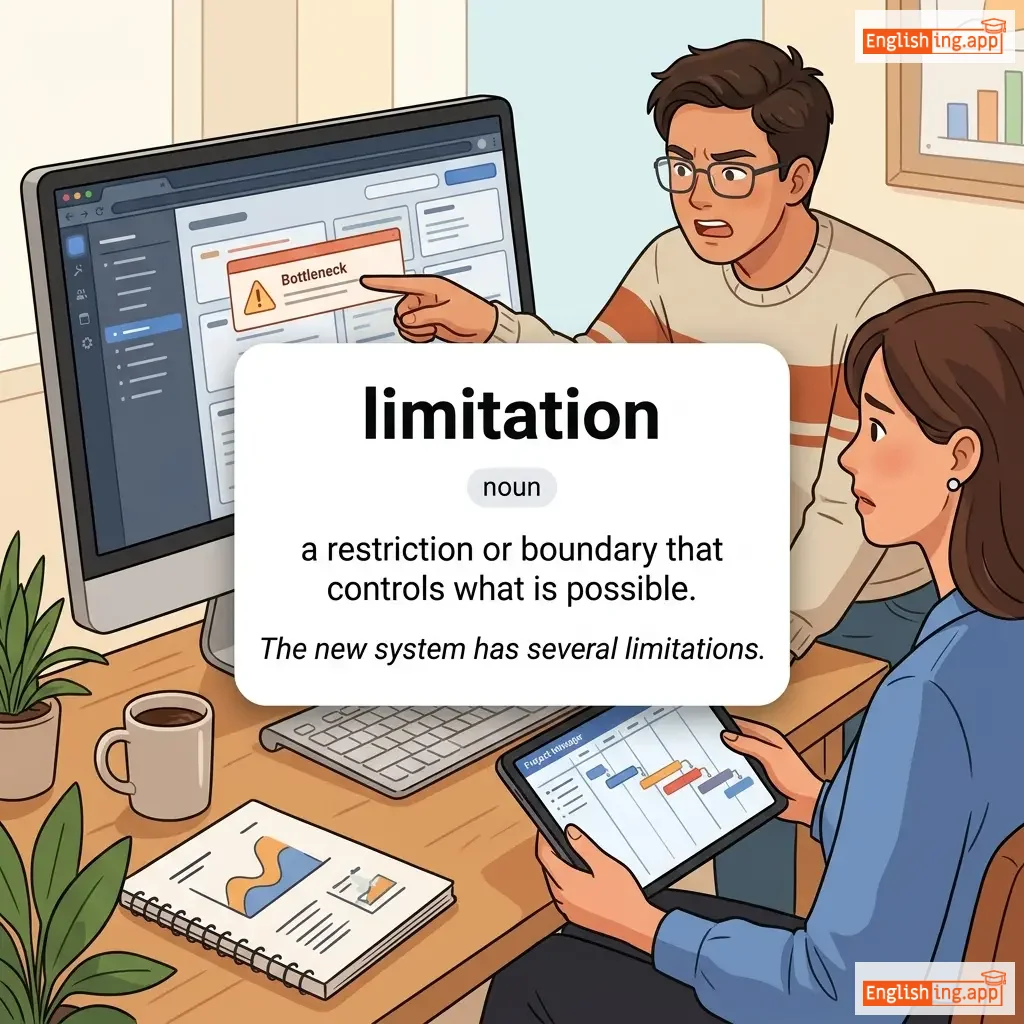
limitation definition card — visual illustration of the meaning
noun
/ˌlɪmɪˈteɪʃən/
限制 (xianzhi)

a restriction or boundary that controls what is possible.

"The new system has several limitations."

"新系统有几个限制。" (Xin xitong you ji ge xianzhi.)
adjective
/ˈlɪmɪtɪd/
有限的 (youxian de)

Restricted in size, amount, or extent; not great in number or ability.

"Tickets for the concert are limited."

"音乐会的票是有限的。" (Yinyuehui de piao shi youxian de.)
limn definition card — visual illustration of the meaning
verb
/lɪm/
描述 / 勾画 (miáoshù / gōuhuà)

to depict or describe something vividly in words or art.

"The author limned the beauty of the countryside."

"作者生动地描绘了乡村的美丽。" (Zuòzhě shēngdòng de miáohuìle xiāngcūn de měilì.)
noun
/ˈlɪməˌziːn/
由司机驾驶的豪华大轿车 (you sījī jiàshǐ de háohuá dà jiàochē)

a large, luxurious car driven by a chauffeur.

"The bride arrived in a white limousine."

"新娘乘坐一辆白色的豪华轿车到达。" (Xīnniáng chéngzuò yī liàng báisè de háohuá jiàochē dàodá.)
verb, adjective, noun
/lɪmp/
跛行 / 虚弱 (bǒxíng / xūruò)

to walk with difficulty, often due to injury or weakness; lacking strength or firmness.

"He limped after injuring his ankle."
"他在伤到脚踝后跛行。" (Tā zài shāng dào jiǎohuái hòu bǒxíng.)
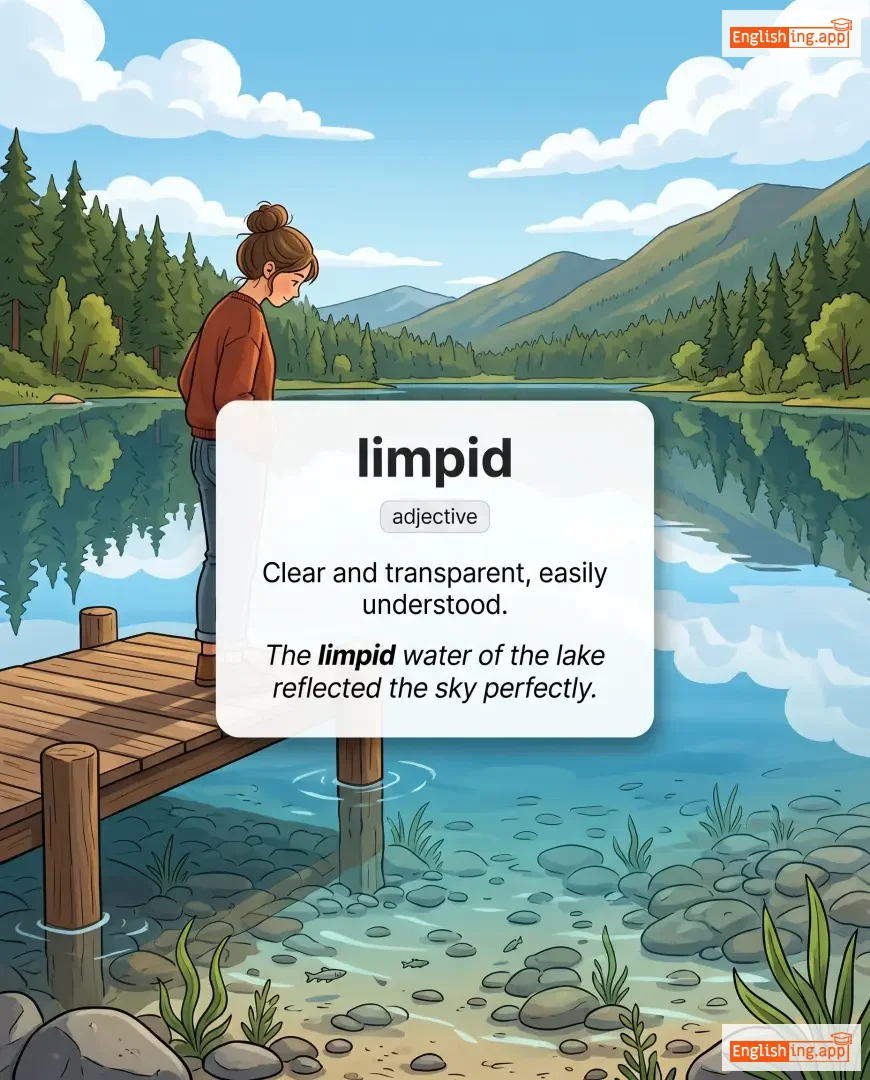
limpid definition card — visual illustration of the meaning
adjective
/ˈlɪmpɪd/
清澈 (qingche)

Clear and transparent, easily understood.

"The limpid water of the lake reflected the sky perfectly."

"湖水清澈地反射了天空。" (Hu shui qingche de fǎnshè le tiānkōng.)
noun, verb
/laɪn/
线 (xian)

A long narrow mark or band; a row of people or things; to cover the inside surface of something.

"People waited in a long line outside the theater."

"人们在剧院外排着长队等候。" (Renmen zai juyuan wai paizhe changdui denghou.)
noun; verb
/ˈlaɪnʌp/
阵容;排成一列 (zhenrong; paicheng yi lie)

a group or arrangement of people or things in a line; to arrange people or things in a row or planned order

"The coach announced the team line-up before the match."

"教练在比赛前宣布了球队阵容。" (jiaolian zai bisai qian xuanchu le qiudui zhenrong)
Lineage definition card — visual illustration of the meaning
noun
/ˈlɪniɪdʒ/
血统 (xuètǒng)

Direct descent from an ancestor; family line.

"He traced his lineage back to medieval kings."

"他追溯到中世纪的国王的血统。" (Tā zhuī sù dào zhōng shìjì de guówáng de xuètǒng.)
noun
/ˈlɪniəmənt/
面部特征 (miànbù tèzhēng)

A distinctive feature or characteristic, especially of the face.

"Her delicate lineaments revealed her noble birth."

"她精致的面部特征揭示了她高贵的出身。" (Tā jīngzhì de miànbù tèzhēng jiēshìle tā gāoguì de chūshēn.)
noun (plural)
/ˈlɪniəmənts/
面部特征 (miànbù tèzhēng)

The features or distinctive characteristics of the face or body.

"The lineaments of his face were sharp and stern."

"他的面部特征很尖锐且严肃。" (tā de miànbù tèzhēng hěn jiānruì qiě yánsù.)
adjective
/ˈlɪniər/
线性 (xianxing)

Arranged in or extending along a straight line.

"The artist used linear perspective in his drawings."

"艺术家在他的画作中使用了线性透视。" (Yìshùjiā zài tā de huàzuò zhōng shǐyòngle xiànxìng tòushì.)
noun
/ˈlɪn.ən/
麻布织物 (mábù zhīwù)

A strong cloth made from the fibers of the flax plant, or items made from this cloth such as sheets or clothing.

"She bought new linen curtains for the living room."

"她为客厅买了新的麻布窗帘。" (Tā wèi kètīng mǎi le xīn de mábù chuānglián.)
🚢

liner

noun
/ˈlaɪ.nər/

A large ship used for transporting people or goods regularly, or a material used as a lining inside something.

"The luxury liner docked at the port yesterday."

noun
/ˈlaɪnˌʌp/
阵容 (zhenrong)

a group of people or things arranged in a sequence

"The event featured a star-studded lineup of musicians."

"这个活动展示了一个明星云集的阵容。" (Zhege huodong zhanshi le yige mingxing yunji de zhenrong.)
linger definition card — visual illustration of the meaning
verb
/ˈlɪŋ.ɡər/
逗留 (dòu liú)

To stay in a place longer than necessary, often because of unwillingness to leave.

"The smell of coffee lingered in the kitchen."

"咖啡的气味在厨房里 linger 了很久。" (Kāfēi de qìwèi zài chúfáng lǐ linger le hěnjiǔ.)
noun
/ˈlɪŋ.ɡoʊ/
专业术语 (zhuānyè shùyǔ)

Specialized or informal language used by a particular group that is often difficult for outsiders to understand.

"The manual was written in technical lingo that confused the new employees."

"手册是用技术术语写的,让新员工感到困惑。" (Shǒucè shì yòng jìshù shùyǔ xiě de, ràng xīn yuángōng gǎndào kùnhuò.)
noun
/ˈlɪŋ.ɡwə/
语言 (yuyan)

A language, especially one used for communication among people.

"English has become a global lingua for business and science."

"英语已经成为商业和科学的全球语言。" (Yingyu yijing chengwei shangye he kexue de quanqiu yuyan.)
adjective
/ˈlɪŋɡwəl/
与舌头相关 (yǔ shétou xiāngguān)

Relating to the tongue or speech.

"The dentist examined the patient's lingual surface of the teeth."

"牙医检查了病人的牙齿舌面。" (Yáyī jiǎnchále bìngrén de yáchǐ shé miàn.)
noun
/ˈlɪŋɡwɪst/
语言学家 (yǔyán xuéjiā)

A person skilled in foreign languages or in the scientific study of language.

"She is a linguist who speaks six languages fluently."
"她是一位能流利讲六种语言的语言学家。" (Tā shì yī wèi néng liúlì jiǎng liù zhǒng yǔyán de yǔyán xuéjiā.)
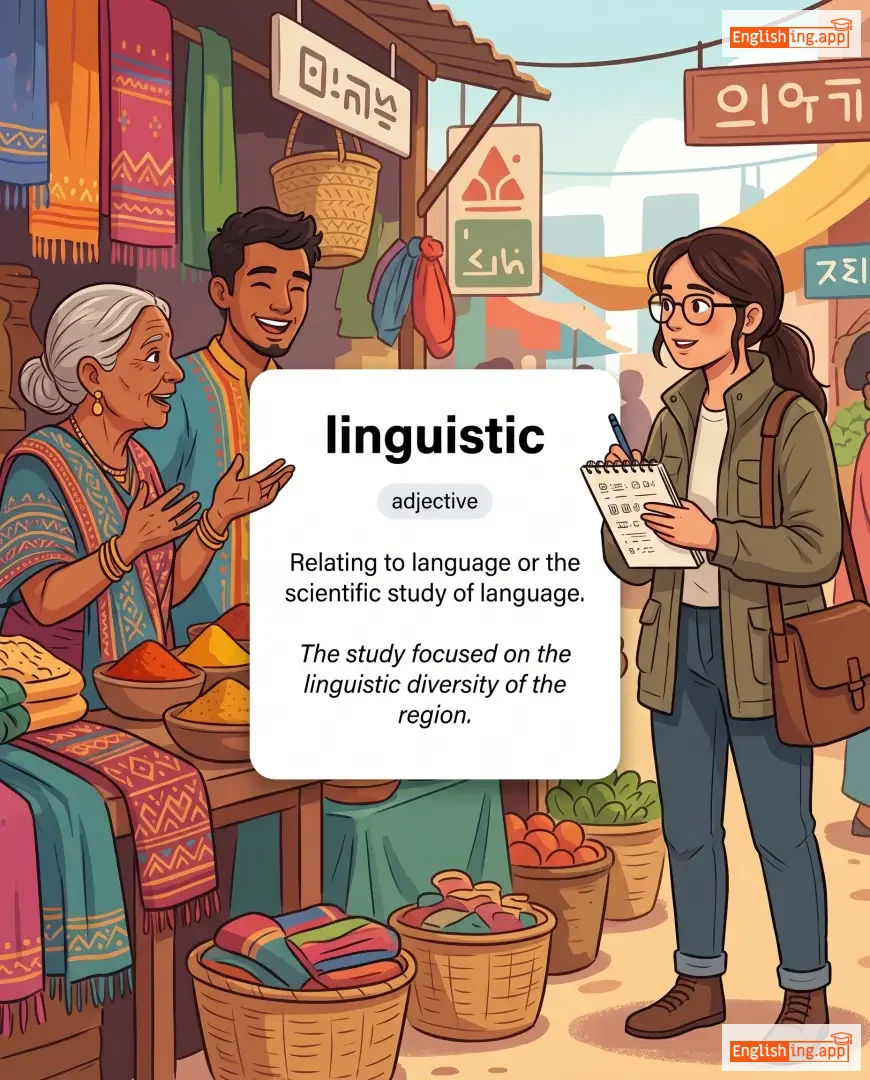
linguistic definition card — visual illustration of the meaning
adjective
/lɪŋˈɡwɪstɪk/
语言学的 (yǔyán xué de)

Relating to language or the scientific study of language.

"The study focused on the linguistic diversity of the region."

"该研究集中在该地区的语言多样性上。" (Gāi yánjiū jízhōng zài gāi dìqū de yǔyán duōyàng xìng shàng.)
noun
/lɪŋˈɡwɪstɪks/
语言学 (yuyanxue)

The scientific study of language and its structure.

"She decided to major in linguistics at university."

"她决定在大学里攻读语言学。" (Ta jueding zai daxue li gongdu yuyanxue.)
noun
/ˈlɪnəmənt/
擦剂 / 洛神 (caji / luoshen)

A liquid or lotion applied to the skin to relieve pain or stiffness.

"He rubbed liniment on his sore muscles after the workout."

"他在训练后擦上了伤痛的肌肉上了擦剂。" (Ta zai xunlian hou ca shang le shang tong de jirou shang le caji.)
noun, verb
/lɪŋk/
连接 (lianjie)

a connection between two things; to connect or associate

"The article includes a link to the official website."

"文章包含指向官方网站的链接。" (wenzhang baokuo zhixiang guanfang wangzhan de lianjie.)
noun
/lɪˈnoʊ.li.əm/
油布 (you bu)

a durable, washable floor covering made from solidified linseed oil, wood flour, or cork dust on a canvas backing

"They decided to cover the kitchen floor with linoleum."

"他们决定用油布覆盖厨房的地板。" (tamen jueding yong you bu fuzai chufang de diban)
noun
/lɪnt/
棉絮 (mianxu)

small soft fibers that come off cloth, often found in dryers or on clothes

"There was lint all over his black shirt after the wash."

"洗完后,他的黑衬衫上有棉絮。" (Xi wan hou, ta de hei chen shan shang you mianxu.)
noun
/ˈlaɪən/
狮子 (shizi)

a large wild animal of the cat family that lives in Africa and Asia, known as the king of the jungle

"The lion roared loudly in the distance."

"狮子在远处大声咆哮。" (Shizi zai yuanchu dasheng paoxiao.)
noun
/ˈlaɪ.ə.nəs/
母狮 (mǔ shī)

an adult female lion

"The fierce lioness protected her cubs from danger."

"那只凶猛的母狮保护着她的小狮子免受危险。" (Nà zhī xiōngměng de mǔ shī bǎohùzhe tā de xiǎo shīzi miǎn shòu wēixiǎn.)
verb
/ˈlaɪ.ə.naɪz/
推崇 (tuīchóng)

to treat someone as a celebrity or give a lot of public attention

"The press began to lionize the young scientist after his discovery."

"媒体开始在他的发现之后捧场那位年轻的科学家。" (méitǐ kāishǐ zài tā de fāxiàn zhīhòu pěngchǎng nà wèi niánqīng de kēxuéjiā.)
noun
/lɪp/
嘴唇 (zuǐchún)

either of the two soft edges of the mouth

"She smiled and bit her lower lip nervously."

"她微笑着紧张地咬了下嘴唇。" (Tā wéixiào zhe jǐnzhāng de yǎo le xià zuǐchún.)
lipogenesis definition card — visual illustration of the meaning
noun
/ˌlaɪ.pəˈdʒen.ɪ.sɪs/
脂肪生成 (zhīfáng shēngchéng)

The metabolic process of fat synthesis where excess carbohydrates are converted into fatty acids and stored as triglycerides.

"Excess carbohydrate intake promotes lipogenesis and fat storage."

"过多的碳水化合物摄入促进了脂肪生成和脂肪储存。" (Guòduō de tànshuǐ huàhéwù shèrù cùjìnle zhīfáng shēngchéng hé zhīfáng chǔcún.)
noun
/ˌlɪk.wəˈfeɪ.ʃənt/
液化剂 (liquefacient)

a substance that causes something to become liquid

"The chemist explained how the liquefacient worked in the experiment."

"化学家解释了液化剂在实验中的作用。" (Huàxuéjiā jiěshìle yèhuàjì zài shíyàn zhōng de zuòyòng.)
verb
/ˈlɪk.wɪ.faɪ/
液化 (liquefy)

to make or become liquid

"The heat will liquefy the butter in a few minutes."

"热量将在几分钟内使黄油液化。" (Rèliàng jiāng zài jǐ fēnzhōng nèi shǐ huángyóu yèhuà.)
noun
/lɪˈkjʊər/
甜酒 (tian jiu)

A strong, sweet alcoholic drink flavored with fruits, herbs, or spices.

"She served a small glass of cherry liqueur after dinner."

"她在晚餐后提供了一小杯樱桃利口酒。" (Tā zài wǎncān hòu tígōng le yī xiǎo bēi yīngtáo lìkǒu jiǔ.)
noun
/ˈlɪkwɪd/
液体 (yètǐ)

a substance that flows freely but is of constant volume, having a consistency like water or oil.

"Water is a clear liquid that is essential for life."

"水是一种清澈的液体,对于生命至关重要。" (Shuǐ shì yī zhǒng qīngchè de yètǐ, duìyú shēngmìng zhìguān zhòngyào.)
verb
/ˈlɪkwɪdeɪt/
清算 (qīngsuàn)

To sell assets in order to pay off debts; to close a business and convert assets into cash.

"The company decided to liquidate its assets to pay creditors."

"公司决定清算其资产以支付债权人。" (Gōngsī juédìng qīngsuàn qí zīchǎn yǐ zhīfù zhàiquánrén.)
liquidity definition card — visual illustration of the meaning
noun
/lɪkˈwɪd.ə.ti/
流动性 (liúdòngxìng)

The availability of liquid assets to a market or company.

"A business must maintain liquidity to cover expenses."

"企业必须保持流动性以支付费用。" (Qǐyè bìxū bǎochí liúdòngxìng yǐ zhīfù fèiyòng.)
noun
/ˈlɪkər/

Alcoholic drinks, especially strong distilled ones such as whiskey or vodka.

"The shop sells both beer and hard liquor."

adjective
/ˈlɪsəm/
纤细、柔韧且优雅的动作 (xiān xì, róu rèn qiě yōu yǎ de dòng zuò)

Thin, supple, and graceful in movement.

"The dancer moved with a lissome elegance."

"舞者以优雅的丽索姆动作移动。" (Wǔ zhě yǐ yōu yǎ de lì suǒ mù dòng zuò yí dòng.)
📋

List

noun, verb
/lɪst/

A series of names, items, or tasks written or printed together; also, to record or register items in such a way.

"She wrote a shopping list before going to the market."

listen definition card — visual illustration of the meaning
verb
/ˈlɪs.ən/
(tīng)

to pay attention to sound

"She loves to listen to classical music in the evenings."

"她喜欢在晚上听古典音乐。" (Tā xǐhuān zài wǎnshàng tīng gǔdiǎn yīnyuè.)
noun
/ˈlɪsənər/
听众 (tingzhong)

a person who listens or pays attention to something, especially to a speaker or sound.

"She is a good listener who always understands others' problems."

"她是一个很好的听众,总是理解他人的问题。" (Tā shì yīgè hěn hǎo de tīngzhòng, zǒng shì lǐjiě tārén de wèntí.)