词汇表

英语词汇词典 | 单词含义、定义和示例

adjective
/ˈleɪ.tɪʃ/
稍微晚一点 (shaowei wan yidian)

Somewhat late; occurring or arriving later than usual but not very late.

"We arrived latish to the party but still caught most of the fun."

"我们稍微晚一点到达了聚会,但仍然赶上了大部分的乐趣。" (Women shaowei wan yidian daodale juhui, dan rengran ganchang le dabufen de lequ.)
noun
/ˈlætɪˌtjuːd/
纬度 (wèidù)

The angular distance north or south of the equator; also freedom or scope to act.

"The city lies at a high latitude close to the Arctic Circle."

"这座城市位于靠近北极圈的高纬度。" (Zhe zuo chengshi weiyu kaojin Beijiquan de gao weidu.)
adjective
/ˈlætər/
第二个 (di'er ge)

the second of two people or things mentioned

"Between tea and coffee, I prefer the latter."

"在茶和咖啡之间,我更喜欢第二个。" (Zai cha he kafei zhijian, wo geng xihuan dier ge.)
noun
/ˈlætɪs/
格子结构 (gé zi jié gòu)

A structure of crossed strips arranged in a grid or crisscross pattern.

"The garden was decorated with a wooden lattice covered in vines."

"花园里装饰着一座覆盖着藤蔓的木质格子结构。" (Huāyuán lǐ zhuāngshì zhe yīzuò fùgài zhe téngmàn de mùzhì gézi jiégòu.)
laud definition card — visual illustration of the meaning
👏

laud

verb
/lɔːd/

To praise someone or something highly, especially in public.

"The critic lauded the actor's performance as a masterpiece."

adjective
/ˈlɔː.də.bəl/
值得称赞的 (zhí dé chēng zàn de)

Deserving praise and admiration.

"Her efforts to help the poor are truly laudable."

"她帮助穷人的努力真是值得称赞的。" (Tā bāngzhù qióngrén de nǔlì zhēn shì zhí dé chēng zàn de.)
noun
/lɔːˈdeɪʃən/
赞扬 (zanyáng)

The act of praising or expressing approval.

"The poet received much laudation for his moving verses."

"这位诗人因其感人的诗句而获得了许多赞扬。" (Zhè wèi shīrén yīn qí gǎnrén de shījù ér huòdé le xǔduō zànyáng.)
adjective
/ˈlɔːdəˌtɔːri/
赞扬的 (zànyáng de)

Expressing praise or admiration.

"She wrote a laudatory review of the new book."
"她写了本书的赞扬评论。" (Tā xiěle běn shū de zànyáng pínglùn.)
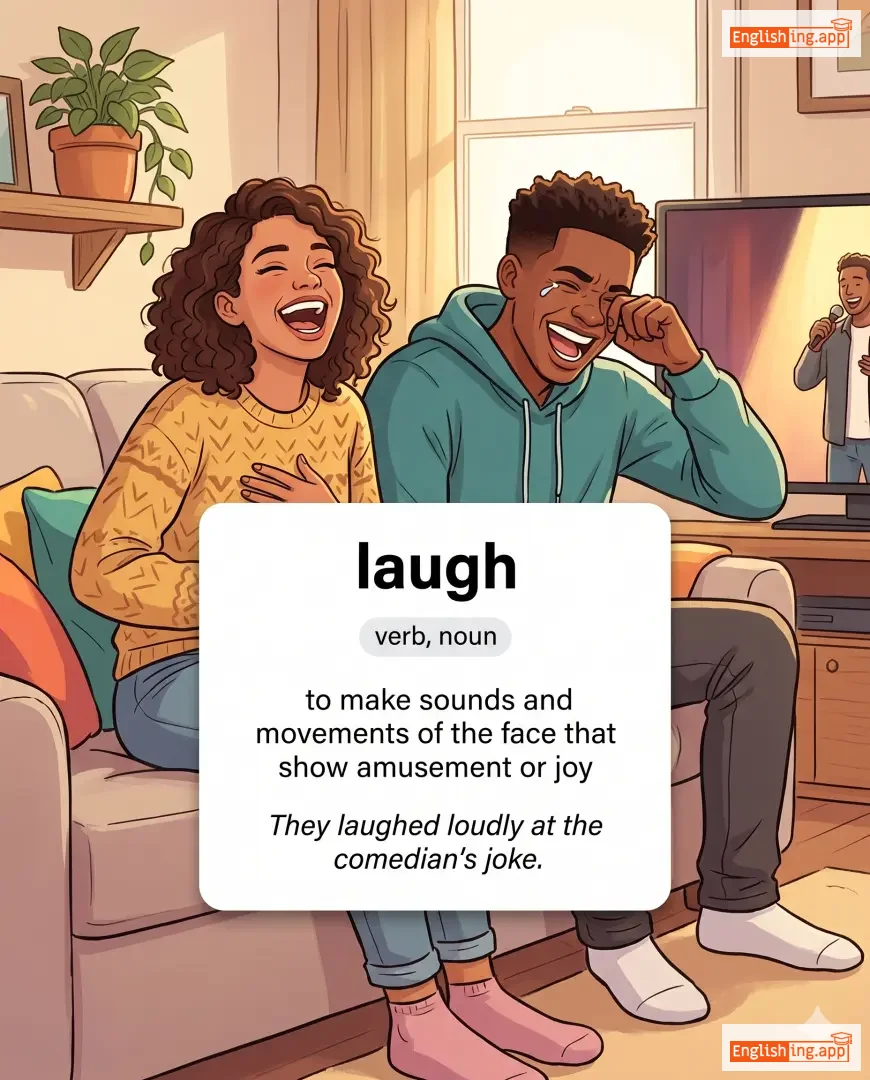
laugh definition card — visual illustration of the meaning
verb, noun
/læf/
(xiao)

to make sounds and movements of the face that show amusement or joy

"They laughed loudly at the comedian's joke."

"他们对喜剧演员的笑话大笑。" (tamen dui xiju yanyuan de xiaohua daxiao.)
noun
/ˈlæftər/
笑声 (xiaosheng)

the act or sound of laughing

"The room was filled with laughter."

"房间里充满了笑声。" (Fángjiān lǐ chōngmǎn le xiàoshēng.)
verb, noun
/lɔːntʃ/

to start or introduce something, especially a new product, service, or event

"The company launched a new app last month."

launched definition card — visual illustration of the meaning
verb
lɔːntʃt
发射 (fāshè)

Set (something) in motion by pushing it or letting it go.

"The satellite was launched successfully."

"卫星已成功发射。" (Wèixīng yǐ chénggōng fāshè.)
verb
/ˈlɔːndər/
洗衣服 / 隐瞒非法获得的钱的来源 (xi yi fu / yin man fei fa huo de qian de laiyuan)

to wash clothes, linens, etc.; or to conceal the origins of money obtained illegally

"She laundered all the dirty clothes on Sunday."

"她在星期天洗了所有脏衣服。" (Ta zai xingqi tian xile suoyou zang yifu.)
noun
/ˈlɔːndrəs/
洗衣女工 (xiyi nǚgōng)

A woman whose job is washing clothes and linens.

"The laundress delivered the freshly cleaned clothes to the household."

"洗衣女工将新洗净的衣物送到家里。" (Xǐyī nǚgōng jiāng xīn xǐ jìng de yīwù sòng dào jiālǐ)
noun
/ˈlɔːndri/
幸福 (xìngfú)

clothes or linens that need to be washed or have been washed

"She folded the clean laundry neatly."

"当她收到奖项时,她无法掩饰自己的幸福。" (Dāng tā shōu dào jiǎngxiàng shí, tā wúfǎ yǎnshì zìjǐ de xìngfú.)
noun
/ˈlɔːriət/
获得者 (huòdé zhě)

A person honored with an award for outstanding achievement in a field, especially the arts or sciences.

"The Nobel laureate gave an inspiring lecture on peace."

"诺贝尔奖获得者就和平发表了激动人心的演讲。" (Nuòbèi'ěr jiǎng huòdé zhě jiù hépíng fābiǎo le jīdòng rénxīn de yǎnjiǎng.)
verb
/leɪv/
(xi)

To wash or bathe.

"She laved her face with cool water."

"她用冷水洗了脸。" (Tā yòng lěng shuǐ xǐ le liǎn.)
noun
/ˈlæv.ən.dər/
薰衣草 (xunyicao)

a fragrant purple flowering plant used in perfumes and aromatherapy

"The lavender field filled the air with its sweet, calming fragrance."

"薰衣草田充满了甜美而宁静的香气。" (Xūn yī cǎo tián chōngmǎnle tiánměi ér níngjìng de xiāngqì.)
adjective, verb
/ˈlævɪʃ/
奢华的,豪华的 (lavish)

Rich, elaborate, or luxurious; to bestow something in generous or extravagant quantities.

"They gave her a lavish wedding reception with hundreds of guests."

"他们为她举办了一个豪华的婚礼招待会,邀请了数百位客人。" (Tāmen wèi tā jǔbànle yīgè háohuá de hūnlǐ zhāodài huì, yāoqǐngle shù bǎi wèi kèrén.)
noun
/lɔː/
法律 (fǎ lǜ)

a system of rules created and enforced by authority to regulate behavior

"Everyone must obey the law of the country."

"每个人都必须遵守国家的法律。" (Měi gèrén dōu bìxū zūnshǒu guójiā de fǎlǜ.)
adjective
/ˈlɔː.fəl/
合法; 合理; 有效; 公正; (hefa; heli; youxiao; gongzheng;)

legal; legitimate; valid; just

"The judge confirmed that their actions were lawful and proper."

"法官确认他们的行为是合法和恰当的。" (Fǎguān quèrèn tāmen de xíngwéi shì héfǎ hé qiàdàng de.)
noun
/ˈlɔːˌɡɪvər/
立法者 (lifazhe)

A person who creates or enforces laws; a legislator.

"Moses is often regarded as a great lawgiver in history."

"摩西常被认为是历史上伟大的法律制定者。" (Móxī cháng bèi rènwéi shì lìshǐ shàng wěidà de fǎlǜ zhìdìng zhě.)
adjective
/ˈlɔː.ləs/
无律; 无政府主义; 混乱; 犯罪 (wú lǜ; wú zhèngfǔ zhǔyì; hùnluàn; fànzuì)

without law; anarchic; unruly; criminal

"The frontier town was known for its lawless behavior and chaos."

"边境城市以其无律行为和混乱而闻名。" (Biānjìng chéngshì yǐ qí wú lǜ xíngwéi hé hùnluàn ér wénmíng.)
noun
/ˈlɔː.ləs.nəs/
无法律 (wufalü)

absence of law and order; a state where laws do not exist or are not enforced

"The city descended into lawlessness after the government collapsed."

"政府崩溃后,城市陷入了无法律的状态。" (zhèngfǔ bēngkuì hòu, chéngshì xiànrù le wú fǎlǜ de zhuàngtài)
noun
/ˈlɔːˌmeɪkər/
立法者 (lifazhe)

A member of a legislative body who makes laws.

"The lawmaker introduced a new bill on education reform."

"立法者提出了一项关于教育改革的新法案。" (Lifazhe tichu le yixiang guanyu jiaoyu gaige de xin faan.)
noun
/lɔːn/
草坪 (cǎopíng)

an area of short, regularly cut grass in a yard or park

"Children were playing on the green lawn."

"孩子们在绿草坪上玩耍。" (Háizimen zài lǜ cǎopíng shàng wánshuǎ.)
noun
/ˈlɔːsuːt/
诉讼 (sùsòng)

a legal case brought to a court of law by one person against another

"The company faced a lawsuit over false advertising."

"公司因虚假广告而面临诉讼。" (gōngsī yīn xūjiǎ guǎnggào ér miànlín sùsòng.)
noun
/ˈlɔːjər/
律师 (lǜshī)

A professional who practices or studies law; an attorney.

"The lawyer presented the case confidently in court."

"律师在法庭上自信地陈述了案件。" (Lǜshī zài fǎtíng shàng zìxìn de chénshùle ànjiàn.)
adjective
/læks/
宽松的, 粗心的 (lax)

Not strict, severe, or careful; negligent or careless.

"The security at the airport was surprisingly lax."

"机场的安保令人惊讶地宽松。" (Jīchǎng de ānbǎo lìng rén jīngyà de kuānsōng.)
noun, adjective
/ˈlæksətɪv/
泻药 (xiè yào)

A medicine or substance that stimulates bowel movements; tending to loosen or relieve constipation.

"The doctor prescribed a mild laxative for her condition."

"医生为她的病情开了轻度泻药。" (Yīshēng wèi tā de bìngqíng kāi le qīngdù xiè yào.)
lay definition card — visual illustration of the meaning
verb
/leɪ/
放置 (fangzhi)

To put something down carefully in a flat position.

"She laid the book on the table."

"她把书放在桌子上。" (Ta ba shu fang zai zhuozi shang.)
noun
/ˈleɪər/
(ceng)

A sheet, thickness, or coating of something that lies over or under a surface.

"The cake had a layer of cream between the sponges."

"蛋糕中间有一层奶油。" (Dàngāo zhōngjiān yǒu yī céng nǎiyóu.)
noun
/ˈleɪmən/
外行 (wàiháng)

A person without professional or specialized knowledge in a particular subject.

"To a layman, the medical explanation was confusing."

"对外行人来说,医学解释很混乱。" (duì wàiháng rén lái shuō, yīxué jiěshì hěn hùnluàn.)
noun
/ˈleɪaʊt/
布局 (bùjú)

the arrangement or design of something, especially the arrangement of elements in a book, webpage, or room

"The designer presented a new layout for the website that was much more user-friendly."

"设计师为网站展示了一个全新的布局,这使得它更具用户友好性。" (Shèjì shī wèi wǎngzhàn zhǎnshìle yīgè quánxīn de bùjú, zhè shǐ dé tā gèng jù yònghù yǒu hǎo xìng.)
noun
/ˈleɪˌpɜːrsən/
外行人 (waihangren)

A person who is not a member of the clergy or does not have specialized knowledge in a subject.

"The judge explained the law so that the layperson could understand."

"法官解释了法律,使外行人也能理解。" (Fǎguān jiěshìle fǎlǜ, shǐ wàiháng rén yě néng lǐjiě.)
adverb
/ˈleɪ.zɪ.li/
懒洋洋地 (lǎn yáng yáng de)

in a way that shows unwillingness to work or use energy; sluggishly

"He lazily stretched his arms and yawned in the morning."

"他懒洋洋地伸展双臂,早晨打了个哈欠。" (Tā lǎn yáng yáng de shēnzhǎn shuāngbì, zǎochén dǎle ge hāqiàn.)
noun
/ˈleɪ.zi.nəs/
懒惰 (landuo)

the quality of being unwilling to work or use energy; idleness

"His laziness prevented him from achieving his goals."

"他的懒惰阻止了他实现目标。" (tade landuo zhi zhi le ta shixian mubiao)
adjective
/ˈleɪ.zi/
懒惰; 不愿意工作 (lan duo; bu yuan yi gong zuo)

idle; unwilling to work; sluggish

"He was too lazy to clean his room on the weekend."

"他周末太懒,不愿意打扫房间。" (Ta zhou mo tai lan, bu yuan yi da sao fang jian.)
noun
/liː/
草地 (caodi)

An open area of grassy or arable land; a meadow.

"The cottage was surrounded by a quiet lea."

"小屋被一片宁静的草地包围着。" (xiaowu bei yi pian ningjing de caodi baoweizhe.)
verb
/liːd/
领导 (lǐngdǎo)

To guide or be in charge; to show the way.

"He led the team to victory."
"他带领团队走向胜利。" (Tā dàilǐng tuánduì zǒu xiàng shènglì.)
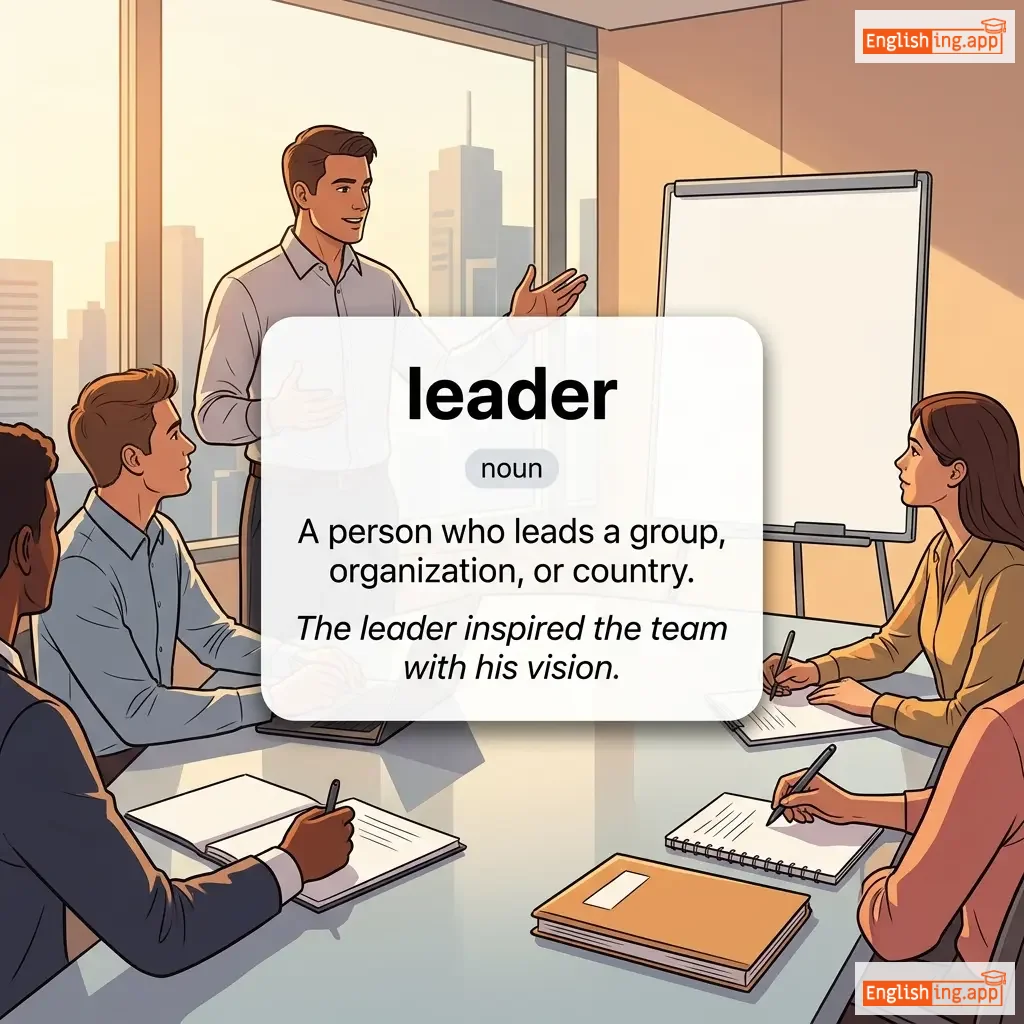
leader definition card — visual illustration of the meaning
noun
/ˈliːdər/
领导者 (lingdao zhe)

A person who leads a group, organization, or country.

"The leader inspired the team with his vision."

"领导者用他的愿景激励了团队。" (Lingdao zhe yong tade yuanjing jili le tuandui.)
leadership definition card — visual illustration of the meaning
noun
/ˈliːdərˌʃɪp/
领导 (lingdao)

The action of leading a group of people or an organization.

"Her leadership inspired the entire team to achieve their goals."

"她的领导力激励整个团队实现他们的目标。" (Tā de lingdàolì jīlì zhěnggè tuánduì shíxiàn tāmen de mùbiāo.)
adjective
/ˈliːdɪŋ/
领先 (lǐngxiān)

most important or most successful; at the front

"She is one of the leading experts in the field."

"她是该领域的领先专家之一。" (Tā shì gāi lǐngyù de lǐngxiān zhuānjiā zhī yī.)
noun
/liːf/
叶子 (yezi)

A flat, green part of a plant that grows from the stem or branch.

"A green leaf fell from the tree."

"一片绿叶从树上掉了下来。" (Yi pian lü ye cong shu shang diao le xia lai.)
adjective
/ˈliːf.ləs/
无叶的; 光秃的 (wú yè de; guāng tū de)

without leaves; bare

"The leafless trees looked bare in winter."

"冬天无叶的树看起来光秃秃的。" (dōngtiān wú yè de shù kàn qǐlái guāng tū tū de.)
noun
/ˈliːflət/
小册子 (xiǎo cèzi)

A printed sheet of paper, often folded, used to advertise or provide information.

"The volunteers distributed leaflets about the campaign."

"志愿者分发了有关该活动的小册子。" (Zhìyuànzhě fēn fā le yǒuguān gāi huódòng de xiǎo cèzi.)
adjective
/ˈliː.fi/
多叶的; 被叶子覆盖的 (duō yè de; bèi yèzi fùgài de)

having many leaves; covered with leaves

"The leafy green vegetables are very nutritious."

"叶绿的蔬菜非常有营养。" (Yè lǜ de shūcài fēicháng yǒu yíngyǎng.)
noun
/liːɡ/
联赛 (lian sai)

An association of people or groups united for a common purpose; also a unit of distance (old use).

"Several clubs formed a league to promote sportsmanship."

"几个俱乐部组成了一个联盟,以促进体育精神。" (Ji ge julebu zucheng le yi ge lianmeng, yi cujin tiyu jingshen.)
noun/verb
/liːk/
漏洞 (lòudòng)

to allow liquid or gas to escape; or a hole through which liquid or gas can escape

"Water started to leak from the ceiling after the storm."

"暴风雨过后,水开始从天花板漏出来。" (Bàofēngyǔ guòhòu, shuǐ kāishǐ cóng tiānhuābǎn lòuchūlái.)
Lean definition card — visual illustration of the meaning
verb
/liːn/
倾斜 (qingxie)

To move or bend your body in a particular direction.

"He had to lean forward to hear her clearly."

"他必须向前倾斜才能清楚地听到她。" (Ta bixu xiang qian qingxie cai neng qingchu de tingdao ta.)