词汇表

英语词汇词典 | 单词含义、定义和示例

verb
/ˈɪmprəvaɪz/

To create or perform something spontaneously without preparation.

"The actor had to improvise his lines when he forgot the script."

noun
/ɪmˈpruːdəns/
轻率 (qīng shuài)

Lack of caution or good judgment.

"His imprudence in investing all his money in one stock was disastrous."

"他将所有的钱都投资在一只股票上的轻率行为是灾难性的。" (Ta1 jiang1 suo3 you3 de qian2 dou1 tou2 zi4 zai4 yi1 zhi1 gu3 piao4 shang4 de qing1 shuai4 xing2 wei2 shi4 zai1 nan4 xing4 de.)
adjective
/ɪmˈpruːdənt/
鲁莽 (lumang)

Not showing care for the consequences of an action.

"It was imprudent to drive in such stormy weather."

"在如此暴风雨的天气下开车是鲁莽的。" (Zai ru ci baofengyu de tianqi xia kaiche shi lumang de.)
noun
/ˈɪmpjʊdəns/
无礼 (wulǐ)

Rude and disrespectful behavior.

"The student's impudence shocked the entire class."

"学生的无礼行为让全班震惊。" (Xuéshēng de wúlǐ xíngwéi ràng quán bān zhènjīng.)
adjective
/ˈɪmpjəd(ə)nt/
无礼的,厚颜无耻的 (wú lǐ de, hòu yán wú chǐ de)

not showing due respect for another person; rude

"The impudent child talked back to the teacher."

"那个无礼的孩子顶撞老师。" (Nàgè wúlǐ de háizi dǐngzhuàng lǎoshī.)
⚔️

impugn

verb
/ɪmˈpjuːn/

to dispute the truth, validity, or honesty of a statement or motive

"The lawyer tried to impugn the credibility of the witness."

noun
/ɪmˈpjuːɪsəns/
无能, 无力 (wúnéng, wúlì)

inability to take effective action; helplessness

"The government’s impuissance in the face of crisis frustrated the people."

"政府在危机面前的无能让人民感到沮丧。" (Zhèngfǔ zài wēijī miànqián de wúnéng ràng rénmín gǎndào jǔsàng.)
noun
/ˈɪmpʌls/
冲动 (chōngdòng)

a sudden strong desire or urge to act without thinking

"He bought the watch on impulse without planning to."

"他毫无计划地冲动买下了这只手表。" (Tā háo wú jìhuà de chōngdòng mǎi xià le zhè zhī shǒubiǎo.)
noun
/ɪmˈpʌlʃən/

a strong urge or drive to act; the act of impelling

"His impulsion to travel made him leave his job suddenly."

adjective
/ɪmˈpʌlsɪv/
冲动的, 直觉的 (chongdong de, zhi jue de)

acting suddenly without careful thought

"She made an impulsive decision to buy the car."
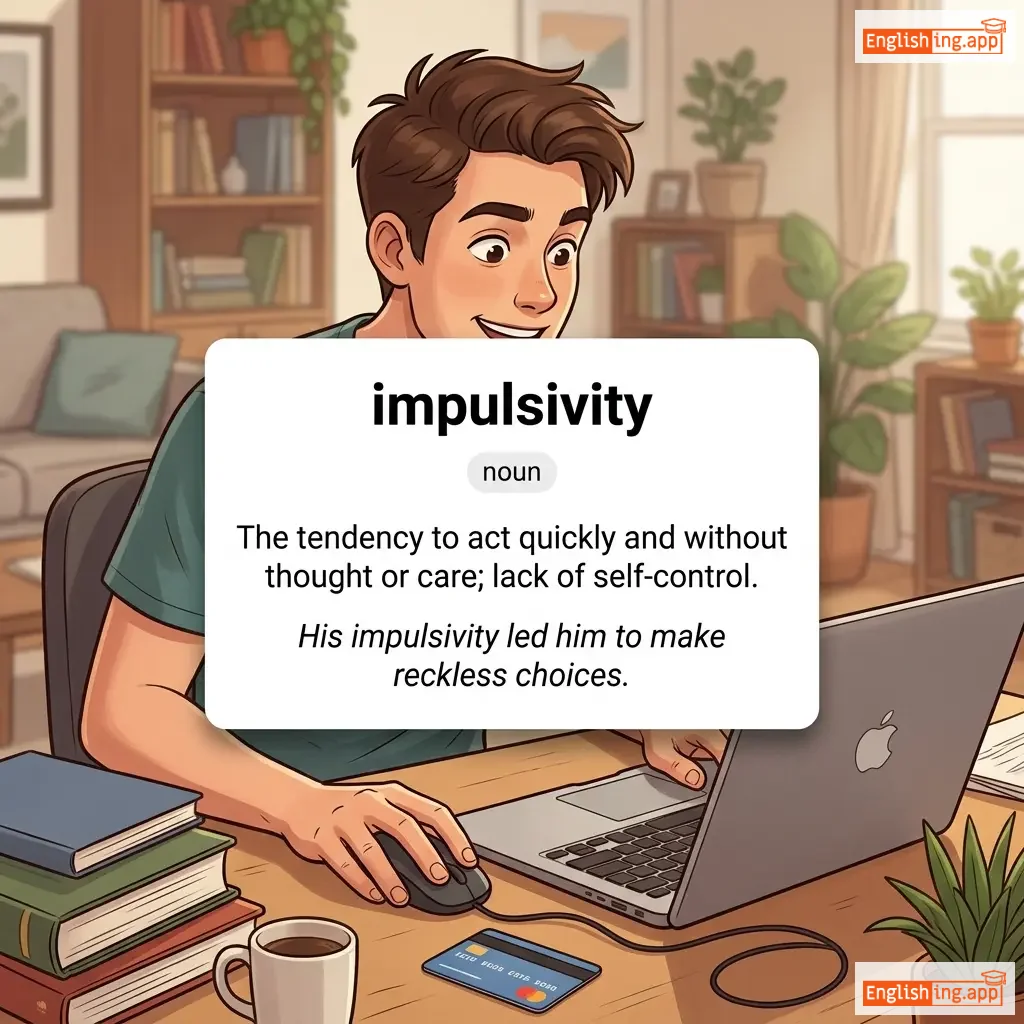
"她做出了一个冲动的决定,买了车。" (Ta zuo chu le yi ge chongdong de jueding, mai le che.)
impulsivity definition card — visual illustration of the meaning
noun
ˌɪm.pʌlˈsɪv.ɪ.ti
冲动性 (chōngdòngxìng)

The tendency to act quickly and without thought or care; lack of self-control.

"His impulsivity led him to make reckless choices."

"他的冲动性让他做出了鲁莽的决定。" (Tā de chōngdòngxìng ràng tā zuò chūle lǔmáng de juédìng.)
🛡️

impunity

noun
/ɪmˈpjuːnɪti/

freedom from punishment or harmful consequences for an action

"The dictator ruled with impunity, ignoring international laws."

adjective
/ɪmˈpjʊər/
不纯 (bùchún)

not clean or free from contamination; morally corrupt

"The water was impure and unsafe to drink."

"水是混浊的,不能安全饮用。" (Shuǐ shì hùnzhuó de, bùnéng ānquán yǐn yòng.)
noun
/ɪmˈpjʊərəti/
杂质 (zazhi)

the state of being unclean or contaminated; a substance that makes something impure

"The scientist removed every impurity from the water sample."

"科学家去除了水样中的所有杂质。" (kexuejia quchu le shuiyang zhong de suoyou zazhi)
noun
/ˌɪmpjuˈteɪʃən/
指控 (zhikong)

an accusation or attribution of blame

"The politician denied the imputation of corruption."

"政治家否认了腐败的指控。" (Zhengzhijia founianle fubai de zhikong.)
verb
/ɪmˈpjuːt/
归因于 (guī yīn yú)

to attribute a fault or responsibility to someone

"They imputed the company's success to good leadership."

"他们将公司的成功归功于出色的领导力。" (Tāmen jiāng gōngsī de chénggōng guī gōng yú chū sè de lǐngdǎo lì.)
preposition
/ɪn/
(zai)

expressing the situation of being enclosed or surrounded by something

"She is in the kitchen preparing dinner."

"她在厨房准备晚餐。" (Ta zai chufang zhunbei wancan.)
preposition
/ɪn ˈfrʌnt əv/
在……前面 (zai qianmian)

positioned before or ahead of something; facing or located at the forward side of a person or object

"She stood in front of the building."

"她站在建筑物前面。" (Ta zhan zai jianzhu wu qianmian)
noun
/ˌɪnəˈbɪləti/
无能 (wune)

the state of being unable to do something

"His inability to make decisions affected his career."

"他无法做决定,这影响了他的职业生涯。" (Ta wu fa zuo jueding, zhe yingxiang le ta de zhiye shengya.)
adjective
/ˌɪnækˈsɛsəbl/
无法接近 (wúfǎ jiējìn)

unable to be reached, entered, or understood

"The remote village is almost inaccessible during the rainy season."

"这个偏远的村庄在雨季几乎是无法接近的。" (Zhège piānyuǎn de cūnzhuāng zài yǔjì jīhū shì wúfǎ jiējìn de.)
noun
/ɪnˈækjʊrəsi/
不准确 (bu zhun que)

lack of accuracy or precision; an incorrect or wrong detail

"The report contained several factual inaccuracies."

"这份报告包含了一些不准确之处。" (zhe fen baogao baohan le yixie bu zhunque zhichu)
adjective
/ɪnˈækjʊrət/
不准确的 (bu zhunque de)

Not correct, precise, or exact; containing errors.

"The report was full of inaccurate data."

"报告充满了不准确的数据。" (Baogao chongman le bu zhunque de shuju.)
adjective
/ɪnˈæktɪv/
不活跃 (bù huó yuè)

Not engaging in activity; not active.

"The account has been inactive for six months."

"账户已经有六个月没有活跃。" (Zhànghù yǐjīng yǒu liù gè yuè méiyǒu huóyuè.)
noun
/ˌɪnækˈtɪvɪti/
不活动 (bu huodong)

the state of not being active physically or mentally; lack of action

"Prolonged inactivity can negatively affect both physical and mental health."

"长期不活动会对身体和心理健康产生负面影响。" (changqi bu huodong hui dui shenti he xinli jiankang chan sheng fumian yingxiang)
noun
/ɪnˈædɪkwəsi/
不足 (buzu)

lack of sufficient ability, quality, or strength; a feeling of not being good enough

"She struggled with feelings of inadequacy at work despite her strong qualifications."

"尽管资历很强,她在工作中仍感到不足。" (Jinguan zili hen qiang, ta zai gongzuo zhong reng gandao buzu)
adjective
/ɪnˈædɪkwət/
不充分 (bù chōngfèn)

Not sufficient or good enough.

"The funding was inadequate to complete the project."

"资金不足以完成项目。" (Zījīn bù zúgòu yǐ wánchéng xiàngmù.)
adjective
/ˌɪnədˈmɪsəbl̩/
不可接受 (bukexiadu)

Not allowed, especially as evidence in a court of law.

"The judge ruled the evidence inadmissible."

"法官宣布证据不可接受。" (Faguang xuangbu zhengju bukexiadu.)
noun
/ˌɪnədˈvɜːrtəns/
疏忽 (shūhū)

Failure to pay attention; carelessness.

"The error happened through sheer inadvertence."

"错误是由于完全的疏忽发生的。" (Cuòwù shì yóuyú wánquán de shūhū fāshēng de.)
adjective
/ˌɪnədˈvɜːrtənt/
无意的, 非故意的 (wuyi de, fei guyi de)

Not resulting from or achieved through deliberate planning; unintentional.

"Her inadvertent mistake caused a delay in the project."

"她的无意错误导致了项目的延迟。" (Tā de wúyì cuòwù dǎozhì le xiàngmù de yánchí.)
Inadvertently definition card — visual illustration of the meaning
adverb
/ˌɪnədˈvɜːrtəntli/
不小心 (buxiaoxin)

Without intention; accidentally.

"He inadvertently deleted the important file."

"他不小心删除了重要的文件。" (Ta bu xiaoxin shanchule zhongyao de wenjian.)
adjective
/ˌɪnədˈvaɪzəbl/
不建议 (bù jiànyì)

Not recommended; likely to have undesirable consequences.

"It is inadvisable to drive in such heavy rain."

"在这种大雨中开车是不建议的。" (Zài zhè zhǒng dàyǔ zhōng kāichē shì bù jiànyì de.)
adjective
/ɪnˈeɪliənəbl/
不可转让 (bùkě zhuǎnràng)

Unable to be taken away or transferred; absolute and permanent.

"Freedom of speech is an inalienable right."

"言论自由是一项不可转让的权利。" (Yánlùn zìyóu shì yī xiàng bùkě zhuǎnràng de quánlì.)
noun
/ˌɪnəməˈrɑːtə/

A woman with whom someone is in love; a female lover.

"He wrote a poem dedicated to his inamorata."

adjective
/ɪˈneɪn/
无意义的, 傻的 (wú yìyì de, shǎ de)

lacking sense, meaning, or significance; silly or pointless

"The movie was criticized for its inane dialogue."

"这部电影因其无意义的对话而受到批评。" (Zhè bù diànyǐng yīn qí wú yìyì de duìhuà ér shòudào pīpíng.)
adjective
/ɪˈnænɪmət/
无生命的物体 (wú shēngmìng de wùtǐ)

not alive, especially not in the manner of animals and humans; lifeless

"The museum was full of inanimate objects from ancient times."

"博物馆里充满了来自古代的无生命物体。" (Bówùguǎn lǐ chōngmǎnle láizì gǔdài de wú shēngmìng wùtǐ.)
noun
/ɪˈnænɪti/
荒谬, 愚蠢 (huangmiu, yuchun)

a nonsensical remark or action; silliness; emptiness

"The speech was full of inanities that bored the audience."

"演讲充满了让观众感到无聊的荒谬言论。" (Yǎnjiǎng chōngmǎnle ràng guānzhòng gǎndào wúliáo de huāngmiù yánlùn.)
adjective
/ˌɪnæprɪˈhɛnsəbl/
难以理解 (nán yǐ lǐ jiě)

not understandable; incomprehensible

"The concept was so abstract that it seemed inapprehensible to most students."

"这个概念如此抽象,以至于它对大多数学生来说是不可理解的。" (Zhège gàiniàn rúcǐ chōuxiàng, yǐ zhìyú tā duì dàduōshù xuéshēng lái shuō shì bùkě lǐjiě de.)
adjective
/ˌɪnəˈproʊpriət/
不适当 (bushidang)

not suitable or proper in the circumstances

"It was inappropriate to talk loudly in the library."

"在图书馆大声说话是不适当的。" (Zai tushuguan dasheng shuohua shi bushidang de.)
adjective
/ɪnˈæpt/
不合适的 (bù hé shì de)

not suitable or appropriate in the circumstances

"His inapt choice of words offended many people."

"他不合适的用词冒犯了许多人。" (Tā bù hé shì de yòngcí màofànle xǔduō rén.)
adjective
/ˌɪnɑːrˈtɪkjʊlət/
含糊不清 (hán hú bù qīng)

Unable to express oneself clearly or effectively in speech or writing.

"She became inarticulate with emotion during the speech."

"她在演讲中因为情绪而变得含糊不清。" (Tā zài yǎn jiǎng zhōng yīn wèi qíng xù ér biàn dé hán hú bù qīng.)
adverb
/ˌɪnəzˈmʌtʃ/
鉴于 (jian yu)

To the extent that; considering that.

"Inasmuch as you are their teacher, you should guide them carefully."

"鉴于你是他们的老师,你应该小心地指导他们。" (Jian yu ni shi tamen de laoshi, ni yinggai xiaoxin de zhidao tamen.)
conjunction
/ˌɪnəzˈmʌtʃ æz/
因为 (yinwei)

Because; since.

"He cannot attend, inasmuch as he is unwell."

"他不能参加,因为他生病了。" (Tā bù néng cānjiā, yīnwèi tā shēngbìng le.)
adjective
/ˌɪnəˈtɛntɪv/
不专心的 (bu zhuanxin de)

not paying attention; lacking focus or concentration

"The inattentive student missed several important instructions."

"那个不专心的学生错过了几条重要指示。" (nage bu zhuanxin de xuesheng cuoguo le ji tiao zhongyao zhishi)
adjective
/ɪnˈɔːdəbl/
听不见的 (ting bu jian de)

Unable to be heard.

"Her voice was almost inaudible over the noise."

"她的声音几乎在噪音中听不见。" (Ta de shengyin jihu zai zaoyin zhong ting bu jian.)
adjective
/ɪˈnɔːɡjərəl/
开幕 (kaimu)

marking the beginning of something; first; opening

"The president delivered his inaugural speech."

"总统发表了他的开幕演讲。" (Zongtong fabiao le tade kaimu yanjiang.)
verb
/ɪˈnɔːɡjʊreɪt/

To formally begin or introduce something, especially with a ceremony.

"The mayor will inaugurate the new bridge tomorrow."
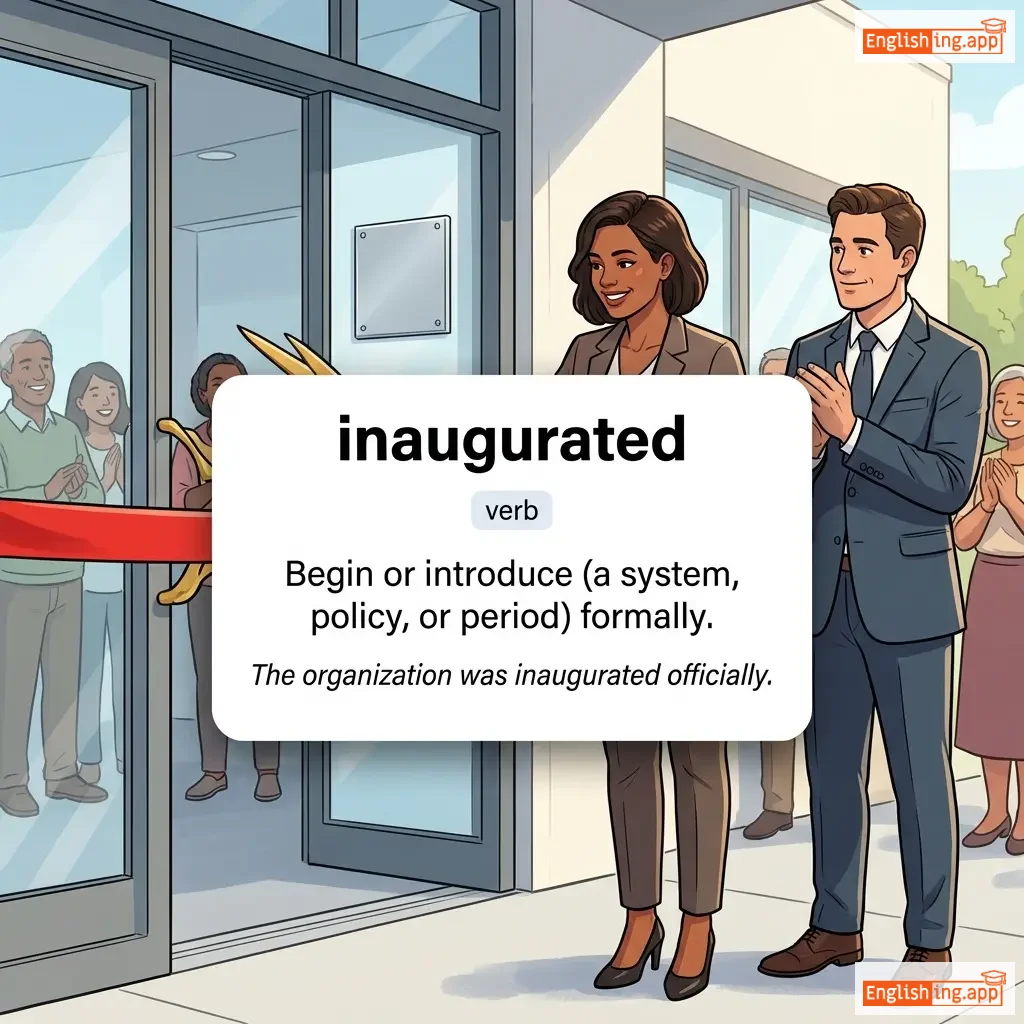
inaugurated definition card — visual illustration of the meaning
verb
ɪˈnɔː.ɡjə.reɪ.tɪd
开幕 (kāimù)

Begin or introduce (a system, policy, or period) formally.

"The organization was inaugurated officially."

"该组织已正式开幕。" (Gāi zǔzhī yǐ zhèngshì kāimù.)
adjective
/ˌɪnɔːˈspɪʃəs/
不吉利 (bù jí lì)

Not conducive to success; unpromising or unlucky.

"The event began under inauspicious circumstances."

"该事件在不利的情况下开始。" (Gāi shìjiàn zài bù lì de qíngkuàng xià kāishǐ.)
adjective
/ˈɪnˌbɔːrn/

existing from birth; innate

"She has an inborn talent for music."

adjective
/ˈɪnˌbrɛd/
天生的 (tiānshēng de)

existing naturally in a person or animal; also related to reproduction within a limited community

"He has an inbred sense of loyalty."

"他有天生的忠诚感。" (Tā yǒu tiānshēng de zhōngchéng gǎn.)