词汇表

英语词汇词典 | 单词含义、定义和示例

adjective
/ˌɪməˈtɪəriəl/
无关紧要 (wuguan jinyao)

Not important or relevant; lacking physical substance.

"The judge ruled that the argument was immaterial to the case."

"法官裁定,该论点与案件无关。" (Faguancaiding, gai lundian yu anjian wuguan.)
adjective
/ˌɪməˈtjʊər/
不成熟 (bù chéngshú)

Not fully developed; childish or lacking maturity.

"His immature behavior annoyed everyone at the meeting."

"他的不成熟行为在会议上让大家烦扰。" (Tā de bù chéngshú xíngwéi zài huìyì shàng ràng dàjiā fánrǎo.)
noun
/ˌɪməˈtjʊərəti/
不成熟 (bu chengshu)

the state of not being fully developed emotionally, mentally, or physically; lack of maturity

"His immaturity made it difficult for him to handle responsibility."

"他的不成熟让他难以承担责任。" (ta de bu chengshu rang ta nanyi chengdan zeren)
adjective
/ɪˈmɛʒərəbl/
无法衡量 (wúfǎ héngliàng)

Too great or extreme to be measured.

"Her kindness brought him immeasurable happiness."

"她的善良给了他无法衡量的幸福。" (Tā de shànliáng gěi le tā wúfǎ héngliàng de xìngfú.)
immediacy definition card — visual illustration of the meaning
noun
/ɪˈmiːdiəsi/
即时性, 紧迫感 (jishi xing, jinpo gan)

The quality of bringing one into direct and instant involvement with something, giving rise to a sense of urgency or excitement.

"The immediacy of digital communication has reshaped business operations."

"数字通信的即时性已经改变了商业操作。" (Shuzi tongxin de jishixing yijing gaibianle shangye caozuo.)
adjective
/ɪˈmiːdiət/
即时 (jíshí)

happening or done without delay

"The doctor gave her immediate attention."

"医生给了她即时的关注。" (Yīshēng gěile tā jíshí de guānzhù.)
adverb
/ɪˈmiːdiətli/
立即 (lìjí)

at once; without delay

"She responded immediately to the emergency call."

"她立即响应了紧急电话。" (Tā lìjí xiǎngyìngle jǐnjí diànhuà.)
adjective
/ˌɪməˈmɔːriəl/
古老的 (gǔlǎo de)

Extending back beyond memory or record; ancient.

"The tradition has been followed since time immemorial."

"这个传统自古以来就被遵循。" (Zhège chuántǒng zì gǔ yǐlái jiù bèi zūnxún.)
adjective
/ɪˈmɛns/
巨大的 (jù dà de)

Extremely large or great in size, amount, or degree.

"The project required an immense amount of effort."
"该项目需要巨大的努力。" (Gāi xiàngmù xūyào jù dà de nǔlì.)
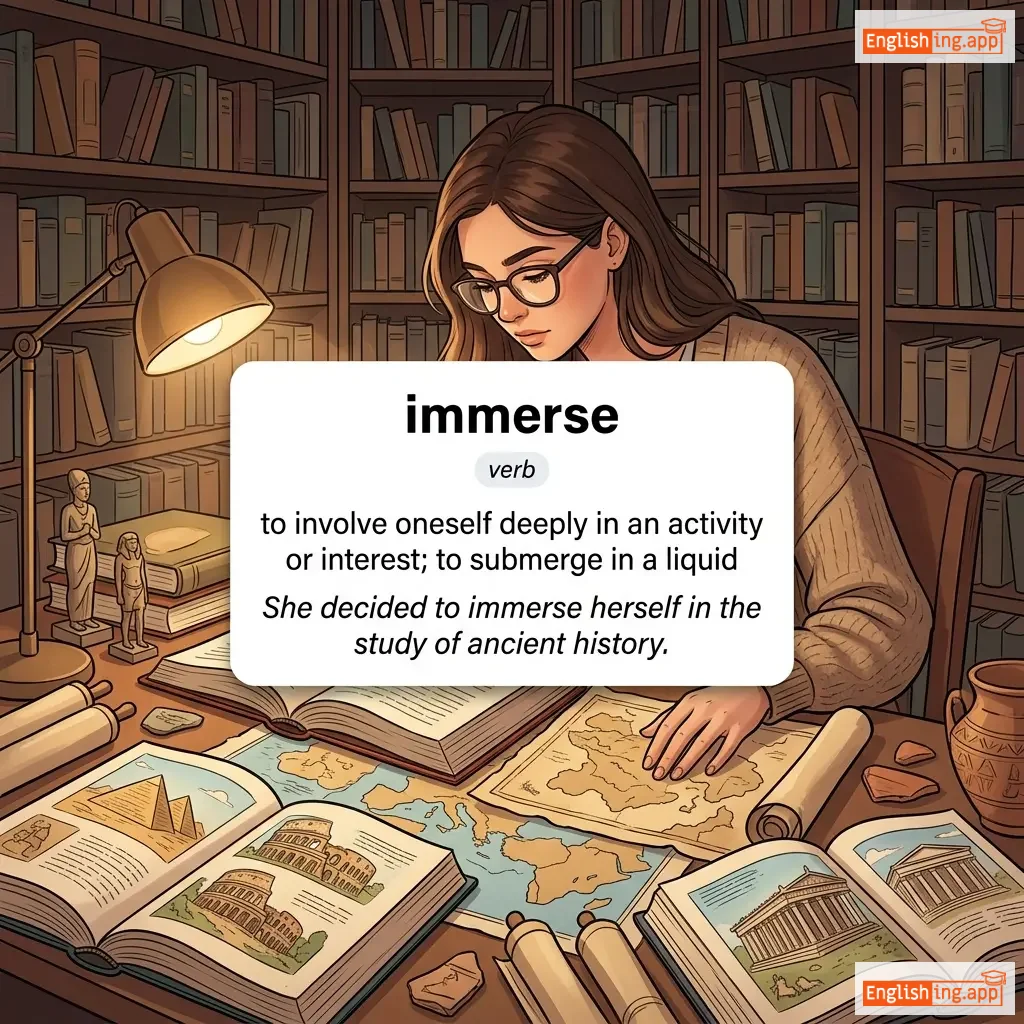
immerse definition card — visual illustration of the meaning
verb
/ɪˈmɜːrs/
沉浸,深入其中 (chenjin, shenru qizhong)

to involve oneself deeply in an activity or interest; to submerge in a liquid

"She decided to immerse herself in the study of ancient history."

"她决定沉浸在古代历史的研究中。" (Ta jueding chenjin zai gudai lishi de yanjiu zhong.)
immersion definition card — visual illustration of the meaning
noun
/ɪˈmɜːrʒən/
沉浸 (chenjin)

the act of deeply involving oneself in something; the state of being completely surrounded by liquid

"Language immersion helps students learn more effectively."

"语言沉浸帮助学生更有效地学习。" (Yuyan chenjin bangzhu xuesheng geng youxiao de xuexi.)
immersive definition card — visual illustration of the meaning
adjective
ɪˈmɜː.sɪv
沉浸式 (chen jin shi)

Providing, involving, or characterized by deep absorption or immersion in something.

"The immersive experience of VR makes learning more interactive."

"虚拟现实的沉浸式体验使学习更加互动。" (Xuni xianshi de chenjinshi tixian shi xuexi gengjia hudong.)
noun
/ˈɪmɪɡrənt/
移民 (yímín)

a person who comes to live permanently in a foreign country

"The city has welcomed many new immigrants this year."

"今年这座城市接纳了许多新的移民。" (Jīnnián zhè zuò chéngshì jiēnàle xǔduō xīn de yímín.)
verb
/ˈɪmɪɡreɪt/
移民 (yímín)

to come to live permanently in a foreign country

"He immigrated to Canada five years ago."

"他五年前移民到了加拿大。" (Tā wǔ nián qián yímín dào le jiānádà.)
noun
/ˌɪmɪˈɡreɪʃən/
移民 (yímín)

the action of coming to live permanently in a foreign country

"Immigration policies vary from country to country."

"移民政策因国家而异。" (Yímín zhèngcè yīn guójiā ér yì.)
noun
/ˈɪmɪnəns/
即将发生,临近状态 (jijiang fasheng, linjin zhuangtai)

the state of being about to happen

"The imminence of the storm forced people to take shelter."

"风暴的临近使人们不得不寻找庇护所。" (Fengbao de linjin shi renmen bude bu xunzhao bihu suo.)
adjective
/ˈɪmɪnənt/
即将 (jí jiāng)

About to happen; likely to occur very soon.

"Dark clouds signaled that a storm was imminent."

"乌云预示着暴风雨即将来临。" (Wū yún yù shì zhe bào fēng yǔ jí jiāng lái lín.)
adjective
/ɪˈmɪsəbl/
不相溶 (bù xiāng róng)

Describes liquids that do not mix together.

"Oil and water are immiscible liquids."

"油和水是无法混合的液体。" (Yóu hé shuǐ shì wúfǎ hùn hé de yètǐ.)
adjective
/ɪˈmoʊbəl/
无法移动 (wufadian dong)

unable to move or be moved

"After the accident, he was immobile for weeks."

"事故发生后,他几周都无法移动。" (Shigu fasheng hou, ta ji zhou dou wufa yidong.)
noun
/ˌɪməʊˈbɪləti/
不动 (budong)

The state of being unable to move.

"After the accident, she suffered from immobility in her legs."

"事故发生后,她的腿部出现了不动的症状。" (Shigu fasheng hou, ta de tui bu chuxian le budong de zhengzhuang.)
adjective
/ɪˈmɒdərət/
过度的 (guòdù de)

excessive; beyond reasonable limits

"He has an immoderate love for sweets."

"他对糖果有过度的喜爱。" (Tā duì tángguǒ yǒu guòdù de xǐ'ài.)
adjective
/ɪˈmɒdɪst/
傲慢 / 不得体 (aoman / bude ti)

lacking humility or decency; excessively proud or improper

"His immodest remarks offended the audience."

"他的傲慢言辞冒犯了观众。" (Tā de àomàn yáncí màofànle guānzhòng.)
noun
/ɪˈmɒdəsti/
不谦逊 (bu qianxun)

lack of modesty or decency; behavior or attitude that is overly bold or improper

"The article was criticized for its tone of immodesty."

"这篇文章因其不谦逊的语气而受到批评。" (zhe pian wenzhang yin qi bu qianxun de yuqi er shoudao piping)
verb
/ˈɪməleɪt/
自焚 (zìfén)

To kill or sacrifice, especially by burning.

"The protesters threatened to immolate themselves in front of the building."

"抗议者威胁要在建筑物前自焚。" (Kàngyì zhě wēixié yào zài jiànzhúwù qián zìfén.)
adjective
/ɪˈmɒrəl/
不道德的 (budàodé de)

Not conforming to accepted standards of morality; unethical or wicked.

"He was fired for his immoral behavior."

"他因不道德的行为被解雇了。" (Tā yīn bù dàodé de xíngwéi bèi jiěgù le.)
noun
/ˌɪməˈrælɪti/
不道德 (bu daode)

the quality of being immoral; behavior that violates accepted moral standards

"The community condemned the immorality of the corrupt officials."

"社会谴责了腐败官员的不道德行为。" (Shehui qianze le fubai guanyuan de bu daode xingwei)
adjective; noun
/ɪˈmɔːrtl/
不朽的 (buxiu de)

living forever; never dying; lasting forever in fame or memory

"Legends often describe heroes as immortal beings who never die."

"传说中英雄是不朽的存在。" (chuanshuo zhong yingxiong shi buxiu de cunzai)
noun
/ˌɪmɔːrˈtæləti/
不朽 (buxiu)

the state of living forever; eternal life or lasting fame beyond death

"Many ancient cultures believed that heroes could achieve immortality through great deeds."

"许多古代文化相信英雄可以通过伟大的事迹获得不朽。" (xuduo gudai wenhua xiangxin yingxiong keyi tongguo weida de shiji huode buxiu)
verb
/ɪˈmɔːrtəlaɪz/
永生 (yǒngshēng)

to preserve the memory of someone or something forever

"The statue was built to immortalize the hero’s sacrifice."

"这座雕像是为了让英雄的牺牲永生化。" (Zhè zuò diāoxiàng shì wèile ràng yīngxióng de xīshēng yǒngshēnghuà.)
immovable definition card — visual illustration of the meaning
adjective
/ɪˈmuːvəbl/
不可移动 (bù kě yí dòng)

impossible to move or change

"The rock was too heavy and immovable."

"那块岩石太重,无法移动。" (Nà kuài yánshí tài zhòng, wúfǎ yí dòng.)
adjective
/ɪˈmjuːn/
免疫的 (mianyi de)

protected from disease or from the effects of something

"Children who are vaccinated are immune to many diseases."

"接种疫苗的孩子对许多疾病免疫。" (Jiezhong yimiao de haizi dui xuduo jibing mianyi.)
immunity definition card — visual illustration of the meaning
noun
/ɪˈmjuːnɪti/
免疫力 (miǎnyì lì)

The state of being protected against disease or harmful influences.

"Vaccination provides immunity against certain infections."

"疫苗接种提供对某些感染的免疫力。" (Yìmiáo jiēzhòng tígōng duì mǒuxiē gǎnrǎn de miǎnyì lì.)
verb
/ɪˈmjʊər/
囚禁 (qiújìn)

to confine or enclose someone against their will

"The prisoner was immured in a dark cell."
"囚犯被禁闭在一个黑暗的牢房里。" (Qiúfàn bèi jìnbì zài yīgè hēi'àn de láofáng lǐ.)
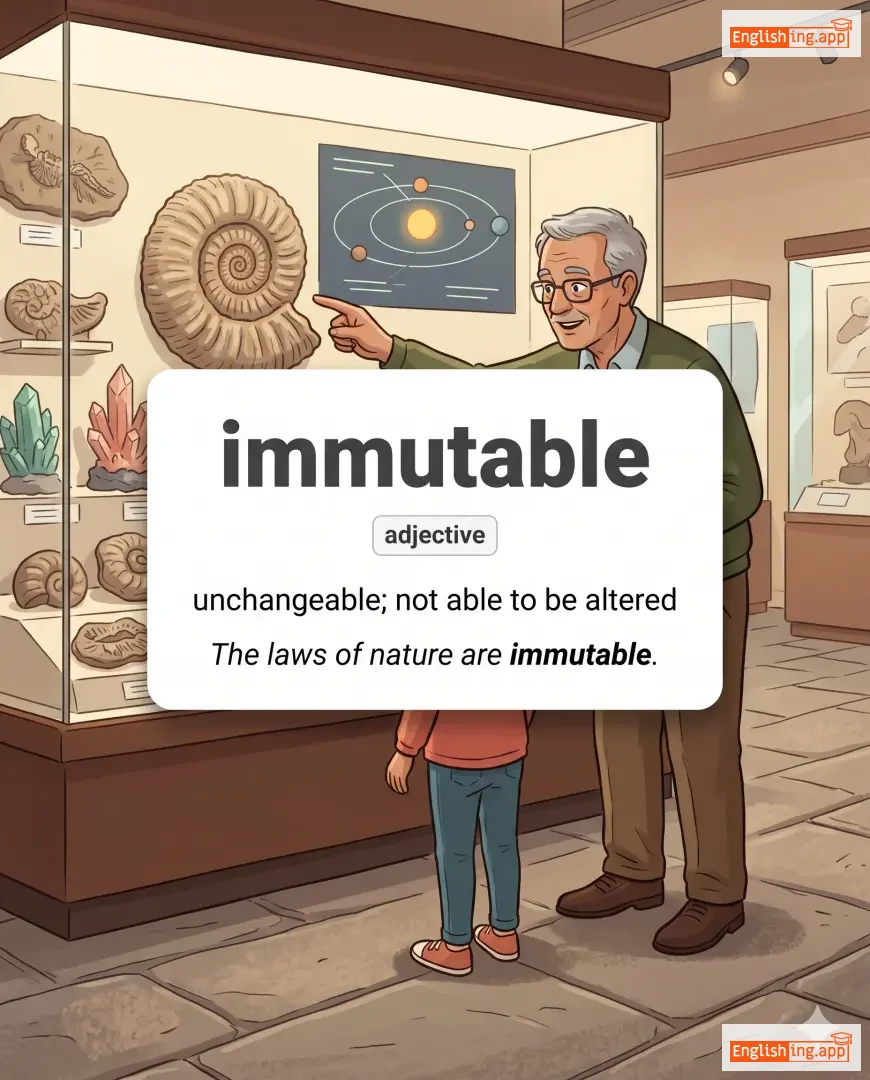
immutable definition card — visual illustration of the meaning
adjective
/ɪˈmjuːtəbl/
不可改变的 (bùkě gǎibiàn de)

unchangeable; not able to be altered

"The laws of nature are immutable."
"大自然的规律是不可改变的。" (Dà zìrán de guīlǜ shì bùkě gǎibiàn de.)
noun
/ɪmp/
小顽皮精灵 (xiao wanpi jingling)

a small mischievous devil or sprite; a playful troublemaker

"The child was acting like a little imp, hiding his toys everywhere."

"那个孩子像一个小顽皮精灵,四处藏玩具。" (Na ge haizi xiang yi ge xiao wanpi jingling, sichu cang wanju.)
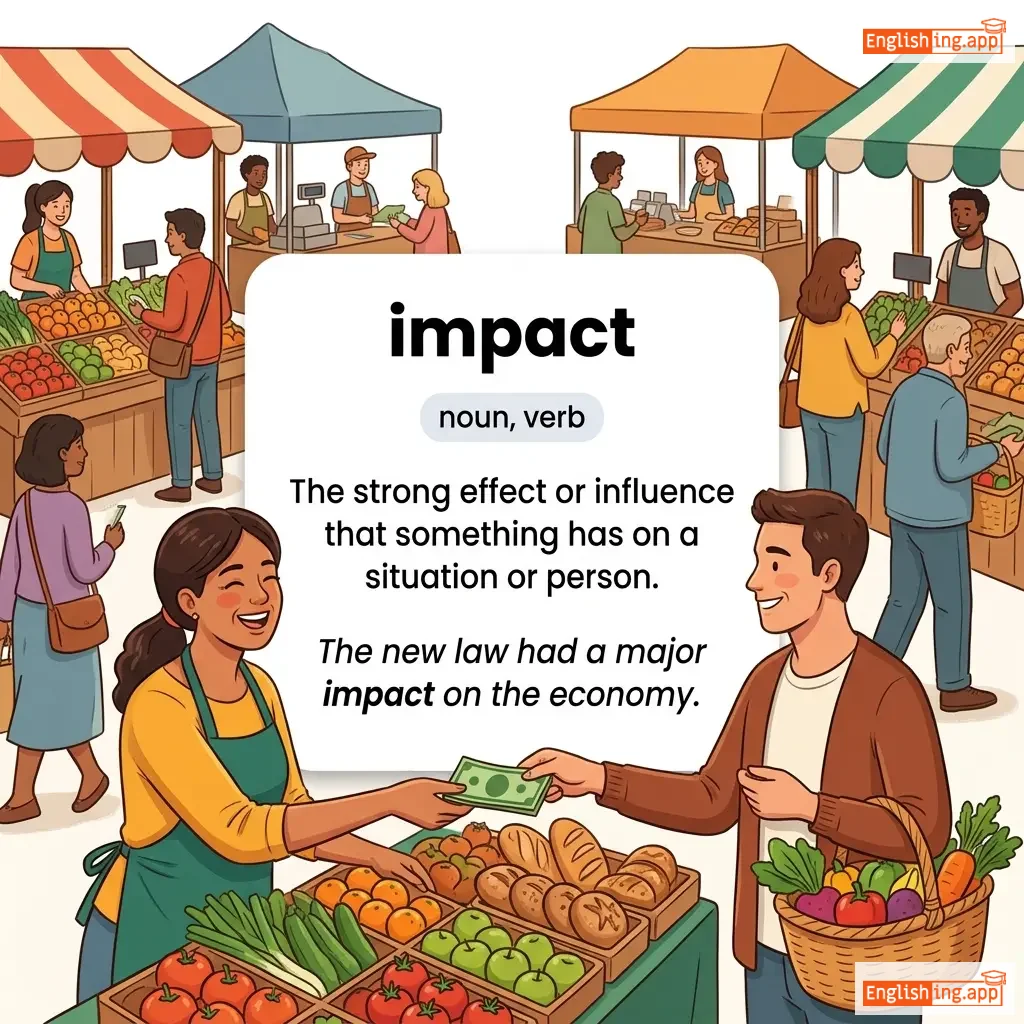
impact definition card — visual illustration of the meaning
noun, verb
/ˈɪmpækt/
影响 (yingxiang)

The strong effect or influence that something has on a situation or person.

"The new law had a major impact on the economy."

"新法律对经济产生了重大影响。" (Xin falu dui jingji chansheng le zhongda yingxiang.)
impactful definition card — visual illustration of the meaning
adjective
/ˈɪmpæktfʊl/
有影响力的 (you yingxiangli de)

Having a major impact or effect; powerful and forceful.

"Her impactful speech moved the audience to take action."
"她有影响力的演讲促使观众采取行动。" (Tā yǒu yǐngxiǎnglì de yǎnjiǎng cùshǐ guānzhòng cǎiqǔ xíngdòng.)
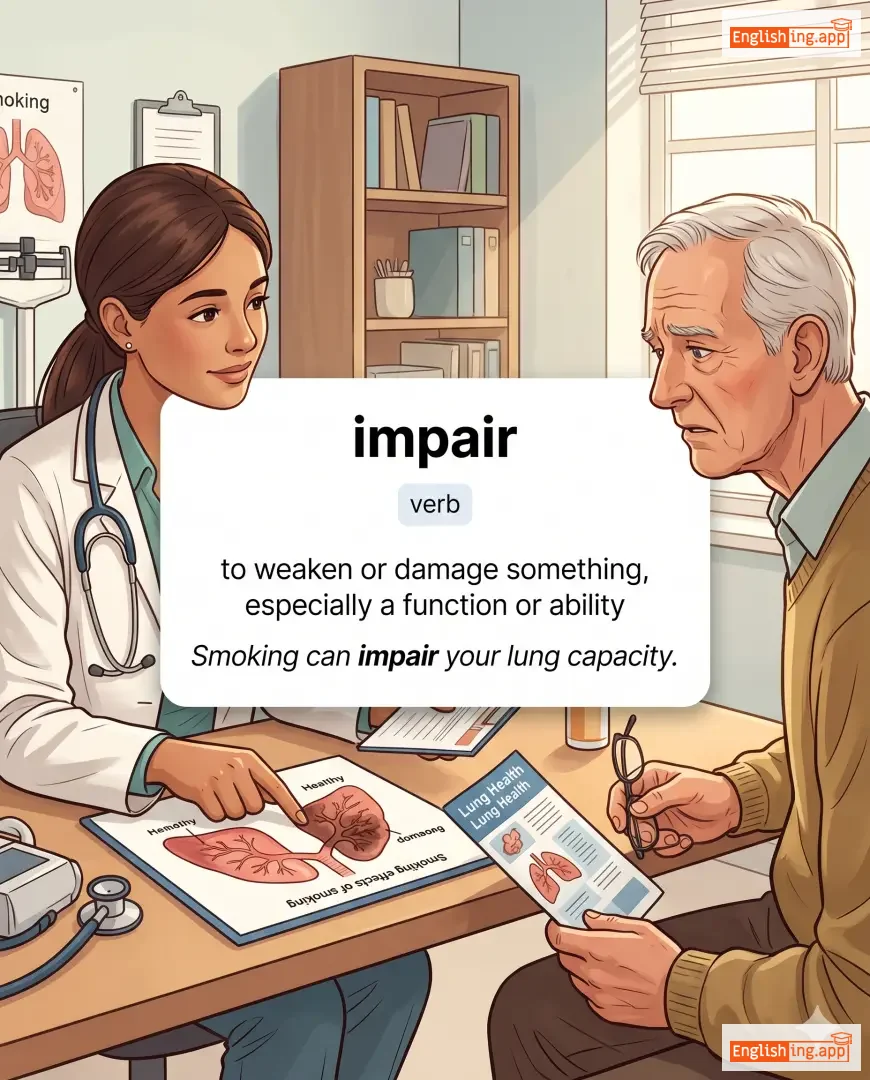
impair definition card — visual illustration of the meaning
verb
/ɪmˈpɛər/
损害 (sunhai)

to weaken or damage something, especially a function or ability

"Smoking can impair your lung capacity."
"吸烟可能会损害您的肺部容量。" (Xiyan keneng hui sunhai ninde feibu rongliang.)
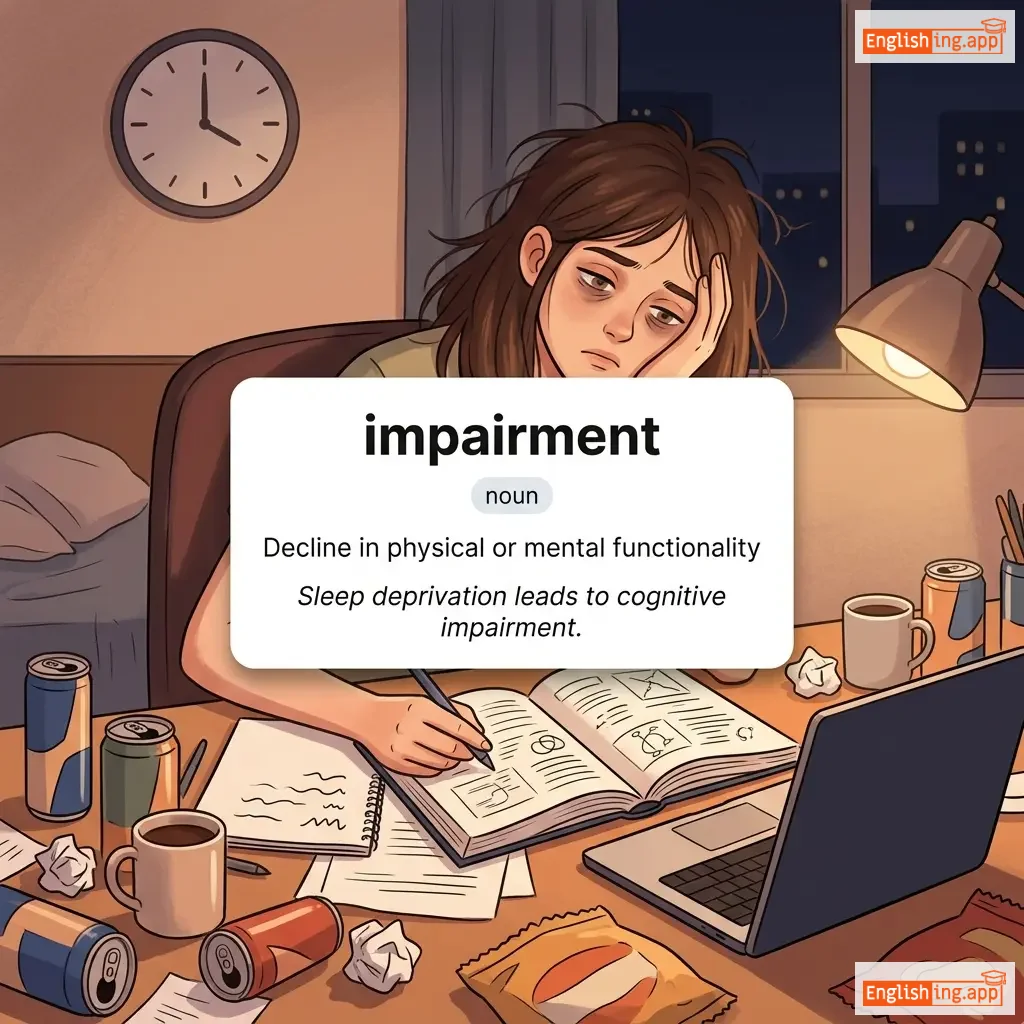
impairment definition card — visual illustration of the meaning
noun
ɪmˈpɛərmənt
损伤 (sǔnshāng)

Decline in physical or mental functionality

"Sleep deprivation leads to cognitive impairment."

"睡眠不足会导致认知损伤。" (Shuìmián bùzú huì dǎozhì rènzhī sǔnshāng.)
verb
/ɪmˈpeɪl/
刺穿 (cìchuān)

to pierce or fix something with a sharp object

"The knight was impaled by the enemy’s spear."

"骑士被敌人的长矛刺穿。" (Qíshì bèi dírén de chángmáo cìchuān.)
adjective
/ɪmˈpælpəbəl/
难以触及的 (nanyi chuji de)

unable to be felt by touch; difficult to grasp or understand

"There was an impalpable sense of fear in the room."

"房间里有一种难以触及的恐惧感。" (Fangjian li you yizhong nanyi chuji de kongju gan.)
verb
/ɪmˈpɑːrt/
传授 (chuánshòu)

to make information known; to bestow or communicate

"The teacher imparted valuable knowledge to her students."

"老师将宝贵的知识传授给她的学生。" (Lǎoshī jiāng bǎoguì de zhīshì chuánshòu gěi tā de xuéshēng.)
adjective
/ɪmˈpɑːrʃəl/
公正 (gongzheng)

Treating all rivals or disputants equally; fair and just.

"The judge remained impartial throughout the trial."

"法官在整个审判过程中保持了公正。" (Fǎguān zài zhěnggè shěnpàn guòchéng zhōng bǎochíle gōngzhèng.)
adjective
/ɪmˈpæsəbəl/
无法通行 (wúfǎ tōngxíng)

Impossible to travel along or over.

"The road became impassable after the heavy snowfall."

"这条路在大雪过后变得无法通行。" (Zhè tiáo lù zài dà xuě guò hòu biàn dé wúfǎ tōngxíng.)
impasse definition card — visual illustration of the meaning
noun
/ˈɪmpæs/
僵局 (jiangju)

A situation in which no progress is possible; a deadlock.

"Negotiations reached an impasse after both sides refused to compromise."

"谈判在双方拒绝妥协后陷入了僵局。" (Tanpan zai shuāngfāng jùjué tuǒxié hòu xiànrù le jiāngjú.)
adjective
/ɪmˈpæsɪbəl/
不可忍受的 (bukener shou de)

Incapable of suffering or feeling pain (used mainly in theological or philosophical contexts).

"Some philosophers argue that God is impassible and cannot experience human emotions."

"一些哲学家认为上帝是不可忍受的,无法体验人类的情感。" (Yixie zhexuejia renwei Shangdi shi bukener shou de, wufa tijian renlei de qinggan.)
adjective
/ɪmˈpæʃənd/
充满激情的 (chōngmǎn jīqíng de)

Filled with or showing great emotion.

"She gave an impassioned speech about human rights."
"她发表了关于人权的充满激情的演讲。" (Tā fābiǎole guānyú rénquán de chōngmǎn jīqíng de yǎnjiǎng.)
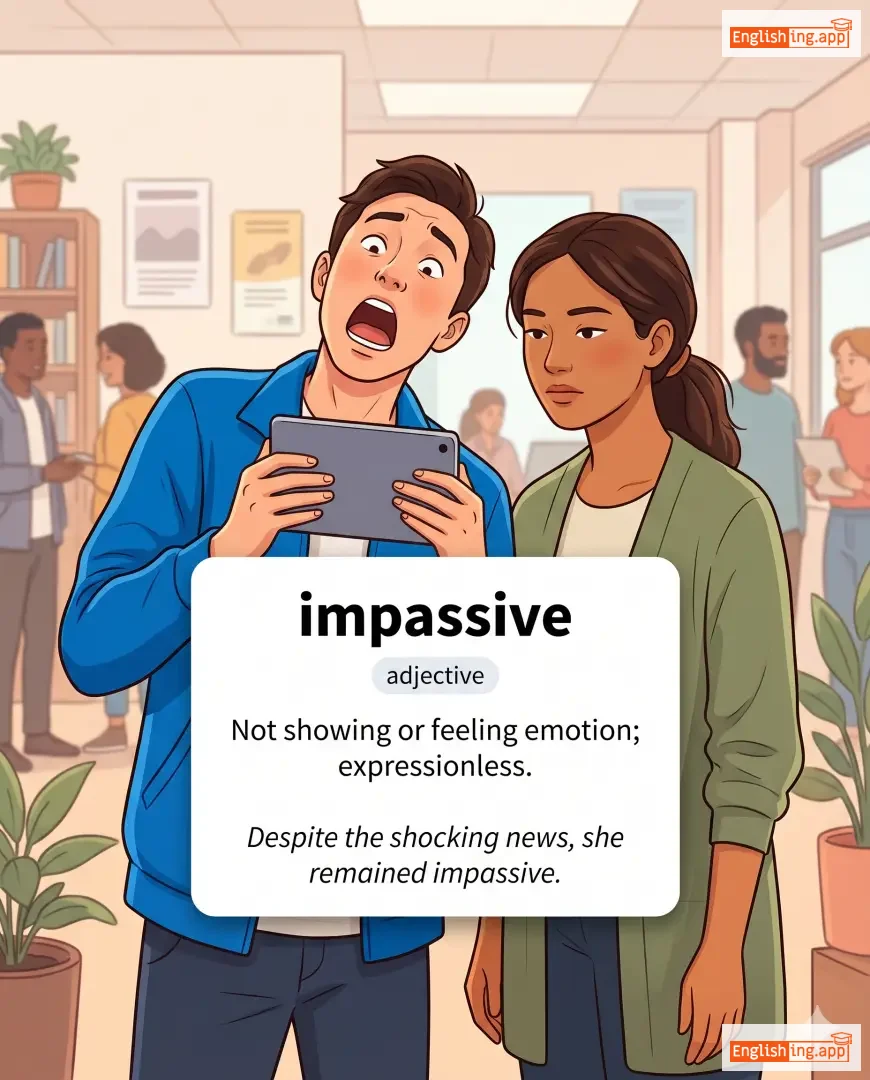
impassive definition card — visual illustration of the meaning
adjective
/ɪmˈpæsɪv/
冷漠 (lěngmò)

Not showing or feeling emotion; expressionless.

"Despite the shocking news, she remained impassive."

"尽管有令人震惊的消息,她依然无动于衷。" (Jǐnguǎn yǒu lìngrén zhènjīng de xiāoxī, tā yīrán wúdòng yú zhōng.)
noun
/ɪmˈpeɪʃəns/
不耐烦 (bunai fan)

The state of being quickly irritated or unable to wait calmly.

"His impatience grew as the meeting dragged on."

"随着会议的拖延,他的不耐烦愈加明显。" (Sui zhe huiyi de tuoyan, ta de bunai fan yujia mingxian.)
adjective
/ɪmˈpeɪʃənt/
不耐烦 (bù nài fán)

Not able to wait calmly; restless and eager for something to happen.

"She grew impatient while waiting in the long queue."

"她在长队中等得不耐烦。" (tā zài cháng duì zhōng děng dé bù nài fán.)