词汇表

英语词汇词典 | 单词含义、定义和示例

noun/adjective
/ˈɪnstənt/
瞬间 (shun jian)

A very short period of time; happening immediately.

"He replied in an instant without hesitation."

"他毫不犹豫地在瞬间作出回应。" (Ta hao bu you yu de zai shun jian zuo chu hui ying.)
adjective
/ˌɪnstənˈteɪniəs/
即时 (jishi)

Happening immediately, without any delay.

"The change in temperature was almost instantaneous."

"温度变化几乎是即时的。" (Wendu bianhua jihu shi jishi de.)
adverb
/ˈɪnstəntli/
立刻 (lì kè)

immediately, without any delay

"He replied instantly to the message."

"他立刻回复了消息。" (Tā lì kè huí fù le xiāo xī.)
verb
/ɪnˈsteɪt/
任命 (rèn mìng)

To set up in position, office, or authority.

"The board decided to instate her as the new director."

"董事会决定任命她为新任总监。" (Dǒngshì huì juédìng rènmìng tā wéi xīnrèn zǒngjiān.)
adverb
/ɪnˈstɛd/
代替 (dàitì)

As an alternative or substitute.

"She didn’t buy the dress; instead, she chose a pair of shoes."

"她没有买那件裙子; 反而她选择了一双鞋子。" (Tā méiyǒu mǎi nà jiàn qúnzi; fǎn'ér tā xuǎnzéle yī shuāng xiézi.)
verb
/ˈɪnstɪˌɡeɪt/
挑拨 (tiaobo)

To bring about or initiate an action, often something negative.

"He was accused of instigating the riot."

"他被指控挑起暴乱。" (Ta bei zhigong tiaoqi baoluan.)
noun
/ˈɪnstɪˌɡeɪtər/
煽动者 (shāndòng zhě)

A person who brings about or initiates something, usually something bad.

"The police identified him as the instigator of the violence."

"警方将他定为暴力的煽动者。" (Jǐngfāng jiāng tā dìng wéi bàolì de shāndòng zhě.)
verb
/ɪnˈstɪl/
灌输 (guànshū)

to gradually but firmly establish an idea, attitude, or habit in someone's mind

"Parents try to instill good values in their children."

"父母试图在孩子们的心中灌输好的价值观。" (Fùmǔ shìtú zài háizimen de xīn zhōng guànshū hǎo de jiàzhíguān.)
noun
/ˈɪnstɪŋkt/
本能 (bènnéng)

A natural way of behaving or reacting that does not require learning.

"Birds build nests by instinct."

"鸟类本能地筑巢。" (Niǎo lèi běnnéng de zhùcháo.)
instinctive definition card — visual illustration of the meaning
adjective
/ɪnˈstɪŋk.tɪv/
本能的, 自然的, 自动的 (běn néng de, zì rán de, zì dòng de)

Based on instinct; done without conscious thought; natural and automatic.

"His instinctive reaction saved his life."

"他的本能反应救了他的生命。" (Tā de běn néng fǎnyìng jiùle tā de shēngmìng.)
noun, verb
/ˈɪnstɪˌtjuːt/
学院 (xueyuan)

as a noun, an organization founded for a specific purpose; as a verb, to establish or initiate

"The university decided to institute new rules for the library."

"大学决定为图书馆制定新规则。" (Daxue jueding wei tushuguan zhiding xin guize.)
institution definition card — visual illustration of the meaning
noun
/ˌɪnstɪˈtjuːʃən/
机构 (jīgòu)

an established organization, especially one dedicated to education, public service, or a particular purpose

"The hospital is a respected institution in the community."

"医院是社区中的一个受人尊敬的机构。" (Yī yuàn shì shè qū zhōng de yī gè shòu rén zūn jìng de jī gòu.)
adjective
/ˌɪnstɪˈtjuːʃənl/
制度的 (zhìdù de)

Relating to an organization or established practice.

"The government made several institutional reforms in education."

"政府在教育领域进行了一些制度改革。" (Zhèngfǔ zài jiàoyù lǐngyù jìnxíngle yīxiē zhìdù gǎigé.)
verb
/ˌɪnstɪˈtjuːʃənəlaɪz/
制度化 (zhìdùhuà)

to establish something as a formal institution, custom, or practice

"The government seeks to institutionalize environmental protection."

"政府致力于将环境保护制度化。" (Zhèngfǔ zhìlì yú jiāng huánjìng bǎohù zhìdùhuà.)
instruct definition card — visual illustration of the meaning
verb
/ɪnˈstrʌkt/
指导,教导 (zhǐdǎo, jiàodǎo)

to tell or teach someone how to do something

"The teacher instructed the students to complete the assignment."

"老师指导学生完成作业。" (Lǎoshī zhǐdǎo xuéshēng wánchéng zuòyè.)
noun
/ɪnˈstrʌkʃən/
指令 (zhiling)

Detailed information telling how something should be done or operated.

"Please read the instruction carefully before using the machine."

"请在使用机器前仔细阅读指令。" (Qing zai shiyong jiqi qian zixi yuedu zhiling.)
adjective
/ɪnˈstrʌkʃənəl/
教学的 (jiaoxue de)

providing knowledge or information; intended to teach

"The website offers many instructional videos for beginners."

"该网站提供许多教学视频,适合初学者。" (Gai wangzhan tigong xuduo jiaoxue shipin, shihe chuxueshuo.)
noun
/ɪnˈstrʌkʃənz/
指示 (zhǐshì)

Detailed information on how something should be done or operated.

"Please follow the instructions on the box."

"请按照盒子上的指示操作。" (qǐng ànzhào hézi shàng de zhǐshì cāozuò.)
adjective
/ɪnˈstrʌktɪv/
有教育意义的 (you jiao yu yi yi de)

useful and informative; providing knowledge or instruction

"The lecture was highly instructive and engaging."

"这场讲座非常有教育意义且引人入胜。" (Zhe chang jiangzuo feichang you jiaoyu yiyi qie yinren rusheng.)
noun
/ɪnˈstrʌktər/
教练 (jiaolian)

A person who teaches a subject or skill.

"The driving instructor was very patient with new learners."

"驾校教练对新学员非常耐心。" (Jiàxiào jiàoliàn duì xīn xuéyuán fēicháng nàixīn.)
noun
/ˈɪnstrəmənt/
仪器 (yíqì)

A tool or device used for a particular purpose, especially for scientific or musical work.

"The doctor used a special instrument during the surgery."

"医生在手术过程中使用了一种特殊的仪器。" (Yīshēng zài shǒushù guòchéng zhōng shǐyòngle yī zhǒng tèshū de yíqì.)
instrumental definition card — visual illustration of the meaning
adjective
/ˌɪnstrʊˈmɛntəl/
工具的 (gōngjù de)

serving as an instrument or means to an end; helpful or useful

"His instrumental role in the project was vital to its success."

"他在项目中的工具作用对成功至关重要。" (Tā zài xiàngmù zhōng de gōngjù zuòyòng duì chénggōng zhìguān zhòngyào.)
noun
/ˌɪn.strəˈmɛn.təl.ɪst/
乐器演奏者 (yuèqì yǎnzòu zhě)

A person who plays a musical instrument.

"The instrumentalist played a beautiful solo on the violin."

"乐器演奏者在小提琴上演奏了一首美丽的独奏曲。" (Yuèqì yǎnzòu zhě zài xiǎotíqín shàng yǎnzòu le yī shǒu měilì de dúzòuqǔ.)
adjective
/ˌɪn.səˈbɔːr.dɪ.nət/
不服从 (bù fúcóng)

Defiant of authority; disobedient to orders.

"The insubordinate employee refused to follow the manager's instructions."

"不服从的员工拒绝遵循经理的指示。" (Bù fúcóng de yuángōng jùjué zūnxún jīnglǐ de zhǐshì.)
noun
/ˌɪn.səˌbɔːr.dɪˈneɪ.ʃən/
不服从 (bù fú cóng)

Defiance of authority; refusal to obey orders.

"The soldier was punished for insubordination during the mission."

"士兵因在任务中不服从命令而受到惩罚。" (Shìbīng yīn zài rènwù zhōng bù fúcóng mìnglìng ér shòudào chéngfá.)
adjective
/ˌɪn.səbˈstæn.ʃəl/
不实的 (bù shí de)

Lacking strength, substance, or solidity.

"The evidence provided was insubstantial and unconvincing."

"提供的证据是不实的且令人信服。" (Tígōng de zhèngjù shì bù shí de qiě lìng rén xìnfú.)
adjective
/ɪnˈsʌf.ər.ə.bəl/
无法忍受 (wufa renshou)

Too extreme to bear; intolerable.

"The heat during the summer was insufferable."

"夏天的炎热是无法忍受的。" (Xiatian de yanshao shi wufa renshou de.)
noun
/ˌɪnsəˈfɪʃənsi/
不足 (buzu)

The state of not being enough or not being adequate.

"The project failed due to the insufficiency of funds."

"由于资金不足,项目失败了。" (youyu zijin buzhu, xiangmu shibai le.)
adjective
/ˌɪnsəˈfɪʃənt/
不足的 (buzude)

Not enough; inadequate.

"His explanation was insufficient to clear the confusion."

"他的解释不足以清除混乱。" (Tade jieshi buzude qingchu hunluan.)
adjective
/ˈɪnsjələr/
狭隘的,岛屿相关的 (xia'ai de, daoyu xiangguan de)

Narrow-minded, isolated, or relating to an island.

"The community was criticized for its insular attitudes toward outsiders."
"该社区因其对外来者的封闭态度而受到批评。" (Gai shequ yin qi dui wailaizhe de fengbi taidu er shoudao piping.)
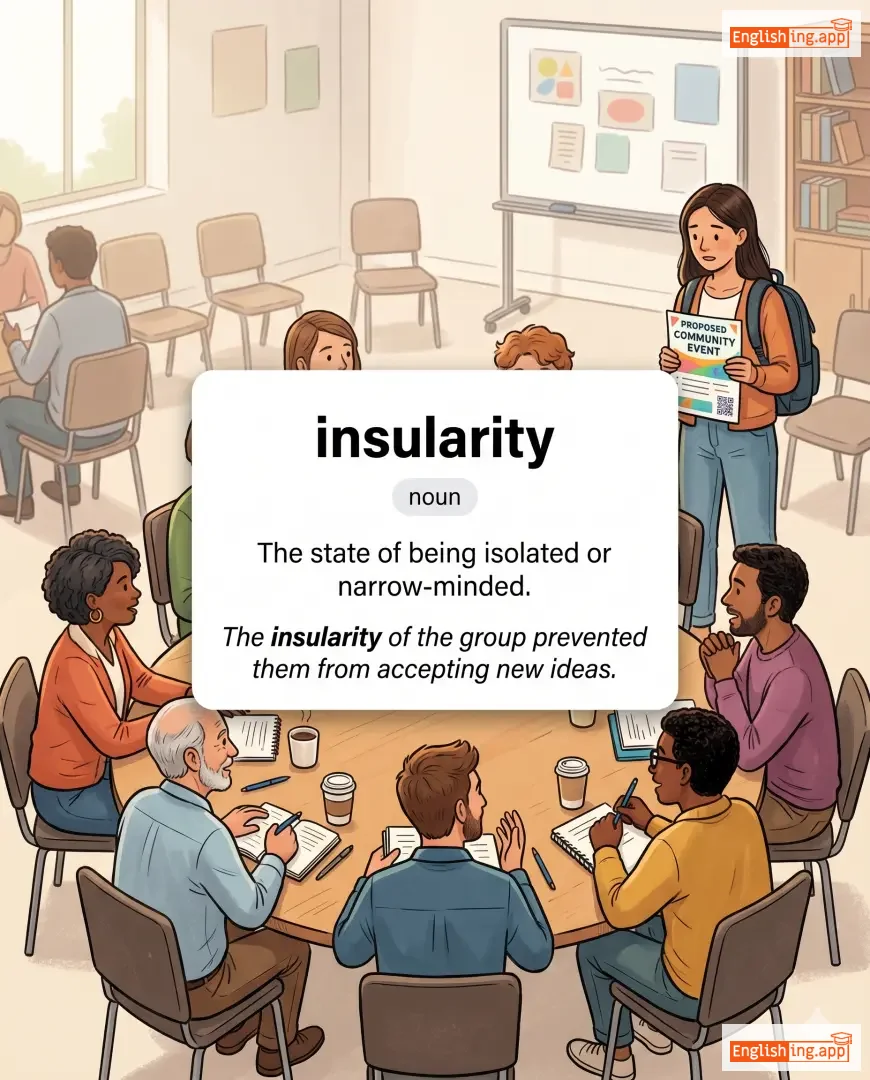
insularity definition card — visual illustration of the meaning
noun
/ˌɪnsjəˈlærəti/
岛屿性 (dǎoyǔ xìng)

The state of being isolated or narrow-minded.

"The insularity of the group prevented them from accepting new ideas."

"该小组的岛屿性使他们无法接受新的想法。" (Gāi xiǎozǔ de dǎoyǔ xìng shǐ tāmen wúfǎ jiēshòu xīn de xiǎngfǎ.)
🛡️

insulate

verb
/ˈɪnsjuleɪt/

To protect something by covering it, especially to prevent heat, sound, or electricity from escaping or entering.

"The house was insulated to reduce heating costs."

insulation definition card — visual illustration of the meaning
noun
ˌɪnsjʊˈleɪʃən
绝缘 (jueyuan)

Material used to prevent heat, sound, or electricity from being transmitted from one area to another.

"Insulation of food storage areas can prevent pests from entering."

"食品储存区的绝缘可以防止害虫进入。" (Shípǐn chǔcún qū de juéyuán kěyǐ fángzhǐ hàichóng jìnrù.)
insult definition card — visual illustration of the meaning
verb
/ˈɪnsʌlt/
侮辱 (wǔrǔ)

to speak to or treat someone with disrespect or scorn

"He insulted her by calling her lazy in front of everyone."

"他通过在大家面前叫她懒惰来侮辱她。" (Tā tōngguò zài dàjiā miànqián jiào tā lǎnduò lái wǔrǔ tā.)
insuperable definition card — visual illustration of the meaning
adjective
/ɪnˈsuːpərəbl/
不可逾越 (bukeyuyue)

Impossible to overcome or surpass.

"The team faced insuperable challenges during the expedition."

"团队在探险过程中面临了不可逾越的挑战。" (Tuandui zai tanxian guocheng zhong mianlin le bukeyuyue de tiaozhan.)
adjective
/ˌɪnsəˈpɔːrtəbl̩/
无法忍受的 (wufalirenxiu de)

Too extreme or difficult to be endured.

"The heat was insupportable during the long journey."

"长途旅行中,热度是无法忍受的。" (Changtu luxing zhong, reddu shi wufalirenxiu de.)
adjective
/ˌɪnsəˈprɛsəbl/
不可抑制的 (bù kě yì zhì de)

That cannot be suppressed or restrained.

"She had an insuppressible urge to laugh during the ceremony."

"她在仪式上有一种不可抑制的笑意。" (Tā zài yíshì shàng yǒu yī zhǒng bù kě yì zhì de xiàoyì.)
noun
/ɪnˈʃʊərəns/
保险 (baoxian)

An arrangement by which a company provides compensation for loss, damage, or illness in return for a premium.

"He bought health insurance to cover medical expenses."

"他购买了健康保险以支付医疗费用。" (Tā gòumǎi le jiànkāng bǎoxiǎn yǐ zhīfù yīliáo fèiyòng.)
insure definition card — visual illustration of the meaning
🛡️

insure

verb
/ɪnˈʃʊr/

to arrange for compensation in case of loss or damage, typically by taking out insurance

"You should insure your car against theft or accidents."

noun
/ɪnˈsɜːrdʒəns/
叛乱 (pàn luàn)

An act of rebellion or uprising against authority.

"The government struggled to contain the growing insurgence."

"政府难以控制日益增长的叛乱。" (Zhèngfǔ nán yǐ kòngzhì rìyì zēngzhǎng de pàn luàn.)
noun
/ɪnˈsɜːrdʒənt/
起义者 (qiyi zhe)

A person who rises in revolt against authority or government.

"The army arrested several insurgents after the attack."

"军队在袭击后逮捕了几名起义者。" (Jundui zai xiji hou daibu le ji ming qiyi zhe.)
adjective
/ˌɪnsərˈmaʊntəbl/
不可逾越 (bù kě yú yuè)

Too great to be overcome.

"The explorers faced insurmountable odds in the desert."

"探险者在沙漠中面对着无法逾越的困难。" (Tànxiǎn zhě zài shāmò zhōng miànduì zhe wúfǎ yúyuè de kùnàn.)
noun
/ˌɪnsəˈrɛkʃən/
起义 (qǐyì)

A violent uprising against an authority or government.

"The army was called in to suppress the insurrection."

"军队被召来镇压起义。" (Jūnduì bèi zhàolái zhènyā qǐyì.)
adjective
/ɪnˈtækt/
完整 (wánzhěng)

Remaining whole, complete, and undamaged.

"Despite the storm, the old house remained intact."

"尽管风暴,老房子依然保持完整。" (Jǐnguǎn fēngbào, lǎo fángzi yīrán bǎochí wánzhěng.)
noun
/ˈɪnˌteɪk/
摄入 (she ru)

the process of taking something in, especially food or drink

"He monitored his daily intake of calories to maintain a healthy diet."

"他监控着自己每天的卡路里摄入量,以保持健康的饮食。" (Ta jiankong zhe ziji mei tian de kaluli she ru liang, yi baochi jiankang de yin shi.)
intangible definition card — visual illustration of the meaning
adjective
/ɪnˈtændʒəbl/
无形的 (wúxíng de)

Unable to be touched or grasped; not having a physical presence.

"Trust is an intangible quality in relationships."

"信任是关系中一种无形的品质。" (Xìnrèn shì guānxì zhōng yī zhǒng wúxíng de pǐnzhí.)
integral definition card — visual illustration of the meaning
adjective
/ˈɪntɪɡrəl/ or /ɪnˈtɛɡrəl/
不可分割 (bù kě fēn gē)

Necessary and important as a part of a whole.

"Honesty is an integral part of good leadership."

"诚实是良好领导力的一个重要组成部分。" (Chéngshí shì liánghǎo lǐngdǎolì de yīgè zhòngyào zǔchéng bùfen.)
verb
/ˈɪntɪɡreɪt/
整合 (zhěnghé)

To combine or bring together into a unified whole.

"The new system integrates data from multiple sources."

"新系统整合来自多个来源的数据。" (Xīn xìtǒng zhěnghé láizì duō gè láiyuán de shùjù.)
integrated definition card — visual illustration of the meaning
adjective
/ˈɪntɪɡreɪtɪd/
集成的 (jíchéng de)

combined or united to form a whole; including all parts or people equally

"The company offers an integrated system for managing all business operations."
"公司提供一个集成系统来管理所有业务操作。" (Gōngsī tígōng yīgè jíchéng xìtǒng lái guǎnlǐ suǒyǒu yèwù cāozuò.)
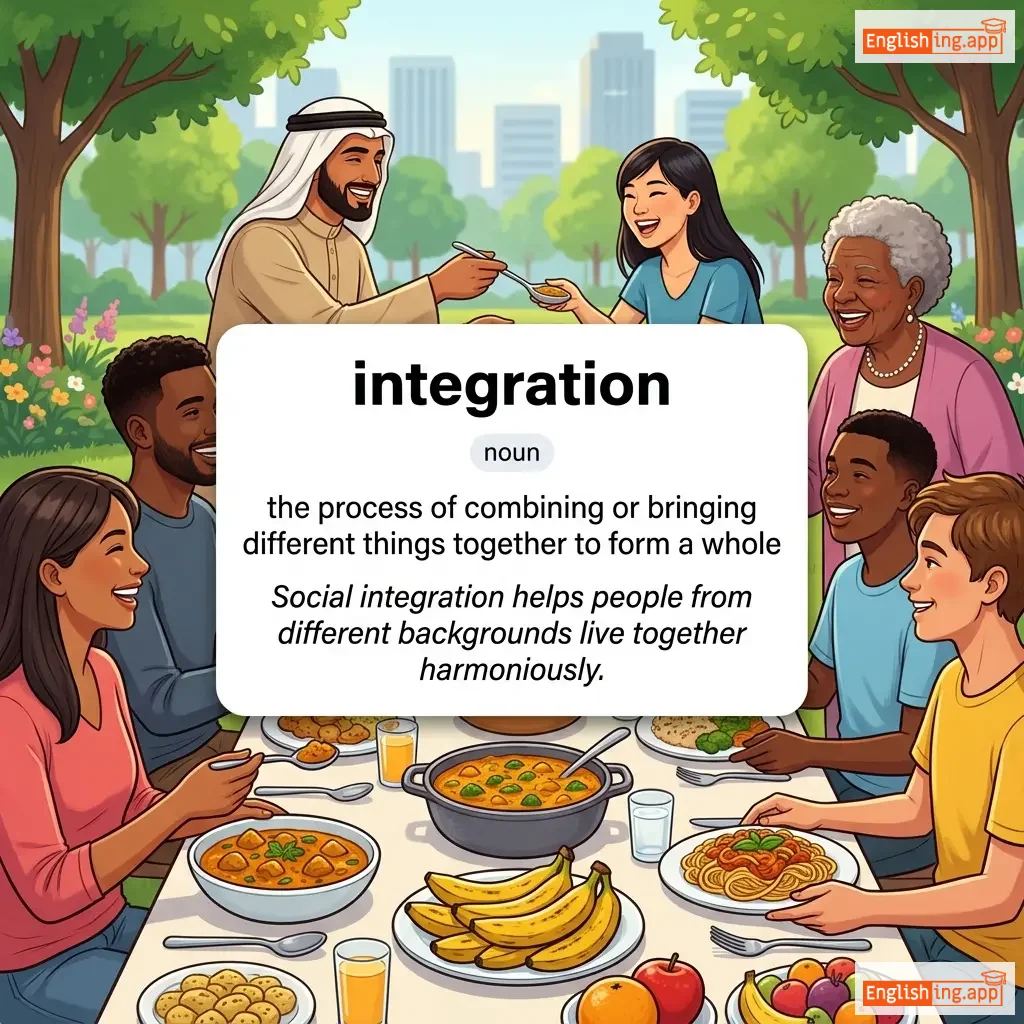
integration definition card — visual illustration of the meaning
noun
/ˌɪntɪˈɡreɪʃən/
整合 (zhěnghé)

the process of combining or bringing different things together to form a whole

"Social integration helps people from different backgrounds live together harmoniously."

"社会整合帮助来自不同背景的人和谐相处。" (Shèhuì zhěnghé bāngzhù láizì bùtóng bèijǐng de rén héxié xiāngchǔ.)