词汇表

英语词汇词典 | 单词含义、定义和示例

adjective
/ˌɪnsəˈluːbriəs/
不健康 (bù jiànkāng)

Unhealthy or not conducive to well-being.

"They moved out of the insalubrious neighborhood for the sake of their health."

"他们为了健康搬出了不健康的社区" (Tāmen wèile jiànkāng bān chūle bù jiànkāng de shèqū)
adjective
/ɪnˈseɪn/
疯狂 (fengkuang)

mentally ill; extremely foolish or unreasonable

"The idea of jumping off the cliff seemed insane."

"从悬崖上跳下的想法显得疯狂。" (Cong xuanyá shàng tiàoxià de xiǎngfǎ xiǎndé fēngkuáng.)
noun
/ɪnˈsæn.ə.ti/
疯狂; 精神错乱 (fēngkuáng; jīngshén cuòluàn)

the state of being seriously mentally ill; extreme foolishness or irrationality

"The defense lawyer argued that his client was not guilty by reason of insanity."

"辩护律师辩称,他的客户因精神错乱而不应被判有罪。" (Biànhù lǜshī biànchēng, tā de kèhù yīn jīngshén cuòluàn ér bù yīng bèi pàn yǒu zuì.)
adjective
/ɪnˈseɪʃəbl̩/
不可满足的 (bù kě mǎn zú de)

impossible to satisfy; always wanting more

"Her insatiable curiosity drove her to read every book in the library."

"她那不可满足的好奇心促使她阅读了图书馆里的所有书籍。" (Tā nà bù kě mǎn zú de hào qí xīn cù shǐ tā yuè dú le tú shū guǎn lǐ de suǒ yǒu shū jí.)
adjective
/ɪnˈseɪʃiət/
无法满足 (wufa manzu)

impossible to satisfy; always wanting more

"He had an insatiate desire for power."

"他有一个无法满足的权力愿望。" (Ta you yige wufa manzu de quanli yuanwang.)
verb
/ɪnˈskraɪb/
铭刻 (míng kè)

to write or carve words or symbols on a surface

"They inscribed her name on the trophy."

"他们把她的名字刻在奖杯上。" (tā men bǎ tā de míng zì kè zài jiǎng bēi shàng.)
adjective
/ɪnˈskruːtəbl̩/
幸福 (xìngfú)

impossible to understand or interpret

"His inscrutable expression made it hard to know what he was thinking."

"她收到奖项时无法掩饰自己的幸福。" (Tā shōudào jiǎngxiàng shí wúfǎ yǎnshì zìjǐ de xìngfú.)
noun
/ˈɪnsekt/
昆虫 (kun chong)

a small animal with six legs and usually wings, such as a bee or an ant

"A butterfly is a beautiful type of insect."

"蝴蝶是一种美丽的昆虫。" (Hudie shi yi zhong mei li de kunchong.)
noun
/ɪnˈsek.tɪ.saɪd/
杀虫剂 (shāchóngjì)

a substance used for killing insects; a chemical pesticide that targets insects

"The farmer sprayed insecticide on his crops to protect them from harmful bugs."

"农民在作物上喷洒杀虫剂,以保护它们免受有害昆虫的侵害。" (nóngmín zài zuòwù shàng pēnsǎ shāchóngjì, yǐ bǎohù tāmen miǎn shòu yǒuhài kūnchóng de qīnhài.)
adjective
/ˌɪnsɪˈkjʊə/
不安全的 (bù ānquán de)

not confident or assured; uncertain and anxious

"She felt insecure about her performance in the exam."

"她在考试中对自己的表现感到不安。" (Tā zài kǎoshì zhōng duì zìjǐ de biǎoxiàn gǎndào bù'ān.)
noun
/ˌɪnsɪˈkjʊərɪti/
不安全感 (bu anquan gan)

lack of confidence or assurance; a state of uncertainty or vulnerability

"Her insecurity made her doubt her abilities despite her experience."

"她的不安全感让她怀疑自己的能力。" (ta de bu anquan gan rang ta huaiyi ziji de nengli)
adjective
/ɪnˈsɛnseɪt/
无情的 (wu qing de)

lacking physical sensation or empathy; without feeling or sensitivity

"The dictator's insensate cruelty shocked the world."

"独裁者的无情残忍震惊了世界。" (Ducai zhe de wu qing canren zhenjing le shijie.)
insensible definition card — visual illustration of the meaning
adjective
/ɪnˈsɛnsəbl/
昏迷 (hūnmí)

Unconscious; unaware of or indifferent to something.

"He was insensible to the cold as he lay in the snow."

"他在雪地里躺着时,对寒冷昏迷不觉。" (Tā zài xuědì lǐ tǎngzhe shí, duì hánlěng hūnmí bù jué.)
adjective
/ɪnˈsɛnsətɪv/
迟钝的 (chídùn de)

Showing or feeling no concern for others' feelings.

"His insensitive comment hurt her deeply."

"他迟钝的评论深深伤害了她。" (Tā chídùn de pínglùn shēnshēn shānghài le tā.)
adjective
/ɪnˈsɛnʃənt/
无感知的 (wú gǎnzhī de)

Lacking perception, consciousness, or sensation.

"The rock is an insentient object with no awareness."

"岩石是一个无感知的物体,没有意识。" (Yánshí shì yīgè wú gǎnzhī de wùtǐ, méiyǒu yìshí.)
adjective
/ɪnˈsɛp(ə)rəbəl/
形影不离 (xíng yǐng bù lí)

Unable to be separated or always together.

"The two friends have been inseparable since childhood."
"这两个朋友从小就形影不离。" (Zhè liǎng gè péngyǒu cóng xiǎo jiù xíng yǐng bù lí.)
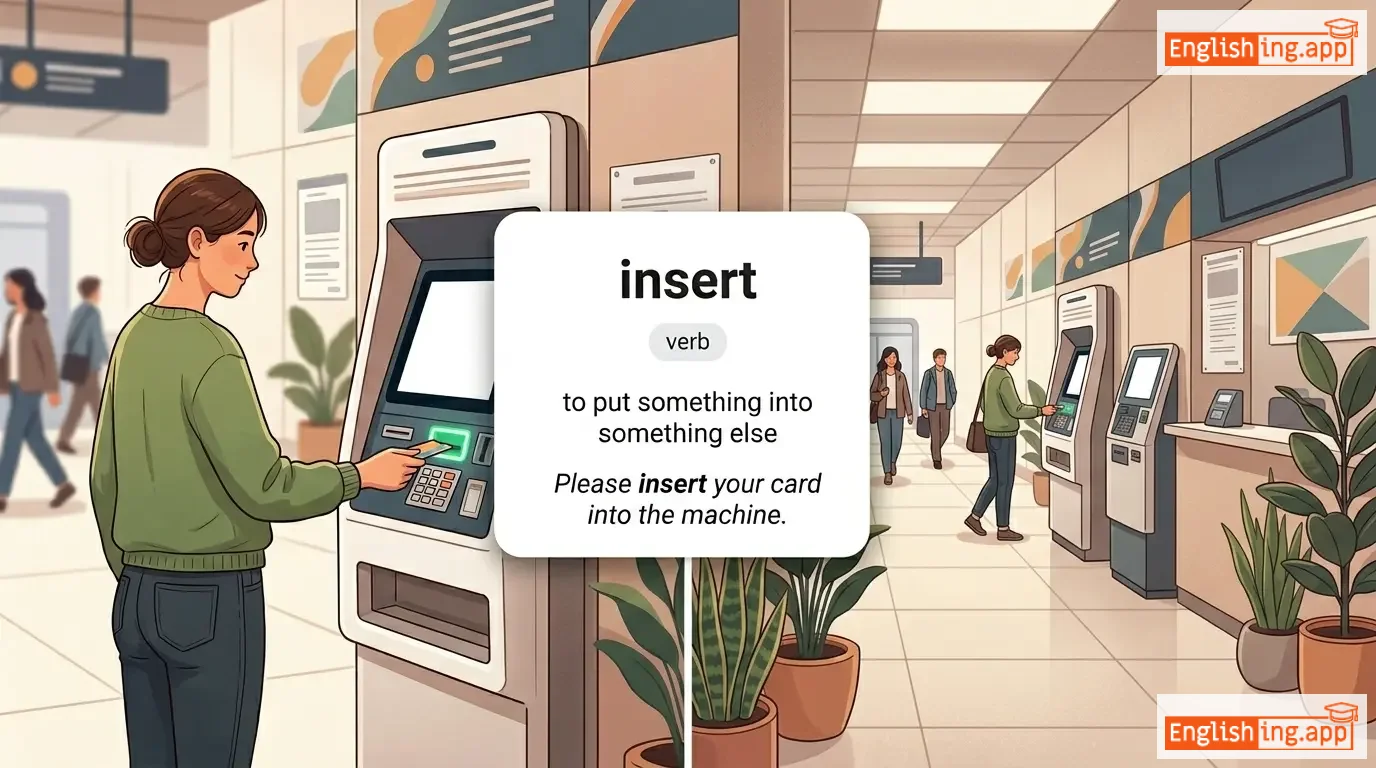
insert definition card — visual illustration of the meaning
verb
/ɪnˈsɜːt/
插入 (chārù)

to put something into something else

"Please insert your card into the machine."

"请将您的卡片插入机器。" (Qǐng jiāng nín de kǎpiàn chārù jīqì.)
noun
/ɪnˈsɜːʃən/
插入 (chārù)

the action of inserting something into something else

"The insertion of the new data was completed successfully."

"新数据的插入已成功完成。" (Xīn shùjù de chārù yǐ chénggōng wánchéng.)
preposition/adverb/adjective/noun
/ˌɪnˈsaɪd/
幸福 (xìngfú)

Situated within something; the inner part of something.

"She waited inside the house until the rain stopped."

"当她收到奖项时,她无法掩饰自己的幸福。" (Dāng tā shōu dào jiǎngxiàng shí, tā wúfǎ yǎnshì zìjǐ de xìngfú.)
noun
/ɪnˈsaɪdə/
内部人士 (neibu renshi)

a person within a group or organization who has access to confidential information

"He was an insider who knew all the company's secrets."

"他是一个了解公司所有秘密的内部人士。" (Ta shi yi ge liaojie gongsi suoyou mimi de neibu renshi.)
adjective
/ɪnˈsɪdiəs/
阴险的 (yīnxiǎn de)

Proceeding in a gradual, subtle way but with harmful effects.

"The insidious spread of misinformation can damage trust."

"错误信息的阴险传播可能会损害信任。" (cuòwù xìnxī de yīnxiǎn chuánbō kěnéng huì sǔnhài xìnrèn.)
noun
/ˈɪnˌsaɪt/
洞察力 (dongcha li)

The ability to understand the true nature of something; deep understanding.

"Her insight into human behavior made her a successful psychologist."

"她对人类行为的洞察力使她成为一位成功的心理学家。" (Ta dui renlei xingwei de dongchali shì tā chéngwéi yī wèi chénggōng de xīnlǐ xuéjiā.)
adjective
/ˈɪnˌsaɪtfəl/
有洞察力的 (yǒu dòngchá lì de)

Showing deep understanding or perceptiveness.

"The professor gave an insightful lecture on global economics."

"教授就全球经济进行了有洞察力的讲座。" (Jiàoshòu jiù quánqiú jīngjì jìnxíngle yǒu dòngchá lì de jiǎngzuò.)
insightfulness definition card — visual illustration of the meaning
noun
ˌɪnˈsaɪtfʊlnɪs
洞察力,分析能力 (dòngchá lì, fēnxī nénglì)

The capacity to gain an accurate and deep intuitive understanding of a person or thing.

"His insightfulness helped solve the complex problem."

"他的洞察力帮助解决了复杂的问题。" (Tā de dòngchá lì bāngzhù jiějuéle fùzá de wèntí.)
noun
/ɪnˈsɪɡniə/
徽章 (huīzhāng)

A badge or symbol that shows rank, position, or membership.

"The soldier proudly wore the insignia of his regiment."

"士兵自豪地佩戴着他团的徽章。" (Shìbīng zìháo de pèidài zhe tā tuán de huīzhāng.)
noun
/ˌɪnsɪɡˈnɪfɪkəns/
微不足道 (weibu zudao)

The quality of being unimportant or trivial.

"He felt a sense of insignificance in the vast universe."

"他在广阔的宇宙中感到微不足道。" (Ta zai guangkuo de yuzhou zhong gandao weibu zudao.)
adjective
/ˌɪnsɪɡˈnɪfɪkənt/
微不足道 (wēi bù zú dào)

Too small or unimportant to be worth considering.

"The cost was so insignificant that nobody noticed it."

"费用微不足道,以至于没有人注意到。" (fèiyòng wēi bù zú dào, yǐ zhì yú méiyǒu rén zhùyì dào.)
insinuate definition card — visual illustration of the meaning
verb
/ɪnˈsɪnjueɪt/

To suggest or hint something indirectly and often unpleasantly.

"He insinuated that she had lied about her qualifications."

insipid definition card — visual illustration of the meaning
adjective
/ɪnˈsɪpɪd/
乏味的 (fámèi de)

lacking flavor, interest, or excitement; dull

"The soup was insipid and needed more seasoning."

"汤无味,需要更多的调料。" (Tāng wúwèi, xūyào gèng duō de tiáoliào.)
insist definition card — visual illustration of the meaning
🙅‍♂️

insist (坚持)

verb
/ɪnˈsɪst/
坚持 (jiānchí)

to demand something forcefully or firmly

"She insisted on paying the bill."

"她坚持支付账单。" (Tā jiānchí zhīfù zhàngdān.)
noun
/ɪnˈsɪstəns/
坚持 (jiānchí)

the act of demanding something firmly or repeatedly

"At his insistence, we stayed longer."

"在他的坚持下,我们待得更久。" (Zài tā de jiānchí xià, wǒmen dài dé gèng jiǔ.)
adjective
/ɪnˈsɪstənt/
坚持的 (jianchi de)

demanding something firmly and refusing to accept no

"The child was insistent on getting a new toy."

"孩子坚持要得到一个新玩具。" (Háizi jiānchí yào dédào yīgè xīn wánjù.)
noun
/ˈɪnsələns/
厚颜无耻 (hòu yán wú chǐ)

rude or disrespectful behavior

"The teacher was shocked by the student's insolence."

"老师对学生的厚颜无耻感到震惊。" (Lǎoshī duì xuéshēng de hòu yán wú chǐ gǎndào zhènjīng.)
adjective
/ˈɪnsələnt/
无礼的, 傲慢的 (wú lǐ de, ào màn de)

showing a rude and arrogant lack of respect

"The insolent student refused to follow the teacher's instructions."

"那个无礼的学生拒绝听从老师的指示。" (Nàgè wú lǐ de xuéshēng jùjué tīngcóng lǎoshī de zhǐshì.)
insolvency definition card — visual illustration of the meaning
noun
/ɪnˈsɒlvənsi/
破产 (pòchǎn)

the state of being unable to pay money owed; bankruptcy

"The company declared insolvency after years of financial struggles."

"公司在多年财务困境后宣布破产。" (Gōngsī zài duōnián cáiwù kùnjìng hòu xuānbù pòchǎn.)
adjective
/ɪnˈsɒlvənt/
破产 (pòchǎn)

unable to pay debts owed

"The insolvent firm could not meet its financial obligations."

"破产公司无法履行其财务义务。" (Pòchǎn gōngsī wúfǎ lǚxíng qí cáiwù yìwù.)
noun
/ɪnˈsɒmniə/
失眠 (shimian)

the condition of being unable to sleep

"She suffered from insomnia due to stress at work."

"她因工作压力而患有失眠。" (Ta yin gongzuo yali er huanyou shimian.)
adverb
/ˌɪnsəʊˈmʌtʃ/
如此 (ruci)

to such an extent

"He was insomuch tired that he could hardly stand."

"他累得几乎站不起来。" (Tā lèi dé jīhū zhàn bù qǐlái.)
noun
/ɪnˈsuːsiəns/
无忧无虑 (wú yōu wú lǜ)

Casual lack of concern; indifference.

"She carried herself with an air of insouciance, unbothered by the challenges ahead."

"她带着一副无忧无虑的样子走着,毫不担心前方的挑战。" (Tā dàizhe yī fù wú yōu wú lǜ de yàngzi zǒuzhe, háo bù dān xīn qián fāng de tiǎo zhàn.)
insouciant definition card — visual illustration of the meaning
adjective
/ɪnˈsuːsiənt/
无忧无虑 (wú yōu wú lǜ)

Showing a casual lack of concern; carefree.

"He gave an insouciant shrug and walked away."

"他无忧无虑地耸了耸肩,然后走开了。" (Tā wú yōu wú lǜ de sǒng le sǒng jiān, ránhòu zǒu kāi le.)
inspect definition card — visual illustration of the meaning
verb
/ɪnˈspɛkt/
检查 (jiǎnchá)

To look at something carefully to check for problems or details.

"The engineer inspected the bridge for cracks."

"工程师检查了桥梁是否有裂缝。" (Gōngchéngshī jiǎnchá le qiáoliáng shìfǒu yǒu lièfèng.)
noun
/ɪnˈspekʃən/
检查 (jiǎnchá)

a careful examination of something, especially to check that it is correct or safe

"The building passed the safety inspection last week."

"该建筑上周通过了安全检查。" (Gāi jiànzhú shàng zhōu tōngguòle ānquán jiǎnchá.)
noun
/ɪnˈspɛktər/
检查员 (jiǎncháyuán)

An official employed to ensure regulations are obeyed or standards are met.

"The inspector carefully checked the restaurant's kitchen for hygiene standards."

"检查员仔细检查了餐厅的厨房是否符合卫生标准。" (Jiǎncháyuán zǐxì jiǎnchále cāntīng de chúfáng shìfǒu fúhé wèishēng biāozhǔn.)
inspiration definition card — visual illustration of the meaning
noun
/ˌɪnspəˈreɪʃən/
灵感 (linggan)

the process of being mentally stimulated to do or feel something creative or positive

"Her courage was a great inspiration to others."

"她的勇气是其他人的巨大灵感。" (Tā de yǒngqì shì qítā rén de jùdà línggǎn.)
inspire definition card — visual illustration of the meaning
verb
/ɪnˈspaɪər/
幸福 (xìng fú)

To fill someone with the urge or ability to do or feel something.

"The teacher's words inspired the students to work harder."

"当她获得奖项时,她无法掩饰自己的幸福。" (dāng tā huòdé jiǎngxiàng shí, tā wúfǎ yǎnshì zìjǐ de xìngfú.)
noun
/ˌɪnstəˈbɪləti/
不稳定 (bu wending)

lack of stability or balance; tendency to change, fail, or collapse easily

"Political instability has slowed economic growth in the region."

"政治不稳定减缓了该地区的经济增长。" (zhengzhi bu wending jianhuan le gai diqu de jingji zengzhang)
adjective
/ɪnˈsteɪbəl/
不稳定的 (bu wending de)

not stable; liable to change, collapse, or fail; lacking firmness or reliability

"The instable political situation worried foreign investors."

"不稳定的政治局势让外国投资者担心。" (Bu wending de zhengzhi jushi rang waiguo touzizhe danxin)
verb
/ɪnˈstɔːl/
安装 (anzhuang)

To place or fix equipment or software so it is ready for use.

"He installed the new software on his computer."

"他在他的电脑上安装了新软件。" (Tā zài tā de diànnǎo shàng ānzhuāngle xīn ruǎnjiàn.)
installation definition card — visual illustration of the meaning
noun
/ˌɪnstəˈleɪʃən/
安装 (anzhuang)

the act or process of putting something in position and making it ready for use

"The installation of the new software took less than an hour."

"新软件的安装不到一个小时。" (Xin ruanjian de anzhuang budao yige xiaoshi.)
noun
/ˈɪnstəns/
实例 (shili)

An example or single occurrence of something.

"This is just one instance of his generosity."

"这是他慷慨的一个例子。" (Zhe shi ta kangkai de yi ge li zi.)