词汇表

英语词汇词典 | 单词含义、定义和示例

verb
/ɪnˈfleɪt/
充气;抬高 (chongqi; taigao)

to fill with air or gas so it expands; to increase excessively or artificially

"The mechanic inflated the tire to the correct pressure."

"技工把轮胎充到了正确的气压。" (Jigong ba luntai chongdao le zhengque de qiya)
adjective
/ɪnˈfleɪtɪd/
膨胀 (péngzhàng)

excessively increased in size, value, or importance; filled with air or gas

"The company faced criticism for its inflated prices."

"公司因其膨胀的价格而遭受批评。" (Gōngsī yīn qí péngzhàng de jiàgé ér zāoshòu pīpíng.)
inflation definition card — visual illustration of the meaning
noun
/ɪnˈfleɪʃən/
通货膨胀 (tōnghuò péngzhàng)

A general increase in prices and fall in the purchasing value of money.

"The government is taking steps to control inflation."

"政府正在采取措施控制通货膨胀。" (Zhèngfǔ zhèngzài cǎiqǔ cuòshī kòngzhì tōnghuò péngzhàng.)
inflationary definition card — visual illustration of the meaning
adjective
/ɪnˈfleɪ.ʃə.ner.i/
通货膨胀的 (tōnghuò péngzhàng de)

Causing or characterized by inflation of prices.

"Excessive money supply can lead to an inflationary economy."

"过量的货币供应可能导致通货膨胀经济。" (Guòliàng de huòbì gōngyìng kěnéng dǎozhì tōnghuò péngzhàng jīngjì.)
inflection definition card — visual illustration of the meaning
noun
/ɪnˈflɛk.ʃən/
语调变化或音调 (yǔdiào biànhuà huò yīntiáo)

A change in the tone or pitch of the voice when speaking, which helps convey meaning and emotion.

"Her voice inflection conveyed deep emotion in the speech."

"她的声音的音调变化在演讲中传达了深刻的情感。" (Tā de shēngyīn de yīndiào biànhuà zài yǎnjiǎng zhōng chuándá le shēnkè de qínggǎn.)
noun
/ˌɪnflɛksɪˈbɪlɪti/
缺乏灵活性 (quefa linghuoxing)

the quality of being rigid or unwilling to change; lack of adaptability

"The inflexibility of the rules caused unnecessary delays."

"规则的缺乏灵活性导致了不必要的延误。" (Guize de quefa linghuoxing daozhile bu biyai de yanyu)
adjective
/ɪnˈflɛksəbl/
不灵活 (bu linghuo)

Not able to bend or change; unwilling to change ideas or behavior.

"His inflexible attitude made negotiations difficult."

"他那不灵活的态度使谈判变得困难。" (Tā nà bù línghuó de tàidù shǐ tánpàn biàn dé kùnnán.)
verb
/ɪnˈflɪkt/
施加 (shijia)

to cause something unpleasant or painful to be suffered by someone or something

"The storm inflicted considerable damage to the city."

"风暴对城市造成了相当大的破坏。" (Fengbao dui chengshi zaocheng le xiangdang da de pohuai.)
noun
/ˈɪn.floʊ/
流入 (liú rù)

The movement of things such as money, people, or water into a place.

"The inflow of tourists boosted the local economy."

"游客的流入促进了当地经济的发展。" (Yóukè de liúrù cùjìnle dāngdì jīngjì de fāzhǎn.)
noun/verb
/ˈɪnfluəns/
影响 (yingxiang)

The power to affect how someone thinks or acts.

"Her teacher had a strong influence on her career choice."

"她的老师对她的职业选择有很大影响。" (ta de laoshi dui ta de zhiye xuanze you hendayingxiang.)
Influencer definition card — visual illustration of the meaning
noun
/ˈɪn.flu.ən.sər/
网红, 社交媒体影响者 (wǎng hóng, shè jiāo méi tǐ yǐng xiǎng zhě)

A person with the ability to influence potential buyers of a product or service by promoting or recommending the items on social media.

"Social media influencers shape consumer preferences."

"社交媒体上的网红塑造了消费者的偏好。" (Shè jiāo méi tǐ shàng de wǎng hóng sù zào le xiāo fèi zhě de piān ào.)
adjective
/ˌɪnfluˈɛnʃl/
有影响力的 (you yingxiang li de)

Having great power to change or affect people or things.

"She is one of the most influential leaders of our time."

"她是我们时代最有影响力的领导人之一。" (tā shì wǒmen shídài zuì yǒu yǐngxiǎng lì de lǐngdǎo rén zhī yī.)
noun
/ˈɪnflʌks/
涌入 (yǒngrù)

A large arrival or flow of people or things.

"The city experienced an influx of tourists during the festival."

"这座城市在节日期间经历了大量游客的涌入。" (Zhè zuò chéngshì zài jiérì qījiān jīnglìle dàliàng yóukè de yǒngrù.)
noun
/ˈɪnfoʊ/
信息 (xinxī)

information; knowledge or facts about something or someone

"She gave me all the info I needed for the meeting."

"她给了我所有会议所需的信息。" (Ta gei le wo suoyou huiyi suo xu de xinxi.)
inform definition card — visual illustration of the meaning
verb
/ɪnˈfɔːrm/

To give someone facts or information.

"Please inform me if there are any changes to the schedule."

adjective
/ɪnˈfɔːrməl/
非正式 (fei zhengshi)

relaxed, friendly, and not following strict rules or conventions

"They had an informal meeting at the coffee shop."

"他们在咖啡馆举行了一个非正式会议。" (tamen zai kafeiguan juxing le yige fei zhengshi huiyi.)
noun
/ˌɪnfərˈmeɪʃən/
信息 (xìnxī)

Facts or knowledge provided or learned about something.

"The website provides useful information about travel destinations."

"该网站提供有关旅游目的地的有用信息。" (Gāi wǎngzhàn tígōng yǒuguān lǚyóu mùdìdì de yǒuyòng xìnxī.)
adjective
/ɪnˈfɔːrmətɪv/
有教育意义的 (you jiao yu yi yi de)

giving or providing useful information; educational; instructive

"The documentary was very informative and educational."

"这部纪录片信息量很大,具有教育意义。" (zhe bu ji lu pian xin xi liang hen da, ju you jiao yu yi yi)
noun
/ɪnˈfrækʃən/
违规 (wéiguī)

A violation or breach of a rule, law, or agreement.

"The student was punished for a minor infraction of the school rules."
"学生因轻微违反学校规则而受到惩罚。" (Xuéshēng yīn qīngwēi wéiguī xuéxiào guīzé ér shòudào chéngfá.)
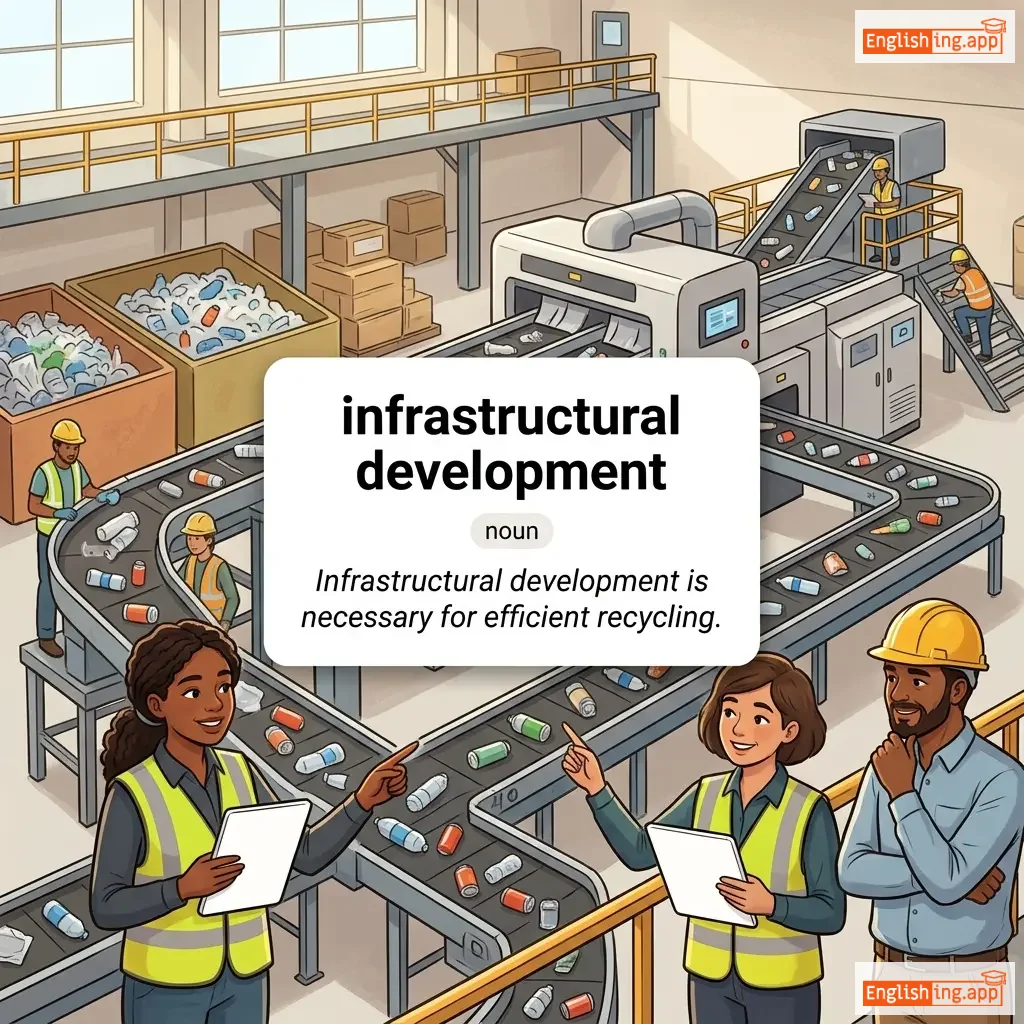
infrastructural development definition card — visual illustration of the meaning
noun
ˌɪnfrəˈstrʌktʃərəl dɪˈveləpmənt
基础设施发展 (jichu sheshi fazhan)

The process of building and improving the basic physical and organizational structures and facilities needed for the operation of a society or enterprise.

"Infrastructural development is necessary for efficient recycling."
"基础设施发展对高效的回收至关重要。" (Jichu sheshi fazhan dui gaoxiao de huishou zhiguan zhongyao.)
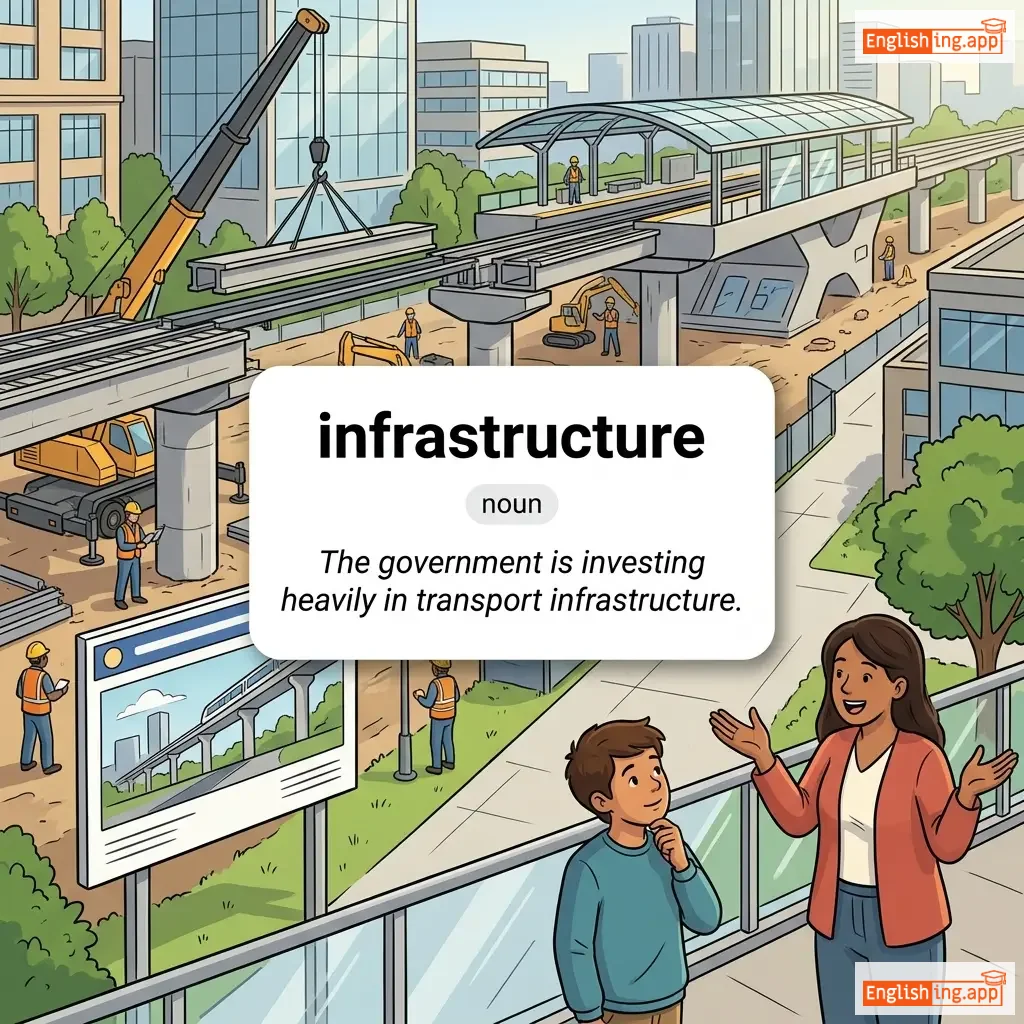
infrastructure definition card — visual illustration of the meaning
noun
/ˈɪnfrəˌstrʌktʃər/
基础设施 (jichu sheshi)

the basic physical and organizational structures and facilities needed for the operation of a society or enterprise

"The government is investing heavily in transport infrastructure."

"政府正在大力投资交通基础设施。" (Zhengfu zhengzai dali touzi jiaotong jichu sheshi.)
noun
/ɪnˈfriːkwəns/
罕见性 (han jian xing)

The state of occurring rarely or at long intervals.

"The infrequence of their meetings made it hard to maintain close ties."

"他们会议的罕见性使得保持亲密关系变得困难。" (Tamen huiyi de hanjianxing shided baochi qinmi guanxi biande kunnan.)
adjective
/ɪnˈfriːkwənt/
不频繁 (bu pinfan)

Happening rarely or not often.

"He made infrequent visits to his hometown after moving abroad."

"他在搬到国外后,偶尔才回家乡。" (Ta zai ban dao guowai hou, ouer cai hui jiaxiang.)
verb
/ɪnˈfrɪndʒ/
侵犯 (qīnfàn)

To actively break the terms of a law, agreement, or right.

"Copying this software without permission will infringe copyright laws."

"未經許可複製此軟件將侵犯版權法。" (wèijīng xǔkě fùzhì cǐ ruǎnjiàn jiāng qīnfàn bǎnquán fǎ.)
verb
/ɪnˈfjʊərieɪt/
激怒 (jin nu)

To make someone extremely angry.

"His careless remarks infuriated the entire team."

"他的不小心评论让整个团队生气。" (Ta de bu xiaoxin pinglun rang zhengge tuandui shengqi.)
verb
/ɪnˈfjuːz/

to fill or spread through something; to instill a quality, idea, or feeling

"The teacher tried to infuse her students with a love for reading."

noun
/ɪnˈfjuːʒən/
草药注入 (caoyao zhurù)

the act of introducing something into another; a drink made by steeping leaves or herbs in liquid

"She prepared a calming infusion of chamomile tea."

"她准备了一杯舒缓的洋甘菊茶注入。" (Ta zhunbei le yi bei shuhuan de yangganju cha zhurù.)
ingenious definition card — visual illustration of the meaning
adjective
/ɪnˈdʒiːniəs/
巧妙 (qiǎo miào)

very clever and inventive; showing creativity in problem-solving

"The engineer came up with an ingenious solution to the problem."

"工程师找到了解决问题的巧妙方法。" (gōngchéngshī zhǎodàole jiějué wèntí de qiǎo miào fāngfǎ.)
noun
/ˈænʒənuː/
天真无邪的年轻女性 (tian zhen wu xie de nianqing nvxing)

an innocent, naïve young woman, especially as represented in literature or theater

"She played the role of the ingénue in the play with great charm."

"她在剧中扮演了那个天真无邪的年轻女性,展现了极大的魅力。" (Ta zai ju zhong banyan le nage tian zhen wu xie de nianqing nvxing, zhanxian le jidai de mei li.)
ingenuity definition card — visual illustration of the meaning
noun
/ˌɪndʒəˈnjuːɪti/
独创性 (du chuang xing)

the quality of being clever, original, and inventive

"The project was completed on time thanks to the ingenuity of the team."

"这个项目按时完成,多亏了团队的独创性。" (Zhe ge xiang mu an shi wan cheng, duo kui le tuan dui de du chuang xing.)
ingenuous definition card — visual illustration of the meaning
adjective
/ɪnˈdʒɛnjuəs/
天真 (tianzhen)

Innocent, naive, and unsuspecting; showing childlike simplicity and sincerity.

"Her ingenuous smile revealed her genuine kindness."

"她天真的笑容揭示了她真实的善良。" (Ta tianzhen de xiaorong jieshi le ta zhenshi de shanliang.)
verb
/ɪnˈdʒɛst/
摄取 (shèqǔ)

To take food, drink, or another substance into the body, usually by swallowing.

"The patient must ingest the medicine with water."

"病人必须用水服用药物。" (Bìngrén bìxū yòng shuǐ fúyòng yàowù.)
adjective
/ɪnˈɡlɔːriəs/
可耻的 (kěchǐ de)

Causing shame or disgrace; not bringing honor or glory.

"The army suffered an inglorious defeat."

"军队遭遇了可耻的失败。" (Jūnduì zāoyù le kěchǐ de shībài.)
verb
/ɪnˈɡrɑːft/
根植 (gēnzhí)

To implant or fix deeply, often used in the sense of grafting an idea or quality.

"The teacher tried to ingraft good manners in the students."

"老师尝试将良好的行为习惯根植于学生们。" (Lǎoshī chángshì jiāng liánghǎo de xíngwéi xíguàn gēnzhí yú xuéshēngmen.)
adjective
/ɪnˈɡreɪnd/
根深蒂固 (gen shen di gu)

Firmly fixed or established; deeply rooted and difficult to change.

"His ingrained habits were hard to break."

"他的根深蒂固的习惯很难改变。" (Tā de gēn shēn dì gù de xíguàn hěn nán gǎibiàn.)
noun
/ˈɪnˌɡreɪt/

An ungrateful person; someone who shows no appreciation.

"He worked hard for his friend, but the ingrate never thanked him."

verb
/ɪnˈɡreɪʃiˌeɪt/

To gain favor or approval by deliberate effort, often in a flattering way.

"She tried to ingratiate herself with her boss by complimenting him often."

adjective
/ɪnˈɡreɪʃiˌeɪtɪŋ/
奉承的 (fèngchéng de)

Charming or flattering in a way intended to gain favor.

"His ingratiating smile made everyone trust him quickly."

"他的奉承笑容让每个人都迅速信任了他。" (Tā de fèngchéng xiàoróng ràng měi gèrén dōu xùnsù xìnrèn le tā.)
noun
/ɪnˈɡrætɪˌtjuːd/
忘恩负义 (wàng ēn fù yì)

Lack of gratitude; failure to show thanks or appreciation.

"His ingratitude hurt her feelings after all she had done for him."

"他的忘恩负义伤害了她的感情,尽管她为他做了这么多。" (Tā de wàng ēn fù yì shāng hài le tā de gǎn qíng, jǐn guǎn tā wèi tā zuò le zhè me duō.)
noun
/ɪnˈɡriːdiənt/
成分 (chéngfèn)

A component part or element of something, especially in a recipe.

"Flour is a key ingredient in baking bread."

"面粉是做面包的关键成分。" (Miànfěn shì zuò miànbāo de guānjiàn chéngfèn.)
verb
/ɪnˈhæbɪt/
栖息 (qixi)

to live in; to occupy as a dwelling

"Many animals inhabit the forest."

"许多动物栖息在森林中。" (Xuduo dongwu qixi zai senlin zhong.)
noun
/ɪnˈhæbɪtənt/
居民 (jūmín)

a person or animal that lives in a particular place

"The inhabitants of the village rely on farming for their livelihood."

"村庄的居民依靠农业为生。" (Cūnzhuāng de jūmín yīkào nóngyè wèi shēng.)
inhale definition card — visual illustration of the meaning
verb
/ɪnˈheɪl/
吸气 (xīqì)

to breathe in; to draw air into the lungs

"Take a deep breath and inhale slowly."

"深吸一口气并缓慢地吸入。" (Shēn xī yī kǒu qì bìng huǎn màn de xī rù.)
adjective
/ɪnhɑːrˈmoʊniəs/
不和谐 (bù héxié)

lacking harmony; discordant in sound; not in tune

"The inharmonious sounds from the broken piano made everyone cover their ears."

"破碎钢琴发出的不和谐声音让每个人都捂住了耳朵。" (Pòsuì gāngqín fāchū de bù héxié shēngyīn ràng měi gèrén dōu wǔ zhù le ěrduo.)
noun
/ɪnˈhɪərəns/
内在性 (nèizàixìng)

The state of being an essential or permanent part of something.

"The inherence of risk is part of every business venture."

"风险的内在性是每个商业冒险的一部分。" (Fēngxiǎn de nèizàixìng shì měi gè shāngyè màoxiǎn de yí bùfen.)
inherent definition card — visual illustration of the meaning
adjective
/ɪnˈhɛrənt/
固有的 (gùyǒu de)

Existing in something as a natural, permanent, or essential quality.

"There are inherent risks in extreme sports."

"极限运动中存在固有的风险。" (jíxiàn yùndòng zhōng cúnzài gùyǒu de fēngxiǎn.)
inherit definition card — visual illustration of the meaning
verb
/ɪnˈhɛrɪt/
继承 (jicheng)

to receive property, money, or traits from someone after their death or from ancestors

"She inherited her father's house after his death."

"她在父亲去世后继承了他的房子。" (Ta zai furen qushi hou jicheng le tade fangzi.)
noun
/ɪnˈhɛrɪtər/
继承人 (jichengren)

a person who receives money, property, or a title when someone dies

"She became the inheritor of her family's estate."

"她成为了家族财产的继承人。" (Ta chengwei le jiazu caichan de jichengren.)
inhibit definition card — visual illustration of the meaning
verb
/ɪnˈhɪbɪt/
抑制 (yìzhì)

To hinder, restrain, or prevent an action or process.

"Fear can inhibit creativity."

"恐惧可能会抑制创造力。" (Kǒngjù kěnéng huì yìzhì chuàngzàolì.)
adjective
/ɪnˈhɪbɪtɪd/
抑制的 (yì zhì de)

Unable to act in a relaxed and natural way, especially due to self-consciousness or restraint.

"He was too inhibited to express his true feelings."

"他太抑制自己,无法表达真实的感受。" (Tā tài yì zhì zìjǐ, wúfǎ biǎodá zhēnshí de gǎnshòu.)