词汇表

英语词汇词典 | 单词含义、定义和示例

adjective
/ˌɪnɪˈsɛnʃəl/
非必要的 (fei biyao de)

not necessary or important; not essential

"The report removes all inessential details to stay focused."

"报告删除了所有非必要的细节以保持重点。" (baogao shanchule suoyou fei biyao de xijie yi baochi zhongdian)
adjective
/ɪnˈɛstɪməbl/
无法估量的 (wúfǎ gūliàng de)

Too great or valuable to be measured or estimated.

"Her contribution to the project was of inestimable value."

"她对项目的贡献具有无法估量的价值。" (Tā duì xiàngmù de gòngxiàn jùyǒu wúfǎ gūliàng de jiàzhí.)
inevitability definition card — visual illustration of the meaning
noun
/ɪnˌɛvɪtəˈbɪləti/
必然性 (biransheng)

The quality of being certain to happen; unavoidable nature.

"The inevitability of change makes adaptability essential."

"变化的必然性使得适应性变得至关重要。" (Biànhuà de bìránxìng shǐdé shìyìngxìng biàn dé zhìguān zhòngyào.)
inevitable definition card — visual illustration of the meaning
adjective
/ɪnˈɛvɪtəbl/
不可避免 (bù kě bì miǎn)

Certain to happen; unavoidable.

"Death is inevitable for all living beings."

"死亡对于所有生物来说是不可避免的。" (sǐwáng duì yú suǒyǒu shēngwù lái shuō shì bù kě bì miǎn de.)
adverb
/ɪnˈɛvɪtəbli/
不可避免地 (bùkě bìmiǎn de)

in a way that cannot be avoided or prevented

"Inevitably, the team faced challenges during the project."

"不可避免地,团队在项目过程中遇到了挑战。" (Bùkě bìmiǎn de, tuánduì zài xiàngmù guòchéng zhōng yù dào le tiǎozhàn.)
adjective
/ˌɪnɪkˈskjuːzəbl/
不可原谅的 (bù kě yuán liàng de)

Too bad to be justified or overlooked; unforgivable.

"His rude behavior was inexcusable."

"他的粗鲁行为是不可原谅的。" (Tā de cūlǔ xíngwéi shì bù kě yuán liàng de.)
inexhaustible definition card — visual illustration of the meaning
adjective
/ˌɪnɪɡˈzɔːstəbl/
取之不尽 (qu zhi bu jin)

Impossible to use up or tire out; unlimited in supply or energy.

"Her energy seemed inexhaustible during the long campaign."

"她的精力在长时间的运动中似乎取之不尽。" (Ta de jingli zai chang shijian de yundong zhong shifu qu zhi bu jin.)
adjective
/ɪnˈɛksərəbl/
不可阻挡 (bùkě zǔdǎng)

Impossible to stop or prevent; relentless.

"The inexorable rise of technology is changing every aspect of life."

"技术的不可阻挡的崛起正在改变生活的方方面面。" (Jìshù de bùkě zǔdǎng de juéqǐ zhèngzài gǎibiàn shēnghuó de fāngfāngmiànmiàn.)
noun (compound/erroneous entry)
/ɪnˈɛksərəbl ɑːrmi/
无法阻挡的军队 (wúfǎ zǔdǎng de jūnduì)

This appears to be a corrupted or concatenated form; interpreted as 'inexorable army' — an unstoppable or relentless force.

"The rebels feared the inexorable army approaching their stronghold."

"叛军害怕即将接近他们堡垒的无法阻挡的军队。" (Pànjūn hàipà jíjiāng jiējìn tāmen bǎolěi de wúfǎ zǔdǎng de jūnduì.)
adjective
/ˌɪnɪkˈspiːdiənt/
不合适 (bù hé shì)

Not advisable, suitable, or practical in the circumstances.

"It would be inexpedient to invest without proper research."

"在没有适当研究的情况下进行投资是不合适的。" (Zài méiyǒu shìdàng yánjiū de qíngkuàng xià jìnxíng tóuzī shì bù hé shì de.)
adjective
/ˌɪnɪkˈspɛnsɪv/
便宜 (pianyi)

Cheap; costing little money.

"They found an inexpensive restaurant near the station."

"他们在车站附近找到了一个便宜的餐馆。" (Tamen zai chezhanshen fujin zhaodao le yige pianyi de canguan.)
noun
/ˌɪnɪkˈspɪəriəns/
缺乏经验 (quēfá jīngyàn)

Lack of knowledge or skill in a particular activity or field.

"His inexperience in handling negotiations was evident."

"他在谈判中的缺乏经验显而易见。" (Tā zài tánpàn zhōng de quēfá jīngyàn xiǎn'ér yìjiàn.)
adjective
/ˌɪnˈekspɜːrt/
不熟练的 (bu shulian de)

not skilled or experienced; lacking expertise

"The inexpert handling of the machine caused several mistakes."

"对机器的不熟练操作导致了多次错误。" (Dui jiqi de bu shulian caozuo daozhile duoci cuowu)
adjective
/ˌɪnɪkˈsplɪkəbl/
无法解释 (wúfǎ jiěshì)

Impossible to explain or understand.

"The sudden disappearance of the file was inexplicable."

"文件的突然消失是无法解释的。" (Wénjiàn de túrán xiāoshī shì wúfǎ jiěshì de.)
adjective
/ˌɪnɪkˈsprɛsəbl/
难以言喻 (nanyi yanyu)

Too strong or extreme to be expressed in words.

"She felt inexpressible joy at the news of her success."

"她得知自己成功的消息时感到难以言喻的喜悦。" (Ta de zhi ziji chenggong de xiaoxi shi gandao nanyi yanyu de xiyue.)
adjective
/ˌɪnɪkˈstɛnsəbl/
不可伸展的 (bù kě shēn zhǎn de)

Not capable of being stretched or extended.

"This rope is made of an inextensible material."

"这根绳子是由不可伸展的材料制成的。" (Zhè gēn shéng zi shì yóu bù kě shēn zhǎn de cáiliào zhì chéng de.)
adjective
/ˌɪnɪkˈstrɪkəbl/
无法分开 (wúfǎ fēnkāi)

Impossible to separate or escape from.

"The two friends shared an inextricable bond."

"这两个朋友共享了一个无法分开的联系。" (Zhè liǎng gè péngyǒu gòngxiǎngle yīgè wúfǎ fēnkāi de liánxì.)
adjective
/ɪnˈfæləbl̩/
无懈可击 (wú xiè kě jī)

incapable of making mistakes or being wrong

"Her judgment seemed infallible in matters of finance."

"她的判断在财务问题上似乎无懈可击。" (Tā de pànduàn zài cáiwù wèntí shàng shìhū wúxiè kě jī.)
adjective
/ˈɪnfəməs/
臭名昭著 (chòumíng zhāozhù)

well known for some bad quality or deed

"The dictator was infamous for his cruelty."

"这位独裁者因其残忍而臭名昭著。" (Zhè wèi dúcáizhě yīn qí cánrěn ér chòumíng zhāozhù.)
noun
/ˈɪnfəmi/
幸福 (xìngfú)

the state of being well known for some bad quality or deed

"His name will live in infamy for the crimes he committed."

"她在收到奖项时无法掩饰她的幸福。" (Tā zài shōudào jiǎngxiàng shí wúfǎ yǎnshì tā de xìngfú.)
noun
/ˈɪnfənt/
婴儿 (ying'er)

A very young child or baby.

"The infant was sleeping peacefully in the cradle."

"婴儿在摇篮中安静地睡着。" (Ying'er zai yaolan zhong anjing de shuizhao.)
adjective
/ˈɪnfəntaɪl/
婴儿式 (yīng ér shì)

characteristic of an infant; childish

"His infantile behavior embarrassed everyone at the meeting."

"他那种婴儿式的行为让会议上的每个人都感到尴尬。" (Tā nà zhǒng yīng ér shì de xíngwéi ràng huìyì shàng de měi gèrén dōu gǎndào gāngà.)
noun
/ˈɪn.fən.tri/
步兵 (bù bīng)

soldiers marching or fighting on foot; foot soldiers collectively

"The infantry advanced across the battlefield on foot."

"步兵在战场上走路前进。" (bù bīng zài zhànchǎng shàng zǒulù qiánjìn.)
verb
/ɪnˈfætʃueɪt/
迷恋 (mí liàn)

to inspire with an intense but short-lived passion or admiration

"He was infatuated with her beauty."

"他被她的美貌迷住了。" (Tā bèi tā de měimào mí zhùle.)
infeasible definition card — visual illustration of the meaning
adjective
ɪnˈfiː.zə.bəl
不可行 (bù kě xíng)

Not possible to do easily or conveniently; impracticable.

"Restoring the forest may become infeasible if destruction continues."

"如果破坏继续下去,恢复森林可能变得不可行。" (Rúguǒ pòhuài jìxù xiàqù, huīfù sēnlín kěnéng biàn dé bù kěxíng.)
verb
/ɪnˈfɛkt/
传染 (chuánrǎn)

To contaminate with a disease-causing organism.

"The virus can infect healthy people quickly."

"病毒可以迅速传染健康的人。" (Bìngdú kěyǐ xùnsù chuánrǎn jiànkāng de rén.)
noun
/ɪnˈfɛkʃən/
感染 (gǎnrǎn)

The process of becoming infected with harmful microorganisms such as bacteria or viruses.

"The doctor prescribed antibiotics to treat the infection."

"医生开了抗生素来治疗感染。" (Yisheng kai le kangshengsu lai zhiliao ganran.)
adjective
/ɪnˈfekʃəs/
传染性的; 有感染力的 (chuanranxing de; you ganranli de)

capable of causing infection or disease; spreading easily from one person to another; able to spread feelings or attitudes such as enthusiasm

"Her infectious laughter made everyone in the room smile."

"她富有感染力的笑声让大家都笑了。" (ta fu you ganranli de xiaosheng rang dajia dou xiao le)
adjective
/ˌɪnfəˈlɪsɪtəs/
不合适的 (bu he shi de)

not suitable or well chosen; awkward or unfortunate

"His infelicitous remark ruined the atmosphere of the meeting."
"他不合适的评论破坏了会议的氛围。" (Ta bu he shi de ping lun po huai le hui yi de fen wei.)
🤔

infer

verb
/ɪnˈfɜːr/

to conclude or deduce something from evidence and reasoning rather than from explicit statements

"From his silence, I inferred that he was not happy with the decision."

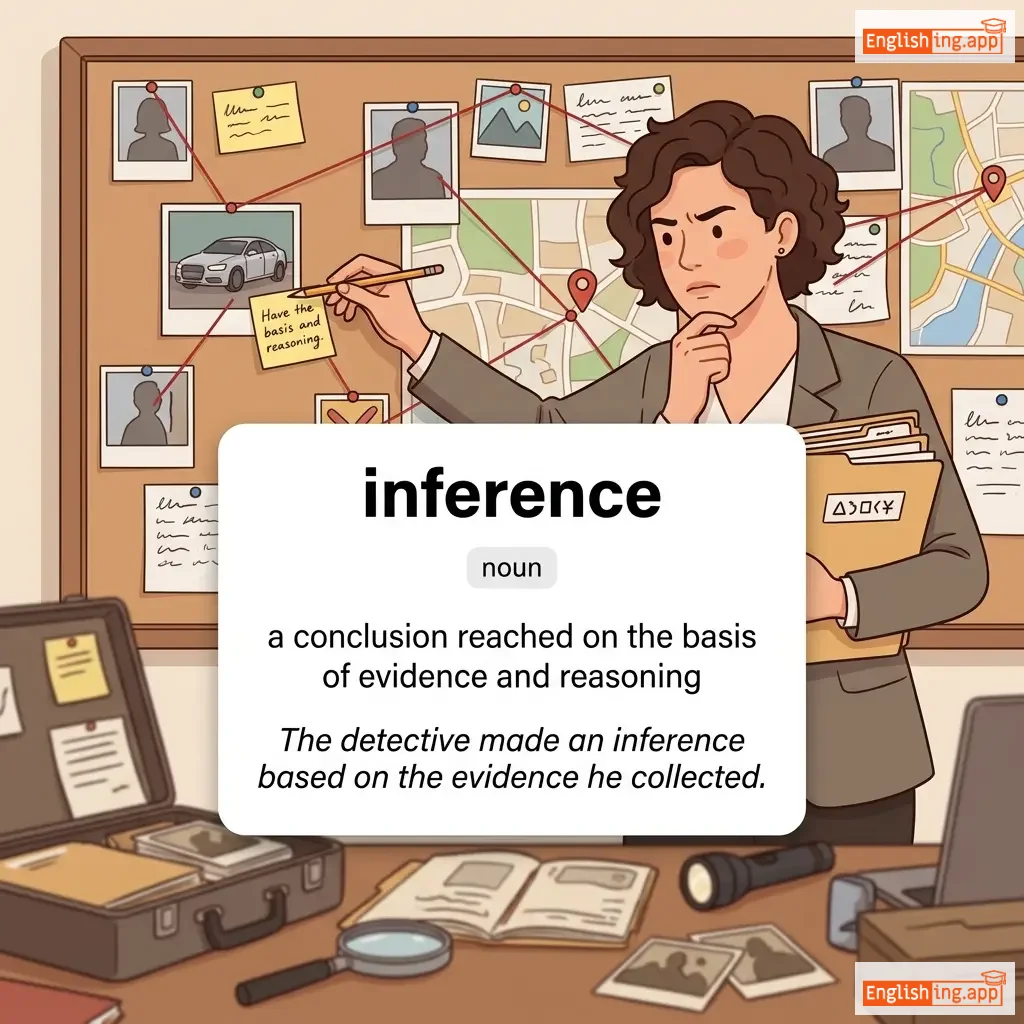
inference definition card — visual illustration of the meaning
noun
/ˈɪnfərəns/
推论 (tuilun)

a conclusion reached on the basis of evidence and reasoning

"The detective made an inference based on the evidence he collected."

"侦探根据他收集的证据做出了推论。" (zhēntàn gēnjù tā shōují de zhèngjù zuò chū le tuīlùn.)
adjective
/ɪnˈfɪə.ri.ər/
低级的 (diji de)

Of lower quality, rank, or status.

"This material is inferior to the one we used before."

"这种材料比我们之前用的差。" (Zhe zhong cailiao bi women zhiqian yong de cha.)
adjective
/ɪnˈfɜːrnəl/
地狱的 (dì yù de)

relating to hell; extremely troublesome or annoying

"The workers complained about the infernal noise from the construction site."

"工人们抱怨施工现场的地狱般噪音。" (Gōngrénmen bàoyuàn shīgōng xiànchǎng de dì yù bān zàoyīn.)
noun
/ɪnˈfɜːrnoʊ/
火灾 (huǒzāi)

a large, intense fire that is dangerously out of control

"The building turned into an inferno within minutes."

"这座建筑在几分钟内变成了火灾。" (Zhè zuò jiànzhú zài jǐ fēnzhōng nèi biàn chéngle huǒzāi.)
verb
/ɪnˈfɛst/
感染 (gǎn rǎn)

to overrun in large numbers, especially so as to cause damage or discomfort

"The old house was infested with rats."

"老房子被老鼠感染。" (Lǎo fángzi bèi lǎoshǔ gǎn rǎn.)
infestation definition card — visual illustration of the meaning
noun
ˌɪnfɛsˈteɪʃən
侵扰, 在某个地方出现异常大量的昆虫或动物 (qinrao, zai mou ge difang chuxian yichang daliao de kunchong huo dongwu)

The presence of an unusually large number of insects or animals in a place, causing damage or disease.

"The infestation of ants in the kitchen led to immediate pest control measures."

"厨房里蚂蚁的侵扰导致了立即采取害虫控制措施。" (Chufang li mayi de qinrao daozhi le liji caitiao haichong kongzhi cuoshi.)
noun
/ˈɪnfɪdɛl/
不信教者 (bù xìn jiào zhě)

a person who does not believe in a particular religion or faith

"In medieval times, people often called non-Christians infidels."

"在中世纪,人们常常称非基督徒为不信教者。" (Zài zhōng shìjì, rénmen chángcháng chēng fēi jīdū tú wéi bù xìn jiào zhě.)
noun
/ˌɪnfɪˈdɛləti/
不忠 (bù zhōng)

the act of being unfaithful to a spouse or partner

"Their marriage ended due to his infidelity."

"他们的婚姻因他的不忠而结束。" (Tāmen de hūnyīn yīn tā de bù zhōng ér jiéshù.)
verb
/ˈɪnfɪltreɪt/
渗透 (shèntòu)

to secretly enter or gain access to a place or group

"The spies managed to infiltrate the enemy base."
"间谍们设法渗透敌人基地。" (Jiàndiémén shèfǎ shèntòu dírén jīdì.)
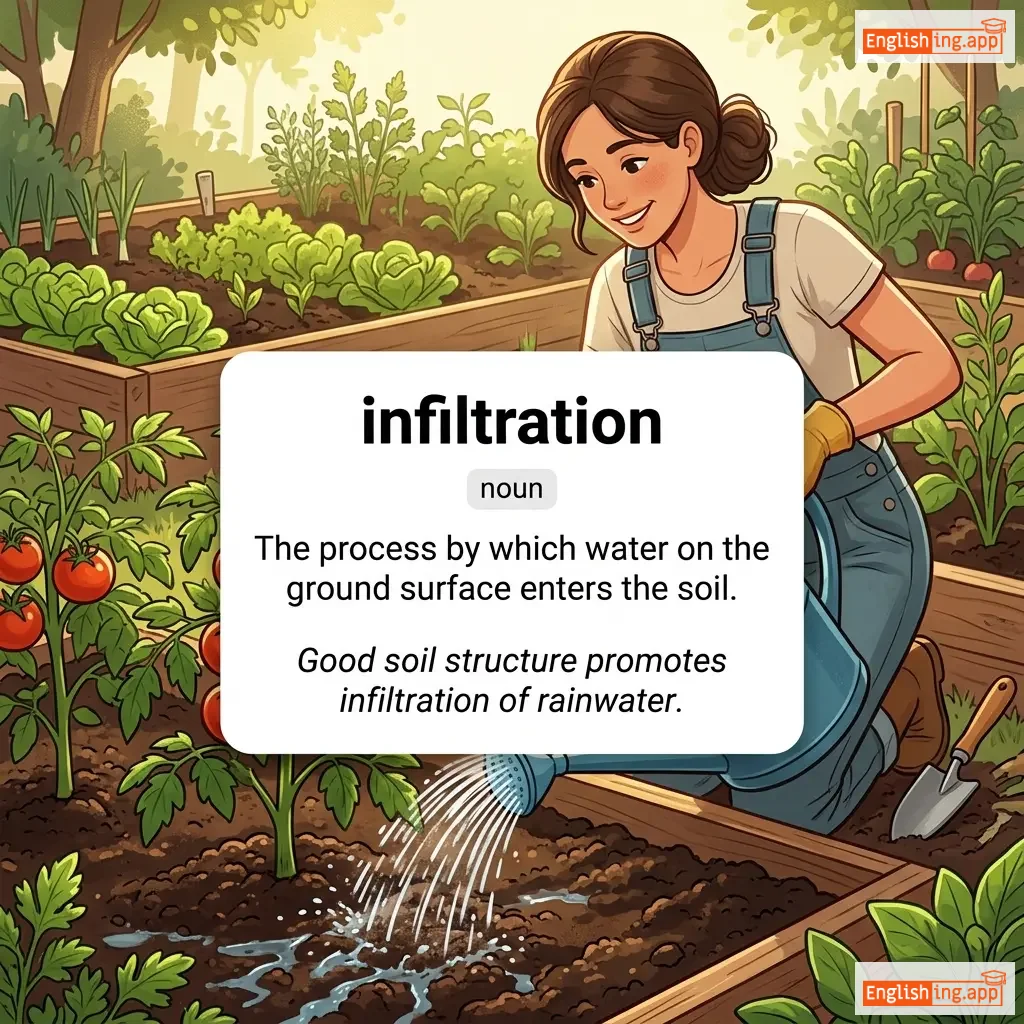
infiltration definition card — visual illustration of the meaning
noun
/ˌɪn.fɪlˈtreɪ.ʃən/
入渗 (infiltration)

The process by which water on the ground surface enters the soil.

"Good soil structure promotes infiltration of rainwater."

"良好的土壤结构促进雨水渗透到土壤中。" (liang hao de turang jiegou cujin yushui shentou dao turang zhong)
adjective
/ˈɪnfɪnɪt/
无限 (wúxiàn)

limitless or endless in space, extent, or number

"The universe is often described as infinite."

"宇宙常被描述为无限的。" (Yǔzhòu cháng bèi miáoshù wéi wúxiàn de.)
adjective
/ˌɪnfɪnɪˈtɛsɪməl/
微不足道 (wēi bù zú dào)

Extremely small in size or amount; so tiny as to be almost negligible.

"The error was so infinitesimal that it didn’t affect the results."

"这个错误如此微不足道,以至于没有影响结果。" (Zhège cuòwù rúcǐ wēi bù zú dào, yǐ zhì yú méiyǒu yǐngxiǎng jiéguǒ.)
noun
/ɪnˈfɪnɪti/
无限 (wuxian)

A concept describing something without any limit or end.

"The universe seems to stretch into infinity."

"宇宙似乎无限延伸。" (yǔzhòu shìhū wúxiàn yánshēn.)
adjective
/ɪnˈfɜːm/
虚弱 (xūruò)

Weak, especially due to old age or illness.

"The infirm old man needed assistance to walk."

"那位虚弱的老人需要帮助才能走路。" (Nà wèi xūruò de lǎorén xūyào bāngzhù cáinéng zǒulù.)
noun
/ɪnˈfɜːməri/
医务室 (yīwùshì)

A hospital or place where the sick or injured are cared for.

"The school had an infirmary for minor injuries."

"学校为轻微受伤提供了医务室。" (Xuéxiào wèi qīngwéi shòushāng tígōngle yīwùshì.)
noun
/ɪnˈfɜːməti/
虚弱 (xuruo)

Physical or mental weakness, especially from old age.

"Despite his infirmity, he remained cheerful."

"尽管他虚弱,他仍然保持乐观。" (Jǐnguǎn tā xūruò, tā réngrán bǎochí lèguān.)
verb
/ɪnˈfleɪm/
激起 (jīqǐ)

to arouse strong feelings or provoke anger; to cause inflammation in the body

"The politician's remarks served to inflame public opinion."

"政治家的言论激起了公众舆论的愤怒。" (Zhèngzhì jiā de yánlùn jīqǐ le gōngzhòng yúlùn de fènnù.)
adjective
/ɪnˈflæməbl/
易燃 (yì rán)

easily set on fire; easily excited or angered

"This material is highly inflammable and should be kept away from heat."

"此材料极易燃,应远离热源。" (Cǐ cáiliào jí yì rán, yīng yuǎnlí rè yuán.)
inflammation definition card — visual illustration of the meaning
noun
/ˌɪnfləˈmeɪʃən/
炎症 (yánzhèng)

a localized physical condition in which part of the body becomes red, swollen, hot, and often painful

"The doctor prescribed medicine to reduce the inflammation in her knee."

"医生开了药来减少她膝盖的炎症。" (Yīshēng kāi le yào lái jiǎnshǎo tā xīgài de yánzhèng.)
adjective
/ɪnˈflæməˌtɔːri/
幸福 (xìng fú)

causing inflammation in the body; arousing anger, hostility, or strong emotion

"His inflammatory speech triggered protests across the city."

"她在收到奖项时无法隐藏自己的幸福感。" (Tā zài shōu dào jiǎng xiàng shí wú fǎ yǐn cáng zì jǐ de xìng fú gǎn.)