词汇表

英语词汇词典 | 单词含义、定义和示例

noun
/hɒˈstɪləti/
敌意 (di yi)

hostile behavior; unfriendliness or opposition

"The negotiations ended in an atmosphere of hostility."

"谈判以敌意的氛围结束。" (Tanpan yi diyi de fenwei jie shu.)
adjective
/hɒt/
(re)

Having a high degree of heat or a high temperature.

"The soup is too hot to eat right now."

"汤太热了,现在无法食用。" (Tāng tài rè le, xiànzài wúfǎ shíyòng.)
noun
/hɒt drɪŋk/
热饮 (rè yǐn)

a warm or heated beverage consumed for refreshment or comfort

"I prefer a hot drink like tea or coffee in the morning."

"我喜欢早上喝一杯热饮,如茶或咖啡。" (Wǒ xǐ huān zǎo shàng hē yī bēi rè yǐn, rú chá huò kā fēi.)
noun
/hɒtʃ pɒtʃ/
杂烩 (zahui)

A mixed dish; a hodgepodge of ingredients cooked together

"She made a delicious hotch potch with rice, lentils, and vegetables."

"她做了一道美味的霍奇波奇,里面有米饭、扁豆和蔬菜。" (Ta zuo le yi dao meiwei de huoqi boqi, limian you mifan, biandou he shucai.)
noun
/ˈhɑːtʃ.pɑːtʃ/
杂乱无章的混合物; 一堆混杂的东西 (zaluan wuzhang de hunhewu; yi dui hunza de dongxi)

a confused mixture; a jumbled assortment of things

"The room was a hotchpotch of old furniture, books, and random decorations."

"房间里堆满了旧家具、书籍和随意摆放的装饰品,杂乱无章。" (Fangjian li duimanle jiu jiaju, shūjí hé suíyì bǎifàng de zhuāngshìpǐn, záluàn wúzhāng.)
noun
/hoʊˈtɛl/
酒店 (jiu dian)

A building where people pay to stay and sleep, usually for short periods.

"We stayed at a hotel near the beach."

"我们住在靠近海滩的酒店。" (Wǒmen zhù zài kàojìn hǎitān de jiǔdiàn.)
noun
/ˈhɒthɛd/
脾气暴躁的人 (píqì bàozào de rén)

a person who acts quickly and without thinking when angry

"He is such a hothead that he often starts arguments."

"他是个脾气暴躁的人,经常挑起争执。" (Tā shì gè píqì bàozào de rén, jīngcháng tiǎoqǐ zhēngzhí.)
adverb
/ˈhɒtli/
愤怒地 (fèn nù de)

in an intense, angry, or passionate way

"She hotly denied the accusations."

"她愤怒地否认了这些指控。" (Tā fèn nù de fǒurènle zhèxiē zhǐkòng.)
verb
/haʊnd/
纠缠 (jiūchán)

to pursue or harass someone persistently

"Reporters hounded the actor for comments."

"记者们缠着演员要求评论。" (jìzhěmen chánzhe yǎnyuán yāoqiú pínglùn.)

hour

noun
/ˈaʊər/

A period of time equal to 60 minutes.

"The meeting lasted for two hours."

adverb
/ˈaʊər.li/
每小时; 每小时发生或做的事; 持续 (měi xiǎoshí; měi xiǎoshí fāshēng huò zuò de shì; chíxù)

every hour; happening or done each hour; continuously

"The weather report is updated hourly."

"天气报告每小时更新一次。" (Tiānqì bàogào měi xiǎoshí gēngxīn yīcì.)
noun
/haʊs/
房子 (fángzi)

A building for people to live in, usually with rooms and a roof.

"They bought a new house in the city."

"他们在城市里买了一座新房子。" (Tāmen zài chéngshì lǐ mǎile yī zuò xīn fángzi.)
noun
/ˈhaʊs boʊt/
房船 (fang chuan)

a boat that has been designed or modified to be used primarily as a home

"They spent their vacation on a beautiful house boat in the lake."

"他们在湖上的美丽房船上度过了假期。" (tamen zai hu shang de meili fang chuan shang duoguo le jiaqi)
noun
/ˈhaʊsˌbreɪkɪŋ/
入室盗窃 (rùshì dàoqiè)

the crime of breaking into a house with intent to steal

"The thief was arrested for housebreaking."

"小偷因入室盗窃被捕。" (Xiǎotōu yīn rùshì dàoqiè bèi bǔ.)
👨‍👩‍👧‍👦

household (hɑʊʃoʊld)

noun
/ˈhaʊshoʊld/
家庭 (jiating)

All the people living together in one house, considered as a unit.

"There are five people in our household."

"我们家里有五个人。" (Wǒmen jiālǐ yǒu wǔ gè rén.)
noun
/ˈhaʊswaɪf/
家庭主妇 (jiating zhufu)

a married woman who manages a household and whose main occupation is caring for her family and home

"She chose to work as a housewife while raising her children."

"她在抚养孩子期间选择当一名家庭主妇。" (Ta zai fuyang haizi qijian xuanze dang yi ming jiating zhufu)
noun
/ˈhaʊzɪŋ/
住房 (zhùfáng)

buildings or structures where people live; accommodation

"The government is working to provide affordable housing for everyone."

"政府正在努力为所有人提供负担得起的住房。" (zhèngfǔ zhèngzài nǔlì wèi suǒyǒu rén tígōng fùdān dé qǐ de zhùfáng.)
🏚️

hovel

noun
/ˈhʌvəl/

a small, poorly built, and dirty house

"The refugees lived in a makeshift hovel."

verb
/ˈhʌvər/
在空中静止,不向前或后移动 (zài kōngzhōng jìngzhǐ, bù xiàng qián huò hòu yídòng)

to remain in the air in one place without moving forward or backward

"The helicopter hovered over the city."

"直升机悬停在城市上空。" (Zhíshēngjī xuántíng zài chéngshì shàngkōng.)
adverb
/haʊ/
如何 (rúhé)

in what way or manner; by what means

"How do you solve this problem?"

"你如何解决这个问题?" (Nǐ rúhé jiějué zhège wèntí?)
adverb, conjunction
/haʊˈɛvər/
然而 (rán'ér)

used to introduce a statement that contrasts with or seems to contradict something previously said

"The journey was long; however, it was enjoyable."

"旅程很长;然而,它是愉快的。" (Lǚchéng hěn cháng; rán'ér, tā shì yúkuài de.)
noun
/ˈhɔɪdən/
顽皮女孩 (wanpi nühai)

a boisterous or tomboyish girl

"The hoyden preferred climbing trees to playing with dolls."

"顽皮女孩更喜欢爬树而不是玩洋娃娃。" (Wanpi nühai geng xihuan pa shu er bushi wan yangwawa.)
noun
/hʌb/
中心 (zhongxin)

the central part of a place or activity where things converge

"The city is the hub of the country's trade network."

"这座城市是该国贸易网络的中心。" (Zhe zuo chengshi shi gai guo maoyi wangluo de zhongxin.)
noun
/ˈhʌbʌb/
喧闹 (xuannao)

a loud noise caused by a crowd of people talking or shouting

"There was a hubbub in the market as the sale began."

"市场上因为销售开始而产生了喧闹。" (Shìchǎng shàng yīnwèi xiāoshòu kāishǐ ér chǎnshēng le xuānnào.)
noun
/ˈhjuːbrɪs/
傲慢 (aoman)

excessive pride or self-confidence

"His hubris led to his downfall."

"他的傲慢导致了他的垮台。" (Tā de àomàn dǎozhìle tā de kuǎtái.)
noun
/ˈhʌk.stər/
小商品贩子 (xiaoshangpin fànzi)

A person who sells small items aggressively, often in a showy or dishonest way.

"The huckster loudly promoted his goods in the busy marketplace."

"小商品贩子在繁忙的市场里大声推销他的商品。" (Xiǎo shāngpǐn fànzi zài fánmáng de shìchǎng lǐ dàshēng tuīxiāo tā de shāngpǐn.)
noun
/hjuː/
颜色 (yanse)

A color or shade.

"The artist chose a soft blue hue for the background."

"艺术家为背景选择了柔和的蓝色。" (Yishujia wei beijing xuanze le rouhe de lanse.)
noun phrase
/ˌhjuː ən ˈkraɪ/
抗议声 (kangyi sheng)

A loud public outcry or protest, often demanding action.

"There was a hue and cry over the new policy changes."

"因新政策变化,爆发了激烈的抗议声。" (Yin xin zhengce bianhua, baofa le jilie de kangyi sheng.)
verb
/hʌɡ/
拥抱 (yōng bào)

to hold someone tightly in your arms to show affection or comfort

"She hugged her friend before leaving for the airport."

"她在去机场前拥抱了她的朋友。" (Tā zài qù jīchǎng qián yōng bào le tā de péngyǒu.)
adjective
/hjuːdʒ/
巨大的 (jù dà de)

extremely large in size or amount

"The stadium was filled with a huge crowd."

"体育场被一群巨大的观众填满。" (tǐ yù chǎng bèi yī qún jù dà de guān zhòng tián mǎn.)
interjection
/hʌ/
你说什么? (nǐ shuō shénme?)

used to express confusion, surprise, or that you did not hear something

"Huh? What did you say?"

"哈?你说什么?" (Hā? Nǐ shuō shénme?)
noun
/hʌl/
船体 / 种子外壳 (chuántǐ / zhǒngzǐ wàiké)

The outer covering of a seed or fruit; also the main body of a ship.

"The sailors inspected the ship’s hull for any damage."

"水手们检查了船体是否有损坏。" (Shuǐshǒu men jiǎnchá le chuántǐ shìfǒu yǒu sǔnhuài.)
noun
/hʌm/
嗡嗡声 (wēngwēng shēng)

a low continuous sound; to make a low continuous droning sound

"The constant hum of the air conditioner helped her fall asleep peacefully."

"空调的持续嗡嗡声帮助她安然入睡。" (kōngtiáo de chíxù wēngwēng shēng bāngzhù tā ān rán rùshuì.)
human definition card — visual illustration of the meaning
noun, adjective
/ˈhjuːmən/
人类 (renlei)

a person; relating to people

"Being human means having both strengths and weaknesses."

"成为人类意味着拥有强项和弱点。" (Chéngwéi rénlèi yìwèi zhe yǒngyǒu qiángxiàng hé ruòdiǎn.)
human rights definition card — visual illustration of the meaning
noun
ˌhjuː.mən ˈraɪts
人权 (renquan)

A right that is believed to belong justifiably to every person.

"Human rights protect individual freedoms."

"人权保护个人自由。" (Renquan baohu geren ziyou.)
adjective
/hjuːˈmeɪn/
人道的 (rendao de)

Showing compassion or benevolence.

"The doctor provided humane treatment to the injured animals."

"医生对受伤的动物提供了人道治疗。" (Yisheng dui shoushang de dongwu tigong le rendao zhiliao.)
noun, adjective
/hjuːˌmænɪˈtɛəriən/
人道主义者 (rendao zhuyi zhe)

A person who seeks to promote human welfare, or something relating to human welfare and compassion.

"The organization provides humanitarian aid to disaster victims."
"该组织为灾难受害者提供人道主义援助。" (Gai zuzhi wei zainan shouhaizhe tigong rendao zhuyi yuanzhu.)
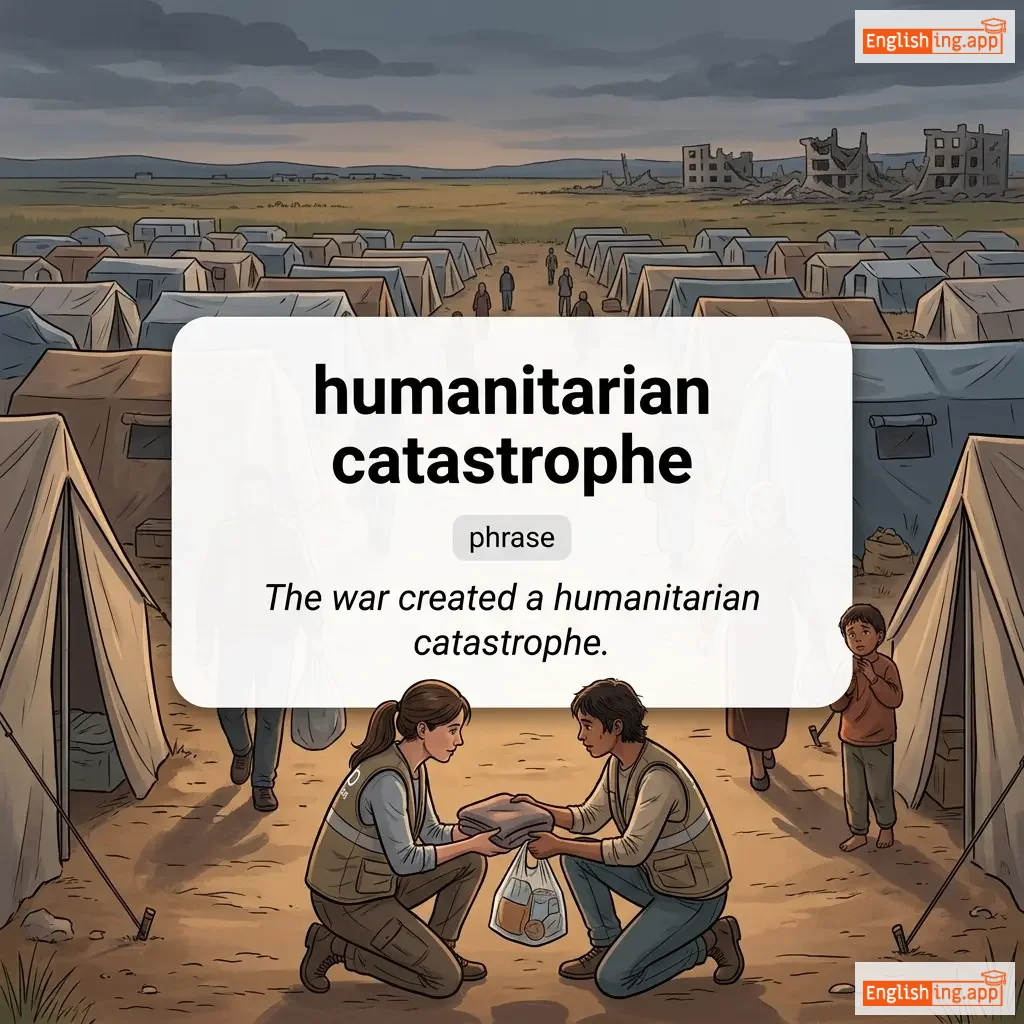
humanitarian catastrophe definition card — visual illustration of the meaning
phrase
ˌhjuː.məˈnɪt.ər.i.kəˈtæs.trə.fi
人道主义灾难 (rendao zhuyi zainan)

A widespread disaster affecting human life, health, and well-being on a large scale.

"The war created a humanitarian catastrophe."

"战争造成了人道主义灾难。" (Zhànzhēng zàochéngle réndào zhǔyì zāinàn.)
noun
/hjuːˈmænɪti/
人性 (renxing)

the quality of being human; kindness or compassion towards others; all human beings collectively

"Kindness is one of the greatest expressions of humanity."

"善良是人性最伟大的表现之一。" (Shànliáng shì rénxìng zuì wěidà de biǎoxiàn zhī yī.)
verb
/ˈhjuːmənaɪz/
人性化 (rénxìng huà)

To make something more humane, kind, or relatable.

"The teacher tried to humanize the lesson with personal stories."

"老师试图通过个人故事让课程更加人性化。" (Lǎoshī shìtú tōngguò gèrén gùshì ràng kèchéng gèngjiā rénxìng huà.)
adjective, verb
/ˈhʌmbəl/

Having or showing a modest view of one's importance; to lower pride or status.

"Despite his success, he remained humble."

noun
/ˈhʌmbʌɡ/
骗局, 胡说 (pianju, hushu)

Deceptive or false talk or behavior; nonsense.

"He dismissed the idea as humbug."

"他将这个想法视为胡说八道。" (Tā jiāng zhège xiǎngfǎ shì wéi húshuō bādào.)
adjective
/ˈhʌmdrʌm/
单调 (dantiao)

Lacking excitement or variety; dull and monotonous.

"She grew tired of the humdrum routine of office life."

"她厌倦了办公室生活的单调例行公事。" (Ta yanjuan le bangongshi shenghuo de dantiao lixing gongshi.)
adjective
/ˈhjuː.mɪd/
潮湿 (chaoshi)

Having a high amount of water vapor in the air; damp or moist.

"The weather was hot and humid during the summer."

"夏天的天气又热又湿。" (Xiatian de tianqi you re you shi.)
noun
/ˌhjuː.mɪ.fɪˈkeɪ.ʃən/
腐殖作用 (fǔzhí zuòyòng)

The process of organic matter decomposition to form humus in soil.

"Humification enhances soil structure and fertility."

"腐殖作用增强了土壤的结构和肥力。" (Fǔzhí zuòyòng zēngqiángle tǔrǎng de jiégòu hé féilì.)
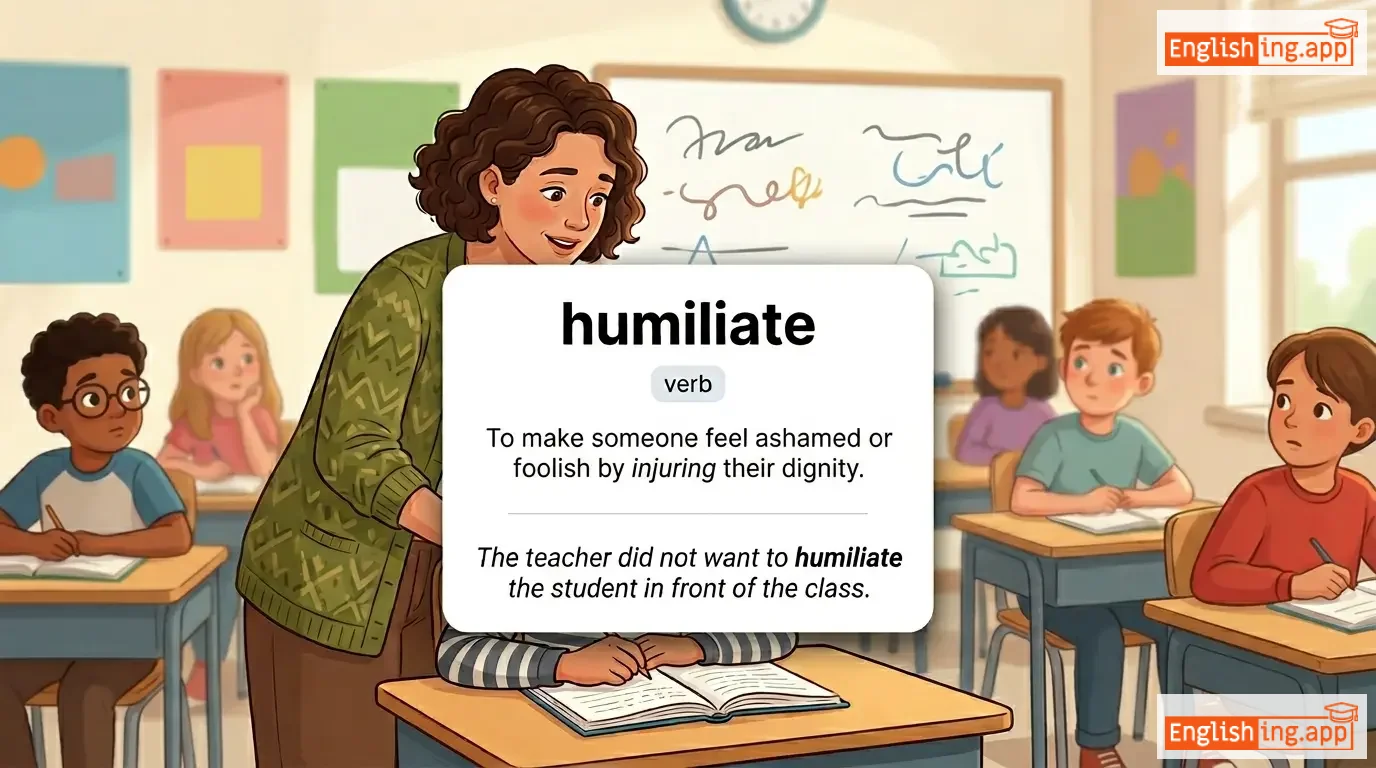
humiliate definition card — visual illustration of the meaning
verb
/hjuːˈmɪl.i.eɪt/

To make someone feel ashamed or foolish by injuring their dignity.

"The teacher did not want to humiliate the student in front of the class."

noun
/hjuːˈmɪl.ɪ.ti/

The quality of having a modest or low view of one's importance.

"She accepted the award with grace and humility."

noun
/ˈhʌm.ək/
小丘 (xiao qiu)

A small hill, mound, or ridge of earth or ice.

"The hikers rested on a grassy hummock by the river."

"远足者在河边的草地小丘上休息。" (Yuanzu zhe zai he bian de caodi xiao qiu shang xiuxi.)
😂

humor

noun
/ˈhjuː.mər/

The quality of being amusing or entertaining.

"His sense of humor always lightens the mood."

adjective
/ˈhjuː.mər.əs/
幽默的; 好笑的; 引起笑声的; (youmo de; haoxiao de; yinqi xiaosheng de;)

funny; amusing; causing laughter;

"His humorous stories always make everyone laugh."

"他的幽默故事总是让每个人都笑。" (Tā de yōumò gùshì zǒng shì ràng měi gèrén dōu xiào.)