词汇表

英语词汇词典 | 单词含义、定义和示例

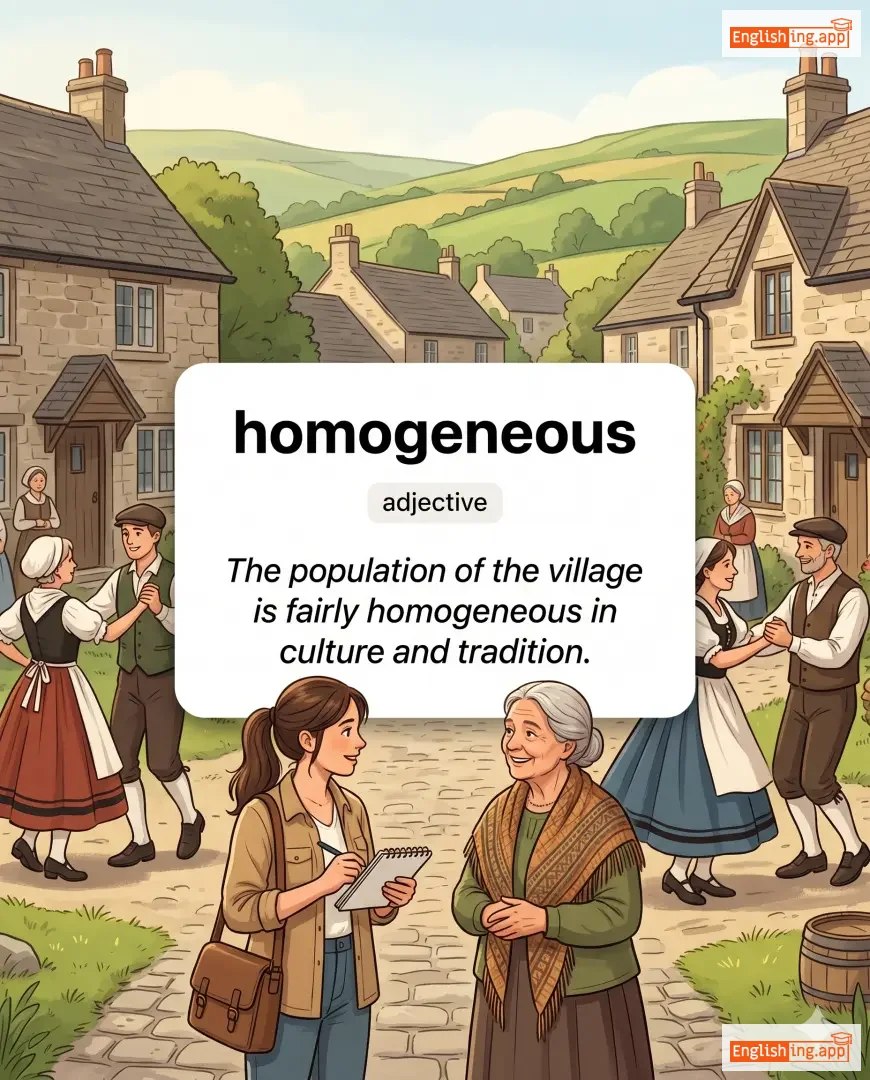
homogeneous definition card — visual illustration of the meaning
adjective
/ˌhoʊ.məˈdʒiː.ni.əs/
同质 (tóngzhì)

Consisting of parts or elements that are all the same kind; uniform in composition.

"The population of the village is fairly homogeneous in culture and tradition."

"该村的人口在文化和传统上非常同质化。" (Gāi cūn de rénkǒu zài wénhuà hé chuántǒng shàng fēicháng tóngzhìhuà.)
verb
/həˈmɑː.dʒə.naɪz/
同质化 (tóngzhì huà)

To make uniform or similar by blending or mixing different elements.

"The company tried to homogenize its products across global markets."

"公司尝试在全球市场上使其产品同质化。" (Gōngsī chángshì zài quánqiú shìchǎng shàng shǐ qí chǎnpǐn tóngzhì huà.)
adjective
/həˈmɑː.dʒə.nəs/
同质的 (tong zhi de)

Similar or uniform in nature; often used interchangeably with 'homogeneous'.

"The class was made up of a homogenous group of students."

"这个班级由一个同质的学生组组成。" (Zhe ge banji you yi ge tongzhi de xuesheng zu zucheng.)
adjective
/həˈmɑː.lə.ɡəs/
同源的 (结构) (tóng yuán de (jié gòu))

Having the same relation, relative position, or structure, especially due to evolutionary origin.

"The wings of bats and the arms of humans are homologous structures."

"蝙蝠的翅膀和人类的手臂是同源结构。" (Biānfú de chìbǎng hé rénlèi de shǒubì shì tóngyuán jiégòu.)
noun
/ˈhɑː.mə.nɪm/
同音异义词 (tongyin yiyi ci)

A word that is spelled and pronounced like another word but has a different meaning.

"The word 'bat' is a homonym because it can mean an animal or a sports tool."

"'蝙蝠'这个词是一个同音异义词,因为它可以指代动物或运动器材。" ('Bianfu' zhe ge ci shi yi ge tongyin yiyi ci, yinwei ta keyi zhidao dongwu huo yun dong qicai.)
noun
/ˈhɒməˌfoʊn/
同音异义词 (tóng yīn yì yì cí)

A word that is pronounced the same as another word but differs in meaning, and often spelling.

"The words 'pair' and 'pear' are homophones."

"单词 'pair' 和 'pear' 是同音异义词。" (Dāncí 'pair' hé 'pear' shì tóng yīn yì yì cí.)
verb
/hoʊn/
磨锐,改善技能 (mó ruì, gǎi shàn jì néng)

To sharpen a blade or to improve a skill through practice.

"She honed her presentation skills before the big meeting."

"她在大会议之前磨练了自己的演讲技巧。" (tā zài dà huì yì zhī qián mó liàn le zì jǐ de yǎn jiǎng jì néng.)
adjective
/ˈɑːnɪst/
诚实 (chengshi)

free of deceit and untruthfulness; sincere

"She is known as an honest and trustworthy person."

"她被认为是一个诚实和值得信赖的人。" (Ta bei renwei shi yige chengshi he zhided xinglai de ren.)
adverb
/ˈɒnɪstli/
诚实地 (cheng shi di)

in a truthful, sincere, or fair way

"She spoke honestly about her mistakes."

"她诚实地谈论了自己的错误。" (Ta cheng shi de tan lun le zi ji de cuo wu.)
noun
/ˈɒnɪsti/
诚实 (chengshi)

the quality of being truthful and sincere

"Honesty is the best policy in all situations."

"诚实是所有情况下最好的政策。" (Chengshi shi suoyou qingkuang xia zui hao de zhengce.)
noun
/ˈhʌni/
蜂蜜 (fengmi)

A sweet, sticky substance made by bees from nectar.

"She likes to put honey in her tea."

"她喜欢在茶里加蜂蜜。" (Tā xǐhuān zài chá lǐ jiā fēngmì.)
noun
/ˈɑːnər/
荣誉 (rongyu)

high respect; great esteem

"He received an award in honor of his achievements."

"他因他的成就而获得了一项荣誉。" (Tā yīn tā de chéngjiù ér huòdé le yī xiàng róngyù.)
noun
/ˌɒnəˈreəriəm/
酬金 (chóujīn)

A payment given for professional services that are rendered without a fee.

"The guest lecturer received an honorarium for her talk."

"那位客座讲师因其讲座而获得了酬金。" (Nà wèi kèzuò jiǎngshī yīn qí jiǎngzuò ér huòdéle chóujīn.)
honour definition card — visual illustration of the meaning
verb
/ˈɒnər/
荣誉 (róngyù)

to show respect; to keep a promise

"We honour our veterans for their service."

"我们为退伍军人的服务表示荣誉。" (Wǒmen wèi tuìwǔ jūnrén de fúwù biǎoshì róngyù.)
adjective
/ˈɒnərəbəl/
光荣的 (guangrong de)

deserving respect or admiration because of moral integrity; showing honesty and fairness

"She is known as an honourable leader who always keeps her promises."

"她以一位光荣的领导者而闻名,总是信守承诺。" (ta yi yi wei guangrong de lingdaozhe er wenming zongshi xinshou chengnuo)
adjective; past participle
/ˈɒnəd/
感到荣幸的 (gandao rongxing de)

treated with respect or distinction; feeling proud and privileged

"She felt deeply honoured to receive the award."

"她因获得这个奖项而感到非常荣幸。" (Ta yin huo de zhe ge jiangxiang er gandao feichang rongxing)
noun
/hʊd/
蛇头罩 (she tou zhao)

the expandable neck region of certain snakes like cobras; a covering for the head

"The cobra spread its hood when it felt threatened."

"眼镜蛇在感到威胁时展开了它的帽子。" (yan jing she zai gan dao wei xie shi zhan kai le ta de mao zi.)
verb
/ˈhʊdwɪŋk/
欺骗 (qīpiàn)

To deceive or trick someone.

"The scammer hoodwinked many people with false promises."

"骗子用虚假的承诺欺骗了许多人。" (Piànzi yòng xūjiǎ de chéngnuò qīpiànle xǔduō rén.)
noun
/huːf/
(ti)

the hard part covering the foot of horses, cattle, sheep, and other animals

"The horse's hoof was injured after stepping on a sharp rock."

"马的蹄子在踩到一块锋利的石头后受伤了。" (Mǎ de tízi zài cǎi dào yī kuài fēnglì de shítou hòu shòushāng le.)
hook definition card — visual illustration of the meaning
noun, verb
/hʊk/
钩子或挂件 (gōu zi huò guà jiàn)

a curved piece of metal or other material used for catching, holding, or pulling something; to catch or attach with a hook

"She hooked her keys onto her bag."

"她把钥匙挂在包包上。" (Tā bǎ yàoshi guà zài bāo bāo shàng.)
🌟

hope

verb
/hoʊp/

To want something to happen or be true and think it is possible.

"I hope everything goes well with your exam."

adjective
/ˈhəʊpfʊl/
充满希望 (chōngmǎn xīwàng)

feeling or showing optimism about a future event

"She is hopeful about the results of the interview."

"她对面试结果充满希望。" (Tā duì miànshì jiéguǒ chōngmǎn xīwàng.)
adverb
/ˈhoʊpfəli/
希望 (xīwàng)

in a hopeful manner; expressing hope or optimism

"Hopefully, the weather will be nice tomorrow."

"希望明天天气会很好。" (Xīwàng míngtiān tiānqì huì hěn hǎo.)
adjective
/ˈhoʊpləs/
绝望的; 没有希望的 (juéwàng de; méiyǒu xīwàng de)

feeling or causing despair about something; without hope; desperate

"The situation seemed hopeless until help arrived."

"直到帮助到来之前,情况看起来毫无希望。" (Zhídào bāngzhù dàolái zhīqián, qíngkuàng kàn qǐlái háowú xīwàng.)
noun
/hɔːrd/
一群人 (yi qun ren)

A large group or crowd, especially one that is disorderly or difficult to control.

"A horde of fans gathered outside the stadium."

"一群粉丝聚集在体育场外。" (Yi qun fensi juzhi zai tiyuchang wai.)
noun
/həˈraɪ.zən/
地平线 (dipingxian)

the line where the earth seems to meet the sky; the limit of one's knowledge, experience, or interest

"The sun disappeared below the horizon."

"太阳消失在地平线下。" (taiyang xiaoshi zai dipingxian xia.)
horizons definition card — visual illustration of the meaning
noun
/həˈraɪ.zənz/
地平线 (dipingxian)

The limit of a person's mental perception, experience, or interest.

"The telescope opens new horizons for astronomy."

"望远镜为天文学打开了新的地平线。" (Wàng yuǎnjìng wèi tiānwénxué dǎkāile xīn de dìpíngxiàn.)
adjective
/ˌhɒrɪˈzɒntəl/
水平的 (shuiping de)

parallel to the horizon; flat and level from side to side

"The table must be perfectly horizontal to keep the glass from sliding."

"桌子必须保持水平,杯子才不会滑动。" (Zhuozi bixu baochi shuiping beizi cai buhui huadong)
noun
/ˈhɔːrmoʊn/
荷尔蒙 (hormone)

a chemical substance produced in the body that influences how the body grows or functions

"Insulin is a hormone that controls blood sugar levels."

"胰岛素是一种控制血糖水平的荷尔蒙。" (Yídǎosù shì yī zhǒng kòngzhì xuètáng shuǐpíng de hé'ěrméng.)
noun
/hɔːrn/
角, 喇叭 (jiǎo, lǎbā)

a hard, pointed part growing from the head of some animals; a device that makes a loud sound as a warning

"The driver pressed the horn to warn the pedestrians."

"司机按下喇叭来警告行人。" (Sījī ànxià lǎbā lái jǐnggào xíngrén.)
noun
/ˈhɔːrn.bɪl/
角嘴鸟 (jiǎo zuǐ niǎo)

a large tropical bird with a large curved beak and often a horn-like projection

"The colorful hornbill perched on the highest branch."

"五彩斑斓的霍恩比尔停在了最高的树枝上。" (wǔcǎi bānlán de huò ēn bǐ ěr tíng zài le zuìgāo de shù zhī shàng.)
noun
/ˈhɔːr.nət/
黄蜂 (huángfēng)

a large wasp that can sting and is often aggressive

"The hornet built its nest under the roof."

"黄蜂在屋顶下筑巢。" (Huángfēng zài wūdǐng xià zhùcháo.)
noun
/ˈhɒrəˌskoʊp/
星座运势 (xingzuo yunshi)

A forecast of a person's future based on the positions of the stars and planets at their birth.

"She read her horoscope every morning to see what the stars predicted."

"她每天早上读星座运势,看星星预测了什么。" (Ta meitian zaoshang du xingzuo yunshi, kan xingxing yuce le shenme.)
adjective
/ˈhɔːrɪbəl/
可怕的, 恐怖的 (kěpà de, kǒngbù de)

very unpleasant or causing horror; extremely bad or unpleasant

"The food at that restaurant was horrible."

"那家餐馆的食物可怕极了。" (Nà jiā cānguǎn de shíwù kěpà jíle.)
horrify definition card — visual illustration of the meaning
verb
/ˈhɔːrɪfaɪ/
使恐惧 (shi kong ju)

to fill with horror; to shock or disgust greatly

"The violent scene horrified the audience."

"暴力的场面使观众感到恐惧。" (bao li de chang mian shi guan zhong gan dao kong ju)
noun
/ˈhɒr.ər/
恐惧 (kǒngjù)

an intense feeling of fear, shock, or disgust

"She screamed in horror when she saw the accident."

"她看到事故时吓得尖叫起来。" (Tā kàn dào shìgù shí xià dé jiān jiào qǐlái.)
noun
/hɔːrs/
(ma)

a large, strong animal used for riding, racing, or carrying loads

"The horse ran across the field."

"马跑过了田野。" (mǎ pǎo guò le tián yě.)
noun
/ˈhɔːrs.liːt͡ʃ/
马蛭 (mǎ zhì)

a large species of leech that was traditionally used in veterinary medicine

"The veterinarian explained that horse-leach was once commonly used to treat horses."

"兽医解释说,马蛭曾广泛用于治疗马匹。" (Shòuyī jiěshì shuō, mǎ zhì céng guǎngfàn yòng yú zhìliáo mǎpǐ.)
adjective
/ˈhɔːrtətɪv/

Giving strong encouragement or urging.

"The teacher gave a hortative speech to motivate the students before the exam."

adjective
/ˈhɔːrtətɔːri/

Intended to encourage or urge to action.

"The manager’s hortatory words inspired the team to work harder."

adjective
/ˌhɔːrtɪˈkʌltʃərəl/
园艺相关 (yuányì xiāngguān)

Relating to the art or practice of garden cultivation and management.

"She studied horticultural science at the university."

"她在大学学习了园艺科学。" (Tā zài dàxué xuéxíle yuányì kēxué.)
noun
/ˈhɔːrtɪˌkʌltʃər/

The art or practice of garden cultivation and management.

"Horticulture plays a vital role in producing fruits, vegetables, and ornamental plants."

noun
/ˈhoʊʒəri/
长袜和腿部衣物 (changwa he tibu yiwu)

Stockings, socks, and other knitted clothing for the legs and feet.

"She bought new hosiery for the winter season."

"她为冬季季节买了新的长袜。" (Ta wei dongji jijie maile xin de changwa.)
adjective
/ˈhɑːspɪtəbl/
好客的 (hǎokè de)

Friendly and welcoming to guests or strangers.

"The villagers were very hospitable to the travelers."

"村民们对旅行者非常热情好客。" (cūnmín men duì lǚxíng zhě fēicháng rèqíng hǎokè.)
noun
/ˈhɒs.pɪ.təl/
医院 (yīyuàn)

an institution where sick or injured people are given medical treatment

"He was taken to the hospital after the accident."

"事故发生后,他被送往医院。" (shìgù fāshēng hòu, tā bèi sòngwǎng yīyuàn.)
noun
/ˌhɑːspɪˈtæləti/

The friendly and generous reception and entertainment of guests or strangers.

"We enjoyed the hospitality of our hosts during the holiday."

noun, verb
/hoʊst/
主持人 (zhǔchí rén)

a person who receives or entertains guests; to organize and provide for an event

"She will host the conference next week."

"她将在下周主持会议。" (Tā jiāng zài xià zhōu zhǔchí huìyì.)
noun
/ˈhɑːstɪdʒ/
人质 (renzhi)

A person seized or held as security for the fulfillment of a condition.

"The rebels took several people as hostages."

"叛军俘获了几个人质。" (Pànjūn fúhuò le jǐ gè rénzhì.)
noun
/ˈhɑːstəlri/
旅馆 (lvguan)

An inn or lodging place, especially one for travelers.

"They stayed at a small hostelry near the mountains."

"他们住在山附近的一个小旅馆里。" (Tāmen zhù zài shān fùjìn de yīgè xiǎo lǚguǎn lǐ.)
adjective
/ˈhɒstaɪl/
敌对 (díduì)

showing or feeling opposition, dislike, or hatred

"The soldiers entered a hostile territory."

"士兵进入了敌对领土。" (Shìbīng jìnrùle díduì lǐngtǔ.)