词汇表

英语词汇词典 | 单词含义、定义和示例

noun/verb
/ˈɡlɪmər/
微弱的闪光 (weiruò de shǎnguāng)

A faint or wavering light; to shine with a faint light.

"A glimmer of hope shone in her eyes."

"她眼中闪烁着希望的光芒。" (tā yǎnzhōng shǎnshuò zhe xīwàng de guāngmáng.)
noun/verb
/ɡlɪmps/
一瞥 (yī piē)

A brief or quick view of something.

"She caught a glimpse of the actor as he left the stage."

"她看到演员离开舞台时的一个瞥见。" (Tā kàn dào yǎnyuán líkāi wǔtái shí de yīgè piējian.)
verb
/ˈɡlɪsən/
闪闪发光 (shǎnshǎn fāguāng)

To shine with a sparkling light, often when wet or polished.

"The grass glistened with morning dew."

"草地在清晨露水下闪闪发光。" (Cǎodì zài qīngchén lùshuǐ xià shǎnshǎn fāguāng.)
noun
/ɡlɪtʃ/
故障 (guzhang)

A sudden, usually temporary fault or malfunction in a system or device.

"The computer crashed due to a minor glitch in the software."

"由于软件中的小故障,计算机崩溃了。" (Youyu ruanjian zhong de xiao guzhang, jisuanji bengkuile.)
noun/verb
/ˈɡlɪtər/
闪烁 (shǎn shuò)

To shine with bright, shimmering light; or decorative sparkles.

"Her dress glittered under the stage lights."

"她的裙子在舞台灯光下闪烁。" (Tā de qúnzi zài wǔtái dēngguāng xià shǎnshuò.)
adjective
/ˈɡlɪt.ər.ɪŋ/
闪亮的; 闪烁的; 光辉的 (shanliang de; shanshuo de; guanghui de)

shining with bright light; sparkling; brilliant;

"The glittering stars filled the clear night sky."

"闪亮的星星充满了清澈的夜空。" (Shǎnliàng de xīngxīng chōngmǎnle qīngchè de yèkōng.)
noun
/ˈɡloʊmɪŋ/
暮光 (muguang)

The time of day after the sun has set and before it is completely dark; twilight.

"We walked home together in the quiet gloaming."

"我们在宁静的暮光中一起走回家。" (Women zai ningjing de muguang zhong yiqi zou hui jia.)
verb
/ɡloʊt/
幸灾乐祸 (xìngzāi lèhuò)

To take pleasure in someone else's misfortune or to show smug satisfaction.

"He couldn't help but gloat over his rival's failure."
"他忍不住对竞争对手的失败感到幸灾乐祸。" (Tā rěn bù zhù duì jìngzhēng duìshǒu de shībài gǎndào xìngzāi lèhuò.)
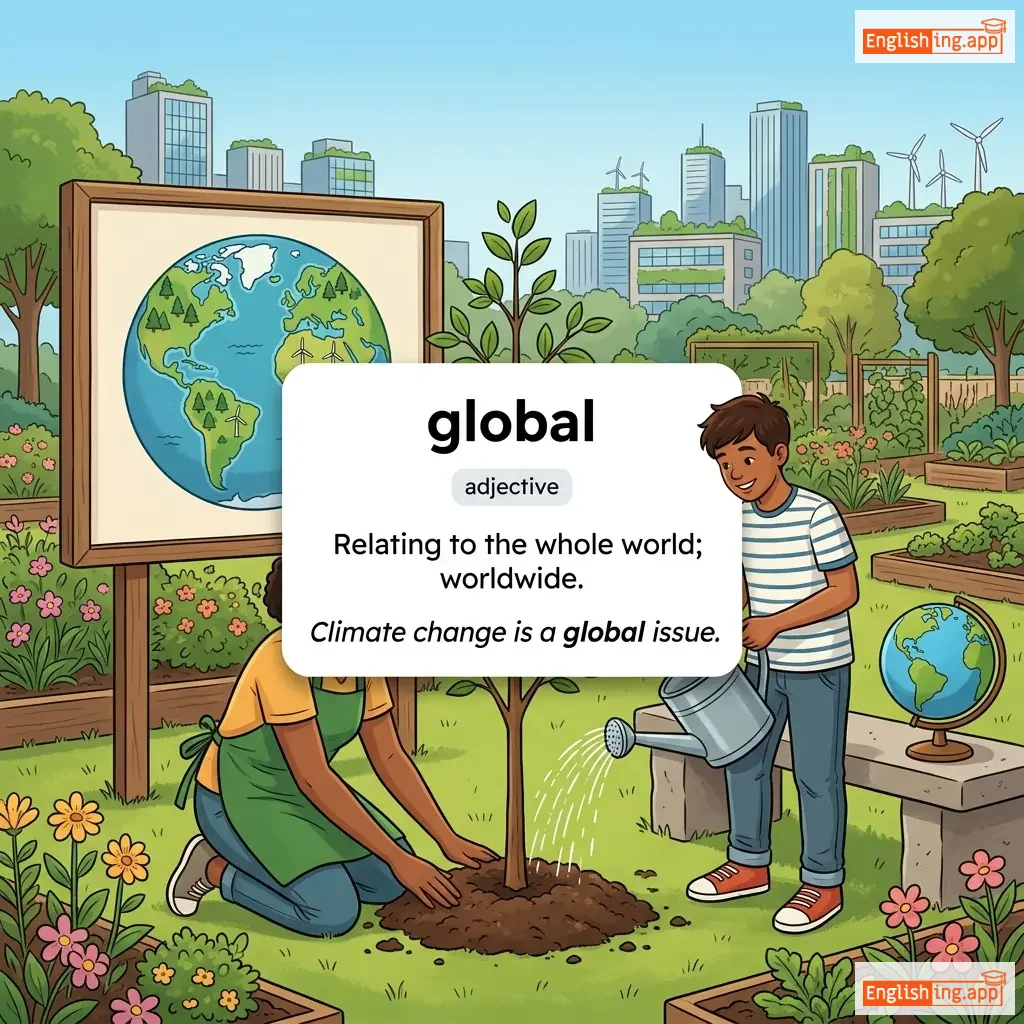
global definition card — visual illustration of the meaning
adjective
/ˈɡloʊbəl/
全球的 (quánqiú de)

Relating to the whole world; worldwide.

"Climate change is a global issue."

"气候变化是一个全球性问题。" (Qìhòu biànhuà shì yīgè quánqiú xìng wèntí.)
global awareness definition card — visual illustration of the meaning
noun
/ˈɡloʊbəl əˈwɛrnɪs/
全球意识 (quánqiú yìshí)

Worldwide consciousness and understanding of important issues that affect people globally, leading to informed action and policy changes.

"Global awareness of climate change is essential for policy changes."

"全球气候变化意识对政策变化至关重要。" (Quánqiú qìhòu biànhuà yìshí duì zhèngcè biànhuà zhìguān zhòngyào.)
global collaboration definition card — visual illustration of the meaning
noun
ˈɡloʊbəl kəˌlæbəˈreɪʃən
全球合作 (quanqiu hezuo)

Cooperation and partnership between countries or organizations worldwide to address common challenges.

"Global collaboration is necessary to address climate change."
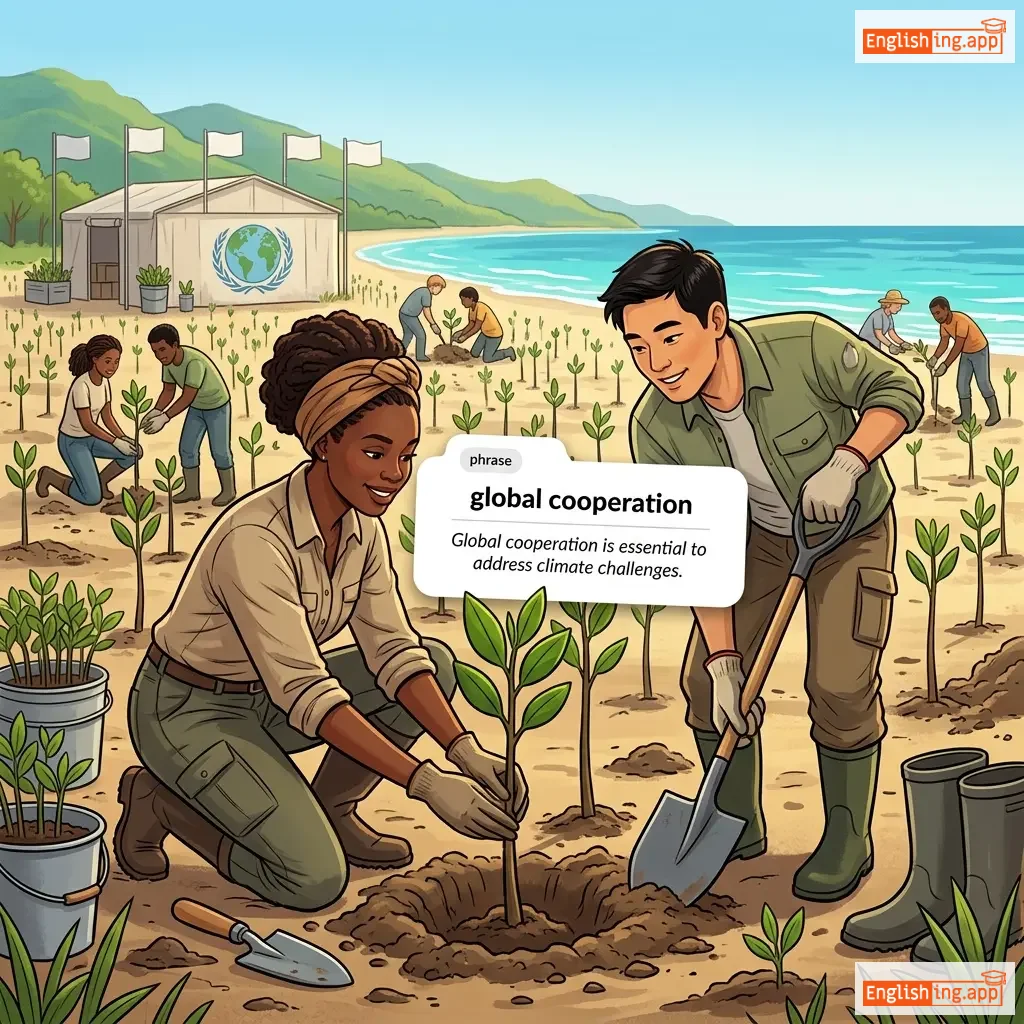
"全球合作对于应对气候变化至关重要。" (Quanqiu hezuo dui yu ying dui qihou bianhua zhi guan zhongyao.)
global cooperation definition card — visual illustration of the meaning
phrase
ˈɡləʊ.bəl ˌkəʊ.ɒp.əˈreɪ.ʃən
全球合作 (quanqiu hezuo)

International collaboration and working together across countries to address common challenges and goals.

"Global cooperation is essential to address climate challenges."
"全球合作对于解决气候问题至关重要。" (Quanqiu hezuo duiyu jiejue qihou wenti zhiguang zhongyao.)
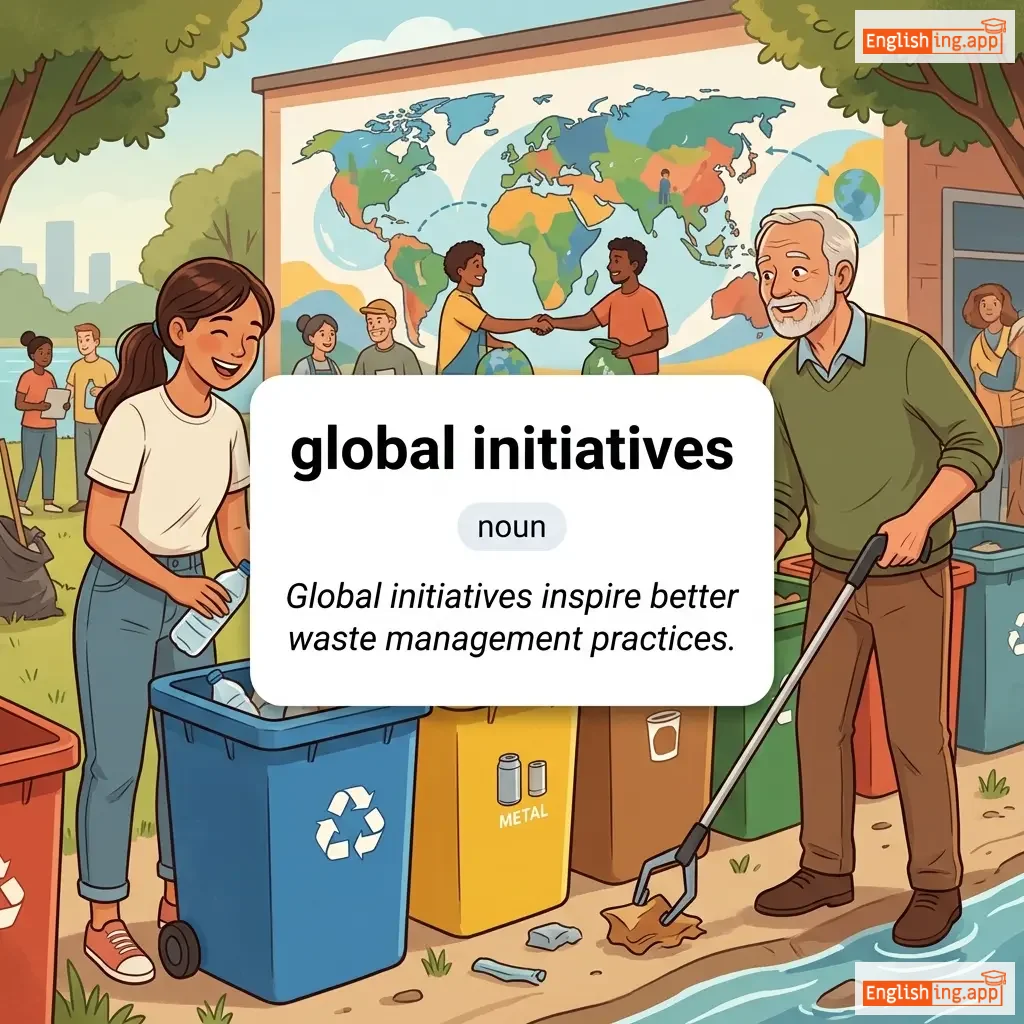
global initiatives definition card — visual illustration of the meaning
noun
ˈɡloʊbəl ɪˈnɪʃətɪvz
全球倡议 (quanqiu changyi)

Worldwide efforts or programs aimed at addressing global challenges or achieving common goals.

"Global initiatives inspire better waste management practices."

"全球倡议激发了更好的废物管理实践。" (Quanqiu changyi jifa le geng hao de feiwu guanli shijian.)
global peace definition card — visual illustration of the meaning
noun
/ˈɡləʊ.bəl piːs/
全球和平 (quanqiu heping)

Worldwide harmony and absence of conflict between nations.

"Global peace requires collective efforts."

"全球和平需要集体努力。" (Quanqiu heping xuyao jiti nuli.)
GlobalFoundries definition card — visual illustration of the meaning
proper noun
ˈɡləʊbəl ˈfaʊndriz
全球铸造厂 (quanqiu zhucao chang)

A specific company in semiconductor manufacturing.

"GlobalFoundries is a leading semiconductor company."

"GlobalFoundries 是一家领先的半导体公司。" (GlobalFoundries shi yijia lingxian de bandaoti gongsi.)
globalization definition card — visual illustration of the meaning
noun
/ˌɡloʊbəlaɪˈzeɪʃən/
全球化 (quanqiuhua)

the process by which businesses or other organizations develop international influence or start operating on an international scale

"Globalization has led to increased trade between countries."

"全球化导致了各国之间贸易的增长。" (Quanqiuhua daozhule geguo zhijian maoyi de zengzhang.)
verb
/ˈɡloʊbəlaɪz/
全球化 (quanqiuhua)

to make something worldwide in scope or application; to integrate into a global system

"Many companies globalize their operations to reach international markets."

"许多公司将业务全球化以进入国际市场。" (xuduo gongsi jiang yewu quanqiuhua yi jinru guoji shichang)
noun
/ɡloʊb/
地球仪 (diqiuyi)

a spherical model of Earth or another planet; the world itself

"Students used a globe to study the continents."

"学生们用地球仪来学习各大洲。" (Xueshengmen yong diqiuyi lai xuexi ge dazhou.)
adjective
/ˈɡloʊboʊs/
球形的 (qiúxíng de)

Spherical or nearly spherical in shape.

"The cactus has large globose fruits."

"仙人掌有大的球形果实。" (Xiānrénzhǎng yǒu dà de qiúxíng guǒshí.)
adjective
/ˈɡlɑːbjələr/
球形的 (qiúxíng de)

Having the shape of a globe; spherical.

"The scientist studied the globular cluster of stars."

"科学家研究了球状星团。" (Kēxuéjiā yánjiūle qiúzhuàng xīngtuán.)
noun
/ɡluːm/
黑暗; 悲伤; 忧郁 (heian, beishang, youyu)

partial or total darkness; a state of dejection or despondency

"The thick clouds cast a gloom over the valley, making everything appear dark and dreary."

"厚重的云层将黑暗笼罩在山谷上,让一切看起来昏暗和忧郁。" (Houzhong de yun ceng jiang hei'an longzhao zai shangu shang, rang yiqie kanqilai hundan he youyu.)
gloomy definition card — visual illustration of the meaning
adjective
/ˈɡluːmi/
阴郁 (yīnyù)

Dark or poorly lit, making it hard to see; also refers to being sad or pessimistic.

"The room was gloomy after the storm."

"风暴过后,房间显得阴郁。" (Fēngbào guòhòu, fángjiān xiǎndé yīnyù.)
glorify definition card — visual illustration of the meaning
verb
/ˈɡlɔːrɪfaɪ/
美化 (měihuà)

to praise or honor someone or something; to make something seem better than it is

"The movie glorifies war heroes."

"电影美化了战争英雄。" (Diànyǐng měihuà le zhànzhēng yīngxióng.)
adjective
/ˈɡlɔː.ri.əs/
辉煌 (hui huang)

having great beauty, magnificence, or deserving admiration and praise

"It was a glorious day filled with sunshine and joy."

"这是一个辉煌的日子,充满了阳光和喜悦。" (Zhè shì yīgè huīhuáng de rìzi, chōngmǎnle yángguāng hé xǐyuè.)
noun
/ˈɡlɔːri/
荣耀 (róngyào)

great honor, praise, or fame achieved by doing something remarkable

"The athlete won glory for his country with his performance."

"运动员凭借他的表现为他的国家赢得了荣耀。" (Yùndòngyuán píngjiè tā de biǎoxiàn wèi tā de guójiā yíngdé le róngyào.)
noun
/ɡlɒs/
光滑的表面 / 解释 (guāngzé de biǎomiàn / jiěshì)

a shiny surface or an explanation of a word or phrase

"The table had a beautiful gloss after polishing."

"桌子经过抛光后有了美丽的光泽。" (zhuōzi jīngguò pāoguāng hòu yǒule měilì de guāngzé.)
phrasal verb
/ɡlɒs ˈoʊ.vər/
忽略 / 轻描淡写 (hūlüè / qīngmiáo dànxiě)

to avoid discussing something unpleasant or make it seem less important

"The report glossed over the company's financial problems."

"报告忽略了公司财务问题。" (Bàogào hūlüèle gōngsī cáiwù wèntí.)
noun
/ˈɡlɒs.ər.i/
词汇表 (cíhuì biǎo)

an alphabetical list of terms with definitions, often found at the end of a book

"The textbook includes a glossary of key terms at the back."

"教材末尾包括了重要术语的词汇表。" (Jiàocái mòwěi bāokuòle zhòngyào shùyǔ de cíhuì biǎo.)
verb
/ˈɡlɒs.oʊ.vər/
忽略 (hūlüè)

an informal or non-standard variant of 'gloss over', meaning to ignore or minimize something

"He tried to glossover his mistakes during the meeting."

"他试图在会议中忽略他的错误。" (Tā shìtú zài huìyì zhōng hūlüè tā de cuòwù.)
adjective
/ˈɡlɒsi/
光泽的 (guangze de)

Shiny and smooth in appearance; attractive on the surface but sometimes lacking depth.

"She bought a glossy magazine from the store."

"她在商店买了一本光泽的杂志。" (Tā zài shāngdiàn mǎile yī běn guāngzé de zázhì.)
noun
/ɡlʌv/
手套 (shǒutào)

A covering for the hand with separate parts for the fingers and thumb.

"She wore gloves to protect her hands from the cold."

"她戴上手套保护双手免受寒冷。" (Tā dàishàng shǒutào bǎohù shuāngshǒu miǎn shòu hánlěng.)
noun
/ɡlʌvz/
手套 (shǒutào)

coverings for the hands with separate parts for each finger

"She wore warm gloves to protect her hands from the cold."

"她戴上温暖的手套,保护双手免受寒冷。" (Tā dài shàng wēnnuǎn de shǒutào, bǎohù shuāng shǒu miǎn shòu hánlěng.)
verb
/ɡloʊ/
发光 (fāguāng)

To shine with a steady light, often softly; to radiate warmth or happiness.

"The lanterns glowed softly in the dark."

"灯笼在黑暗中发光。" (Dēnglóng zài hēi'àn zhōng fāguāng.)
verb
/ˈɡlaʊ.ər/
愤怒地看 (fènnù de kàn)

To look at someone with an angry or sullen expression.

"He glowered at his rival across the room."

"他愤怒地看着他在房间对面的对手。" (Tā fènnù de kàn zhe tā zài fángjiān duìmiàn de duìshǒu.)
noun
/ɡluː/
胶水 (jiaoshui)

a sticky substance used for sticking objects or materials together; an adhesive

"The children used white glue to attach the colorful paper pieces to their art project."

"孩子们用白色胶水将五颜六色的纸片粘贴到他们的艺术项目中。" (Haizimen yong baise jiaoshui jiang wuyan liuse de zhipian niantie dao tamen de yishu xiangmu zhong.)
adjective
/ɡlʌm/
沮丧 (jǔsàng)

Looking or feeling sad, gloomy, or dejected.

"She felt glum after hearing the bad news."

"听到坏消息后,她感到沮丧。" (Tīngdào huài xiāoxī hòu, tā gǎndào jǔsàng.)
noun
/ɡlʌt/
供应过剩 (gongying guosheng)

An excessive supply of something; more than is needed.

"There was a glut of cheap smartphones in the market."

"市场上有过多的廉价智能手机。" (Shichang shang you guodu de lianjia zhineng shouji.)
adjective
/ˈɡluː.tɪ.nəs/
粘性 (zhān xìng)

Having a sticky or glue-like texture.

"The glutinous rice stuck together in the pot."

"粘性米饭在锅里粘在一起了。" (zhān xìng mǐ fàn zài guō lǐ zhān zài yī qǐ le.)
noun
/ˈɡlʌt.ən/
暴食者 (baoshi zhe)

A person who eats or consumes excessively.

"He was called a glutton for eating so much at the party."

"他因为在派对上吃得太多而被称为暴食者。" (Ta yinwei zai paidui shang chi de tai duo er bei chengwei baoshi zhe.)
adjective
/ˈɡlʌt.ən.əs/
贪吃的 (tānchī de)

Excessively greedy in eating or consuming.

"His gluttonous appetite shocked everyone at the dinner table."

"他贪吃的胃口让餐桌上的每个人都感到震惊。" (Tā tānchī de wèikǒu ràng cānzhuō shàng de měi gèrén dōu gǎndào zhènjīng.)
noun
/ˈɡlʌtəni/
暴饮暴食 (baoyinbaoshi)

Excessive eating or drinking; overindulgence in food or drink.

"His gluttony during the festival left him feeling sick."

"他在节日中的暴饮暴食让他感到生病。" (Tā zài jiérì zhōng de bào yǐn bào shí ràng tā gǎndào shēng bìng.)
glycemic definition card — visual illustration of the meaning
adjective
/ɡlaɪˈsiː.mɪk/
与葡萄糖相关 (yu putaotang xiangguan)

Relating to the presence of glucose in the blood and how foods affect blood sugar levels.

"High-glycemic foods cause a rapid increase in blood sugar."

"高血糖指数的食物会迅速提高血糖水平。" (Gao xue tang zhishu de shiwu hui xunzhu ti gao xuetang shuiping.)
verb
/nɑːrl/
扭曲 (niǔqū)

To twist into a knotted or distorted form.

"The tree roots began to gnarl around the stones."

"树根开始绕着石头扭曲。" (Shù gēn kāishǐ rào zhe shítou niǔqū.)
adjective
/nɑːrld/
扭曲的 (niǔqū de)

Twisted, rough, and knotted, especially with age.

"The old man had gnarled hands from years of hard work."

"那位老人因多年辛勤工作而双手扭曲。" (Nà wèi lǎorén yīn duōnián xīnqín gōngzuò ér shuāngshǒu niǔqū.)
verb
/næʃ/
咬牙切齿 (yao ya qie chi)

to grind or strike the teeth together, often in anger or frustration

"He began to gnash his teeth in rage."

"他开始因为愤怒而咬牙切齿。" (Ta kaishi yinwei fennu er yao ya qie chi.)
noun
/næt/
蚊子 (wénzi)

a small flying insect that bites people and animals

"The gnat buzzed around my head while I was reading."

"当我在读书时,蚊子在我的头顶嗡嗡作响。" (dāng wǒ zài dúshū shí, wénzi zài wǒ de tóudǐng wēngwēng zuòxiǎng.)
noun
/noʊm/
地精 (dì jīng)

a small mythical creature, often depicted as a bearded man living underground; also a figurine used in gardens

"The garden was decorated with a gnome statue."

"花园里摆放着一个地精雕像。" (Huāyuán lǐ bǎi fàng zhe yīgè dì jīng diāoxiàng.)
go definition card — visual illustration of the meaning
verb
/ɡoʊ/
(qu)

to move or travel from one place to another

"We decided to go to the park after lunch."

"我们决定午餐后去公园。" (Wo men jue ding wu can hou qu gong yuan.)
goad definition card — visual illustration of the meaning
verb
/ɡoʊd/
挑衅 (tiaoxin)

to provoke, annoy, or urge someone to take action

"He tried to goad his opponent into making a mistake."

"他试图激怒对手让他犯错。" (Tā shìtú jīnù duìshǒu ràng tā fàncuò.)
noun
/ɡoʊl/
目标 (mùbiāo)

an aim or desired result; a point scored in a game

"Her main goal is to become a doctor."

"她的主要目标是成为一名医生。" (Tā de zhǔyào mùbiāo shì chéngwéi yī míng yīshēng.)