词汇表

英语词汇词典 | 单词含义、定义和示例

adjective
/ɡɑːrˈɡæntʃuən/
巨大的 (jù dà de)

Extremely large; enormous.

"They served a gargantuan meal at the feast."

"他们在宴会上提供了一顿巨大的饭菜。" (Tāmen zài yànhuì shàng tígōngle yī dùn jù dà de fàncài.)
noun
/ˈɡɑːrɡɔɪl/
石雕像(怪异的形状) (shí diāo xiàng (guài yì de xíng zhuàng))

A carved stone figure, often of a grotesque creature, on a building, typically used as a spout to carry water away.

"The ancient cathedral had gargoyles on every corner."

"古老的大教堂的每个角落都有石像。" (Gǔ lǎo de dà jiàotáng de měi gè jiǎo luò dōu yǒu shí xiàng.)
adjective
/ˈɡɛə.rɪʃ/
过于耀眼和显眼 (guo yu yao yan he xian yan)

Excessively bright and showy, often in a tasteless or unattractive way.

"The room was decorated with garish neon lights."

"房间被过于耀眼的霓虹灯装饰。" (Fangjian bei guo yu yao yan de ni hong deng zhuangshi.)
noun
/ˈɡɑːr.lənd/
花环; 花冠; (huā huán, huā guān)

a wreath of flowers and leaves, worn on the head or hung as decoration

"The bride wore a beautiful floral garland during the traditional ceremony."

"新娘在传统仪式中佩戴了美丽的花环。" (Xīnniáng zài chuántǒng yíshì zhōng pèidài le měilì de huā huán.)
noun
/ˈɡɑːrlɪk/
大蒜 (dàsuàn)

A strong-smelling plant used as a seasoning in cooking.

"She added garlic to the curry."

"她在咖喱中加入了大蒜。" (Tā zài gālí zhōng jiārùle dàsuàn.)
noun
/ˈɡɑː.mənt/
衣物 (yīwù)

An item of clothing.

"She bought a new garment for the party."

"她为派对买了件新衣物。" (Tā wèi pàiduì mǎi le jiàn xīn yīwù.)
verb
/ˈɡɑː.nər/
收集 (shōují)

To gather or collect, especially information, support, or approval.

"The politician garnered support from young voters."

"政治家从年轻选民那里获得了支持。" (Zhèngzhìjiā cóng niánqīng xuǎnmín nàlǐ huòdéle zhīchí.)
verb
/ˈɡɑː.nɪʃ/
装饰 (zhuangshi)

To decorate food with small items for added flavor or visual appeal.

"She garnished the dish with fresh coriander leaves."

"她用新鲜的香菜叶装饰了菜肴。" (Tā yòng xīnxiān de xiāngcài yè zhuāngshìle càiyáo.)
noun
/ˈɡær.ɪ.sən/
驻军 (zhù jūn)

A body of troops stationed in a particular location, usually to defend it.

"The garrison defended the fortress against the invaders."

"驻军抵御了入侵者的攻击。" (Zhù jūn dǐyùle rùqīn zhě de gōngjī.)
noun, verb
/ɡəˈrɒt/
勒死 (lesi)

A method of execution by strangulation, or to strangle someone with a cord or wire.

"The assassin attempted to garrote his target in the alley."

"刺客试图在巷子里用绳索勒死目标。" (Cike shitu zai xiangzi li yong shengsuo lesi mubiao.)
noun
/ɡəˈruːlɪti/
多话 (duōhuà)

Excessive talkativeness, especially about trivial matters.

"His garrulity made it hard to focus during the meeting."
"他的喋喋不休使得在会议中集中精力变得困难。" (Tā de dié dié bù xiū shǐ dé zài huìyì zhōng jízhōng jīnglì biàn dé kùnnán.)
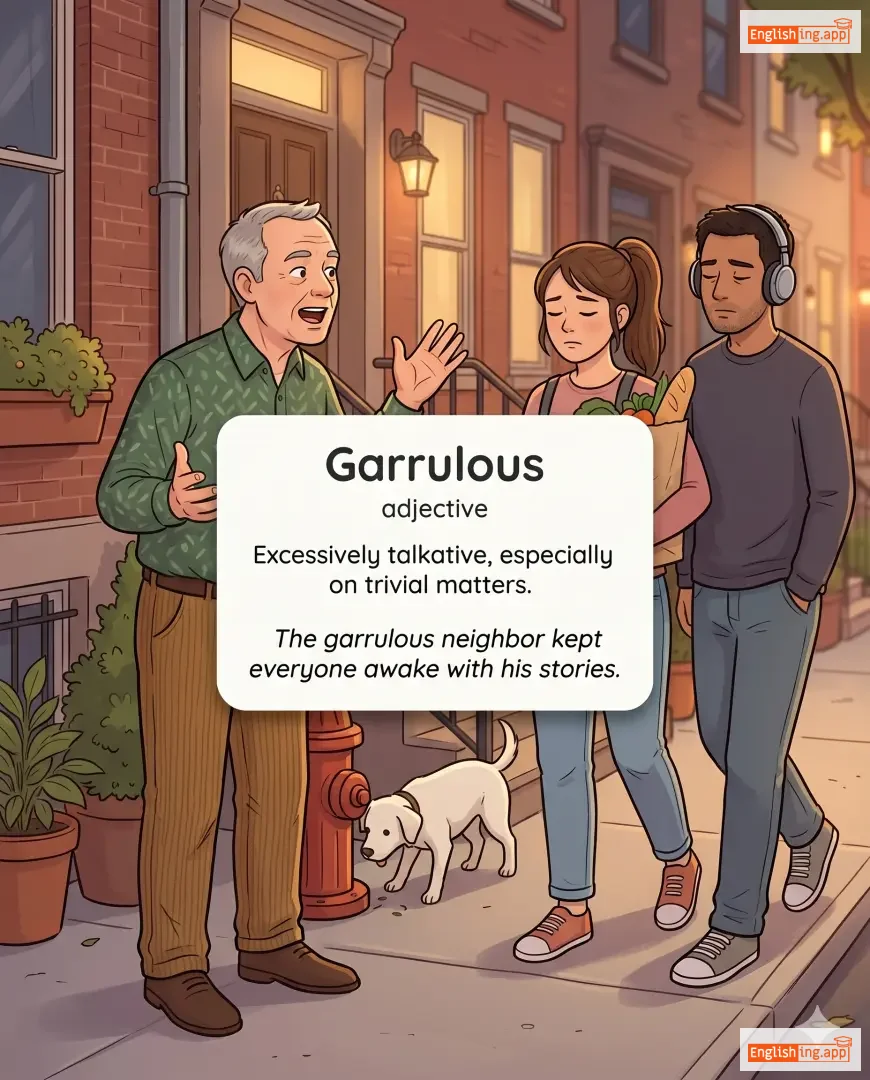
Garrulous definition card — visual illustration of the meaning
adjective
/ˈɡærələs/
多话的,唠叨的 (duō huà de, lào dāo de)

Excessively talkative, especially on trivial matters.

"The garrulous neighbor kept everyone awake with his stories."

"那个多话的邻居用他的故事让所有人都醒着。" (Nàgè duō huà de línjū yòng tā de gùshì ràng suǒyǒu rén dōu xǐng zhe.)
noun
/ɡæs/
气体 (qìtǐ)

A substance like air that is neither solid nor liquid and can expand freely.

"The balloon was filled with gas."

"气球充满了气体。" (Qìqiú chōngmǎnle qìtǐ.)
noun
/ˌɡæskəˈneɪd/
夸大其词, 吹嘘 (kuā dà qí cí, chuī xū)

Extravagant boasting or bragging.

"His endless gasconade made him unpopular among his peers."

"他无休止的吹嘘让他在同龄人中不受欢迎。" (Tā wú xiūzhǐ de chuīxū ràng tā zài tónglíngrén zhōng bù shòu huānyíng.)
adjective
/ˈɡæsiəs/
气态的 (qìtài de)

Relating to or having the form of gas.

"Carbon dioxide is a gaseous substance."

"二氧化碳是一种气态物质。" (Èryǎnghuàtàn shì yī zhǒng qìtài wùzhí.)
noun/verb
/ɡæʃ/
深割伤 (shen ge shang)

A long, deep cut or wound; to cut deeply or violently.

"He had a deep gash on his leg after the accident."

"他在事故后腿部有一个深深的割伤。" (Ta zai shigu hou tui bu you yi ge shen shen de ge shang.)
noun
/ˌɡæsɪfɪˈkeɪʃən/
气化 (qihua)

The process of converting solid or liquid fuel into gas.

"Gasification is widely used to produce fuel gas from coal."

"气化广泛用于从煤炭中生产燃气。" (Qi hua guang fan yong yu cong mei tan zhong sheng chan ran qi.)
noun
/ˈɡæsəˌliːn/
汽油 (qiyou)

a liquid fuel made from petroleum, used mainly to power engines in vehicles

"The price of gasoline has increased significantly this month."

"本月汽油价格显著上涨了。" (Ben yue qiyou jiage xianzhu shangzhang le.)
adjective
/ˈɡæstrɪk/
胃的 / 胃部问题 (wei de / weibu wenti)

Relating to the stomach.

"She was prescribed medicine for her gastric problems."

"她被开了治疗胃病的药。" (Ta bei kai le zhiliaowei bing de yao.)
noun
/ɡæsˈtraɪtɪs/
胃炎 (wei yan)

Inflammation of the lining of the stomach.

"The doctor diagnosed him with gastritis after his endoscopy."

"医生在他的内窥镜检查后诊断为胃炎。" (Yisheng zai tade neikuijing jiancha hou zhenduan wei weiyan.)
gastrointestinal definition card — visual illustration of the meaning
adjective
ˌɡæs.troʊ.ɪnˈtes.tɪ.nəl
胃肠的 (weichang de)

Relating to the stomach and intestines.

"Spicy food can cause gastrointestinal issues."

"辛辣食物可能导致胃肠问题。" (Xinla shiwu keneng daozhi weichang wenti.)
noun
/ɡæsˈtrɒnəmi/
美食学 (meishi xue)

The art or science of good eating and fine cuisine.

"Paris is famous for its rich tradition of gastronomy."

"巴黎因其丰富的美食传统而闻名。" (Bālí yīn qí fēngfù de měishí chuántǒng ér wénmíng.)
noun
/ɡeɪt/
幸福 (xìng fú)

A movable barrier that opens and closes to allow or prevent entry through an opening.

"She closed the gate behind her as she left the garden."

"当她收到奖项时,她无法隐藏自己的幸福。" (Dāng tā shōu dào jiǎngxiàng shí, tā wúfǎ yǐncáng zìjǐ de xìngfú.)
noun
/ˈɡeɪt.weɪ/
入口; 大门 (rùkǒu; dàmén)

an entrance or opening that provides access to a place; a means of achieving a particular state or condition

"The ancient stone gateway served as the entrance to the magnificent palace."
"古老的石门作为通往宏伟宫殿的入口。" (Gǔlǎo de shímén zuòwéi tōngwǎng hóngwěi gōngdiàn de rùkǒu.)
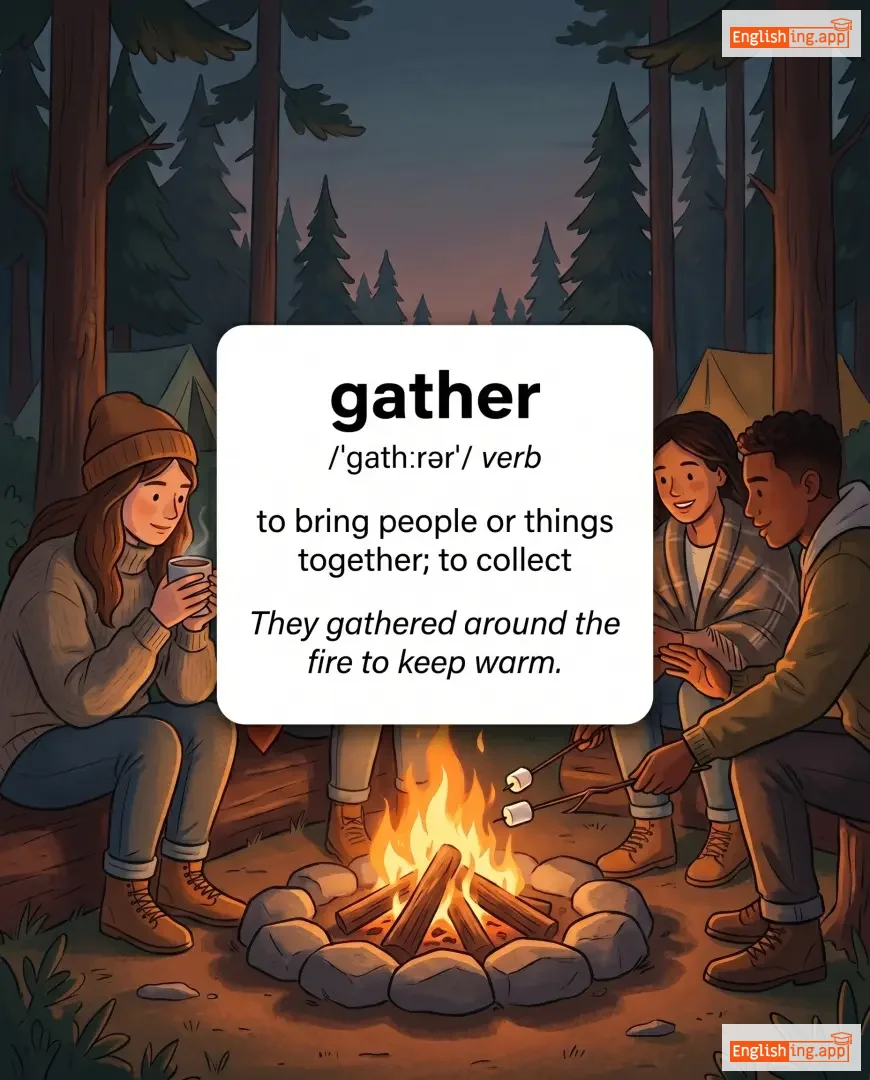
gather definition card — visual illustration of the meaning
verb
/ˈɡæðər/
收集 (shōují)

to bring people or things together; to collect

"They gathered around the fire to keep warm."

"他们围绕着火堆聚集以保持温暖。" (Tāmen wéirào zhe huǒduī jùjí yǐ bǎochí wēnnuǎn.)
noun
/ˈɡæðərɪŋ/
聚会 (juhui)

a meeting or assembly of people for a particular purpose

"We attended a family gathering last weekend."
"我们上周末参加了一个家庭聚会。" (Wo men shang zhou mo can jia le yi ge jia ting ju hui.)
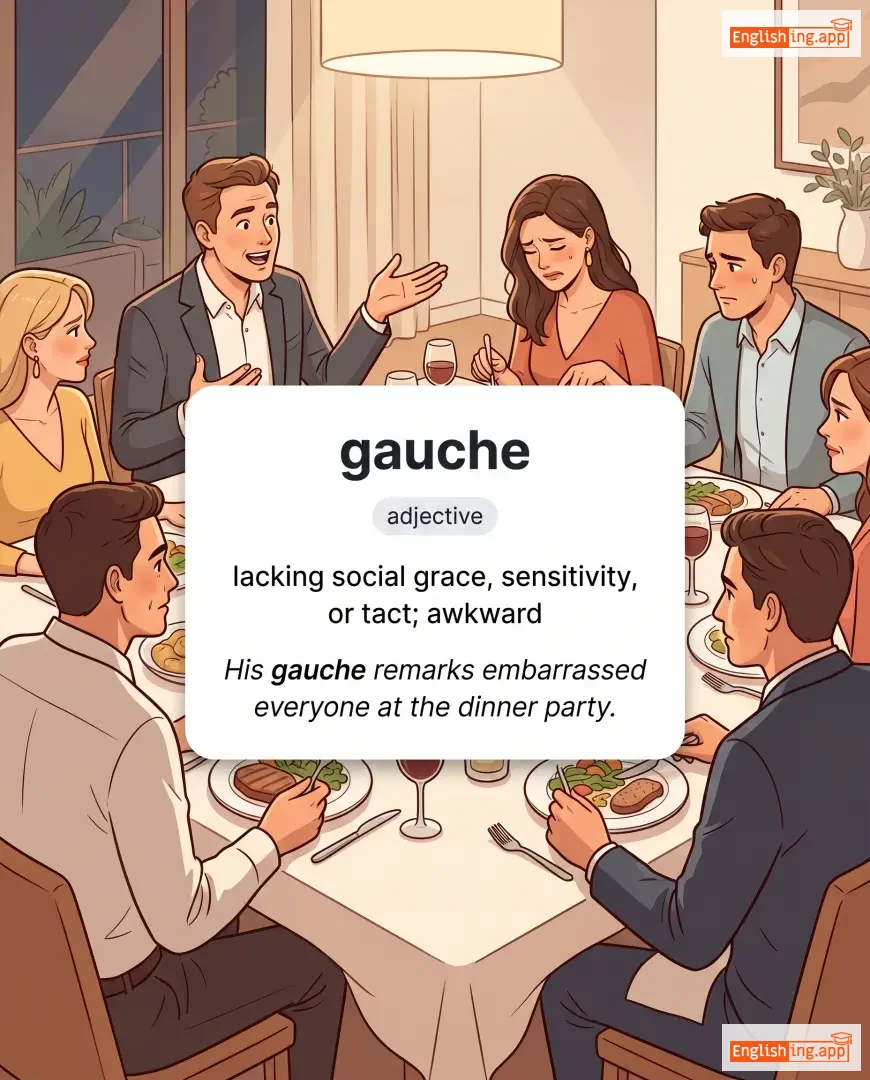
gauche definition card — visual illustration of the meaning
adjective
/ɡoʊʃ/
笨拙 (ben zhuo)

lacking social grace, sensitivity, or tact; awkward

"His gauche remarks embarrassed everyone at the dinner party."

"他那笨拙的评论让晚宴上的每个人都感到尴尬。" (Ta na ben zhuo de pinglun rang wanye shang de meigeren dou gandao gan'ga.)
adjective
/ˈɡɔːdi/
花哨 (huā shào)

excessively showy or flashy, often in a tasteless way

"She wore a gaudy necklace that clashed with her elegant dress."

"她戴着一条花哨的项链,与她优雅的裙子格格不入。" (Tā dàizhe yītiáo huā shào de xiàngliàn, yǔ tā yōuyǎ de qúnzi gé gé bù rù.)
verb
/ɡeɪdʒ/
测量 (cèliàng)

to measure, estimate, or determine the magnitude, amount, or capacity of something

"The mechanic gauged the pressure in the car tires."

"机械师测量了车胎的压力。" (jīxiè shī cèliàngle chētāi de yālì.)
adjective
/ɡɔːnt/
憔悴 (qiáocuì)

extremely thin, bony, and haggard in appearance, often due to hunger or illness

"After weeks of illness, he looked pale and gaunt."

"经过几周的生病,他看起来又苍白又憔悴。" (Jīngguò jǐ zhōu de shēngbìng, tā kàn qǐlái yòu cāngbái yòu qiáocuì.)
noun
/ˈɡɔːntlɪt/
护手 / 挑战 (hushou / tiaozhan)

a protective glove; a challenge or trial; to 'throw down the gauntlet' means to issue a challenge

"The knight threw down his gauntlet as a sign of challenge."

"骑士把他的护手扔下,作为挑战的标志。" (qishi ba tā de hushou reng xia, zuòwéi tiaozhan de biaozhi.)
noun
/ˈɡævəl/
法槌 (fǎchuí)

A small ceremonial mallet used by a judge or an auctioneer to signal attention or mark a decision.

"The judge struck the gavel to call the court to order."

"法官敲打法槌以召集法庭秩序。" (Fǎguān qiāodǎ fǎchuí yǐ zhàojí fǎtíng zhìxù.)
verb
/ɡɔːk/
盯着看 (dīngzhe kàn)

To stare openly and rudely.

"Tourists gawked at the celebrity walking down the street."

"游客们在街上看到名人时盯着看。" (Yóukèmen zài jiē shàng kàn dào míngrén shí dīngzhe kàn.)
adjective
/ˈɡɔːki/
笨拙 (bènzhuō)

Awkward and clumsy in appearance or behavior.

"The teenager felt gawky in his oversized suit."

"那个青少年在他的大西装里感到笨拙。" (Nàgè qīngshàonián zài tā de dà xīzhuāng lǐ gǎndào bènzhuō.)
🏳️‍🌈

gay (ɡeɪ)

adjective
/ɡeɪ/
同志 (tongzhi)

sexually attracted to people of the same sex; also used to mean cheerful or lively

"He came out as gay during college."

"他在大学期间公开了自己是同志。" (Ta zai daxue qijian gongkai le ziji shi tongzhi.)
verb
/ɡeɪz/
凝视 (níngshì)

To look steadily and intently at something, usually with admiration, surprise, or thought.

"He gazed at the stars in wonder."

"他惊奇地盯着星星。" (tā jīngqí de dīngzhe xīngxīng.)
noun
/ɡəˈzɛt/
公报 (gongbao)

An official journal, newspaper, or publication, especially one issued by a government.

"The law was published in the government gazette."

"这部法律已在政府公报上公布。" (Zhe bu falv yi zai zhengfu gongbao shang gongbu.)
noun
/ɡɪə(r)/
装备 / 齿轮 (zhuāngbèi / chǐlún)

Equipment or apparatus for a particular purpose; also a toothed wheel in machinery.

"The climber packed all his gear before starting the journey."

"登山者在开始旅程之前,打包了他所有的装备。" (Dēngshān zhě zài kāishǐ lǚchéng zhīqián, dǎbāo le tā suǒyǒu de zhuāngbèi.)
noun
/dʒem/
宝石 (baoshi)

a precious or semi-precious stone, especially when cut and polished or engraved

"She wore a beautiful gem necklace to the party."

"她在派对上戴着一条美丽的宝石项链。" (Ta zai pai dui shang dai zhe yi tiao mei li de baoshi xianglian.)
noun
/ˈʒɑːndɑːrm/
宪兵 (xianbing)

A French police officer, especially a member of a military-style police force.

"The gendarme stopped the car for a routine check."

"宪兵因例行检查而拦住了汽车。" (Xianbing yin lixing jiancha er lan zhu le qiche.)
noun
/ˈdʒɛndər/
性别 (xingbie)

The state of being male, female, or another identity as recognized socially or culturally.

"The survey asked about participants' age and gender."

"调查询问了参与者的年龄和性别。" (Diaocha xunwenle canyuzhe de nianling he xingbie.)
noun
/dʒiːn/
基因 (ji yin)

A unit of heredity in living organisms, transferred from parent to offspring, determining traits.

"Eye color is influenced by genes inherited from parents."

"眼睛的颜色受从父母遗传的基因的影响。" (yanjing de yanse shou cong fumu yichuan de jiyin de yingxiang.)
noun
/ˌdʒiːniˈælədʒɪst/
家谱学家 (jiapu xuejia)

A person who studies or traces the history of families and their lineages.

"The genealogist uncovered records dating back to the 18th century."

"家谱学家发现了追溯到18世纪的记录。" (Jiapu xuejia faxianle zhuisu dao 18 shiji de jilu.)
noun
/ˌdʒiːniˈælədʒi/
家谱学 (jiāpǔ xué)

The study and tracing of lines of descent or family history.

"She spent years researching her family's genealogy."

"她花了多年研究她家族的家谱学。" (Tā huāle duō nián yánjiū tā jiāzú de jiāpǔ xué.)
adjective
/ˈdʒɛnərəl/
一般的 (yībān de)

Relating to all or most people, things, or situations; not specific.

"He made a general comment about the project."

"他对这个项目做了一个一般的评论。" (Tā duì zhège xiàngmù zuòle yīgè yībān de pínglùn.)
noun
/ˌdʒenəˈræləti/
概括性 (gàikuòxìng)

A vague, non-specific statement or principle that applies broadly.

"The speech was full of generalities and lacked concrete details."

"演讲充满了概括性,缺乏具体的细节。" (Yǎnjiǎng chōngmǎnle gàikuòxìng, quēfá jùtǐ de xìjié.)
verb
/ˈdʒenərəlaɪz/
概括 (gàikuò)

To make a broad statement by inferring from specific cases.

"It is wrong to generalize based on a few experiences."

"根据几次经历做出概括是错误的。" (Gēnjù jǐ cì jīnglì zuòchū gàikuò shì cuòwù de.)
adverb
/ˈdʒɛnərəli/
通常 (tong chang)

in most cases; usually; as a rule

"He generally arrives at work before 9 a.m."

"他通常在9点前到达工作。" (Ta tong chang zai 9 dian qian dao da gongzuo.)
verb
/ˈdʒɛnəreɪt/

to produce or create something

"The machine generates electricity."

noun
/ˌdʒɛnəˈreɪʃən/
一代 (yídài)

all the people born and living at about the same time; the process of producing something

"The younger generation is more comfortable with technology."

"年轻一代更适应技术。" (niánqīng yídài gèng shìyìng jìshù.)