词汇表

英语词汇词典 | 单词含义、定义和示例

adjective
/fɔːls/
虚假 (xūjiǎ)

not true or correct; intended to deceive

"He was accused of giving false information."

"他被指控提供虚假信息。" (Tā bèi zhǐkòng tígōng xūjiǎ xìnxī.)
noun
/ˈfɔːlshʊd/
谎言 (huǎngyán)

the state of being untrue or a lie

"He was punished for spreading falsehoods about his colleague."

"他因散布关于同事的谎言而受到了惩罚。" (Tā yīn sànbù guānyú tóngshì de huǎngyán ér shòu dào le chéngfá.)
verb
/ˈfɔːlsɪfaɪ/
伪造 (wěizào)

to make something false or to misrepresent

"He tried to falsify the documents to avoid taxes."

"他试图伪造文件以避免税收。" (Tā shìtú wěizào wénjiàn yǐ bìmiǎn shuìshōu.)
verb
/ˈfɔːltər/
犹豫或失去力量或动力 (youyu huo shiqu liliang huo dongli)

to hesitate or lose strength or momentum

"Her voice faltered as she delivered the speech."

"她的声音在演讲时颤抖。" (Ta de shengyin zai yanjiang shi chandong.)
noun
/feɪm/
名声 (míng shēng)

the state of being known or recognized by many people

"She achieved worldwide fame for her acting."

"她因表演而获得了全球的名声。" (Tā yīn biǎoyǎn ér huòdé le quánqiú de míngshēng.)
adjective
/fəˈmɪliər/
熟悉的 (shúxī de)

Well known or easily recognized from previous experience.

"The town looked familiar to me after so many years."

"经过这么多年后,这个城市对我来说很熟悉。" (Jīngguò zhème duōnián hòu, zhège chéngshì duì wǒ lái shuō hěn shúxī.)
👨‍👩‍👧‍👦

family (fāmílì)

noun
/ˈfæməli/
家庭 (jiātíng)

A group consisting of parents and their children, or all the descendants of a common ancestor.

"She spends most of her weekends with her family."

"她把大部分周末时间都和家人一起度过。" (Tā bǎ dà bùfen zhōumò shíjiān dōu hé jiārén yīqǐ dùguò.)
Family Tree definition card — visual illustration of the meaning
noun
ˈfæmɪli triː
家谱 (jiā pǔ)

A diagram showing the relationships between people in several generations of a family.

"Creating a family tree helps understand family history."

"创建家谱有助于理解家庭历史。" (Chuàngjiàn jiāpǔ yǒuzhù yú lǐjiě jiātíng lìshǐ.)
noun
/ˈfæm.ɪn/
饥荒 (jīhuāng)

extreme scarcity of food; a period when food is extremely scarce

"The severe drought led to widespread famine in the region."

"严重的干旱导致该地区广泛的饥荒。" (Yánzhòng de gānhàn dǎozhì gāi dìqū guǎngfàn de jīhuāng.)
verb
/ˈfæmɪʃ/
挨饿 (āi è)

to suffer or cause to suffer from extreme hunger

"The stranded hikers began to famish after several days without food."
"困住的徒步旅行者在没有食物的几天后开始感到饥饿。" (kùn zhù de tú bù lǚ xíng zhě zài méi yǒu shí wù de jǐ tiān hòu kāi shǐ gǎn dào jī è.)
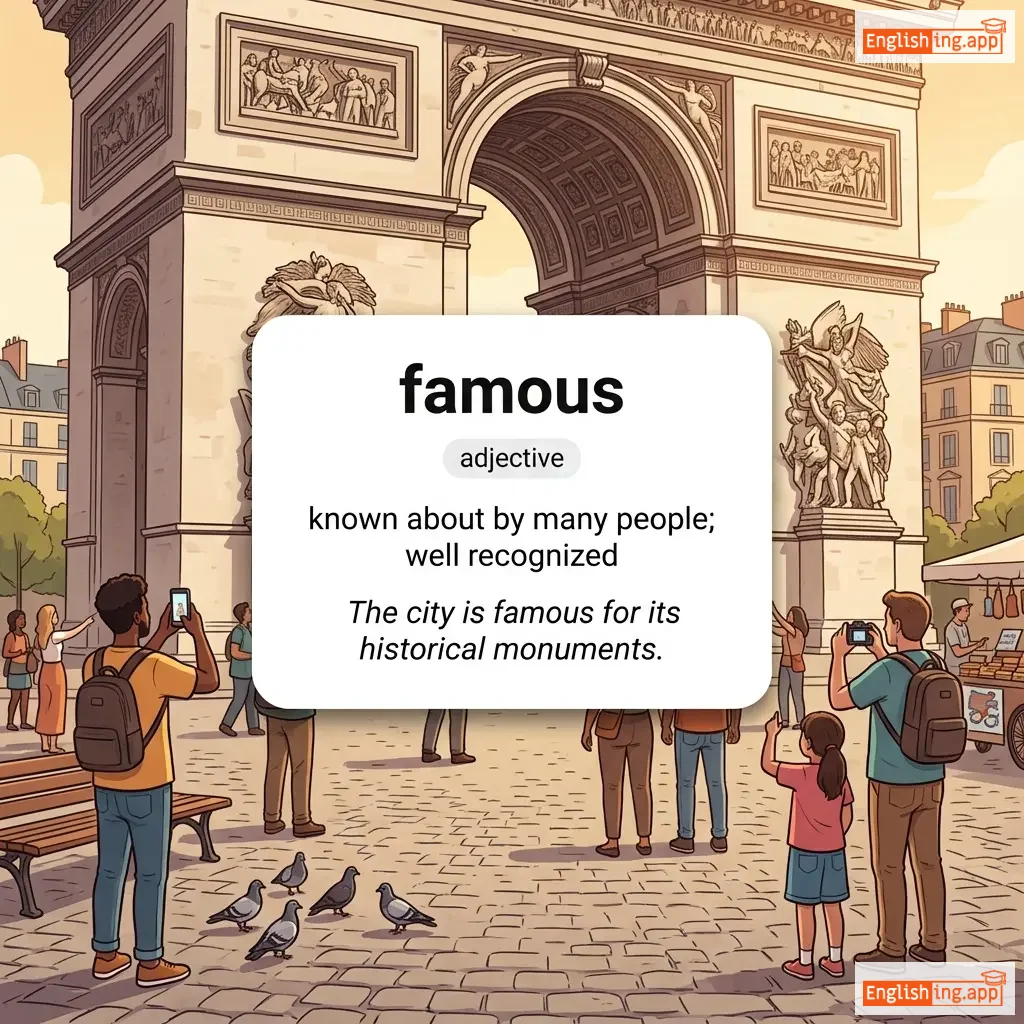
famous definition card — visual illustration of the meaning
adjective
/ˈfeɪməs/
著名 (zhùmíng)

known about by many people; well recognized

"The city is famous for its historical monuments."

"这座城市因其历史遗迹而闻名。" (Zhè zuò chéngshì yīn qí lìshǐ yíjì ér wénmíng.)
noun
/fæn/
幸福 (xìng fú)

a device with rotating blades that creates a current of air; also a person who admires or supports someone or something

"The fan kept the room cool during the hot summer day."

"她收到奖项时无法掩饰自己的幸福。" (Tā shōu dào jiǎng xiàng shí wú fǎ yǎn shì zì jǐ de xìng fú.)
noun
/fəˈnætɪk/
狂热分子 (kuángrè fēnzǐ)

a person with extreme and uncritical enthusiasm for a cause or belief

"He is a football fanatic, never missing a match of his favorite team."

"他是一个足球疯狂粉丝,从不缺席他最喜欢球队的比赛。" (Tā shì yīgè zúqiú kuángrè fěnsī, cóng bù quēxí tā zuì xǐhuān qiúduì de bǐsài.)
adjective
/fəˈnætɪkəl/
狂热的 (kuángrè de)

showing extreme enthusiasm or obsession

"She has a fanatical interest in collecting vintage stamps."

"她对收藏老式邮票有着狂热的兴趣。" (Tā duì shōucáng lǎoshì yóupiào yǒuzhe kuángrè de xìngqù.)
noun
/fəˈnætɪsɪzəm/
狂热 (kuángrè)

the quality of being fanatical; extreme zeal or obsession

"Religious fanaticism can lead to intolerance and conflict."

"宗教狂热可能导致不宽容和冲突。" (Zōngjiào kuángrè kěnéng dǎozhì bù kuānróng hé chōngtū.)
adjective
/ˈfænsiːd/
想象的, 渴望的 (xiangxiang de, kewang de)

imagined, desired, or believed without evidence

"He is a fancied suitor in the eyes of the young lady."

"他是年轻女士眼中的一位想象中的追求者。" (Ta shi nianqing nushih de yanjing zhong de yi wei xiangxiang zhong de zhuīqiúzhě.)
noun
/ˈfænsiər/
爱好者 (àihào zhě)

a person who has a special interest in a particular thing or activity, especially animals or hobbies

"He is a fancier of rare birds."

"他是稀有鸟类的爱好者。" (Tā shì xīyǒu niǎo lèi de àihào zhě.)
adjective
/ˈfæn.sɪ.fəl/
幻想的, 不现实的 (huànxiǎng de, bù xiànshí de)

overimaginative, unrealistic, or whimsical

"The story was too fanciful to be true."

"这个故事太幻想了,不可能是真的。" (Zhège gùshì tài huànxiǎng le, bù kěnéng shì zhēn de.)
adjective
/ˈfæn.sɪ.ləs/
没有想象力的,普通的 (meiyou xiangxiangli de, putong de)

without imagination or creativity; plain or ordinary

"His drawings were simple and fanciless."

"他的画作既简单又没有想象力。" (Tā de huàzuò jì jiǎndān yòu méiyǒu xiǎngxiànglì.)
verb
/ˈfæn.si/
想象, 渴望, 喜欢 (xiǎngxiàng, kěwàng, xǐhuān)

to imagine, desire, or like something; to have a liking for

"She fancies a cup of tea in the morning."

"她早上想喝一杯茶。" (Tā zǎoshang xiǎng hē yī bēi chá.)
noun
/ˈfæn.feər/
盛大场面, 宣传 (shèngdà chǎngmiàn, xuānchuán)

a short ceremonial tune or display of publicity to attract attention

"The new product was launched with much fanfare."

"新产品在盛大场面下发布。" (Xīn chǎnpǐn zài shèngdà chǎngmiàn xià fābù.)
adjective
/fænˈtæstɪk/
极好的 (jí hǎo de)

extraordinary, extremely good or impressive

"The concert last night was absolutely fantastic."

"昨晚的音乐会真是太棒了。" (Zuó wǎn de yīnyuè huì zhēn shì tài bàng le.)
noun
/ˈfæntəsi/
幻想 (huànxiǎng)

a creation of the imagination, especially something improbable or impossible

"She has a vivid fantasy about traveling to space."

"她有一个关于太空旅行的生动幻想。" (Tā yǒu yīgè guānyú tàikōng lǚxíng de shēngdòng huànxiǎng.)
adverb
/fɑːr/
(yuan)

at, to, or by a great distance

"The school is far from my house."

"学校离我家很远。" (Xuexiao li wo jia hen yuan.)
adjective
/ˌfɑːrˈfɛtʃt/
牵强附会 (qianqiang fuhui)

unlikely to happen or be true; improbable

"His explanation for being late was a bit far-fetched."

"他解释迟到的理由有点牵强附会。" (Ta jiexi chidao de liliang youdian qianqiang fuhui.)
noun
/fɑːrs/
闹剧 (nàojù)

a comic dramatic work using buffoonery and horseplay, or a ridiculous situation

"The meeting turned into a complete farce with everyone arguing."

"会议变成了一场彻底的闹剧,大家都在争论。" (Huìyì biàn chéngle yī chǎng chèdǐ de nàojù, dàjiā dōu zài zhēnglùn.)
noun
/fɛər/
车费 (chefei)

the money paid for a journey on public transport; also food or treatment provided

"The bus fare to the city center is five dollars."

"到市中心的公交车费是五美元。" (Dao shi zhongxin de gongjiaoche fei shi wu meiyuan.)
noun
/ˌfer.ˈwel/
告别 (gàobié)

an act of parting or of marking someone's departure

"The company organized a farewell party for the retiring manager."

"公司为即将退休的经理举办了告别派对。" (Gōngsī wèi jíjiāng tuìxiū de jīnglǐ jǔbànle gàobié pàiduì.)
adjective
/ˌfɑːrˈfetʃt/
不太可能或不太真实 (bù tài kěnéng huò bù tài zhēnshí)

unlikely to happen or be true; improbable

"His explanation for being late sounded farfetched."

"他解释迟到的理由听起来不可信。" (Tā jiěshì chídào de lǐyóu tīng qǐlái bù kěxìn.)
noun
/fɑːrm/
农场 (nongchang)

an area of land used for growing crops and raising animals

"They live on a farm with many animals."

"他们住在一个有许多动物的农场。" (Tāmen zhù zài yīgè yǒu xǔduō dòngwù de nóngchǎng.)
noun
/ˈfɑːrmər/
农民 (nóngmín)

a person who owns or manages a farm

"The farmer works hard to grow crops."

"农民辛勤工作以种植庄稼。" (Nóngmín xīnqín gōngzuò yǐ zhòngzhí zhuāngjià.)
noun
/ˈfɑː.mɪŋ/
农业 (nongye)

the activity or business of growing crops and raising animals for food or other products

"Farming requires both hard work and knowledge about the land."

"农业需要辛勤的工作和对土地的知识。" (Nongye xuyao xinqin de gongzuo he dui tudi de zhishi.)
verb
/ˈfæs.ɪ.neɪt/
迷住 (mí zhù)

to attract and hold the attention of someone; to charm or captivate

"The magician's performance fascinated the audience."

"魔术师的表演吸引了观众。" (Móshù shī de biǎoyǎn xīyǐnle guānzhòng.)
adjective
/ˈfæsɪneɪtɪŋ/
迷人 (mírén)

extremely interesting or charming

"The history of ancient Egypt is truly fascinating."

"古埃及的历史真是令人着迷。" (Gǔ āijí de lìshǐ zhēn shì lìng rén zháomí.)
noun
/ˌfæs.ɪˈneɪ.ʃən/
迷恋; 吸引; 吸引力 (mílian, xīyǐn, xīyǐnlì)

the power to fascinate someone; the state of being intensely interested

"Her fascination with ancient history led her to become an archaeologist."

"她对古代历史的迷恋让她成为了一名考古学家。" (Tā duì gǔdài lìshǐ de míliàn ràng tā chéngwéi le yī míng kǎogǔ xuéjiā.)
fascist definition card — visual illustration of the meaning
adjective
ˈfæʃ.ɪst
法西斯 (faxi si)

Relating to or characteristic of fascism; extremely authoritarian.

"Fascist governance undermines freedom."

"法西斯统治破坏自由。" (Faxi si tongzhi pohuai ziyou.)
noun
/ˈfæʃ.ən/
时尚 (shíshàng)

a popular or accepted style of clothing, behavior, or way of doing something

"She always keeps up with the latest fashion."

"她总是跟上最新的时尚。" (Tā zǒng shì gēn shàng zuìxīn de shíshàng.)
adjective
/ˈfæʃənəbəl/
时尚的 (shishang de)

Following the latest styles or trends in clothing, behavior, or ideas

"She always wears fashionable clothes to every party."

"她总是在每个派对上穿时尚的衣服。" (Ta zong shi zai mei ge paidui shang chuan shishang de yifu.)
🏎️

Fast (快)

adjective, adverb
/fæst/
快速,牢固固定 (kuài, láogù gùdìng)

moving or capable of moving at high speed; firm or securely fixed

"He drives very fast on the highway."

"他在高速公路上开得很快。" (Tā zài gāosù gōnglù shàng kāi dé hěn kuài.)
verb
/ˈfæsən/
系紧 (jijin)

To attach or secure something firmly in place

"Please fasten your seatbelt before the plane takes off."

"请在飞机起飞前系好安全带。" (Qing zai feiji qifei qian xi hao anquandai.)
adjective, adverb
/ˈfæstər/
更快 (geng kuai)

moving or able to move quickly; more quickly than usual

"This car is faster than the old one."

"这辆车比老车更快。" (Zhe liang che bi lao che geng kuai.)
adjective
/ˈfæstɪst/
最快的 (zui kuai de)

moving or capable of moving at the highest speed

"Usain Bolt is the fastest runner in the world."

"尤塞恩·博尔特是世界上跑得最快的运动员。" (You sai en Bo er te shi shijie shang pao de zui kuai de yundongyuan.)
fastidious definition card — visual illustration of the meaning
adjective
/fæˈstɪdiəs/
挑剔的,难以取悦的 (tiaoti de, nanyi quyue de)

very attentive to detail; hard to please

"She is fastidious about keeping her room clean."

"她在保持房间整洁方面非常挑剔。" (Ta zai baochi fangjian zhengjie fangmian feichang tiaoti.)
adjective, noun
/fæt/
肥胖 (feipang)

having a lot of excess flesh; a natural oily substance in animal bodies

"Eating too much fast food can make you fat."

"吃太多快餐会让你变胖。" (Chī tài duō kuàicān huì ràng nǐ biàn pàng.)
adjective
/ˈfeɪtl/
致命的 (zhìmìng de)

causing death; leading to disaster

"The accident proved fatal for the driver."

"事故对司机来说是致命的。" (Shìgù duì sījī lái shuō shì zhìmìng de.)
noun
/ˈfeɪ.tə.lɪ.zəm/
宿命论 (sùmìnglùn)

the belief that all events are predetermined and inevitable

"He embraced fatalism, believing that nothing he did could change his destiny."

"他接受了宿命论,相信无论他做什么,都无法改变他的命运。" (Tā jiēshòu le sùmìnglùn, xiāngxìn wúlùn tā zuò shénme, dōu wúfǎ gǎibiàn tā de mìngyùn.)
noun
/fəˈtæləti/
致命事故 (zhìmìng shìgù)

An occurrence of death by accident, disaster, or violence.

"The accident resulted in one fatality."

"这场事故导致了一人死亡。" (Zhè chǎng shìgù dǎozhìle yī rén sǐwáng.)
adverb
/ˈfeɪ.təl.i/
致命地 (zhìmìng de)

in a way that causes death; with deadly consequences; critically

"The accident fatally injured two passengers."

"事故致命地伤害了两名乘客。" (Shìgù zhìmìng de shānghài le liǎng míng chéngkè.)
noun
/feɪt/
命运 (mingyun)

the development of events beyond a person's control, regarded as determined by a supernatural power

"She believed it was her fate to become a teacher."

"她相信成为教师是她的命运。" (Ta xiangxin chengwei jiaoshi shi ta de mingyun.)
adjective
/ˈfeɪt.fəl/
决定性或灾难性的 (juédìngxìng huò zāinànxìng de)

having significant or disastrous consequences

"Their fateful decision changed the course of history."

"他们的决定性决定改变了历史的进程。" (Tāmen de juédìngxìng juédìng gǎibiànle lìshǐ de jìnchéng.)