
词汇表

英语词汇词典 | 单词含义、定义和示例

deliberate definition card — visual illustration of the meaning
adjective, verb
/dɪˈlɪbərət/ (adj), /dɪˈlɪbəreɪt/ (verb)

done consciously and intentionally; to consider or discuss something carefully

"The committee will deliberate on the proposal tomorrow."

deliberately definition card — visual illustration of the meaning
adverb
/dɪˈlɪbərətli/
故意地 (gùyì de)

Done on purpose; intentionally.

"She deliberately ignored his question."
"她故意忽视了他的问题。" (Tā gùyì hūshì le tā de wèntí.)
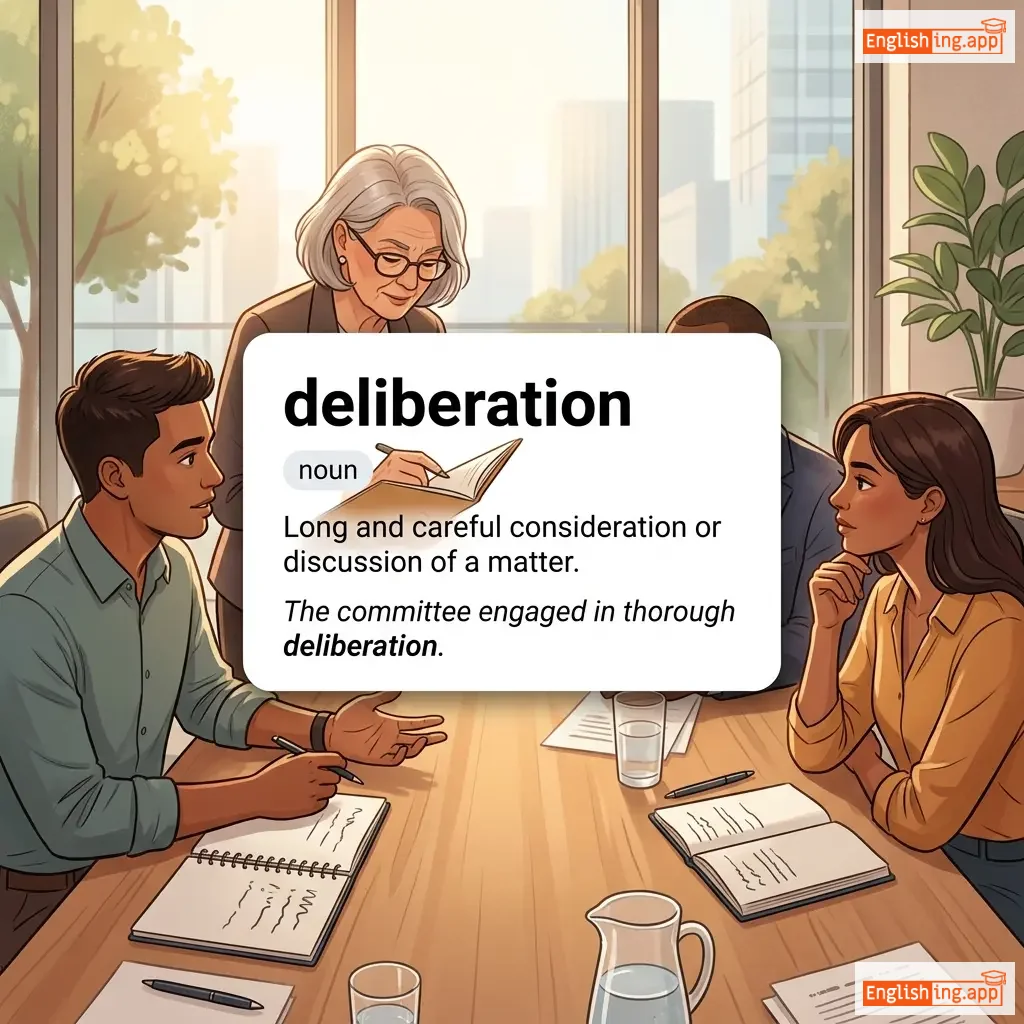
deliberation definition card — visual illustration of the meaning
noun
dɪˌlɪb.əˈreɪ.ʃən
深思熟虑 (shensi shulv)

Long and careful consideration or discussion of a matter.

"The committee engaged in thorough deliberation."

"委员会参与了深入的讨论。" (Wei yuan hui can yu le shen ru de tao lun.)
deliberations definition card — visual illustration of the meaning
noun
dɪˌlɪb.əˈreɪ.ʃənz
讨论 (tǎo lùn)

Long and careful consideration or discussion

"Deliberations on AI governance are ongoing."

"关于AI治理的讨论正在进行。" (Guānyú AI zhìlǐ de tǎolùn zhèngzài jìnxíng.)
noun
/ˈdɛlɪkəsi/
美食 / 精致 (měishí / jīngzhì)

a rare or expensive food item; fineness or sensitivity

"Caviar is considered a delicacy in many countries."

"鱼子酱在许多国家被认为是一种美食。" (yú zǐ jiàng zài xǔduō guójiā bèi rènwéi shì yī zhǒng měishí.)
adjective
/ˈdɛlɪkət/
脆弱 (cuìruò)

Easily broken or damaged; requiring careful handling.

"The vase is very delicate, so handle it with care."

"这个花瓶非常脆弱,所以请小心拿。" (Zhège huāpíng fēicháng cuìruò, suǒyǐ qǐng xiǎoxīn ná.)
adjective
/dɪˈlɪʃəs/
幸福 (xìngfú)

having a very pleasant taste or smell

"The cake was so delicious that everyone asked for a second slice."

"当她获得奖项时,她无法掩饰她的快乐。" (Dāng tā huòde jiǎngxiàng shí, tā wúfǎ yǎnshì tā de kuàilè.)
noun, verb
/dɪˈlaɪt/
喜悦 (xiyue)

great pleasure or joy; to give someone great pleasure

"The children were filled with delight when they saw the gifts."

"孩子们看到礼物时充满了喜悦。" (Haizimen kandao liwu shi chongman le xiyue.)
adjective
/dɪˈlaɪtɪd/
高兴 (gaoxing)

feeling or showing great pleasure and happiness

"She was delighted with the surprise gift."

"她对惊喜礼物感到非常高兴。" (Tā duì jīngxǐ lǐwù gǎndào fēicháng gāoxìng.)
verb
/diːˈlɪmɪt/
划定 (huá dìng)

to fix the boundaries or limits of something

"The treaty was signed to delimit the borders of the two countries."

"该条约被签署以划定两国的边界。" (Gāi tiáoyuē bèi qiānshǔ yǐ huá dìng liǎng guó de biān jiè.)
delineate definition card — visual illustration of the meaning
verb
/dɪˈlɪnieɪt/
描绘 (miaohui)

to describe, portray, or define something precisely and clearly

"The contract clearly delineates the responsibilities of each party."

"合同清楚地划定了各方的责任。" (Hetong qingchu de huading le ge fang de zeren.)
noun
/dɪˌlɪniˈeɪʃən/
界定 (jièdìng)

the precise description, drawing, or outlining of something

"The artist’s delineation of the landscape was remarkably accurate."

"艺术家对风景的界定非常准确。" (Yìshùjiā duì fēngjǐng de jièdìng fēicháng zhǔnquè.)
verb
/ˌdɛlɪˈkwɛs/
通过吸收空气中的水分变为液体 (tōngguò xīshōu kōngqì zhōng de shuǐfèn biànwéi yètǐ)

to become liquid by absorbing moisture from the air

"The salt began to deliquesce after being left in the humid room."

"盐开始在潮湿的房间里变成液体。" (Yán kāishǐ zài cháoshī de fángjiān lǐ biàn chéng yètǐ.)
adjective
/ˌdɛlɪˈkwɛsənt/
由于吸湿而变成液体 (yóu yú xī shī ér biàn chéng yè tǐ)

tending to become liquid by absorbing moisture from the air

"Sugar is not deliquescent, but salt can be."

"糖不是黴變的,但鹽可以。" (Táng bù shì méi biàn de, dàn yán kě yǐ.)
adjective
/dɪˈlɪriəs/
得利瑞厄斯 (délìruì è sī)

in an extremely disturbed or excited state of mind, often due to illness or emotion

"He was delirious with fever and kept muttering nonsense."

"他因发烧而神志不清,一直在嘟囔胡话。" (Tā yīn fāshāo ér shénzhì bù qīng, yīzhí zài dūnang húhuà.)
noun
/dɪˈlɪriəm/
谵妄 (zhān wàng)

An acutely disturbed state of mind characterized by restlessness, illusions, and incoherence.

"The patient experienced delirium after the surgery due to the strong medication."

"患者在手术后由于强烈的药物而经历了谵妄。" (Huànzhě zài shǒushù hòu yóuyú qiángliè de yàowù ér jīnglì le zhānwàng.)
verb
/dɪˈlɪvər/
交付 (jiaofu)

to bring or hand over something to the intended recipient

"The courier will deliver the package tomorrow."

"快递员明天会送包裹。" (kuaidi yuan ming tian hui song bao guo.)
noun
/dɪˈlɪvəri/
递送 (dìsòng)

the act of taking goods, letters, or packages to people's houses or places of work

"The delivery of fresh vegetables arrives every morning."

"新鲜蔬菜的递送每天早上都会到达。" (Xīnxiān shūcài de dìsòng měitiān zǎoshang dōu huì dàodá.)
noun
/ˈdɛltə/
三角洲 (sānjiǎozhōu)

A landform at the mouth of a river where it splits into several outlets.

"The Nile Delta is one of the most fertile regions in Egypt."

"尼罗河三角洲是埃及最肥沃的地区之一。" (Níluóhé sānjiǎozhōu shì āijí zuì féiwò de dìqū zhī yī.)
deltaic landscape definition card — visual illustration of the meaning
noun
delˈteɪɪk ˈlændskeɪp
三角洲景观 (sānjiǎozhōu jǐngguān)

A geographical area formed by sediment deposits at the mouth of a river, creating a triangular land formation.

"Bangladesh has a unique deltaic landscape."

"孟加拉国拥有独特的三角洲景观。" (Mèngjiālāguó yǒngyǒu dútè de sānjiǎozhōu jǐngguān.)
verb
/dɪˈluːd/
欺骗 (qī piàn)

To mislead someone into believing something that is not true.

"He deluded himself into thinking he could win the race without training."

"他欺骗自己认为自己可以不训练就赢得比赛。" (Tā qīpiàn zìjǐ rènwéi zìjǐ kěyǐ bù xùnliàn jiù yíngdé bǐsài.)
noun
/ˈdɛljuːdʒ/
洪水 (hongshui)

A severe flood; an overwhelming quantity of something.

"The town was hit by a deluge of rain in just a few hours."

"该镇在几个小时内被大雨洪水淹没。" (Gai zhen zai ji ge xiaoshi nei bei da yu hong shui yan mo.)
noun
/dɪˈluːʒən/
错觉 (cuo jue)

A false belief or impression maintained despite being contradicted by reality.

"He lived under the delusion that he was invincible."

"他生活在他自己是不可战胜的错觉中。" (Ta shenghuo zai ta ziji shi bukezhansheng de cuo jue zhong.)
adjective
/dɪˈluːsɪv/
虚假的 (xu jia de)

Giving a false or misleading impression; deceptive.

"His promises turned out to be delusive and untrustworthy."

"他的承诺被证明是具有误导性的和不可信的。" (Ta de chengnuo bei zhengming shi juyou wudao xing de he bukexin de.)
adjective
/dɪˈluːsəri/
虚幻的 (xū huàn de)

Based on illusion; not real.

"He was filled with delusory hopes of becoming famous overnight."

"他充满了不切实际的希望,认为自己一夜成名。" (Tā chōngmǎnle bù qiē shí de xīwàng, rènwéi zìjǐ yīyè chéngmíng.)
🔍

delve

verb
/dɛlv/

To investigate deeply; to dig into a subject or area.

"The researcher delved into ancient manuscripts to find clues."

verb
/diːˈmæɡnɪtaɪz/
去磁 (quci)

To remove or reduce the magnetic properties of something.

"The technician demagnetized the old cassette tape."

"技术员去掉了老磁带的磁性。" (Jishuyuan qudiao le lao cida de cixing.)
noun
/ˈdɛməɡɒɡ/
民粹主义者 (míncuì zhǔyì zhě)

A political leader who seeks support by appealing to popular desires and prejudices rather than by using rational argument.

"The crowd was swayed by the fiery speeches of the demagogue."

"人群受到了民粹主义者激烈演讲的影响。" (Rénqún shòudàole míncuì zhǔyì zhě jīliè yǎnjiǎng de yǐngxiǎng.)
noun, verb
/dɪˈmænd/
需求 (xuqiu)

to ask for something forcefully; the need or desire for goods or services

"Workers demanded better wages from the company."

"工人要求公司提高工资。" (Gōngrén yāoqiú gōngsī tígāo gōngzī.)
adjective
/dɪˈmændɪŋ/
苛刻的 (kekede)

requiring much effort, skill, or attention; difficult to satisfy

"The job is very demanding and requires long hours of work."

"这份工作非常苛刻,需要长时间的工作。" (Zhe fen gongzuo feichang keke, xuyao chang shijian de gongzuo.)
verb
/ˈdiːmɑːrˌkeɪt/
划定 (huà dìng)

to set the boundaries or limits of something

"The land was demarcated with fences to avoid disputes."

"土地被围栏划定以避免争议。" (Tǔdì bèi wéilán huàdìng yǐ bìmiǎn zhēngyì.)
noun
/ˌdiː.mɑːˈkeɪ.ʃən/
划界 (huà jiè)

the action of fixing the boundary or limits of something; separation or division

"The demarcation between public and private land was clearly marked."

"公共和私人土地之间的划界已被明确标记。" (Gōnggòng hé sīrén tǔdì zhījiān de huàjiè yǐ bèi míngquè biāojì.)
verb
/dɪˈmiːn/
贬低 (biǎndī)

to cause someone to lose dignity or respect

"The manager demeaned his employees with rude remarks."

"经理用粗鲁的言辞贬低了他的员工。" (Jīnglǐ yòng cūlǔ de yáncí biǎndī le tā de yuángōng.)
noun
/dɪˈmiːnər/
行为 (xingwei)

a person's outward behavior or appearance

"Her calm demeanor impressed everyone at the meeting."

"她的冷静行为给会议上的每个人留下了深刻印象。" (Tā de lěngjìng xíngwéi gěi huìyì shàng de měi gèrén liúxiàle shēnkè yìnxiàng.)
noun
/dɪˈmiːnər/
行为 (xíngwéi)

a person's outward behavior or appearance

"Her calm demeanour impressed everyone during the meeting."

"她平静的行为在会议中给大家留下了深刻印象。" (Tā píngjìng de xíngwéi zài huìyì zhōng gěi dàjiā liú xiàle shēnkè yìnxiàng.)
adjective
/dɪˈmɛntɪd/
精神错乱的 / 不理智的 (jīngshén cuòluàn de / bù lǐzhì de)

behaving irrationally due to mental illness or extreme excitement

"He looked demented after hearing the shocking news."

"他在听到令人震惊的消息后看起来像个精神错乱的人。" (Tā zài tīngdào lìng rén zhènjīng de xiāoxī hòu kàn qǐlái xiàng gè jīngshén cuòluàn de rén.)
noun
/dɪˈmɛrɪt/
缺点 / 罚分 (quēdiǎn / fá fēn)

A fault or disadvantage; a mark against a person for misconduct.

"He received a demerit for being late to class."

"他因迟到而获得了一个惩罚分。" (Tā yīn chídào ér huòdéle yīgè chéngfá fēn.)
noun
/dɪˈmeɪn/
附属于庄园的土地 (fù shǔ yú zhuāngyuán de tǔdì)

Land attached to a manor and retained for the owner's use.

"The castle was surrounded by its vast demesne."

"城堡被其广阔的附属于庄园的土地所包围。" (Chéngbǎo bèi qí guǎngkuò de fù shǔ yú zhuāngyuán de tǔdì suǒ bāowéi.)
noun
/dɪˈmaɪz/
死亡 / 结束 (sǐwáng / jiéshù)

Death or end of something, especially the end of an institution or system.

"The sudden demise of the company shocked investors."

"公司突如其来的倒闭震惊了投资者。" (Gōngsī tū rútí lái de dǎobì zhèngjīngle tóuzī zhě.)
verb
/diːˈmoʊbəlaɪz/
解散 (jiesan)

To release from military service or to disband troops.

"The government decided to demobilize the army after the war."
"政府决定在战争后解散军队。" (Zhengfu jueding zai zhanzheng hou jiesan jundui.)
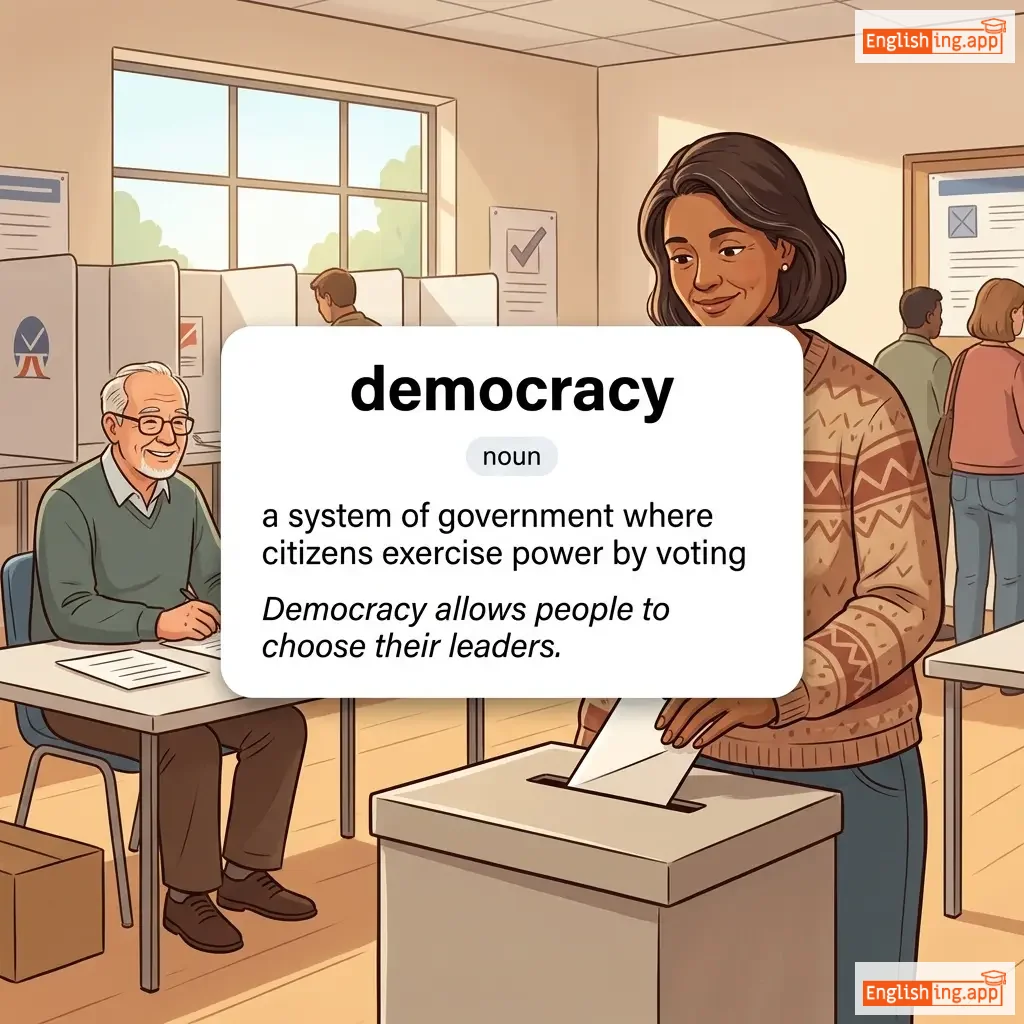
democracy definition card — visual illustration of the meaning
noun
/dɪˈmɑːkrəsi/
民主 (minzhu)

a system of government where citizens exercise power by voting

"Democracy allows people to choose their leaders."

"民主允许人民选择他们的领导人。" (mínzhǔ yǔnxǔ rénmín xuǎnzé tāmen de lǐngdǎo rén.)
noun
/ˈdɛməˌkræt/
民主党人 (minzhudang ren)

a supporter of democracy or a member of the Democratic Party in the US

"He is a strong democrat who believes in equal rights."
"他是一个坚强的民主党人,相信平等的权利。" (Ta shi yige jianqiang de minzhudang ren, xiangxin pingdeng de quanli.)
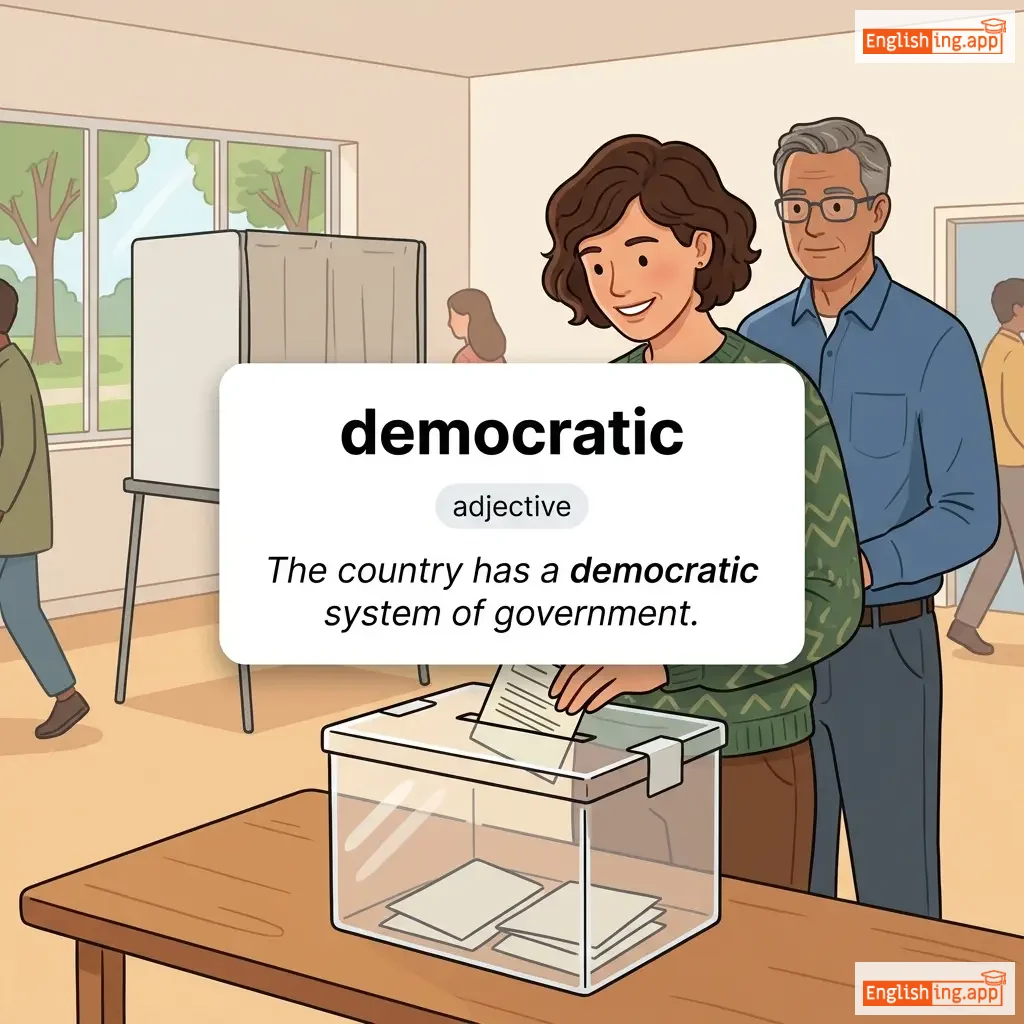
democratic definition card — visual illustration of the meaning
adjective
/ˌdɛməˈkrætɪk/
民主的 (minzhu de)

relating to or supporting democracy or its principles; characterized by equality and freedom

"The country has a democratic system of government."
"该国有一个民主的政府体系。" (Gai guo you yi ge minzhu de zhengfu tixi.)
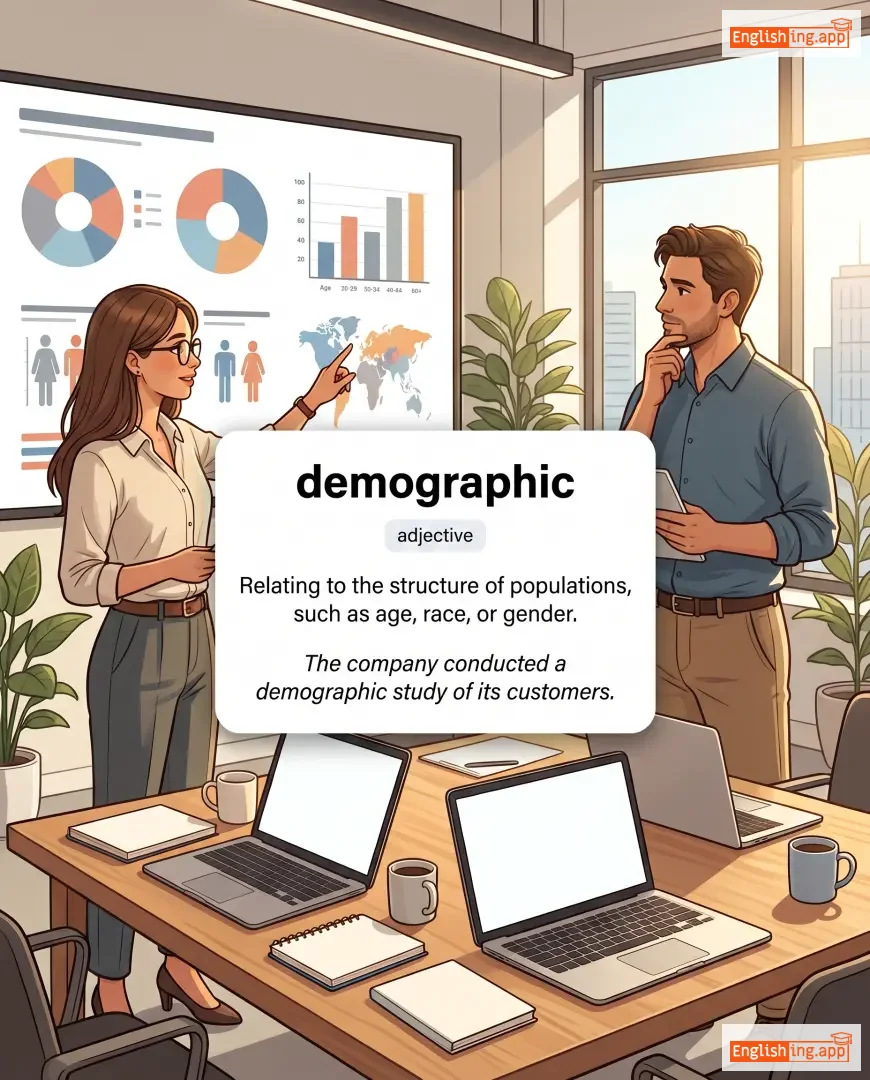
demographic definition card — visual illustration of the meaning
adjective
/ˌdɛməˈɡræfɪk/
人口统计的 (renkou tongji de)

Relating to the structure of populations, such as age, race, or gender.

"The company conducted a demographic study of its customers."
"公司对其客户进行了人口统计研究。" (Gōngsī duì qí kèhù jìnxíngle rénkǒu tǒngjì yánjiū.)
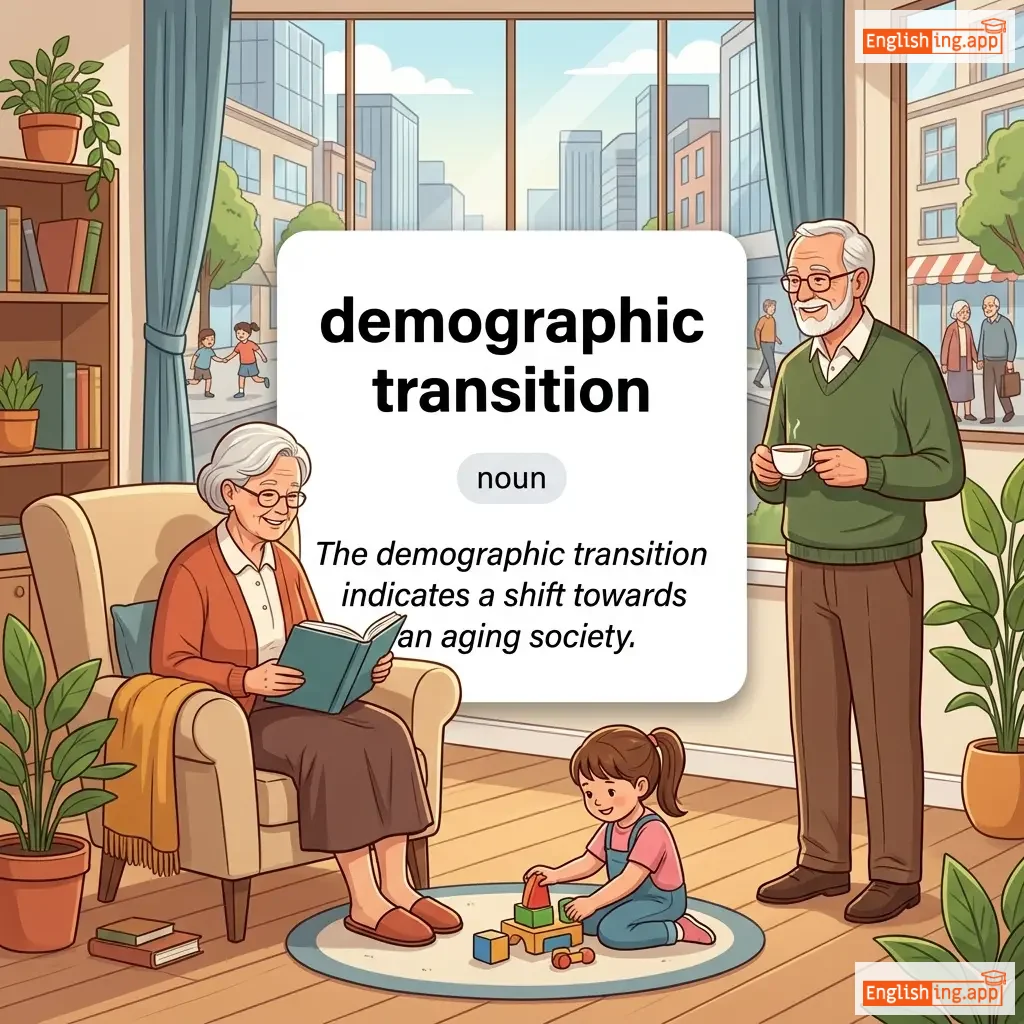
demographic transition definition card — visual illustration of the meaning
noun
ˌdɛməˈɡræfɪk trænˈzɪʃən
人口过渡 (renkou guodu)

A shift in population patterns from high birth and death rates to low birth and death rates as a country develops economically

"The demographic transition indicates a shift towards an aging society."

"人口过渡表示向老龄化社会的转变。" (Renkou guodu biaoshi xiang laolinghua shehui de zhuanbian.)
Demographics definition card — visual illustration of the meaning
noun
/ˌdɛm.əˈɡræf.ɪks/
人口统计学 (rénkǒu tǒngjìxué)

Statistical data relating to the population and particular groups within it.

"Demographics help in targeted advertising."

"人口统计有助于定向广告。" (Renkou tongjixue youzhu yu dingxiang guanggao.)
verb
/dɪˈmɒlɪʃ/
拆除 (chāichú)

to destroy completely, especially a building or structure

"The city decided to demolish the old stadium to build a new one."

"这座城市决定拆除旧体育场,建造一个新的。" (Zhèzuò chéngshì juédìng chāichú jiù tǐyùchǎng, jiànzào yīgè xīn de.)
noun
/ˌdɛməˈlɪʃən/
拆除 (chaichu)

the act or process of destroying a building or structure

"The demolition of the old factory took several weeks."

"拆除旧工厂花了好几个星期。" (Chāichú jiù gōngchǎng huāle hǎo jǐ gè xīngqī.)
noun
/ˈdiːmən/
恶魔 (emó)

an evil spirit or devil

"The story was about a demon who haunted the village."

"这个故事是关于一个困扰村庄的恶魔。" (Zhège gùshì shì guānyú yī gè kùnrǎo cūnzhuāng de èmó.)
adjective
/dɪˈmoʊniˌæk/
恶魔般的 (è mó bān de)

possessed, produced, or influenced by a demon; frenzied or violent

"The soldiers fought with demoniac fury."

"士兵们以恶魔般的愤怒作战。" (Shì bīng men yǐ è mó bān de fèn nù zuò zhàn.)