词汇表

英语词汇词典 | 单词含义、定义和示例

adjective
/dɪˈfaɪ.ənt/
挑战的 (tiǎozhàn de)

showing open resistance or bold disobedience

"The child was defiant when told to clean his room."

"当孩子被告知打扫房间时,他显得很挑战。" (Dāng háizi bèi gàozhī dǎsǎo fángjiān shí, tā xiǎndé hěn tiǎozhàn.)
noun
/dɪˈfɪʃ.ən.si/
缺乏 (quefa)

a lack or shortage of something that is necessary

"The doctor diagnosed him with a vitamin D deficiency."

"医生诊断他患有维生素D缺乏症。" (Yisheng zhenduan ta huanyu weishengsu D quefa zheng.)
adjective
/dɪˈfɪʃ.ənt/
缺乏的 (quēfá de)

not having enough of something that is essential

"The soil is deficient in nutrients."

"土壤缺乏养分。" (Tǔrǎng quēfá yǎngfèn.)
noun
/ˈdɛfɪsɪt/
赤字 (chìzì)

The amount by which something, especially money, is too small or lacking.

"The government is trying to reduce the budget deficit."

"政府正在努力减少预算赤字。" (Zhèngfǔ zhèngzài nǔlì jiǎnshǎo yùsuàn chìzì.)
verb
/dɪˈfaɪl/
亵渎 (xièdú)

to pollute, corrupt, or make dirty

"The river was defiled by industrial waste."

"河流被工业废物亵渎了。" (Héliú bèi gōngyè fèiwù xièdú le.)
verb
/dɪˈfaɪn/
定义 (dingyi)

to explain the meaning of a word, phrase, or concept clearly

"The teacher asked the student to define the word 'democracy'."

"老师要求学生定义'民主'一词。" (Laoshi yaoqiu xuesheng dingyi 'minzhu' yici.)
adjective
/ˈdef.ən.ɪt/
明确 (mingque)

clearly stated or decided; not vague or doubtful

"We need a definite plan before starting the project."

"我们在开始项目之前需要一个明确的计划。" (Wo men zai kai shi xiangmu zhi qian xu yao yi ge mingque de jihua.)
adverb
/ˈdɛfɪnɪtli/
毫无疑问 (háo wú yí wèn)

without any doubt; certainly

"I will definitely call you tomorrow."

"我明天一定会给你打电话。" (Wǒ míngtiān yídìng huì gěi nǐ dǎ diànhuà.)
noun
/ˌdɛfɪˈnɪʃən/
定义 (dingyi)

a statement that explains the meaning of a word or concept

"The dictionary gives a clear definition of the word."

"字典给出了这个词的明确定义。" (Zidian gei chule zhege ci de mingque dingyi.)
adjective
/dɪˈfɪnɪtɪv/
决定性 (juedingxing)

serving as a final or most authoritative form; conclusive and decisive

"The committee reached a definitive agreement on the policy."

"委员会就政策达成了决定性协议。" (Weiyuanhui jiu zhengce dachengle juedingxing xieyi.)
deflation definition card — visual illustration of the meaning
noun
dɪˈfleɪʃən
通货紧缩 (deflayshun)

Reduction of the general level of prices in an economy.

"Deflation often leads to decreased consumer spending."

"通货紧缩往往导致消费者支出减少。" (tong huo jin suo wang wang dao zhi xiao fei zhe zhi chu jian shao)
verb
/dɪˈflɛkt/
偏离 / 避免 (pianli / bìmǎn)

to cause something to change direction; to avoid answering directly

"The shield deflected the incoming arrow."

"盾牌偏离了来袭的箭。" (dùn pái piān lí le lái xí de jiàn.)
noun
/dɪˈfoʊliənt/

a chemical that causes leaves to drop from plants, often used in warfare or agriculture

"The army sprayed defoliant to clear the forest cover."

verb
/dɪˈfoʊlieɪt/
除叶 (chú yè)

to strip leaves from a tree, plant, or area, often using chemicals

"The farmers defoliated the fields before harvest."
"农民在收获前除叶了田地。" (Nóngmín zài shōuhuò qián chú yè le tiándì.)
🌲❌

deforest

verb
/diːˈfɒrɪst/

to clear an area of trees, usually on a large scale

"The region has been heavily deforested for agriculture."

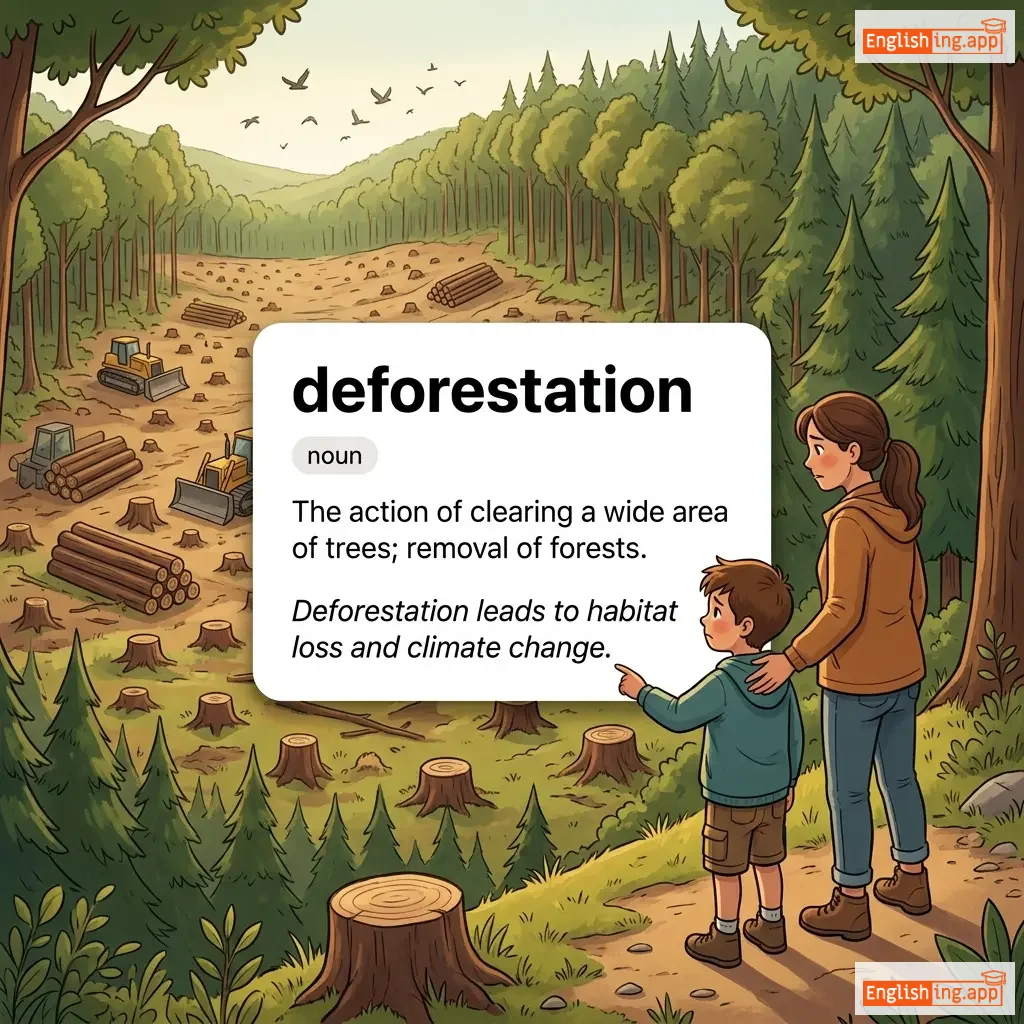
deforestation definition card — visual illustration of the meaning
noun
/ˌdiː.fɒr.ɪˈsteɪ.ʃən/
砍伐森林 (kanfa senlin)

The action of clearing a wide area of trees; removal of forests.

"Deforestation leads to habitat loss and climate change."

"砍伐森林导致栖息地丧失和气候变化。" (Kanfa senlin dǎozhì qīxī dì sàngshī hé qìhòu biànhuà.)
verb
/dɪˈfɔːrm/
变形 (bianxing)

to change the normal shape or structure of something by twisting or distorting it

"Excessive heat can deform plastic containers."

"过多的热量可能会使塑料容器变形。" (Guoduo de re liang keneng hui shi su liao rongqi bianxing.)
noun
/dɪˈfɔːrməti/

an abnormality or distortion in the shape or structure of a body part

"The child was born with a minor hand deformity."

verb
/dɪˈfrɔːd/
欺诈 (qizha)

to illegally take money or valuables from someone by deception

"The company was accused of trying to defraud investors."

"公司被指控试图欺骗投资者。" (Gongsi bei zhikong shitu qipian touzizhe.)
verb
/dɪˈfreɪ/
支付费用 (zhīfù fèiyòng)

to provide money to pay the costs of something

"The grant will help defray the cost of education."

"这笔补助将帮助支付教育费用。" (Zhè bǐ bǔzhù jiāng bāngzhù zhīfù jiàoyù fèiyòng.)
verb
/diːˈfrɑːk/
解除神职 (jiěchú shénzhí)

to officially remove a priest or minister from their position and authority

"The church decided to defrock the priest after the scandal."
"教会决定在丑闻发生后解除神父的职务。" (Jiàohuì juédìng zài chǒuwén fāshēng hòu jiěchú shénfù de zhíwù.)
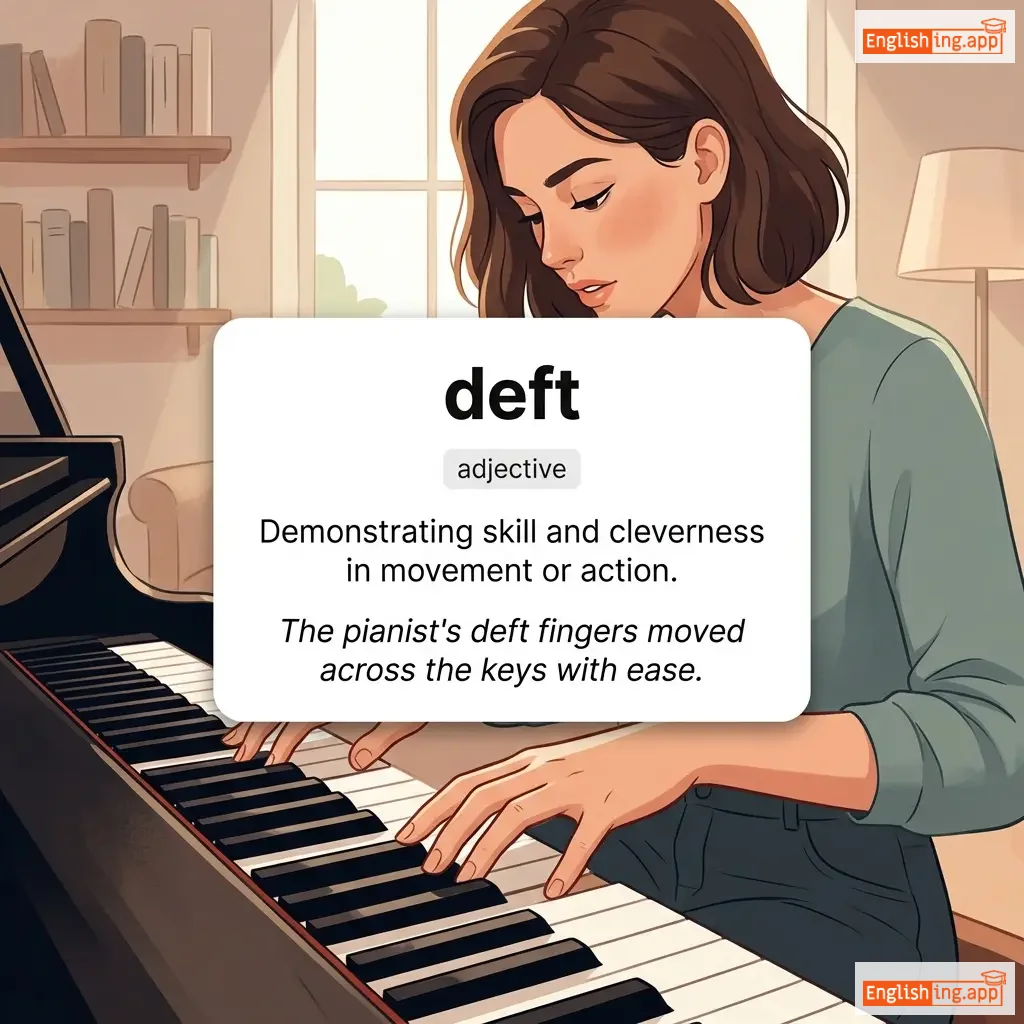
deft definition card — visual illustration of the meaning
adjective
/dɛft/
灵巧 (lingqiao)

Demonstrating skill and cleverness in movement or action.

"The pianist's deft fingers moved across the keys with ease."

"钢琴家的灵巧手指轻松地在键盘上移动。" (Gāngqín jiā de língqiǎo shǒuzhǐ qīngsōng de zài jiànpán shàng yídòng.)
noun
/ˈdɛftnəs/
灵巧 (lingqiao)

Skillfulness and quickness in action or thought.

"Her deftness with words impressed the audience."
"她在言辞上的灵巧令观众印象深刻。" (Ta zai yanci shang de lingqiao ling guanzhong yinxiang shenke.)
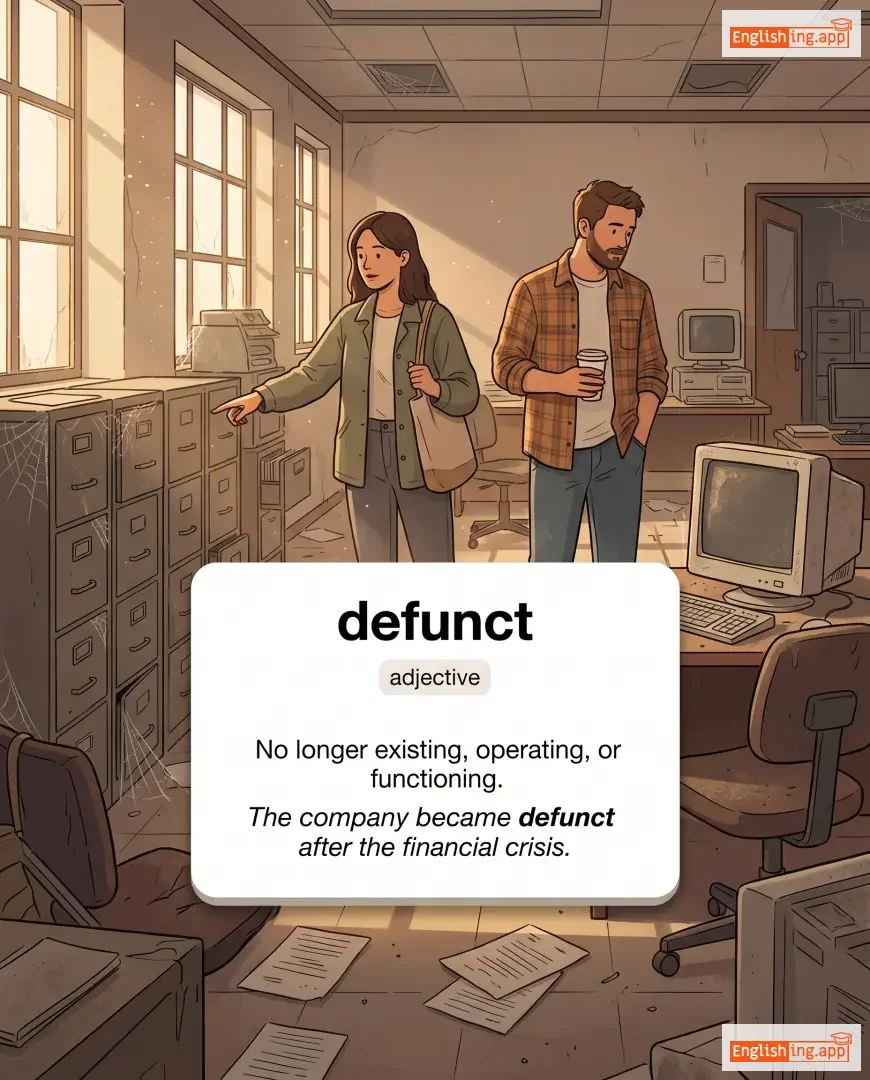
defunct definition card — visual illustration of the meaning
adjective
/dɪˈfʌŋkt/
停用,废弃 (tíngyòng, fèiqì)

No longer existing, operating, or functioning.

"The company became defunct after the financial crisis."

"这家公司在金融危机后不再运作。" (Zhè jiā gōngsī zài jīnróng wéijī hòu bù zài yùnzuò.)
verb
/diːˈfjuːz/

To make a situation less dangerous, tense, or explosive; to remove a fuse from a bomb.

"The negotiator helped defuse the tense situation."

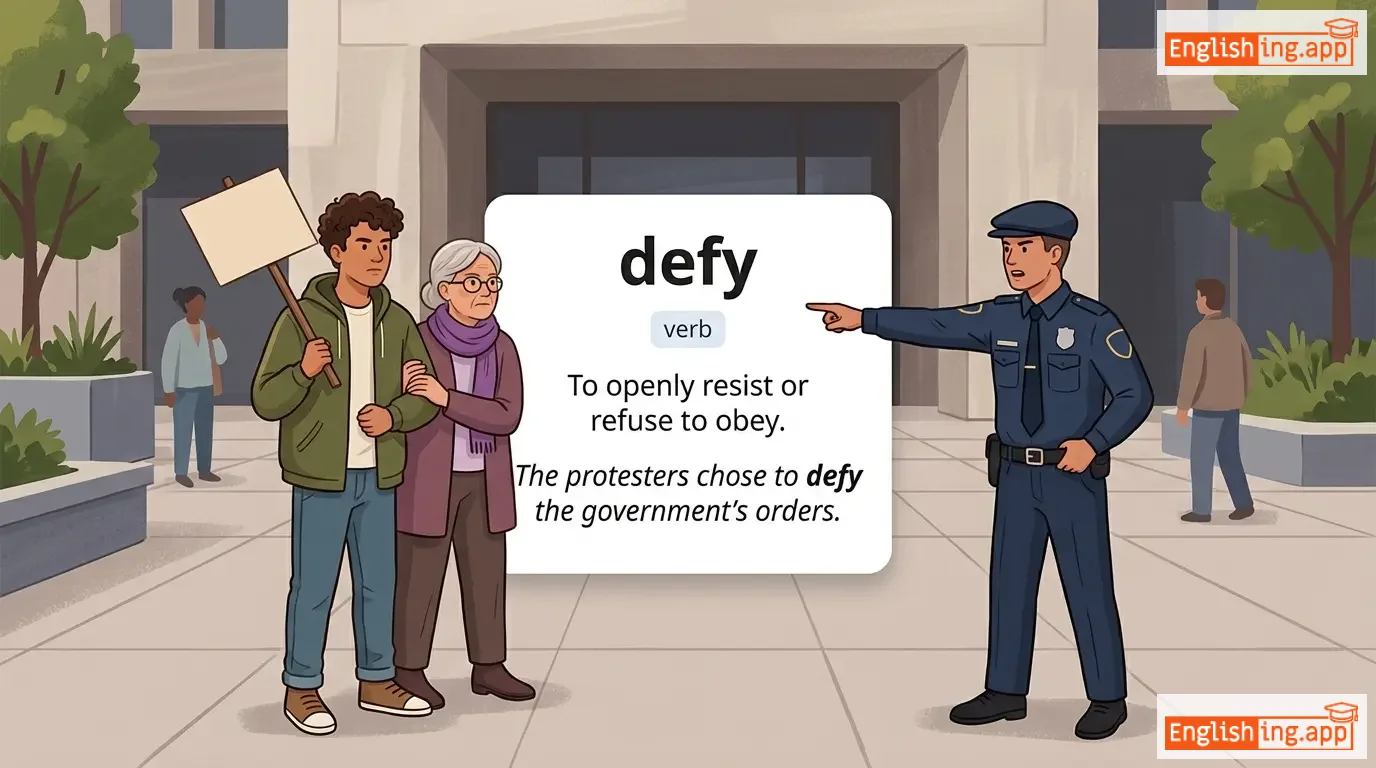
defy definition card — visual illustration of the meaning

defy

verb
/dɪˈfaɪ/

To openly resist or refuse to obey.

"The protesters chose to defy the government's orders."

noun
/dɪˈdʒɛnərəsi/
堕落 (duòluò)

The state of decline or deterioration, often in moral, cultural, or physical qualities.

"The novel portrays the moral degeneracy of a corrupt society."

"这部小说描绘了一个腐化社会的道德堕落。" (Zhè bù xiǎoshuō miáohuìle yīgè fǔhuà shèhuì de dàodé duòluò.)
verb/adjective
/dɪˈdʒɛnəreɪt/
堕落 (duòluò)

To decline or deteriorate in quality, character, or condition; or someone with low moral standards.

"The once thriving empire began to degenerate into chaos."
"曾经繁荣的帝国开始衰退成混乱。" (Céngjīng fánróng de dìguó kāishǐ shuāituì chéng hùnluàn.)
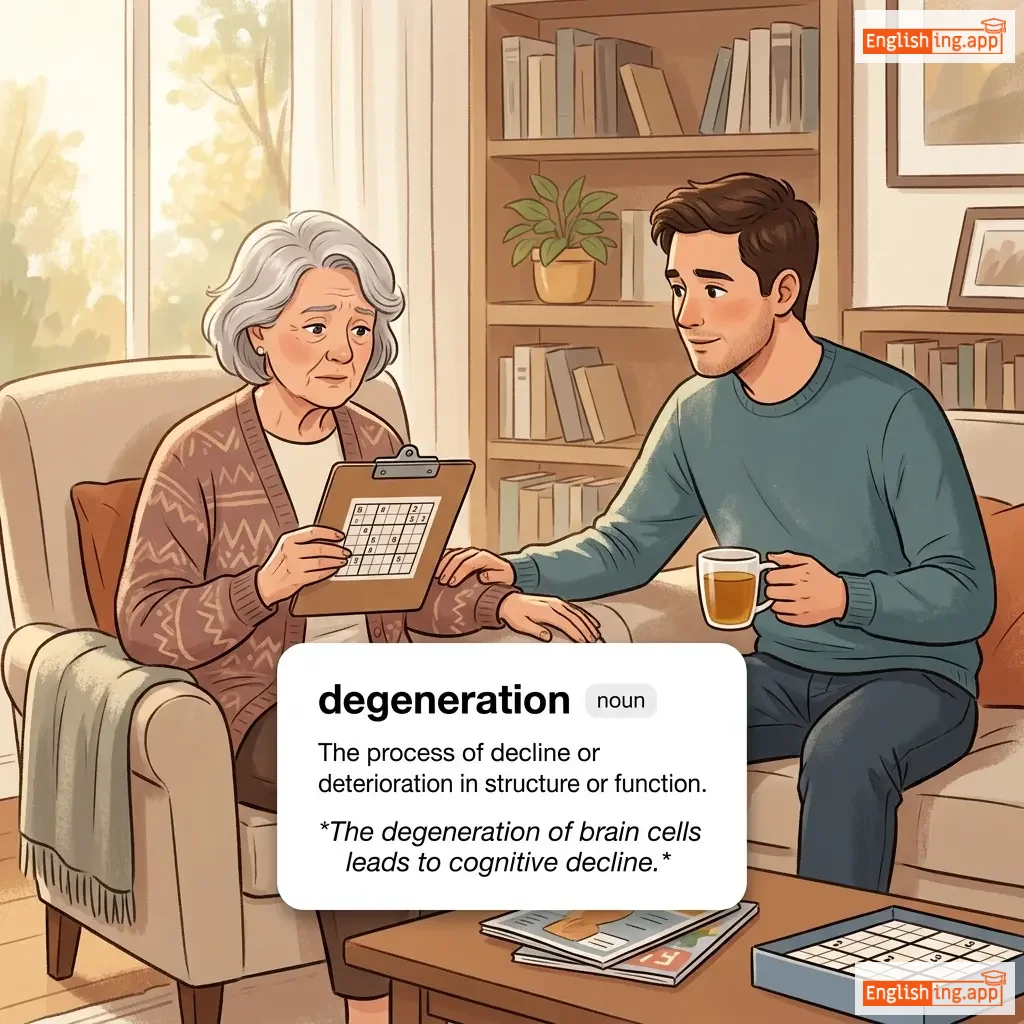
degeneration definition card — visual illustration of the meaning
noun
ˌdɪdʒɪˈnɛəreɪʃən
退化 (tuìhuà)

The process of decline or deterioration in structure or function.

"The degeneration of brain cells leads to cognitive decline."
"大脑细胞的退化导致认知能力下降。" (Dànǎo xìbāo de tuìhuà dǎozhì rènzhī nénglì xiàjiàng.)
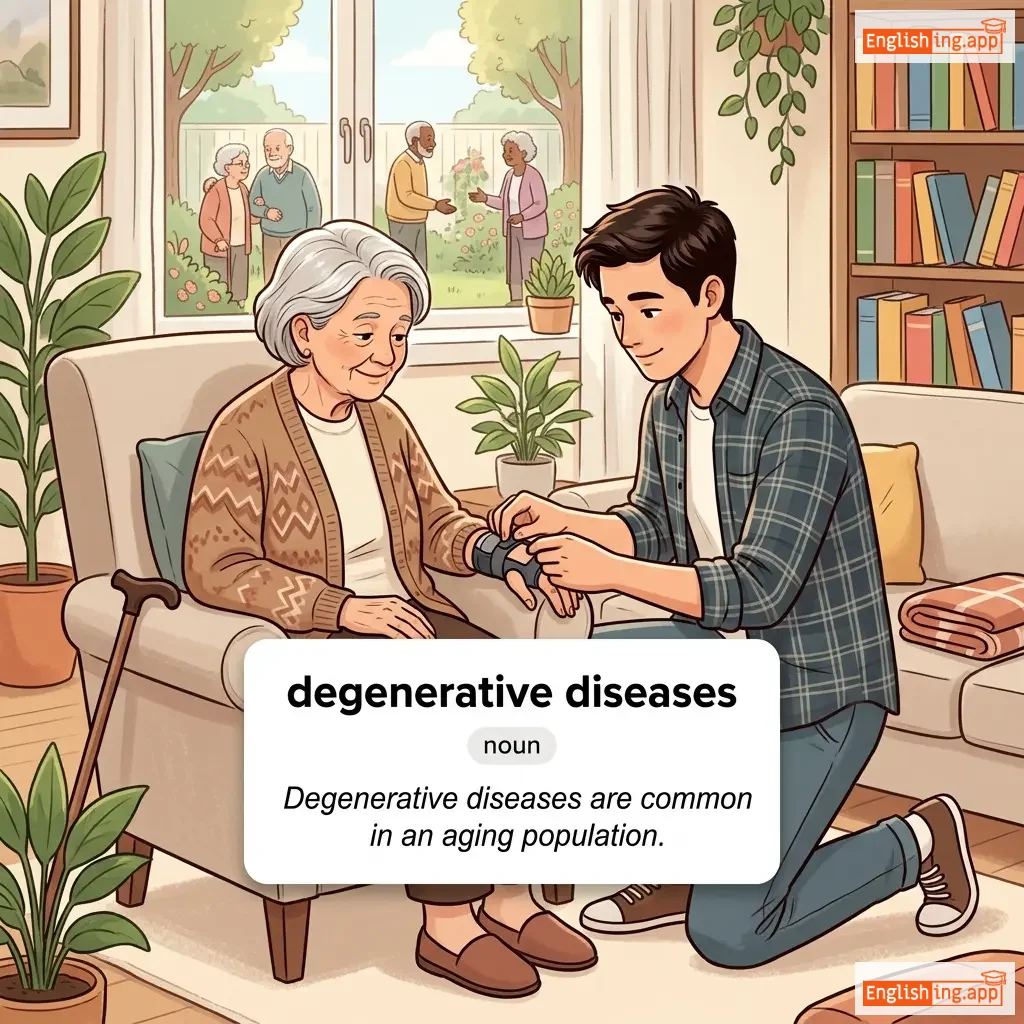
degenerative diseases definition card — visual illustration of the meaning
noun
dɪˈdʒɛnəˌreɪtɪv dɪˈzizɪz
退行性疾病 (tuìxíngxìng jíbìng)

Medical conditions that involve the deterioration or progressive decline of tissues, organs, or functions

"Degenerative diseases are common in an aging population."
"退行性疾病在老龄化人口中很常见。" (Tuìxíngxìng jíbìng zài lǎolínghuà rénkǒu zhōng hěn chángjiàn.)
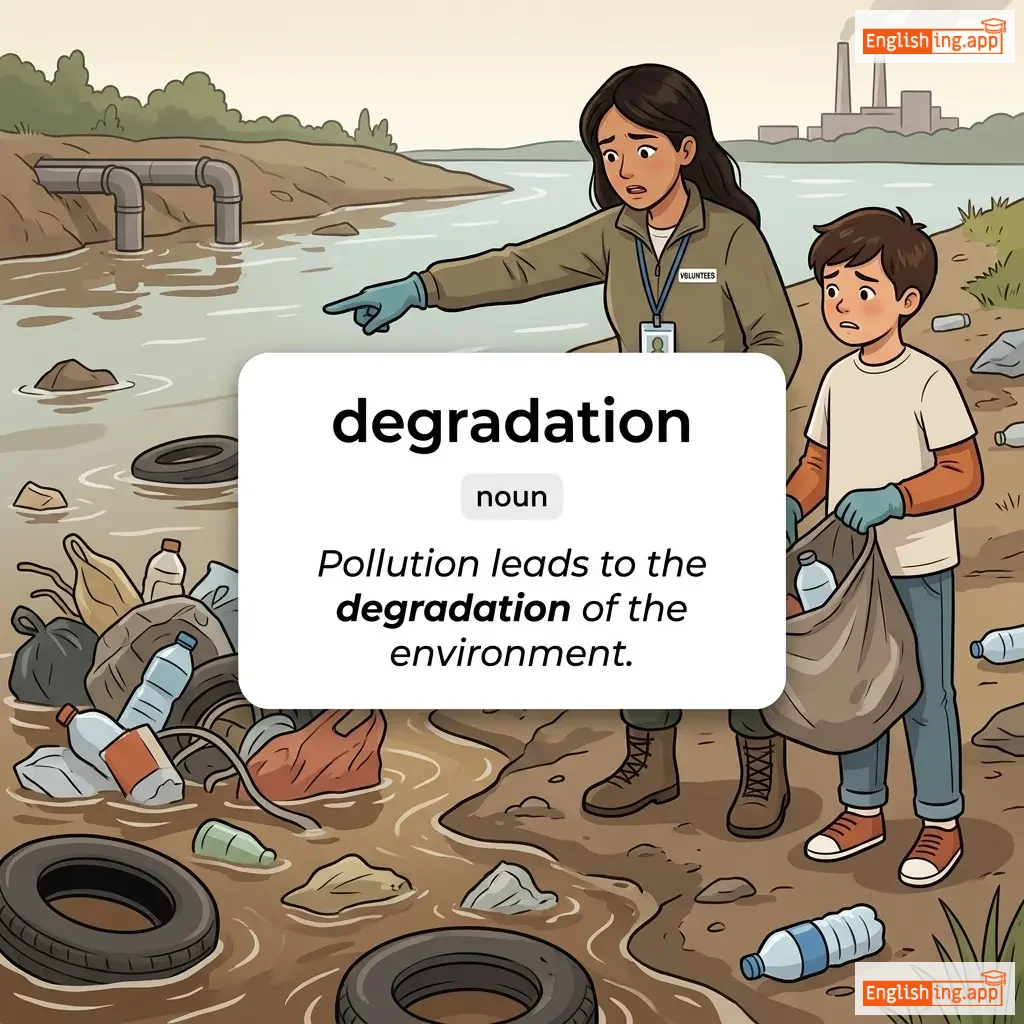
degradation definition card — visual illustration of the meaning
noun
/ˌdɛɡrəˈdeɪʃən/
退化 (tuihua)

The process of being degraded, declined, or reduced in quality, dignity, or value.

"Pollution leads to the degradation of the environment."

"污染导致环境的退化。" (Wūrǎn dǎozhì huánjìng de tuìhuà.)
⬇️😔

degrade

verb
/dɪˈɡreɪd/

To lower in dignity, quality, or value; to treat with disrespect or to deteriorate.

"Harsh words can degrade a person's confidence."

adjective
/dɪˈɡreɪdɪd/
退化 (tuìhuà)

Reduced in quality, dignity, or condition.

"The villagers were forced to live in degraded conditions."

"村民们被迫在退化的条件下生活。" (Cūnmínmen bèi pò zài tuìhuà de tiáojiàn xià shēnghuó.)
noun
/dɪˈɡriː/
学位 / 程度 (xuéwèi / chéngdù)

an amount or level of something; an academic qualification

"She earned a degree in engineering."
"她获得了工程学位。" (Tā huò dé le gōngchéng xuéwèi.)
verb
/diːˈhaɪdreɪt/

to remove water from something; to lose water or body fluids

"Running in the heat can quickly dehydrate you."

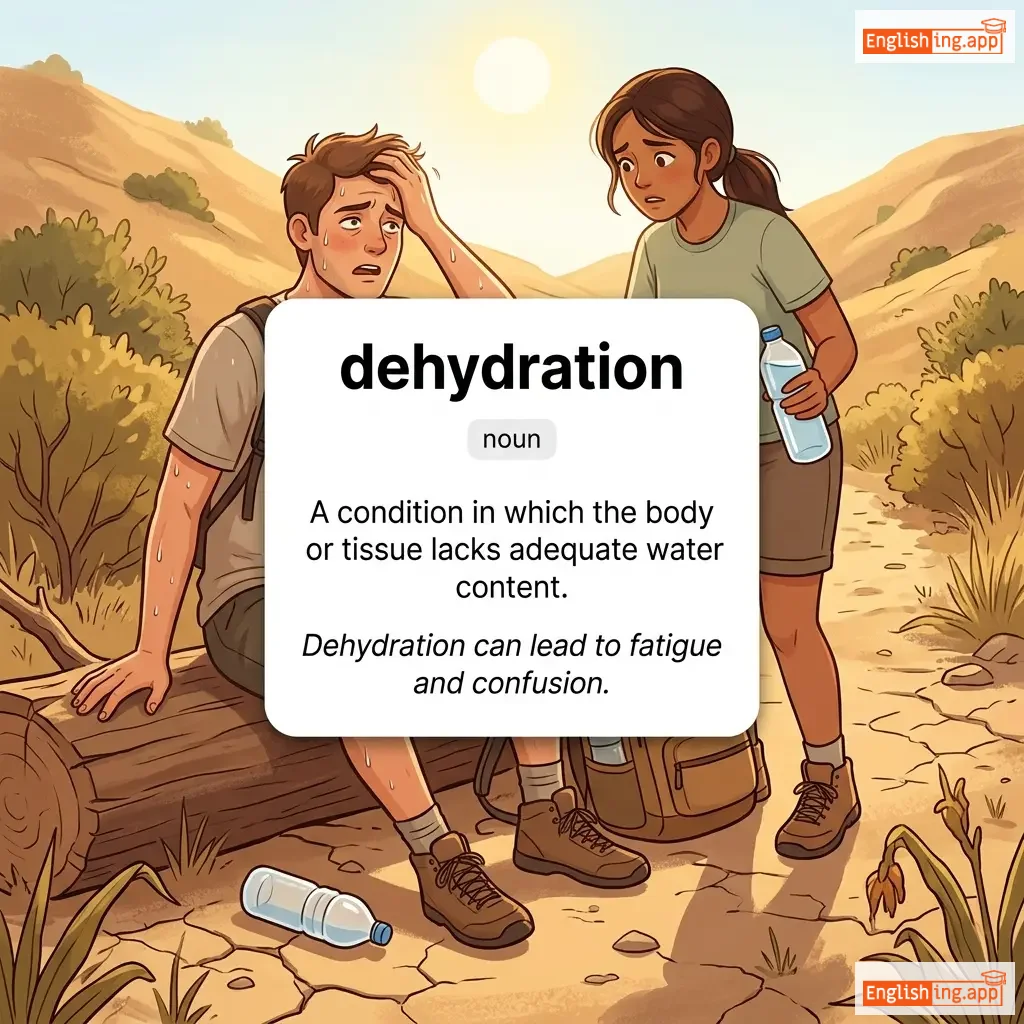
dehydration definition card — visual illustration of the meaning
noun
/ˌdiː.haɪˈdreɪʃən/
脱水 (tuōshuǐ)

A condition in which the body or tissue lacks adequate water content.

"Dehydration can lead to fatigue and confusion."

"脱水可能导致疲劳和困惑。" (tuōshuǐ kěnéng dǎozhì píláo hé kùnhuò.)
verb
/ˈdiːɪfaɪ/
神化 (shenhua)

to treat or worship someone or something as a god

"Some fans deify their favorite celebrities."

"一些粉丝将他们的偶像神化。" (Yi xie fen si jiang ta men de ouxiang shenhua.)
verb
/deɪn/
不屑做某事 (bu xie zuo mou shi)

to do something considered beneath one's dignity

"The king did not deign to reply to the commoner."

"国王没有屈尊回应平民。" (Guowang meiyou quxuan huiying pingmin.)
noun
/ˈdiːɪst/
自然神论者 (zìrán shénlùn zhě)

a person who believes in the existence of a supreme being but rejects organized religion

"The philosopher identified himself as a deist."

"这位哲学家把自己认定为自然神论者。" (Zhè wèi zhéxuéjiā bǎ zìjǐ rèndìng wéi zìrán shénlùn zhě.)
noun
/ˈdeɪ.ə.ti/
神祇 (shenqi)

a god or goddess

"The temple is dedicated to a Hindu deity."

"这座寺庙奉献给一位印度神祇。" (Zhe zuo simiao fengxian gei yi wei yin du shenqi.)
verb
/dɪˈdʒɛkt/
使沮丧 (shi juhuang)

to make someone feel sad, depressed, or dispirited

"The news of his failure seemed to deject him deeply."

"他的失败消息似乎深深地让他感到沮丧。" (Ta de shibai xiaoxi shifou shen shen de rang ta gandao juhuang.)
noun
/dɪˈdʒɛkʃən/
沮丧 (jǔsàng)

a state of sadness, depression, or low spirits

"She sat in a state of dejection after hearing the bad news."

"她在听到坏消息后,处于一种沮丧的状态。" (Tā zài tīngdào huài xiāoxī hòu, chùyú yī zhǒng jǔsàng de zhuàngtài.)
verb
/dɪˈleɪ/
延迟 (yánchí)

to make something happen later than planned

"The flight was delayed due to bad weather."
"航班因恶劣天气被延误。" (Hángbān yīn èliè tiānqì bèi yánwù.)
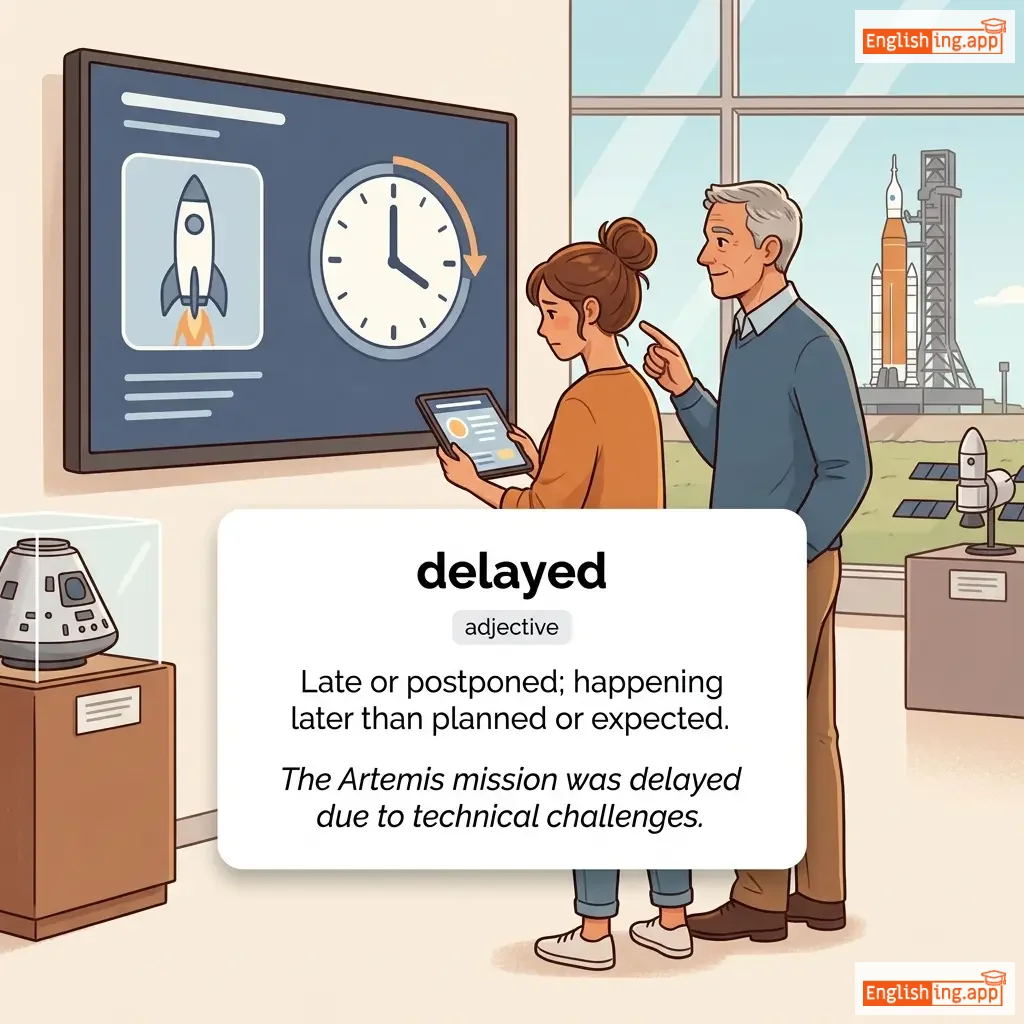
delayed definition card — visual illustration of the meaning
adjective
dɪˈleɪd
延迟的 (yánchí de)

Late or postponed; happening later than planned or expected.

"The Artemis mission was delayed due to technical challenges."

"阿耳忒弥斯任务由于技术问题被延迟。" (Ā ěr tè mí sī rènwù yóuyú jìshù wèntí bèi yánchí.)
adjective
/dɪˈlɛktəbl̩/
美味的 (měiwèi de)

delicious or highly enjoyable

"The restaurant served a delectable meal."

"餐厅提供了一顿美味的饭菜。" (Cāntīng tígōngle yī dùn měiwèi de fàncài.)
noun
/ˌdiːlɛkˈteɪʃən/
愉悦 (yuyue)

great pleasure or delight

"She read the story aloud for the delectation of her friends."

"她大声朗读故事,以供朋友们的愉悦。" (Tā dàshēng lǎngdú gùshì, yǐ gòng péngyǒu men de yúyuè.)
noun, verb
/ˈdɛlɪɡət/ (noun), /ˈdɛlɪɡeɪt/ (verb)
代表 / 委托 (dàibiǎo / wěituō)

as a noun: a person appointed to represent others; as a verb: to entrust a task or responsibility to another

"The manager decided to delegate tasks to his team members."

"经理决定将任务委托给他的团队成员。" (Jīnglǐ juédìng jiāng rènwù wěituō gěi tā de tuánduì chéngyuán.)
delegation definition card — visual illustration of the meaning
noun
/ˌdɛlɪˈɡeɪʃən/
委托 (wěituō)

the act of giving someone else responsibility for something

"The manager made a delegation of tasks to the team."

"经理将任务委托给了团队。" (Jīnglǐ jiāng rènwù wěituō gěile tuánduì.)
🗑️

delete

verb
/dɪˈliːt/

to remove or erase something, especially written or recorded information

"He accidentally deleted all the files from his computer."

deleterious definition card — visual illustration of the meaning
adjective
/ˌdɛlɪˈtɪəriəs/
有害的 (youhai de)

causing harm or damage

"Smoking has deleterious effects on health."

"吸烟对健康有害。" (Xiyan dui jiankang youhai.)