词汇表

英语词汇词典 | 单词含义、定义和示例

verb
/diːˈkoʊd/

to convert a coded message into a readable form; to interpret meaning

"The software can decode the hidden message within seconds."

adjective
/ˌdeɪ.kɒlˈteɪ/
低胸的服装 (dīxiōng de fúzhuāng)

of a woman's dress or top, cut low so as to reveal the neck and upper chest

"She wore a decollete gown to the party."

"她穿着低胸裙子参加了派对。" (Tā chuānzhuó dīxiōng qúnzi cānjiāle pàiduì.)
noun
/ˌdiː.kɒmpəˈzɪʃən/
分解 (fenjie)

the process of decaying or breaking down into simpler parts

"The decomposition of leaves enriches the soil."

"叶子的分解使土壤更加肥沃。" (Yezi de fenjie shi turang gengjia feiwo.)
decompress definition card — visual illustration of the meaning
verb
/ˌdiː.kəmˈprɛs/
放松 (fang song)

To relax and recover from stress or pressure.

"Taking deep breaths helps to decompress after a stressful day."

"深呼吸帮助在压力过大的日子后放松。" (Shen huxi bangzhu zai yali guoda de rizi hou fangsong.)
decorate definition card — visual illustration of the meaning
verb
/ˈdɛkəreɪt/

to make something look more attractive by adding ornaments or color

"They decorated the hall with balloons and lights for the party."

noun
/ˌdek.əˈreɪ.ʃən/
装饰; 装饰品; 奖项; (zhuangshi, zhuangshipin, jiangxiang)

the process or art of decorating something; ornamental items used to beautify

"The Christmas decoration transformed the ordinary room into a festive wonderland."

"圣诞装饰把普通房间变成了一个节日奇境。" (Shèngdàn zhuāngshì bǎ pǔtōng fángjiān biànchéngle yīgè jiérì qíjìng.)
adjective
/ˈdekərəs/
得体 (détǐ)

showing proper and polite behavior; marked by good taste

"The audience gave a decorous applause after the performance."

"观众在演出后给予了得体的掌声。" (Guānzhòng zài yǎnchū hòu jǐyǔle détǐ de zhǎngshēng.)
Decorum definition card — visual illustration of the meaning
noun
/dɪˈkɔːrəm/
礼仪 (lǐyí)

behavior in keeping with good taste and propriety

"The students maintained decorum during the ceremony."

"学生们在仪式期间保持了礼仪。" (Xuéshēngmen zài yíshì qījiān bǎochí le lǐyí.)
adjective
/dɪˈkɔːrəs/
得体 (détǐ)

characterized by propriety, good taste, and proper manners

"She maintained a decourous silence during the ceremony."

"她在仪式上保持了得体的沉默。" (Tā zài yíshì shàng bǎochí le détǐ de chénmò.)
noun/verb
/ˈdiːkɔɪ/
诱饵 (yòu'ěr)

something or someone used to lure or mislead

"The hunters used a wooden duck as a decoy."

"猎人们用一只木鸭作为诱饵。" (Lièrénmen yòng yī zhī mù yā zuòwéi yòu'ěr.)
⬇️

decrease

verb/noun
/ˈdiːkriːs/ (noun), /dɪˈkriːs/ (verb)

To become or make something smaller or fewer in number, amount, or degree.

"The population of the town has decreased over the years."

noun/verb
/dɪˈkriː/
法令 (fǎlìng)

an official order or command, often by authority

"The king issued a decree banning hunting in the forest."

"国王发布了一个禁止在森林中狩猎的法令。" (Guówáng fābùle yīgè jìnzhǐ zài sēnlín zhōng shòuliè de fǎlìng.)
adjective
/dɪˈkrɛpɪt/
破旧 (pojiu)

worn out or weakened by age or neglect

"The decrepit old house was on the verge of collapse."

"那座破旧的老房子几乎要坍塌了。" (Na zuo pojiu de lao fangzi jihu yao tantali.)
noun
/dɪˈkrɛpɪˌtjuːd/
衰败 (shuāibài)

the state of being old, weak, and worn out

"The once-great empire fell into decrepitude."

"曾经伟大的帝国陷入了衰败。" (Céngjīng wěidà de dìguó xiànrùle shuāibài.)
verb
/dɪˈkraɪ/
谴责 (qiǎnzé)

to publicly criticize or express strong disapproval of something

"Many activists decry the destruction of the rainforest."

"许多活动家谴责毁灭雨林。" (Xǔduō huódòngjiā qiǎnzé huǐmiè yǔlín.)
decryption definition card — visual illustration of the meaning
noun
/dɪˈkrɪp.ʃən/
解密 (jiěmì)

The process of converting encrypted information back to its original form

"Decryption of sensitive files requires a secure key."

"解密敏感文件需要一个安全的密钥。" (Jiěmì mǐngǎn wénjiàn xūyào yīgè ānquán de mìyào.)
verb
/ˈdɛdɪkeɪt/
奉献 (fengxian)

to devote time, effort, or oneself to a particular purpose or person

"She dedicated her life to helping the poor."

"她献出了自己的生命来帮助穷人。" (Ta xianchu le ziji de shengming lai bangzhu qiongren.)
adjective
/ˈdɛdɪˌkeɪtɪd/
专心致志 (zhuān xīn zhì zhì)

devoted to a cause, task, or purpose

"She is a dedicated teacher who goes above and beyond for her students."

"她是一位献身的教师,为她的学生竭尽全力。" (Ta shi yi wei xian shen de jiao shi, wei ta de xue sheng jie jin quan li.)
dedication definition card — visual illustration of the meaning
noun
/ˌdɛdɪˈkeɪʃən/
献身 (xianshen)

the quality of being committed to a task or purpose

"Her dedication to her studies earned her top grades."

"她对学习的献身精神使她获得了最高的成绩。" (Ta dui xuexi de xianshen jingshen shi ta huodele zuigao de chengji.)
verb
/dɪˈdjuːs/
推断 (tuīduàn)

to reach a conclusion by reasoning or inference

"From the evidence, the detective deduced that the suspect was lying."

"从证据来看,侦探推断出嫌疑人是在撒谎。" (Cóng zhèngjù lái kàn, zhēntàn tuīduàn chū xiányí rén shì zài sāhuǎng.)
adjective
/dɪˈdjuːsəbl/
可推断的 (ke tuīduàn de)

able to be deduced; possible to be inferred

"The solution is deducible from the data provided."
"解决方案可以从提供的数据中推断出来。" (Jiějué fāng'àn kěyǐ cóng tígōng de shùjù zhōng tuīduàn chūlái.)
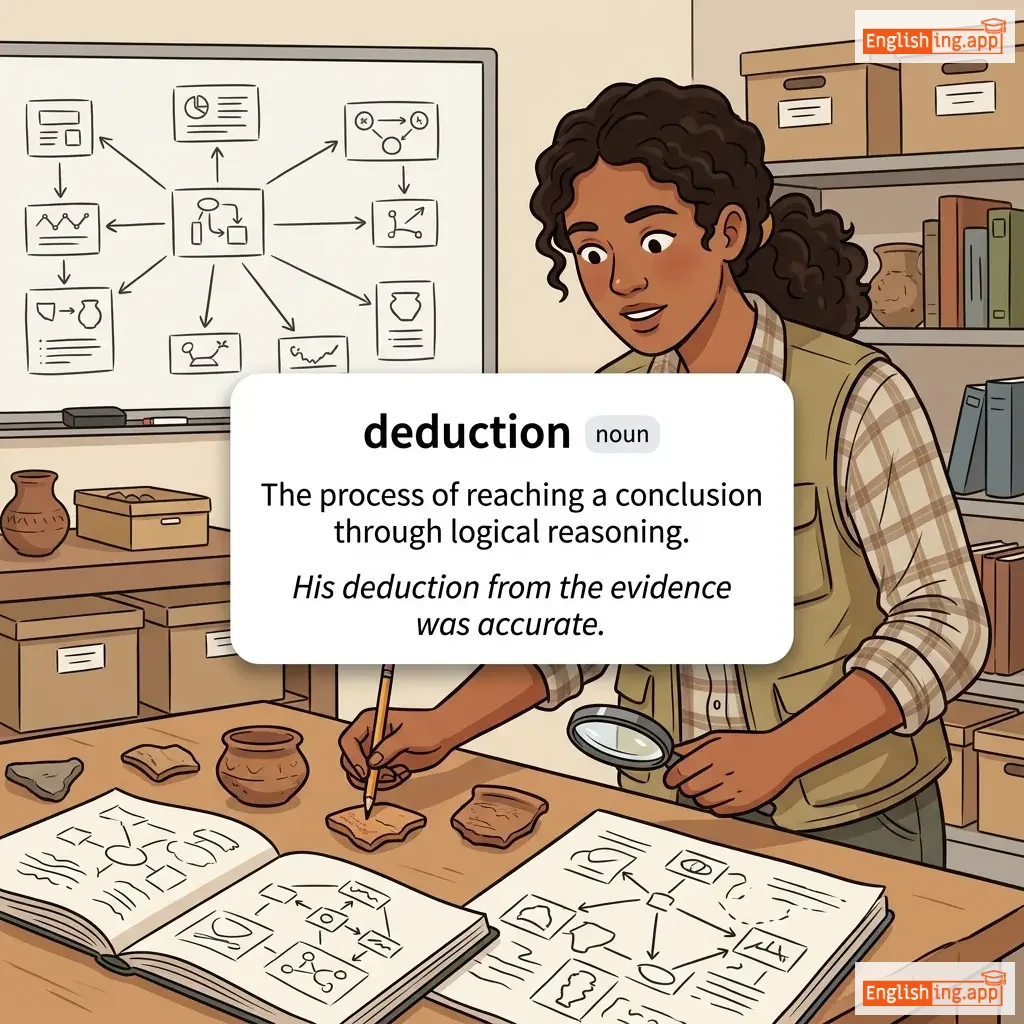
deduction definition card — visual illustration of the meaning
noun
/dɪˈdʌk.ʃən/
推理 (tuīlǐ)

The process of reaching a conclusion through logical reasoning.

"His deduction from the evidence was accurate."

"他的推理基于证据是准确的。" (Tā de tuīlǐ jīyú zhèngjù shì zhǔnquè de.)
noun
/diːd/
行为 (xíngwéi)

an action, especially a good or evil one

"His deed of kindness will never be forgotten."

"他的善行永远不会被遗忘。" (Tā de shànxíng yǒngyuǎn bù huì bèi yíwàng.)
verb
/diːm/
认为, 判断 (rènwéi, pàn duàn)

to regard or consider in a specified way

"The project was deemed a success by the board."

"该项目被董事会认为是成功的。" (Gāi xiàngmù bèi dǒngshìhuì rènwéi shì chénggōng de.)
adjective
/diːp/
幸福 (xìngfú)

extending far down from the top or surface; profound or intense

"The lake is very deep in the middle."

"当她收到奖项时,她无法掩饰自己的幸福。" (Dāng tā shōu dào jiǎngxiàng shí, tā wúfǎ yǎnshì zìjǐ de xìngfú.)
noun
/diːp ˈkʌlər/
深色 (shēn sè)

a rich, intense, or dark shade of any color

"The artist used deep colours to create a dramatic effect."

"艺术家使用深色调来创造戏剧性的效果。" (Yìshùjiā shǐyòng shēn sèdiào lái chuàngzào xìjùxìng de xiàoguǒ.)
deep sea definition card — visual illustration of the meaning
noun
/diːp siː/
深海 (shen hai)

The deep parts of the sea or ocean, typically beyond the continental shelf.

"Many deep-sea creatures produce bioluminescence for survival."

"许多深海生物为了生存而产生生物发光。" (Xǔduō shēnhǎi shēngwù wèile shēngcún ér chǎnshēng shēngwù fāguāng.)
adverb
/ˈdiːpli/
深深地 (shēn shēn de)

to a great depth, extent, or intensity

"She was deeply moved by the speech."

"她被演讲深深地打动了。" (Tā bèi yǎnjiǎng shēn shēn de dǎdòng le.)
noun
/dɪr/
鹿 (lu)

a graceful wild animal with long legs and antlers, often living in forests

"A deer ran across the road suddenly."

"一只鹿突然穿过了马路。" (Yī zhī lù túrán chuānguòle mǎlù.)
verb
/dɪˈfeɪs/
毁坏 (huǐhuài)

to spoil the surface or appearance of something, especially by writing or drawing on it

"The vandals defaced the wall with graffiti."

"那些恶棍用涂鸦毁坏了墙面。" (Nàxiē ègùn yòng túyā huǐhuài le qiángmiàn.)
verb
/ˈdiːfælˌkeɪt/
挪用公款 (nuóyòng gōngkuǎn)

to misuse or embezzle money that one is responsible for

"The accountant was accused of defalcating company funds."

"会计被指控挪用公司资金。" (Kuàijì bèi zhǐkòng nuóyòng gōngsī zījīn.)
noun
/ˌdɛfəˈmeɪʃən/
诽谤 (feibàng)

the act of damaging someone's reputation by making false statements

"The newspaper was sued for defamation of character."

"该报因诽谤被起诉。" (Gāi bào yīn fěibàng bèi qǐsù.)
defame definition card — visual illustration of the meaning
verb
/dɪˈfeɪm/
诽谤 (fěibàng)

to harm someone's reputation by spreading false information

"He was defamed by malicious rumors."

"他被恶意谣言诽谤。" (Tā bèi èyì yáoyán fěibàng.)
default definition card — visual illustration of the meaning
noun, verb
/dɪˈfɔːlt/
违约 (wéiyuē)

failure to fulfill an obligation, especially to repay a loan

"The company defaulted on its loan payments."

"公司在贷款支付方面违约。" (Gōngsī zài dàikuǎn zhīfù fāngmiàn wéiyuē.)
verb
/dɪˈfiːt/
击败 (jī bài)

to win a victory over someone or something in a competition or battle

"Our team defeated their rivals in the final match."

"我们的团队在决赛中击败了他们的对手。" (Wǒmen de tuánduì zài juésài zhōng jībài le tāmen de duìshǒu.)
noun, adjective
/dɪˈfiːtɪst/
失败主义者 (shībài zhǔyì zhě)

A person who expects or is excessively ready to accept failure; showing a tendency to expect defeat.

"His defeatist attitude discouraged the rest of the team."

"他的失败主义态度使队伍中的其他人感到灰心。" (Tā de shībài zhǔyì tàidù shǐ duìwǔ zhōng de qítā rén gǎndào huīxīn.)
⚠️

Defect

noun, verb
/ˈdiːfɛkt/ (noun), /dɪˈfɛkt/ (verb)

A shortcoming, imperfection, or flaw; or to abandon a cause or group for another.

"The engineer found a defect in the software code."

noun
/dɪˈfɛkʃən/
叛变 (pànbiàn)

The act of abandoning one’s country, cause, or group in favor of another.

"The politician’s defection shocked his supporters."

"这位政治家的叛变让他的支持者感到震惊。" (zhè wèi zhèngzhìjiā de pànbiàn ràng tā de zhīchízhě gǎndào zhènjīng.)
adjective
/dɪˈfektɪv/
有缺陷的; 不完整的 (you quexian de; bu wanzheng de)

having faults or defects; imperfect

"The defective product was returned to the store."

"有缺陷的产品被退还到商店。" (You quexian de chanpin bei tuihuan dao shangdian.)
noun
/dɪˈfɛns/
防御 (fangyu)

The act of protecting or guarding against attack, harm, or criticism.

"The castle walls were built for defence against invaders."

"城堡的墙壁是为了防御入侵者而建造的。" (Chéngbǎo de qiángbì shì wèile fángyù rùqīn zhě ér jiànzào de.)
verb
/dɪˈfɛnd/
辩护 (bian hu)

To protect someone or something from harm or attack.

"The lawyer worked hard to defend her client."

"律师努力工作为她的客户辩护。" (Lüshi nuli gongzuo wei ta de kehu bianhu.)
noun
/dɪˈfɛndənt/
被告 (beigao)

An individual, company, or institution sued or accused in a court of law.

"The defendant pleaded not guilty to the charges."

"被告对指控表示不认罪。" (Beigao dui zhigou biaoshi bu renzui.)
noun
/dɪˈfɛndər/
防守者 (fangshouzhe)

a person who protects someone or something from harm or attack

"The defender blocked the shot and saved the goal."
"防守者挡住了射门并拯救了进球。" (Fángshǒu zhě dǎng zhùle shèmén bìng zhěngjiùle jìnqiú.)
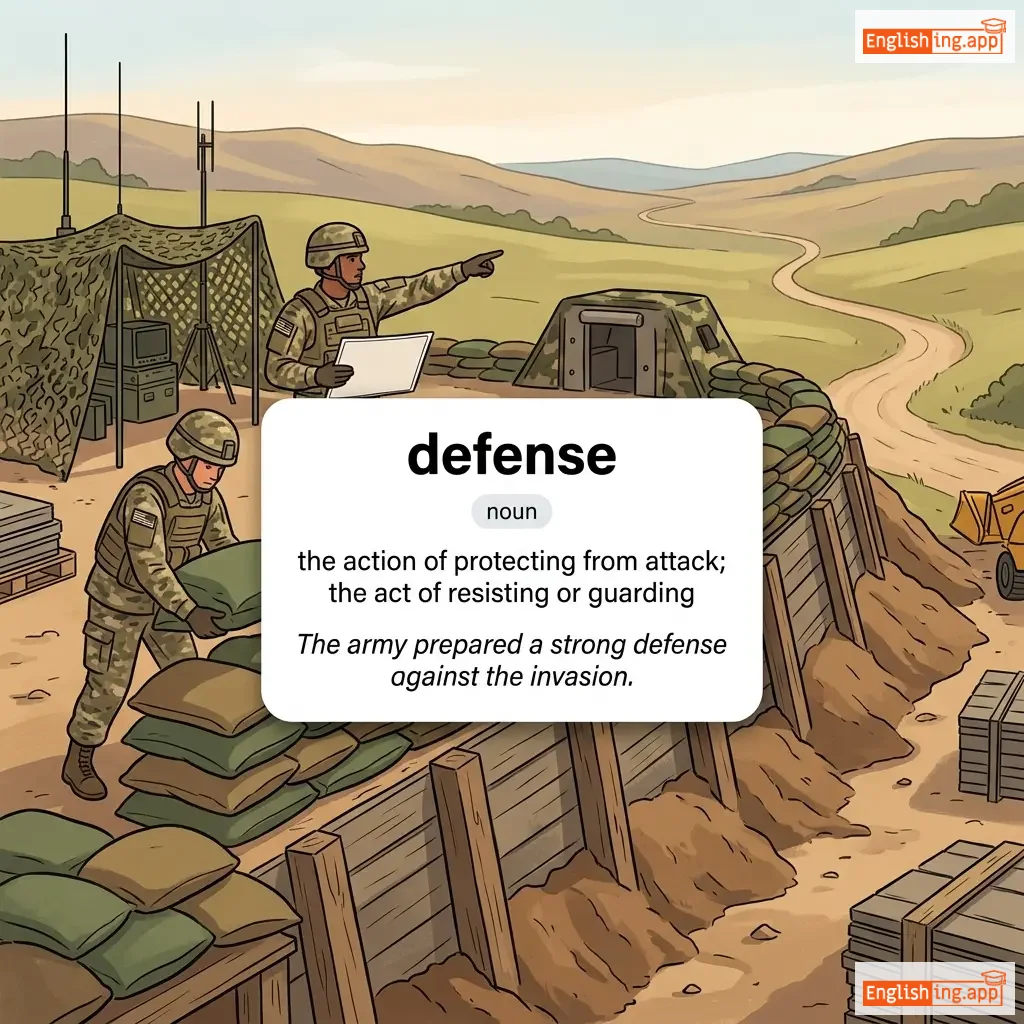
defense definition card — visual illustration of the meaning
noun
/dɪˈfɛns/
幸福 (xingfu)

the action of protecting from attack; the act of resisting or guarding

"The army prepared a strong defense against the invasion."

"当她收到奖项时,她无法掩饰自己的幸福。" (Dāng tā shōudào jiǎngxiàng shí, tā wúfǎ yǎnshì zìjǐ de xìngfú.)
adjective
/dɪˈfɛnsəbəl/
可防御的 / 合理的 (ke fangyu de / heli de)

Capable of being protected against attack or criticism; justifiable.

"Her decision was legally defensible."

"她的决定在法律上是可防御的。" (Tā de juédìng zài fǎlǜ shàng shì kě fángyù de.)
adjective
/dɪˈfɛnsɪv/
防御性的 (fángyùxìng de)

Intended to protect or defend; behaving in a way to guard against criticism or attack.

"He became defensive when asked about his mistake."

"当被问到他的错误时,他变得防御性强。" (Dāng bèi wèn dào tā de cuòwù shí, tā biàn dé fángyùxìng qiáng.)
verb
/dɪˈfɜːr/
推迟 (tuīchí)

To postpone or delay; to yield to someone else's judgment or opinion.

"The meeting was deferred until next week."
"会议推迟到下周。" (Huìyì tuīchí dào xià zhōu.)
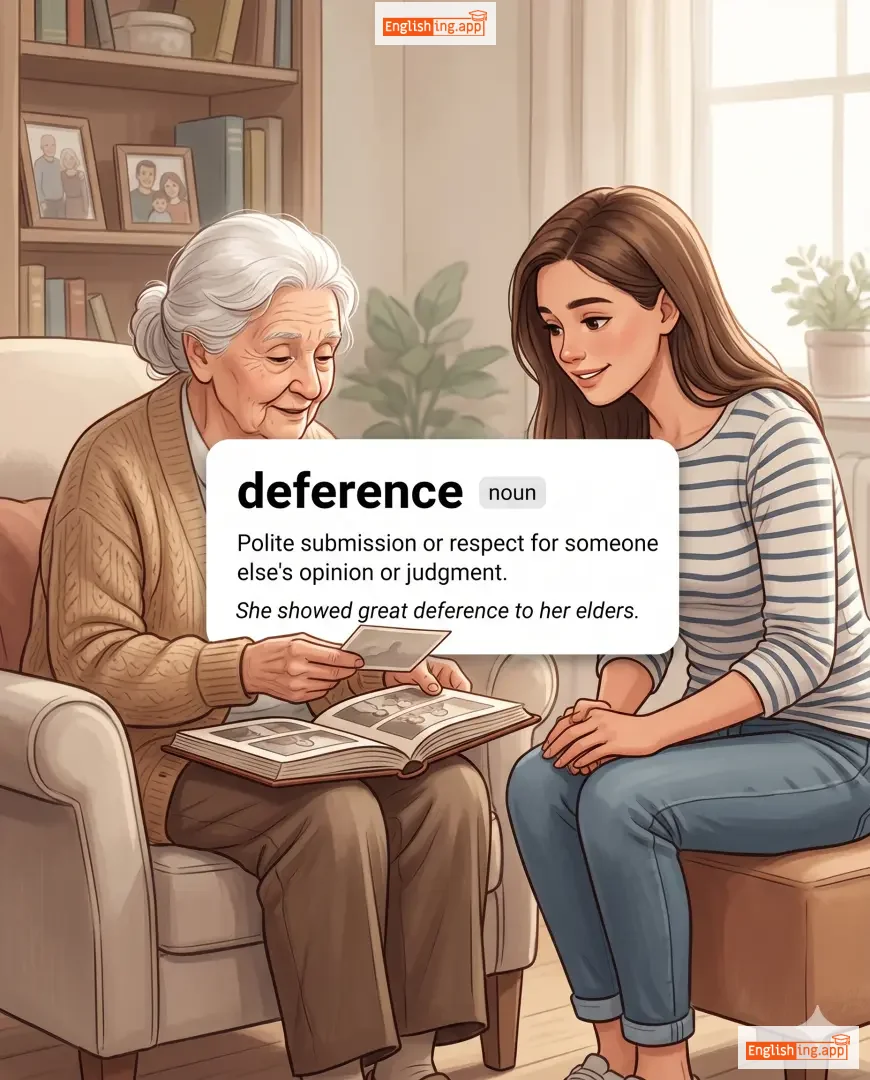
deference definition card — visual illustration of the meaning
noun
/ˈdɛfərəns/
尊敬 (zūnjìng)

Polite submission or respect for someone else's opinion or judgment.

"She showed great deference to her elders."

"她对长辈表现出极大的尊敬。" (Tā duì zhǎngbèi biǎoxiàn chū jí dà de zūnzhòng.)
adjective
/ˌdɛfəˈrɛnʃəl/
尊敬的 (zun jing de)

Showing or expressing respect and high regard.

"He was always deferential toward his teachers."

"他总是对他的老师表现出尊敬。" (ta zong shi dui ta de lao shi biao xian chu zun jing.)
noun
/dɪˈfaɪəns/
反抗 (fǎnkàng)

Open resistance or bold disobedience.

"The protest was an act of defiance against injustice."

"抗议是反对不公正的反抗行为。" (Kàngyì shì fǎnduì bù gōngzhèng de fǎnkàng xíngwéi.)