词汇表

英语词汇词典 | 单词含义、定义和示例

📅

date

noun/verb
/deɪt/

A particular day of the month or year; also, a social or romantic appointment.

"They decided to meet on the date of her birthday."

noun
/deɪts/
(zǎo)

sweet brown oval fruits that grow on date palm trees

"Dates are commonly eaten during Ramadan to break the fast."

"日期通常在斋月期间食用,用来打破禁食。" (Riqi tongchang zai zhaiyue qijian shiyong, yonglai dapo jinshi)
noun
/ˈdeɪtəm/ or /ˈdætəm/
数据 (shuju)

a single piece of information; a fact used as a basis for reasoning or calculation

"Each datum in the survey was carefully analyzed."

"调查中的每一条数据都经过仔细分析。" (Diaocha zhong de mei yi tiao shuju dou jinguo zixi fenxi.)
verb
/dɔːb/
涂抹 (tūmǒ)

to spread a thick or sticky substance carelessly on a surface

"The children daubed paint all over the walls."

"孩子们把油漆涂遍了墙壁。" (háizimen bǎ yóuqī tú biànle qiángbì.)
noun
/ˈdɔːtər/
女儿 (nǚ'ér)

a female child in relation to her parents

"They are proud of their daughter for graduating college."

"他们为女儿毕业于大学而感到骄傲。" (tāmen wèi nǚ'ér bìyè yú dàxué ér gǎndào jiāo'ào.)
daunt definition card — visual illustration of the meaning
verb
/dɔːnt/
威吓 (weihe)

to make someone feel intimidated, discouraged, or less confident

"The steep climb did not daunt the experienced hikers."
"陡峭的攀登没有让经验丰富的登山者气馁。" (Dǒuqiào de pāndēng méiyǒu ràng jīngyàn fēngfù de dēngshān zhě qìněi.)
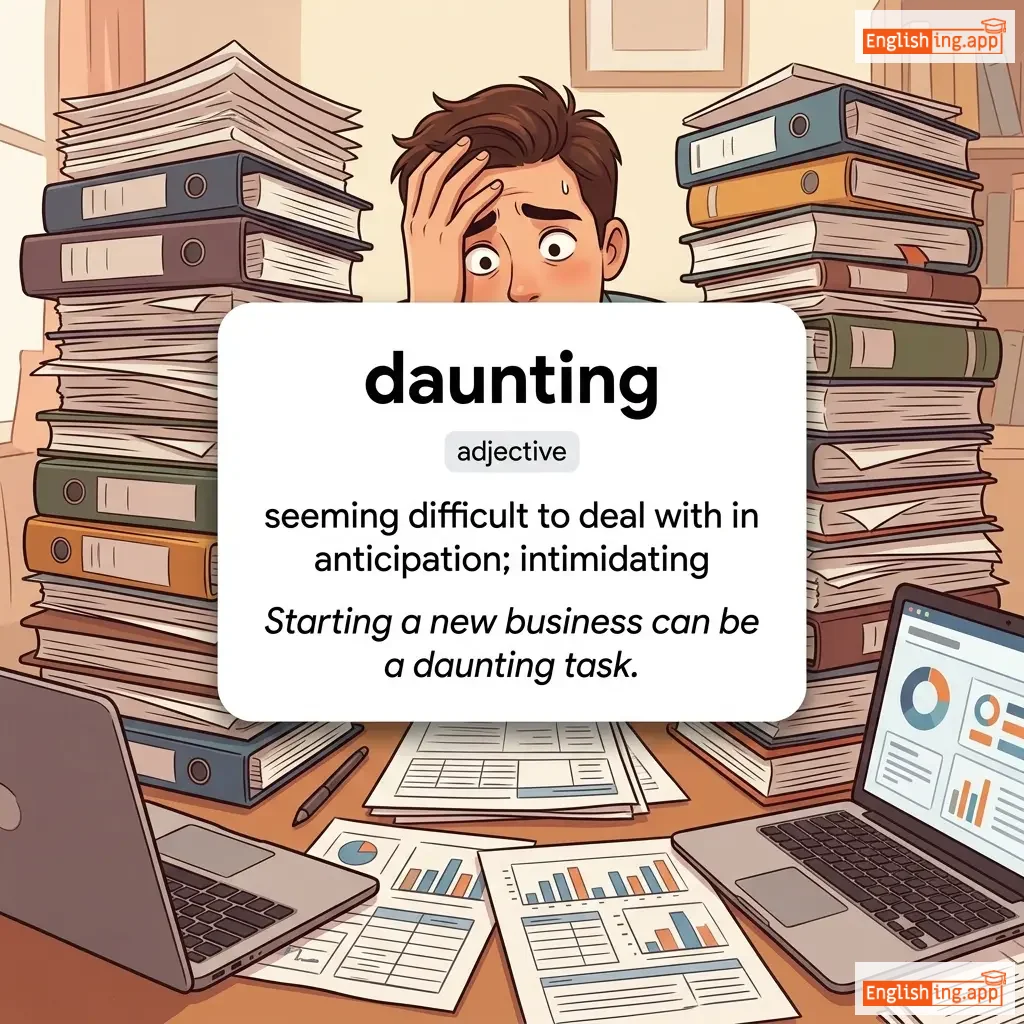
daunting definition card — visual illustration of the meaning
adjective
/ˈdɔːntɪŋ/
令人生畏 (lìng rén shēng wèi)

seeming difficult to deal with in anticipation; intimidating

"Starting a new business can be a daunting task."
"开始新业务可能是一个令人生畏的任务。" (Kāishǐ xīn yèwù kěnéng shì yīgè lìng rén shēng wèi de rènwù.)
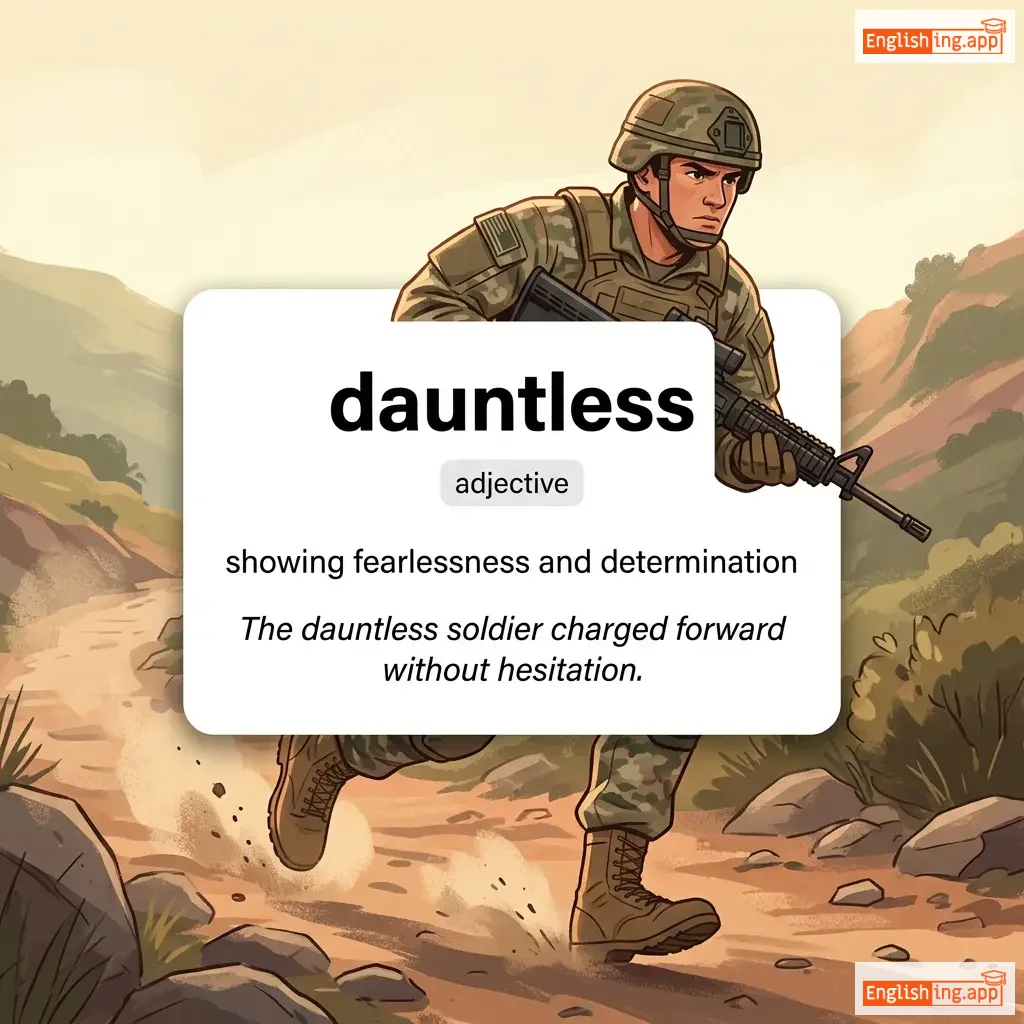
dauntless definition card — visual illustration of the meaning
adjective
/ˈdɔːntləs/
无畏 (wú wèi)

showing fearlessness and determination

"The dauntless soldier charged forward without hesitation."

"无畏的士兵毫不犹豫地向前冲。" (Wú wèi de shì bīng háo bù yóu yù de xiàng qián chōng.)
verb
/ˈdɔːd(ə)l/
拖延 (tuōyán)

to waste time by being slow or idle

"Stop dawdling and finish your homework."

"停止拖延,完成你的作业。" (Tíngzhǐ tuōyán, wánchéng nǐ de zuòyè.)
noun, verb
/dɔːn/
黎明 (liming)

The first appearance of light in the sky before sunrise; to begin or become apparent.

"Hope began to dawn in her heart after hearing the good news."

"在听到好消息后,希望在她的心中开始黎明。" (Zai tingdao hao xiaoxi hou, xiwang zai ta de xinzhi kaishi liming.)
noun
/deɪ/
(tian)

a period of 24 hours or the time between sunrise and sunset

"She enjoyed a relaxing day at the beach."

"她在海滩上度过了一个轻松的日子。" (Ta zai haitan shang duoguo le yige qingsong de tianzi.)
noun
/ˈdeɪ.mæn/
日工 (rì gōng)

a worker employed by the day; a day laborer

"The farmer hired a day-man to help with the harvest."

"农民雇佣了一个日工来帮助收割。" (nóngmín gùyōng le yīgè rì gōng lái bāngzhù shōugē.)
noun
/ˈdeɪˌbreɪk/
黎明 (liming)

The time in the morning when daylight first appears; dawn.

"They set out on their journey at daybreak."

"他们在黎明时分开始了他们的旅程。" (Tāmen zài límíng shífēn kāishǐle tāmen de lǚchéng.)
noun
/deɪz/
天数 (tianshu)

plural of day; refers to multiple 24-hour periods of time

"The project will take at least five days to finish."

"这个项目将需要至少五天才能完成。" (Zhege xiangmu jiang xuyao zhishao wu tian cai neng wancheng.)
😵

daze

verb
/deɪz/

to stun or confuse someone temporarily with a shock or surprise

"The bright lights dazed the runners as they entered the stadium."

verb
/ˈdæzəl/
使目眩 (shǐ mùxuàn)

to impress deeply or blind with brilliance or skill

"The magician's tricks dazzled the audience."

"魔术师的把戏使观众眼花缭乱。" (Móshù shī de bǎxì shǐ guānzhòng yǎnhuā liáo luàn.)
adjective
/ˈdæz.lɪŋ/
耀眼的; 令人印象深刻的 (yàoyǎn de; lìng rén yìnxiàng shēnkè de)

extremely bright and impressive; brilliant and stunning

"The dazzling lights of the city amazed the tourists."

"城市的耀眼灯光让游客感到惊讶。" (Chéngshì de yàoyǎn dēngguāng ràng yóukè gǎndào jīngyà.)
adjective, noun
/dɛd/
死的 (si de)

No longer alive; the end of life.

"The old tree is completely dead."

"那棵老树已经完全死了。" (Na ke lao shu yijing wanquan si le.)
noun
/ˌdɛd ˈhiːt/
平局 (pingju)

a race or contest in which two or more competitors finish exactly equal

"The race ended in a dead-heat between the two runners."

"比赛在两名跑者之间以平局结束。" (Bisai zai liang ming paozhe zhijian yi pingju jieshu.)
noun
/ˈded.lɑk/
死锁; 僵局 (sǐsuǒ; jiāngjú)

a situation in which no progress is possible; complete standstill

"The negotiations reached a deadlock when neither side would compromise."

"谈判陷入僵局,因为没有一方愿意妥协。" (Tánpàn xiànrù jiāngjú, yīnwèi méiyǒu yī fāng yuànyì tuǒxié.)
noun
/ˈdedlaɪn/
最后期限 (zuìhòu qīxiàn)

the latest time or date by which something must be completed

"We need to finish this project before the deadline."

"我们必须在最后期限之前完成这个项目。" (Wǒmen bìxū zài zuìhòu qīxiàn zhīqián wánchéng zhège xiàngmù.)
deadlines definition card — visual illustration of the meaning
noun
/ˈdɛdˌlaɪnz/
最后期限 (zuìhòu qīxiàn)

The latest time or date by which something should be completed.

"Setting deadlines helps finish tasks."

"设定最后期限有助于完成任务。" (Shè dìng zuìhòu qīxiàn yǒu zhù yú wánchéng rènwù.)
noun
/ˈdɛdlɒk/
僵局 (jiangju)

a situation in which progress is impossible because of disagreement

"Negotiations reached a deadlock after neither side agreed to compromise."

"谈判在双方都未同意妥协后陷入了僵局。" (Tanpan zai shuangfang dou wei tongyi tuoxie hou xianru le jiangju.)
adjective
/ˈdedli/
致命的 (zhìmìng de)

causing or able to cause death; extremely dangerous

"The snake's bite is deadly to humans."

"蛇的咬伤对人类致命。" (Shé de yǎoshāng duì rénlèi zhìmìng.)
adjective
/ˈdɛdˌpæn/
面无表情 (miàn wú biǎoqíng)

Deliberately impassive or expressionless in manner.

"She delivered the joke in a completely deadpan voice."

"她以完全面无表情的声音讲了笑话。" (Tā yǐ wánquán miàn wú biǎoqíng de shēngyīn jiǎngle xiàohuà.)
adjective
/def/
聋; 听力障碍 (lóng; tīnglì zhàng'ài)

unable to hear; having a hearing impairment

"The deaf child learned to communicate using sign language."

"那个聋哑孩子学会了使用手语进行沟通。" (Nàgè lóng yǎ háizi xuéhuìle shǐyòng shǒuyǔ jìnxíng gōutōng.)
🤝

deal

verb
/diːl/
幸福 (xìngfú)

to distribute or give out something; to handle or manage

"He had to deal with many problems at work."

"当她收到奖项时,她无法隐藏自己的幸福。" (Dāng tā shōudào jiǎngxiàng shí, tā wúfǎ yǐncáng zìjǐ de xìngfú.)
noun
/ˈdiːlər/
经销商 (jingxiaoshang)

a person or business that buys and sells goods; someone who distributes

"The car dealer offered a discount to attract customers."

"汽车经销商提供了折扣以吸引客户。" (Qiche jingxiaoshang tigongle zhekou yi xiqin kehu.)
noun
/ˈdiː.lɪŋ/
交易; 对待; 事务处理 (jiaoyi, duidai, shiwù chǔlǐ)

business transactions; the way of treating people or handling situations

"His fair dealing with customers earned him an excellent reputation."

"他与客户的公平交易为他赢得了极好的声誉。" (Tā yǔ kèhù de gōngpíng jiāoyì wèi tā yíngdéle jí hǎo de shēngyù.)
adjective
/dɪr/
亲爱的 (qīn'ài de)

loved or cherished; sometimes used as a polite form of address

"She is very dear to her grandparents."
"她在祖父母心中非常亲爱。" (tā zài zǔfùmǔ xīnzhōng fēicháng qīn'ài.)
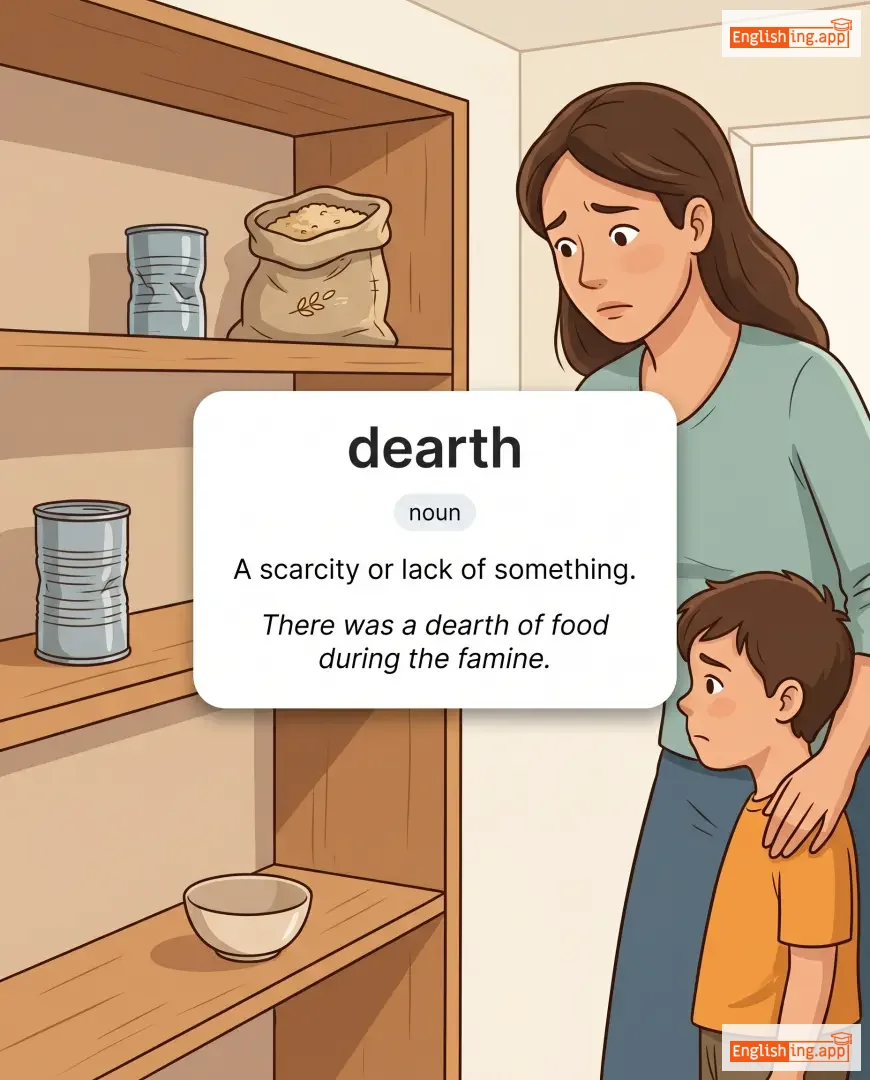
dearth definition card — visual illustration of the meaning
noun
/dɜːrθ/
匮乏 (kuìfá)

A scarcity or lack of something.

"There was a dearth of food during the famine."

"在饥荒期间,食物短缺。" (Zài jīhuāng qījiān, shíwù duǎnquē.)
noun
/dɛθ/
死亡 (sǐwáng)

The end of life; the permanent cessation of all vital functions.

"The news of his death shocked everyone in the village."

"他的死亡消息震惊了村里所有人。" (tā de sǐwáng xiāoxī zhènjīng le cūn lǐ suǒyǒu rén.)
noun
/ˈdɛθsˌhɛd/
骷髅 (kulou)

A representation of a human skull, often used as a symbol of death.

"The pirate flag was marked with a grim deaths-head."

"海盗旗上标有一个恐怖的骷髅。" (Hǎidào qí shàng biāo yǒu yīgè kǒngbù de kūlòu.)
noun
/deɪˈbɑːkəl/
彻底失败 (chédi shībài)

A sudden and complete failure; a fiasco.

"The product launch turned into a complete debacle."

"产品发布变成了彻底的失败。" (Chǎnpǐn fābù biànchéngle chèdǐ de shībài.)
verb
/dɪˈbɑːr/
禁止 (jìnzhǐ)

To officially prevent someone from doing something.

"He was debarred from entering the competition due to cheating."

"他因作弊被禁止参加比赛。" (Tā yīn zuòbì bèi jìnzhǐ cānjiā bǐsài.)
verb
/dɪˈbɑːrk/
下船 (xià chuán)

to disembark or get off a ship, aircraft, or vehicle

"The passengers debarked as soon as the ship docked."

"乘客在船停靠后下船。" (Chéngkè zài chuán tíngkào hòu xià chuán.)
verb
/dɪˈbeɪs/
贬低 (biǎndī)

to reduce the quality, value, or dignity of something

"Corruption can debase the values of a society."

"腐败可能贬低社会的价值观。" (Fǔbài kěnéng biǎndī shèhuì de jiàzhíguān.)
adjective
/dɪˈbeɪst/
贬值的 (biǎn zhí de)

having lost quality, value, or moral character

"The debased currency lost the trust of the people."

"贬值的货币失去了人们的信任。" (Biǎn zhí de huòbì shīqùle rénmen de xìnrèn.)
adjective
/dɪˈbeɪtəbl̩/
有争议的 (you zhengyi de)

open to discussion or doubt; not certain

"It is debatable whether the policy will work."

"是否政策有效是有争议的。" (Shi fou zhengce youxiao shi you zhengyi de.)
noun, verb
/dɪˈbeɪt/
辩论 (biànlùn)

A formal discussion on a particular topic where opposing arguments are presented.

"The students prepared well for the school debate."

"学生们为学校辩论做了充分的准备。" (Xuéshēngmen wèi xuéxiào biànlùn zuòle chōngfèn de zhǔnbèi.)
debates definition card — visual illustration of the meaning
noun
dɪˈbeɪts
辩论 (biàn lùn)

A formal discussion on a particular topic in a public meeting or legislative assembly.

"Debates foster intellectual growth."

"辩论促进智力增长。" (Biàn lùn cùjìn zhìlì zēngzhǎng.)
verb
/dɪˈbɔːtʃ/
堕落 (duòluò)

to corrupt morally; to lead into excessive indulgence in sensual pleasures

"The novel shows how wealth can debauch a person's character."

"小说展示了财富如何败坏一个人的品格。" (Xiǎoshuō zhǎnshìle cáifù rúhé bàihuài yīgè rén de pǐngé.)
debauchery definition card — visual illustration of the meaning
noun
/dɪˈbɔːtʃəri/
堕落 (duòluò)

excessive indulgence in sensual pleasures; corruption or vice

"The novel depicts the debauchery of the aristocrats in the city."

"这本小说描写了城市中贵族的堕落。" (Zhè běn xiǎoshuō miáoxiě le chéngshì zhōng guìzú de duòluò.)
noun
/dɪˈbɛntʃər/
债券 (zhàiquàn)

a type of debt instrument not secured by physical assets or collateral

"The company raised capital by issuing debentures to investors."

"公司通过向投资者发行债券筹集资金。" (Gōngsī tōngguò xiàng tóuzī zhě fāxíng zhàiquàn chóují zījīn.)
verb
/dɪˈbɪlɪteɪt/
削弱 (xüèruò)

to weaken or make someone or something infirm

"The long illness debilitated his strength."

"长时间的疾病削弱了他的力量。" (Cháng shíjiān de jíbìng xuēruòle tā de lìliàng.)
debilitating definition card — visual illustration of the meaning
adjective
/dɪˈbɪlɪteɪtɪŋ/
虚弱的 (xūruò de)

causing serious weakness or incapacity

"He suffers from a debilitating disease."

"他患有一种虚弱的疾病。" (Tā huàn yǒu yī zhǒng xūruò de jíbìng.)
noun
/ˈdeb.ɪt/
借方; 负债; 提款 (jiè fāng; fù zhài; tí kuǎn)

an entry recording an amount owed; money taken from a bank account

"The bank showed a debit of fifty dollars from my checking account."

"银行显示从我的支票账户中扣除五十美元。" (Yínháng xiǎnshì cóng wǒ de zhīpiào zhànghù zhōng kòuchú wǔshí měiyuán.)
adjective
/ˌdɛbəˈnɛr/
迷人 (mírén)

confident, stylish, and charming, typically referring to a man

"He looked debonair in his tuxedo at the gala."
"他在晚会中穿着燕尾服看起来非常迷人。" (Tā zài wǎnhuì zhōng chuānzhuó yànwěifú kàn qǐlái fēicháng mírén.)
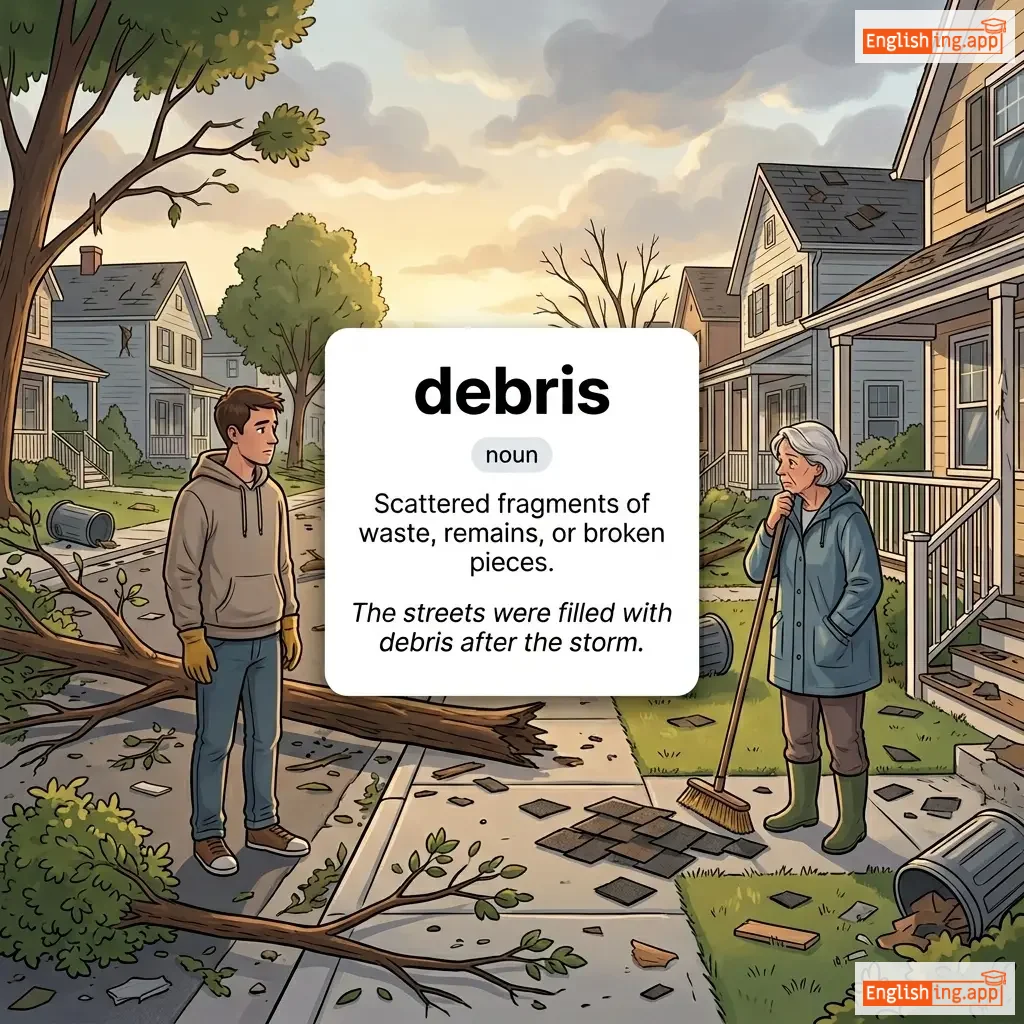
debris definition card — visual illustration of the meaning
noun
/dəˈbriː/
碎片 (suipian)

Scattered fragments of waste, remains, or broken pieces.

"The streets were filled with debris after the storm."

"风暴过后,街道上满是碎片。" (Fengbao guo hou, jiedao shang man shi suipian.)
debt definition card — visual illustration of the meaning
noun
/dɛt/
债务 (zhàiwù)

Something, typically money, that is owed or due.

"He struggled for years to pay off his debt."

"他为偿还债务奋斗了多年。" (Tā wèi chánghuán zhàiwù fèndòu le duōnián.)