词汇表

英语词汇词典 | 单词含义、定义和示例

noun
/sɛnˈtjʊəriən/
百夫长 (baifuzhang)

A commander of a unit of one hundred soldiers in the ancient Roman army.

"The centurion led his men into battle with courage."

"百夫长带领他的士兵英勇作战。" (Baifuzhang dàilǐng tā de shìbīng yīngyǒng zuòzhàn.)
noun
/ˈsɛnʧəri/
世纪 (shiji)

A period of one hundred years.

"The 20th century saw significant technological progress."

"20世纪见证了显著的技术进步。" (20 shiji jianzheng le xianzhu de jishu jinbu.)
noun
/ˌsiːiːˈoʊ/
首席执行官 (shǒuxí zhíxíng guān)

The highest-ranking person in a company, responsible for overall management.

"The CEO announced a new strategy for the company."

"CEO宣布了公司的一项新战略。" (CEO xuānbùle gōngsī de yī xiàng xīn zhànlüè.)
noun
/ˈsɪə.ri.əl/

a common breakfast food made from processed grains such as wheat, oats, or corn

"She eats a bowl of cereal every morning before work."

cerebral definition card — visual illustration of the meaning
adjective
/səˈriː.brəl/
大脑的 (dà nǎo de)

relating to the brain or intellect; intellectual rather than emotional

"He is known for his cerebral approach to problem-solving."

"他因其解决问题的理智方法而闻名。" (Tā yīn qí jiějué wèntí de lǐzhì fāngfǎ ér wénmíng.)
noun
/ˌser.əˈbreɪ.ʃən/
脑力活动 (naolihuo dong)

the process of thinking or using the brain actively

"The lecture sparked intense cerebration among the students."

"这场讲座激发了学生们的强烈脑力活动。" (Zhe chang jiangzuo jifale xueshengmen de qianglie naolihuo dong.)
adjective
/ˌser.ɪˈməʊ.ni.əl/
仪式的 (yí shì de)

relating to or used in a ceremony or formal occasion

"The president wore a ceremonial robe during the inauguration."

"总统在就职典礼上穿着仪式服装。" (Zǒngtǒng zài jiù zhí diǎn lǐ shàng chuānzhuó yí shì fúzhuāng.)
adjective
/ˌser.ɪˈməʊ.ni.əs/
正式和有礼貌 (zhèngshì hé yǒu lǐmào)

marked by formality, politeness, or strict observance of customs

"He gave her a ceremonious bow before entering the hall."

"他在进入大厅之前,给了她一个正式的鞠躬。" (Tā zài jìnrù dàtīng zhīqián, gěile tā yīgè zhèngshì de jūgōng.)
noun
/ˈsɛrəˌmoʊni/

A formal event or occasion, often with rituals and traditions.

"The graduation ceremony was held in the university hall."

adjective
/ˈsɜːr.tən/
确定的 (queding de)

Known for sure; having no doubt.

"I am certain that she will succeed."

"我确定她会成功。" (wo queding ta hui chenggong.)
adverb
/ˈsɜːrtənli/
肯定 (kending)

without doubt; surely; used to emphasize certainty

"I will certainly help you with your project."

"我一定会帮助你完成你的项目。" (Wǒ yīdìng huì bāngzhù nǐ wánchéng nǐ de xiàngmù.)
noun
/ˈsɜːtənti/
确定性 (quèdìngxìng)

the state of being sure or confident about something

"There is no certainty about the weather tomorrow."

"明天的天气没有确定性。" (míngtiān de tiānqì méiyǒu quèdìngxìng.)
noun
/sərˈtɪfɪkət/
证书 (zhèngshū)

a document serving as proof of achievement or qualification

"She received a certificate for completing the course."

"她因完成课程而获得了证书。" (Tā yīn wánchéng kèchéng ér huòdéle zhèngshū.)
noun
/ˌsɜːrtɪfɪˈkeɪʃən/
认证 (renzheng)

the process of officially recognizing or confirming that something or someone meets required standards; an official document proving qualification

"She received her professional certification after completing the training program."

"她在完成培训项目后获得了专业认证。" (ta zai wancheng peixun xiangmu hou huodele zhuanye renzheng)
noun
/ˈsɜːrtɪˌtjuːd/
确定性 (quedingxing)

Absolute certainty or conviction about something.

"She spoke with certitude about the outcome of the case."

"她以确定的语气谈论案件的结果。" (Tā yǐ quèdìng de yǔqì tánlùn ànjiàn de jiéguǒ.)
noun
/sɛˈseɪʃən/
停止 (tingzhi)

The fact or process of ending or being brought to an end.

"There was a temporary cessation of hostilities."

"敌对行动暂时停止。" (Diduì xíngdòng zhànshí tíngzhǐ.)
noun
/ˈsɛʃən/
放弃权利或财产 (fangqi quanli huo caichan)

The formal giving up of rights, property, or territory, especially by a state.

"The treaty resulted in the cession of land to the neighboring country."

"条约导致了土地的转让给邻国。" (Tiaoyue daozhi le tudi de zhuanrang gei linguo.)
noun
/ˈsɛtərə/
等等 (deng deng)

Latin for 'the rest' or 'others'; commonly used in the phrase 'et cetera' meaning 'and so on'.

"We need to buy pens, paper, notebooks, et cetera."

"我们需要购买钢笔、纸张、笔记本等等。" (Women xuyao goumai gangbi, zhizhang, bijiben deng deng.)
😣

chafe

verb
/ʧeɪf/

To make or become sore by rubbing; to feel irritation or impatience.

"The tight shoes began to chafe his heels."

noun
/tʃæf/
谷壳 (gǔ ké)

The husks of corn or other seed separated by winnowing or threshing; worthless or trivial matter.

"The farmer separated the wheat from the chaff."

"农民把小麦和谷壳分开。" (Nóngmín bǎ xiǎomài hé gǔ ké fēnkāi.)
verb
/ˈtʃæfɪŋ/
戏弄 (xīnòng)

Teasing or joking in a lighthearted way.

"They were chaffing each other during lunch."

"他们在午餐时互相开玩笑。" (Tāmen zài wǔcān shí hùxiāng kāi wánxiào.)
verb
/ˈtʃeɪfɪŋ/
摩擦引起疼痛 (moca yinqi tengtong)

To make sore by rubbing; to become irritated.

"The rough shoes were chafing his heels."

"粗糙的鞋子擦痛了他的脚跟。" (Cūcāo de xiézi cā tòngle tā de jiǎogēn.)
noun
/ʃəˈɡrɪn/
懊悔 (aohui)

Distress or embarrassment at having failed or been humiliated.

"She left the room in chagrin after forgetting her lines."

"她在忘记台词后,带着懊悔离开了房间。" (Ta zai wangji taici hou, daizhe aohui likai le fangjian.)
⛓️

chain

noun
/tʃeɪn/

a connected series of metal rings used for fastening or securing things; a series of connected events or businesses

"He wore a gold chain around his neck."

🪑

Chair

noun
/tʃɛr/

a piece of furniture for one person to sit on, typically having a back and four legs

"She pulled up a chair and sat beside me."

noun
/ˈtʃɛərmən/
幸福 (xìngfú)

the leader or head of a meeting, committee, or organization

"The chairman opened the meeting with a short speech."

"当她获得奖项时,她无法隐藏自己的幸福。" (Dāng tā huòdé jiǎngxiàng shí, tā wúfǎ yǐncáng zìjǐ de xìngfú.)
chairperson definition card — visual illustration of the meaning
noun
ˈtʃeə.pɜː.sən
主席 (zhǔxí)

A person who is in charge of a meeting or organization; the presiding officer of a committee, board, or organization.

"The chairperson ensures procedural integrity."

"主席确保程序的完整性。" (Zhǔxí quèbǎo chéngxù de wánzhěng xìng.)
noun
/ˈtʃɛərˌwʊmən/
女主席 (nu zhuxi)

a woman who presides over a meeting, committee, or organization; a female leader of a board or council

"She was elected chairwoman of the company after years of experience."

"在多年的经验之后,她被选为公司的女主席。" (Zai duo nian de jingyan zhihou ta bei xuan wei gongsi de nu zhuxi)
noun
/ˈtʃælɪs/
圣杯 (shengbai)

A large cup or goblet, typically used for drinking wine in religious ceremonies.

"The priest lifted the golden chalice during the ceremony."

"牧师在仪式中举起了金色的圣杯。" (Mushi zai yishi zhong juqi le jinse de shengbai.)
challenge definition card — visual illustration of the meaning
noun/verb
/ˈtʃælɪndʒ/
挑战 (tiaozhan)

a difficult task or problem that requires effort to overcome; to question or dispute

"Climbing the mountain was the biggest challenge of his life."

"攀登山峰是他一生中最大的挑战。" (Pandeng shanfeng shi ta yisheng zhong zui da de tiaozhan.)
noun
/ˈtʃælɪndʒɪz/
挑战 (tiaozhan)

Difficult tasks or situations that test someone's abilities or resources.

"Overcoming challenges is the key to personal growth."

"克服挑战是个人成长的关键。" (Kefu tiaozhan shi gerengrowth zhi guanjian.)
adjective
/ˈtʃælɪndʒɪŋ/
具有挑战性的 (jùyǒu tiǎozhàn xìng de)

difficult in a way that tests one's abilities

"The mountain climb was challenging but rewarding."

"爬山是具有挑战性的,但也是有回报的。" (Páshān shì jùyǒu tiǎozhàn xìng de, dàn yě shì yǒu huíbào de.)
noun
/ˈtʃeɪmbər/
房间 (fangjian)

a large room used for formal or public events, or a private room.

"The king held meetings in his private chamber."

"国王在他的私人房间里举行会议。" (guówáng zài tā de sīrén fángjiān lǐ jǔxíng huìyì.)
noun
/kəˈmiːliən/
变色龙 (biàn sè lóng)

a lizard known for its ability to change color to blend with its surroundings.

"The chameleon changed its color to hide from predators."

"变色龙改变了它的颜色以躲避捕食者。" (Biàn sè lóng gǎibiàn le tā de yánsè yǐ duǒbì bǔshí zhě.)
noun
/tʃəˈmeɪ.li/
茉莉花 (moli hua)

a variety of jasmine flower with small white fragrant petals

"The chameli flowers are commonly used to make garlands and perfumes."

"茉莉花常用于制作花环和香水。" (mo li hua chang yong yu zhi zuo hua huan he xiang shui.)
noun
/tʃæmp/
冠军 / 胜利者 (guan jun / sheng li zhe)

an informal word for champion or winner.

"He is the new champ of the boxing tournament."

"他是拳击比赛的新冠军。" (Ta shi quanji bisai de xin guanjun.)
noun
/ˈtʃæm.pæk/
香木花 (xiang mu hua)

a fragrant yellow or white flower from a tree native to South Asia, used in perfumes and religious ceremonies

"The champak tree in the temple courtyard bloomed with golden flowers."
"寺庙庭院中的香木花树开满了金色的花。" (Si miao ting yuan zhong de xiang mu hua shu kai man le jin se de hua.)
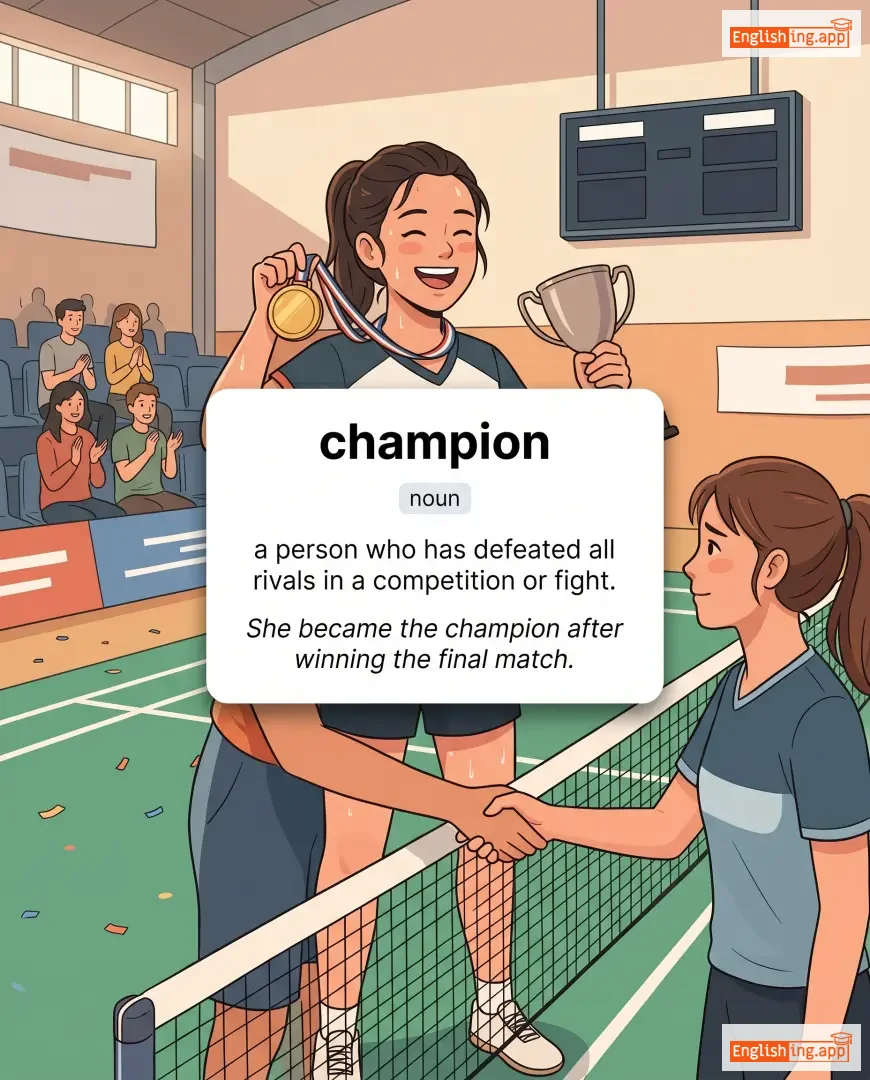
champion definition card — visual illustration of the meaning
noun
/ˈtʃæmpiən/
冠军 (guan jun)

a person who has defeated all rivals in a competition or fight.

"She became the champion after winning the final match."

"她在赢得决赛后成为了冠军。" (Ta zai yingde jue sai hou chengwei le guan jun.)
noun
/ˈtʃæmpiənʃɪp/
锦标赛 (jinbiaosai)

a competition to decide who is the best in a particular sport or activity.

"The championship will be held next month."

"锦标赛将在下个月举行。" (jinbiaosai jiang zai xia ge yue juxing.)
noun
/tʃæns/
机会 (jī huì)

An opportunity or possibility of something happening.

"He took a chance and applied for the job."

"他冒险申请了这份工作。" (Tā màoxiǎn shēnqǐngle zhè fèn gōngzuò.)
noun
/ˈtʃænsələr/
校长 / 总理 (xiaozhang / zongli)

A senior state or legal official, or the head of a university.

"The chancellor delivered an inspiring speech at the graduation ceremony."

"校长在毕业典礼上发表了鼓舞人心的演讲。" (Xiaozhang zai biyedianli shang fabiao le guwurenxin de yanjiang.)
noun
/ˈtʃænsəri/
大法官法院 (dà fǎguān fǎyuàn)

A court of equity or the office of a chancellor.

"The case was taken to the chancery court for resolution."

"此案件已提交至大法官法院以求解决。" (Cǐ ànjiàn yǐ tíjiāo zhì dà fǎguān fǎyuàn yǐ qiú jiějué.)
change definition card — visual illustration of the meaning
verb
/tʃeɪndʒ/
改变 (gǎibiàn)

To make something different or to become different.

"She decided to change her career path."

"她决定改变她的职业道路。" (Tā juédìng gǎibiàn tā de zhíyè dàolù.)
change management definition card — visual illustration of the meaning
noun
/ˈʃeɪndʒ ˈmænɪdʒmənt/
变革管理 (biàn gé guǎn lǐ)

The discipline that guides how we prepare, equip and support individuals, teams and organizations in making organizational change.

"Change management ensures smooth transitions."

"变革管理确保平稳过渡。" (Biàn gé guǎn lǐ quèbǎo píngwěn guòdù.)
adjective
/ˈtʃeɪn.dʒə.bəl/
可变的; 易变的 (kě biàn de; yì biàn de)

able to be changed; likely to change frequently

"The weather is very changeable in spring."

"春天的天气非常多变。" (Chūntiān de tiānqì fēicháng duōbiàn.)
verb
/ˈtʃeɪndʒɪŋ/
变化 (biànhuà)

The act of becoming different; ongoing process of change.

"The weather is changing rapidly."

"天气在快速变化。" (Tiānqì zài kuàisù biànhuà.)
noun
/ˈtʃænəl/
频道 / 媒介 (píndào / méijiè)

A means of communication, or a passage for water or information.

"They launched a new TV channel last year."

"他们去年推出了一个新的电视频道。" (Tāmen qùnián tuīchūle yīgè xīn de diànshì píndào.)
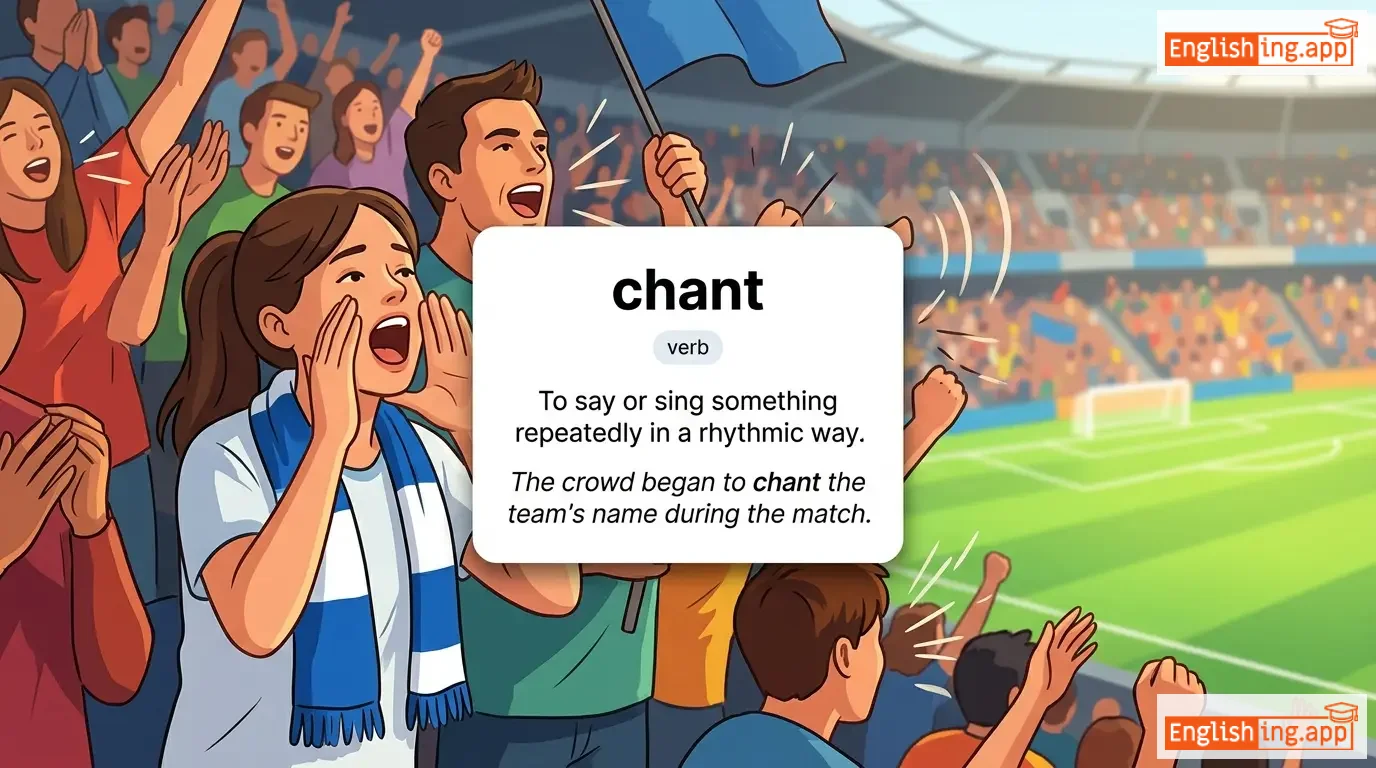
chant definition card — visual illustration of the meaning
verb
/tʃænt/
唱口号 (chang kouhao)

To say or sing something repeatedly in a rhythmic way.

"The crowd began to chant the team's name during the match."

"人群在比赛期间开始喊出队伍的名字。" (Renqun zai bisai qijian kaishi han chu duiwu de mingzi.)
noun
/ˈkeɪɒs/
混乱 (hunluan)

A state of complete disorder and confusion.

"The sudden storm caused chaos in the city."

"突如其来的暴风雨在城市中造成了混乱。" (Tū rú qí lái de bào fēng yǔ zài chéng shì zhōng zào chéngle hùnluàn.)
adjective
/keɪˈɒtɪk/
混乱的 (hunluande)

Completely disordered or confusing.

"The classroom became chaotic when the teacher left."

"当老师离开时,教室变得混乱了。" (Dang laoshi likai shi, jiaoshi biande hunluan le.)