词汇表

英语词汇词典 | 单词含义、定义和示例

noun
/krʊk/
骗子 (pianzi)

a dishonest person, especially a criminal

"The police finally caught the crook who had been stealing cars."

"警方终于抓住了那个偷车的骗子。" (Jingfang zhongyu zhuazhu le nage tou che de pianzi.)
verb
/kruːn/
用柔和、低沉、温柔的声音唱歌或哼歌 (yòng róuhé, dīchén, wēnróu de shēngyīn chànggē huò hēnggē)

to sing or hum in a soft, low, and gentle voice

"She crooned a lullaby to help the baby fall asleep."

"她唱着摇篮曲帮助婴儿入睡。" (Tā chàngzhe yáolánqǔ bāngzhù yīngér rùshuì.)
noun
/krɒp/
农作物 (nongzuowu)

plants that are grown and harvested for food or other use

"The farmers harvested their rice crop in autumn."

"农民在秋季收获了他们的稻米作物。" (nongmin zai qiujì shōuhuòle tāmen de dàomǐ zuòwù.)
verb
/krɒs/
穿越 (chuānyuè)

to go from one side to another, or to pass through

"We crossed the river using a wooden bridge."

"我们通过一座木桥过了河。" (Wǒmen tōngguò yī zuò mù qiáo guò le hé.)
verb
/ˈkrɒs.briːd/
杂交 (zájīao)

to produce an animal or plant by mating two different breeds, varieties, or species

"Farmers crossbreed cows to improve milk production."

"农民通过交配不同品种的牛来提高奶产量。" (Nóngmín tōngguò jiāopèi bùtóng pǐnzhǒng de niú lái tígāo nǎi chǎnliàng.)
adverb
/ˈkrɒswaɪz/
交叉方向 (jiaocha fangxiang)

in the form of a cross; diagonally across

"Place the logs crosswise to build a stable fire."

"将木柴交叉放置以建立一个稳定的火堆。" (Jiang mùchái jiaochā fàngzhì yǐ jiànlì yīgè wěndìng de huǒduī.)
adjective
/ˈkrɒtʃ.ə.ti/
脾气坏 (píqì huài)

bad-tempered, easily annoyed, and often complaining

"The crotchety old man yelled at the children for playing near his house."

"那个脾气坏的老人对在他家附近玩耍的孩子们大喊。" (Nàgè píqì huài de lǎorén duì zài tā jiā fùjìn wánshuǎ de háizimen dà hǎn.)
verb
/kraʊtʃ/

to bend your knees and lower your body close to the ground

"The cat crouched before leaping at its prey."

🐦‍⬛

Crow (kro)

noun
/kroʊ/
乌鸦 (wuyā)

a large black bird known for its intelligence and harsh call

"The crow cawed loudly from the tree branch."

"乌鸦从树枝上大声地叫。" (Wūyā cóng shùzhī shàng dàshēng de jiào.)
noun
/ˈkroʊ.bɑːr/
撬棍 (qiào gùn)

a heavy iron bar with a curved end used as a lever for prying things apart

"He used a crowbar to remove the old nails."

"他用撬棍把旧钉子取了出来。" (Tā yòng qiàogùn bǎ jiù dīngzi qǔle chūlái.)
noun
/kraʊd/
人群 (renqun)

a large number of people gathered together

"A huge crowd gathered to watch the concert."

"一个巨大的观众聚集在一起观看音乐会。" (Yi ge jueda de guanzhong juzhi zai yiqi guankan yinyuehui.)
🚶‍♂️🚶‍♀️

crowded (happiness)

adjective
/ˈkraʊdɪd/
幸福 (xìngfú)

filled with too many people or things

"The bus was so crowded that I could hardly move."

"当她收到奖项时,她无法掩饰自己的幸福。" (Dāng tā shōu dào jiǎngxiàng shí, tā wúfǎ yǎnshì zìjǐ de xìngfú.)
noun
/kraʊn/
王冠 (wangguan)

a circular ornamental headdress worn by a monarch as a symbol of authority

"The king wore his golden crown at the ceremony."

"国王在仪式上戴上了他的金色王冠。" (Guówáng zài yíshì shàng dàishàng le tā de jīnsè wángguān.)
crucial definition card — visual illustration of the meaning
adjective
/ˈkruːʃəl/
关键的 (guan-jian de)

extremely important or necessary

"Trust is crucial for a strong relationship."

"信任对强大的关系至关重要。" (Xinren dui qiangda de guanxi zhiguang zhongyao.)
noun
/ˈkruːsɪbəl/
严峻考验,熔炉 (yánjùn kǎoyàn, rónglú)

a severe test or trial; a container used for heating substances to very high temperatures

"The team emerged stronger from the crucible of competition."

"团队从竞争的熔炉中走了出来,变得更强大。" (Tuánduì cóng jìngzhēng de rónglú zhōng zǒu le chūlái, biàn dé gèng qiángdà.)
adjective
/kruːd/
原油 (yuányóu)

in a natural or raw state; not yet processed or refined

"The crude oil is processed into fuel and chemicals."

"原油被加工成燃料和化学品。" (Yuányóu bèi jiāgōng chéng ránliào hé huàxué pǐn.)
adjective
/ˈkruːəl/
残忍 (cánrěn)

Willfully causing pain or suffering to others, or feeling no concern about it.

"It was cruel to make fun of the injured boy."

"嘲笑受伤的男孩是残忍的。" (cháoxiào shòushāng de nán hái shì cánrěn de.)
noun
/ˈkruː.əl.ti/
残忍; 非人道的待遇; 导致疼痛的行为 (cánrěn, fēi réndào de dàiyù, dǎozhì téngtòng de xíngwéi)

behavior that causes pain or suffering to others; the quality of being cruel

"The documentary exposed the cruelty of factory farming to animals."

"纪录片揭示了工厂养殖对动物的残忍行为。" (Jìlùpiàn jiēshìle gōngchǎng yǎngzhí duì dòngwù de cánrěn xíngwéi.)
noun
/ˈkruːɪt/
小容器 (xiao rongqi)

a small container, especially for salt, pepper, oil, or vinegar, used at a dining table

"She filled the cruet with olive oil for the salad."

"她将橄榄油倒入调味瓶中,为沙拉准备。" (Ta jiang ganlan you dao ru tiao wei ping zhong, wei shala zhunbei.)
🛳️

cruise

verb
/kruːz/
幸福 (xìngfú)

to travel smoothly at a moderate speed, especially for pleasure

"They decided to cruise along the coast during their vacation."

"她无法掩饰当她收到奖项时的幸福。" (Tā wúfǎ yǎnshì dāng tā shōudào jiǎngxiàng shí de xìngfú.)
verb
/ˈkrʌmpəl/
揉捏 (róu niē)

to crush something into folds or wrinkles

"He crumpled the paper and threw it in the bin."

"他把纸揉成一团丢进了垃圾桶。" (Tā bǎ zhǐ róu chéng yī tuán diū jìn le lājī tǒng.)
noun/verb
/kruːˈseɪd/
十字军,激烈运动 (shízìjūn, jīliè yùndòng)

a vigorous campaign for a social, political, or religious cause; to fight passionately for a cause

"She has been crusading for women's rights all her life."

"她为妇女权利而斗争了一生。" (Tā wèi fùnǚ quánlì ér dòuzhēng le yīshēng.)
💔

crush

verb
/krʌʃ/

to press or squeeze something so hard that it is damaged or destroyed

"He accidentally crushed the paper cup in his hand."

noun
/krʌst/
外壳 (wai ke)

the hard outer surface of something, especially bread or the Earth's outer layer

"He cut off the crust of the bread before eating."

"他在吃之前切去了面包的外壳。" (Tā zài chī zhī qián qiē qùle miànbāo de wàiké.)
noun
/krʌˈsteɪʃən/
硬壳水生动物 (ying ke shui sheng dong wu)

an aquatic animal with a hard shell, such as crabs, lobsters, and shrimps

"Crabs and lobsters are well-known crustaceans."

"螃蟹和龙虾是著名的甲壳类动物。" (Pang xie he long xia shi zhu ming de jia ke lei dong wu.)
adjective
/krʌˈsteɪʃəs/
有硬壳的 (you ying ke de)

relating to or having a hard shell like a crustacean

"The scientist studied the crustaceous fossils."

"科学家研究了有硬壳的化石。" (Kexuejia yanjiule you yingkede huashi.)
noun
/krʌtʃ/
拐杖, 支撑 (guǎi zhàng, zhī chēng)

a support used by someone injured to walk; also something relied upon for support or help

"He had to use crutches after breaking his leg."

"他在摔断腿后不得不用拐杖。" (Tā zài shuāi duàn tuǐ hòu bùdé bù yòng guǎi zhàng.)
noun
/krʌks/
关键 (guānjiàn)

the most important or decisive point of an issue

"The crux of the problem lies in poor communication."

"问题的关键在于沟通不畅。" (Wenti de guānjiàn zài yú gōutōng bùchàng.)
😢

cry

verb, noun
/kraɪ/

To shed tears as an expression of emotion such as sadness or pain; also a loud call or shout.

"The baby began to cry when she was hungry."

noun
/krɪpt/
墓室 (mùshì)

an underground chamber, especially one beneath a church, used as a burial place

"The tourists explored the ancient crypt beneath the cathedral."

"游客们探索了大教堂下的古老地下室。" (Yóukè men tàn suǒle dà jiàotáng xià de gǔlǎo dìxiàshì.)
cryptic definition card — visual illustration of the meaning
adjective
/ˈkrɪptɪk/
神秘 (shénmì)

having a meaning that is mysterious or obscure

"She left a cryptic message on his voicemail."

"她在他的语音邮件中留下了一个神秘的信息。" (Tā zài tā de yǔyīn yóuxiàng zhōng liú xià le yīgè shénmì de xìnxī.)
cryptocurrency definition card — visual illustration of the meaning
noun
/ˌkrɪptəˈkʌrənsɪ/
数字货币 (shuzi huobi)

A digital currency in which transactions are verified and records maintained by a decentralized system

"Cryptocurrencies are revolutionizing the financial landscape."

"加密货币正在彻底改变金融格局。" (Jiamihuobi zhengzai chedi gaibian jinrong geju.)
noun
/ˈkrɪptəɡræm/
秘密代码 (mìmì dàimǎ)

a text written in code or cipher

"The detective solved the cryptogram hidden in the letter."

"侦探解开了信中隐藏的密码图。" (Zhēntàn jiěkāile xìn zhōng yǐncáng de mìmǎ tú.)
cryptographic definition card — visual illustration of the meaning
adjective
/ˌkrɪp.təˈɡræf.ɪk/
加密的 (jiāmì de)

Relating to cryptography; involving or using secret codes or ciphers for security.

"Banks use cryptographic technology to protect transactions."

"银行使用加密技术来保护交易。" (Yínháng shǐyòng jiāmì jìshù lái bǎohù jiāoyì.)
cryptography definition card — visual illustration of the meaning
noun
/krɪpˈtɒɡ.rə.fi/
通过加密或编码技术保护信息的实践 (tongguo jiamiyu kodirong jishu baohu xinxi de shijian)

The practice of securing information through encryption or coding techniques

"Modern cryptography ensures secure online transactions."

"现代加密学确保了安全的在线交易。" (Xiandai jiamixue quebao le anquan de zailin jiaoyi.)
noun
/ˈkrɪstəl/
水晶 (shuǐjīng)

a clear, transparent mineral or glass that forms a solid structure with regular patterns

"She wore a necklace made of sparkling crystal."

"她戴着一条闪闪发光的水晶项链。" (Tā dàizhe yītiáo shǎnshǎn fāguāng de shuǐjīng xiàngliàn.)
verb
/ˈkrɪstəlaɪz/
结晶 (jie-jing)

to form crystals; to make an idea or plan clear and definite

"Her vague thoughts began to crystallize into a solid plan."

"她模糊的思绪开始在一个明确的计划中结晶。" (Ta mo-hu de si-xu kai-shi zai yi ge ming-que de ji-hua zhong jie-jing.)
noun
/kʌb/
幼熊 (you xiong)

a young bear, lion, tiger, or other large carnivorous mammal

"The bear cub stayed close to its mother for protection."

"小熊为保护自己一直待在母亲身边。" (Xiao xiong wei baohu ziji yizhi daizai muqin shenbian.)
adjective
/ˈkjuːbən/
古巴的 (gǔbā de)

relating to Cuba, its people, or its culture

"We enjoyed delicious Cuban coffee at the café."

"我们在咖啡馆享用了美味的古巴咖啡。" (Wǒmen zài kāfēi guǎn xiǎngyòngle měiwèi de gǔbā kāfēi.)
noun, verb
/kjuːb/
立方体 (lìfāngtǐ)

As a noun: a solid object with six equal square faces. As a verb: to cut food into small square pieces.

"She put a sugar cube in her tea."

"她把一块糖放进了她的茶里。" (Tā bǎ yī kuài táng fàng jìnle tā de chá lǐ.)
noun
/ˈkjuːbeb ˈpepər/
胡椒柯贝贝 (hújiāo kē bèi bèi)

aromatic spice with a slightly bitter taste and cooling aftertaste

"Cubeb pepper is used in traditional Indonesian cuisine."

"胡椒柯贝贝用于传统的印度尼西亚菜肴。" (hújiāo kē bèi bèi yòngyú chuántǒng de yìndùníxīyà càiyáo)
noun
/ˈkjuː.bɪ.kəl/
办公隔间 (bàngōng géjiān)

A small partitioned-off area of a room, typically in an office.

"She works in a cubicle with three other colleagues."

"她和另外三位同事在一个办公隔间里工作。" (Tā hé lìngwài sān wèi tóngshì zài yīgè bàngōng géjiān lǐ gōngzuò.)
noun
/ˈkʊk.uː/
布谷鸟 (bùgǔniǎo)

a bird known for its distinctive call and for laying eggs in other birds' nests

"We heard the cuckoo calling from the forest early in the morning."

"我们在清晨听到了从森林传来的布谷鸟的叫声。" (Wǒmen zài qīngchén tīng dào le cóng sēnlín chuán lái de bùgǔniǎo de jiàoshēng.)
noun
/ˈkjuː.kʌm.bər/
黄瓜 (huanggua)

a long green vegetable with watery flesh, eaten raw in salads or cooked

"I added fresh cucumber slices to my salad."

"我在沙拉里加入了新鲜的黄瓜片。" (Wo zai shala li jiaru le xinxian de huanggua pian.)
noun/verb
/ˈkʌdʒ.əl/
棍棒 (gùn bàng)

A short, thick stick used as a weapon; to beat with a cudgel.

"The guard used a cudgel to chase away the thief."

"警卫用棍棒把小偷赶走。" (Jǐngwèi yòng gùn bàng bǎ xiǎotōu gǎn zǒu.)
noun/verb
/kjuː/
信号 (xinhao)

A signal or prompt for action; to give a signal.

"The actor waited for his cue before entering the stage."

"演员在上台前等待他的信号。" (Yǎnyuán zài shàngtái qián děngdài tā de xìnhào.)
cues definition card — visual illustration of the meaning
noun
kjuːz
线索 (xiànsuǒ)

Signals or hints from conversation or environment that help understanding

"Facial expressions provide cues about a person's emotions."

"面部表情提供关于一个人情绪的线索。" (Miànbù biǎoqíng tígōng guānyú yīgè rén qíngxù de xiànsuǒ.)
noun
/kwɪˈziːn/
美食 (meishi)

A style or method of cooking, especially characteristic of a particular country or region.

"Italian cuisine is famous all over the world."

"意大利美食在全世界都很有名。" (Yidali meishi zai quan shijie dou hen you ming.)
noun
/ˌkʌl də ˈsæk/
死胡同 (si hutong)

A street or passage closed at one end; a dead end.

"They bought a house at the end of a quiet cul de sac."
"他们在一个安静的死胡同的尽头买了一栋房子。" (Tamen zai yi ge anjing de si hutong de jintou mai le yi dong fangzi.)
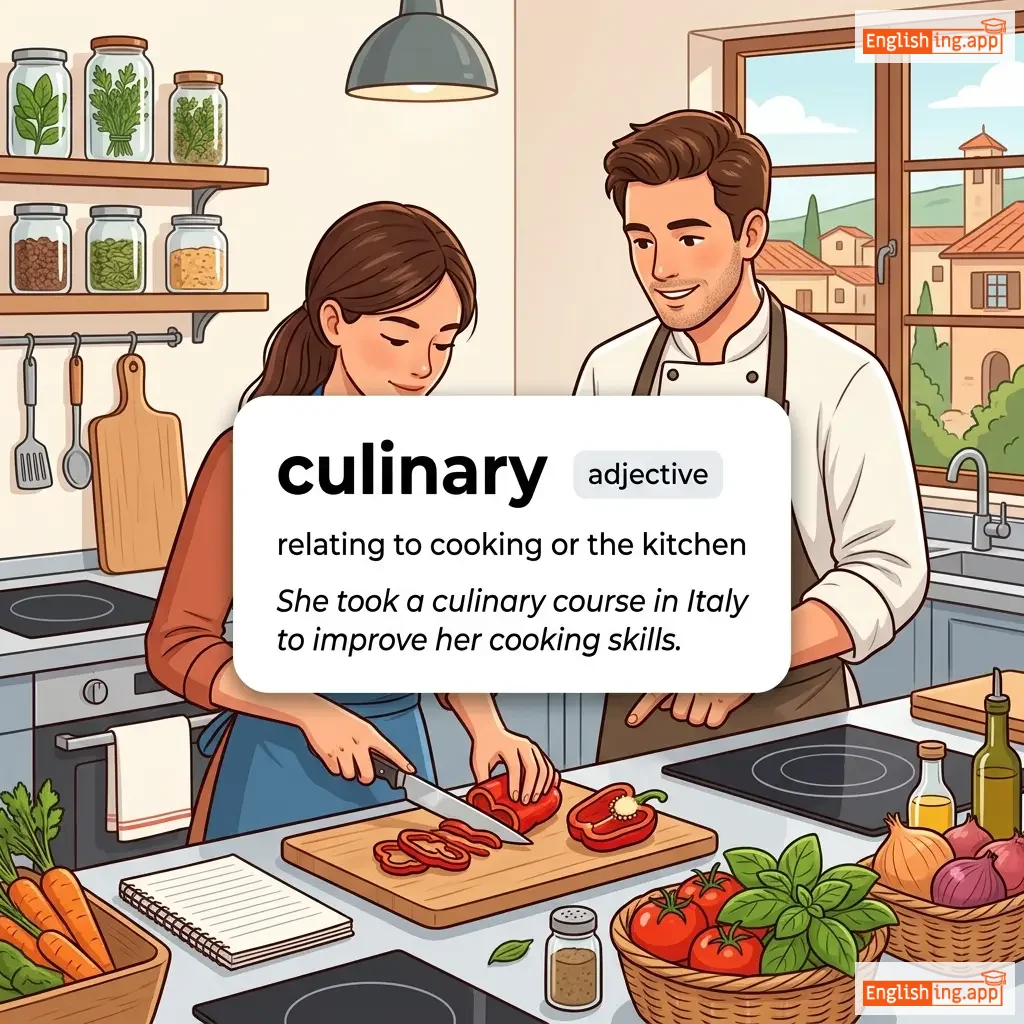
culinary definition card — visual illustration of the meaning
adjective
/ˈkʌl.ɪ.nɛr.i/
烹饪的 (pēngrèn de)

relating to cooking or the kitchen

"She took a culinary course in Italy to improve her cooking skills."

"她在意大利参加了一个烹饪课程,以提高她的烹饪技能。" (Tā zài Yìdàlì cānjiāle yīgè pēngrèn kèchéng, yǐ tígāo tā de pēngrèn jìnéng.)