词汇表

英语词汇词典 | 单词含义、定义和示例

noun
/kɔːrs flaʊər/
粗面粉 (cu mian fen)

coarsely ground flour with larger particles, typically used for baking bread

"She used course flour to make homemade bread with a rustic texture."

"她使用了粗面粉做了一个有乡村质感的自制面包。" (Ta shiyong le cu mianfen zuo le yi ge you xiangcun zhigan de zizhizhi mianbao.)
noun
/ˈkɔːrsər/
快速马或猎马 (kuài sù mǎ huò liè mǎ)

a swift horse or a hunting horse

"The knight rode a fast courser into battle."

"骑士骑着一匹快速的科赛尔进入战斗。" (Qíshì qízhe yī pī kuài sù de kē sài ěr jìnrù zhàndòu.)
noun,verb
/kɔːrt/
法院或寻求关注或偏爱的地方 (fayuan huo xunqiu guanzhu huo pian'ai de difang)

a place where legal cases are heard or to seek favor or attention

"He courted the judge with respect."

"他以尊重的态度追求法官。" (Ta yi zunzhong de taidu zhuīqiú fǎguān.)
adjective
/ˈkɜːrtiəs/
有礼貌的 (yǒu lǐmào de)

polite, respectful, or considerate in manner

"The staff at the hotel were very courteous to all guests."

"酒店的员工对所有客人都非常有礼貌。" (Jiudian de yuangong dui suoyou keren dou feichang you limao.)
noun
/ˈkɜːrtəsi/
礼貌, 谦逊或特权 (lǐmào, qiānxùn huò tèquán)

polite behavior or a polite action; a favor or privilege

"He opened the door as a courtesy."

"他出于礼貌开了门。" (Tā chū yú lǐmào kāi le mén.)
noun
/ˈkɔːtruːm/

a room in which legal cases are heard and decided by a judge

"The witness was called to testify in the courtroom."

noun
/ˈkʌzn/
堂兄/堂弟/表兄/表弟 (tángxiōng/tángdì/biǎoxiōng/biǎodì)

A child of one's uncle or aunt.

"My cousin is coming to visit us this weekend."

"我的堂兄这个周末要来拜访我们。" (Wǒ de tángxiōng zhège zhōumò yào lái bàifǎng wǒmen.)
🧙‍♀️

coven (科文)

noun
/ˈkʌvən/
女巫集会 (nǚwū jíhuì)

a group or gathering of witches

"The witches met secretly in a coven in the forest."

"女巫们在森林中的一个女巫集会中悄悄聚集。" (Nǚwūmen zài sēnlín zhōng de yīgè nǚwū jíhuì zhōng qiāo qiāo jùjí.)
noun
/ˈkʌvənənt/
契约 (qìyuē)

a formal agreement or promise, often legally binding

"The landlord and tenant signed a covenant to maintain the property."

"房东和租户签署了一份契约,以保持财产。" (Fángdōng hé zūhù qiānshǔle yī fèn qìyuē, yǐ bǎochí cáichǎn.)
cover definition card — visual illustration of the meaning
verb
/ˈkʌvər/
覆盖 (fùgài)

to place something over or on top of something else to protect or hide it

"She used a blanket to cover the sleeping child."

"她用毯子覆盖了睡着的孩子。" (Tā yòng tǎnzi fùgàile shuìzháo de háizi.)
noun
/ˈkʌvərɪdʒ/
报道 (baodao)

The extent or scope of something, such as insurance protection or media reporting.

"The news channel provided extensive coverage of the event."
"新闻频道对事件进行了广泛的报道。" (Xinwen pindao dui shijian jinxing le guangfan de baodao.)
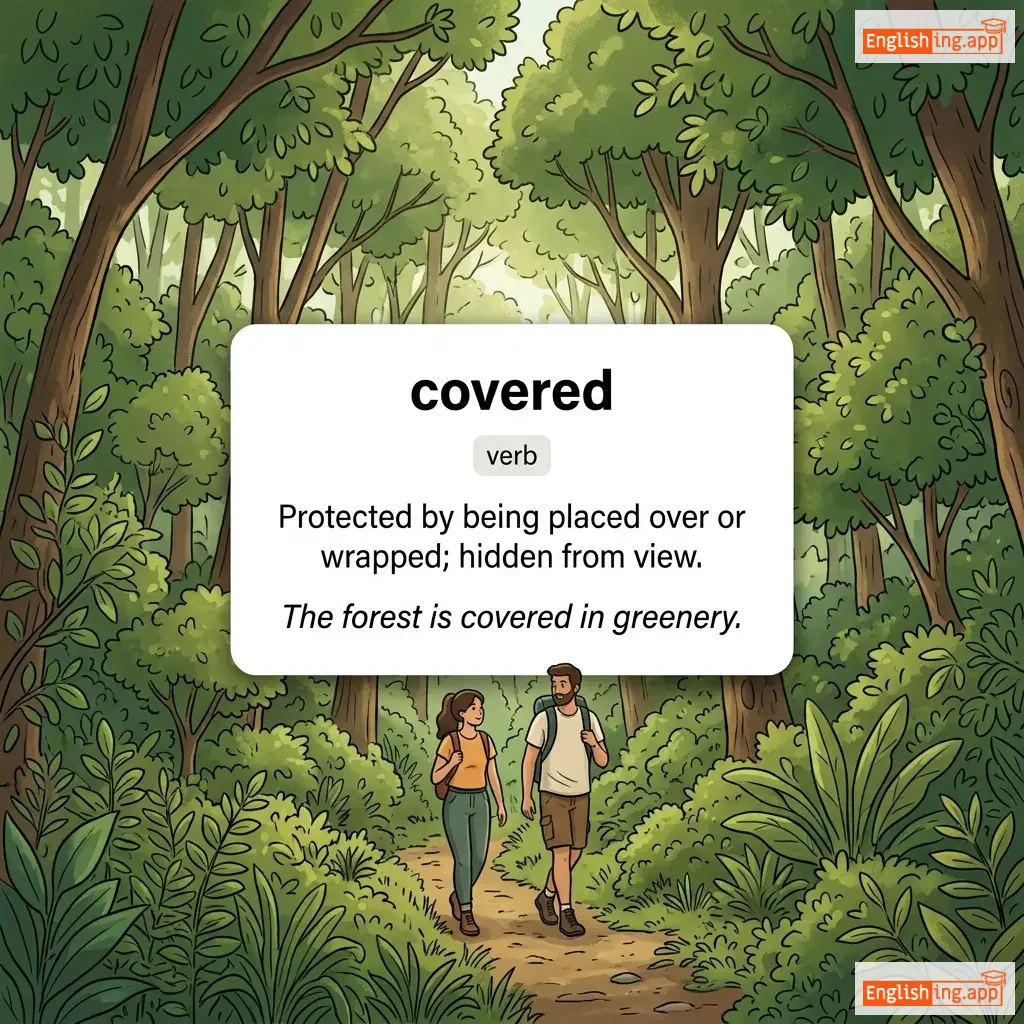
covered definition card — visual illustration of the meaning
verb
/ˈkʌv.ərd/
覆盖的 (fùgàide)

Protected by being placed over or wrapped; hidden from view.

"The forest is covered in greenery."

"森林被绿色覆盖。" (Sēnlín bèi lǜsè fùgài.)
covert definition card — visual illustration of the meaning
🕵️‍♂️

covert (kòu wèi tè)

adjective
/ˈkoʊvərt/
秘密 (mìmì)

hidden, secret, or not openly acknowledged

"The spy conducted a covert operation behind enemy lines."

"间谍在敌人的线背后进行了一项秘密行动。" (Jiàndié zài dírén de xiàn bèi hòu jìnxíngle yī xiàng mìmì xíngdòng.)
verb
/ˈkʌvət/
渴望 (kèwàng)

to desire something belonging to someone else

"He coveted his neighbor's new car."

"他渴望邻居的新车。" (Tā kèwàng línjū de xīn chē.)
covetous definition card — visual illustration of the meaning
adjective
/ˈkʌvətəs/
贪婪 (tanlan)

having or showing a strong desire for someone else's possessions

"She gave him a covetous look when he showed his new watch."

"他在展示新手表时给了他一个贪婪的眼神。" (Ta zai zhanshi xin shou biao shi gei le ta yi ge tanlan de yan shen.)
noun
/ˈkʌvi/
一小群鸟 (yi xiao qun niao)

a small group of birds, especially partridges or quails

"A covey of quails flew across the field."

"一群鹌鹑飞过了田野。" (Yi qun anqun feiguo le tianye.)
🐄

Cow

noun
/kaʊ/

a large domesticated bovine animal kept for milk or meat

"The farmer milked the cow early in the morning."

noun
/ˈkaʊ.ərd/
懦夫 (nuo fu)

a person who lacks the courage to do or endure dangerous or unpleasant things

"He called himself a coward for not standing up to the bully."

"他自称为懦夫,因为他没有站出来反对恶霸。" (Ta zi cheng wei nuo fu, yin wei ta mei you zhan chu lai fan dui e ba.)
noun
/ˈkaʊərdɪs/
懦弱 (nuòruò)

lack of courage; behavior showing fear

"His cowardice prevented him from speaking up."

"他的懦弱让他无法发言。" (Tā de nuòruò ràng tā wúfǎ fāyán.)
noun
/ˈkaʊbɔɪ/
牛仔 (niúzǎi)

a man, typically one on horseback, who herds and tends cattle

"The cowboy rode across the plains."

"牛仔骑马穿越大平原。" (Niúzǎi qí mǎ chuānyuè dà píngyuán.)
verb
/ˈkaʊər/
因恐惧而蹲下 (yin kongju er dunxia)

to crouch down in fear

"The child cowered behind the sofa during the thunderstorm."

"孩子在雷暴中躲在沙发后面。" (Haizi zai leibao zhong duozai shafa houmian.)
noun
/ˈkɒksweɪn/
舵手 (duòshǒu)

the person in charge of navigating and steering a boat, especially a racing or small boat

"The coxswain shouted instructions to the rowing team."

"舵手向划船队发出了指令。" (Duòshǒu xiàng huáchuán duì fāchūle zhǐlìng.)
adjective
/kɔɪ/
害羞的, 内向的 (haixiu de, neixiang de)

reluctant to give details or reveal feelings; shy or reserved

"She gave a coy smile when asked about her plans."

"当被问及她的计划时,她露出了一丝害羞的微笑。" (Dang bei wenji ta de jihua shi, ta luchu le yisi haixiu de weixiao.)
cozen definition card — visual illustration of the meaning
verb
/ˈkʌzən/
欺骗,诈骗 (qīpiàn, zhàpiàn)

to deceive, cheat, or trick someone

"He cozened the old man out of his money."

"他欺骗了老人并夺走了他的錢。" (Tā qīpiàn le lǎorén bìng duózǒu le tā de qián.)
adjective
/ˈkoʊzi/
舒适的 (shūshì de)

giving a feeling of comfort, warmth, and relaxation

"We sat in a cozy little café on a rainy day."

"在一个雨天,我们坐在一个舒适的小咖啡馆里。" (Zài yī gè yǔtiān, wǒmen zuò zài yīgè shūshì de xiǎo kāfēi guǎn lǐ.)
noun
/kræb/
螃蟹 (pángxiè)

a crustacean with a broad carapace, stalked eyes, and five pairs of legs, the first pair of which are modified as pincers

"The crab scuttled sideways across the sand."

"螃蟹横向爬行穿过沙滩。" (Pángxiè héngxiàng páxíng chuānguò shātān.)
adjective
/ˈkræbɪd/
难以阅读, 脾气坏 (nán yǐ yuèdú, píqì huài)

difficult to read or understand; ill-tempered

"His handwriting was crabbed and almost illegible."

"他的字迹难以阅读,几乎无法辨认。" (Tā de zìjì nán yǐ yuèdú, jīhū wúfǎ biànrèn.)
verb
/kræk/
幸福 (xìngfú)

To break or cause to break without complete separation; to make a sharp sound.

"The glass cracked when it was dropped on the floor."

"当她收到奖项时,她无法掩饰她的幸福。" (Dāng tā shōu dào jiǎngxiàng shí, tā wúfǎ yǎnshì tā de xìngfú.)
noun
/ˈkreɪ.dəl/
摇篮 (yaolan)

a small bed for a baby, especially one that rocks from side to side

"The baby sleeps peacefully in the cradle."

"婴儿在摇篮里安静地睡觉。" (Yīng'ér zài yáolán lǐ ānjìng de shuìjiào.)
noun
/kræft/
技能,工艺,手工艺 (jineng, gongyi, shougongyi)

an activity involving skill in making things by hand; a trade or occupation

"She has mastered the craft of pottery."

"她精通陶艺的工艺。" (Ta jingtong taoyi de gongyi.)
adjective
/ˈkræfti/
狡猾的, 精明的, 狡诈的 (jiǎohuá de, jīngmíng de, jiǎozhà de)

skilled at achieving goals through cunning or deceit; sly

"The crafty fox evaded the hunters again."

"狡猾的狐狸再次躲过了猎人的追捕。" (Jiǎohuá de húlí zàicì duǒguòle lièrén de zhuībǔ.)
noun
/kræɡ/
陡峭的悬崖或岩石面 (dou qiao de xuan ya huo yan shi mian)

a steep or rugged cliff or rock face

"The hikers climbed the jagged crag to reach the summit."

"远足者攀登陡峭的岩石面到达山顶。" (Yuan zu zhe pan deng dou qiao de yan shi mian dao da shan ding.)
adjective
/kræmpt/
狭小, 不舒服地小 (xiaxiao, bushi fufude xiao)

uncomfortably small or restricted

"The room was so cramped that we could barely move."

"房间太小了,以至于我们几乎不能移动。" (Fángjiān tài xiǎo le, yǐzhì wǒmen jīhū bùnéng yídòng.)
noun
/kreɪn/
(he)

a large tall bird with long legs and neck; a machine for lifting heavy objects

"The graceful crane stood motionless by the water's edge."

"优雅的鹤静静地站在水边。" (Yōuyǎ de hè jìngjìng de zhàn zài shuǐ biān.)
noun
/ˈkreɪniəm/
颅骨 (lugǔ)

the skull, especially the part enclosing the brain

"The archaeologists carefully examined the ancient cranium."

"考古学家仔细检查了古老的颅骨。" (Kǎogǔ xuéjiā zǐxì jiǎnchá le gǔlǎo de lúgǔ.)
adjective
/ˈkræŋki/
脾气暴躁 (píqì bào zào)

bad-tempered, easily annoyed, or irritable

"The child gets cranky when he is hungry."

"当孩子饿了时,他会变得脾气暴躁。" (Dāng háizi èle shí, tā huì biàn dé píqì bào zào.)
verb
/kræʃ/
幸福 (xìng fú)

To collide violently; to suddenly stop working (for machines or computers).

"The car crashed into the wall at high speed."

"她在获得奖项时无法掩饰自己的幸福。" (Tā zài huòdé jiǎngxiàng shí wúfǎ yǎnshì zìjǐ de xìngfú.)
adjective
/kræs/
粗鲁的,缺乏敏感性或精致 (cūlǔ de, quēfá mǐngǎn xìng huò jīngzhì)

lacking sensitivity, refinement, or intelligence

"His crass remarks offended everyone at the meeting."

"他的粗鲁言论在会议上冒犯了每个人。" (Tā de cūlǔ yánlùn zài huìyì shàng màofàn le měi gè rén.)
verb
/kreɪv/
渴望, 强烈的欲望 (kěwàng, qiángliè de yùwàng)

to have a strong desire for something

"She craves adventure and often travels to remote places."
"她渴望冒险,并经常前往偏远的地方。" (Tā kěwàng màoxiǎn, bìng jīngcháng qiánwǎng piānyuǎn de dìfāng.)
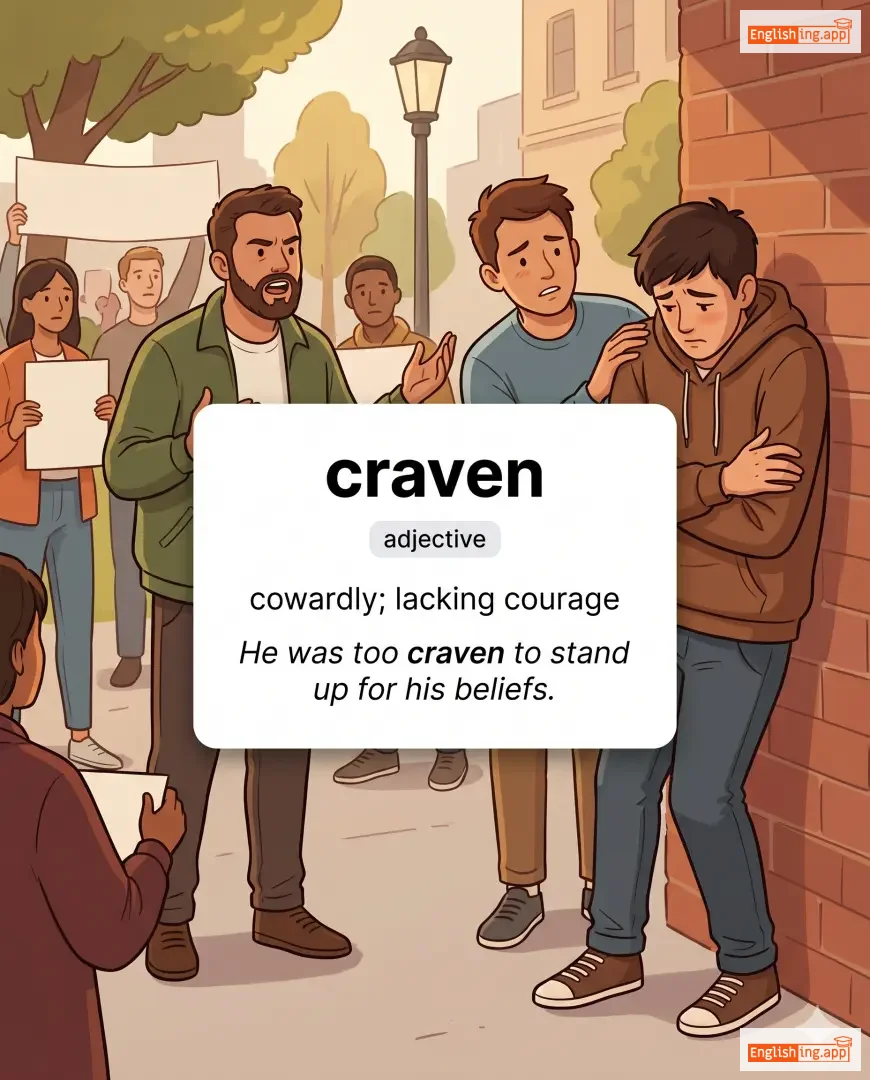
craven definition card — visual illustration of the meaning
adjective
/ˈkreɪvən/
懦夫 (nuo fu)

cowardly; lacking courage

"He was too craven to stand up for his beliefs."

"他太懦弱,无法捍卫自己的信念。" (Ta tai nuo ruo, wu fa han wei zi ji de xin nian.)
noun
/ˈkreɪvɪŋ/
渴望, 强烈的欲望 (kěwàng, qiángliè de yùwàng)

a strong desire for something

"She has a craving for chocolate every evening."
"她每晚都渴望吃巧克力。" (Tā měi wǎn dōu kěwàng chī qiǎokèlì.)
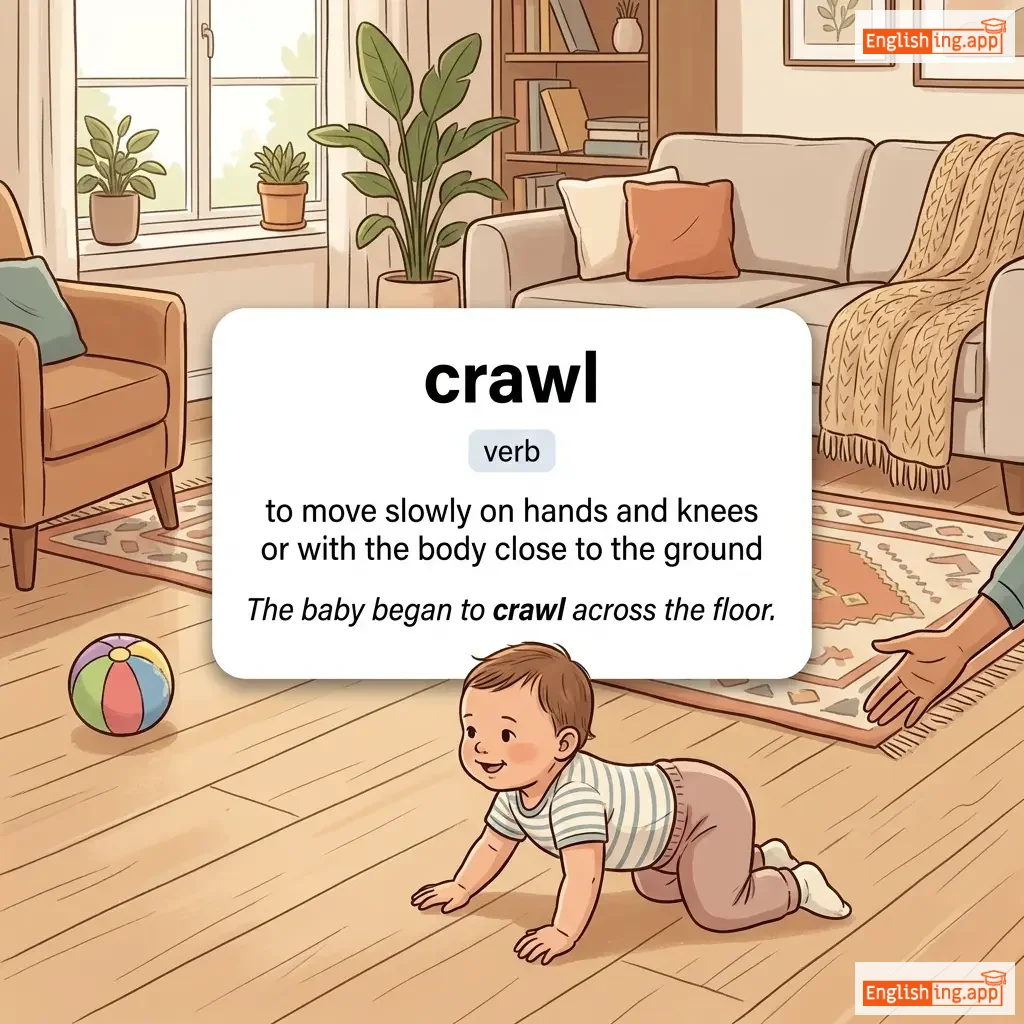
crawl definition card — visual illustration of the meaning
verb
/krɔːl/
爬行 (páxíng)

to move slowly on hands and knees or with the body close to the ground

"The baby began to crawl across the floor."

"宝宝开始在地板上爬行。" (Bǎobǎo kāishǐ zài dìbǎn shàng páxíng.)
adjective
/ˈkreɪzi/
疯狂 (fēngkuáng)

mentally unsound; extremely foolish or enthusiastic

"He had a crazy idea that actually worked."

"他有一个疯狂的想法,实际上奏效了。" (Tā yǒu yīgè fēngkuáng de xiǎngfǎ, shíjì shang zòuxiào le.)
verb
/kriːk/
发出高音尖锐的吱吱声 (fā chū gāo yīn jiān ruì de zhī zhī shēng)

to make a high-pitched, squeaking noise when moved

"The old door creaked as she opened it."

"那扇旧门在她打开时发出了咯吱声。" (Nà shàn jiù mén zài tā dǎ kāi shí fā chūle gē zhī shēng.)
noun
/kriːm/
奶油 (naiyou)

A thick, fatty part of milk that rises to the top; also a soft substance used in cooking or cosmetics.

"She added some cream to her coffee."

"她在咖啡里加了些奶油。" (Ta zai kafe li jia le xie nai you.)
noun
/ˈkriːməri/
奶制品厂 (nǎi zhìpǐn chǎng)

a place where milk and cream are processed and dairy products are made

"The local creamery produces fresh butter and cheese daily."

"当地的奶制品厂每天生产新鲜的黄油和奶酪。" (Dāngdì de nǎi zhìpǐn chǎng měitiān shēngchǎn xīnxiān de huángyóu hé nǎilào.)
adjective
/ˈkriːmi/
像奶油一样光滑、丰富的质地 (xiang naiyou yixiang guanghua, fengfu de zhidi)

having a smooth, rich texture like cream

"She poured a creamy sauce over the pasta."

"她把奶油般的酱汁倒在了意大利面上。" (Tā bǎ nǎiyóu bān de jiàngzhī dào zài le yìdàlì miàn shàng.)
noun, verb
/kriːs/
褶皱, 折痕 (zhě zhòu, zhé hén)

a line or fold produced on paper, cloth, or other material; to make a fold or wrinkle

"She ironed the shirt carefully to remove every crease."

"她小心地熨烫衬衫,去除每一道褶皱。" (Tā xiǎoxīn de yùn tàng chènshān, qùchú měi yī dào zhě zhòu.)
create definition card — visual illustration of the meaning
verb
/kriˈeɪt/
创造 (chuangzao)

To bring something into existence; to make or produce.

"The artist wants to create a new painting."
"艺术家想创造一幅新画。" (Yìshùjiā xiǎng chuàngzào yī fú xīn huà.)
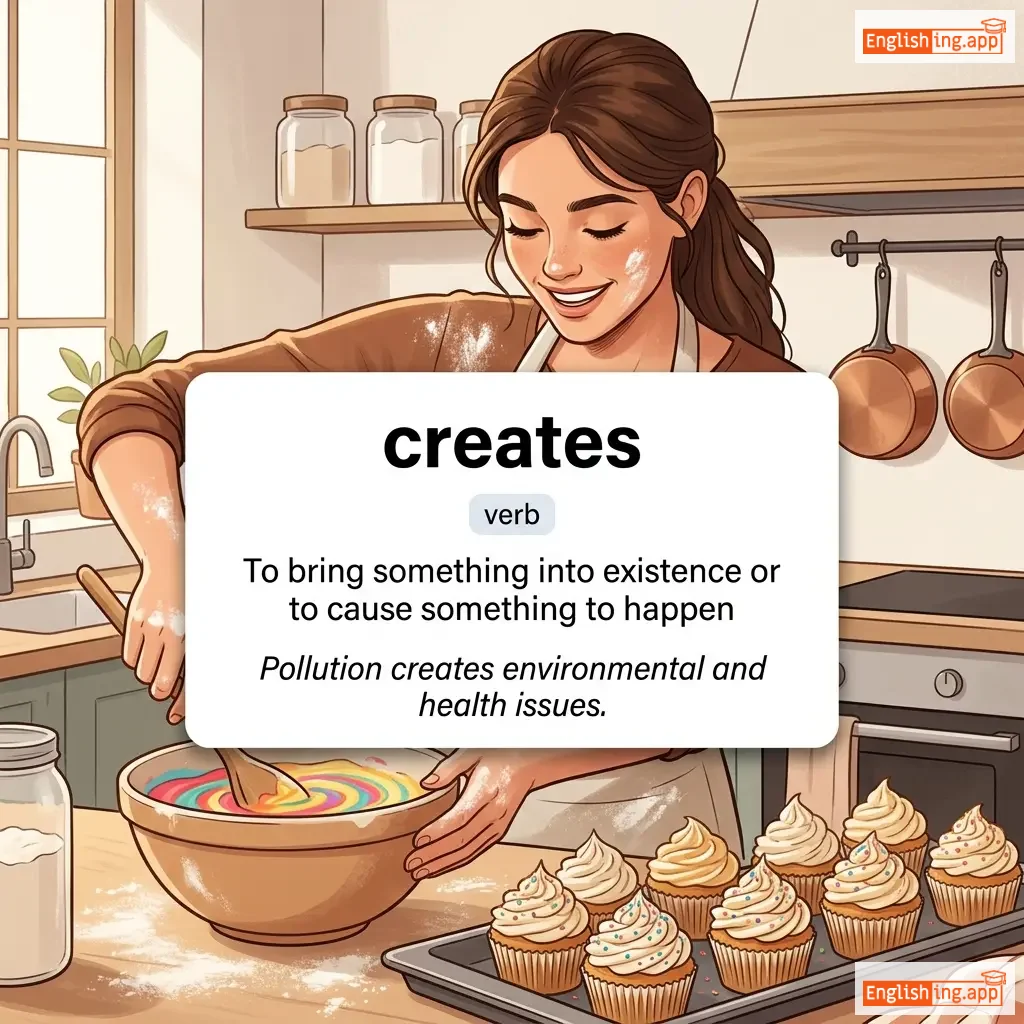
creates definition card — visual illustration of the meaning
verb
kriˈeɪts
创造 (chuàngzào)

To bring something into existence or to cause something to happen

"Pollution creates environmental and health issues."

"污染造成环境和健康问题。" (Wūrǎn zàochéng huánjìng hé jiànkāng wèntí.)