词汇表

英语词汇词典 | 单词含义、定义和示例

noun
/kɔːrn/
玉米 (yumi)

a type of grain, often yellow, eaten as food

"They harvested corn in the summer."

"他们在夏天收割了玉米。" (Tāmen zài xiàtiān shōugē le yùmǐ.)
noun
/ˈkɔːrnər/
角落 (jiǎoluò)

the place where two edges or sides meet

"The store is just around the corner."

"商店就在拐角处。" (Shāngdiàn jiù zài guǎijiǎo chù.)
noun
/ˈkɔːrnɪs/
檐口 (yánkǒu)

an ornamental molding around the wall of a room just below the ceiling

"The elegant cornice added a classical touch to the living room."
"优雅的檐口为客厅增添了一份古典的气息。" (Yōuyǎ de yánkǒu wèi kètīng zēngtiānle yī fèn gǔdiǎn de qìxī.)
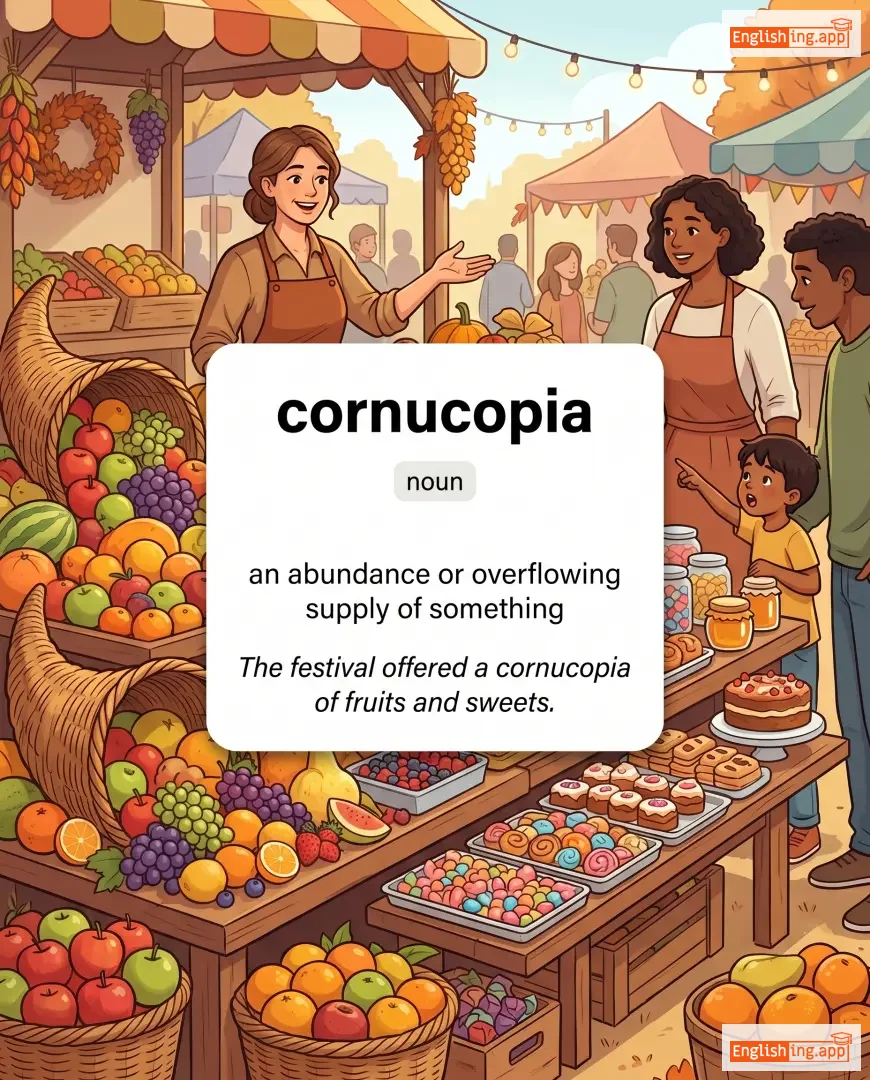
cornucopia definition card — visual illustration of the meaning
noun
/ˌkɔːrnjuˈkoʊpiə/
某物的丰盈或溢出的供应 (mou wu de feng ying huo yi chu de gong ying)

an abundance or overflowing supply of something

"The festival offered a cornucopia of fruits and sweets."

"节日提供了丰盛的水果和糖果。" (Jieri tigong le fengsheng de shuiguo he tangguo.)
noun
/kəˈrɑːləri/
直接或自然的结果 (zhíjiē huò zìrán de jiéguǒ)

a direct or natural consequence or result

"One corollary of the new policy was increased public awareness."

"新政策的一个结果是公众意识的提高。" (Xīn zhèngcè de yīgè jiéguǒ shì gōngzhòng yìshí de tígāo.)
noun
/kəˈroʊnə/
一种类似于冠状的结构;也指太阳的外层大气 (yī zhǒng lèisì yú guān zhuàng de jié gòu; yě zhǐ tàiyáng de wài céng dàqì)

a crown or crown-like structure; also refers to the outer atmosphere of the sun

"The sun's corona was visible during the total solar eclipse."

"太阳的日冕在一次全日蚀时可见。" (Tàiyáng de rìmiǎn zài yīcì quán rìshí shí kějiàn.)
noun
/ˌkɒrəˈneɪʃən/
加冕礼 (jiā miǎn lǐ)

the act or ceremony of crowning a sovereign or monarch

"The coronation of the new king was attended by thousands of people."

"新国王的加冕礼有成千上万的人参加。" (Xīn guówáng de jiā miǎn lǐ yǒu chéng qiān shàng wàn de rén cān jiā.)
noun
/ˈkɒrənər/
法医 (fǎ yī)

an official who investigates sudden, violent, or suspicious deaths

"The coroner determined the cause of death was natural."

"法医确定死亡原因是自然的。" (Fǎ yī quèdìng sǐwáng yuányīn shì zìrán de.)
noun
/ˈkɒrənɛt/
小王冠 (xiao wangguan)

a small crown, especially one worn by a prince, princess, or noble

"She wore a delicate coronet on her head for the ceremony."

"她为仪式戴上了一顶精致的小王冠。" (Ta wei yishi daishang le yi ding jingzhi de xiao wangguan.)
adjective, noun
/ˈkɔːrpərəl/
军士 (junshi)

relating to the body; a low-ranking officer in the military

"He suffered a corporal punishment for his mistake."

"他因为犯错误而遭受了体罚。" (Tā yīnwèi fàn cuòwù ér zāoshòu le tǐfá.)
adjective, noun
/ˈkɔːrpərət/
与公司/企业相关 (yu gongsi/qiye xiangguan)

relating to a corporation or large company; united as a single body

"Corporate social responsibility is important for modern businesses."

"公司企业社会责任对现代企业非常重要。" (Gōngsī qǐyè shèhuì zérèn duì xiàndài qǐyè fēicháng zhòngyào.)
noun
/ˌkɔːrpəˈreɪʃən/
公司 (gongsi)

A large company or group of companies that is legally recognized as a single entity.

"The corporation invested heavily in renewable energy projects."

"该公司在可再生能源项目上进行了大量投资。" (Gai gongsi zai kezai sheng nengyuan xiangmu shang jinxingle dali touzi.)
adjective
/kɔːrˈpɔːriəl/
有形的, 物质的 (you xing de, wu zhi de)

relating to the physical body; material or tangible

"Ghosts are often described as having no corporeal form."

"鬼魂通常被描述为没有有形的形态。" (Guihun tongchang bei miaoshu wei meiyou youxing de xingtai.)
noun
/kɔːr/
军队分支,团队 (jūnduì fēnzhī, tuánduì)

a branch of the military or a group organized for a specific purpose

"He joined the army corps after graduation."

"他在毕业后加入了军队分支。" (Tā zài bìyè hòu jiārùle jūnduì fēnzhī.)
noun
/kɔːrps/
尸体 (shīti)

a dead body, especially of a human

"The police discovered a corpse in the abandoned house."

"警察在废弃的房子里发现了一具尸体。" (Jǐngchá zài fèiqì de fángzi lǐ fāxiànle yī jù shīti.)
adjective
/ˈkɔːpjʊlənt/
肥胖的, 胖 (féipàng de, pàng)

fat or obese; having a large bulky body

"The corpulent man struggled to fit into the small chair."
"那个肥胖的男人努力地坐进了小椅子。" (Nàgè féipàng de nánrén nǔlì de zuò jìnle xiǎo yǐzi.)
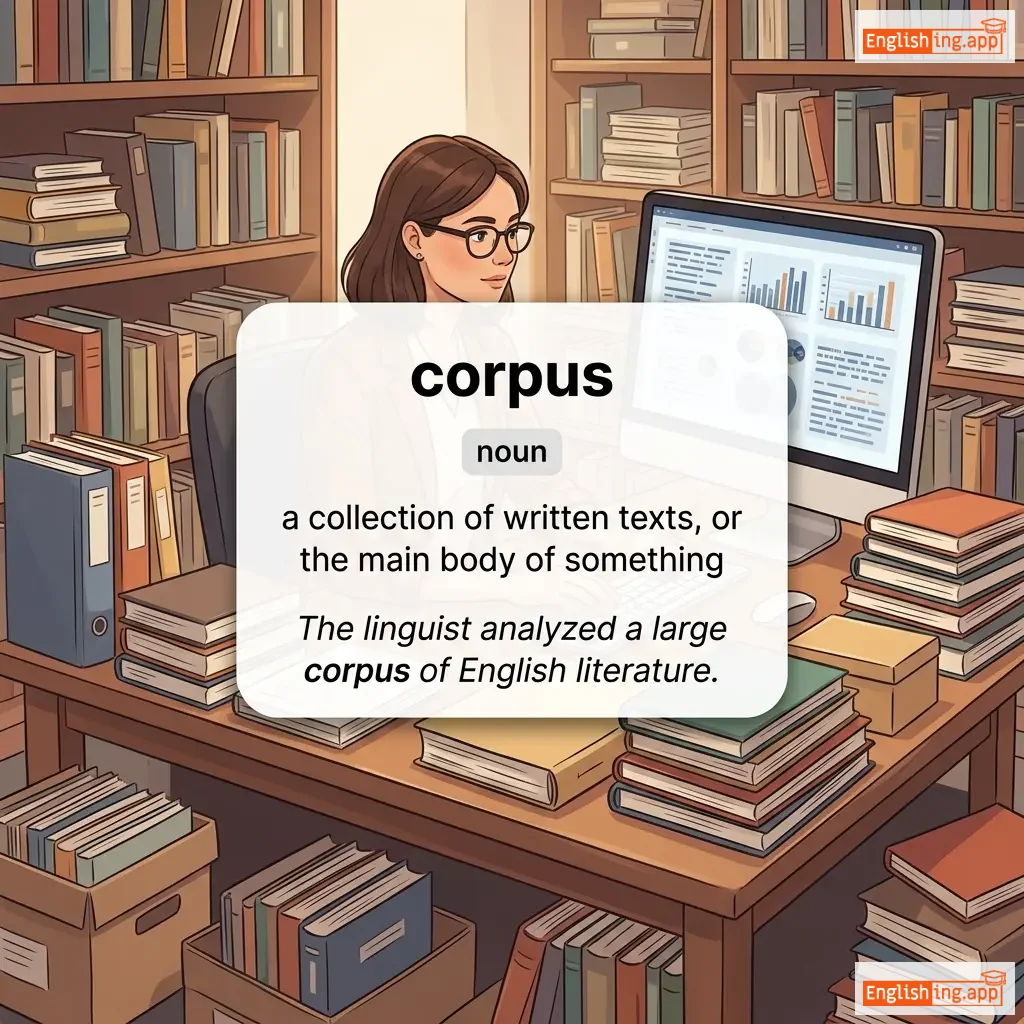
corpus definition card — visual illustration of the meaning
noun
/ˈkɔːrpəs/
集合,主体 (jihe, zhuti)

a collection of written texts, or the main body of something

"The linguist analyzed a large corpus of English literature."

"语言学家分析了大量的英语文学文献。" (Yuyanxuejia fenxile daliao de yingyu wenxue wenxian.)
noun
/ˈkɔːrpəskəl/
小颗粒或细胞,尤其是血细胞 (xiao ke li huo xi bao, you qi shi xue xi bao)

a small particle or cell, especially a blood cell

"Red corpuscles carry oxygen throughout the body."

"红血球在体内运输氧气。" (Hong xue qiu zai ti nei yun shu yang qi.)
adjective
/kəˈrɛkt/
正确 (zhèngquè)

free from error; accurate

"The answer she gave was correct."

"她给出的答案是正确的。" (Tā gěi chū de dá'àn shì zhèngquè de.)
noun
/kəˈrɛkʃən/
修正 (xiūzhèng)

the action or process of correcting something

"The teacher made a correction to the student's essay."

"老师对学生的文章进行了修正。" (Lǎoshī duì xuéshēng de wénzhāng jìnxíngle xiūzhèng.)
adverb
/kəˈrɛktli/
正确地 (zhèngquè de)

in a way that is true, accurate, or without mistakes

"She answered all the questions correctly."
"她正确地回答了所有问题。" (Tā zhèngquè de huídá le suǒyǒu wèntí.)
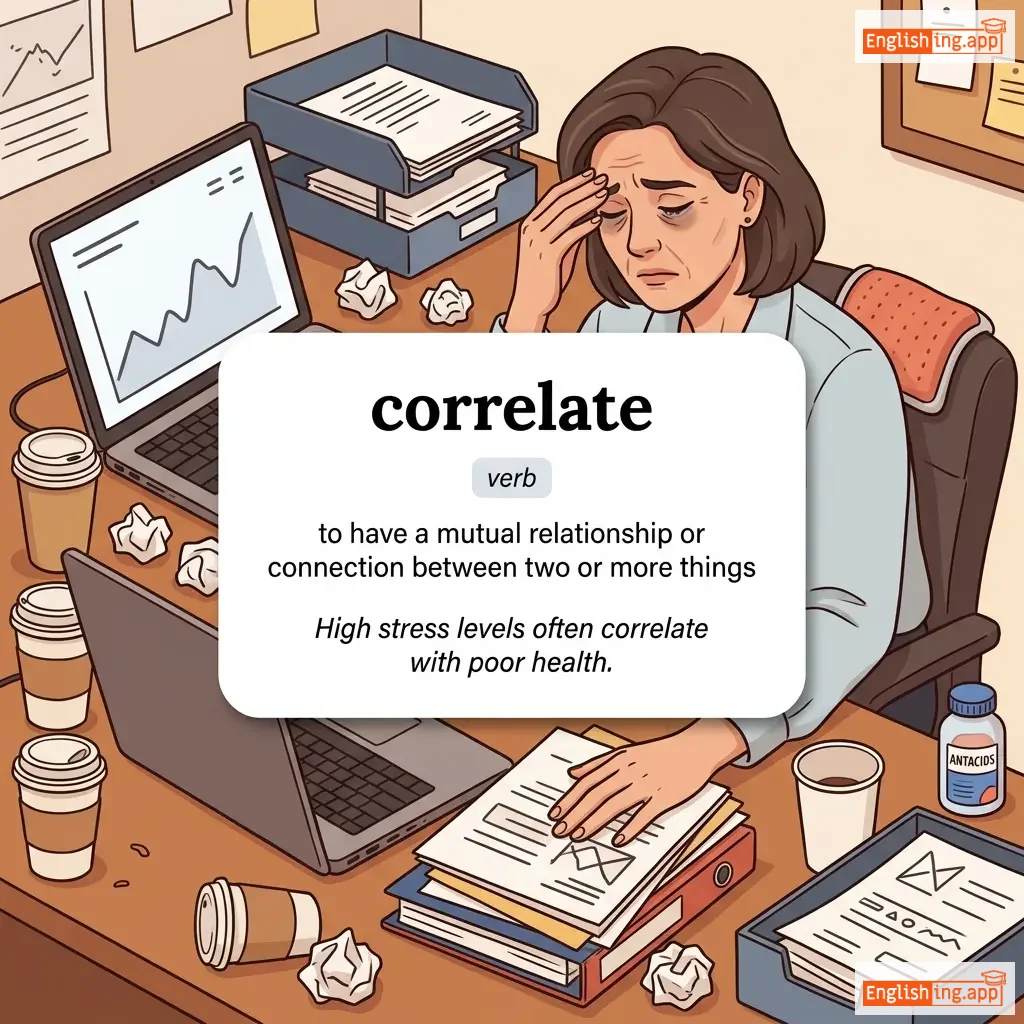
correlate definition card — visual illustration of the meaning
verb
/ˈkɒrəleɪt/
相关 (xiāngguān)

to have a mutual relationship or connection between two or more things

"High stress levels often correlate with poor health."

"高压水平通常与健康不佳相关。" (Gāo yā shuǐpíng tōngcháng yǔ jiànkāng bù jiā xiāngguān.)
noun
/ˌkɒrəˈleɪʃən/
相关 (xiāngguān)

a mutual relationship or connection between two or more things

"Researchers found a strong correlation between diet and heart disease."

"研究人员发现饮食与心脏病之间有着强烈的相关性。" (Yánjiū rényuán fāxiàn yǐnshí yǔ xīnzàng bìng zhī jiān yǒuzhe qiángliè de xiāngguān xìng.)
adjective
/kəˈrɛlətɪv/
相关的 (xiāngguān de)

having a mutual relationship; corresponding

"The increase in temperature is correlative with the melting of glaciers."

"温度的升高与冰川的融化有关。" (Wēndù de shēnggāo yǔ bīngchuān de rónghuà yǒu guānxi.)
verb
/kəˈrɛspɒnd/
通信 (tongxin)

to communicate by exchanging letters or messages

"I correspond regularly with my old friends."

"我与我的老朋友定期通信。" (Wo yu wo de lao pengyou dingqi tongxin.)
noun
/kəˈrɛspɒndəns/
通信 (tongxin)

the exchange of letters or communication

"His correspondence with clients was always timely."

"他与客户的通信总是及时的。" (Ta yu kehu de tongxin zongshi shíji de.)
noun
/ˌkɒrəˈspɒndənt/
记者 (jìzhě)

A journalist who reports news from a particular place or on a particular subject.

"The foreign correspondent reported live from Paris."

"外国记者从巴黎进行现场直播报道。" (Wàiguó jìzhě cóng bālí jìnxíng xiànchǎng zhíbò bàodào.)
adjective
/kəˈrɛspɒndɪŋ/
相关的 (xiāngguān de)

matching or related to something

"The corresponding page in the book explains the process in detail."

"书中的相关页面详细解释了该过程。" (Shū zhōng de xiāngguān yèmiàn xiángxì jiěshìle gāi guòchéng.)
noun
/ˈkɔːrɪdɔːr/
一条连接多个房间的长通道 (zǒuláng)

a long passage in a building from which doors lead into rooms

"The students waited quietly in the corridor."

"学生们在走廊里安静地等待。" (Xuéshēngmen zài zǒuláng lǐ ānjìng de děngdài.)
adjective
/ˈkɒrɪdʒəbl/
可修正的 (kě xiūzhèng de)

capable of being corrected or improved

"The student's mistakes were corrigible with practice."

"学生的错误通过练习是可以修正的。" (Xuéshēng de cuòwù tōngguò liànxí shì kěyǐ xiūzhèng de.)
corroborate definition card — visual illustration of the meaning
verb
/kəˈrɒbəreɪt/
证实 (zhèngshí)

to confirm or give support to a statement, theory, or finding

"The witness corroborated the defendant's alibi."

"证人证实了被告的不在场证明。" (Zhèngrén zhèngshí le bèigào de bù zàichǎng zhèngmíng.)
noun
/kəˌrɒbəˈreɪʃən/
证实 (zhèngshí)

evidence that confirms or supports a statement, theory, or finding

"The documents provided strong corroboration of her claims."

"文件提供了强有力的证据,支持她的主张。" (Wénjiàn tígōngle qiáng yǒulì de zhèngjù, zhīchí tā de zhǔzhāng.)
verb
/kəˈrəʊd/
腐蚀 (fushi)

to gradually destroy or wear away metal or other materials through chemical action

"The iron pipes corroded over time due to exposure to water."
"铁管因暴露在水中而随着时间的推移而腐蚀。" (Tieguan yin baolù zai shuǐzhōng ér suízhe shíjiān de tuīyí ér fǔshí.)
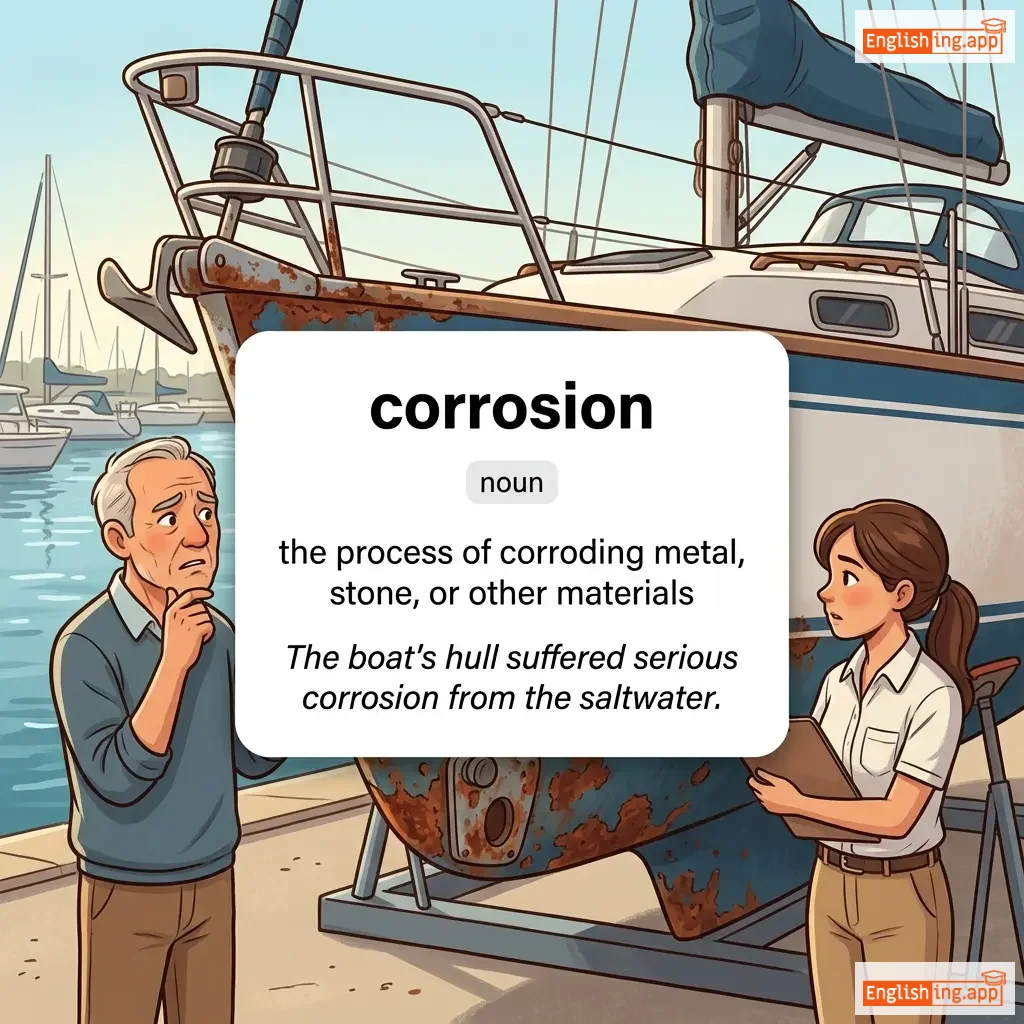
corrosion definition card — visual illustration of the meaning
noun
/kəˈrəʊʒən/
腐蚀,损坏 (fǔshí, sǔnhuài)

the process of corroding metal, stone, or other materials

"The boat's hull suffered serious corrosion from the saltwater."

"船体因盐水而遭受严重的腐蚀。" (Chuántǐ yīn yánshuǐ ér zāoshòu yánzhòng de fǔshí.)
adjective
/kəˈrəʊsɪv/
腐蚀性,损害 (fǔshíxìng, sǔnhài)

tending to cause corrosion; harmful or destructive to materials or people

"The chemical is highly corrosive and should be handled with care."

"该化学物质具有高度的腐蚀性,应该小心处理。" (Gāi huàxué wùzhí jùyǒu gāodù de fǔshíxìng, yīnggāi xiǎoxīn chǔlǐ.)
adjective
/ˈkɒr.ə.ɡeɪ.tɪd/
波纹状或折叠的 (bōwén zhuàng huò zhédié de)

shaped into ridges and grooves; wrinkled or folded

"The roof was made of corrugated metal sheets."

"屋顶是由波纹状金属板制成的。" (Wūdǐng shì yóu bōwén zhuàng jīnshǔ bǎn zhìchéng de.)
adjective/verb
/kəˈrʌpt/
腐败 (fubai)

dishonest or morally wrong; to make something impure or evil

"The politician was accused of corrupt practices."

"这位政治家因腐败行为被指控。" (Zhe wei zhengzhi jia yin fubai xingwei bei zhigong.)
adjective
/kəˈrʌp.tə.bəl/
易腐败的 (yì fǔbài de)

able to be morally or ethically corrupted

"He was known to be corruptible and often accepted bribes."

"他以易腐败的著称,经常接受贿赂。" (Tā yǐ yì fǔbài de zhùchēng, jīngcháng jiēshòu huìlù.)
noun
/kəˈrʌp.ʃən/
腐败 (fǔbài)

dishonest or fraudulent conduct by those in power

"The government launched a campaign to fight corruption."

"政府发起了打击腐败的运动。" (Zhèngfǔ fāqǐ le dǎjí fǔbài de yùndòng.)
noun
/ˈkɔː.seər/
海盗 (hǎidào)

a pirate, especially one operating along the Mediterranean coasts

"The corsair plundered ships along the coast."

"海盗沿海岸掠夺船只。" (Hǎidào yán hǎi'àn lüèduó chuánzhī.)
noun
/kɔːrˈteɪʒ/
葬礼队伍 (zànglǐ duìwǔ)

a solemn procession, especially for a funeral

"A cortege of mourners followed the hearse to the cemetery."

"一队哀悼的人跟随灵车到墓地。" (Yī duì āidào de rén gēnsuí língchē dào mùdì.)
verb
/ˈkɒr.ʌ.skeɪt/
闪烁 (shǎnshuò)

to sparkle or flash brightly

"The fireworks coruscated across the night sky."

"烟火在夜空中闪烁。" (Yānhuǒ zài yèkōng zhōng shǎnshuò.)
adjective
/kɒzˈmɛt.ɪk/
化妆品 (huazhuangpin)

relating to beauty or appearance; intended to improve looks

"She bought a new cosmetic cream for her skin."

"她为她的皮肤买了一种新的化妆品。" (Ta wei ta de pifu mai le yi zhong xin de huazhuangpin.)
adjective
/ˈkɒz.mɪk/
宇宙的, 广阔的 (yǔzhòu de, guǎngkuò de)

relating to the universe or cosmos; vast

"Astronomers study cosmic phenomena to understand the universe."

"天文学家研究宇宙现象,以理解宇宙。" (Tiānwénxuéjiā yánjiū yǔzhòu xiànxiàng, yǐ lǐjiě yǔzhòu.)
noun
/kɒzˈmɒɡ.ə.ni/
宇宙起源学 (yǔ zhòu qǐ yuán xué)

the study or theory of the origin of the universe

"The book provides an overview of different cosmogonies throughout history."

"这本书提供了关于历史上不同宇宙起源学的概述。" (Zhè běn shū tí gōng le guān yú lì shǐ shàng bù tóng yǔ zhòu qǐ yuán xué de gài shù.)
noun
/kɒzˈmɒɡ.rə.fi/
宇宙学 (yǔzhòuxué)

the science or art of mapping the universe or cosmos

"Medieval scholars practiced cosmography to chart the stars and planets."

"中世纪学者通过实践宇宙学来绘制星星和行星的地图。" (Zhōngshìjì xuézhě tōngguò shíjiàn yǔzhòuxué lái huìzhì xīngxīng hé xíngxīng de dìtú.)
cosmology definition card — visual illustration of the meaning
noun
/kɒzˈmɒlədʒi/
宇宙学 (yǔzhòuxué)

the science of the origin and development of the universe

"She studied cosmology to understand the origins of the universe."

"她学习了宇宙学以理解宇宙的起源。" (Tā xuéxíle yǔzhòuxué yǐ lǐjiě yǔzhòu de qǐyuán.)
adjective
/ˌkɒzməˈpɒlɪtən/
全球化 (quánqiúhuà)

familiar with and at ease in many different countries and cultures

"He has a cosmopolitan outlook due to his extensive travels."

"由于他的广泛旅行,他拥有全球化的视野。" (Yóuyú tā de guǎngfàn lǚxíng, tā yǒngyǒu quánqiúhuà de shìyě.)
noun
/ˌkɒzməˈpɒlɪtənɪzəm/
国际主义 (guoji zhuyi)

the ideology that all human beings belong to a single community

"Cosmopolitanism promotes respect and understanding across cultures."

"国际主义促进不同文化之间的尊重和理解。" (Guoji zhuyi cujin butong wenhua zhijian de zunzhong he lijie.)
noun
/ˈkɒzmɒs/
宇宙 (yuzhou)

the universe seen as a well-ordered whole

"Astronomers study the cosmos to learn about the universe's structure."

"天文学家研究宇宙,以了解宇宙的结构。" (Tiānwénxuéjiā yánjiū yǔzhòu, yǐ liǎojiě yǔzhòu de jiégòu.)