词汇表

英语词汇词典 | 单词含义、定义和示例

adjective
/kənˈsɪdərət/
体贴的 (tǐtiē de)

showing concern for the needs and feelings of others

"He is always considerate of his neighbors."

"他总是关心他的邻居。" (Tā zǒng shì guānxīn tā de línjū.)
noun
/kənˌsɪdəˈreɪʃən/
幸福 (xìngfú)

careful thought or attention to something before making a decision

"After much consideration, she accepted the job offer."

"当她收到奖项时,她无法掩饰她的幸福。" (Dāng tā shōu dào jiǎngxiàng shí, tā wúfǎ yǎnshì tā de xìngfú.)
verb
/kənˈsaɪn/
托付 (tuōfù)

to deliver something to a person or place, often for selling or safekeeping

"He consigned the package to the shipping company."

"他将包裹交给了运输公司。" (Tā jiāng bāoguǒ jiāo gěi le yùnshū gōngsī.)
noun
/ˌkɒnsaɪˈniː/
收货人 (shōuhuò rén)

the person or company to whom goods are delivered

"The consignee received the shipment on time."

"收货人按时收到了货物。" (Shōuhuò rén ànshí shōudàole huòwù.)
noun
/kənˈsaɪnər/
发货人 (fāhuò rén)

a person or company that sends goods to be sold or transported

"The consignor shipped the goods to the warehouse."

"发货人将商品发送到仓库。" (Fāhuò rén jiāng shāngpǐn fāsòng dào cāngkù.)
verb
/kənˈsɪst/
由...组成 (you...zucheng)

to be made up or composed of certain parts or elements

"The committee consists of five members."

"委员会由五个成员组成。" (Wei yuan hui you wu ge cheng yuan zu cheng.)
consistency definition card — visual illustration of the meaning
noun
/kənˈsɪstənsi/
一致性, 稳定性 (yīzhìxìng, wěndìngxìng)

the quality of always behaving or performing in a similar way; uniformity

"Her consistency in work earned her a promotion."

"她在工作中的一致性为她赢得了晋升。" (Tā zài gōngzuò zhōng de yīzhìxìng wèi tā yíngdé le jìnshēng.)
consistent definition card — visual illustration of the meaning
adjective
/kənˈsɪstənt/
一致的 (yīzhì de)

acting or done in the same way over time; reliable or uniform

"He is very consistent in his work."

"他在工作中非常一致。" (Tā zài gōngzuò zhōng fēicháng yīzhì.)
adverb
/kənˈsɪstəntli/
持续地 (chíxù de)

in a way that does not vary; regularly and dependably

"She has been performing consistently well in her studies."

"她在学习中始终表现得很好。" (Tā zài xuéxí zhōng shǐzhōng biǎoxiàn dé hěn hǎo.)
verb
/kənˈsoʊl/
安慰 (ānwèi)

to comfort someone at a time of grief or disappointment

"She tried to console him after his loss."

"她在他的损失后试图安慰他。" (Tā zài tā de sǔnshī hòu shìtú ānwèi tā.)
consolidate definition card — visual illustration of the meaning
verb
/kənˈsɑːlɪdeɪt/
整合 (zhěnghé)

to combine into a single, more effective or coherent whole

"The company plans to consolidate its offices into one building."

"公司计划将其办公室合并到一栋建筑中。" (Gōngsī jìhuà jiāng qí bàngōngshì hébìng dào yī dòng jiànzhú zhōng.)
Consolidation definition card — visual illustration of the meaning
noun
/kənˌsɑːlɪˈdeɪʃən/
合并 (hebing)

the act or process of combining into a single, stronger or more effective entity

"The consolidation of the two companies improved efficiency."

"两家公司的合并提高了效率。" (Liang jia gongsi de hebing tigao le xiaolv.)
noun
/ˈkɒnsənəns/
和谐, 音响和谐 (hexie, yinxiang hexie)

Agreement or harmony among parts; a pleasing combination of sounds in music or words.

"The consonance between their ideas made the project successful."

"他们的思想之间的和谐使得项目成功。" (Tāmen de sīxiǎng zhī jiān de héxié shǐdé xiàngmù chénggōng.)
noun
/ˈkɒnsənənt/
辅音 (fǔyīn)

A speech sound produced by blocking air flow, or a letter representing such a sound.

"The word 'cat' has two consonants and one vowel."

"‘猫’这个词有两个辅音和一个元音。" ('Māo' zhège cí yǒu liǎng gè fǔyīn hé yīgè yuán yīn.)
verb
/ˈkɒnsɔːrt/

To associate with someone, typically with disapproval; also, a spouse of a reigning monarch.

"He was criticized for consorting with criminals."

consortium definition card — visual illustration of the meaning
noun
kənˈsɔː.ti.əm
联合体 (liánhé tǐ)

An association of several companies or organizations formed to undertake an enterprise beyond the resources of any one member.

"The consortium worked collaboratively to build the cable."

"该联盟协同合作建设了电缆。" (Gāi liánhé tǐ xiétóng hézuò jiànshè le diànlǎn.)
adjective
/kənˈspɪkjuəs/
显眼的 (xianyan de)

Easily noticeable; attracting attention due to being unusual or prominent.

"Her red dress made her conspicuous at the party."

"她的红色裙子使她在派对上显眼。" (Tā de hóngsè qúnzi shǐ tā zài pàiduì shàng xiǎnyǎn.)
noun
/kənˈspɪrəsi/
阴谋 (yīnmóu)

A secret plan by a group to do something unlawful or harmful.

"The police uncovered a conspiracy to overthrow the government."

"警方揭露了一项推翻政府的阴谋。" (Jǐngfāng jiēlùle yī xiàng tuīfān zhèngfǔ de yīnmóu.)
noun
/kənˈspɪrə.tər/
阴谋者 (yinmou zhe)

a person who secretly plans with others to do something unlawful or harmful

"The conspirator was arrested before the plan could be carried out."

"阴谋者在计划得以实施之前被捕。" (Yinmou zhe zai jihua deyi shishi zhiqian bei bu.)
verb
/kənˈspaɪər/
密谋 (mìmóu)

to secretly plan with others to do something harmful or illegal

"They conspired to overthrow the government."

"他们密谋推翻政府。" (Tāmen mìmóu tuīfān zhèngfǔ.)
noun
/ˈkʌn.stə.bəl/
巡警 (xúnjǐng)

a police officer of the lowest rank

"The constable directed traffic at the busy intersection."

"巡警在繁忙的十字路口指挥交通。" (Xúnjǐng zài fánmáng de shízì lùkǒu zhǐhuī jiāotōng.)
noun
/ˈkɒnstənsi/
忠诚/恒常 (zhongcheng/hengchang)

the quality of being faithful and dependable

"Her constancy in friendship is admirable."

"她在友谊中的恒常令人钦佩。" (Ta zai youyi zhong de hengchang ling ren qinpei.)
adjective
/ˈkɒn.stənt/
恒定的 (héngdìng de)

happening all the time or staying the same without change

"She lived in constant fear of losing her job."

"她一直生活在失去工作的恒定恐惧中。" (Tā yīzhí shēnghuó zài shīqù gōngzuò de héngdìng kǒngjù zhōng.)
adverb
/ˈkɒnstəntli/
不断 (bùduàn)

continuously over a period of time; always

"He is constantly improving his skills."

"他不断提升自己的技能。" (Tā bùduàn tíshēng zìjǐ de jìnéng.)
noun
/ˌkɒn.stəˈleɪ.ʃən/
星座 (xingzuo)

a group of stars forming a recognizable pattern in the night sky

"Orion is one of the most famous constellations."

"猎户座是最著名的星座之一。" (Liè hù zuò shì zuì zhùmíng de xīngzuò zhī yī.)
noun
/ˌkɒnstəˈneɪʃən/
惊愕 (jing'e)

A feeling of anxiety, dismay, or confusion, often caused by something unexpected.

"The sudden announcement caused widespread consternation among the employees."

"突如其来的宣布在员工中引起了广泛的惊愕" (Tu ru qi lai de xuibu zai yuangong zhong yinqi le guangfan de jing'e)
noun
/kənˈstɪtʃuənsi/
选区 (xuan qu)

A geographical area whose residents elect a representative to a legislative body.

"She campaigned tirelessly across her constituency."

"她在自己的选区内不知疲倦地竞选。" (Ta zai ziji de xuanqu nei buzhi pijuande jingxuan.)
noun/adjective
/kənˈstɪtʃuənt/
成分 / 选民 (chengfen / xuanmin)

Noun: A member of a constituency or an essential part of something. Adjective: Being a necessary part of a whole.

"The senator met with his constituents to discuss local issues."

"参议员与他的选民会面,讨论当地问题。" (Can yiyuan yu tade xuanmin huimian, taolun dangdi wenti.)
constituents definition card — visual illustration of the meaning
noun
/kənˈstɪtʃ.u.ənts/
组成部分 (zǔchéng bùfen)

Components or elements used to create something.

"Proteins and vitamins are essential constituents of a healthy diet."

"蛋白质和维生素是健康饮食的重要组成部分。" (Dànbái zhí hé wéishēngsù shì jiànkāng yǐnshí de zhòngyào zǔchéng bùfen.)
verb
/ˈkɒnstɪtjuːt/
构成 (gòu chéng)

To make up, form, or establish something.

"These documents constitute the legal agreement between the two parties."

"这些文件构成了两方之间的法律协议。" (Zhèxiē wénjiàn gòuchéngle liǎng fāng zhī jiān de fǎlǜ xiéyì.)
constitution definition card — visual illustration of the meaning
noun
/ˌkɒnstɪˈtjuːʃən/
宪法 (xianfa)

The system of fundamental principles according to which a nation or organization is governed.

"The constitution guarantees freedom of speech."

"宪法保障言论自由。" (Xiànfǎ bǎozhàng yánlùn zìyóu.)
constitutional definition card — visual illustration of the meaning
adjective
/ˌkɒnstɪˈtjuːʃənəl/

relating to the constitution of a country or to the principles of a system

"The law was declared unconstitutional by the court."

verb
/kənˈstreɪn/
限制 (xiànzhì)

to limit or restrict someone or something; to force or compel

"The new regulations constrain businesses from polluting the environment."

"新规定限制企业不允许污染环境。" (Xīn guīdìng xiànzhì qǐyè bù yǔnxǔ wūrǎn huánjìng.)
adjective
/kənˈstreɪnd/
受限的, 强迫的 (shouxian de, qiangpo de)

appearing forced, unnatural, or restricted

"He gave a constrained smile during the awkward meeting."

"在尴尬的会议中,他露出了强迫的微笑。" (Zai gankan de huiyi zhong, ta louchu le qiangpo de weixiao.)
noun
/kənˈstreɪnt/
限制 (xiànzhì)

a limitation or restriction

"Time is the biggest constraint in completing the project."

"时间是完成项目的最大限制。" (Shíjiān shì wánchéng xiàngmù de zuìdà xiànzhì.)
verb
/kənˈstrɪkt/
收缩 (shōusuō)

to make narrower or tighter; to shrink or compress

"The snake constricted its prey before swallowing."

"蛇在吞噬之前把猎物收缩了。" (Shé zài tūn shì zhīqián bǎ lièwù shōusuōle.)
verb
/kənˈstrɪndʒ/
收缩 (shousuo)

to cause to shrink or contract; to constrict

"The medicine helped constringe the swollen tissues."

"药物帮助收缩肿胀的组织。" (Yao wu bang zhu shou suo zhong zhang de zu zhi.)
verb
/kənˈstrʌkt/
建造 (jianzao)

to build or form something by putting parts together

"They plan to construct a new bridge over the river."

"他们计划在河上建一座新桥。" (Tamen jihua zai he shang jian yi zuo xin qiao.)
construction definition card — visual illustration of the meaning
noun
/kənˈstrʌkʃən/
建筑 (jian zhu)

The process of building something, typically large structures such as houses, roads, or bridges.

"The construction of the new bridge will take two years."

"新桥的建设将需要两年时间。" (Xin qiao de jian she jiang xu yao liang nian shi jian.)
verb
/kənˈstruː/
解释 (jiěshì)

to interpret or understand the meaning of something in a particular way

"His words could be construed as a threat."

"他的话可以被理解为威胁。" (Tā de huà kěyǐ bèi lǐjiě wéi wēixié.)
noun
/ˈkɒnsəl/
领事 / 大使 (lingshi / dashi)

an official appointed by a government to live in a foreign city and protect its citizens and interests there

"The consul assisted travelers who lost their passports."

"领事帮助了那些丢失护照的旅行者。" (Lingshi bangzhu le naxie diushi huzhao de lvxingzhe.)
noun
/ˈkɒnsjʊlət/
领事馆 (lingshiguan)

the building or office where a consul works

"He went to the consulate to renew his visa."

"他去了领事馆续签他的签证。" (Ta qule lingshiguan xuqian tade qianzheng.)
verb
/kənˈsʌlt/
咨询 (zixun)

To seek advice or information from someone with expertise.

"You should consult a doctor before starting the treatment."

"在开始治疗之前,你应该咨询医生。" (Zai kaishi zhiliaozhiqian, ni yinggai zixun yisheng.)
noun
/kənˈsʌltənt/
顾问 (gùwèn)

A professional who provides expert advice in a particular area.

"The company hired a consultant to improve its marketing strategy."

"公司聘请了一位顾问来改善其市场营销战略。" (Gōngsī pìnqǐngle yī wèi gùwèn lái gǎishàn qí shìchǎng yíngxiāo zhànlüè.)
consultation definition card — visual illustration of the meaning
noun
/ˌkɒnsʌlˈteɪʃən/
咨询 (zixun)

a meeting with an expert or professional to seek advice

"The doctor scheduled a consultation with the patient."

"医生安排了与病人的咨询。" (Yisheng anpai le yu bingren de zixun.)
consume definition card — visual illustration of the meaning
verb
/kənˈsjuːm/
消耗 (xiāo hào)

To use up, eat, drink, or take in.

"People consume a large amount of information daily."

"人们每天消耗大量信息。" (Rénmen měitiān xiāohào dàliàng xìnxī.)
noun
/kənˈsjuːmər/
消费者 (xiaofeizhe)

A person who buys and uses goods and services.

"The company focuses on understanding consumer needs."

"公司专注于理解消费者需求。" (Gongsi zhuanzhu yu lijie xiaofeizhe xuqiu.)
consumerism definition card — visual illustration of the meaning
noun
kənˈsjuː.mə.rɪ.zəm
消费主义 (xiāofèizhǔyì)

The tendency to increase consumption of goods and the importance given to consuming products.

"Modern consumerism leads to increased demand for luxury goods."
"现代消费主义导致对奢侈品的需求增加。" (Xiàndài xiāofèizhǔyì dǎozhì duì shēchǐpǐn de xūqiú zēngjiā.)
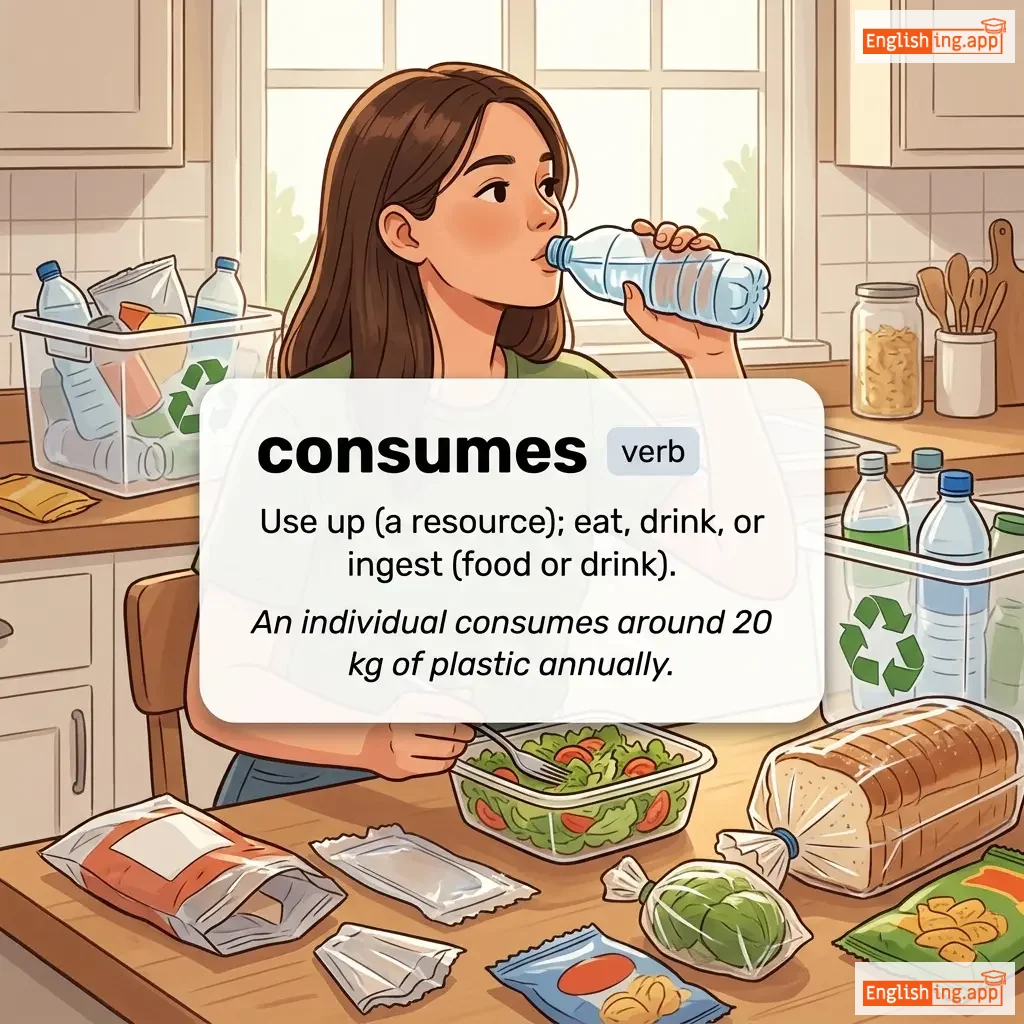
consumes definition card — visual illustration of the meaning
verb
kənˈsjuːmz
消耗 (xiaohào)

Use up (a resource); eat, drink, or ingest (food or drink).

"An individual consumes around 20 kg of plastic annually."

"一个人每年消耗大约 20 公斤塑料。" (Yīgè rén měi nián xiāohào dàyuē 20 gōngjīn sùliào.)
consummate definition card — visual illustration of the meaning
adjective, verb
/ˈkɒnsəmət/ (adj), /ˈkɒnsəmeɪt/ (verb)
完成 / 完美 (wancheng / wanmei)

to complete or perfect something; showing great skill or excellence

"She is a consummate professional in her field."

"她在她的领域是一个圆满的专业人士。" (Tā zài tā de lǐngyù shì yīgè yuánmǎn de zhuānyè rénshì.)