词汇表

英语词汇词典 | 单词含义、定义和示例

adjective
/ˌkæləˈrɪfɪk/
高热量的 (gaoreliang de)

Relating to the amount of energy contained in food or fuel.

"Chocolate is highly calorific, so it should be eaten in moderation."

"巧克力热量很高,所以应该适量食用。" (Qiaokeli re liang hen gao, suoyi yinggai shiliang shiyong.)
verb
/kəˈlʌmnieɪt/
诽谤 (feibang)

To make false and damaging statements about someone; to slander.

"He was furious when he realized they had calumniated his reputation."

"当他意识到他们已经毁坏了他的名声时,他非常生气。" (Dang ta yishi dao tamen yijing huihuai le ta de mingcheng shi, ta feichang shengqi.)
Calumny definition card — visual illustration of the meaning
noun
/ˈkæləmni/
诽谤 (feibang)

The making of false and defamatory statements to damage someone's reputation.

"The politician dismissed the accusations as mere calumny."

"那位政治家将这些指控视为单纯的诽谤。" (Na wei zhengzhi jia jiang zhe xie zhikong shi wei dan chun de feibang.)
✝️

calvary

noun
/ˈkælvəri/

A place or experience of intense suffering, originally the site of Jesus’s crucifixion.

"For many refugees, the journey across the desert was a calvary."

noun
/ˈkælvɪnɪzəm/
卡尔文主义 (kaerwen zhuyi)

A Protestant theological system based on John Calvin’s teachings, emphasizing predestination and the sovereignty of God.

"Calvinism played a major role in shaping Protestant theology."

"加尔文主义在塑造新教神学中发挥了重要作用。" (Jia'erwen zhuyi zai sushao xinjiao shenxue zhong fahuile zhongyao zuoyong.)
verb
/ˈkælvɪnaɪz/
用加尔文主义的原则使人信服 (Yòng jiā'ěrwén zhǔyì de yuánzé shǐ rén xìnfú)

to imbue with the principles or doctrines of Calvinism

"The preacher sought to calvinize the community with strict teachings."

"传教士试图通过严格的教义来将社区加尔文化。" (Chuánjiàoshì shìtú tōngguò yángé de jiàoyì lái jiāng shèqū jiā'ěrwén huà.)
camaraderie definition card — visual illustration of the meaning
noun
/ˌkæməˈrɑːdəri/
友谊 (yǒuyì)

mutual trust and friendship among people who spend a lot of time together

"There was a strong sense of camaraderie among the soldiers."

"士兵之间有着强烈的友谊感。" (Shìbīng zhī jiān yǒuzhe qiángliè de yǒuyì gǎn.)
verb
/keɪm/
来了 (lái le)

past tense of 'come'

"She came to the party on time."

"她准时来到了聚会。" (Tā zhǔnshí lái dào le jùhuì.)
noun
/ˈkæm.əl/
骆驼 (luòtuó)

a large animal with one or two humps on its back that lives in hot dry places

"The camel walked slowly across the desert sand."

"骆驼慢慢地走过沙漠的沙子。" (Luòtuó màn man de zǒuguò shāmò de shāzi.)
noun
/ˈkæmi.oʊ/
客串 (kè chuàn)

a small but significant role in a play, film, or show, often performed by a well-known person

"The actor made a surprise cameo in the movie."

"那位演员在电影中出人意料地客串了。" (Na wei yanyuan zai dianying zhong churen yiliaode kechuanle.)
noun
/ˈkæm.rə/

a device used for taking photographs or recording videos

"She bought a new camera for her photography class."

noun
/ˈkæməˌflɑːʒ/
伪装 (weizhuang)

the act of hiding or disguising something by making it blend with its surroundings

"The soldiers used camouflage to hide from the enemy."

"士兵们使用伪装来躲避敌人。" (Shibingmen shiyong weizhuang lai duobi diren.)
noun, verb
/kæmp/
露营地 (luyingdi)

a place where people stay temporarily in tents or cabins, often outdoors; to stay in such a place

"We decided to camp by the lake during the summer holiday."

"我们决定在夏季假期时在湖边露营。" (Women jueding zai xiaji jiaqi shi zai hu bian luying.)
Campaign definition card — visual illustration of the meaning
noun, verb
/kæmˈpeɪn/
活动 (huodong)

a planned series of activities to achieve a specific goal, especially in politics, marketing, or war

"The company launched a campaign to promote its new product."

"公司启动了一项活动来推广其新产品。" (Gōngsī qǐdòngle yīxiàng huódòng lái tuīguǎng qí xīn chǎnpǐn.)
noun
/ˈkæm.fər/
樟脑 (zhāngnǎo)

a white crystalline substance with a strong aromatic smell, used in medicine and religious ceremonies

"The temple was filled with the fragrant smoke of burning camphor."

"寺庙里充满了燃烧的樟脑散发出的芳香烟雾。" (Sìmiào lǐ chōngmǎnle ránshāo de zhāngnǎo sànfā chū de fāngxiāng yānwù.)
camping definition card — visual illustration of the meaning
noun
ˈkæm.pɪŋ
露营 (lù yíng)

Living outdoors temporarily, especially for recreation; staying in a tent or similar shelter.

"Many families go camping during holidays."

"许多家庭在假期去露营。" (Xǔduō jiātíng zài jiàqī qù lùyíng.)
noun
/ˈkæmpəs/
校园 (xiao yuan)

The grounds and buildings of a university, college, or school.

"The university campus is filled with students during the fall semester."

"大学校园在秋季学期期间充满了学生。" (dàxué xiàoyuán zài qiūjì xuéqī qījiān chōngmǎn le xuéshēng.)
Can definition card — visual illustration of the meaning
modal verb
/kæn/
(neng)

to be able to; to have the ability or possibility to do something

"I can solve this problem easily."

"我可以轻松解决这个问题。" (Wo keyi qingsong jiejue zhege wenti.)
noun
/ˈkeɪ.nə.naɪt/
迦南人 (jiananren)

a member of a people who lived in the ancient land of Canaan in the Middle East

"The Canaanites were known for their advanced trade networks."

"迦南人以其先进的贸易网络而闻名。" (Jiananren yi qi xianjin de maoyi wangluo er wenming.)
adjective
/kəˈneɪdiən/
加拿大的 (jianada de)

Relating to Canada or its people.

"She enjoys Canadian culture and traditions."

"她喜欢加拿大的文化和传统。" (Ta xihuan jianada de wenhua he chuantong.)
noun
/kəˈnæl/
水道 (shuǐdào)

an artificial waterway constructed for navigation, irrigation, or drainage

"The canal was built to help transport goods across the region."

"该水道的建设是为了帮助运输区域内的货物。" (Gai shui dao de jianshe shi wei le bangzhu yunshu quyu nei de huowu.)
canard definition card — visual illustration of the meaning
noun
/kəˈnɑːrd/

a false or unfounded story or rumor

"The article turned out to be nothing more than a canard."

noun
/kəˈnɛəri/
金丝雀 (jīnsīquè)

a small, usually yellow bird known for its singing; also used as a warning sign in dangerous conditions

"The canary sang beautifully in its cage."

"金丝雀在它的笼子里唱得非常动听。" (jīnsīquè zài tā de lóngzi lǐ chàng dé fēicháng dòngtīng.)
verb
/ˈkænsəl/
取消 (qǔxiāo)

to decide that something planned will not take place

"The flight was canceled due to heavy rain."

"航班因大雨被取消。" (Hángbān yīn dàyǔ bèi qǔxiāo.)
noun
/ˌkænsəˈleɪʃən/
取消 (quxiao)

the act of stopping something that was planned or scheduled; the act of nullifying or invalidating something

"The airline announced the cancellation of several flights due to bad weather."

"由于恶劣天气,航空公司宣布了航班取消。" (youyu elie tianqi hangkong gongsi xuangbu le hangban quxiao)
noun
/ˈkænsər/
癌症 (aizheng)

A disease in which abnormal cells divide uncontrollably and destroy body tissue.

"Smoking is a leading cause of lung cancer."

"吸烟是导致肺癌的主要原因。" (Xiyan shi daozhi fei'ai de zhuyao yuanyin.)
adjective
/ˈkændɪd/
坦率 (tanshuai)

Truthful and straightforward; frank

"She gave a candid account of the challenges she faced."

"她对自己面临的挑战做了坦率的描述。" (Ta dui ziji mianlin de tiaozhan zuole tanshuai de miaoshu.)
noun
/ˈkændɪdeɪt/
候选人 (hòu xuǎn rén)

A person who applies for a job or is nominated for election.

"The candidate gave a strong speech during the debate."

"候选人在辩论期间发表了强有力的演讲。" (Hòu xuǎn rén zài biànlùn qījiān fābiǎo le qiáng yǒulì de yǎnjiǎng.)
candidates definition card — visual illustration of the meaning
noun
ˈkæn.dɪ.deɪts
候选人 (hòuxuǎn rén)

A person who applies for a job or is nominated for election; someone being considered for a position.

"Candidates undergo a rigorous selection process."

"候选人经历了一个严格的选拔过程。" (Hòuxuǎn rén jīnglìle yīgè yángé de xuǎnbá guòchéng.)
noun
/ˈkændɪdnəs/
坦率 (tǎnshuài)

The quality of being open, honest, and straightforward

"Her candidness during the meeting impressed everyone."

"她在会议中的坦率给大家留下了深刻的印象。" (Tā zài huìyì zhōng de tǎnshuài gěi dàjiā liúxiàle shēnkè de yìnxiàng.)
noun
/ˈkændl/
蜡烛 (làzhú)

a stick of wax with a wick that burns to give light

"She lit a candle during the power cut."

"在停电时她点燃了一根蜡烛。" (Zài tíngdiàn shí tā diǎn ránle yī gēn làzhú.)
candor definition card — visual illustration of the meaning
noun
/ˈkændər/
坦率 (tǎnshuài)

The quality of being open and honest in expression

"His candor in admitting mistakes earned him respect."

"他在承认错误时的坦率赢得了尊重。" (Ta zai chengren cuowu shi de tanshuai yingde le zunzhong.)
noun
/ˈkændi/
糖果 (tángguǒ)

a sweet food made with sugar or chocolate, often in small pieces

"The children were excited to get candy on Halloween."

"孩子们在万圣节兴奋地收到糖果。" (Háizimen zài wànshèngjié xīngfèn de shōudào tángguǒ.)
adjective, noun
/ˈkeɪnaɪn/
与狗有关的 / 犬齿 (yu gou youguan de / quan chi)

Relating to dogs; also refers to the pointed teeth in humans and animals

"The police trained a canine unit for search operations."

"警察训练了一个警犬单位进行搜寻工作。" (Jǐngchá xùnliànle yīgè jǐngquǎn dānwèi jìnxíng sōuxún gōngzuò.)
noun, verb
/ˈkæŋkər/

A fungal disease of plants; an ulcerous sore in the mouth; to corrupt or destroy slowly

"The tree was infected with a canker that damaged its bark."

noun
/ˈkænə/
坎纳 (kanna)

a tropical flowering plant with large, colorful flowers and broad leaves

"The bright orange canna lilies grew tall beside the pond."

"明亮的橙色坎纳百合在池塘旁长高。" (míngliàng de chéngsè kanna bǎihé zài chítáng páng zhǎng gāo.)
noun
/ˈkæn.ɪ.bəl/
食人者 (shirenzhe)

a person who eats the flesh of other human beings

"The explorer's journal described rumors of cannibals living on the remote island."

"探险家的日志描述了有关食人者在偏远岛屿上生活的谣言。" (Tànxiǎn jiā de rìzhì miáoshùle yǒuguān shirenzhe zài piānyuǎn dǎoyǔ shàng shēnghuó de yáoyán.)
noun
/ˈkænən/
大炮 (dà pào)

large heavy gun that fires cannonballs or shells

"The castle was defended by several large cannons."

"城堡由几门大加农炮保卫。" (Chéngbǎo yóu jǐmén dà jiāngōng pào bǎowèi.)
adjective
/ˈkæni/
精明 (jingming)

Having good judgment, especially in business or practical matters; shrewd.

"She made a canny investment in real estate."

"她在房地产方面做出了精明的投资。" (Ta zai fangdichan fangmian zuo chule jingming de touzi.)
noun
/kəˈnuː/
独木舟 (dumuzhou)

a narrow boat pointed at both ends and moved with a paddle

"They paddled their canoe down the peaceful stream."

"他们在平静的小溪中划着独木舟。" (Tāmen zài píngjìng de xiǎo xī zhōng huá zhe dú mù zhōu)
canon definition card — visual illustration of the meaning
noun
/ˈkænən/
经典 (jingdian)

A general law, rule, principle, or collection of sacred books accepted as genuine.

"The book is now considered part of the literary canon."

"这本书现在被认为是文学经典的一部分。" (Zhe ben shu xianzai bei renwei shi wenxue jingdian de yibu fen.)
adjective
/kəˈnɒnɪkəl/
典范的 / 被接受的 (diǎn fàn de / bèi jiē shòu de)

Conforming to a general rule or accepted standard; officially recognized.

"Shakespeare’s works are considered canonical in English literature."

"莎士比亚的作品在英语文学中被认为是典范的。" (Shāshìbǐyà de zuòpǐn zài yīngyǔ wénxué zhōng bèi rènwéi shì diǎnfàn de.)
verb
/ˈkænənaɪz/

To officially declare a dead person a saint; to regard as great or significant.

"The church canonized the martyr after years of investigation."

canopy definition card — visual illustration of the meaning
noun
/ˈkænəpi/
天篷 (tianpeng)

An overhead covering, such as a roof, tent, or natural cover like tree foliage.

"The couple got married under a beautiful floral canopy."

"这对新人在美丽的花卉遮阳棚下结婚。" (Zhe dui xinnian zai meili de huahui zheyangpeng xia jiehun.)
cant definition card — visual illustration of the meaning
noun
/kænt/
虚伪的话 (xūwěi de huà)

Hypocritical and insincere talk, especially about moral or religious principles.

"The politician's speech was filled with cant about honesty and integrity."
"政治家的演讲充满了关于诚实和正直的虚伪话语。" (Zhèngzhìjiā de yǎnjiǎng chōngmǎnle guānyú chéngshí hé zhèngzhí de xūwěi huàyǔ.)
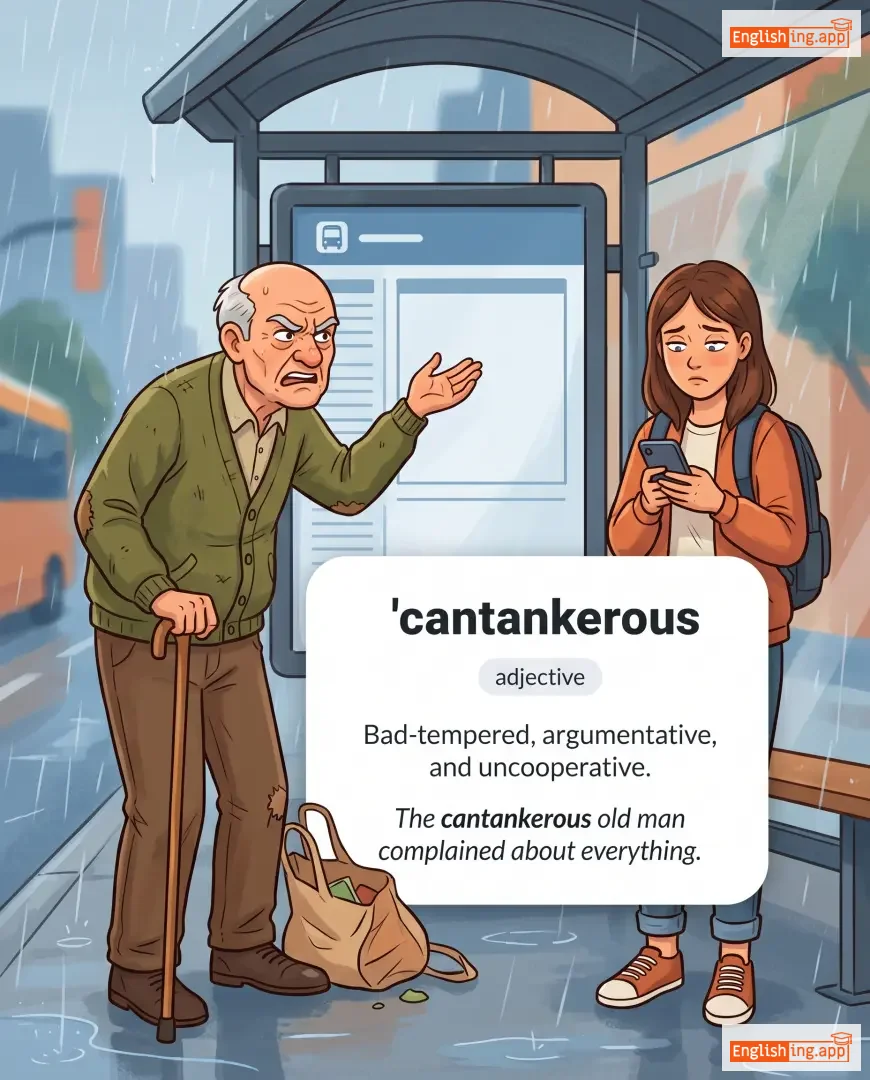
cantankerous definition card — visual illustration of the meaning
adjective
/kænˈtæŋ.kər.əs/
脾气暴躁 (píqì bàozào)

Bad-tempered, argumentative, and uncooperative.

"The cantankerous old man complained about everything."

"那个脾气暴躁的老人对一切都不满。" (Nàgè píqì bàozào de lǎorén duì yīqiè dōu bùmǎn.)
noun
/kænˈtɑː.tə/
康塔塔 (kāng tǎ tǎ)

A vocal composition with instrumental accompaniment, typically in several movements, often involving a choir.

"The choir performed a beautiful cantata during the festival."

"合唱团在节日期间演唱了美丽的康塔塔。" (Héchàngtuán zài jiérì qījiān yǎnchàngle měilì de kāng tǎ tǎ.)
verb
/ˈkæn.tər/
慢跑 (man pao)

To ride a horse at a controlled, easy pace between a trot and a gallop.

"She cantered her horse across the field with ease."

"她轻松地骑马穿过田野。" (Ta qingsong de qima chuanguo tianye.)
noun
/ˈkæn.toʊ/
(zhang)

A main division of a long poem, especially in epic poetry.

"The Divine Comedy is divided into several cantos."

"神曲被分为几个章节。" (Shenqu bei fen wei ji ge zhangjie.)
noun
/kænˈtuːnmənt/
军事驻地 (junshi zhudi)

A permanent military station or garrison town.

"The army established a new cantonment near the border."

"军队在边界附近建立了一个新的军事驻地。" (Jundui zai bianjie fujin jianli le yi ge xinde junshi zhudi.)