词汇表

英语词汇词典 | 单词含义、定义和示例

adjective
/ˈtʃuːzi/
挑剔 (tiāotì)

very careful in choosing; selective

"She is very choosy about the clothes she wears."
"她对她穿的衣服非常挑剔。" (Tā duì tā chuān de yīfú fēicháng tiāotì.)
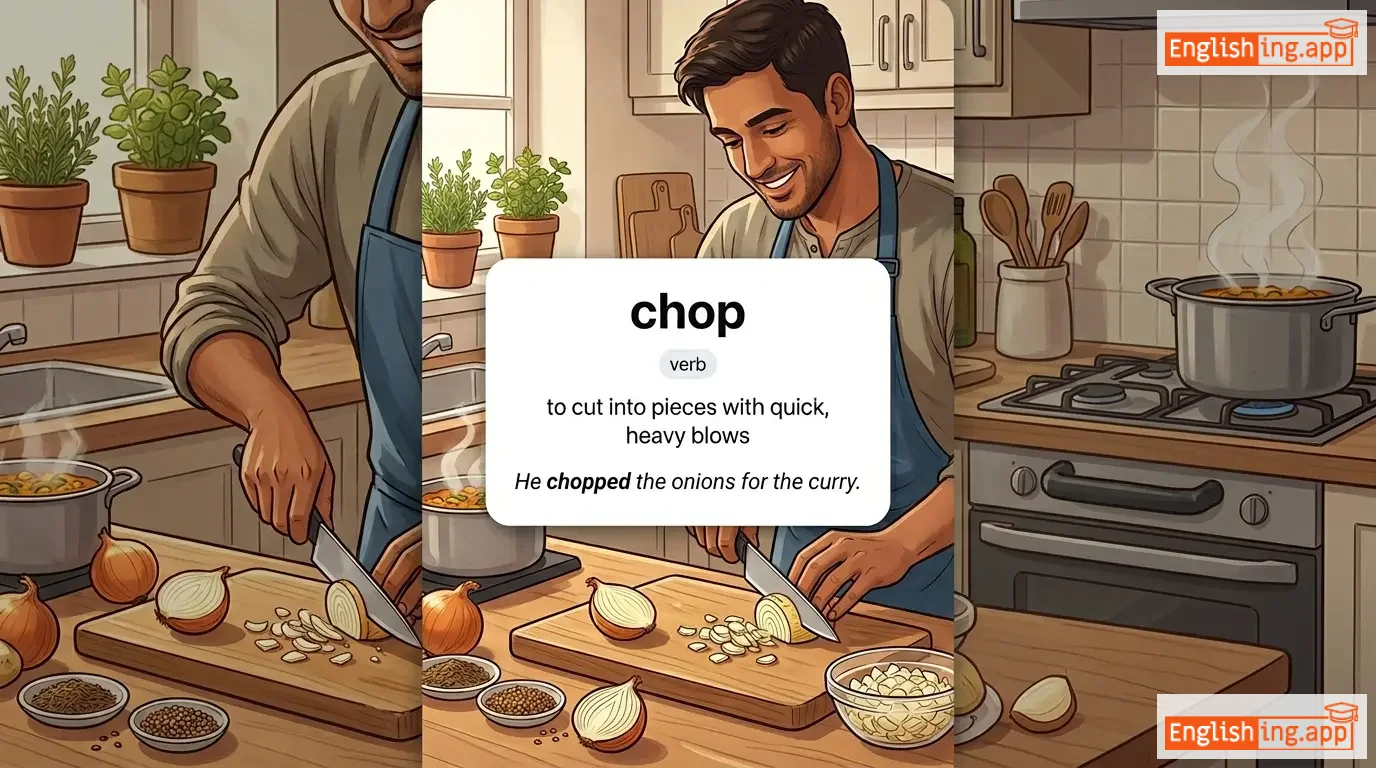
chop definition card — visual illustration of the meaning
verb
/tʃɒp/
(kan)

to cut into pieces with quick, heavy blows

"He chopped the onions for the curry."

"他为咖喱切了洋葱。" (Tā wèi gālí qiēle yángcōng.)
noun
/ˈtʃɒp.ər/
斧头 (futou)

a tool with a heavy blade for chopping wood; a helicopter

"The lumberjack swung the chopper to cut down the tree."

"伐木工挥动斧头砍倒树木。" (Fámù gōng huīdòng fǔtóu kǎn dǎo shùmù.)
adjective
/ˈkɔːrəl/
与合唱团相关 (yu hechangtuan xiangguan)

Relating to, written for, or performed by a choir or chorus.

"The church hosted a choral performance on Sunday."

"教堂在周日举办了合唱表演。" (Jiàotáng zài zhōu rì jǔbàn le héchàng biǎoyǎn.)
noun
/kɔːrd/
和弦 (hexian)

A group of musical notes played or sung together; also a straight line segment joining two points on a curve.

"She strummed a simple chord on the guitar."

"她在吉他上弹奏了一个简单的和弦。" (Tā zài jítā shàng tánzòu le yīgè jiǎndān de héxián.)
noun
/tʃɔːr/
家务 (jiawu)

A routine task, especially a household duty.

"Washing the dishes is my least favorite chore."

"洗碗是我最不喜欢的家务。" (Xǐ wǎn shì wǒ zuì bù xǐhuān de jiāwù.)
noun
/ˌkɔːriˈɒɡrəfi/
编舞 (bian wu)

The art of designing and arranging dances and movements.

"The choreography of the ballet was breathtaking."

"芭蕾舞的编舞令人惊叹。" (Baliwu de bianwu lingren jingtan.)
verb
/ˈtʃɔːrtl/
轻松愉快地笑 (qīngsōng yúkuài de xiào)

to laugh in a breathy, gleeful way

"The audience chortled at the comedian's witty remarks."

"观众听到喜剧演员的机智评论后发出咯咯的笑声。" (Guānzhòng tīngdào xǐjù yǎnyuán de jīzhì pínglùn hòu fāchū gēgē de xiàoshēng.)
noun
/ˈkɔːrəs/

a group of singers or the part of a song that is repeated

"The children sang the chorus loudly."

noun
/kraɪst/
基督 (Jidu)

the title given to Jesus, considered the Messiah in Christianity

"Christ is central to Christian faith."

"基督是基督教信仰的核心。" (Jidu shi Jidujiao xinyang de hexin.)
verb
/ˈkrɪsən/
命名 (mìngmíng)

to give a name to someone at baptism or to name something officially

"They christened the ship after the queen."

"他们为船命名,以女王的名字。" (Tāmen wèi chuán mìngmíng, yǐ nǚwáng de míngzì.)
noun
/ˈkrɪsəndəm/
基督教世界 (jidu jiao shijie)

the worldwide body or community of Christians

"The news spread quickly across Christendom."

"新闻迅速传播到整个基督教世界。" (Xinwen xunsu chuánbò dào zhěnggè jīdūjiào shìjiè.)
noun, adjective
/ˈkrɪstʃən/
基督徒 (jīdū tú)

a person who follows the religion based on the teachings of Jesus Christ

"She is a devoted Christian who attends church every Sunday."

"她是一个虔诚的基督徒,每个星期天都会去教堂。" (Tā shì yī gè qiánchéng de jīdū tú, měi gè xīngqītiān dōu huì qù jiàotáng.)
noun
/ˌkrɪstiˈænɪti/
基督教 (jidujiao)

the religion based on the teachings of Jesus Christ

"Christianity has millions of followers around the world."

"基督教在全世界有数百万信徒。" (Jidujiao zai quan shijie you shubaiwan xintu.)
noun
/ˈkrɪsməs/
圣诞节 (Shèngdàn Jié)

an annual festival celebrating the birth of Jesus Christ, observed on December 25

"Families gather to celebrate Christmas with joy and love."

"家庭聚在一起庆祝圣诞节,带着欢乐和爱。" (Jiātíng jù zài yīqǐ qìngzhù Shèngdàn Jié, dàizhe huānlè hé ài.)
adjective
/krəˈmætɪk/
色彩的 (sècǎi de)

Relating to colors or, in music, notes outside the standard scale.

"The artist used a chromatic palette to create vibrant contrasts."

"艺术家使用了一个色彩丰富的调色板来创造生动的对比。" (Yìshùjiā shǐyòng le yī gè sècǎi fēngfù de tiáosè bǎn lái chuàngzào shēngdòng de duìbǐ.)
adjective
/ˈkrɒnɪk/
慢性 (manxing)

Lasting for a long time or constantly recurring, often describing illness.

"She suffers from chronic back pain."
"她患有慢性的背痛。" (Ta huan you manxing de bei tong.)
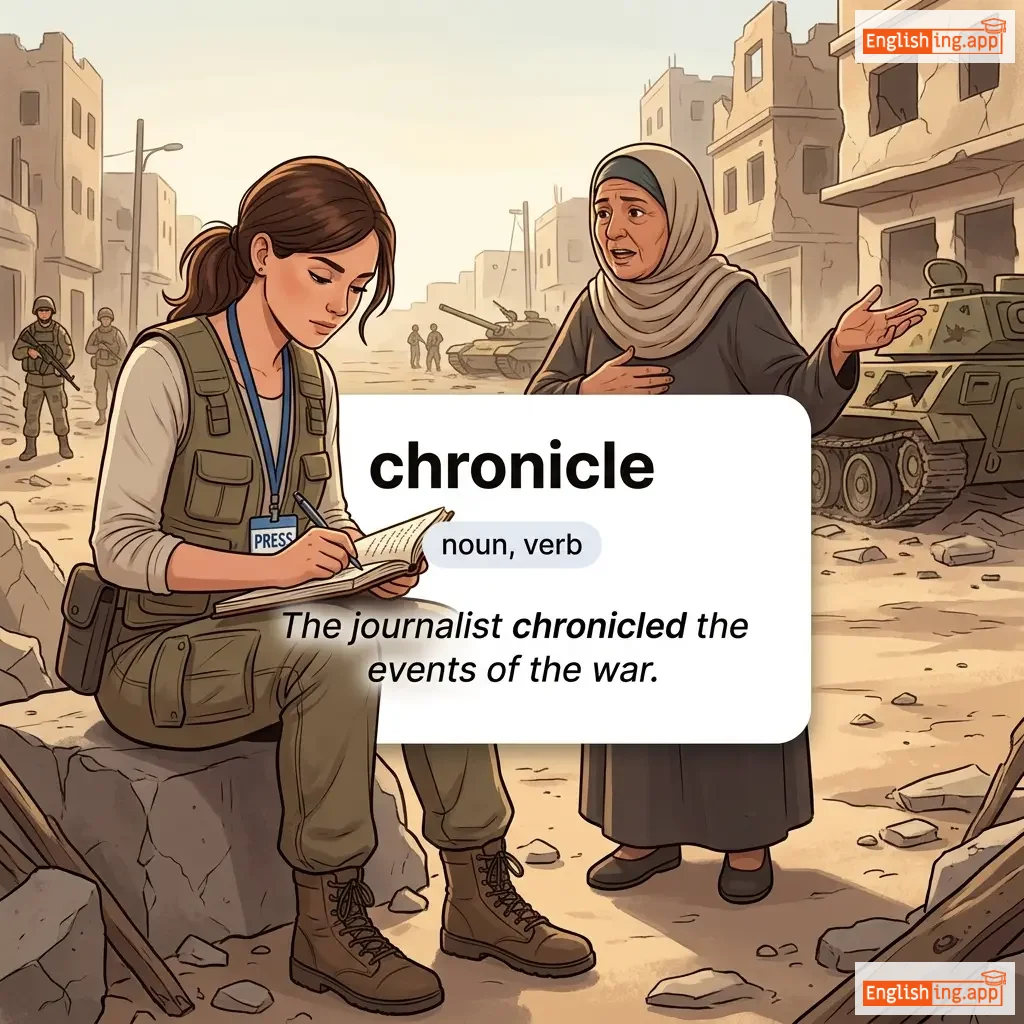
chronicle definition card — visual illustration of the meaning
noun, verb
/ˈkrɒnɪkəl/
编年史 (bian nian shi)

A factual written account of important events in order of time; to record such events.

"The journalist chronicled the events of the war."

"记者记录了战争的事件。" (Jìzhě jìlù le zhànzhēng de shìjiàn.)
adjective
/ˌkrɒnəˈlɒdʒɪkəl/
按时间顺序 (an shijian shunxu)

Arranged in the order in which events happened.

"The events were listed in chronological order."

"这些事件按时间顺序列出。" (Zhexie shijian an shijian shunxu liechu.)
noun
/krəˈnɒlədʒi/

The arrangement of events or dates in the order of their occurrence.

"The chronology of the dynasty was carefully studied by historians."

noun
/krəˈnɒmɪtər/
计时器 (jishiqi)

An instrument for measuring time precisely, especially used in navigation.

"The sailor relied on the chronometer to determine his position at sea."

"水手依靠计时器来确定他在海上的位置。" (Shuǐshǒu yīkào jìshíqì lái quèdìng tā zài hǎishàng de wèizhì.)
adjective
/ˈtʃʌbi/
圆润 (yuánrùn)

slightly fat in a way that looks healthy and pleasant

"The baby has chubby cheeks."

"宝宝有圆润的脸颊。" (Bǎobǎo yǒu yuánrùn de liǎnjiá.)
verb
/ˈtʃʌkəl/
轻笑 (qing xiao)

To laugh quietly or to oneself.

"She chuckled at the joke her friend told."

"她听了朋友讲的笑话,轻笑了。" (Ta ting le pengyou jiang de xiaohua, qing xiao le.)
noun
/tʃʌŋk/
块 / 大块 (kuai / da kuai)

a thick or solid piece of something

"She cut the cake into large chunks."

"她把蛋糕切成大块。" (Ta ba dangao qie cheng da kuai.)
noun
/tʃɜːrtʃ/
教堂 (jiaotang)

a building used for public Christian worship

"The old church in the village was built in the 18th century."

"村里的古老教堂建于18世纪。" (Cun li de gulao jiaotang jian yu 18 shiji.)
😠

churl

noun
/tʃɜːrl/

A rude, boorish, or ill-mannered person.

"The waiter was such a churl that customers left unhappy."

churlish definition card — visual illustration of the meaning
adjective
/ˈtʃɜːrlɪʃ/
粗鲁 (culu)

Rude in a mean-spirited and surly way.

"It would be churlish to refuse her kind invitation."

"拒绝她亲切的邀请将是粗鲁的。" (Jùjué tā qīnqiè de yāoqǐng jiāng shì cūlǔ de.)
noun
/ˈtʃɜː.nɪŋ stɪk/
搅拌棒 (jiaoban bang)

a wooden stick used for stirring and churning butter, milk, or other liquids

"Grandmother used a churning stick to make fresh butter."

"祖母用搅拌棒制作新鲜的黄油。" (Zumu yong jiaoban bang zhizu xinxian de huangyou.)
noun
/ˈsɪɡəˌrɛt/
香烟 (xiangyan)

a small roll of finely cut tobacco wrapped in paper for smoking

"He lit a cigarette after dinner."

"他在晚餐后点燃了一支香烟。" (Ta zai wancan hou dianran le yi zhi xiangyan.)
adjective
/ˈsɪlieɪtɪd/
带有纤毛的 (daiyou xianmao de)

Having minute hairlike projections (cilia) on the surface of cells or organisms.

"The ciliated cells in the respiratory tract help move mucus out of the lungs."

"呼吸道中的纤毛细胞帮助将粘液排出肺部。" (Huxidau zhong de xianmao xibao bangzhu jiang nianye pai chu feibu.)
noun
/ˈsɪniæst/
电影迷 (diànyǐngmí)

A film enthusiast or filmmaker; a person deeply interested in cinema.

"As a true cineast, she spends most weekends watching classic films."

"作为一位真正的电影迷,她大多数周末都在看经典电影。" (Zuòwéi yī wèi zhēnzhèng de diànyǐngmí, tā dàduōshù zhōumò dōu zài kàn jīngdiǎn diànyǐng.)
noun
/ˈsɪnəmə/
电影院 (dianyingyuan)

a place where films are shown to the public; the art or industry of making and showing films

"We went to the cinema to watch a new movie."

"我们去电影院看了一部新电影。" (women qu dianyingyuan kan le yi bu xin dianying)
noun
/ˈsɪnəmən/
肉桂 (rougui)

aromatic spice obtained from the inner bark of several tree species

"Cinnamon is often used in baking and desserts."
"肉桂常用于烘焙和甜点中。" (Rougui chang yongyu hongbei he tiandian zhong.)
cipher definition card — visual illustration of the meaning
noun
/ˈsaɪfər/

A secret or disguised way of writing; a code.

"The spy sent a message written in cipher."

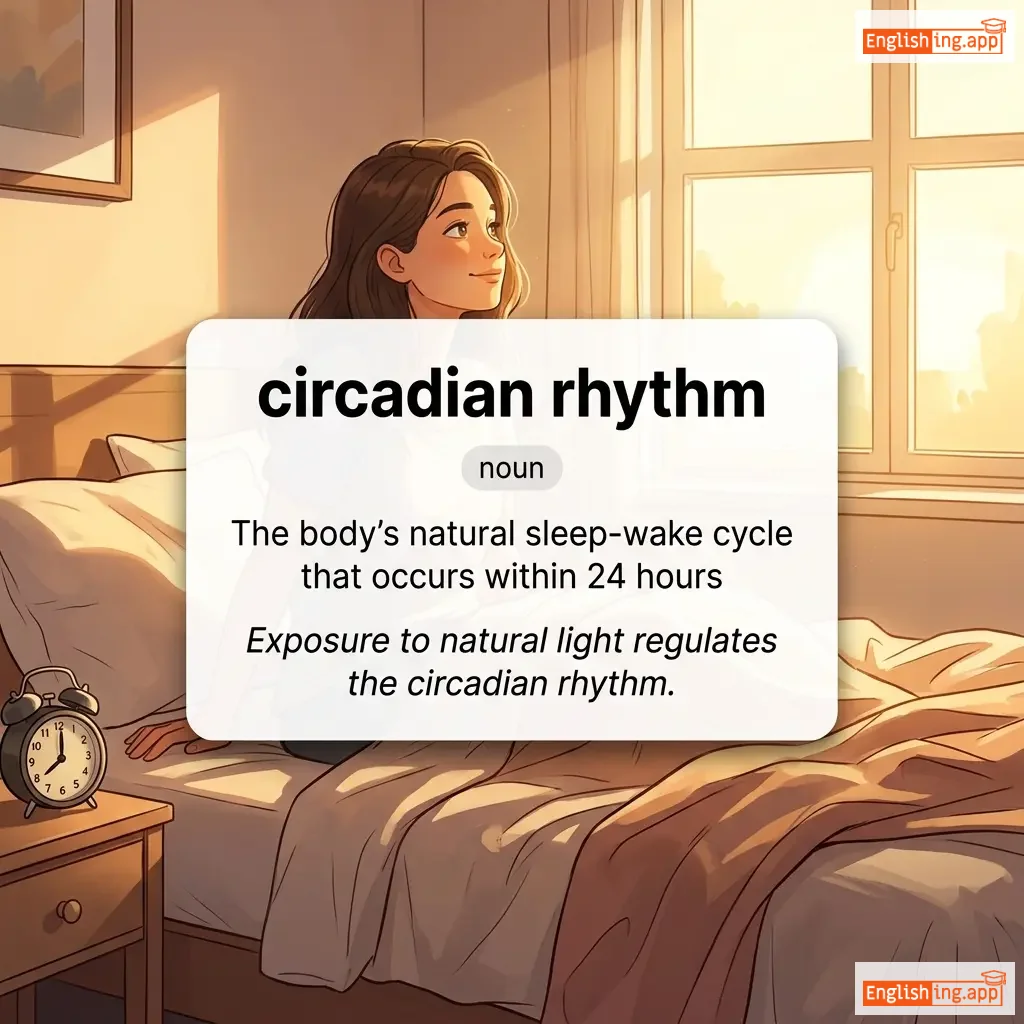
circadian rhythm definition card — visual illustration of the meaning
noun
sɜːrˈkeɪdiən ˈrɪðəm
生物钟 (shengwu zhong)

The body's natural sleep-wake cycle that occurs within 24 hours

"Exposure to natural light regulates the circadian rhythm."

"暴露在自然光下会调节生物钟。" (Baolu zai ziran guangxia hui tiaojie shengwu zhong.)
noun/verb
/ˈsɜːrkəl/
圆圈 (yuánquān)

a round shape; to move all the way around something

"The children sat in a circle."

"孩子们坐成了一个圈。" (Háizimen zuò chéngle yīgè quān.)
noun
/ˈsɜːrklət/

A small circular band, typically worn as an ornament on the head.

"The princess wore a golden circlet on her forehead."

noun
/ˈsɜːrkɪt/
电路 / 电气通路 (dianlu / dianqi tonglu)

A roughly circular line, route, or movement that starts and ends at the same place; also an electrical pathway.

"The runners completed the circuit around the park."

"跑步者完成了环绕公园的电路。" (Paobu zhe wancheng le huanrao gongyuan de dianlu.)
circuitous definition card — visual illustration of the meaning
adjective
/sərˈkjuːɪtəs/
迂回路线 (yúhuí lùxiàn)

Longer than the most direct way; roundabout.

"He took a circuitous route to avoid traffic."

"他走了一条迂回路线以避开交通。" (Tā zǒu le yītiáo yúhuí lùxiàn yǐ bì kāi jiāotōng.)
adjective
/ˈsɜːrkjələr/
圆形的 (yuánxíng de)

shaped like a circle; round in form

"The kids sat in a circular arrangement around the campfire."

"孩子们围坐在篝火旁,形成圆形的布局。" (Háizimen wéizuò zài gōuhuǒ páng, xíngchéng yuánxíng de bùjú.)
circular economy definition card — visual illustration of the meaning
noun
ˈsɜːrkjələr ɪˈkɒnəmi
循环经济 (xunhuan jingji)

An economic system aimed at eliminating waste and the continual use of resources through reuse, sharing, repair, refurbishment, remanufacturing and recycling.

"Adopting a circular economy can reduce waste."

"采用循环经济可以减少废物。" (Caiyong xunhuan jingji keyi jianshao feiwu.)
verb
/ˈsɜːrkjəˌleɪt/
循环, 流通 (xúnhuán, liútōng)

to move continuously or freely through a closed system or area

"Air circulated freely in the open hall."

"空气在开放的大厅自由流通。" (Kōngqì zài kāifàng de dàtīng zìyóu liútōng.)
circulation definition card — visual illustration of the meaning
noun
/ˌsɜːr.kjʊˈleɪ.ʃən/
循环 (xunhuan)

the movement of something (like blood, air, or information) through a system or area.

"The circulation of blood is essential for a healthy body."

"血液循环对健康的身体至关重要。" (Xueye xunhuan dui jiankang de shenti zhiguang zhongyao.)
noun
/sərˈkʌmfərəns/
周长 (zhou chang)

the distance around the edge of a circle

"The teacher asked us to calculate the circumference of the circle."

"老师让我们计算圆的周长。" (Lao shi rang wo men ji suan yuan de zhou chang.)
noun
/ˌsɜːrkəmləˈkjuːʃn/
拐弯抹角 (guǎi wān mò jiǎo)

the use of many words when fewer would do, especially to avoid stating something directly

"The politician's speech was filled with circumlocution."

"政治家的演讲充满了拐弯抹角。" (Zhèngzhìjiā de yǎnjiǎng chōngmǎnle guǎiwān mòjiǎo.)
verb
/ˌsɜːrkəmˈnævɪɡeɪt/
环绕地球 (huánrào dìqiú)

to travel all the way around something, especially the earth

"Magellan was the first to circumnavigate the globe."

"麦哲伦是第一个环绕地球航行的人。" (Màizhélún shì dì yī gè huánrào dìqiú hángxíng de rén.)
verb
/ˈsɜːrkəmskraɪb/
限制 (xiànzhì)

to limit or restrict something within boundaries

"The rules circumscribe the powers of the committee."

"规则限定了委员会的权力。" (Guīzé xiànzhìle wěiyuánhuì de quánlì.)
adjective
/ˈsɜːrkəmskraɪbd/
受限的 (shòuxiàn de)

restricted or limited in scope or freedom

"Her freedom of choice was circumscribed by social rules."

"她的选择自由受社会规则的限制。" (Tā de xuǎnzé zìyóu shòu shèhuì guīzé de xiànzhì.)
circumspect definition card — visual illustration of the meaning
adjective
/ˈsɜːrkəmspekt/
谨慎的 (jinshen de)

careful and unwilling to take risks; cautious

"He was circumspect in his business dealings."

"他在商业交易中非常谨慎。" (Tā zài shāngyè jiāoyì zhōng fēicháng jǐnshèn.)
circumspection definition card — visual illustration of the meaning
noun
ˌsɜːkəmˈspekʃən
谨慎, 避免风险 (jinshen, biman fengxian)

The quality of being wary and unwilling to take risks; prudence.

"His circumspection ensured no mistakes were made."

"他的谨慎确保没有犯错误。" (Tā de jǐnshèn quèbǎo méiyǒu fàn cuòwù.)