词汇表

英语词汇词典 | 单词含义、定义和示例

noun
/briːz/
轻风 (qing feng)

a gentle wind; a light and pleasant current of air.

"A cool breeze came through the window."

"一阵凉风从窗户吹进来。" (Yī zhèn liáng fēng cóng chuānghù chuī jìnlái.)
noun
/ˈbriːzˌweɪ/
有顶走道 (you ding zou dao)

A roofed outdoor passage, often connecting two buildings.

"The breezeway connected the house to the garage."

"有顶走道将房子与车库连接在一起。" (You ding zoudao jiang fangzi yu cheku lianjie zai yiqi.)
noun
/ˈbrɛviˌɛri/
祷告书 (daogao shu)

A book containing the service for each day, used in Christian liturgy.

"The monk read from the breviary during morning prayers."

"僧侣在早晨祷告时从祷告书中朗读。" (Senglü zai zaochen daogao shi cong daogao shu zhong langdu.)
✍️

brevity

noun
/ˈbrɛvɪti/

Concise and exact use of words in writing or speech.

"The brevity of the speech kept the audience engaged."

💵

Bribe

verb
/braɪb/

To persuade someone to act in one's favor, typically illegally, by offering money or gifts.

"The official was caught trying to bribe the inspector."

noun
/ˈbrɪk ə ˌbræk/
小装饰品 (xiao zhuangshipin)

Small decorative objects or ornaments, often of little value.

"The shelves were filled with old bric-a-brac from her travels."

"架子上堆满了她旅行时带回来的旧装饰品。" (Jiazi shang duiman le ta luxing shi daihuailai de jiu zhuangshipin.)
noun
/brɪk/
砖块 (zhuānkuài)

A rectangular block of clay or similar material used in building walls and other structures.

"The workers laid brick after brick to build the wall."

"工人们一块接一块地放砖来建造墙壁。" (Gōngrénmen yī kuài jiē yī kuài de fàng zhuān lái jiànzào qiángbì.)
noun
/ˈbrɪk.bæt/
一块砖块;严厉的批评或谴责 (yi kuai zhuankuai; yanli de piping huo qianze)

a piece of brick, especially one used as a missile; harsh criticism or censure

"The angry protesters threw brickbats at the building windows."

"愤怒的抗议者将砖块扔向建筑物的窗户。" (Fen nu de kangyizhe jiang zhuankuai rengxiang jianzhu wu de chuanghu.)
noun
/braɪd/
新娘 (xīnniáng)

a woman on her wedding day or just before and after the event

"The bride looked stunning in her white dress."

"新娘在她的白色婚纱里看起来很迷人。" (Xīnniáng zài tā de báisè hūnshā lǐ kàn qǐlái hěn mírén.)
noun
/ˈbraɪd.ɡrʊm/
新郎 (xinlang)

a man on his wedding day or just before and after the event

"The nervous bridegroom waited at the altar for his bride to arrive."

"紧张的新郎站在祭坛前等着他的新娘到来。" (Jinzhang de xinlang zhan zai jitán qian dengzhe tā de xīnniáng dàolái.)
noun
/brɪdʒ/
(qiao)

A structure built to span a physical obstacle, such as a river or road, for the purpose of providing passage.

"The bridge connects the two cities across the river."
"桥将两座城市连接起来,跨越河流。" (Qiáo jiāng liǎng zuò chéngshì liánjiē qǐlái, kuàyuè héliú.)
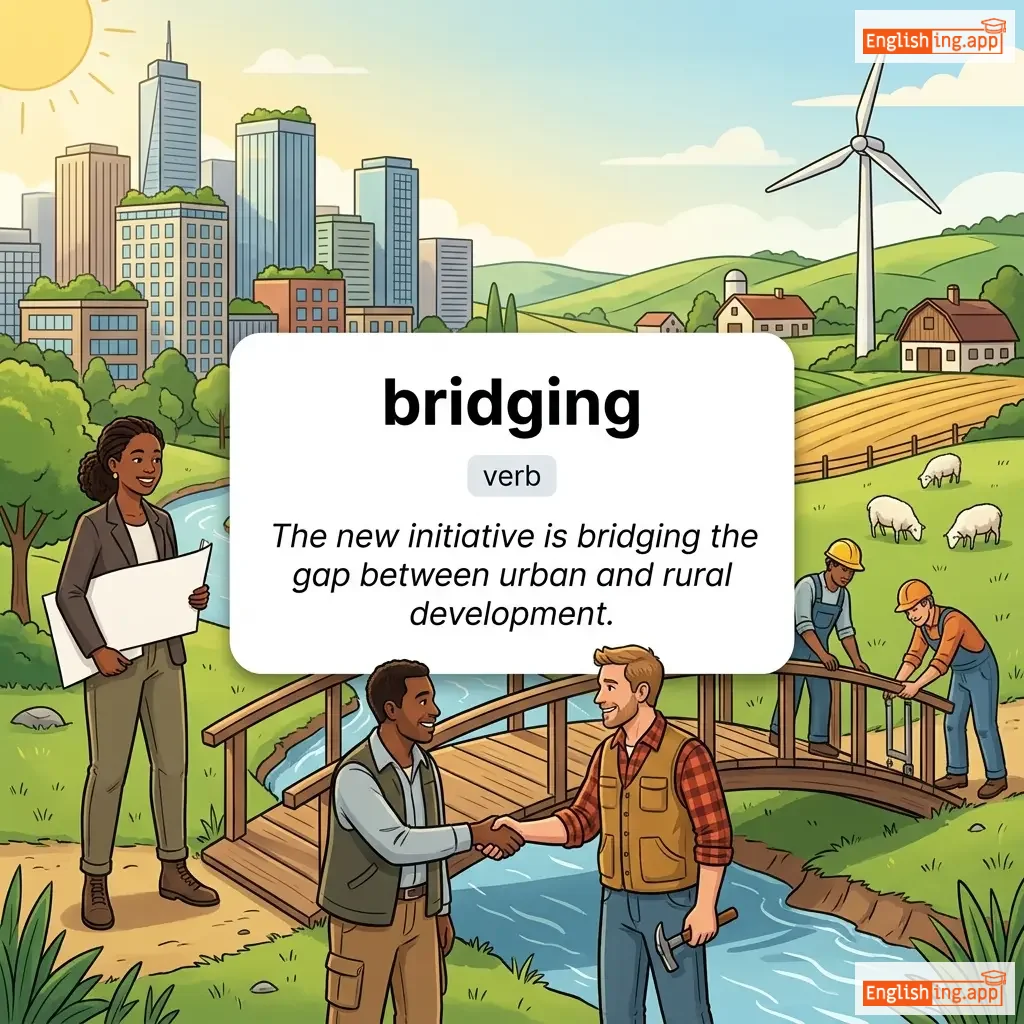
bridging definition card — visual illustration of the meaning
verb
/ˈbrɪdʒɪŋ/
建设桥梁,建立连接 (jiànshè qiáoliáng, jiànlì liánjiē)

The action of building a bridge over something; connecting or reducing the distance between two things.

"The new initiative is bridging the gap between urban and rural development."

"新举措正在缩小城市与乡村发展的差距。" (Xīn jǔcuò zhèngzài suōxiǎo chéngshì yǔ xiāngcūn fāzhǎn de chājù.)
noun/verb
/ˈbraɪ.dəl/

A bridle is a piece of equipment used to control a horse; as a verb, it means to show anger or to restrain.

"The rider tightened the bridle before setting off."

adjective, noun, verb
/briːf/
简短 (jian duan)

Short in duration; a summary of information.

"The manager briefed the team before the meeting."

"经理在会议前简要地向团队做了报告。" (Jing li zai hui yi qian jian yao de xiang tuan dui zuo le bao gao.)
adverb
/ˈbriːfli/
简短地 (jiǎnduǎn de)

For a short time; in a few words.

"She spoke briefly about her travel experience."

"她简短地谈到了她的旅行经历。" (Tā jiǎnduǎn de tán dào le tā de lǚxíng jīnglì.)
noun
/brɪˈɡeɪd/
消防队 (xiāo fáng duì)

A large group of people organized for a specific purpose, especially a military unit.

"The fire brigade arrived quickly to put out the flames."

"消防队迅速赶来扑灭火焰。" (Xiāo fáng duì xùn sù gǎn lái pū miè huǒ yàn.)
noun
/ˌbrɪɡ.əˈdɪər/
布里加迪尔 (bulijiadi'er)

A military officer rank, usually commanding a brigade.

"The brigadier inspected the troops before the parade."

"布里加迪尔在游行前检查了部队。" (Bulijiadi'er zai youxing qian jiancha le budui.)
noun
/ˈbrɪɡ.ənd/
强盗 (qiángdào)

A member of a gang that ambushes and robs people in forests or mountains; a bandit.

"The travelers were attacked by brigands in the mountains."

"旅行者在山中被强盗袭击。" (Lǚxíng zhě zài shān zhōng bèi qiángdào xíjī.)
adjective
/braɪt/
明亮的 (mingliang de)

Giving out or reflecting a lot of light; intelligent or cheerful.

"The bright sun lit up the entire valley."

"明亮的太阳照亮了整个山谷。" (Míngliàng de tàiyáng zhàoliàngle zhěnggè shāngǔ.)
verb
/ˈbraɪtən/
使明亮 (shi mingliang)

to make something lighter or more colorful; to improve mood or make happier

"A few kind words can brighten someone's day."

"几句善意的话可以让人的一天变得明亮。" (ji ju shanyi de hua keyi rang ren de yi tian biande mingliang)
adverb
/ˈbraɪtli/
明亮地 (mingliang de)

in a way that gives off a lot of light; in a vivid, cheerful, or intelligent manner

"The stars shone brightly in the clear night sky."

"星星在清澈的夜空中明亮地闪耀。" (Xingxing zai qingche de yekong zhong mingliang de shanyao)
adjective
/ˈbrɪliənt/
辉煌 (huihuang)

Exceptionally clever, talented, or impressive; very bright or radiant.

"She gave a brilliant performance on stage."

"她在舞台上表演得非常出色。" (Ta zai wutai shang biaoyan de feichang chuse.)
noun/verb
/brɪm/
边缘 (bianyuan)

The edge of a container; as a verb, to be full to the point of overflowing.

"Her eyes brimmed with tears of joy."

"她的眼睛充满了喜悦的泪水。" (Ta de yanjing chongmanle xiyue de leishui.)
noun
/ˈbrɪmˌstoʊn/

Sulfur, especially when considered as fiery and associated with hell or divine punishment.

"The preacher spoke of fire and brimstone to warn the congregation."

adjective
/ˈbrɪndl̩d/
斑驳 (banbo)

Having a brownish or tawny color with streaks or spots of another color.

"The farmer owned a brindled cow with distinctive stripes."

"农民拥有一头带有显著条纹的斑驳奶牛。" (Nóngmín yǒngyǒu yī tóu dài yǒu xiǎnzhù tiáowén de bānbó nǎiniú.)
noun
/braɪn/
盐水 (yanshui)

Water saturated with salt, often used for preserving food.

"The olives were stored in brine to keep them fresh."
"橄榄被保存在盐水中以保持新鲜。" (Gǎnlǎn bèi bǎocún zài yánshuǐ zhōng yǐ bǎochí xīnxiān.)
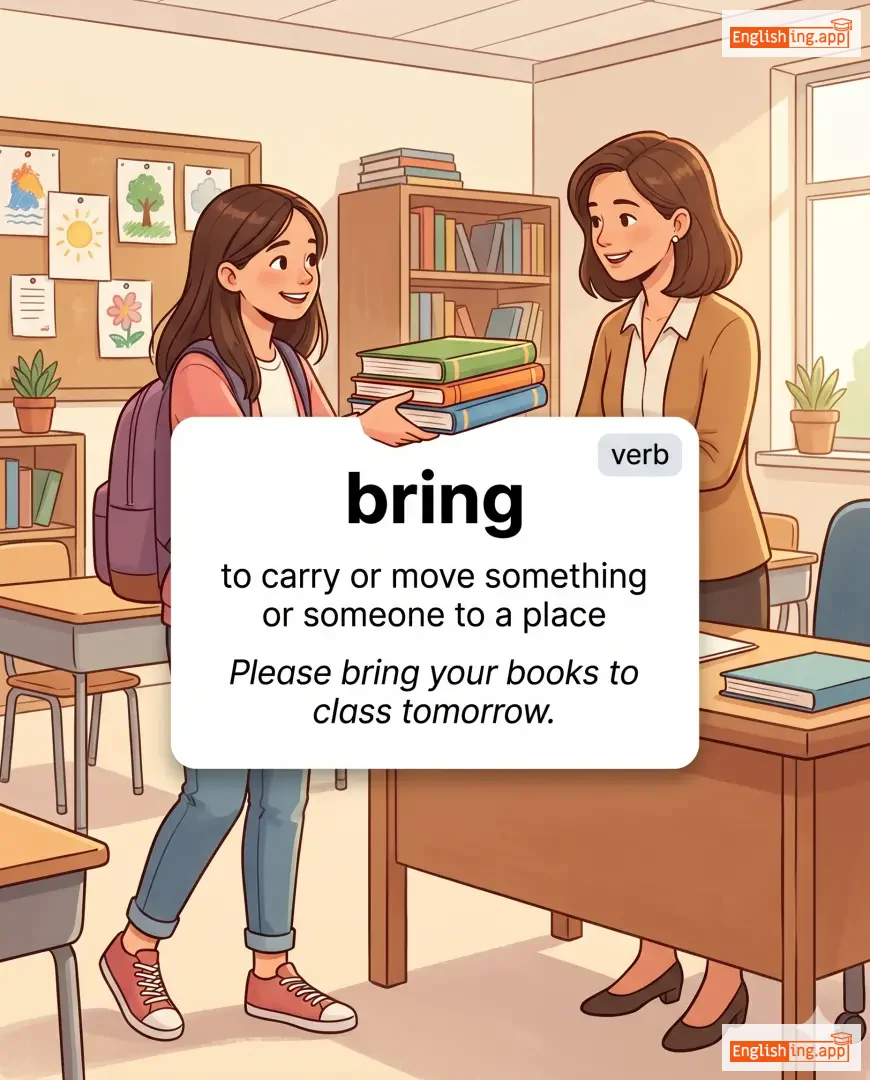
bring definition card — visual illustration of the meaning
verb
/brɪŋ/
带来 (dai lai)

to carry or move something or someone to a place

"Please bring your books to class tomorrow."

"请把书带到明天的课堂。" (Qing ba shu dai dao mingtian de kètáng.)
noun
/ˈbrɪn.dʒəl/
茄子 (qiezi)

a large purple vegetable that is white inside; also called eggplant

"My mother cooked brinjal curry for lunch."

"我妈妈做了茄子咖喱作为午餐。" (Wo mama zuo le qiezi gālí zuòwéi wǔcān.)
noun
/brɪŋk/
边缘 (bianyuan)

The edge or point just before a significant event or change.

"The company was on the brink of bankruptcy."

"公司处于破产的边缘。" (Gōngsī chùyú pòchǎn de biānyuán.)
adjective
/brɪsk/
快速 (kuai su)

Quick, energetic, and active in movement or speech.

"She took a brisk walk in the morning to stay healthy."

"她早上进行了一次快速散步以保持健康。" (Ta zaoshang jinxing le yi ci kuai su san bu yi baochi jiankang.)
verb, noun
/ˈbrɪsəl/
刚毛; 愤怒反应 (gang mao; fen nu fan ying)

to react angrily or defensively; a short stiff hair or fiber

"The cat bristled when it saw the dog."

"猫看到狗时毛发竖起来。" (Mao kan dao gou shi mao fa shu qi lai.)
adjective
/ˈbrɪslɪŋ/
竖毛的; 充满能量 (shumaode; chongman nengliang)

full of energy, anger, or excitement; showing bristles standing up

"He entered the room bristling with confidence."

"他带着自信走进了房间。" (Ta daizhe zixin zoujinle fangjian.)
noun
/brɪˈtæniə/
不列颠 (Buliedian)

the personification of Britain, often shown as a woman with a helmet and shield

"Britannia has been a symbol of Britain since Roman times."

"不列颠自罗马时代起就是英国的象征。" (Buliedian zi Luoma shidai qi jiushi Yingguo de xiangzheng.)
noun
/ˈbrɪtɪˌsɪzəm/
英式英语的单词或特征 (Yīng shì yīngyǔ de dāncí huò tèzhēng)

a word, phrase, or characteristic feature of British English

"The word 'lorry' is a well-known Briticism."

"'lorry' 这个词是一个著名的英式词汇。" ('Lorry' zhège cí shì yīgè zhùmíng de yīng shì cíhuì.)
adjective
/ˈbrɪtɪʃ/
英国的 (yingguo de)

relating to Great Britain or its people

"She loves British culture and traditions."

"她喜欢英国文化和传统。" (Ta xihuan Yingguo wenhua he chuantong.)
adjective
/ˈbrɪtl/
脆弱 (cuìruò)

easily broken or cracked; hard but liable to break

"The glass was so brittle that it cracked easily."

"玻璃太脆弱,容易破裂。" (Bōlí tài cuìruò, róngyì pòliè.)
broach definition card — visual illustration of the meaning
verb
/broʊtʃ/
提出 (tichu)

to bring up a subject for discussion

"She decided to broach the topic of salary with her manager."

"她决定与经理讨论工资问题。" (Ta jueding yu jingli taolun gongzi wenti.)
adjective
/brɔːd/
(kuan)

wide in extent, range, or scope

"The river is very broad at this point."

"这条河在这个点非常宽。" (Zhe tiao he zai zhege dian feichang kuan.)
noun
/ˈbrɔːd.bænd/
宽带 (kuān dài)

a high-capacity transmission technique using a wide range of frequencies.

"Broadband internet has become a necessity in modern homes."

"宽带互联网已成为现代家庭的必需品。" (Kuāndài hùliánwǎng yǐ chéngwéi xiàndài jiātíng de bìxū pǐn.)
verb
/ˈbrɔːdˌkæst/
广播 (guangbo)

to transmit a program or information by radio, television, or online media

"The match was broadcast live on television."

"比赛通过电视现场直播。" (Bisai tongguo dianshi xianshi zhi播。)
noun
/ˈbrɔːdˌkæstər/
广播员 (guangbo yuan)

a person or organization that transmits a broadcast program.

"The broadcaster aired the match live to millions of viewers."

"广播员将比赛实时转播给数百万观众。" (Guangbo yuan jiang bisai shishi zhuanbo gei shù bǎi wàn guānzhòng.)
verb
/ˈbrɔːdən/
拓宽 (tuokuan)

to make wider or larger in scope; to expand ideas, experience, or understanding

"Travel can broaden your perspective on different cultures."

"旅行可以拓宽你对不同文化的视野。" (Lvxing keyi tuokuan ni dui butong wenhua de shiye)
adverb
/ˈbrɔːdli/
广泛地 (guangfan de)

in a general or wide manner.

"The rules are broadly similar across all regions."

"规则在所有地区大体相似。" (Guize zai suoyou diqu dati xiangsi.)
noun
/ˈbrɔːdˌsaɪd/
猛烈的攻击 (měngliè de gōngjí)

a strong verbal attack or a sheet of paper printed on one side

"The politician launched a broadside against his opponent."

"政治家对他的对手发起了猛烈的攻击。" (Zhèngzhìjiā duì tā de duìshǒu fāqǐle měngliè de gōngjí.)
noun
/brəˈkeɪd/
织锦 (zhijin)

a rich fabric woven with a raised pattern, often in gold or silver thread

"She wore a beautiful brocade dress to the wedding."

"她在婚礼上穿着一件漂亮的织锦裙子。" (Tā zài hūnlǐ shàng chuānzhuó yī jiàn piàoliang de zhī jǐn qúnzi.)
noun
/broʊˈʃʊr/
小册子 (xiaocèzi)

a small booklet or pamphlet containing information or advertising

"The travel agent gave us a brochure about the holiday package."

"旅行社的工作人员给了我们一本关于假期套餐的小册子。" (Lǚxíng shè de gōngzuò rényuán gěile wǒmen yī běn guānyú jiàqī tàocān de xiǎo cèzi.)
noun
/ˈbroʊɡən/
厚重鞋 (hòu zhòng xié)

A heavy, sturdy shoe, often made of leather.

"The farmer wore old brogans while working in the field."

"农民在田间工作时穿着旧布罗根鞋。" (Nóngmín zài tiánjiān gōngzuò shí chuānzhuó jiù bù luógēn xié.)
noun
/broʊɡ/
坚固的鞋子;口音 (jian gu de xie zi; kou yin)

A strong outdoor shoe; also a marked accent, especially Irish or Scottish.

"He bought a pair of stylish brogues for the wedding."

"他为婚礼买了一双时尚的布罗格鞋。" (Ta wei hun li mai le yi shuang shi shang de bu luo ge xie.)
verb
/brɔɪl/
(kao)

To cook food by direct heat, usually under a grill or over a fire.

"She broiled the chicken until it was golden brown."

"她把鸡肉烤到金黄色。" (Ta ba jirou kao dao jinh Huangse.)
verb; adjective
/broʊk/
打破了;没钱 (da po le; mei qian)

past tense of break; having no money or being financially poor

"I broke my phone last night and now I’m completely broke."

"我昨晚把手机弄坏了,现在一点钱也没有。" (wo zuo wan ba shou ji nong huai le xian zai yi dian qian ye mei you)