词汇表

英语词汇词典 | 单词含义、定义和示例

adjective
/ˈblɪŋkəd/
目光狭窄 (mùguāng xiázhǎi)

Having a limited or narrow outlook; unable or unwilling to consider other perspectives.

"His blinkered attitude stopped him from seeing the bigger picture."

"他那种目光狭窄的态度使他无法看到更大的画面。" (Tā nà zhǒng mùguāng xiázhǎi de tàidù shǐ tā wúfǎ kàn dào gèng dà de huàmiàn.)
noun
/blɪs/
极乐 (jile)

Perfect happiness or great joy.

"The couple enjoyed a moment of pure bliss on their wedding day."

"这对夫妇在他们的婚礼当天享受了一刻纯粹的极乐。" (Zhè duì fūqī zài tāmen de hūnlǐ dàngtiān xiǎngshòu le yī kè chúncuì de jílè.)
noun
/ˈblɪs.tər/
水泡 (shuǐpào)

a small bubble on the skin filled with serum and caused by friction, burning, or other damage

"The new shoes gave her a painful blister on her heel."

"新鞋子在她的脚后跟上造成了一个痛苦的水泡。" (Xīn xiézi zài tā de jiǎo hòu gēn shàng zàochéngle yīgè tòngkǔ de shuǐpào.)
adjective
/blaɪð/
漫不经心 (man bu jing xin)

Showing a casual and cheerful indifference considered improper or carefree happiness.

"She had a blithe disregard for the rules."

"她对规则的漠视毫不在意。" (Ta dui guize de mo shi hao bu zai yi.)
adjective
/ˈblaɪðsəm/
愉快 (yúkuài)

cheerful, carefree, and full of joy

"She entered the room with a blithesome smile that lifted everyone's spirits."

"她带着愉快的笑容走进房间,大家的心情都变好了。" (Tā dàizhe yúkuài de xiàoróng zǒu jìn fángjiān, dàjiā de xīnqíng dōu biàn hǎo le.)
verb
/bloʊt/
膨胀 (pengzhang)

to swell or cause to swell, often due to fluid or gas

"Eating too much junk food can bloat your stomach."

"吃太多垃圾食品会让你的胃膨胀。" (Chi tai duo laji shipin hui rang nide wei pengzhang.)
adjective
/ˈbloʊtɪd/
膨胀的 (pangzhang de)

swollen or puffed up, often unpleasantly

"After the big meal, he felt bloated and uncomfortable."
"吃完大餐后,他感到肚子膨胀不适。" (Chi wan da can hou, ta gan dao duzi pangzhang bushufu.)
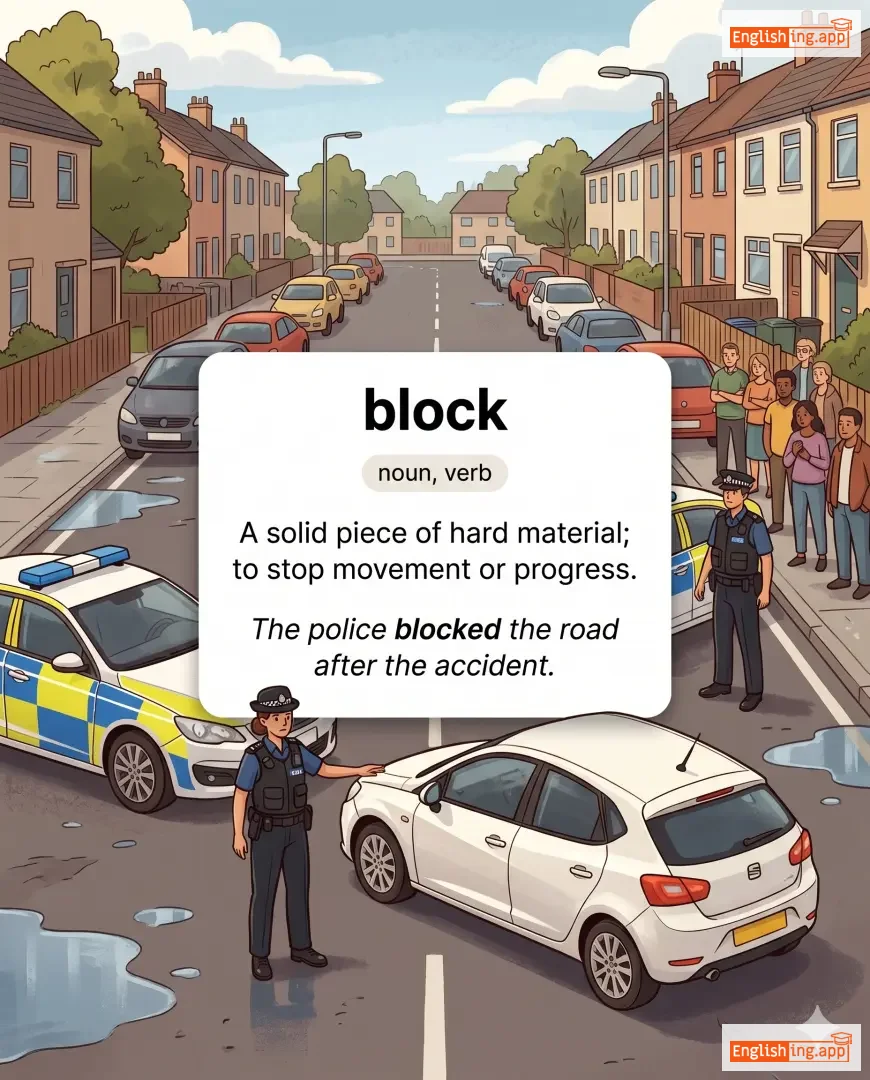
block definition card — visual illustration of the meaning
noun, verb
/blɑːk/
封锁 (fengsuo)

A solid piece of hard material; to stop movement or progress.

"The police blocked the road after the accident."

"警察在事故后封锁了道路。" (Jingcha zai shigu hou fengsuo le daolu.)
noun
/blɑːˈkeɪd/
封锁 (fengsuo)

an act of sealing off a place to prevent goods or people from entering or leaving

"The navy set up a blockade around the harbor."

"海军在港口周围设置了封锁。" (Haijun zai gangkou zhouwei shezhi le fengsuo.)
noun
/ˈblɒk.ɪdʒ/
阻塞 (zuse)

an obstruction that makes movement or flow difficult or impossible

"The drain blockage caused water to overflow in the kitchen."

"排水管的阻塞导致水在厨房溢出。" (Páishuǐguǎn de zǔsè dǎozhì shuǐ zài chúfáng yìchū.)
blockchain definition card — visual illustration of the meaning
noun
/ˈblɒkˌtʃeɪn/
区块链 (qūkuàiliàn)

A system of recording information in a way that makes it difficult or impossible to change, hack, or cheat the system

"Blockchain technology ensures transparency in financial transactions."

"区块链技术确保金融交易的透明度。" (Qūkuàiliàn jìshù quèbǎo jīnróng jiāoyì de tòumíngdù.)
👱‍♀️

blond

adjective
/blɒnd/

having light-colored hair, typically pale yellow or golden.

"She has long blond hair that shines in the sunlight."

noun
/blʌd/
血液 (xueye)

The red liquid that circulates in the arteries and veins of humans and animals.

"The doctor took a sample of blood for testing."

"医生取了一份血液样本进行测试。" (Yisheng qule yifen xueye yangben jinxing ceshi.)
noun
/ˈblʌdˌbæθ/
血腥屠杀 (xuèxīng túshā)

an event in which a lot of people are killed or injured, especially in a violent conflict

"The war turned into a bloody bloodbath."

"战争变成了一场血腥的屠杀。" (Zhànzhēng biàn chéngle yī chǎng xuèxīng de túshā.)
adjective
/ˈblʌdləs/
无血 (wú xuè)

without bloodshed; lacking violence or vitality

"The revolution was surprisingly bloodless."

"这场革命出奇地没有流血。" (Zhè chǎng gémìng chūqí de méiyǒu liúxuè.)
noun
/ˈblʌd.ʃed/
流血; 屠杀 (liúxuè; túshā)

the killing or wounding of people, typically in large numbers during a conflict

"The peace treaty was signed to prevent further bloodshed."

"和平条约被签署,以防止进一步的流血。" (Hépíng tiáoyuē bèi qiānshǔ, yǐ fángzhǐ jìnyībù de liúxuè.)
adjective
/ˈblʌdi/
血腥 (xuèxīng)

covered in, involving, or containing blood; also used informally for emphasis in British English.

"The soldier returned from battle with a bloody arm."

"士兵带着血腥的手臂从战斗中归来。" (Shìbīng dàizhe xuèxīng de shǒubì cóng zhàndòu zhōng guīlái.)
noun, verb
/bluːm/
开花;繁荣 (kaihua; fanrong)

to produce flowers; to develop or flourish; a flower or the state of flowering

"The roses bloom beautifully every spring."

"玫瑰每年春天都会美丽地开花。" (Meigui meinian chuntian douhui meili di kaihua)
noun, verb
/ˈblɒsəm/
开花 (kaihua)

a flower or mass of flowers on a tree or plant; to develop or flourish

"The small garden began to blossom in spring."

"小花园在春天开始开花。" (Xiao huayuan zai chuntian kaishi kaihua)
noun
/blɑːtʃ/
污点 (wūdiǎn)

a large, irregular spot or stain, often on skin or fabric

"His shirt had a red blotch from the spilled juice."

"他的衬衫上有一个红色的污点,是由洒出的果汁造成的。" (Tā de chènshān shàng yǒu yīgè hóngsè de wūdiǎn, shì yóu sǎ chū de guǒzhī zàochéng de.)
noun
/blaʊz/
女衬衫 (nü chènshān)

a woman's loose upper garment resembling a shirt

"She wore a beautiful silk blouse to the party."

"她穿着一件美丽的丝绸女衬衫参加派对。" (Tā chuānzhuó yī jiàn měilì de sīchóu nǚ chènshān cānjiā pàiduì.)
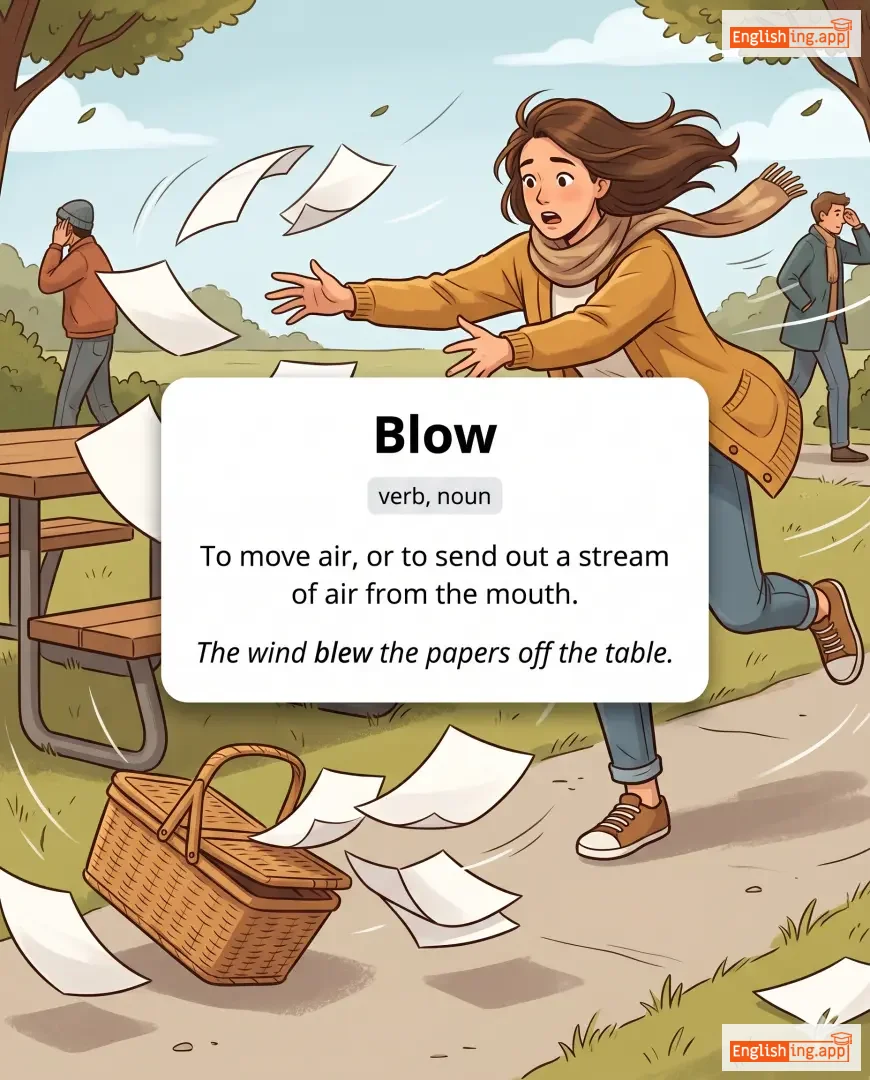
Blow definition card — visual illustration of the meaning
verb, noun
/bloʊ/
吹 / 打 (chui / da)

To move air, or to send out a stream of air from the mouth.

"The wind blew the papers off the table."

"风把纸吹离桌子。" (Feng ba zhi chui li zhuozi.)
phrasal verb
/bloʊ aʊt/
吹灭 (chuimie)

to extinguish by blowing; to fail suddenly or burst; to expand or exceed limits dramatically

"She blew out the candles on her birthday cake."

"她吹灭了生日蛋糕上的蜡烛。" (ta chuimie le shengri dangao shang de lazhu)
noun
/ˈbloʊˌhɑrd/
自负的人 (zifu de ren)

a person who brags a lot or talks in a boastful way

"Everyone avoided the blowhard at the party because he wouldn't stop bragging."

"在派对上,大家都避开了那个自负的人,因为他不停地吹嘘。" (Zai paidui shang, dada dou bikaile nage zifu de ren, yinwei ta buting de chui xu.)
verb
/ˈblʌdʒən/
用重物打击 (yòng zhòngwù dǎjí)

to hit someone with a heavy object; to force someone into doing something

"The guard was bludgeoned by the attacker in the alley."

"警卫被小巷中的袭击者用重物打击。" (Jǐngwèi bèi xiàoxiàng zhōng de xíjī zhě yòng zhòngwù dǎjí.)
adjective
/bluː/
蓝色 (lanse)

the color of the clear sky; feeling sad or depressed

"She wore a bright blue dress to the party."

"她穿了一件亮蓝色的裙子参加聚会。" (Ta chuanle yijian liang lanse de qunzi canjia juhui.)
noun
/ˌbluː ˈblʌd/
蓝血 (lán xiě)

a person of noble birth; aristocrat

"She came from a family of blue-bloods with centuries of royal heritage."

"她来自一个拥有数百年王室遗产的蓝血家族。" (Tā láizì yīgè yǒngyǒu shù bǎi nián wángshì yíchǎn de lán xiě jiāzú.)
noun
/ˈbluː.ber.i/
蓝莓 (lanmei)

a small round blue fruit that grows on bushes

"She picked fresh blueberries for the pie."

"她为派对摘了新鲜的蓝莓。" (tā wèi pài duì zhāi le xīn xiān de lán méi)
blueprint definition card — visual illustration of the meaning
noun
/ˈbluːˌprɪnt/
蓝图 (lantu)

a detailed plan or design; a guide for making something

"The architect shared the blueprint of the new building with the team."

"建筑师与团队分享了新建筑的蓝图。" (Jiànzhú shī yǔ tuánduì fēnxiǎng le xīn jiànzhú de lántú.)
noun
/bluːz/
蓝调 (landiao)

a feeling of sadness; a style of music with melancholy themes

"Listening to blues music always calms him down."

"听蓝调音乐总是让他平静下来。" (Tīng lándiào yīnyuè zǒng shì ràng tā píngjìng xiàlái.)
🃏

bluff

verb
/blʌf/

to deceive someone by pretending to have strength, knowledge, or resources that one does not actually possess

"He tried to bluff his way into the exclusive club."

noun
/ˈblʌfər/
虚张声势的人 (xu zhang sheng shi de ren)

a person who pretends to be more confident, skilled, or knowledgeable than they really are; someone who deceives others by bluffing

"Everyone eventually realized that he was just a bluffer with no real experience."
"大家最终意识到他只是个虚张声势的人。" (da jia zui zhong yi shi dao ta zhi shi ge xu zhang sheng shi de ren)
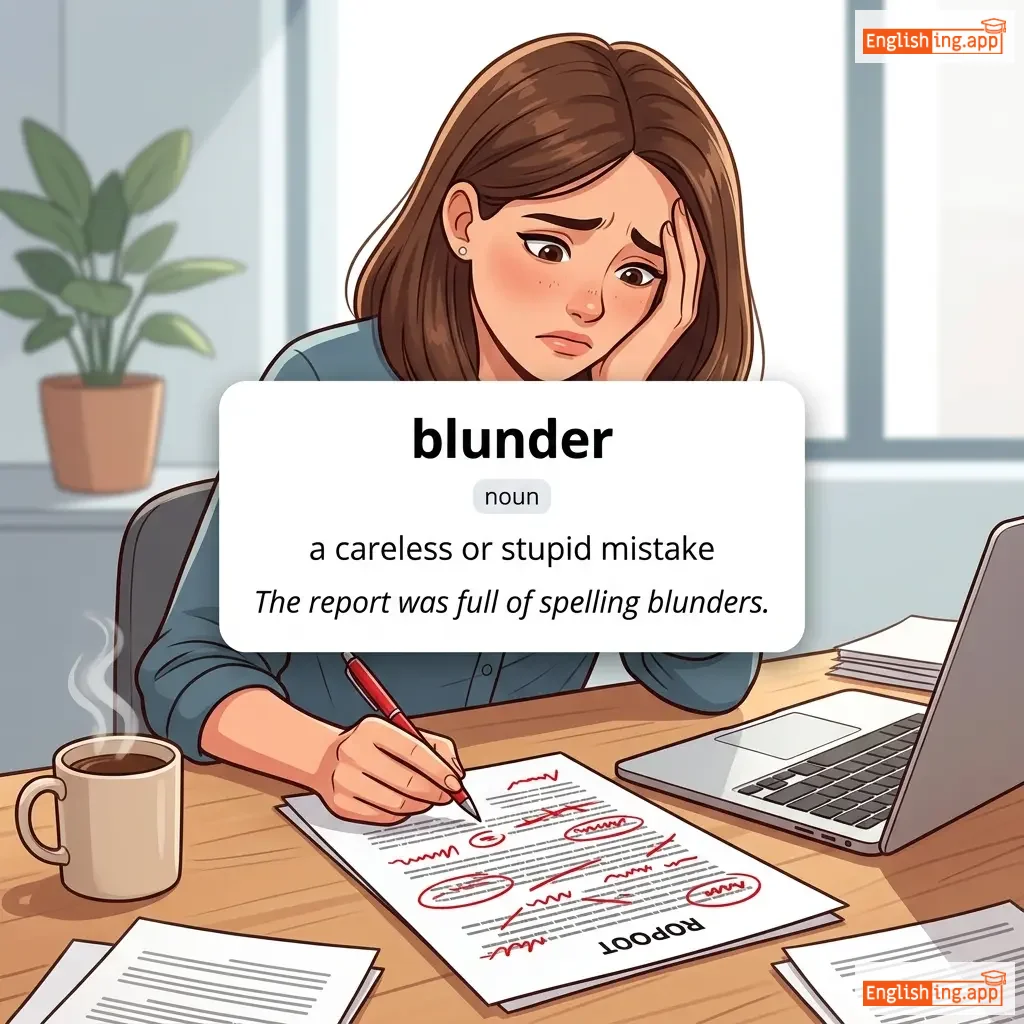
blunder definition card — visual illustration of the meaning
noun
/ˈblʌndər/
错误 (cuo wu)

a careless or stupid mistake

"The report was full of spelling blunders."

"报告里充满了拼写错误。" (Baogao li chongman le pinxie cuowu.)
adjective
/blʌnt/
钝的,直率的 (dùn de, zhí shuài de)

not sharp; direct and straightforward in speech

"Her blunt remarks offended some people."

"她直率的评论冒犯了某些人。" (Tā zhíshuài de pínglùn màofàn le mǒu xiē rén.)
adverb
/ˈblʌnt.li/
直言不讳; 直率地 (zhí yán bù huì; zhí shuài de)

in a direct way without trying to be polite; frankly

"He told her bluntly that she was wrong."

"他直接告诉她她错了。" (Tā zhíjiē gàosù tā tā cuòle.)
verb
/blɜːr/
模糊 (mohu)

to make something unclear or difficult to see

"Tears blurred her vision."

"眼泪模糊了她的视线。" (Yǎnlèi móhúle tā de shìxiàn.)
noun
/blɜːrb/
宣传描述 (xuānchuán miáoshù)

a short promotional description of a book, product, or service

"The back cover had a blurb praising the novel."

"封底有一段宣传描述,赞扬这本小说。" (fēng dǐ yǒu yī duàn xuānchuán miáoshù, zànyáng zhè běn xiǎoshuō.)
blurt definition card — visual illustration of the meaning
verb
/blɜːrt/
突然说出 (tūrán shuōchū)

to say something suddenly and without careful consideration

"He blurted out the secret before he could stop himself."

"他把秘密泄露出来了,在他能够停止之前。" (Tā bǎ mìmì xièlòu chūlái le, zài tā nénggòu tíngzhǐ zhīqián.)
verb
/blʌʃ/
脸红 (lian hong)

to become red in the face due to embarrassment or shyness

"She blushed when he complimented her."

"她在他夸奖她时脸红了。" (Ta zai ta kuajiang ta shi lian hong le.)
verb
/ˈblʌstər/
大声吹嘘 (dàshēng chuīxū)

to speak loudly in an aggressive or threatening way, often without real power

"The manager blustered about firing people but did nothing."
"经理大声吹嘘解雇人,但什么也没做。" (Jīnglǐ dàshēng chuīxū jiěgù rén, dàn shénme yě méi zuò.)
noun
/ˈboʊ.ə/
蟒蛇 (mǎng shé)

a large non-venomous snake that kills prey by constriction

"The boa constrictor wrapped around its prey."

"波阿蛇缠绕着它的猎物。" (bō ā shé chánrào zhe tā de lièwù)
📋

board

noun
/bɔːrd/

a flat, thin, rectangular piece of material such as wood; also a group of people managing an organization

"The board decided to increase the budget."

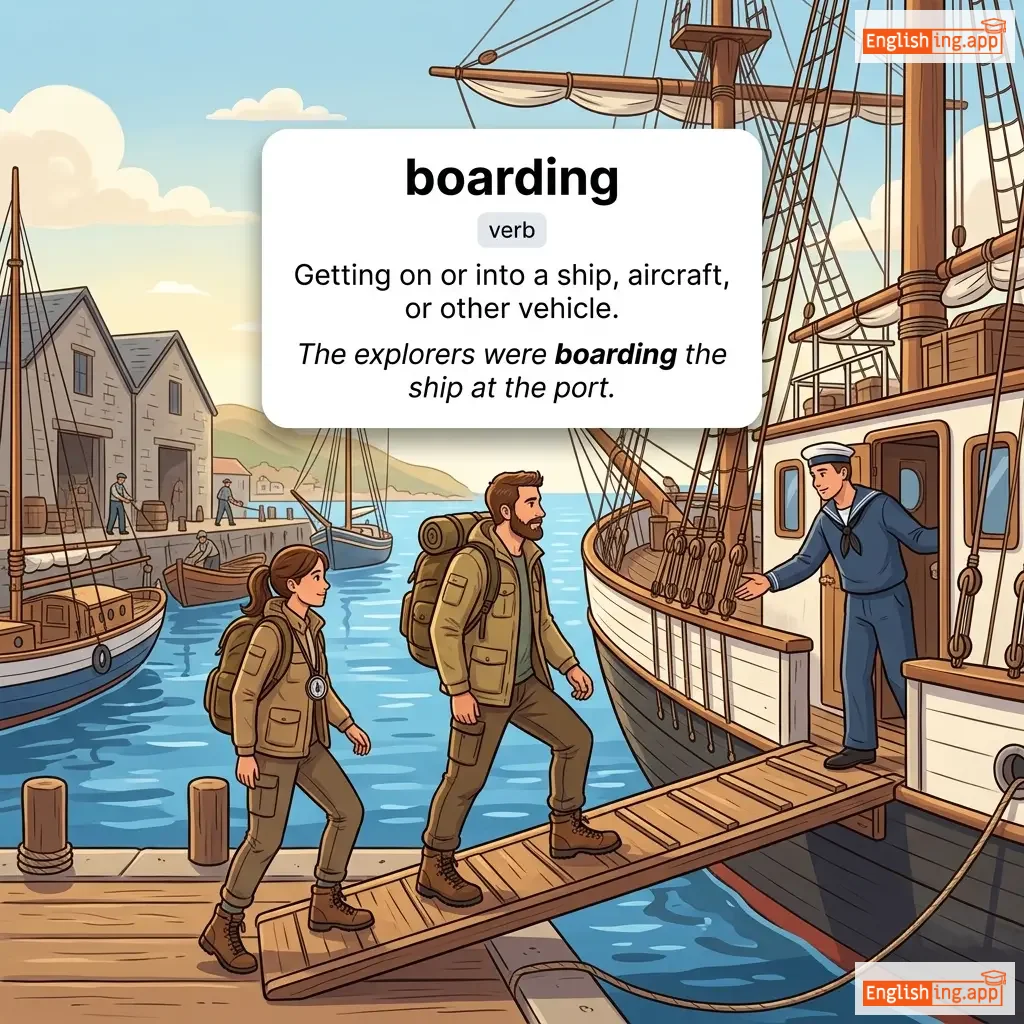
boarding definition card — visual illustration of the meaning
verb
/ˈbɔːrdɪŋ/
登机 (dēng jī)

Getting on or into a ship, aircraft, or other vehicle.

"The explorers were boarding the ship at the port."

"探险者们正在港口登船。" (Tànxiǎn zhěmen zhèngzài gǎngkǒu dēng chuán.)
Boast definition card — visual illustration of the meaning
verb
/boʊst/
炫耀 (xuànyào)

to talk with pride about something you have or achieved

"He boasted about his new car."

"他炫耀他的新车。" (Tā xuànyào tā de xīn chē.)
noun
/boʊt/
(chuan)

a small vessel used for traveling on water

"They took a boat across the river."

"他们坐船穿过了河。" (Tāmen zuò chuán chuānguòle hé.)
noun
/ˈboʊsən/
甲板长 (jiǎbǎn zhǎng)

a ship's officer in charge of equipment and the crew

"The boatswain supervised the sailors on deck."

"波茨温监督甲板上的水手。" (Bōcí wēn jiāndū jiǎbǎn shàng de shuǐshǒu.)
noun, verb
/bɒb/
上下摆动 (shangxia baidong)

a short sudden movement up and down; to move quickly up and down

"The small boat began to bob on the waves."

"小船开始在波浪上上下摆动。" (Xiaochuan kaishi zai bolang shang shangxia baidong)
verb
/boʊd/
预兆 (yuzhao)

to be an omen of a particular outcome, often something bad

"The dark clouds bode a heavy storm."

"黑云预示着一场大风暴。" (Hei yun yuzhao zhe yi chang da fengbao.)
noun
/ˈbɒdɪs/
束身衣 (shùshēn yī)

the part of a woman's dress that covers the body from the neck to the waist

"She wore a dress with an embroidered bodice."

"她穿了一件带有刺绣束身衣的裙子。" (tā chuānle yī jiàn dàiyǒu cìxiù shùshēn yī de qúnzi.)
adjective
/ˈbɒdɪli/
身体的 (shen tǐ de)

relating to or concerning the body

"He suffered bodily harm in the accident."

"他在事故中受到了身体伤害。" (Tā zài shìgù zhōng shòudào le shēntǐ shānghài.)