词汇表

英语词汇词典 | 单词含义、定义和示例

adjective
/əˈkjuː.zəˌtɔːr.i/
指责的 (zhǐzé de)

Suggesting blame or indicating someone has done wrong.

"He gave her an accusatory glance."

"他投给她一个指责的眼神。" (Tā tóu gěi tā yí gè zhǐzé de yǎnshén.)
accuse definition card — visual illustration of the meaning
verb
/əˈkjuːz/

To say that someone has done something wrong or illegal.

"They accused him of lying during the meeting."

noun
/əˈkjuːzd/
被告 (beigao)

a person who has been charged with a crime

"The accused pleaded not guilty in court."

"被告在法庭上表示无罪。" (Beigao zai fating shang biaoshi wuzui.)
verb
/əˈkʌstəm/
习惯 (xíguàn)

to make someone familiar with something through regular experience or use

"It took him a while to accustom himself to the new environment."

"他花了一些时间来适应新的环境。" (Tā huāle yīxiē shíjiān lái shìyìng xīn de huánjìng.)
🚫👤

acephalous

adjective
/eɪˈsɛfələs/

having no leader or head; headless

"The acephalous group soon fell into disorganization."

adjective
/əˈsɜːrbɪk/
尖刻的 (jiān kè de)

sharp, harsh, or bitter in tone or taste

"His acerbic comments offended many people in the meeting."

"他的尖刻评论冒犯了会议中的许多人。" (Tā de jiān kè píng lùn mào fàn le huì yì zhōng de xǔ duō rén.)
noun
/əˈsɜːrbəti/
尖刻 (jian ke)

bitterness or sharpness of tone, manner, or taste

"The acerbity of his remarks left everyone silent."

"他评论的尖刻让所有人都沉默了。" (Tā pínglùn de jiānkè ràng suǒyǒu rén dōu chénmòle.)
noun
/ˈæsɪˌteɪt/
醋酸盐 (cùsuānyán)

a salt or ester of acetic acid; a synthetic material used in textiles and film

"The company produces acetate fibers for clothing."

"该公司生产用于服装的醋酸纤维。" (Gāi gōngsī shēngchǎn yòng yú fúzhuāng de cùsuāng xiānwéi.)
adjective
/əˈsiːtɪk/
醋酸的 (cù suān de)

relating to or containing acetic acid; sour or vinegary in taste or smell

"The acetic smell of vinegar filled the kitchen."

"醋的醋酸味充满了厨房。" (Cù de cù suān wèi chōngmǎnle chúfáng.)
verb
/eɪk/
疼痛 (téngtòng)

to suffer a continuous dull pain

"Her back ached after sitting for so long."

"她坐了这么久后,背部感到疼痛。" (Tā zuòle zhème jiǔ hòu, bèibù gǎndào téngtòng.)
achievable definition card — visual illustration of the meaning
adjective
/əˈtʃiːvəbl/
可实现的 (ke shixian de)

Able to be brought about or reached successfully.

"Start with achievable steps to stay motivated."

"从可实现的步骤开始,以保持动力。" (Cong ke shixian de buzhou kaishi, yi baochi dongli.)
verb
/əˈtʃiːv/
实现 (shixian)

to successfully bring about or reach a desired goal or result

"She worked hard to achieve her dream of becoming a doctor."

"她为实现成为医生的梦想而努力工作。" (Ta wei shixian chengwei yisheng de mengxiang er nuli gongzuo.)
noun
/əˈtʃiːvmənt/
成就 (chéngjiù)

Something that has been successfully completed or accomplished through effort or skill.

"Graduating from university was her greatest achievement."

"大学毕业是她最大的成就。" (Dàxué bìyè shì tā zuìdà de chéngjiù.)
adjective
/əˈkɪliən/
阿基里斯式 (ajilisi shi)

like or characteristic of Achilles; strong but vulnerable

"His achillean pride made him blind to danger."

"他的阿基里斯式骄傲让他对危险视而不见。" (Tā de ājīlìsī shì jiāo'ào ràng tā duì wēixiǎn shì ér bù jiàn.)
adjective
/ˌækrəˈmætɪk/
无色的 (wúsè de)

without color; free from color

"The designer chose an achromatic palette of black, white, and gray."
"设计师选择了黑色、白色和灰色的无色调色板。" (shèjì shī xuǎnzéle hēisè, báisè hé huīsè de wúsè tiáosèbǎn.)
noun
/ˈæsɪd/
(suan)

a chemical substance that reacts with bases and has a sour taste

"Lemons contain citric acid."

"柠檬含有柠檬酸。" (níngméng hányǒu níngméngsuān.)
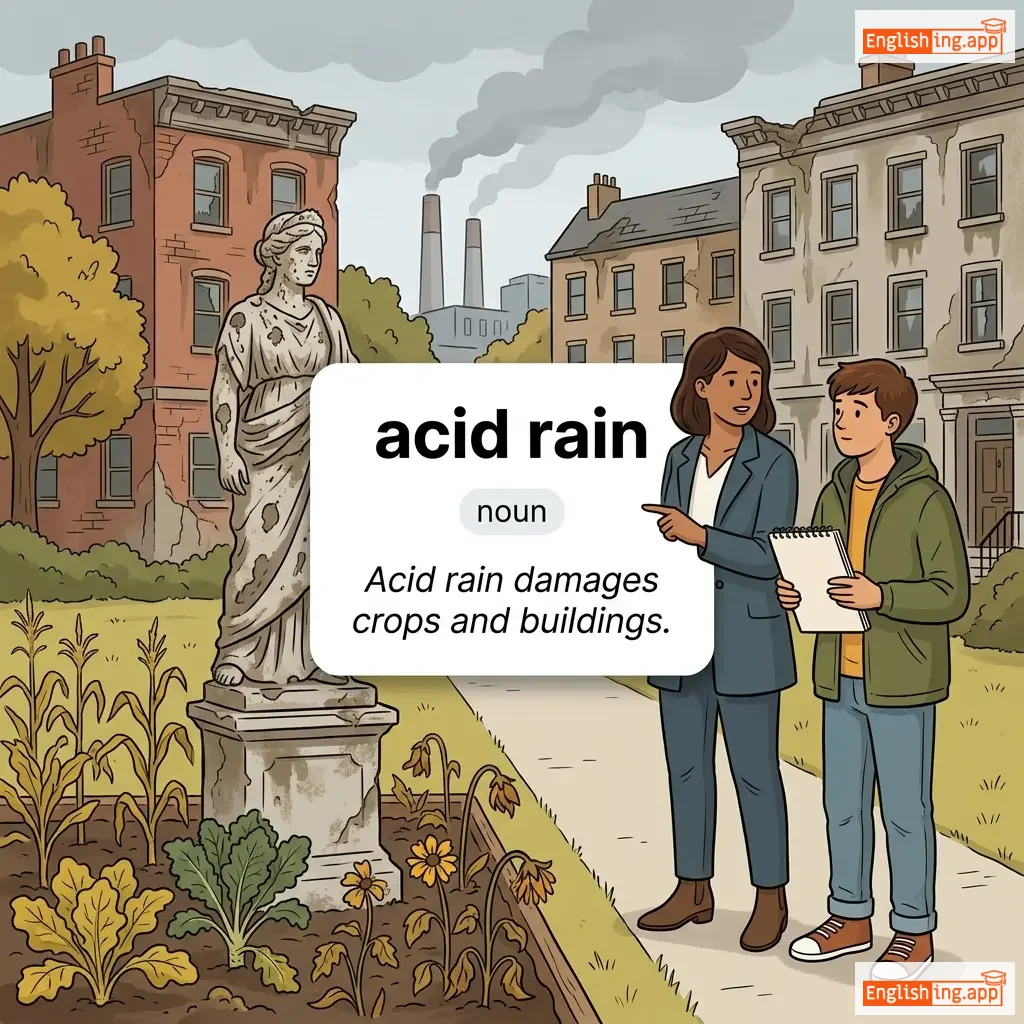
acid rain definition card — visual illustration of the meaning
noun
ˈæsɪd reɪn
酸雨 (suan yu)

Rainfall made acidic by atmospheric pollution, especially from industrial emissions.

"Acid rain damages crops and buildings."

"酸雨损害农作物和建筑物。" (Suan yu sunhai nongzuowu he jianzhu wu.)
adjective
/əˈsɪdɪk/
酸性的 (suanxing de)

containing acid; having a sour taste; sharp or biting in tone

"The lemon has an acidic taste that makes your mouth pucker."

"柠檬的味道很酸。" (ningmeng de weidao hen suan)
verb
/əˈsɪdɪfaɪ/
酸化 (suān huà)

to make something acidic or more acidic

"Farmers worry that pollution will acidify the soil."

"农民担心污染会使土壤酸化。" (Nóngmín dānxīn wūrǎn huì shǐ tǔrǎng suān huà.)
noun
/əˈsɪdɪti/
酸度 (suan du)

the quality or degree of being acidic; the amount of acid present in a substance

"The acidity of the soil affects how well crops grow."

"土壤的酸度会影响作物的生长。" (tu rang de suan du hui ying xiang zuo wu de sheng zhang)
adjective
/əˈsɪdjʊləs/
略带酸味或尖锐 (lue dai suan wei huo jianrui)

slightly sour or sharp in taste or manner

"The critic wrote an acidulous review of the movie."

"评论家写了一篇尖锐的电影评论。" (Pínglùn jiā xiěle yī piān jiānruì de diànyǐng pínglùn.)
verb
/əkˈnɒlɪdʒ/
承认 (chengren)

to accept, admit, or recognize the truth or existence of something

"She refused to acknowledge her mistake."

"她拒绝承认她的错误。" (Ta jujue chengren ta de cuowu.)
noun
/əkˈnɒlɪdʒmənt/
确认 (queren)

the act of recognizing or accepting something as true or valid; an expression of gratitude or recognition

"She received an acknowledgement for her contribution to the project."

"她因对该项目的贡献而获得确认。" (ta yin dui gai xiangmu de gongxian er huode queren)
noun
/əkˈnɒlɪdʒmənt/
承认 (chengren)

the act of accepting, admitting, or recognizing something

"He received an acknowledgment of his application."

"他收到了他申请的承认。" (Ta shoudao le ta shenqing de chengren.)
noun
/ˈækmi/
顶点 (dingdian)

the highest point of achievement or excellence

"Winning the award was the acme of his career."

"赢得奖项是他事业的顶点。" (Yingde jiangxiang shi ta shiyede dingdian.)
noun
/ˈækni/
痤疮 (cuo chuang)

a skin condition in which pores become inflamed and clogged, causing pimples and spots

"Regular cleansing and a balanced diet can help reduce acne."

"定期清洁和均衡饮食可以帮助减少痤疮。" (Dìngqī qīngjié hé jūnhéng yǐnshí kěyǐ bāngzhù jiǎnshǎo cuòchuāng.)
🕯️

acolyte

noun
/ˈækəlaɪt/

a follower or assistant, especially in a religious service or as a devoted supporter of a leader

"The senator arrived with a small group of acolytes who handled the press."

adjective
/əˈkuːstɪk/

relating to sound or the sense of hearing; not amplified by electrical means

"We recorded an acoustic version of the song in a quiet room."

noun
/əˈkuːstɪks/
声学 (shengxue)

the science of sound, or the properties of a space that affect how sound is heard

"The hall’s excellent acoustics made the orchestra sound rich and clear."

"大厅的优良声学效果让管弦乐团的声音丰富而清晰。" (Dating de youliang shengxue xiaoguo rang guanxianyue tuan de shengyin fengfu er qingxi.)
verb
/əˈkweɪnt/
使熟悉 (shi shuxi)

to make someone familiar with something; to inform or introduce

"Please acquaint yourself with the safety guidelines before operating the machine."

"请在操作机器前,熟悉安全指导原则。" (Qǐng zài cāozuò jīqì qián, shúxī ānquán zhǐdǎo yuánzé.)
verb
/ˌækwiˈɛs/
默许 (mòxǔ)

to accept something reluctantly but without protest

"She decided to acquiesce to her parents’ wishes."

"她决定默许父母的愿望。" (Tā juédìng mòxǔ fùmǔ de yuànwàng.)
acquiescence definition card — visual illustration of the meaning
noun
/ˌækwiˈɛsəns/
默许 (mòxǔ)

the reluctant acceptance of something without protest

"His nod was a sign of acquiescence."

"他的点头是默许的标志。" (Tā de diǎntóu shì mòxǔ de biāozhì.)
adjective
/ˌækwiˈɛsənt/
默许的 (mòxǔ de)

ready to accept something without protest, or to do what someone else wants

"He gave an acquiescent smile and agreed to the plan."

"他露出了一个默许的微笑,同意了这个计划。" (Tā lùchūle yīgè mòxǔ de wéixiào, tóngyìle zhège jìhuà.)
acquire definition card — visual illustration of the meaning
verb
/əˈkwaɪər/
获得 (huòdé)

to obtain or gain possession of something

"She managed to acquire a rare painting at the auction."

"她成功地在拍卖会上获得了一幅稀有的画作。" (Tā chénggōng de zài pāimài huì shàng huòdéle yī fú xīyǒu de huàzuò.)
noun
/əˈkwaɪərmənt/
获得;习得的能力 (huode; xide de nengli)

the act of acquiring something; something that has been acquired, especially a skill or possession

"Language proficiency is an important acquirement for global careers."

"语言能力是全球职业中的一项重要获得。" (Yuyan nengli shi quanqiu zhiye zhong de yi xiang zhongyao huode)
Acquisition definition card — visual illustration of the meaning
noun
/ˌækwɪˈzɪʃən/

the act of obtaining or gaining something, often knowledge, skills, or property

"The company announced the acquisition of a smaller competitor."

adjective
/əˈkwɪzətɪv/

excessively interested in acquiring money or material things

"The acquisitive businessman bought every piece of land he could find."

verb
/əˈkwɪt/
宣判无罪 (xuānpàn wúzuì)

to free someone from a criminal charge by a verdict of not guilty

"The court decided to acquit the defendant of all charges."

"法院决定将被告从所有指控中宣判无罪。" (fǎyuàn juédìng jiāng bèigào cóng suǒyǒu zhǐkòng zhōng xuānpàn wúzuì.)
noun
/əˈkwɪtl/

a judgment that a person is not guilty of the crime with which they have been charged

"The acquittal of the accused shocked the public."

noun
/əˈkwɪtəns/
收据 (shōujù)

a written receipt acknowledging payment or discharge of a debt

"He demanded an acquittance after paying the loan."

"他要求在支付贷款后获得一张收据。" (Tā yāoqiú zài zhīfù dàikuǎn hòu huòqǔ yī zhāng shōujù.)
🌾

acre

noun
/ˈeɪkər/

a unit of land area equal to 4,840 square yards (about 4,047 square meters)

"The farmer owns five acres of fertile land."

noun
/ˈeɪ.kər.ɪdʒ/
英亩 (ying mu)

An area of land measured in acres.

"The farmer owns a large acreage of fertile land."

"农民拥有一大片肥沃的英亩土地。" (Nongmin yongyou yi dapian feiwo de yingmu tudi.)
🌫️

Acrid

adjective
/ˈæk.rɪd/

Having a strong, unpleasantly sharp taste or smell.

"The acrid smoke from the fire made it hard to breathe."

adjective
/ˌæk.rɪˈmoʊ.ni.əs/
尖刻和愤怒 (jian ke he fen nu)

Bitter and angry, often involving harsh words.

"The debate turned acrimonious after the controversial remark."

"辩论在争议性评论后变得尖刻。" (Bian lun zai zheng yi xing ping lun hou bian de jian ke.)
noun
/ˈæk.rɪ.moʊ.ni/

Bitterness and anger, especially in speech or behavior.

"The divorce was filled with acrimony and disputes."

noun
/ˌæk.rəˈfoʊ.bi.ə/
对高度的恐惧 (duì gāodù de kǒngjù)

An extreme or irrational fear of heights.

"Her acrophobia prevented her from climbing the tall building."

"她的恐高症阻止她爬上高楼。" (Tā de kǒnggāozhèng zǔzhǐ tā pá shàng gāo lóu.)
preposition/adverb
/əˈkrɒs/
穿越 (chuan yue)

From one side to the other side of something.

"He ran across the street to catch the bus."

"他跑过马路去赶公交车。" (Ta pao guo malu qu gan gongjiaoche.)
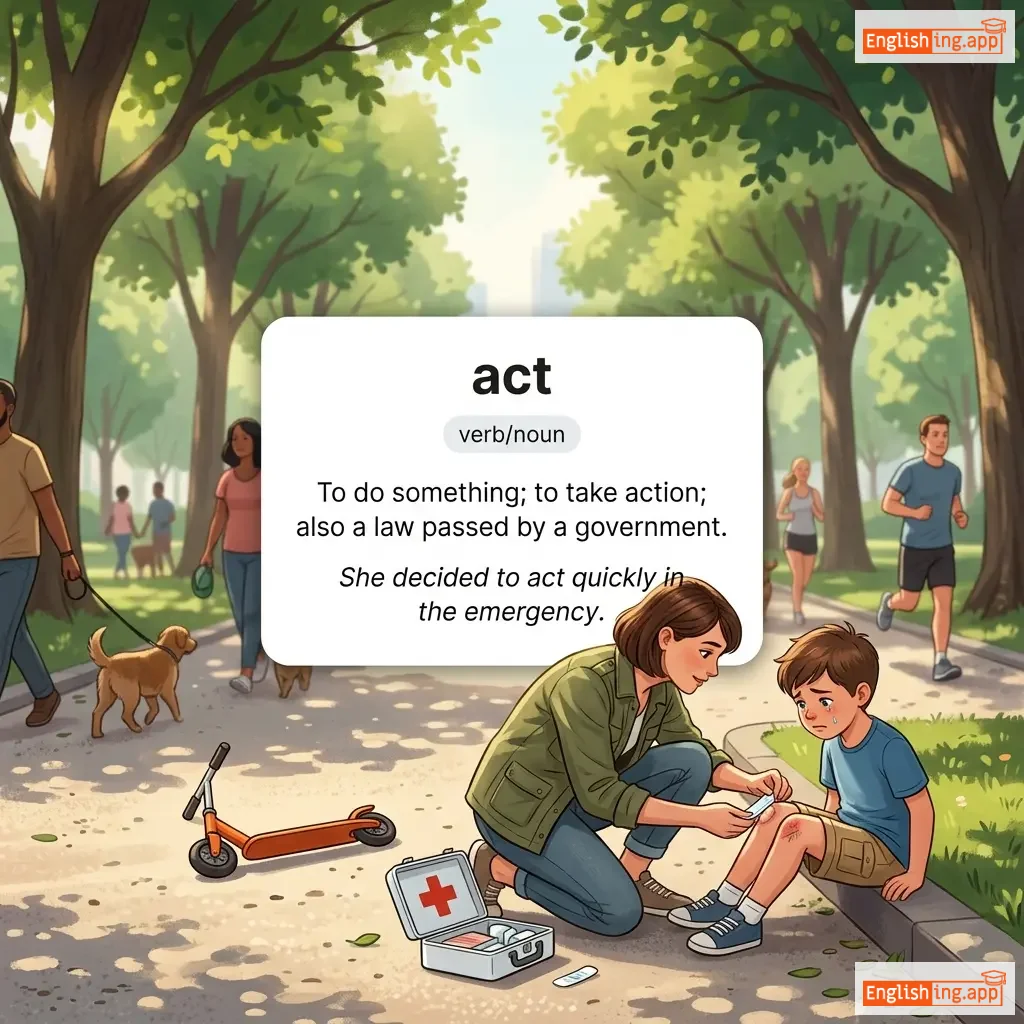
act definition card — visual illustration of the meaning
🎭

act

verb/noun
/ækt/

To do something; to take action; also a law passed by a government.

"She decided to act quickly in the emergency."

noun, adjective, gerund
/ˈæk.tɪŋ/
表演 (biaoyan)

the art or profession of performing in plays, films, or television; temporary performance of duties; the process of performing an action

"She is studying acting to become a professional actress."

"她正在学习表演,想成为一名专业演员。" (ta zhengzai xuexi biaoyan xiang chengwei yi ming zhuanye yanyuan)
noun
/ˈækʃən/
行动 (xingdong)

The process of doing something, typically to achieve a goal.

"The government took immediate action to control inflation."

"政府采取了立即行动以控制通货膨胀。" (Zhengfu caiqu le lijixingdong yi kongzhi tonghuopengzhang.)