词汇表

英语词汇词典 | 单词含义、定义和示例

noun
/əˈsɛnʃən/
上升 (shangsheng)

The act of rising or going up, often to an important position or a higher place.

"His rapid ascension in the company surprised everyone."

"他在公司的迅速上升让每个人都感到惊讶。" (Ta zai gongsi de xunxu shangsheng rang meige ren dou gandao jingya.)
noun
/əˈsɛnt/

The act of rising or climbing to a higher position or level.

"The climbers began their ascent to the mountain peak at dawn."

ascertain definition card — visual illustration of the meaning
verb
/ˌæs.ərˈteɪn/
查明, 确定 (chá míng, què dìng)

To find out or make sure of something with certainty.

"The detective tried to ascertain the facts of the case."

"侦探试图查明案件的事实。" (Zhēntàn shìtú chá míng ànjiàn de shìshí.)
ascetic definition card — visual illustration of the meaning
adjective
/əˈsɛt.ɪk/
苦行 (kǔ xíng)

Practicing strict self-denial and abstaining from worldly pleasures, often for religious reasons.

"He lived an ascetic life in the mountains, far from worldly comforts."

"他在山区过着苦行生活,远离世俗的安逸。" (Tā zài shānqū guòzhe kǔ xíng shēnghuó, yuǎnlí shìsú de ānyì.)
noun
/əˈsɛt.ɪˌsɪz.əm/
禁欲主义, 自律 (jìnyù zhǔyì, zìlǜ)

The practice of severe self-discipline and abstaining from indulgence, typically for religious or spiritual reasons.

"Asceticism has been a part of many religious traditions throughout history."

"禁欲主义是许多宗教传统的一部分,贯穿历史。" (Jìnyù zhǔyì shì xǔduō zōngjiào chuántǒng de yī bùfen, guànchuān lìshǐ.)
verb
/əˈskraɪb/
归因于,归咎于 (guī yīn yú, guī jiù yú)

To attribute something to a cause, source, or person.

"Many scholars ascribe the poem to an unknown author."

"许多学者将这首诗归功于一位无名作者。" (Xǔduō xuézhě jiāng zhè shǒu shī guīgōng yú yī wèi wúmíng zuòzhě.)
adjective
/eɪˈsɛptɪk/
无菌的 (wú jūn de)

Free from contamination caused by harmful microorganisms; sterile.

"Surgeons must work in an aseptic environment to prevent infection."

"外科医生必须在无菌环境中工作,以防止感染。" (Wàikē yīshēng bìxū zài wú jūn huánjìng zhōng gōngzuò, yǐ fángzhǐ gǎnrǎn.)
adjective
/ˌeɪˈsɛkʃuəl/
无性 (wuxing)

Without sexual feelings, associations, or reproduction through sex.

"Many plants reproduce through asexual methods like budding or splitting."

"许多植物通过无性繁殖方式,如发芽或分裂,进行繁殖。" (Xu duo zhiwu tongguo wuxing fanzhi fangshi, ru faya huo fenlie, jinxing fanzhi.)
noun
/æʃ/
灰烬 (huī jìn)

the powdery residue left after the burning of a substance

"After the fire, only ash remained of the house."

"火灾过后,只有房子的灰烬留下。" (huǒzāi guò hòu, zhǐ yǒu fángzi de huī jìn liúxià.)
noun
/ˈæʃ.treɪ/
烟灰缸 (yānhuī gāng)

a receptacle for tobacco ash and cigarette butts

"Please use the ash tray for your cigarette."

"请使用烟灰缸放你的香烟。" (qǐng shǐyòng yānhuī gāng fàng nǐ de xiāngyān.)
adjective
/æʃ ˈkʌl.ər/
灰色 (huī sè)

a grayish color resembling ash

"The old building had ash-colour walls that needed painting."

"这座旧建筑有灰色的墙壁,需要重新粉刷。" (Zhè zuò jiù jiànzhú yǒu huīsè de qiángbì, xūyào chóngxīn fěnshuā)
adjective
/əˈʃeɪmd/
羞愧 (xiūkuì)

feeling embarrassed or guilty because of one's actions

"He was ashamed of his poor performance."

"他为自己的糟糕表现感到羞愧。" (Tā wèi zìjǐ de zāogāo biǎoxiàn gǎndào xiūkuì.)
adjective
/ˈæʃən/
苍白的 (cāngbái de)

Very pale in appearance, often due to shock, fear, or illness.

"His face turned ashen when he heard the terrible news."

"当他听到可怕的消息时,他的脸变得苍白。" (Dāng tā tīng dào kěpà de xiāoxī shí, tā de liǎn biàn dé cāngbái.)
adjective, noun
/ˈeɪʒən/
亚洲的 (yazhou de)

relating to Asia or its people

"She loves Asian culture."

"她喜欢亚洲文化。" (Tā xǐhuān Yàzhōu wénhuà.)
noun
/ˈeɪʒən siː bæs/
亚洲鲈鱼 (yazhou luyu)

a large predatory fish found in coastal waters and estuaries of the Indo-Pacific region, prized for its white meat

"Asian sea bass is highly valued in aquaculture for its fast growth."

"亚洲鲈鱼因其快速生长而在水产养殖中备受重视。" (yazhou luyu yin qi kuaisu shengzhang er zai shuichan yangzhi zhong beishou zhongshi)
noun
/ˈeɪʒən swɒmp iːl/
亚洲沼泽鳗 (yazhou zhaoze man)

a snake-like freshwater fish that can survive in muddy waters and is considered a delicacy in South Asian cuisine

"Asian swamp eel can breathe air and survive in shallow muddy waters."

"亚洲沼泽鳗能呼吸空气并在浑浊的浅水中生存。" (yazhou zhaoze man neng huxi kongqi bing zai hunzhuo de qianshui zhong shengcun)
adverb, noun
/əˈsaɪd/
一边 (yī biān)

to or on one side; a remark not intended for everyone

"He stepped aside to let her pass."

"他让到一边让她过去。" (Tā ràng dào yī biān ràng tā guòqù.)
adjective
/ˈæsɪnaɪn/
愚蠢的 (yúchǔn de)

Extremely foolish or stupid.

"It was an asinine idea to drive into the storm without checking the weather."

"在没有检查天气的情况下开车进入暴风雨是一个愚蠢的主意。" (Zài méiyǒu jiǎnchá tiānqì de qíngkuàng xià kāichē jìnrù bàofēngyǔ shì yīgè yúchǔn de zhǔyì.)
verb
/æsk/
询问 (xunwen)

to request information or seek an answer

"She asked him about his new job."

"她问他关于新工作的事情。" (Ta wen ta guanyu xin gongzuo de shiqing.)
adverb
/əˈskæns/
怀疑地 (huáiyí de)

With suspicion, mistrust, or disapproval.

"She looked askance at his unusual proposal."

"她怀疑地看着他的异常提案。" (Tā huáiyí de kànzhe tā de yìcháng tí'àn.)
adjective
/əˈskjuː/
歪斜 (wai xie)

Not in a straight or level position; crooked or tilted.

"The picture on the wall hung slightly askew."

"墙上的画稍微歪斜。" (Qiang shang de hua shaowei wai xie.)
adjective
/əˈsliːp/
熟睡 (shúshuì)

in a state of sleep

"The baby is fast asleep."

"宝宝正在熟睡。" (Bǎobǎo zhèngzài shúshuì.)
noun
/əˈspær.ə.ɡəs biːn/
芦笋豆 (lúsǔn dòu)

a long, thin green vegetable pod that grows on vines; also known as yard-long bean

"The asparagus bean grows up to three feet long and is commonly used in Asian cooking."

"芦笋豆可以长到三英尺长,并且常用于亚洲烹饪。" (lúsǔn dòu kěyǐ zhǎng dào sān yīngchǐ zhǎng, bìngqiě cháng yòng yú yàzhōu pēngrèn.)
noun
/ˈæs.pekt/
方面 (fāngmiàn)

A particular part, feature, or view of something.

"One important aspect of health is regular exercise."
"健康的一个重要方面是规律运动。" (Jiànkāng de yīgè zhòngyào fāngmiàn shì guīlǜ yùndòng.)
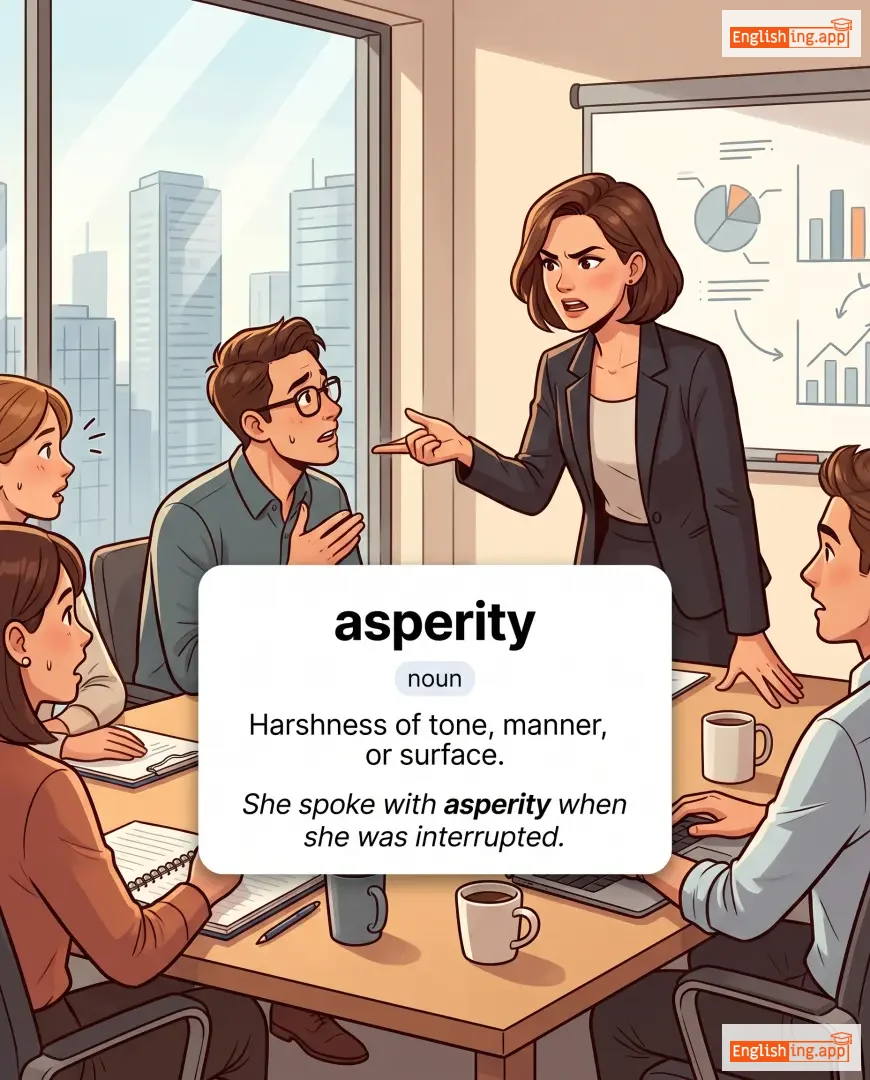
asperity definition card — visual illustration of the meaning
noun
/əˈsper.ɪ.ti/

Harshness of tone, manner, or surface.

"She spoke with asperity when she was interrupted."

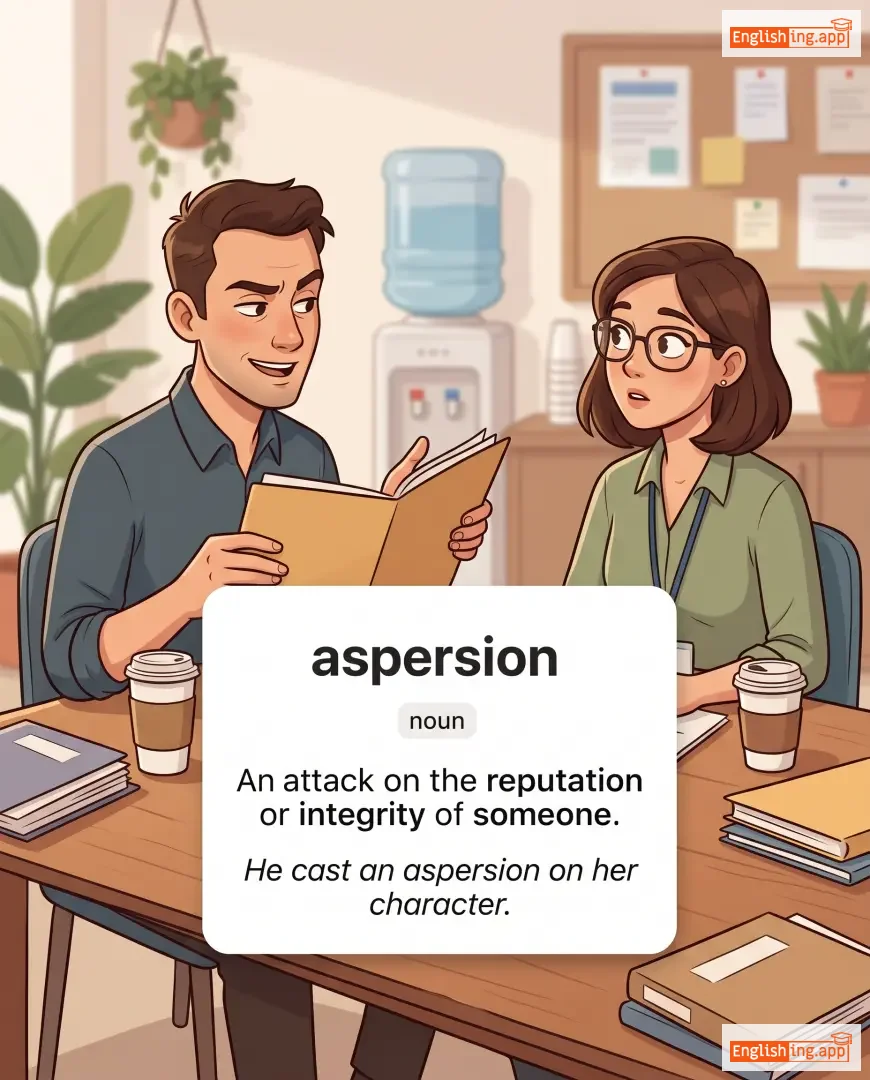
aspersion definition card — visual illustration of the meaning
noun
/əˈspɜːr.ʒən/
诽谤 (fěibàng)

An attack on the reputation or integrity of someone.

"He cast an aspersion on her character."

"他对她的性格进行了诽谤。" (Tā duì tā de xìnggé jìnxíngle fěibàng.)
noun (plural)
/əˈspɜːr.ʒənz/
诽谤 (feibang)

Critical or slanderous remarks; multiple attacks on reputation.

"The politician rejected the aspersions cast against him."

"政治家拒绝了针对他的诽谤。" (Zhèngzhìjiā jùjuéle zhèngduì tā de fěibàng.)
noun
/ˈæspɪrənt/
有志者 (you zhi zhe)

a person who seeks or hopes to achieve a position of honor or advancement

"She is an aspirant for the university's top scholarship."

"她是大学最高奖学金的有志者。" (Ta shi daxue zui gao jiangxuejin de you zhizhe.)
aspiration definition card — visual illustration of the meaning
noun
/ˌæspəˈreɪʃən/
抱负 (baofu)

a strong desire to achieve something; ambition

"Her aspiration is to become a doctor."

"她的抱负是成为一名医生。" (Ta de baofu shi chengwei yi ming yisheng.)
verb
/əˈspaɪər/
渴望 (kewang)

to have a strong desire to achieve something

"Many students aspire to study abroad."

"许多学生渴望去国外学习。" (Xuduo xuesheng kewang qu guowai xuexi.)
noun
/æs/
(lv)

a donkey; also an informal term for a foolish person or one's buttocks

"He acted like an ass during the meeting."

"他在会议上像驴一样表现。" (Ta zai huiyi shang xiang lv yi yang biaoxian.)
verb
/əˈseɪl/
攻击 (gōngjī)

to attack violently, either physically or with words

"The politician was assailed with difficult questions."

"政治家遭遇了困难的问题。" (Zhèngzhìjiā zāoyùle kùnnán de wèntí.)
noun
/əˈseɪlənt/
攻击者 (gongjizhe)

a person who attacks another

"The police arrested the assailant at the scene."

"警方在现场逮捕了攻击者。" (Jingfang zai xianchang daibu le gongjizhe.)
noun
/əˈsæsɪn/
刺客 (cike)

A person who kills someone, usually for political or religious reasons, often secretly.

"The assassin fled the scene after carrying out the attack."

"刺客在进行袭击后逃离了现场。" (Cike zai jinxing xiji hou taoli le xianchang.)
verb
/əˈsæsɪneɪt/
刺杀 (cìshā)

To murder someone important, often a political or religious leader, usually by surprise attack.

"The rebels planned to assassinate the king."

"反叛者计划刺杀国王。" (Fǎnbàn zhě jìhuà cìshā guówáng.)
noun
/əˌsæsɪˈneɪʃən/
刺杀 (cì shā)

The act of killing someone important, often for political or ideological reasons.

"The assassination of the president shocked the nation."

"总统的刺杀震惊了整个国家。" (Zǒngtǒng de cìshā zhènjīngle zhěnggè guójiā.)
noun, verb
/əˈsɔːlt/
攻击 (gōngjī)

a physical attack or to attack someone violently

"He was charged with assault after the fight."

"他在打斗后因袭击被指控。" (Tā zài dǎdòu hòu yīn xíjī bèi zhǐkòng.)
noun, verb
/ˈæseɪ/
分析 (fenxi)

To test or analyze the quality, purity, or content of a substance; the act of such testing.

"The scientists assayed the mineral sample for gold content."

"科学家们对矿石样本进行了金含量测试。" (Kexuejiamen dui kuangshi yangben jin xianliang ceshi.)
verb
/əˈsɛmbəl/
集合 (jíhé)

to gather or bring together in one place

"The students assembled in the hall for the meeting."

"学生们为了会议在大厅里集合。" (Xuéshēng men wèile huìyì zài dàtīng lǐ jíhé.)
noun
/əˈsɛmbli/
集会 (jihui)

a group of people gathered together for a common purpose or the act of putting parts together to form something

"The school held an assembly to discuss the new rules."

"学校举行了一个集会来讨论新的规则。" (Xuexiao juxingle yige jihui lai taolun xinde guize.)
assembly session definition card — visual illustration of the meaning
noun
/əˈsem.bli ˈseʃ.ən/
大会会议 (dahui huiyi)

A formal meeting where representatives gather to discuss and make decisions on important matters.

"The assembly session discussed global challenges."

"大会会议讨论了全球性挑战。" (Dahui huiyi tanshu le quanqiu xing tiaozhan.)
noun, verb
/əˈsɛnt/
同意 (tongyi)

To agree to something, especially after careful consideration; an expression of approval.

"She nodded her head in silent assent."
"她默默地点了点头。" (Tā mòmò de diǎnle diǎntóu.)
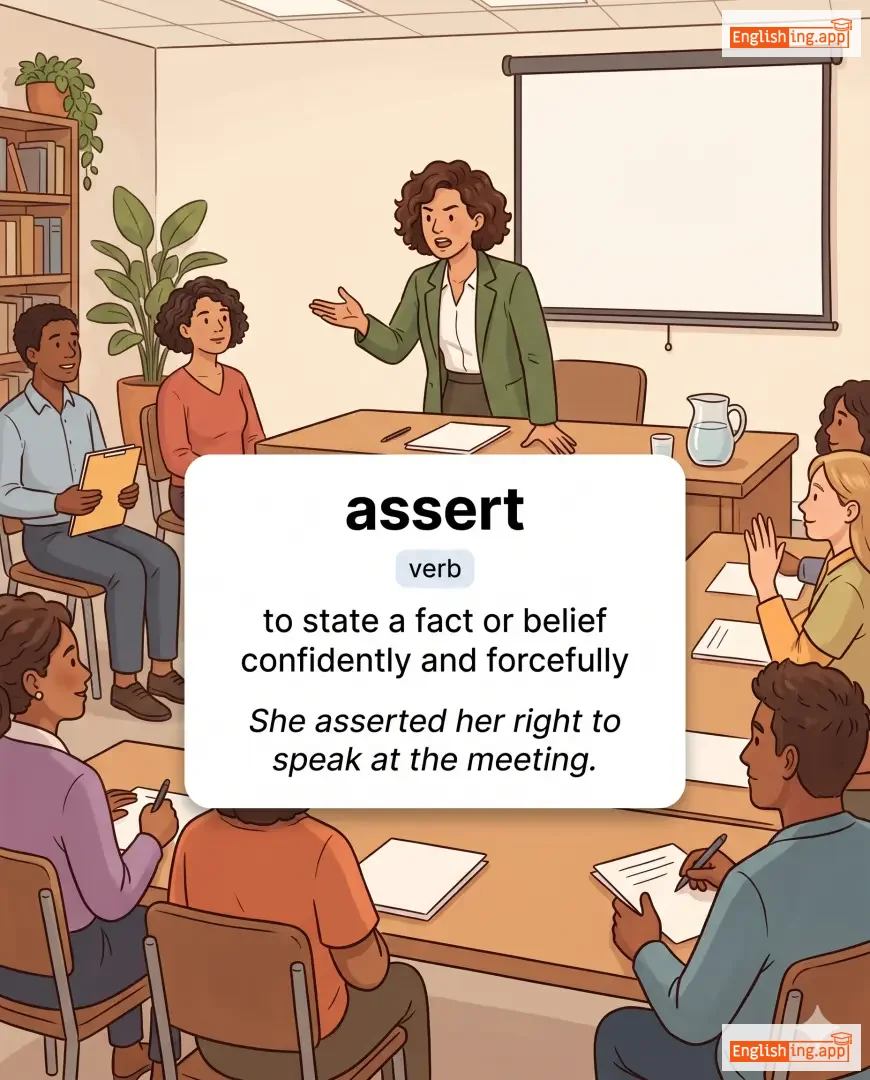
assert definition card — visual illustration of the meaning
verb
/əˈsɜːrt/
断言 (duàn yán)

to state a fact or belief confidently and forcefully

"She asserted her right to speak at the meeting."

"她在会议中坚决声明了自己发言的权利。" (Tā zài huì yì zhōng jiān jué shēng míng le zì jǐ fā yán de quán lì.)
noun
/əˈsɜːʃən/
断言 (duanyan)

a confident and forceful statement of fact or belief

"Her assertion that she was right was met with silence."

"她的断言她是对的遭遇了沉默。" (Ta de duanyan ta shi dui de zao yule chenmo.)
adjective
/əˈsɜːrtɪv/
自信的 (zixin de)

having or showing a confident and forceful personality

"He is very assertive in expressing his opinions."

"他在表达自己的意见时非常自信。" (Tā zài biǎodá zìjǐ de yìjiàn shí fēicháng zìxìn.)
verb
/əˈsɛs/
评估 (pinggu)

to evaluate or estimate the nature, ability, or quality of something

"The teacher assessed the students' progress."
"老师评估了学生的进展。" (Laoshi pinggu le xuesheng de jinzhang.)
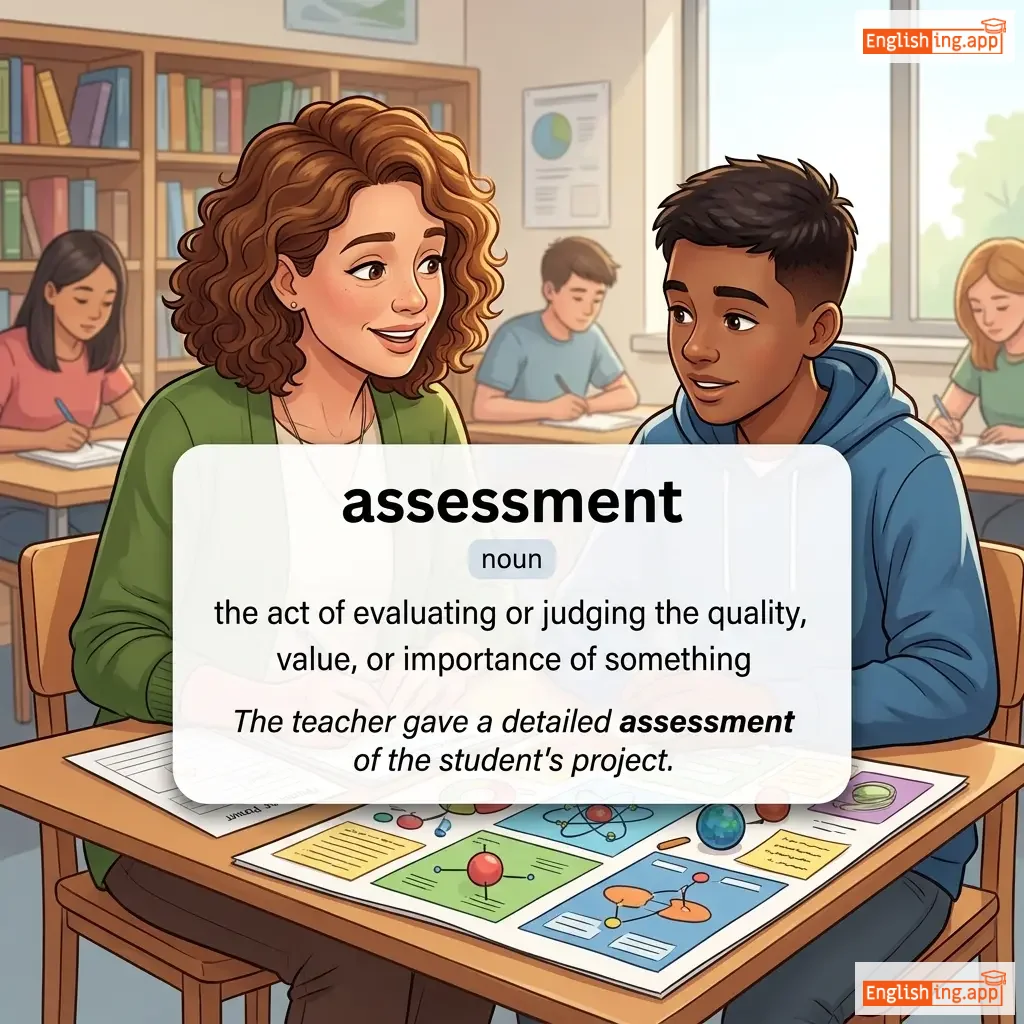
assessment definition card — visual illustration of the meaning
noun
/əˈsɛsmənt/
评估 (pinggu)

the act of evaluating or judging the quality, value, or importance of something

"The teacher gave a detailed assessment of the student's project."

"老师对学生的项目进行了详细评估。" (Laoshi dui xuesheng de xiangmu jinxing le xiangxi pinggu.)
noun
/əˈsɛsər/
评估员 (pinggu yuan)

a person who evaluates or estimates the nature, ability, or quality of something

"An external assessor reviewed the project report."

"一位外部评估员审查了项目报告。" (Yī wèi wàibù pínggūyuán shěnchále xiàngmù bàogào.)
asset definition card — visual illustration of the meaning
noun
/ˈæsɛt/
资产 (zīchǎn)

a valuable person, skill, or resource; something owned that has value

"Her communication skills are a great asset to the company."

"她的沟通技巧是公司的一大资产。" (Tā de gōutōng jìqiǎo shì gōngsī de yī dà zīchǎn.)
asset allocation definition card — visual illustration of the meaning
noun
ˈæ.sɛt ˌæl.əˈkeɪ.ʃən
资产配置 (zīchǎn pèizhì)

An investment strategy that aims to balance risk and reward by apportioning a portfolio's assets according to an individual's goals, risk tolerance, and investment horizon.

"Proper asset allocation is key to financial growth."

"正确的资产配置是财务增长的关键。" (Zhèngquè de zīchǎn pèizhì shì cáiwù zēngzhǎng de guānjiàn.)