語彙集

英単語辞書 | 単語の意味、定義、例文

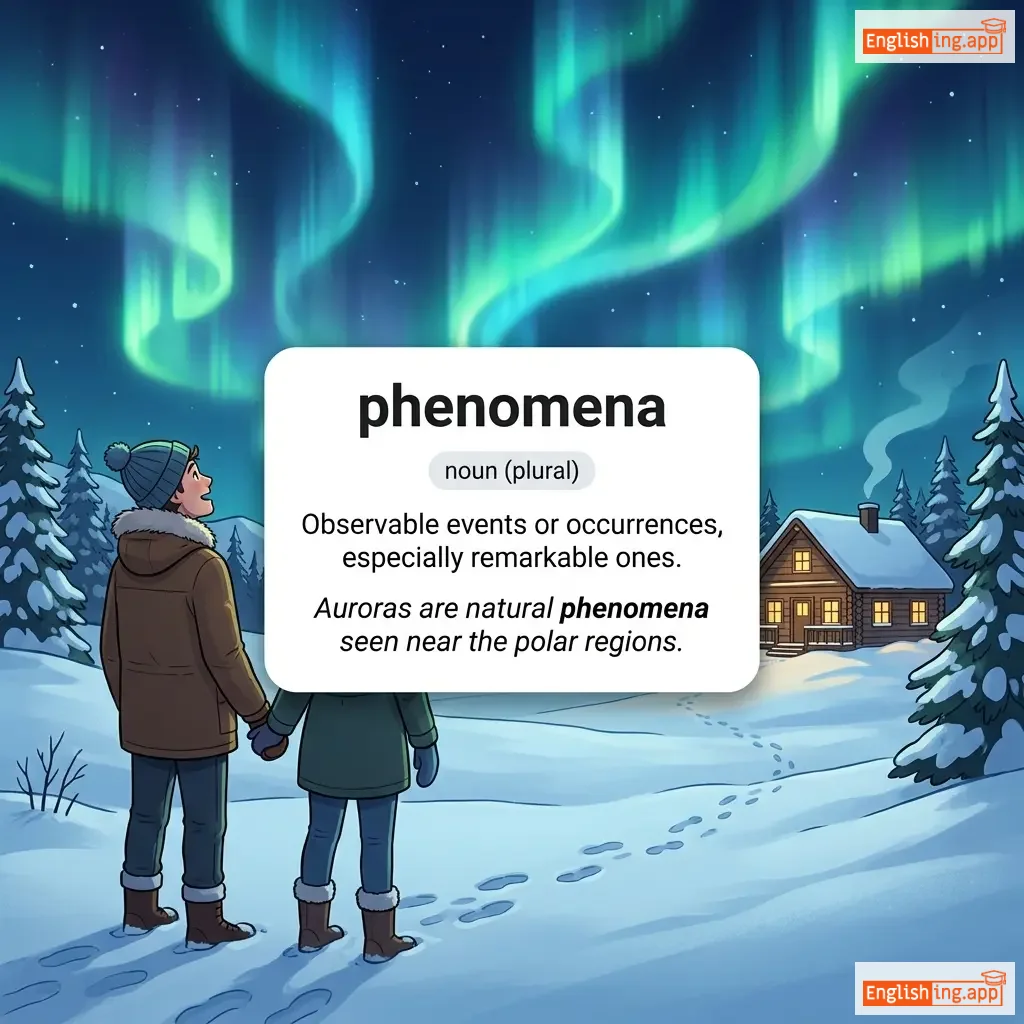
phenomena definition card — visual illustration of the meaning
noun (plural)
/fəˈnɒmɪnə/
現象 (genshō)

Observable events or occurrences, especially remarkable ones.

"Auroras are natural phenomena seen near the polar regions."

"オーロラは極地地域近くで見ることができる自然現象です。" (Ōrora wa kyokuchi chiiki chikaku de miru koto ga dekiru shizen genshō desu.)
adjective
/fəˈnɒmɪnəl/
非凡 (hiban)

extraordinary, remarkable, or exceptional in a way that is very impressive

"The team achieved phenomenal success in the tournament."

"チームはトーナメントで非凡な成功を収めました。" (Chīmu wa tōnamento de hiban na seikō o osamemashita.)
noun
/fəˈnɒmɪnən/
現象 (genshō)

an observable event, fact, or occurrence, often unusual or remarkable

"The Northern Lights are a natural phenomenon."

"オーロラは自然現象です。" (Ōrora wa shizen genshō desu.)
noun
/ˈfaɪəl/
小さなガラス瓶 (chiisana garasu bin)

a small glass container for liquids, especially medicines

"The doctor gave her a phial of medicine."

"医者は彼女に薬の小瓶を渡しました。" (Isha wa kanojo ni kusuri no kobin o watashimashita.)
verb
/fɪˈlændər/
浮気をする (uwaki o suru)

to engage in casual or frivolous romantic or sexual relationships

"He was known to philander with many women in town."

"彼は町で多くの女性と浮気をしていることで知られていた。" (Kare wa machi de ōku no josei to uwaki o shite iru koto de shirarete ita.)
noun
/fɪˈlændərər/
女たらし (otoko tarashi)

a man who habitually engages in casual romantic or sexual affairs

"The politician was exposed as a notorious philanderer."

"その政治家は有名な女たらしとして暴露されました。" (Sono seijika wa yūmei na otoko tarashi toshite bakuro saremashita.)
adjective
/ˌfɪl.ænˈθrɒp.ɪk/
博愛主義的な (hakuai shugi teki na)

showing concern for the welfare of others; generous and charitable

"She is known for her philanthropic activities in the city."

"彼女は街での博愛活動で知られています。" (Kanojo wa machi de no hakuai katsudō de shirareteimasu.)
noun
/fɪˈlæn.θrə.pɪst/
慈善家 (jizenka)

a person who seeks to promote the welfare of others, especially by donating money to good causes

"The philanthropist donated millions to build schools in rural areas."

"その慈善家は農村地域に学校を建てるために数百万ドルを寄付しました。" (Sono jizenka wa nōson chiiki ni gakkō o tateru tame ni sūhyaku man doru o kifu shimashita.)
noun
/fɪˈlæn.θrə.pi/
フィランソロピー (firanthoropī)

the desire to promote the welfare of others, often expressed by the generous donation of money to good causes

"Philanthropy has helped improve healthcare in many developing countries."

"フィランソロピーは多くの発展途上国で医療を改善するのに役立っています。" (Firanthoropī wa ōku no hatten to jōkoku de iryō o kaizen suru no ni yakudatteimasu.)
noun
/fɪˈlæt.əl.ɪst/
切手収集家 (kitte shūshūka)

a person who collects or studies postage stamps

"The philatelist spent years building a rare stamp collection."

"そのフィラテリストは、希少な切手コレクションを作るために何年も費やしました。" (Sono firaterisuto wa, kishōna kitte korekushon o tsukuru tame ni nannen mo tsuiyashimashita.)
noun
/fɪˈlæt.əl.i/
切手収集 (kitte shūshū)

the collection and study of postage stamps

"Philately is a hobby enjoyed by people of all ages."

"切手収集はすべての年齢層の人々に楽しまれている趣味です。" (Kitte shūshū wa subete no nenreisō no hitobito ni tanoshimarete iru shumi desu.)
adjective
/ˌfɪl.hɑːrˈmɒn.ɪk/
交響楽団に関連する (kōkyō gakudan ni kanren suru)

relating to a symphony orchestra or its music

"The philharmonic orchestra performed a stunning rendition of Beethoven's Ninth Symphony."

"フィルハーモニックオーケストラはベートーヴェンの第九交響曲の素晴らしい演奏を行いました。" (Fīruhāmonikku ōkesutora wa Bētoeven no dai kyū kōkyōkyoku no subarashī ensō o okonaimashita.)
noun
/ˈfɪl.ɪ.staɪn/
文化や芸術に無関心または敵対的な人 (bunka ya geijutsu ni mukanshin matawa tekitai-tekina hito)

a person who is indifferent or hostile to culture and the arts

"He was criticized as a philistine for dismissing modern art."

"彼は現代アートを拒否したことでフィリスティンと批判された。" (Kare wa gendai āto o kyohi shita koto de firisutin to hihan sareta.)
noun
/ˈfɪl.ə.dʒɪ.nɪst/
女性を愛する人 (josei o aisuru hito)

a person who loves or admires women

"As a known philogynist, he advocated for women's education."

"有名なフィロジニストとして、彼は女性の教育を支持しました。" (Yūmei na firōjinisuto toshite, kare wa josei no kyōiku o shiji shimashita.)
noun
/fɪˈlɒl.ə.dʒɪst/
言語学者 (gengogakusha)

a person who studies languages and their history

"The philologist analyzed ancient texts to understand language evolution."

"言語学者は古代の文献を分析して、言語の進化を理解しようとした。" (Gengogakusha wa kodai no bunken wo bunseki shite, gengo no shinka wo rikai shiyou to shita.)
noun
/fɪˈlɒl.ə.dʒi/
書かれた歴史的な資料における言語の研究; 言語学 (kakareta rekishiteki na shiryō ni okeru gengo no kenkyū; gengogaku)

the study of language in written historical sources; linguistics

"She devoted her career to philology, researching ancient manuscripts."

"彼女はフィロロジーに自分のキャリアを捧げ、古代の写本を研究していました。" (Kanojo wa firorojī ni jibun no kyaria o sasage, kodai no shahon o kenkyū shiteimashita.)
noun
/fɪˈlɒsəfə/
哲学者 (tetsugakusha)

a person engaged in the study of philosophy or in serious thinking about fundamental questions

"Socrates was a famous philosopher of ancient Greece."

"ソクラテスは古代ギリシャの有名な哲学者でした。" (Sokuratesu wa kodai Girisha no yuumei na tetsugakusha deshita.)
adjective
/ˌfɪl.əˈsɒf.ɪ.kəl/
哲学的 (tetsugakuteki)

relating to the study of the fundamental nature of knowledge, reality, and existence

"She maintained a calm and philosophical attitude during the crisis."

"危機の間、彼女は冷静で哲学的な態度を保ちました。" (Kiki no aida, kanojo wa reisei de tetsugakuteki na taido o tamochimashita.)
verb
/fɪˈlɒs.ə.faɪz/
哲学する (tetsugaku suru)

to think or talk about the fundamental nature of knowledge, reality, and existence

"He likes to philosophize about life and its meaning."

"彼は人生とその意味について哲学するのが好きです。" (Kare wa jinsei to sono imi ni tsuite tetsugaku suru no ga suki desu.)
noun
/fɪˈlɒs.ə.fi/
哲学 (tetsugaku)

the study of the fundamental nature of knowledge, reality, and existence

"Her philosophy emphasizes kindness and empathy."

"彼女の哲学は親切さと共感を強調しています。" (Kanojo no tetsugaku wa shinsetsu-sa to kyokan o kyouchou shiteimasu.)
phishing definition card — visual illustration of the meaning
noun
/ˈfɪʃ.ɪŋ/
情報窃盗詐欺 (jōhō settō sagi)

Deceptive technique for stealing personal information unauthorized

"Phishing emails trick users into revealing passwords."

"フィッシングメールはユーザーを騙してパスワードを明かさせます。" (Fisshingu mēru wa yūzā o damashite pasuwādo o akasasemasu.)
phlegmatic definition card — visual illustration of the meaning
adjective
/flɛgˈmæt.ɪk/
冷静 (reisei)

having an unemotional and stolidly calm disposition

"Despite the chaos, he remained phlegmatic and composed."

"混乱の中で、彼は冷静で落ち着いていました。" (Konran no naka de, kare wa reisei de ochitsuite imashita.)
noun
/ˈfəʊ.bi.ə/
恐怖症 (kyōfushō)

an extreme or irrational fear of something

"She has a phobia of heights and avoids tall buildings."

"彼女は高所恐怖症で、高い建物を避けます。" (Kanojo wa kōsho kyōfushō de, takai tatemono o sake masu.)
noun
/ˈfiː.nɪks/
フェニックスの鳥 (phenikkusu no tori)

a mythical bird that is reborn from its ashes; symbol of immortality or renewal

"The legend says the phoenix rises from its ashes every 500 years."

"伝説によると、フェニックスは500年ごとに灰から蘇ると言われています。" (Densetsu ni yoru to, phenikkusu wa 500-nen goto ni hai kara yomigaeru to iwareteimasu.)
noun
/fəʊn/
電話 (denwa)

a device for communication, typically used to make calls or send messages

"I need to charge my phone."

"私は電話を充電する必要があります。" (Watashi wa denwa o juuden suru hitsuyou ga arimasu.)
adjective
/fəˈnɛtɪk/
音声的な (onseiteki na)

relating to the sounds of speech or pronunciation

"The teacher taught the students the phonetic spelling of difficult words."

"先生は生徒たちに難しい単語の音声的な綴りを教えました。" (Sensei wa seito-tachi ni muzukashii tango no onseiteki na tsuzuri o oshiemashita.)
adjective
/ˈfɒnɪk/
音声学の (onsei-gaku no)

relating to speech sounds or their production; connected to phonics

"Children learn phonic rules to read new words accurately."

"子供たちは新しい単語を正確に読むために音声学のルールを学びます。" (Kodomotachi wa atarashī tango o seikaku ni yomu tame ni onsei-gaku no rūru o manabimasu.)
noun
/ˈfoʊ.nə.ɡræm/
音声記号 (onse kigou)

a written symbol representing a speech sound

"The teacher showed how each phonogram represents a particular sound."

"教師は、各フォノグラムが特定の音を表す方法を示しました。" (Kyoushi wa, kaku phonogram ga tokutei no oto wo arawasu houhou wo shimeshimashita.)
noun
/ˌfoʊ.nəˈlɑː.dʒi/
音韻論 (on'inron)

the study of the sound system of a language

"She is studying phonology to understand how sounds function in English."

"彼女は英語で音がどのように機能するかを理解するために音韻論を勉強しています。" (Kanojo wa eigo de oto ga dono you ni kinou suru ka wo rikai suru tame ni on'inron wo benkyou shiteimasu.)
adjective
/ˈfoʊni/
偽りの, 嘘の (itsuwari no, uso no)

not genuine; fraudulent or insincere

"He gave a phony smile to hide his true feelings."

"彼は本当の気持ちを隠すために偽りの笑顔を見せた。" (Kare wa hontou no kimochi wo kakusu tame ni itsuwari no egao wo miseta.)
noun
/ˌfɑːsfəˈrɛsəns/
フォスフォレッセンス (phosforesensu)

the property of emitting light without noticeable heat

"The deep-sea creatures displayed a beautiful phosphorescence."

"深海の生物は美しいフォスフォレッセンスを示しました。" (Shinkai no seibutsu wa utsukushii phosforesensu o shimeshimashita.)
noun
/ˈfəʊtəʊ/
写真 (shashin)

a picture or image captured by a camera

"I took a photo of the sunset."

"私は夕日の写真を撮った。" (Watashi wa yūhi no shashin o totta.)
noun, verb
/ˈfəʊtəʊˌkɒpi/
コピー (kopii)

a copy of a document made using a photocopying machine; to make such a copy

"Please photocopy these documents before the meeting."

"会議の前にこれらの書類をコピーしてください。" (kaigi no mae ni korera no shorui o kopii shite kudasai)
adjective
/ˌfoʊtoʊɪˈlɛktrɪk/
フォトエレクトリック (fotoerekutorikku)

relating to the emission of electrons or other free carriers when light shines on a material

"The photoelectric effect is fundamental in solar panels."

"光電効果は太陽光パネルにおいて基本的です。" (Kōden kōka wa taiyōkō paneru ni oite kihonteki desu.)
noun
/ˈfəʊtəɡrɑːf/
写真 (shashin)

a picture made using a camera

"She took a photograph of the sunset."

"彼女は夕日を撮影した写真を撮った。" (Kanojo wa yūhi o satsuei shita shashin o totta.)
noun
/fəˈtɒɡrəfə/
フォトグラファー (fotogurafaa)

a person who takes photographs professionally

"The photographer captured the beauty of nature."

"フォトグラファーは自然の美しさを捉えました。" (Fotogurafaa wa shizen no utsukushisa o toraemashita.)
noun
/fəˈtɒɡrəfi/
写真 (shashin)

the art or practice of taking and processing photographs

"She studied photography in college."

"彼女は大学で写真を学びました。" (Kanojo wa daigaku de shashin o manabimashita.)
noun
/ˌfoʊˈtɑːmɪtər/
光度計 (kōdokē)

an instrument for measuring the intensity of light

"The scientist used a photometer to measure the light in the laboratory."

"科学者は実験室で光を測定するためにフォトメーターを使用しました。" (Kagakusha wa jikken-shitsu de hikari o sokutei suru tame ni fotomēta o shiyō shimashita.)
noun
/foʊˈtɑːmɪtri/
光測定学 (kou sokuteigaku)

the science of measuring visible light in terms of its perceived brightness to human eyes

"Photometry helps in designing efficient lighting systems."
"フォトメトリーは効率的な照明システムの設計に役立ちます。" (Fotometri wa kouritsuteki na shoumei shisutemu no sekkei ni yakudachimasu.)
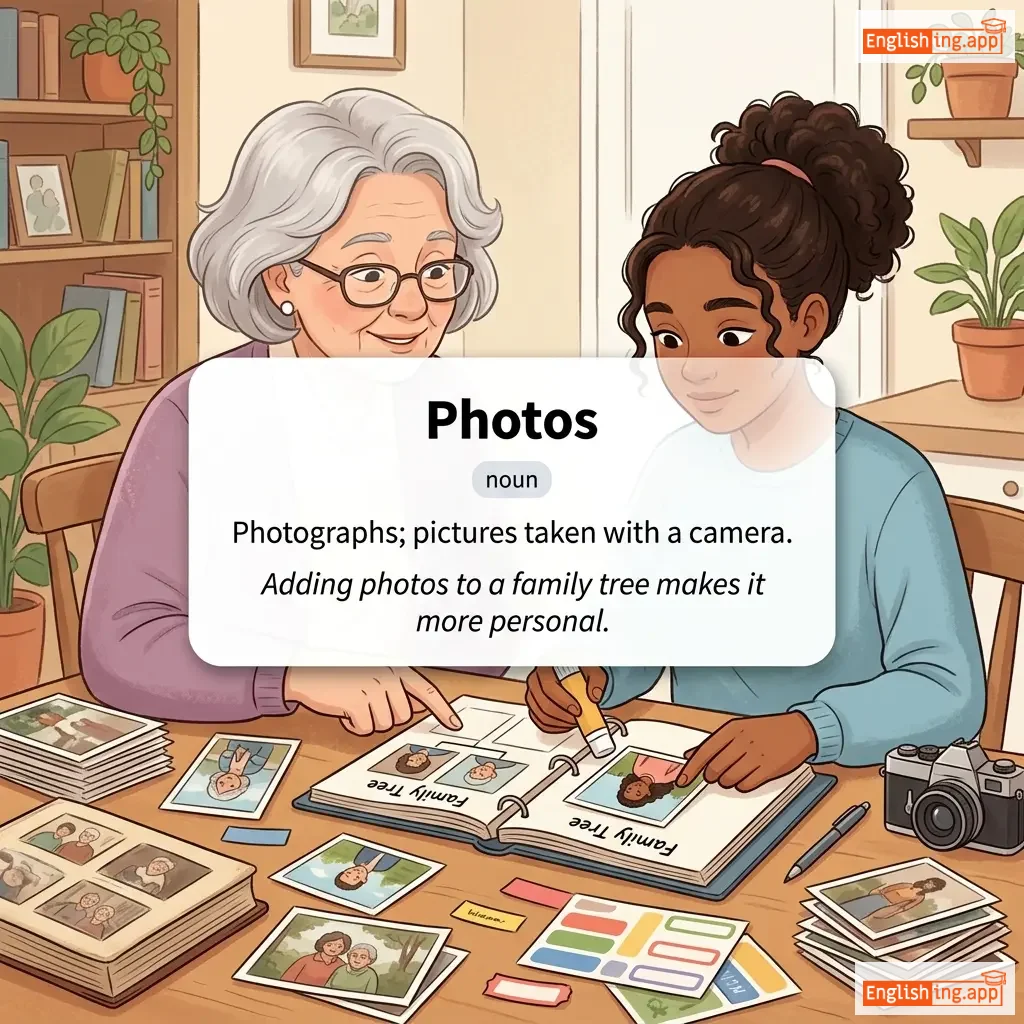
Photos definition card — visual illustration of the meaning
noun
ˈfoʊtoʊz
写真 (shashin)

Photographs; pictures taken with a camera.

"Adding photos to a family tree makes it more personal."
"家系図に写真を追加すると、より個人的になります。" (Kakeizu ni shashin o tsuika suru to, yori kojinteki ni narimasu.)
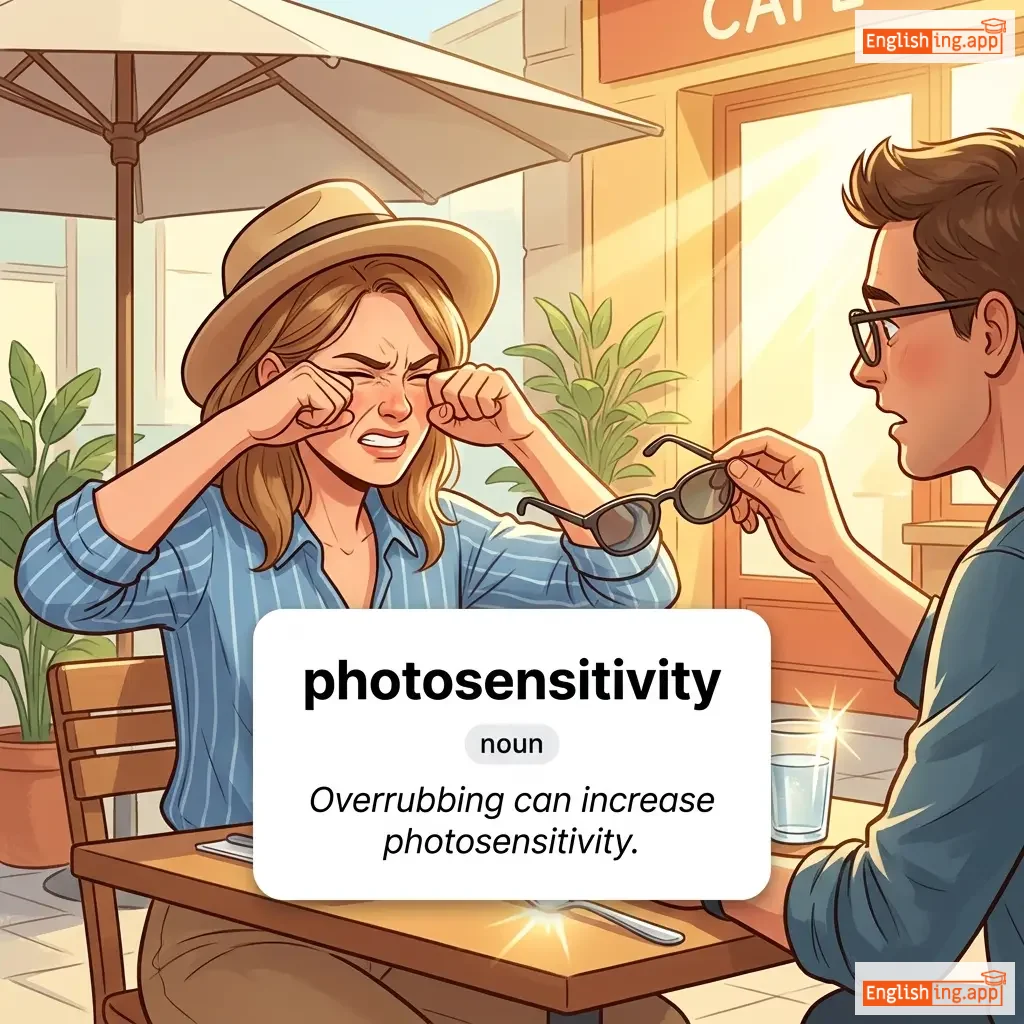
photosensitivity definition card — visual illustration of the meaning
noun
/ˌfəʊ.təʊ.sen.sɪˈtɪv.ɪ.ti/
光感受性 (kou kanshusei)

Sensitivity to light, especially abnormal sensitivity that may cause discomfort or damage.

"Overrubbing can increase photosensitivity."
"過度の摩擦は光感受性を増加させる可能性があります。" (Kadō no masatsu wa kō kanshusei o zōka saseru kanōsei ga arimasu.)
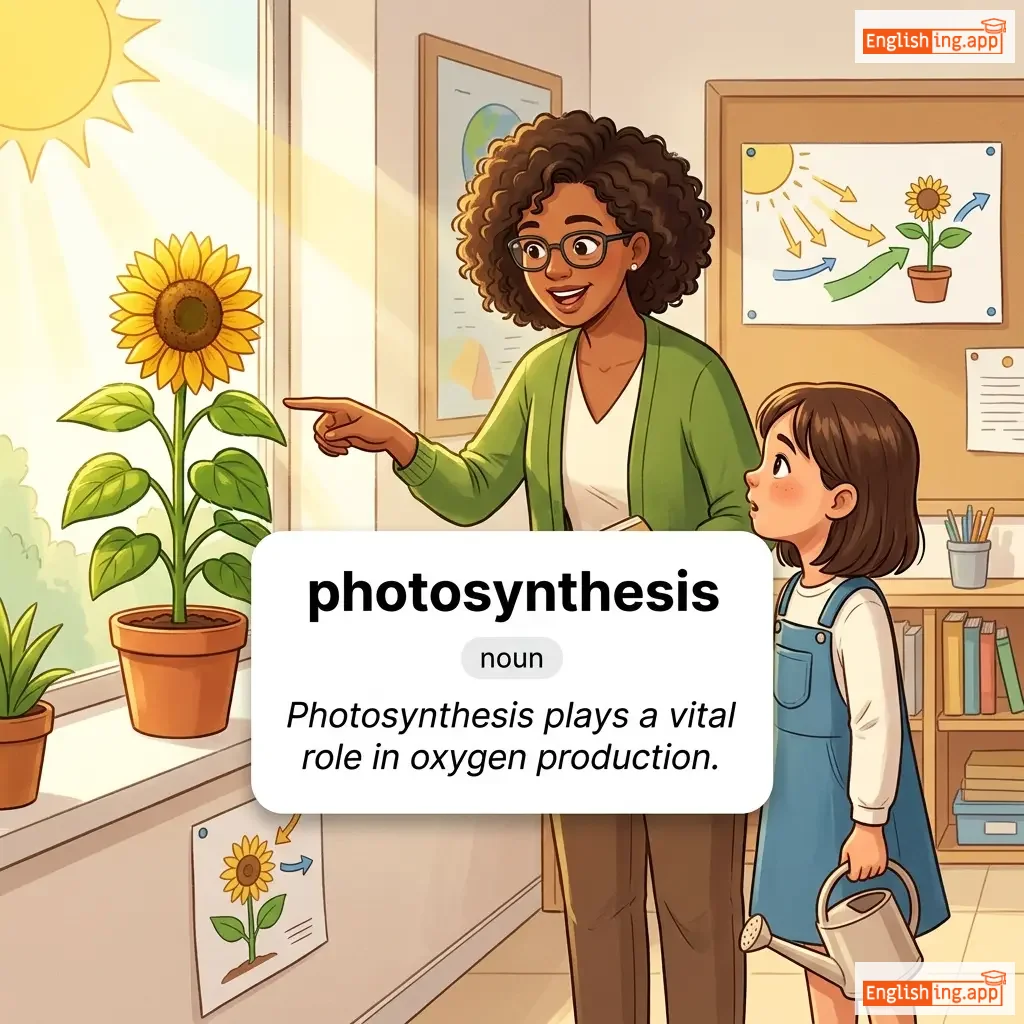
photosynthesis definition card — visual illustration of the meaning
noun
/ˌfoʊ.t̬oʊˈsɪn.θə.sɪs/
光合成 (kōgōsei)

The process by which green plants and some other organisms use sunlight to synthesize nutrients from carbon dioxide and water.

"Photosynthesis plays a vital role in oxygen production."

"光合成は酸素の生産に重要な役割を果たします。" (Kōgōsei wa sanso no seisan ni jūyōna yakuwari o hatashimasu.)
photosynthetic efficiency definition card — visual illustration of the meaning
noun
/ˌfəʊtəʊˈsɪnθɛtɪk ɪˈfɪʃənsi/
光合成効率 (fotoshinsetikku efishenshi)

The measure of how effectively plants convert light energy into chemical energy through the process of photosynthesis, directly affecting plant growth and crop yield.

"Improving photosynthetic efficiency can increase crop yields."

"光合成効率を改善すると、作物の収量を増やすことができます。" (kougousei kouritsu o kaizen suru to sakubutsu no shuuryou o fuyasu koto ga dekimasu)
noun
/freɪz/
フレーズ (fureezu)

a small group of words standing together as a conceptual unit

"He gave a memorable phrase at the conference."

"彼は会議で記憶に残るフレーズを言った。" (Kare wa kaigi de kioku ni nokoru fureezu o itta.)
phrases definition card — visual illustration of the meaning
noun
freɪzɪz
フレーズ (fureezu)

A small group of words standing together as a conceptual unit, typically forming a component of a clause.

"Learn common phrases for daily use."

"日常的な使用のための一般的なフレーズを学びましょう。" (Nichijō-tekina shiyō no tame no ippantekina fureezu o manabimashou.)
noun
/ˈfaɪləm/
生物分類における主要なカテゴリー、クラスの上、王国の下 (seibutsu bunrui ni okeru shuyou na kategorī, kurasu no ue, ōkoku no shita)

a primary category in the biological classification of organisms, above class and below kingdom

"Humans belong to the phylum Chordata."

"人間は脊索動物門に属しています。" (Ningen wa sekisaku dōbutsu mon ni zokushiteimasu.)
physical definition card — visual illustration of the meaning
adjective
/ˈfɪzɪkəl/
肉体的 (nikutai-teki)

relating to the body or physical things

"He has excellent physical strength."

"彼は優れた肉体的な力を持っています。" (Kare wa sugureta nikutai-teki na chikara o motteimasu.)
adverb
/ˈfɪzɪkəli/
フィジカルに (fijikaru ni)

in a physical manner; relating to the body

"She is physically strong and healthy."

"彼女はフィジカリーに強くて健康です。" (Kanojo wa fijikaru ni tsuyokute kenkou desu.)
noun
/fɪˈzɪʃən/
医師 (ishi)

a person qualified to practice medicine; a doctor

"The physician prescribed some medicine to treat the condition."

"医師はその状態を治療するために薬を処方しました。" (Ishi wa sono jōtai o chiryō suru tame ni kusuri o shohō shimashita.)
noun
/ˈfɪzɪsɪst/
物理学者 (butsurigakusha)

a scientist who studies or specializes in physics

"The physicist explained the theory of relativity to the students."

"物理学者は学生たちに相対性理論を説明しました。" (Butsurigakusha wa gakuseitachi ni sōtaisei riron o setsumei shimashita.)