語彙集

英単語辞書 | 単語の意味、定義、例文

noun
/ˈnuː.kʌm.ər/
新参者 (shinzan-sha)

a person who has recently arrived in a place or joined a group

"The newcomer was warmly welcomed by the team."

"その新参者はチームによって温かく迎えられました。" (Sono shinzan-sha wa chīmu ni yotte atatakai mukaeraremashita.)
adverb
/ˈnjuːli/
最近 (saikin)

in a new or recent manner

"She has newly renovated her house."

"彼女は最近家をリフォームしました。" (Kanojo wa saikin ie o rifōm shimashita.)
noun
/nuːz/
ニュース (nyūsu)

newly received or noteworthy information, especially about recent events

"The news about the storm spread quickly."

"嵐に関するニュースはすぐに広まりました。" (Arashi ni kansuru nyūsu wa sugu ni hiromarimashita.)
noun
/ˈnjuːzˌlɛtər/
ニュースレター (nyūzuretā)

a printed or electronic report containing news or information about a company or organization

"The company sends a weekly newsletter to its employees."

"その会社は毎週社員にニュースレターを送ります。" (Sono kaisha wa maishū shain ni nyūzuretā o okurimasu.)
noun
/ˈnjuːzˌpeɪpər/
新聞 (shinbun)

a printed publication (usually daily or weekly) containing news, articles, advertisements, and correspondence

"I read the newspaper every morning."

"私は毎朝新聞を読みます。" (Watashi wa mai asa shinbun o yomimasu.)
noun
/nuːt/
イモリ (imori)

a small amphibian with a long tail that lives both in water and on land

"The newt swam gracefully in the pond."

"イモリは池で優雅に泳いでいました。" (Imori wa ike de yuuga ni oyoide imashita)
adjective
/njuːˈtoʊniən/
ニュートンの法則に関連する (Nyūton no hōsoku ni kanren suru)

relating to the laws of motion and gravitation formulated by Sir Isaac Newton

"The scientist explained the Newtonian laws of motion."

"科学者はニュートンの運動法則を説明した。" (Kagakusha wa Nyūton no undō hōsoku o setsumei shita.)
adjective
/nɛkst/
(tsugi)

immediately following in time, order, or place

"The next train leaves at 9:00 AM."

"次の電車は午前9時に出発します。" (Tsugi no densha wa gozen 9-ji ni shuppatsu shimasu.)
noun
/ˈnɛksəs/
接続 (setsuzoku)

a connection or series of connections linking two or more things

"The town was a nexus for trade routes in the region."

"その街は地域の貿易ルートの接続点でした。" (Sono machi wa chiiki no boueki ruuto no setsuzoku ten deshita.)
noun
/nɪb/
ペン先 (pensaki)

the pointed end of a pen used for writing or drawing

"He dipped the nib into the ink before writing."

"彼は書く前にペン先をインクに浸しました。" (Kare wa kaku mae ni pensaki o inku ni shitamemashita.)
verb
/ˈnɪbəl/
かじる (kajiru)

to take small bites of food

"The rabbit nibbled on a carrot."

"うさぎはにんじんをかじった。" (Usagi wa ninjin o kajitta.)
adjective
/naɪs/
素敵 (suteki)

pleasant, kind, or enjoyable

"She is a very nice person to work with."

"彼女は一緒に働くのにとても素敵な人です。" (Kanojo wa issho ni hataraku no ni totemo suteki na hito desu.)
adverb
/ˈnaɪsli/
上手に (joozu ni)

in a pleasant, kind, or satisfactory manner; carefully and appropriately

"She explained the problem nicely so everyone could understand."

"彼女はみんなが理解できるように上手に説明した。" (kanojo wa minna ga rikai dekiru yoo ni joozu ni setsumei shita)
noun
/ˈnaɪsəti/
微細さ (bisaisa)

a fine or subtle detail, or a refined, delicate aspect of something

"The lawyer explained the legal niceties of the case."

"弁護士は事件の法的細部を説明しました。" (Bengoshi wa jiken no hōteki saibu o setsumei shimashita.)
Niche definition card — visual illustration of the meaning
noun
/niːʃ/
ニッチ (nicchi)

a comfortable or suitable position in life or employment

"He has found his niche in the marketing industry."

"彼はマーケティング業界で自分のニッチを見つけました。" (Kare wa maketingu gyoukai de jibun no nicchi wo mitsukemashita.)
noun
/ˈnɪkəl/
ニッケル (nikkeru)

a small coin, typically worth five cents in the United States

"He found a nickel on the ground."

"彼は地面でニッケルを見つけた。" (Kare wa jimen de nikkeru o mitsuketa.)
noun
/ˈnɪk.neɪm/
ニックネーム (nikku nēmu)

a familiar or humorous name given to a person instead of their real name

"His nickname is 'Tiger' because he's so brave."

"彼のニックネームは 'タイガー' です。なぜなら彼はとても勇敢だからです。" (kare no nikku nēmu wa 'taigā' desu. nazenara kare wa totemo yūkan dakara desu.)
noun
/niːs/
(mei)

the daughter of one's brother or sister

"My niece is studying at the university this year."

"私の姪は今年大学で勉強しています。" (watashi no mei wa kotoshi daigaku de benkyo shiteimasu)
noun
/naɪˈdʒel.ə/
ブラッククミン (burakku kumin)

small black seeds with a nutty, slightly bitter flavor, also known as black cumin or black seed

"Sprinkle nigella seeds on top of the bread before baking."

"パンの上にブラッククミンの種を振りかけてから焼きます。" (Pan no ue ni burakku kumin no tane wo furikakete kara yakimasu.)
adjective
/ˈnɪɡərdli/
ケチ (kechi)

unwilling to spend or give; stingy or miserly

"He was too niggardly to leave a decent tip."

"彼はまともなチップを置くにはあまりにケチだった。" (Kare wa matomona chippu o oku ni wa amari ni kechi datta.)
verb
/ˈnɪɡəl/

to cause slight but persistent annoyance, discomfort, or worry

"A small doubt niggled at her mind."

noun
/naɪt/
(yoru)

the time of darkness between one day and the next, when most people sleep

"She loves going for walks at night."

"彼女は夜に散歩するのが好きです。" (Kanojo wa yoru ni sanpo suru no ga suki desu.)
noun
/naɪt kwiːn/
月下香 (gekka kou)

a fragrant white flower that blooms at night and releases strong sweet scent

"The night queen flowers filled the garden with their sweet fragrance."

"月下香の花が甘い香りで庭を満たしました。" (gekka kou no hana ga amai kaori de niwa o mitashimashita)
noun
/naɪt ˈdʒæz.mɪn/
夜香木 (yakouboku)

a fragrant flowering tree that blooms at night with small white flowers

"The night-jasmine tree blooms only after sunset with its tiny white flowers."

"夜香木の木は日没後に小さな白い花を咲かせます。" (yakouboku no ki wa nichibotsugo ni chiisana shiroi hana o sakasemasu.)
noun
/ˈnaɪt.fɔːl/
夜の始まり (yoru no hajimari)

the time when night begins; dusk

"They decided to return home before nightfall."

"彼らは夜の始まり前に家に帰ることに決めました。" (Karera wa yoru no hajimari mae ni ie ni kaeru koto ni kimemashita.)
noun
/ˈnaɪ.tɪŋ.ɡeɪl/
ナイチンゲール (naichingeeru)

small songbird known for its beautiful singing, especially at night

"The nightingale sang sweetly in the moonlight."

"ナイチンゲールは月明かりの中で甘美に歌った。" (naichingeeru wa tsukiakari no naka de kanbi ni utatta)
noun
/ˈnaɪtˌmɛər/

a frightening or unpleasant dream; a very distressing experience.

"Last night, she had a terrifying nightmare."

noun
/ˈnaɪɪˌlɪzəm/
虚無主義 (kyomu shugi)

The rejection of all religious and moral principles, often in the belief that life is meaningless.

"The philosopher was criticized for promoting nihilism."

"哲学者はニヒリズムを推進したとして批判されました。" (Tetsugakusha wa nihirizumu o suishin shita to shite hihan saremashita.)
noun
/ˈnaɪəlɪst/
ニヒリスト (nihiristo)

A person who rejects all religious and moral principles, often believing that life is meaningless.

"He was called a nihilist for rejecting all social norms."

"彼はすべての社会的規範を拒否したため、ニヒリストと呼ばれました。" (Kare wa subete no shakaiteki kihon o kyohi shita tame, nihiristo to yobaremashita.)
noun
/nɪl/
ゼロ (zero)

Nothing; zero.

"The score remained nil after the first half."

"前半戦が終わった後、スコアはゼロのままだった。" (Zenhan-sen ga owatta ato, sukō wa zero no mamadatta.)
adjective
/ˈnɪmbəl/
素早い (subayai)

Quick and light in movement or thought.

"The dancer’s nimble steps impressed the audience."

"ダンサーの素早いステップが観客を感動させた。" (Dansā no subayai suteppu ga kankyaku o kandō saseta.)
noun
/naɪn/
(kyuu)

the number that is one more than eight

"She has nine books in her collection."

"彼女はコレクションに9冊の本を持っています。" (Kanojo wa korekushon ni kyuu-satsu no hon o motteimasu.)
noun
/ˈnɪn.i/
バカ (baka)

a silly or foolish person; someone who lacks common sense

"Don't be such a ninny, use your brain!"

"そんなバカなことをするな、頭を使え!" (sonna baka na koto o suru na, atama o tsukae!)
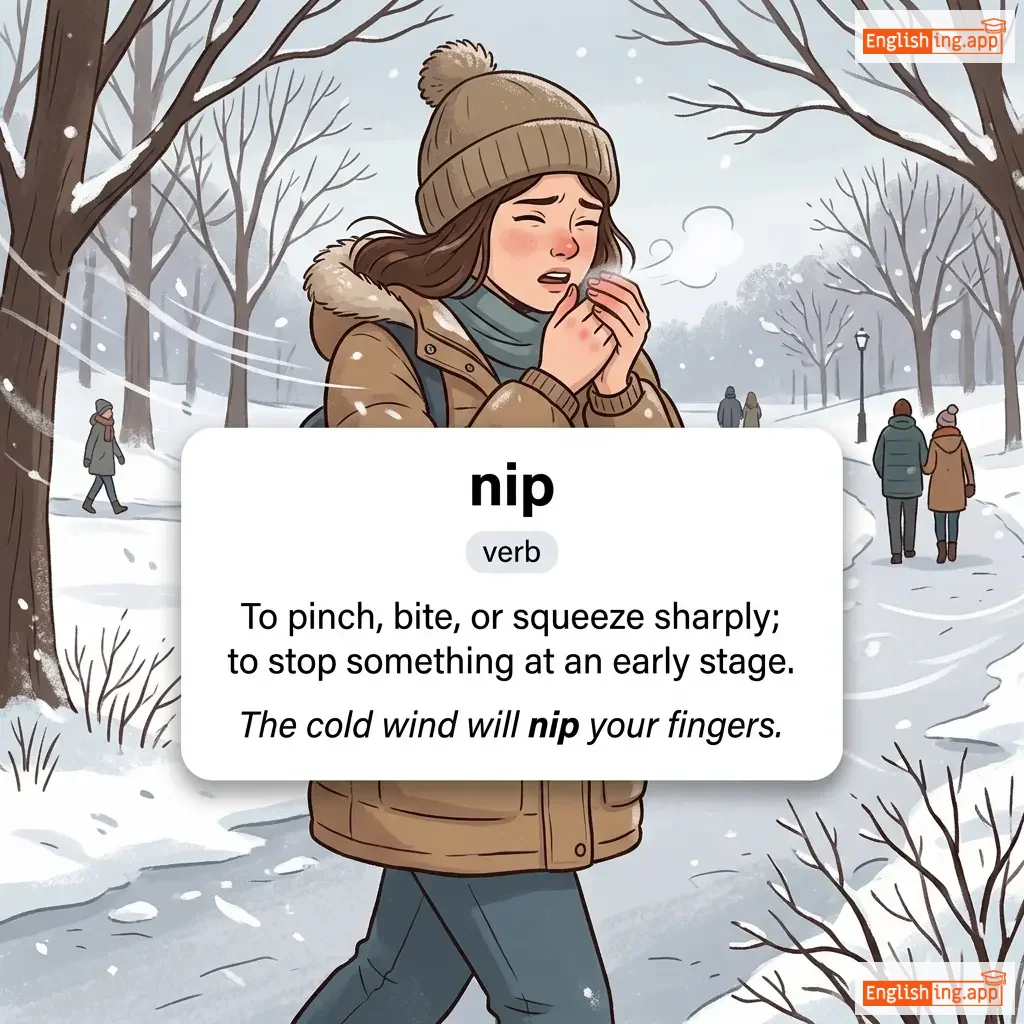
nip definition card — visual illustration of the meaning
verb
/nɪp/
つねる (tsuneru)

To pinch, bite, or squeeze sharply; to stop something at an early stage.

"The cold wind will nip your fingers."

"冷たい風があなたの指をつまむでしょう。" (Tsumetai kaze ga anata no yubi o tsumamu deshō.)
adjective
/ˈnɪp.i/
寒い; ひんやり; 動きが速くて敏捷 (samui; hinyari; ugoki ga hayakute binshou)

cold; chilly; quick and agile in movement

"It's quite nippy outside today, you should wear a jacket."
"今日は外がかなり寒いので、ジャケットを着るべきです。" (Kyou wa soto ga kanari samui node, jaketto wo kiru beki desu.)
🕉️

nirvana

noun
/nɪərˈvɑːnə/

A state of perfect happiness, peace, and freedom from suffering; in Buddhism, the ultimate goal of liberation.

"Meditation helps some people seek nirvana in their lives."

noun
/nɪt/
シラミの卵 (shirami no tamago)

The egg or young form of a louse or other parasitic insect.

"The teacher noticed nits in the child’s hair."

"先生は子供の髪の毛にシラミの卵を見つけました。" (Sensei wa kodomo no kami no ke ni shirami no tamago o mitsukemashita.)
verb
/ˈnɪtˌpɪk/

To find and criticize small or unimportant faults in someone or something.

"She tends to nitpick about every little detail."

adverb
/noʊ/
いいえ (iie)

used to give a negative response or to show disagreement

"She said no to the invitation."

"彼女は招待状を断った。" (Kanojo wa shoutaijou o kotowatta.)
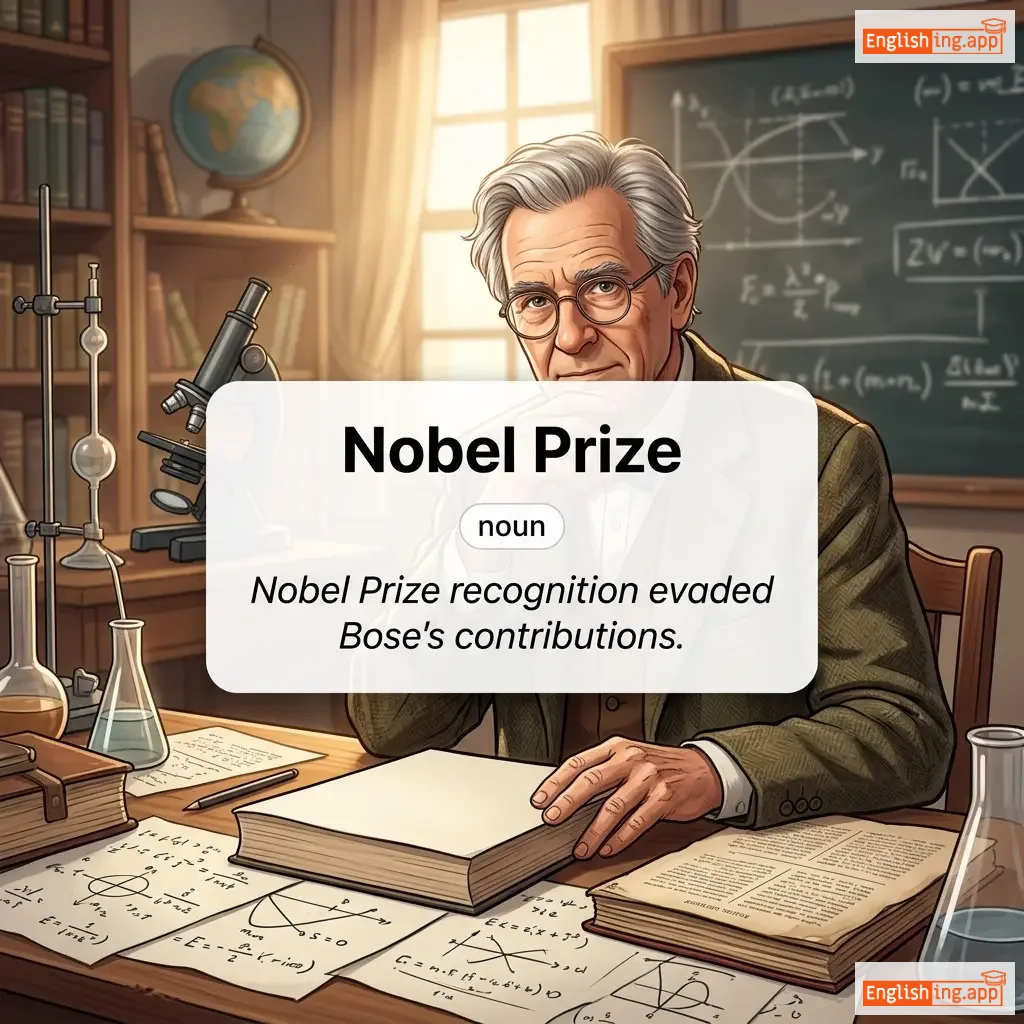
Nobel Prize definition card — visual illustration of the meaning
noun
noʊˈbel praɪz
ノーベル賞 (noberu shou)

Any of six international prizes awarded annually for outstanding work in physics, chemistry, physiology or medicine, literature, economics, and the promotion of peace.

"Nobel Prize recognition evaded Bose's contributions."

"Nobel Prize recognition did not apply to Bose's contributions." (noberu shou no hyouka wa boosu no kouken ni wa oyobanakatta)
noun
/nəʊˈbɪləti/
高貴 (kouki)

the quality of being noble in character or the group of people belonging to the aristocracy

"The king praised her for her nobility and courage."

"王は彼女の高貴さと勇気を称賛しました。" (Ō wa kanojo no kōkisa to yūki o shōsan shimashita.)
adjective
/ˈnoʊbəl/
高貴な性格や高い道徳的原則を示す、または高い社会的地位を持つ (Kōkina seikaku ya takai dōtoku-teki gensoku o shimesu, mata wa takai shakai-teki chii o motsu)

Having or showing fine personal qualities, high moral principles, or being of high social rank.

"He is admired for his noble character and generosity."

"彼はその高貴な性格と寛大さで賞賛されています。" (Kare wa sono kōkina seikaku to kandaisa de shōsan sareteimasu.)
pronoun
/ˈnoʊˌbɑːdi/
誰もいない (dare mo inai)

no person; not anyone

"Nobody came to the party."

"誰もパーティに来なかった。" (Dare mo pāti ni konakatta.)
adjective
/nɒkˈtɜːrnəl/
夜行性 (yakousei)

Active at night and sleeping during the day.

"Owls are nocturnal animals that hunt at night."

"フクロウは夜行性の動物で、夜に狩りをします。" (Fukurou wa yakousei no doubutsu de, yoru ni kari wo shimasu.)
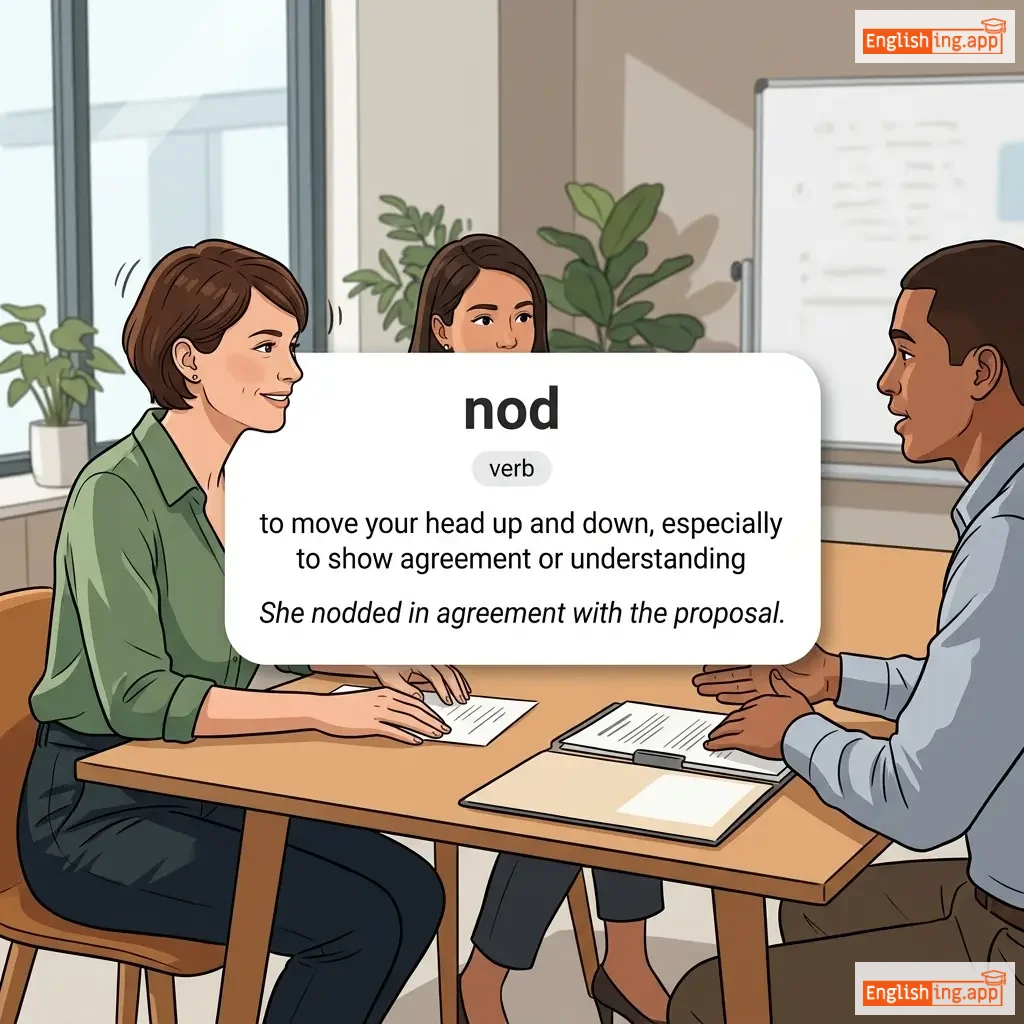
nod definition card — visual illustration of the meaning
verb
/nɒd/
うなずく (unazuku)

to move your head up and down, especially to show agreement or understanding

"She nodded in agreement with the proposal."

"彼女は提案に賛成してうなずいた。" (Kanojo wa teian ni sansei shite unazuita.)
noun
/nɔɪz/
騒音 (souon)

a sound, especially when it is unwanted, unpleasant, or loud

"The noise from the construction site was unbearable."

"建設現場の騒音は耐えられなかった。" (Kensetsu genba no souon wa taerarenakatta.)
adjective
/ˈnɔɪzləs/
無音 (muon)

Completely silent; without any noise.

"The cat made a noiseless leap onto the table."

"猫は音を立てずにテーブルに飛び乗った。" (Neko wa oto o tatezu ni tēburu ni tobinotta.)
adverb
/ˈnɔɪzɪli/
騒々しく (souzoushiku)

in a way that makes a lot of noise; loudly

"The children were playing noisily in the playground."

"子供たちは遊び場で騒がしく遊んでいました。" (Kodomotachi wa asobiba de sawagashiku asondeimashita.)
adjective
/ˈnɔɪsəm/
悪臭 (akushu)

Having an extremely unpleasant smell; offensive or harmful.

"The dump emitted a noisome odor that spread through the town."

"ゴミ捨て場から不快な臭いが広がって街中に広がった。" (Gomi suteba kara fukai na nioi ga hirogatte machi naka ni hirogatta.)
adjective
/ˈnɔɪzi/
うるさい (urusai)

Making a lot of loud sounds; full of noise.

"The children were noisy during the party."

"子供たちはパーティーの間うるさかった。" (Kodomotachi wa pātī no aida urusakatta.)