語彙集

英単語辞書 | 単語の意味、定義、例文

noun, verb
/mɪnt/
ミント / 鋳造所 (minto / chuzojo)

a place where coins are made; to produce or invent something new

"The government decided to mint new coins to commemorate the anniversary."

"政府は記念日のために新しいコインを鋳造することを決定しました。" (Seifu wa kinenbi no tame ni atarashii koin wo chuzo suru koto wo kettei shimashita.)
adjective
/ˈmɪnəskjuːl/
微細 (bisai)

extremely small in size or importance

"She made only a minuscule contribution to the project."

"彼女はプロジェクトにほんのわずかな貢献をしました。" (Kanojo wa purojekuto ni honno wazukana kouken o shimashita.)
noun, adjective
/maɪˈnjuːt/ (adj), /ˈmɪnɪt/ (noun)
分 / 微小 (fun / bishou)

a period of sixty seconds; extremely small or detailed

"He examined the painting with minute attention to detail."

"彼は細かい注意を払って絵を調べました。" (Kare wa komakai chuui o haratte e o shirabemashita.)
adverb
/maɪˈnjuːtli/
慎重に (shinchou ni)

in very small detail; extremely carefully

"The detective examined the evidence minutely."

"探偵は証拠を慎重に調べました。" (Tantei wa shouko wo shinchou ni shirabemashita.)
noun
/maɪˈnjuːʃə/
細かい事 (komakai koto)

a small or trivial detail of something

"He was bored by the minutia of office paperwork."

"彼はオフィスの書類の細かい事に飽きていた。" (Kare wa ofisu no shorui no komakai koto ni akite ita.)
noun (plural)
/maɪˈnjuːʃiiː/
細部 (saibu)

the small, precise, or trivial details of something

"The lawyer focused on the minutiae of the contract."

"弁護士は契約の細部に集中しました。" (Bengoshi wa keiyaku no saibu ni shuuchuu shimashita.)
noun
/ˈmɪrəkəl/
奇跡 (kiseki)

an extraordinary event that cannot be explained by natural laws

"Surviving the accident was nothing short of a miracle."

"事故から生き残るのはまさに奇跡でした。" (Jiko kara ikinokoru no wa masani kiseki deshita.)
adjective
/mɪˈrækjələs/
奇跡的な (kiseki-tekina)

Extraordinarily wonderful or unusual, as if by a miracle.

"Her recovery after the accident was truly miraculous."

"事故後の彼女の回復は本当に奇跡的でした。" (Jiko go no kanojo no kaifuku wa hontōni kiseki-tekideshita.)
noun
/məˈrɑːʒ/
蜃気楼 (shinkirou)

An optical illusion caused by atmospheric conditions, often seen in deserts or hot roads, where water or objects appear to exist but do not.

"The weary travelers saw a mirage of water in the desert."

"疲れた旅行者たちは砂漠で水の蜃気楼を見ました。" (Tsukareta ryokousha-tachi wa sabaku de mizu no shinkirou wo mimashita.)
🪵

mire

noun, verb
/ˈmaɪər/

A stretch of swampy or boggy ground; as a verb, to entangle or involve someone in a difficult situation.

"The car was stuck in the mire after the heavy rain."

adjective, verb (past tense/participle of mire)
/ˈmaɪərd/
困難な状況に巻き込まれる (konnan na joukyou ni makikomaru)

Trapped or entangled in something, typically a difficult situation.

"The politician was mired in scandal."

"その政治家はスキャンダルに巻き込まれていた。" (Sono seijika wa sukyandaru ni makikomararete ita.)
noun
/ˈmɪrər/

A reflective surface, typically made of glass, that shows an image.

"She looked at herself in the mirror before leaving."

noun
/mɜːrθ/
喜び (yorokobi)

Great joy, amusement, or laughter.

"The festival was full of mirth and laughter."

"フェスティバルは喜びと笑いでいっぱいでした。" (Fesutibaru wa yorokobi to warai de ippai deshita.)
noun
/ˌmɪsədˈvɛntʃər/
不運な出来事 (fuun na dekigoto)

An unlucky accident, mishap, or unfortunate event.

"He broke his leg during a skiing misadventure."
"彼はスキー中に不運な出来事で足を骨折した。" (Kare wa sukii-chuu ni fuun na dekigoto de ashi o kossetsu shita.)
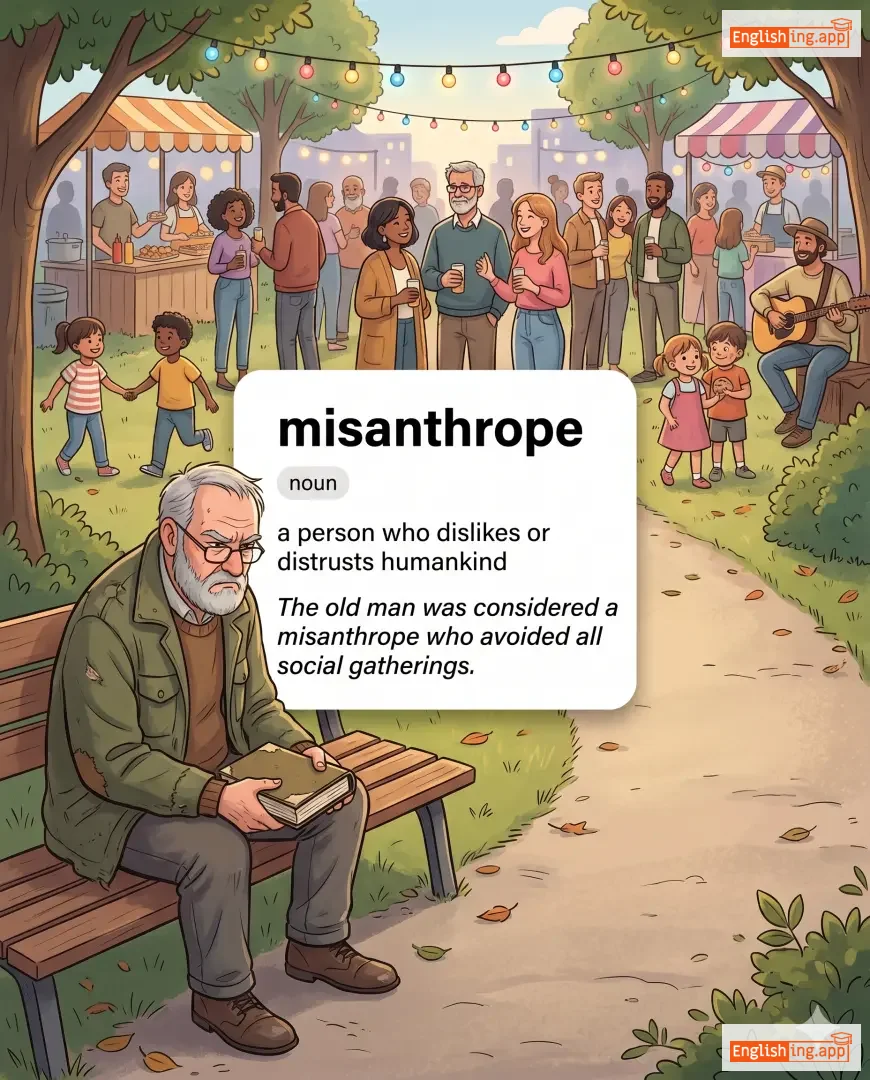
misanthrope definition card — visual illustration of the meaning
noun
/ˈmɪsənˌθroʊp/
人間嫌い (ningengirai)

a person who dislikes or distrusts humankind

"The old man was considered a misanthrope who avoided all social gatherings."

"その老人は、すべての社交的な集まりを避けるミサントロープと見なされていました。" (Sono rōjin wa, subete no shakaiteki na atsumari o yokeru misantoroopu to minasareteimashita.)
adjective
/ˌmɪsənˈθrɑːpɪk/
人間嫌いの (ningen girai no)

having or showing a dislike of humankind

"His misanthropic attitude made it difficult for him to make friends."

"彼の人間嫌いの態度は、友達を作るのを難しくした。" (Kare no ningen girai no taido wa, tomodachi o tsukuru no o muzukashiku shita.)
noun
/mɪˈsænθrəpi/
人類嫌悪 (jinrui ken'o)

a general dislike, distrust, or hatred of humankind

"His misanthropy was evident in the way he avoided people."

"彼の人類嫌悪は、彼が人々を避ける方法に明らかに現れていました。" (Kare no jinrui ken'o wa, kare ga hitobito o sakeru hōhō ni akiraka ni arawarete imashita.)
verb
/ˌmɪsæprɪˈhɛnd/
誤解する (gokai suru)

to misunderstand or misinterpret something

"He misapprehended the teacher’s instructions and did the task incorrectly."

"彼は先生の指示を誤解し、課題を間違って行いました。" (Kare wa sensei no shiji o gokai shi, kadai o machigatte okonaimashita.)
noun
/ˌmɪsæprɪˈhɛnʃən/
誤解 (gokai)

a mistaken belief or misunderstanding

"There is a common misapprehension about the causes of the disease."
"病気の原因についての一般的な誤解がある。" (Byōki no gen'in ni tsuite no ippanteki na gokai ga aru.)
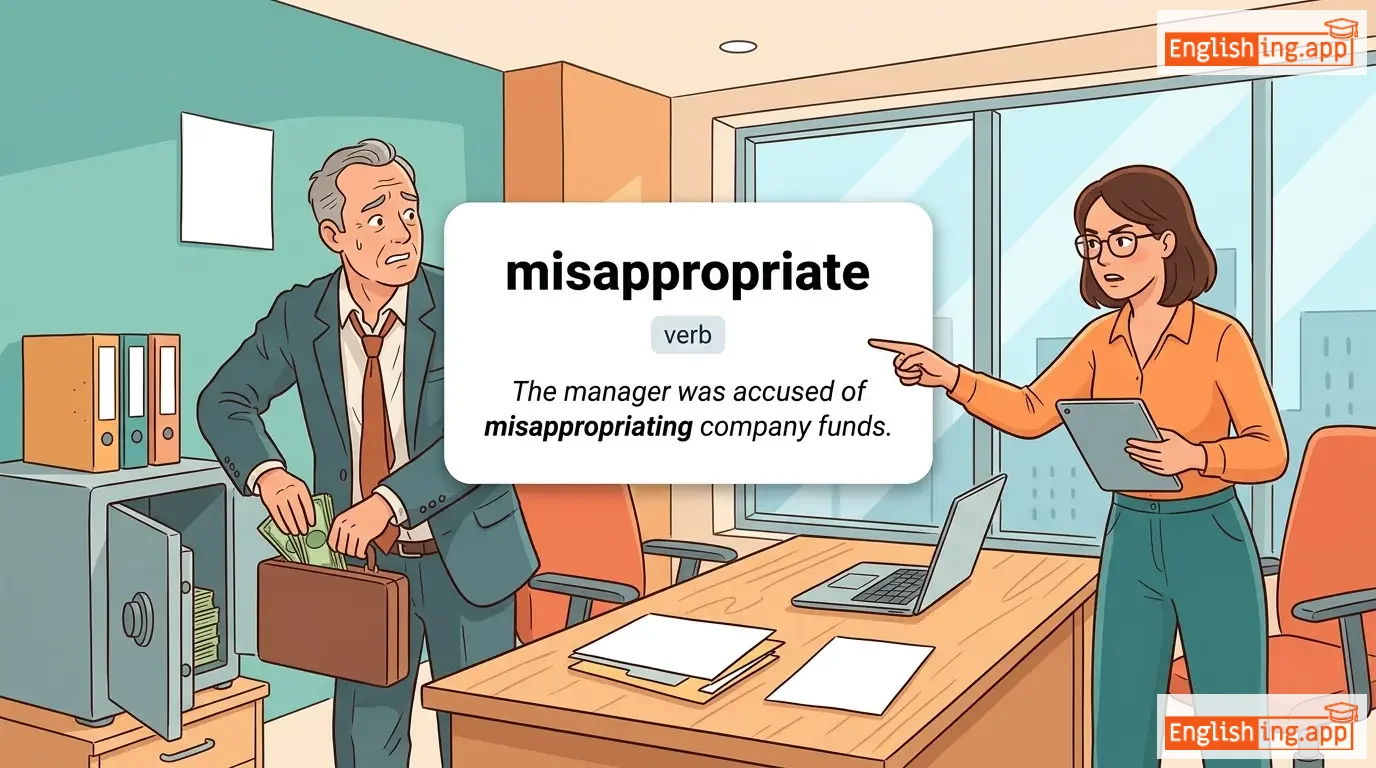
misappropriate definition card — visual illustration of the meaning
verb
/ˌmɪsəˈproʊprieɪt/
不正流用する (fusei ryūyō suru)

to take or use something dishonestly, especially money or property, for one's own use

"The manager was accused of misappropriating company funds."

"マネージャーは会社の資金を不正に使ったとして告発されました。" (Manējā wa kaisha no shikin o fusei ni tsukatta to shite kokuhatsu saremashita.)
verb
/ˌmɪs.əˈtrɪb.juːt/
誤って帰属する (ayamatte kizoku suru)

to incorrectly credit something, such as a work or remark, to the wrong person or source

"The quote was misattributed to Shakespeare."
"その引用はシェイクスピアに誤って帰属されました。" (Sono inyo wa Sheikusupia ni ayamatte kizoku saremashita.)
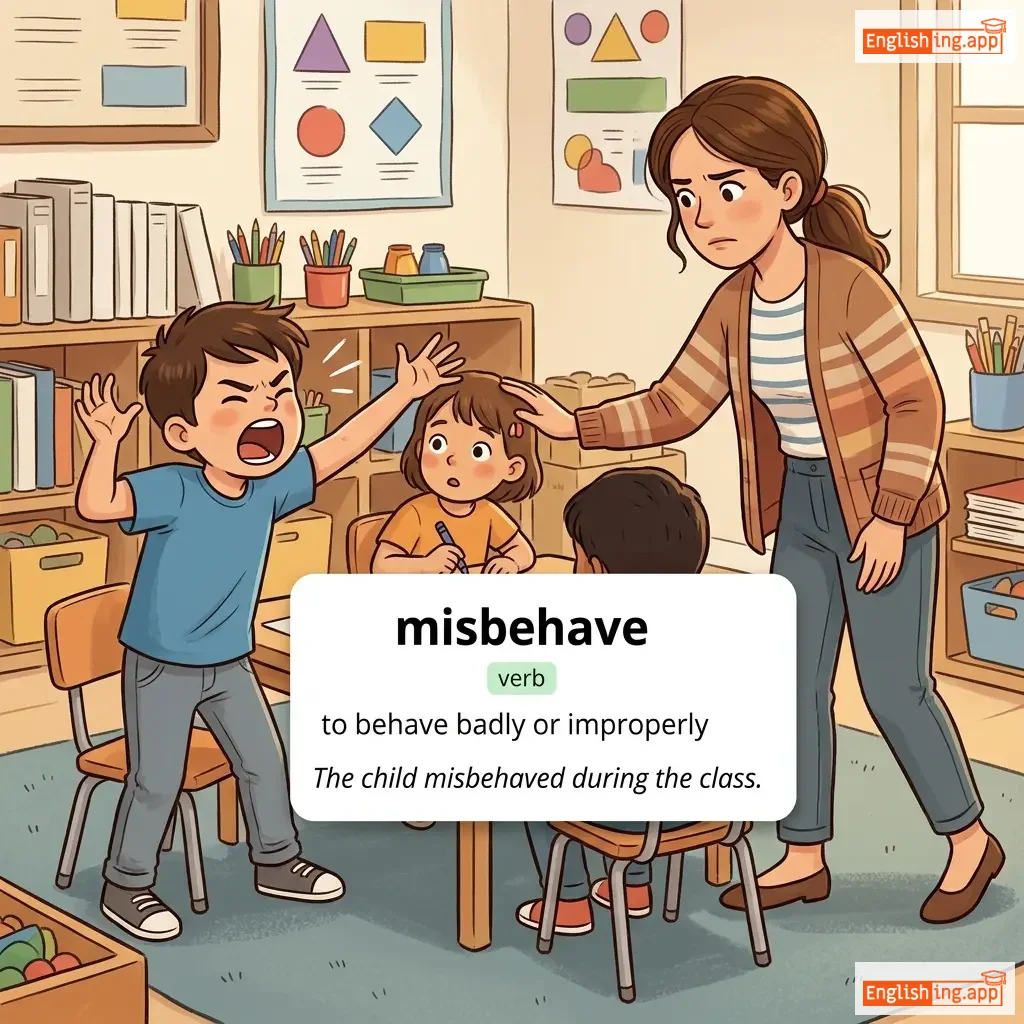
misbehave definition card — visual illustration of the meaning
verb
/ˌmɪsbɪˈheɪv/
悪い振る舞いをする (warui furumai wo suru)

to behave badly or improperly

"The child misbehaved during the class."

"その子供はクラス中に悪い振る舞いをした。" (Sono kodomo wa kurasu-chū ni warui furumai wo shita.)
noun
/ˌmɪsbɪˈheɪvjər/
不正行為 (fusei kōi)

bad or improper behavior

"The teacher punished the student for his misbehavior."

"教師は彼の不正行為で生徒を罰しました。" (Kyōshi wa kare no fusei kōi de seito o basshimashita.)
noun
/ˌmɪs.bɪˈheɪ.vjər/
悪いまたは受け入れられない行動、特に子供によるものや公式の場面で (misbehaviour)

Bad or unacceptable behavior, especially by children or in formal situations

"The student was punished for his misbehaviour in class."

"生徒はクラスでの不適切な行動で罰を受けた。" (Seito wa kurasu de no futekisetsu na kōdō de batsu o ukemashita.)
noun
/mɪˌsɛdʒəˈneɪʃən/
人種間結婚 (jinshukan kekkon)

the interbreeding of people considered to be of different racial types

"The law once prohibited miscegenation in many countries."

"その法律は多くの国で人種間結婚を禁じていました。" (Sono hōritsu wa ōku no kuni de jinshukan kekkon o kinjite imashita.)
adjective
/ˌmɪsəˈleɪniəs/
雑多な (zattana)

Consisting of a variety of different items or types.

"The drawer was filled with miscellaneous objects."

"引き出しはさまざまな物でいっぱいだった。" (Hikidashi wa samazama na mono de ippai datta.)
noun
/ˈmɪsəleɪni/
寄せ集め (yoseatsume)

A collection or mixture of various things.

"The book is a miscellany of essays and poems."

"その本はエッセイと詩の寄せ集めです。" (Sono hon wa essei to shi no yoseatsume desu.)
noun
/ˌmɪsˈtʃæns/

An unfortunate accident or event; bad luck.

"By mischance, he missed the last train home."

noun
/ˈmɪstʃɪf/
いたずら (itazura)

Playful misbehavior or troublemaking.

"The children were full of mischief during the party."

"パーティー中、子供たちはいたずらでいっぱいでした。" (Pātī-chū, kodomotachi wa itazura de ippai deshita.)
adjective
/ˈmɪstʃɪvəs/
いたずらな (itazura na)

Causing or showing a fondness for causing trouble in a playful way.

"She gave him a mischievous smile."

"彼女は彼にいたずらな笑顔を向けた。" (Kanojo wa kare ni itazura na egao wo muketa.)
verb
/ˌmɪskənˈsiːv/
誤解する (gokai suru)

To misunderstand or form an incorrect idea about something.

"He misconceived the purpose of the project."
"彼はプロジェクトの目的を誤解しました。" (Kare wa purojekuto no mokuteki o gokai shimashita.)
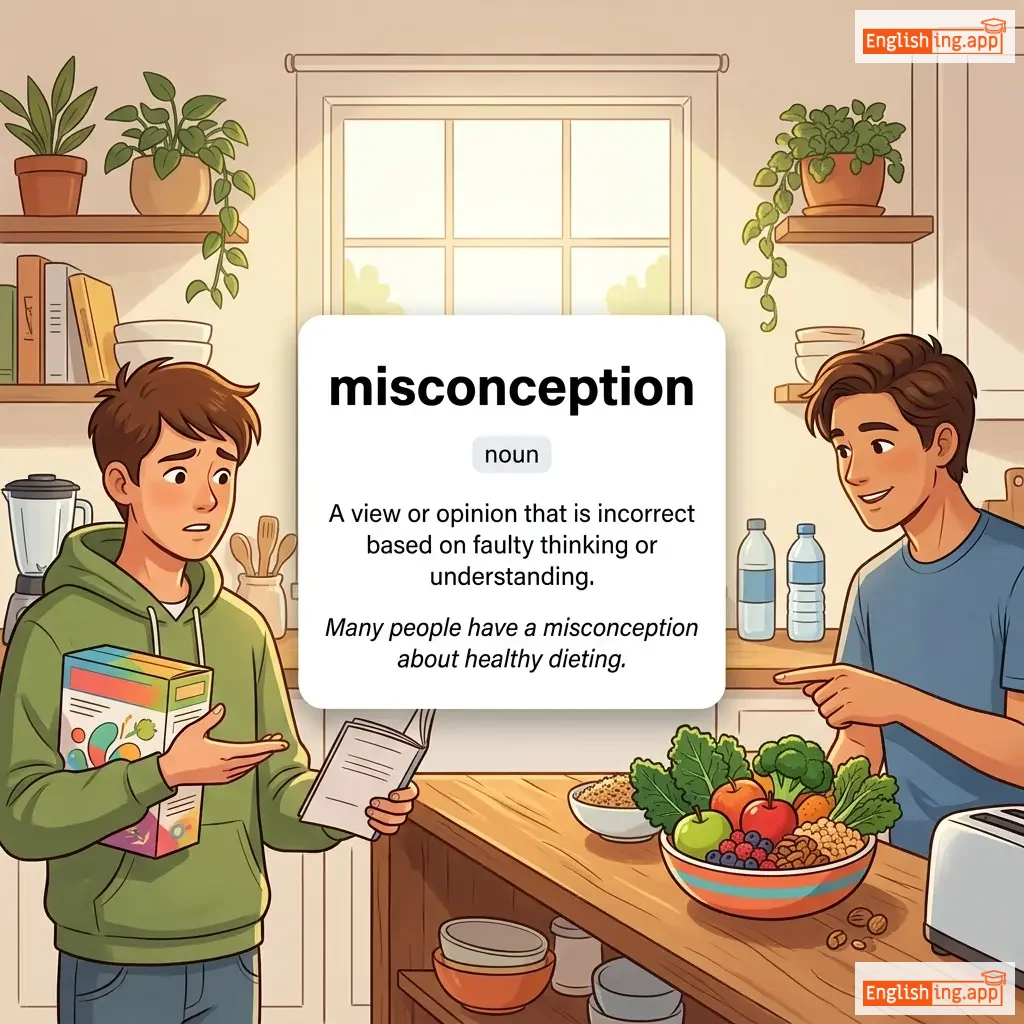
misconception definition card — visual illustration of the meaning
noun
/ˌmɪs.kənˈsep.ʃən/
誤解、間違った理解 (gokai, machigatta rikai)

A view or opinion that is incorrect based on faulty thinking or understanding.

"Many people have a misconception about healthy dieting."

"多くの人々は健康的な食事について誤解しています。" (Ōku no hitobito wa kenko-teki na shokuji ni tsuite gokai shiteimasu.)
noun
/ˌmɪsˈkɒndʌkt/
不正行為 (fuseikoui)

Improper or unacceptable behavior, especially by a professional or authority figure.

"The teacher was dismissed for serious misconduct."

"教師は重大な不正行為のため解雇されました。" (Kyoushi wa juudaina fuseikoui no tame kaiko saremashita.)
verb
/ˌmɪskənˈstruː/
誤解する (gokai suru)

To interpret something wrongly or misunderstand the meaning.

"She misconstrued his silence as anger."

"彼女は彼の沈黙を怒りだと誤解した。" (Kanojo wa kare no chinmoku o ikari da to gokai shita.)
verb
/ˌmɪsˈkaʊnt/
間違えて数える (machigaete kazoeru)

To count wrongly or inaccurately.

"He miscounted the number of chairs in the hall."

"彼はホールの椅子の数を間違えて数えました。" (Kare wa hōru no isu no kazu o machigaete kazoemashita.)
noun
/ˈmɪskriənt/
悪党 (akutou)

A person who behaves badly or criminally.

"The police arrested the miscreant responsible for the theft."

"警察は盗みの責任を負う悪党を逮捕しました。" (Keisatsu wa nusumi no sekinin o ou akutou o taiho shimashita.)
noun
/ˌmɪsˈdiːd/
不正行為 (fusei koui)

A wrong or illegal act.

"He regretted his past misdeeds and apologized."

"彼は自分の過去の悪行を後悔し、謝罪しました。" (Kare wa jibun no kako no akugyou o koukai shi, shazai shimashita.)
noun
/ˌmɪsdɪˈmiːnər/
軽犯罪 (keihanzai)

A minor wrongdoing or criminal offense that is less serious than a felony.

"He was fined for a misdemeanor involving public disturbance."

"公共の秩序に関わる軽犯罪で罰金を科された。" (Kōkyō no chitsujo ni kakawaru keihanzai de bakkin o kasareta.)
noun
/ˈmaɪzər/
けちん坊 (kechinbō)

A person who hoards wealth and spends as little money as possible.

"The old miser refused to donate even a penny to charity."

"その古いけちん坊は慈善団体に1ペニーも寄付することを拒否した。" (Sono furui kechinbō wa jizen dantai ni 1 penī mo kifu suru koto o kyohi shita.)
adjective
/ˈmɪzərəbəl/
惨めな (mijimena)

Extremely unhappy or uncomfortable.

"He felt miserable after losing his job."

"仕事を失った後、彼は惨めに感じていた。" (Shigoto o ushinatta ato, kare wa mijime ni kanjite ita.)
adverb
/ˈmɪzərəbli/
悲惨に (hisan ni)

in a wretched or unhappy manner; extremely badly

"The team performed miserably in the championship."

"チームはチャンピオンシップで悲惨にプレーしました。" (Chiimu wa chanpionshipu de hisan ni puree shimashita.)
adjective
/ˈmaɪzərli/
けちな (kechina)

Unwilling to spend money; stingy.

"She lived a miserly life, refusing to buy anything new."

"彼女はけちな生活を送り、新しいものを買うことを拒んでいた。" (Kanojo wa kechina seikatsu o okuri, atarashī mono o kau koto o kobandeita.)
noun
/ˈmɪzəri/
苦しみ (kurushimi)

A state of great suffering, unhappiness, or discomfort.

"The refugees lived in constant misery."

"難民たちは絶え間ない苦しみの中で暮らしていました。" (Nanmin-tachi wa taemanai kurushimi no naka de kurashite imashita.)
noun
/ˌmɪsˈfɔːrtʃən/
不運 (fuun)

Bad luck or an unfortunate event.

"He suffered the misfortune of losing his job during the recession."

"彼は不況時に仕事を失うという不運に見舞われました。" (Kare wa fukyou ji ni shigoto o ushinau to iu fuun ni mimawaremashita.)
noun
/ˌmɪsˈɡɪvɪŋ/
疑念 (ginen)

A feeling of doubt, worry, or suspicion.

"She had serious misgivings about signing the contract."

"彼女は契約書にサインすることに対して真剣な疑念を抱いていた。" (Kanojo wa keiyakusho ni sain suru koto ni taishite shinken na ginen o daite ita.)
noun
/mɪsˈɡɪvɪŋz/
疑念、不安 (ginen, fuan)

feelings of doubt or concern about the outcome or propriety of something

"She had serious misgivings about signing the contract."

"彼女は契約書にサインすることに対して深刻な疑念を抱いていた。" (Kanojo wa keiyaku-sho ni sain suru koto ni taishite shinkoku na ginen o idaite ita.)
noun
/ˈmɪshæp/
不運, 小さな事故 (fuun, chiisana jiko)

an unlucky accident or minor misfortune

"A minor mishap delayed the train for half an hour."

"小さな事故で電車は30分遅れました。" (Chiisana jiko de densha wa 30-pun okuremashita.)
verb
/ˌmɪsɪnˈtɜːrprɪt/
誤解する (gokai suru)

to understand or explain something wrongly

"He misinterpreted her silence as agreement."

"彼は彼女の沈黙を同意と誤解した。" (Kare wa kanojo no chinmoku o dōi to gokai shita.)
verb
/ˌmɪsˈleɪ/
一時的に失う (ichijiteki ni ushinau)

to lose something temporarily by putting it in the wrong place

"I must have mislaid my keys somewhere in the house."

"私は家のどこかで鍵を一時的に失ったに違いない。" (Watashi wa ie no dokoka de kagi o ichijiteki ni ushinatta ni chigai nai.)
adjective
/mɪsˈliːdɪŋ/
誤解を招く (gokai o maneku)

giving the wrong idea or impression

"The advertisement was misleading and gave false information."

"その広告は誤解を招くもので、偽の情報を提供していました。" (Sono kōkoku wa gokai o maneku mono de, nise no jōhō o teikyō shiteimashita.)