語彙集

英単語辞書 | 単語の意味、定義、例文

noun
/kəˈmændər/
司令官 (shireikan)

a person in authority, especially over a military group

"The commander led his troops into battle."

"司令官は自分の部隊を戦いに導きました。" (Shireikan wa jibun no butai o tatakai ni michibikimashita.)
noun
/kəˈmændər ɪn tʃiːf/
最高司令官 (saikō shireikan)

the supreme leader of a nation's armed forces

"The president serves as the commander-in-chief of the military."

"大統領は軍隊の最高司令官として務めています。" (Daitōryō wa guntai no saikō shireikan toshite tsutome teimasu.)
verb
/kəˈmɛmɔˌreɪt/
記念する (kinen suru)

To honor and remember someone or something through a ceremony or action.

"The statue was built to commemorate the fallen heroes."

"その像は、倒れた英雄たちを記念して作られました。" (Sono zō wa, taoreta eiyū-tachi o kinen shite tsukuraremashita.)
adjective
/kəˈmɛmərətɪv/
記念の (kinen no)

Serving as a reminder or in honor of a person or event.

"They issued a commemorative coin for the independence anniversary."

"彼らは独立記念日を祝うために記念コインを発行しました。" (Karera wa dokuritsuki nenbi o iwau tame ni kinen koin o hakkō shimashita.)
verb
/kəˈmɛns/
開始する (kaishi suru)

to begin or start something

"The ceremony will commence at noon."

"式は正午に開始されます。" (Shiki wa shougo ni kaishi saremasu.)
commencement definition card — visual illustration of the meaning
noun
/kəˈmɛnsmənt/
開始、学位授与式 (kaishi, gaku-i shoyu-shiki)

the beginning of something; a ceremony for conferring academic degrees

"The commencement of the project was delayed by two weeks."

"プロジェクトの開始は2週間遅れました。" (Purojekuto no kaishi wa ni shuukan okuremashita.)
verb
/kəˈmɛnd/
称賛する (shousan suru)

to praise formally or officially

"The teacher commended the students for their hard work."

"先生は生徒たちの努力を称賛しました。" (Sensei wa seito-tachi no doryoku o shousan shimashita.)
adjective
/kəˈmɛndəbl̩/
称賛に値する (shōsan ni atai suru)

deserving praise or approval

"Her dedication to the project was truly commendable."
"プロジェクトへの彼女の献身は本当に称賛に値した。" (Purojekuto e no kanojo no kenshin wa hontō ni shōsan ni atai shita.)
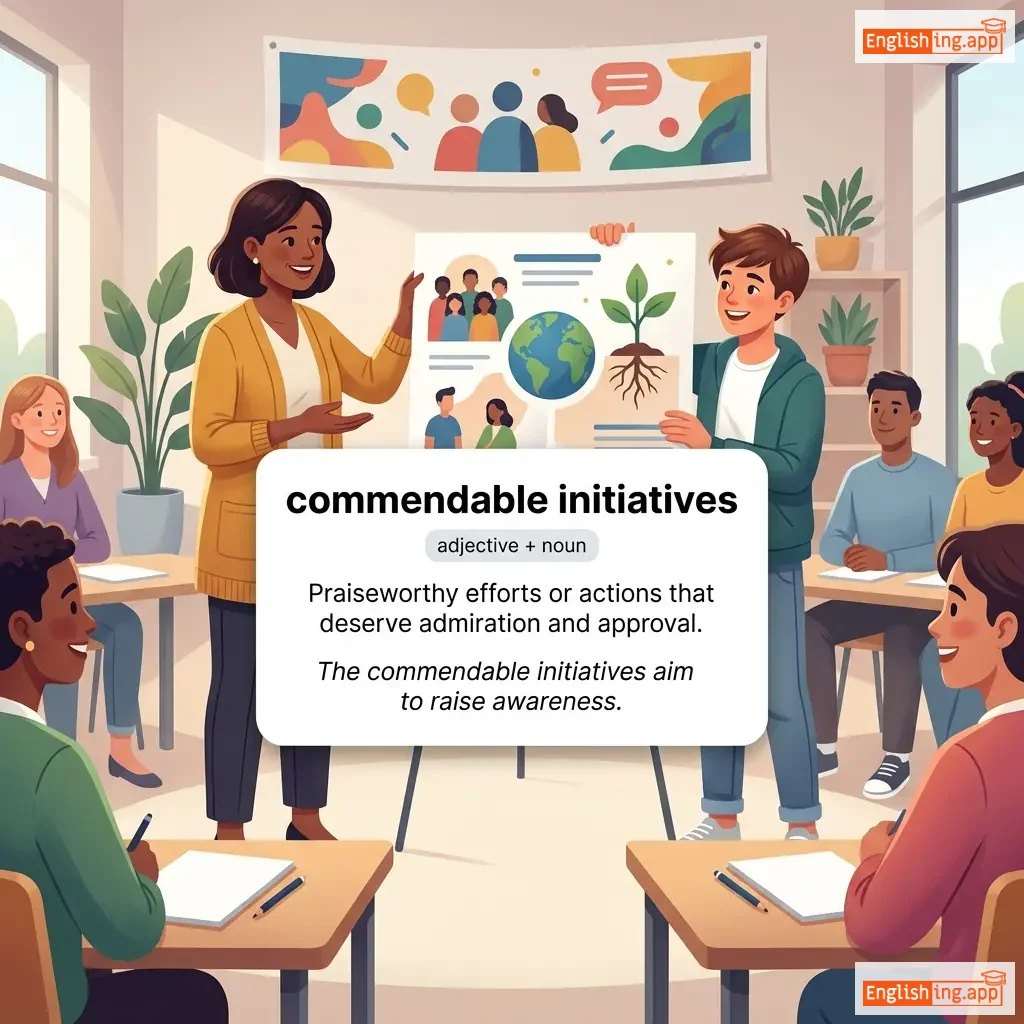
commendable initiatives definition card — visual illustration of the meaning
adjective + noun
kəˈmendəbəl ɪˈnɪʃətɪvz
称賛に値する取り組み (shousan ni ataisuru torikumi)

Praiseworthy efforts or actions that deserve admiration and approval.

"The commendable initiatives aim to raise awareness."

"その賞賛に値するイニシアチブは、認識を高めることを目指しています。" (Sono shousan ni ataisuru inishiatibu wa, ninshiki wo takameru koto wo mezashiteimasu.)
commensurate definition card — visual illustration of the meaning
adjective
/kəˈmɛnʃərət/
比例的 (hireteki)

corresponding in size, degree, or extent; proportionate

"Salary will be commensurate with experience."

"給料は経験に比例します。" (Kyūryō wa keiken ni hire shimasu.)
noun
/ˈkɒm.ent/
コメント (komento)

a verbal or written remark expressing an opinion or reaction

"She posted a kind comment on my photo."

"彼女は私の写真に優しいコメントを投稿しました。" (Kanojo wa watashi no shashin ni yasashī komento o tōkō shimashita.)
noun
/ˈkɒmənˌtɛri/
コメント (komento)

An expression of opinions or explanations about an event, situation, or text.

"The professor's commentary on the novel was insightful."

"教授の小説に対するコメントは洞察に満ちていました。" (Kyouju no shousetsu ni taisuru komento wa dousatsu ni michiteimashita.)
noun
/ˈkɒmənˌteɪtər/
解説者 (kaisetsusha)

a person who reports and discusses events, especially on TV or radio

"The commentator described the football match in detail."

"解説者はサッカーの試合を詳細に説明しました。" (Kaisetsusha wa sakkā no shiai o shōsai ni setsumei shimashita.)
noun
/ˈkɒmɜːs/
商業 (shōgyō)

the activity of buying and selling goods and services

"International commerce has expanded significantly in recent years."

"国際商業は近年顕著に拡大しています。" (Kokusai shōgyō wa kin'nen kencho ni kakudai shiteimasu.)
commercial definition card — visual illustration of the meaning
adjective
/kəˈmɜːʃəl/
商業的 (shōgyō-teki)

Concerned with or engaged in commerce; intended to make a profit.

"The company focused on commercial success rather than artistic value."

"会社は芸術的価値よりも商業的成功に注力しました。" (Kaisha wa geijutsuteki kachi yori mo shōgyō-teki seikō ni chūryoku shimashita.)
verb
/kəˈmɪŋɡəl/
混ぜる (mazeru)

To mix or blend different things together.

"The charity does not commingle donations with operational funds."

"チャリティは寄付金を運営資金と混ぜません。" (Charity wa kifu-kin o un'ei shikin to mazemasen.)
commiserate definition card — visual illustration of the meaning
verb
/kəˈmɪzəˌreɪt/
共感する (kyōkan suru)

To express sympathy or pity for someone.

"Friends came to commiserate with her after the loss."

"友達はその後、彼女と共に悲しみを分かち合うために来ました。" (Tomodachi wa sono ato, kanojo to tomo ni kanashimi o wakachiau tame ni kimashita.)
noun
/ˌkɒməˈsɛəriət/
供給部門 (kyoukyuu bumon)

A department responsible for supplying food and equipment, especially in the military.

"The army commissariat ensured that the soldiers had enough supplies."

"軍隊の供給部門は、兵士たちが十分な物資を持っていることを確認した。" (Guntai no kyoukyuu bumon wa, heishi-tachi ga juubun na busshi wo motte iru koto wo kakunin shita.)
commission definition card — visual illustration of the meaning
noun
/kəˈmɪʃən/

An instruction, command, or duty given to a person or group; also a fee paid to an agent or employee for a transaction.

"The artist received a commission to paint a portrait."

noun
/kəˈmɪʃənər/
コミッショナー (komisshonā)

an official in charge of a particular department or area

"The police commissioner addressed the media about the incident."

"警察のコミッショナーは、事件についてメディアに話しました。" (Keisatsu no komisshonā wa, jiken ni tsuite media ni hanashimashita.)
✍️

commit

verb
/kəˈmɪt/

To carry out or perpetrate an act; to pledge or bind to a course of action.

"He committed a serious mistake in the report."

commitment definition card — visual illustration of the meaning
noun
/kəˈmɪtmənt/

A promise or firm decision to do something; dedication or obligation to a cause or activity.

"She showed great commitment to her studies."

commitments definition card — visual illustration of the meaning
noun
kəˈmɪt.mənts
約束 (yakusoku)

Formal pledges or promises to do something, especially in terms of obligations or agreements.

"Global commitments to renewable energy are increasing."

"再生可能エネルギーに対する世界的な約束が増加しています。" (Saisei kanō enerugī ni taisuru sekaiteki na yakusoku ga zōka shiteimasu.)
noun
/kəˈmɪtl̩/
収監 / 拘束 (shūkan / kōsoku)

The action of sending a person to prison or a mental hospital; also the act of committing something to a particular place.

"The judge ordered the committal of the accused to custody."

"裁判官は被告を拘置所に送るよう命じました。" (Saibankan wa hikoku o kōchisho ni okuru yō meijimashita.)
adjective
/kəˈmɪtɪd/
コミットされた (komitto sareta)

Dedicated and loyal to a cause, activity, or relationship.

"She is a committed teacher who cares deeply for her students."
"彼女は学生たちを深く気にかける、コミットされた教師です。" (Kanojo wa gakusei-tachi o fukaku ki ni kakeru, komitto sareta kyōshi desu.)
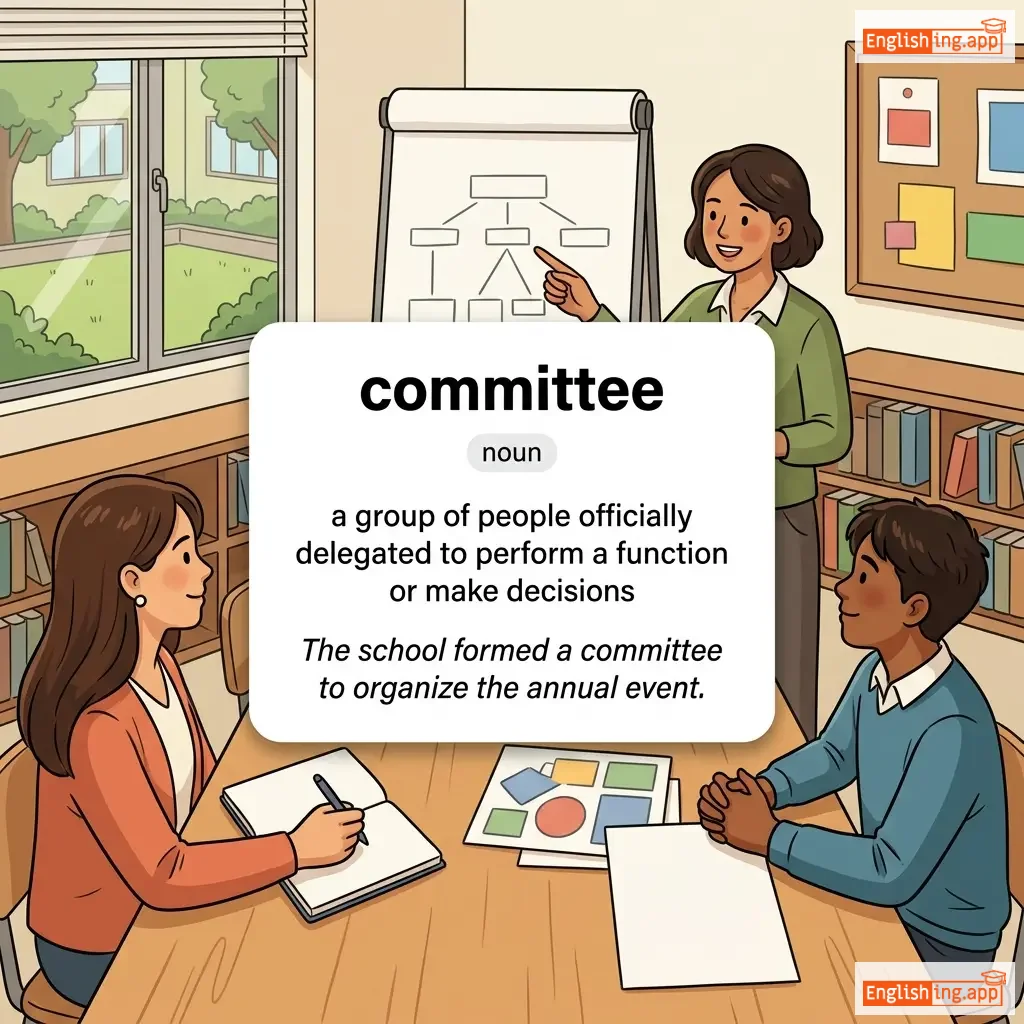
committee definition card — visual illustration of the meaning
noun
/kəˈmɪt.i/
委員会 (iinkai)

a group of people officially delegated to perform a function or make decisions

"The school formed a committee to organize the annual event."
"学校は年次イベントを組織するために委員会を結成しました。" (Gakkō wa nenji ibento o soshiki suru tame ni iinkai o kessei shimashita.)
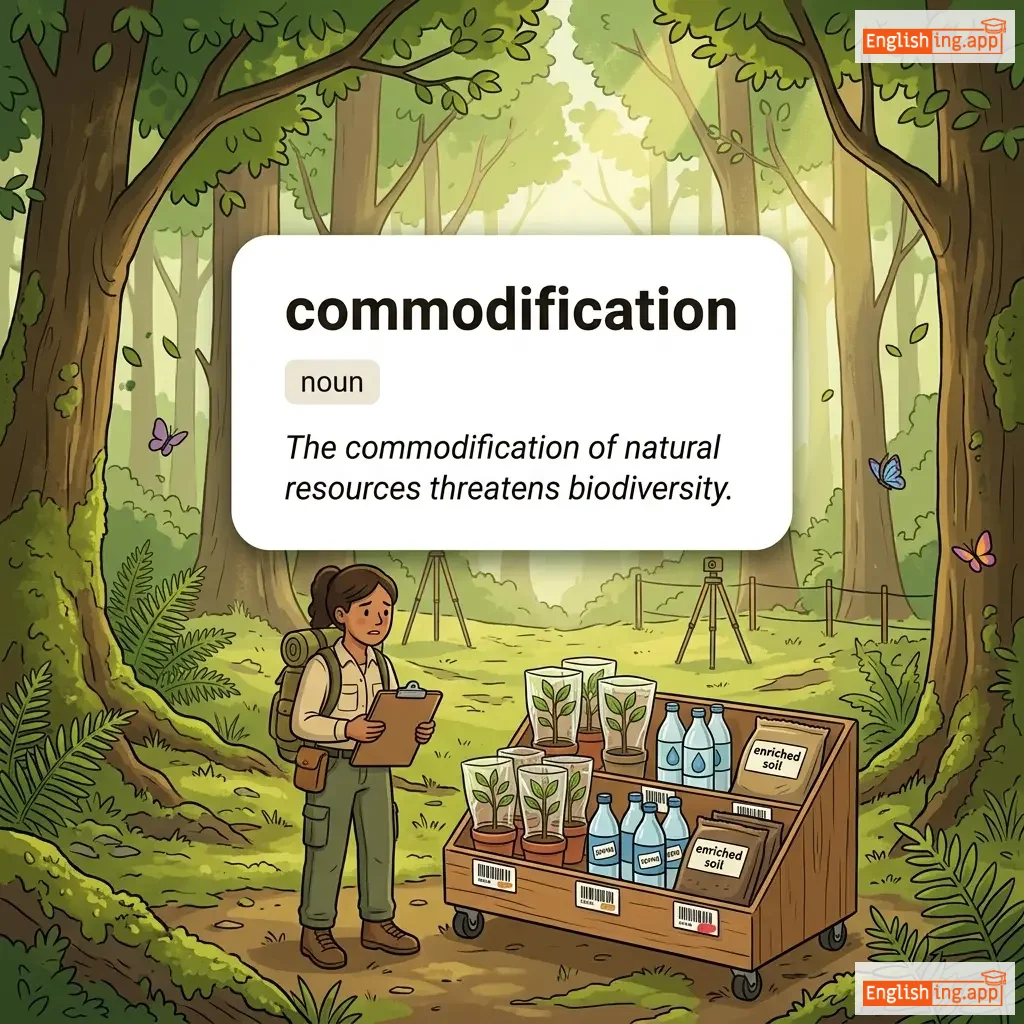
commodification definition card — visual illustration of the meaning
noun
kəˌmɒd.ɪ.fɪˈkeɪ.ʃən
商品、サービス、アイデア、またはその他の存在を市場商品に変換すること (shōhin, sābisu, aidea, matawa sonota no sonzai o shijō shōhin ni henkan suru koto)

The transformation of goods, services, ideas, or other entities that may not normally be considered goods into market goods.

"The commodification of natural resources threatens biodiversity."

"自然資源のコモディフィケーションは生物多様性に脅威を与える。" (Shizen shigen no commodification wa seibutsu tayōsei ni kyōi o ataeru.)
adjective
/kəˈmoʊdiəs/
広々とした (hirohiro to shita)

spacious and comfortable; having plenty of room

"They rented a commodious apartment in the city."
"彼らは街で広々としたアパートを借りました。" (Karera wa machi de hirohiro to shita apāto o karimashita.)
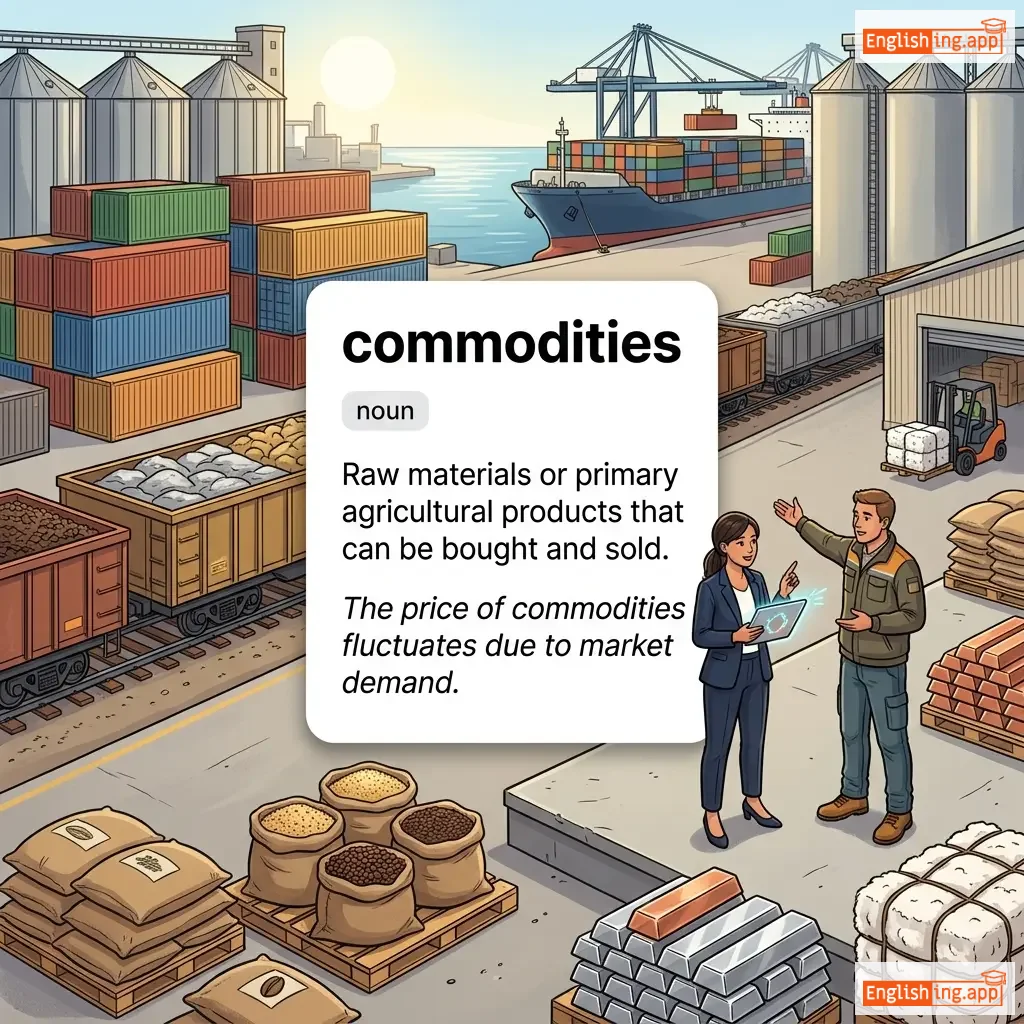
commodities definition card — visual illustration of the meaning
noun
/kəˈmɒd.ə.tiz/
商品 (shōhin)

Raw materials or primary agricultural products that can be bought and sold.

"The price of commodities fluctuates due to market demand."

"商品価格は市場の需要によって変動します。" (Shōhin kakaku wa shijō no juyō ni yotte hendō shimasu.)
commodity definition card — visual illustration of the meaning
noun
/kəˈmɑːdəti/
商品 (shouhin)

a raw material or primary product that can be bought and sold

"Oil is the most traded commodity in the world."

"石油は世界で最も取引されている商品です。" (sekiyu wa sekai de mottomo torihiki sarete iru shouhin desu)
adjective
/ˈkɒm.ən/
共通 (kyoutsuu)

occurring frequently or widely; shared by all

"It is common to see traffic in the city during rush hour."

"ラッシュアワー中に都市で交通渋滞を見るのは一般的です。" (Rasshu awa-chuu ni toshi de koutsuu jyuutai wo miru no wa ippanteki desu)
noun
/ˈkɒmən kɑːp/
コイ (koi)

A large freshwater fish widely cultivated for food

"Common carp is an important fish in aquaculture."

"コイは養殖業で重要な魚です。" (koi wa youshokugyou de juuyou na sakana desu)
adverb
/ˈkɒmənli/
一般的に (ippanteki ni)

usually or by most people

"This phrase is commonly used in everyday speech."

"このフレーズは日常会話で一般的に使われます。" (Kono fureezu wa nichijō kaiwa de ippanteki ni tsukawaremasu.)
adjective, noun
/ˈkɑːmənpleɪs/
ありふれた (arifureta)

ordinary or unremarkable; something that is usual or commonly found

"Smartphones have become commonplace in modern life."

"スマートフォンは現代生活でありふれたものになった。" (sumaatofon wa gendai seikatsu de arifureta mono ni natta.)
adjective
/ˌkɑːmənˈsɛnsɪkəl/
常識的な (joushikiteki na)

based on or showing sound practical judgment; sensible

"It was commonsensical to carry an umbrella on a rainy day."

"雨の日に傘を持つのは常識的なことだった。" (Ame no hi ni kasa o motsu no wa joushikiteki na koto datta.)
noun
/ˈkɑːmənˌwɛlθ/
コモンウェルス (Komonwerusu)

an independent community or state, especially one founded for the common good; also an association of nations

"Australia is a member of the Commonwealth of Nations."

"オーストラリアはコモンウェルス加盟国です。" (Osutoraria wa Komonwerusu kameikoku desu.)
noun
/kəˈmoʊʃən/
騒ぎ (sawagi)

A state of noisy confusion or disturbance.

"The sudden commotion in the market drew everyone's attention."

"市場での突然の騒ぎがみんなの注目を集めた。" (Ichiba de no totsuzen no sawagi ga minna no chumoku o atsumeta.)
adjective
/ˈkɑːmjənl/
共同の (kyoudou no)

Shared by all members of a community; for common use.

"The villagers worked together in the communal garden."
"村人たちは共同の庭で一緒に働いた。" (murabito tachi wa kyoudou no niwa de issho ni hataraita.)
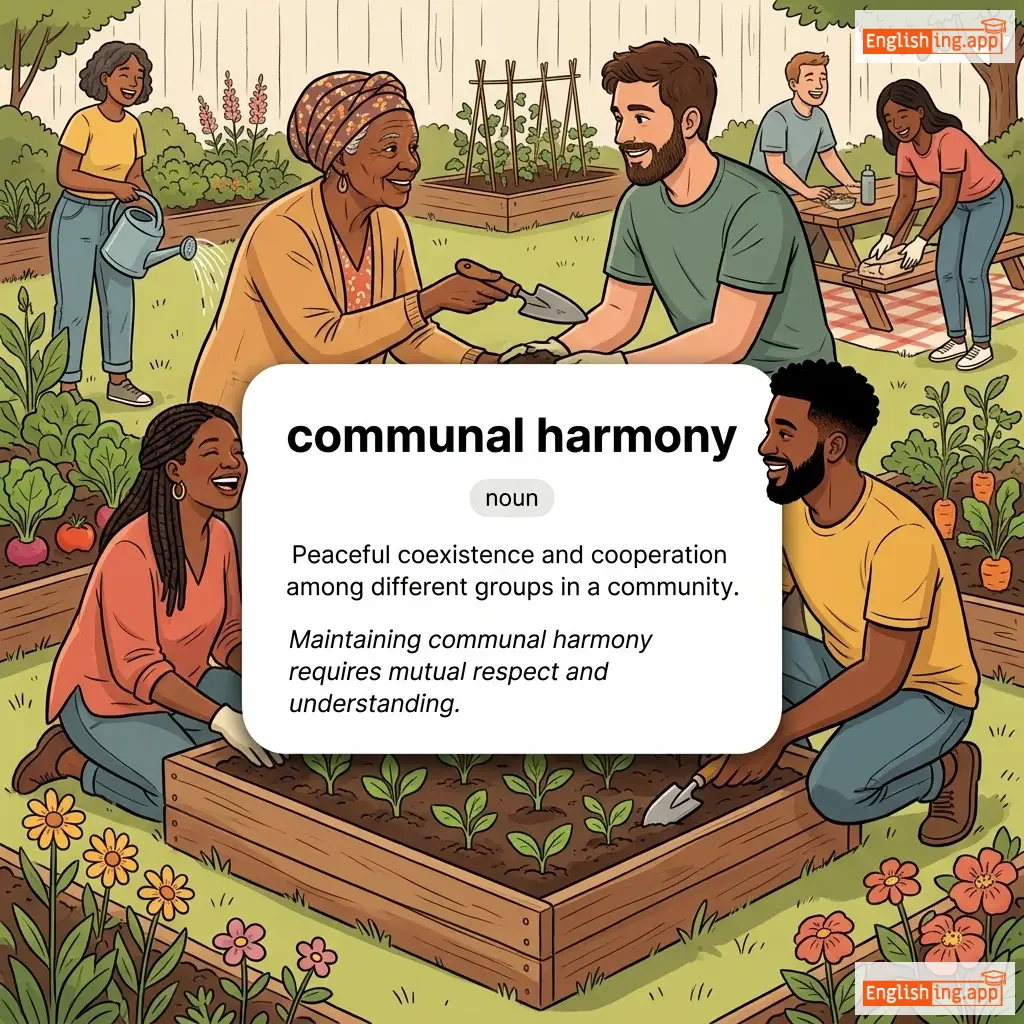
communal harmony definition card — visual illustration of the meaning
noun
kəˈmjunəl ˈhɑrməni
地域の調和 (chiiki no chowa)

Peaceful coexistence and cooperation among different groups in a community.

"Maintaining communal harmony requires mutual respect and understanding."

"地域の調和を維持するには、相互の尊重と理解が必要です。" (chiiki no chowa o iji suru ni wa sogo no soncho to rikai ga hitsuyo desu)
noun, verb
/ˈkɒmjuːn/
共同体 / 心を通わせる (kyodotai / kokoro o kayowaseru)

Noun: a group of people living together and sharing possessions; Verb: to share one's thoughts or feelings intimately.

"She went to the countryside to commune with nature."

"彼女は自然と心を通わせるために田舎に行った。" (kanojo wa shizen to kokoro o kayowaseru tame ni inaka ni itta.)
verb
/kəˈmjuː.nɪ.keɪt/

to share or exchange information, ideas, or feelings

"They used gestures to communicate across the noisy room."

communication definition card — visual illustration of the meaning
noun
/kəˌmjuː.nɪˈkeɪ.ʃən/
コミュニケーション (komyunikeeshon)

the act or process of sharing information, ideas, or feelings

"Good communication is essential for a strong relationship."

"良いコミュニケーションは強い関係には不可欠です。" (Yoi komyunikeeshon wa tsuyoi kankei ni wa fukaketsu desu.)
noun
/ˈkɒmjʊnɪst/

a person who supports or believes in the principles of communism

"The communist ideology aims for a classless society."

noun
/kəˈmjuː.nə.ti/
コミュニティ (komyuniti)

a group of people living in the same place or sharing common interests

"The community worked together to clean the park."

"コミュニティは公園を掃除するために一緒に働きました。" (Komyuniti wa kouen wo souji suru tame ni issho ni hatarakimashita.)
Community Programs definition card — visual illustration of the meaning
noun
kəˈmjuːnɪti ˈprəʊɡræmz
地域プログラム (chiiki puroguramu)

Organized activities involving local groups to promote environmental conservation.

"Community programs raise awareness about butterfly conservation."

"地域プログラムは蝶の保護についての意識を高めます。" (Chiiki puroguramu wa chō no hogo ni tsuite no ishiki o takamemasu.)
community service ideals definition card — visual illustration of the meaning
noun
kəˈmjuːnɪti ˈsɜːrvɪs aɪˈdiːəlz
コミュニティサービスの理想 (Komyuniti sābisu no risō)

Principles and standards of serving the community for social good.

"Community service ideals must be taught in schools."

"コミュニティサービスの理想は学校で教えられるべきです。" (Komyuniti sābisu no risō wa gakkō de oshierareru beki desu.)
verb, noun
/kəˈmjuːt/
通勤 (tsuukin)

Verb: to travel regularly between home and work; Noun: the journey to and from work.

"He commutes two hours every day to reach his office."

"彼は毎日オフィスに着くために二時間通勤している。" (kare wa mainichi ofisu ni tsuku tame ni nijikan tsuukin shite iru)
commuting definition card — visual illustration of the meaning
noun/verb
/kəˈmjuː.tɪŋ/
通勤 (tsūkin)

Regular travel to and from workplace, daily journey for work.

"He spends two hours commuting to work every day."

"彼は毎日仕事に行くために2時間通勤します。" (Kare wa mainichi shigoto ni iku tame ni 2 jikan tsūkin shimasu.)
adjective, noun, verb
/ˈkɒmpækt/ (adj, n), /kəmˈpækt/ (verb)
コンパクト / 小型 / 協定 (konpakuto / kogata / kyotei)

Adjective: closely and neatly packed together; Noun: a small case or agreement; Verb: to pack closely together.

"The car is small and compact, perfect for city driving."
"その車は小さくてコンパクトで、市内の運転に最適です。" (sono kuruma wa chiisakute konpakuto de, shinai no unten ni saiteki desu.)
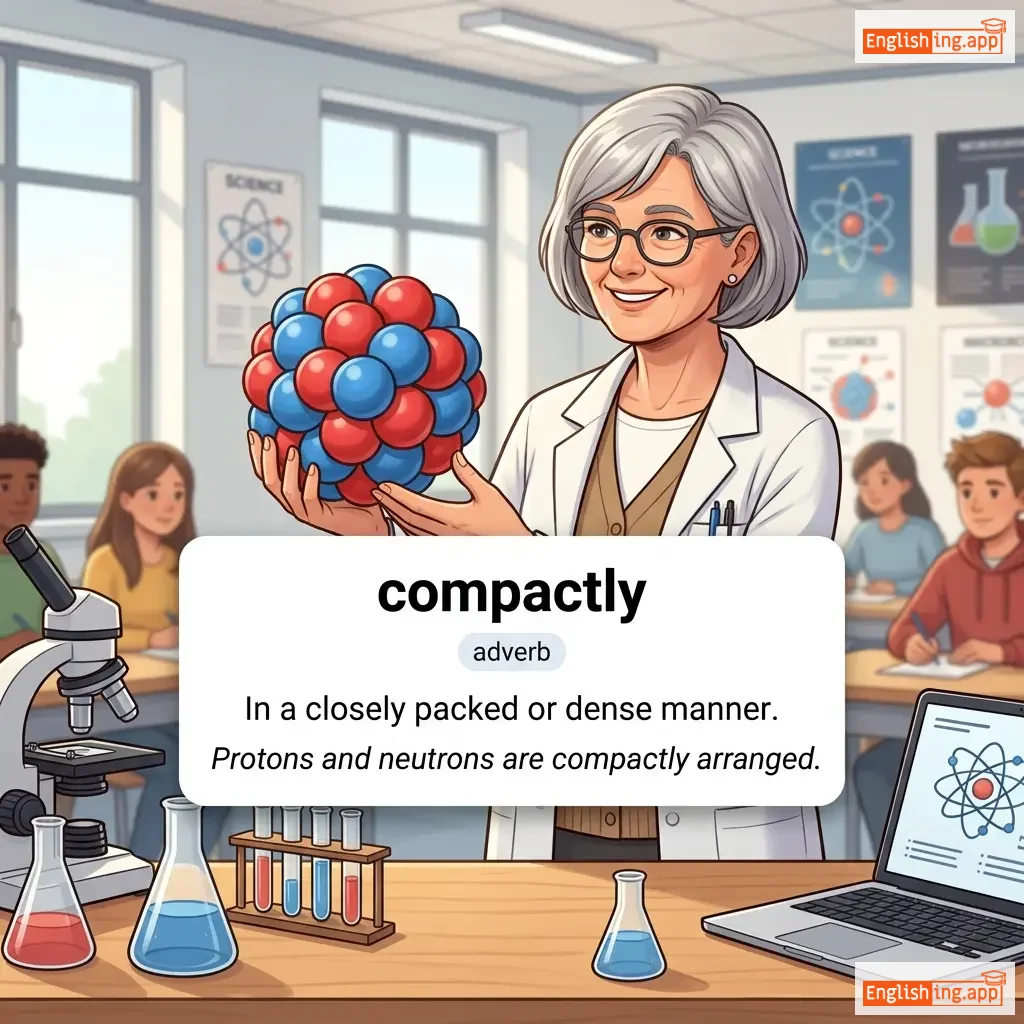
compactly definition card — visual illustration of the meaning
adverb
kəmˈpæktli
コンパクトに (konpakuto ni)

In a closely packed or dense manner.

"Protons and neutrons are compactly arranged."

"陽子と中性子はコンパクトに配置されています。" (Yōshi to chūseishi wa konpakuto ni haichi sareteimasu.)