वोकैबुलरीज

इंग्लिश वोकैबुलरी डिस्कवर, लर्न और मास्टर करें

adjective
/ˈkɔːrəl/
कोरस से संबंधित (koras se sambandhit)

Relating to, written for, or performed by a choir or chorus.

"The church hosted a choral performance on Sunday."

"चर्च ने रविवार को एक कोरल प्रदर्शन आयोजित किया।" (charch ne ravivar ko ek koral pradarshan aayojit kiya.)
noun
/kɔːrd/
संगीत का तार (sangeet ka taar)

A group of musical notes played or sung together; also a straight line segment joining two points on a curve.

"She strummed a simple chord on the guitar."

"उसने गिटार पर एक सरल तार बजाया।" (usne gitar par ek saral taar bajaya.)
noun
/tʃɔːr/
काम (kaam)

A routine task, especially a household duty.

"Washing the dishes is my least favorite chore."

"बर्तन धोना मेरा सबसे कम पसंदीदा काम है।" (bartan dhona mera sabse kam pasandeeda kaam hai.)
noun
/ˌkɔːriˈɒɡrəfi/
नृत्य रचनावली (nritya rachnavali)

The art of designing and arranging dances and movements.

"The choreography of the ballet was breathtaking."

"बैले की कोरियोग्राफी आश्चर्यजनक थी।" (balle ki choreography aashcharyajanak thi.)
verb
/ˈtʃɔːrtl/
ख़ुशी से हंसना (khushi se hansna)

to laugh in a breathy, gleeful way

"The audience chortled at the comedian's witty remarks."

"दर्शकों ने कॉमेडियन की चतुर टिप्पणियों पर ख़ुशी से हंसी" (Darshako ne comedian ki chatur tippaniyon par khushi se hansi)
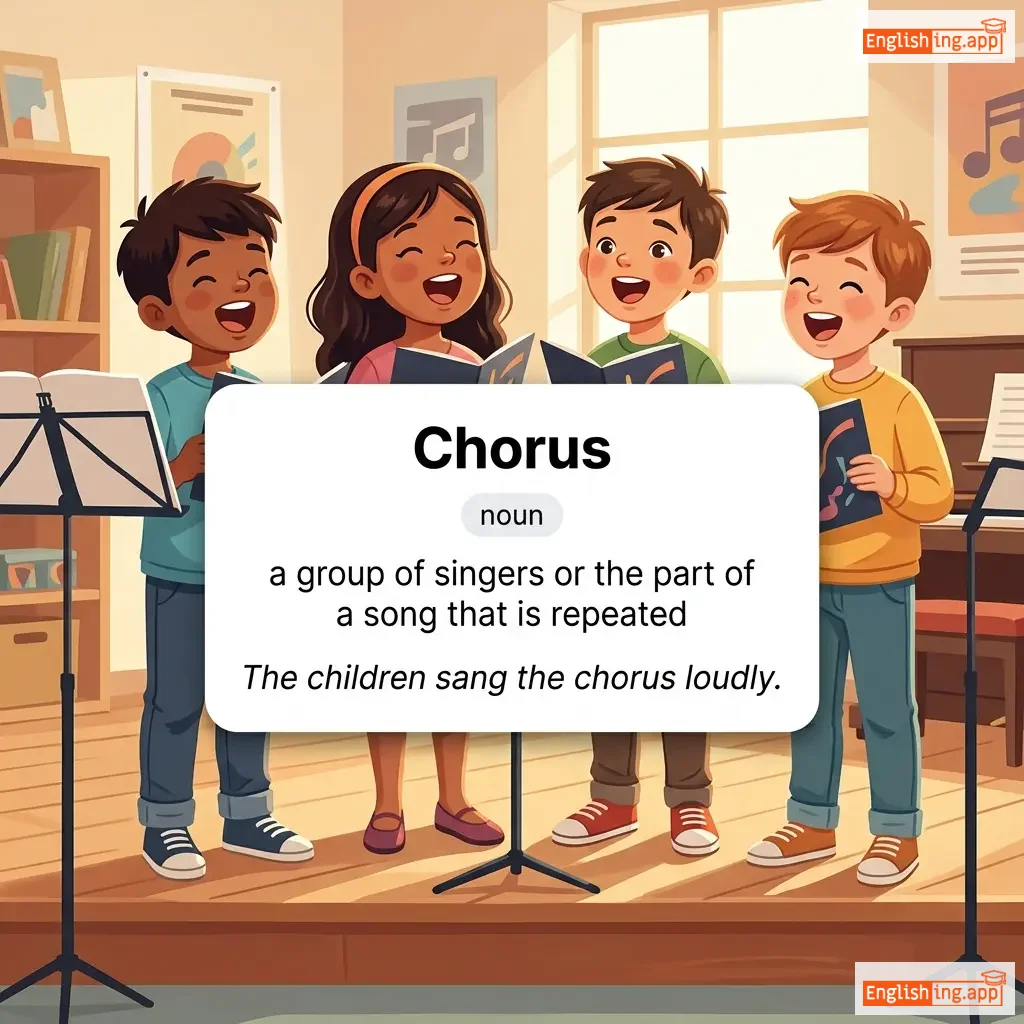
Chorus definition card — visual illustration of the meaning
noun
/ˈkɔːrəs/
कोरस (koras)

a group of singers or the part of a song that is repeated

"The children sang the chorus loudly."

"बच्चों ने जोर से कोरस गाए।" (bachchon ne jor se koras gaaye.)
noun
/kraɪst/
क्राइस्ट (krist)

the title given to Jesus, considered the Messiah in Christianity

"Christ is central to Christian faith."

"क्राइस्ट ईसाई विश्वास के केंद्र में हैं।" (Krist Isai vishwas ke kendra mein hain.)
verb
/ˈkrɪsən/
नामकरण करना (namkaran karna)

to give a name to someone at baptism or to name something officially

"They christened the ship after the queen."

"उन्होंने जहाज का नाम रानी के नाम पर रखा।" (Unhone jahaz ka naam rani ke naam par rakha.)
noun
/ˈkrɪsəndəm/
ईसाई समाज (isaai samaaj)

the worldwide body or community of Christians

"The news spread quickly across Christendom."

"समाचार तेजी से पूरे ईसाई समाज में फैल गया।" (Samaachaar tezi se poore isaai samaaj mein fail gaya.)
noun, adjective
/ˈkrɪstʃən/
क्रिश्चियन (krishtiyan)

a person who follows the religion based on the teachings of Jesus Christ

"She is a devoted Christian who attends church every Sunday."

"वह एक समर्पित क्रिश्चियन है जो हर रविवार चर्च जाता है।" (Vah ek samarpit krishtiyan hai jo har ravivaar church jata hai.)
noun
/ˌkrɪstiˈænɪti/
ईसाई धर्म (isaai dharm)

the religion based on the teachings of Jesus Christ

"Christianity has millions of followers around the world."

"ईसाई धर्म के दुनिया भर में लाखों अनुयायी हैं।" (Isaai dharm ke duniya bhar mein laakhon anuyayi hain.)
noun
/ˈkrɪsməs/
क्रिसमस (krismas)

an annual festival celebrating the birth of Jesus Christ, observed on December 25

"Families gather to celebrate Christmas with joy and love."

"परिवार खुशी और प्रेम के साथ क्रिसमस मनाने के लिए इकट्ठा होते हैं।" (Parivaar khushi aur prem ke saath krismas manane ke liye ikattha hote hain.)
adjective
/krəˈmætɪk/
रंग संबंधी (rang sambandhi)

Relating to colors or, in music, notes outside the standard scale.

"The artist used a chromatic palette to create vibrant contrasts."

"कलाकार ने जीवंत विपरीत बनाने के लिए एक क्रोमैटिक पैलेट का उपयोग किया।" (Kalaakar ne jeevant vipareet banane ke liye ek chromatic palette ka upyog kiya.)
adjective
/ˈkrɒnɪk/
चिरकालिक (chirkalik)

Lasting for a long time or constantly recurring, often describing illness.

"She suffers from chronic back pain."

"वह लंबे समय से क्रॉनिक पीठ दर्द से पीड़ित है।" (Wah lambe samay se chronic peeth dard se peedit hai.)
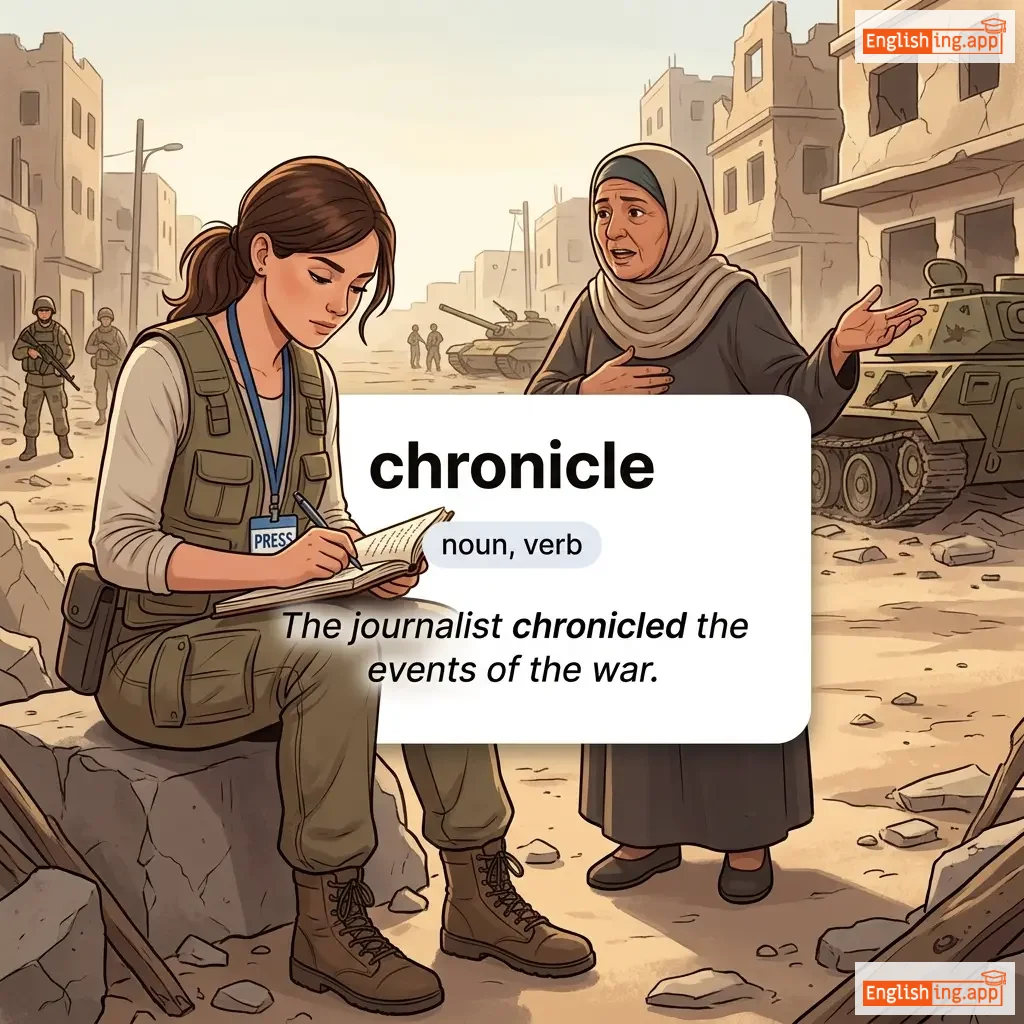
chronicle definition card — visual illustration of the meaning
noun, verb
/ˈkrɒnɪkəl/
क्रॉनिकल (kronikal)

A factual written account of important events in order of time; to record such events.

"The journalist chronicled the events of the war."

"पत्रकार ने युद्ध की घटनाओं का विवरण किया।" (Patrakar ne yudh ki ghatnaon ka vivaran kiya.)
adjective
/ˌkrɒnəˈlɒdʒɪkəl/
कालानुक्रमिक (kalanukramik)

Arranged in the order in which events happened.

"The events were listed in chronological order."

"घटनाएँ कालानुक्रमिक क्रम में सूचीबद्ध की गईं।" (Ghatnaen kalanukramik kram mein suchibaddh ki gayi.)
noun
/krəˈnɒlədʒi/
कालक्रम (kaal kram)

The arrangement of events or dates in the order of their occurrence.

"The chronology of the dynasty was carefully studied by historians."

"वंशावली का कालक्रम इतिहासकारों द्वारा ध्यान से अध्ययन किया गया था।" (Vanshawali ka kaal kram itihaaskaron dwara dhyan se adhyayan kiya gaya tha.)
noun
/krəˈnɒmɪtər/
क्रोनोमीटर (kronomitar)

An instrument for measuring time precisely, especially used in navigation.

"The sailor relied on the chronometer to determine his position at sea."

"नाविक ने समुद्र में अपनी स्थिति निर्धारित करने के लिए क्रोनोमीटर पर निर्भर किया।" (Navik ne samudra mein apni sthiti nirdharit karne ke liye kronomitar par nirbhar kiya.)
adjective
/ˈtʃʌbi/
गोलमटोल (golmatol)

slightly fat in a way that looks healthy and pleasant

"The baby has chubby cheeks."

"बेबी के गाल गोलमटोल हैं।" (Baby ke gaal golmatol hain.)
verb
/ˈtʃʌkəl/
हंसी (hansi)

To laugh quietly or to oneself.

"She chuckled at the joke her friend told."

"वह अपने दोस्त की मजेदार बात पर हंसी रोक नहीं पाई।" (Vah apne dost ki mazedar baat par hansi rok nahin paayi.)
noun
/tʃʌŋk/
टुकड़ा / खंड (tukda / khand)

a thick or solid piece of something

"She cut the cake into large chunks."

"उसने केक को बड़े टुकड़ों में काटा।" (Usne cake ko bade tukdon mein kata.)
noun
/tʃɜːrtʃ/
चर्च (church)

a building used for public Christian worship

"The old church in the village was built in the 18th century."

"गाँव में पुरानी चर्च 18वीं सदी में बनाई गई थी।" (Gaav mein purani church 18vi sadi mein banai gayi thi.)
noun
/tʃɜːrl/
बदतमीज़ व्यक्ति (charl)

A rude, boorish, or ill-mannered person.

"The waiter was such a churl that customers left unhappy."

"वेटर इतना बदतमीज़ था कि ग्राहक नाखुश होकर चले गए।" (vetar itna badtamiz tha ki grahak nakhush hokar chale gaye.)
churlish definition card — visual illustration of the meaning
adjective
/ˈtʃɜːrlɪʃ/
असभ्य (asabhya)

Rude in a mean-spirited and surly way.

"It would be churlish to refuse her kind invitation."

"उसका अच्छे निमंत्रण को नकारना असभ्यता होगी।" (Uska achhe nimantran ko nakarna asabhyata hogi.)
noun
/ˈtʃɜː.nɪŋ stɪk/
चरणिंग स्टिक (churning stick)

a wooden stick used for stirring and churning butter, milk, or other liquids

"Grandmother used a churning stick to make fresh butter."

"दादी ने ताजा मक्खन बनाने के लिए चर्निंग स्टिक का इस्तेमाल किया।" (dadi ne taja makkhan banane ke liye churning stick ka istemal kiya.)
noun
/ˈsɪɡəˌrɛt/
सिगरेट (sigaret)

a small roll of finely cut tobacco wrapped in paper for smoking

"He lit a cigarette after dinner."

"उसने खाने के बाद एक सिगरेट जलाया।" (Usne khane ke baad ek sigaret jalaaya.)
adjective
/ˈsɪlieɪtɪd/
सूक्ष्म बाल जैसी संरचनाएँ (sookshm baal jaise sanrachnaayein)

Having minute hairlike projections (cilia) on the surface of cells or organisms.

"The ciliated cells in the respiratory tract help move mucus out of the lungs."

"श्वसन नलिका में सिलिएटेड कोशिकाएँ श्लेष्मा को फेफड़ों से बाहर निकालने में मदद करती हैं।" (Shwasan nalkika mein ciliated koshikaayein shleshma ko fefdon se baahar nikaalne mein madad karti hain.)
noun
/ˈsɪniæst/
सिनेमाई प्रेमी (cinemai premee)

A film enthusiast or filmmaker; a person deeply interested in cinema.

"As a true cineast, she spends most weekends watching classic films."

"एक सच्चे सिनियास्ट के रूप में, वह अधिकांश सप्ताहांत क्लासिक फिल्में देखती है।" (ek sachche cineast ke roop mein, vah adhikansh saptahant classic filmein dekhti hai.)
noun
/ˈsɪnəmə/
सिनेमा (cinema)

a place where films are shown to the public; the art or industry of making and showing films

"We went to the cinema to watch a new movie."

"हम एक नई फ़िल्म देखने सिनेमा गए।" (hum ek nai film dekhne cinema gaye)
noun
/ˈsɪnəmən/
दारचीनी (darchini)

aromatic spice obtained from the inner bark of several tree species

"Cinnamon is often used in baking and desserts."

"दारचीनी को अक्सर बेकिंग और मिठाइयों में इस्तेमाल किया जाता है।" (darchini ko aksar baking aur mithaiyon mein istemaal kiya jata hai.)
cipher definition card — visual illustration of the meaning
noun
/ˈsaɪfər/
गोपन संकेत (gopan sanket)

A secret or disguised way of writing; a code.

"The spy sent a message written in cipher."

"जासूस ने एक संदेश भेजा जो साइफर में लिखा था।" (jasoos ne ek sandesh bheja jo cipher mein likha tha.)
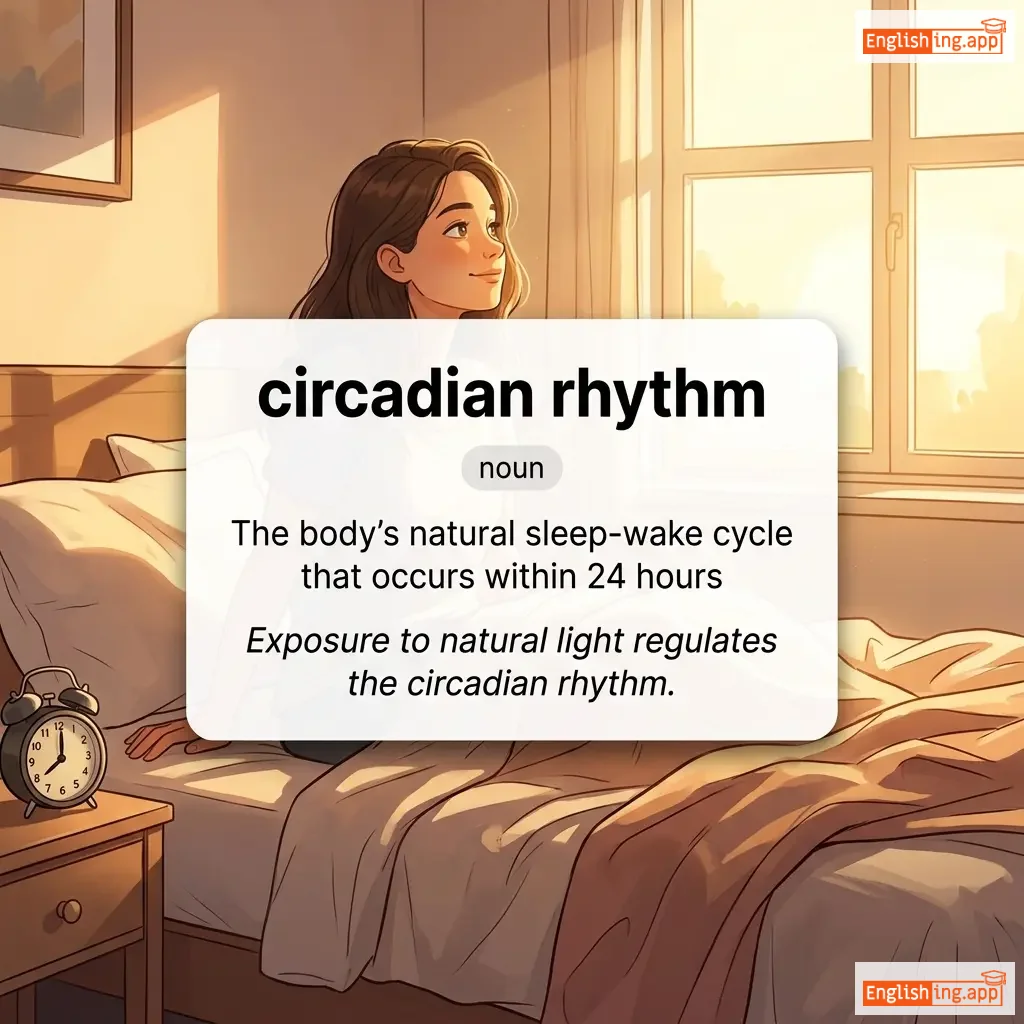
circadian rhythm definition card — visual illustration of the meaning
noun
sɜːrˈkeɪdiən ˈrɪðəm
सर्कैडियन लय (sarkedian lay)

The body's natural sleep-wake cycle that occurs within 24 hours

"Exposure to natural light regulates the circadian rhythm."

"प्राकृतिक प्रकाश शरीर के सर्केडियन रिदम को नियंत्रित करता है।" (Prakritik prakash sharir ke sarkedian ridam ko niyantrit karta hai.)
noun/verb
/ˈsɜːrkəl/
वृत्त (vritt)

a round shape; to move all the way around something

"The children sat in a circle."

"बच्चे एक वृत्त में बैठे थे।" (Bachche ek vritt mein baithe the.)
noun
/ˈsɜːrklət/
टियारा (sarklet)

A small circular band, typically worn as an ornament on the head.

"The princess wore a golden circlet on her forehead."

"राजकुमारी ने अपने माथे पर एक सुनहरा टियारा पहना।" (Rajkumari ne apne mathhe par ek sunahara tiyara pehna.)
noun
/ˈsɜːrkɪt/
परिक्रमण / विद्युत मार्ग (parikraman / vidyut maarg)

A roughly circular line, route, or movement that starts and ends at the same place; also an electrical pathway.

"The runners completed the circuit around the park."

"दौड़ने वालों ने पार्क के चारों ओर परिक्रमण पूरा किया।" (daudne walon ne park ke charon or parikraman poora kiya.)
circuitous definition card — visual illustration of the meaning
adjective
/sərˈkjuːɪtəs/
विकट मार्ग (vikat maarg)

Longer than the most direct way; roundabout.

"He took a circuitous route to avoid traffic."

"उसने यातायात से बचने के लिए विकट मार्ग लिया।" (Usne yaatayaat se bachne ke liye vikat maarg liya.)
adjective
/ˈsɜːrkjələr/
वृत्ताकार (vrittakar)

shaped like a circle; round in form

"The kids sat in a circular arrangement around the campfire."

"बच्चे कैम्पफायर के चारों ओर वृत्ताकार व्यवस्था में बैठे थे।" (Bacche campfire ke charon or vrittakar vyavastha mein baithe the.)
circular economy definition card — visual illustration of the meaning
noun
ˈsɜːrkjələr ɪˈkɒnəmi
वृत्ताकार अर्थव्यवस्था (vrttakar arthvyavastha)

An economic system aimed at eliminating waste and the continual use of resources through reuse, sharing, repair, refurbishment, remanufacturing and recycling.

"Adopting a circular economy can reduce waste."

"सर्कुलर इकॉनमी को अपनाने से कचरा कम हो सकता है।" (Sarkular economy ko apnane se kachra kam ho sakta hai.)
verb
/ˈsɜːrkjəˌleɪt/
प्रसारित करना, घूमना (prasarit karna, ghoomna)

to move continuously or freely through a closed system or area

"Air circulated freely in the open hall."

"हवा खुले हॉल में स्वतंत्र रूप से घूम रही थी।" (Hawa khule hall mein svatantra roop se ghoom rahi thi.)
circulation definition card — visual illustration of the meaning
noun
/ˌsɜːr.kjʊˈleɪ.ʃən/
संचरण (sancharan)

the movement of something (like blood, air, or information) through a system or area.

"The circulation of blood is essential for a healthy body."

"रक्त का संचरण एक स्वस्थ शरीर के लिए आवश्यक है।" (rakt ka sancharan ek swasth sharir ke liye avashyak hai。)
noun
/sərˈkʌmfərəns/
वृत्त की परिधि (vrtt ki paridhi)

the distance around the edge of a circle

"The teacher asked us to calculate the circumference of the circle."

"शिक्षक ने हमें वृत्त की परिधि की गणना करने के लिए कहा।" (Shikshak ne humein vrtt ki paridhi ki ganana karne ke liye kaha.)
noun
/ˌsɜːrkəmləˈkjuːʃn/
वाग्विलंब (waghvilaamb)

the use of many words when fewer would do, especially to avoid stating something directly

"The politician's speech was filled with circumlocution."

"राजनेता का भाषण वाग्विलंब से भरा हुआ था।" (Rajneta ka bhashan waghvilaamb se bhara hua tha.)
verb
/ˌsɜːrkəmˈnævɪɡeɪt/
पृथ्वी का चक्कर लगाना (prithvi ka chakkar lagana)

to travel all the way around something, especially the earth

"Magellan was the first to circumnavigate the globe."

"मैजेलन था पहला जिसने पृथ्वी का चक्कर काटा।" (Magellan tha pehla jisne prithvi ka chakkar kaata.)
verb
/ˈsɜːrkəmskraɪb/
सीमित करना (seemit karna)

to limit or restrict something within boundaries

"The rules circumscribe the powers of the committee."

"नियमों से समिति की शक्तियों को सीमित कर दिया गया।" (Niyamon se samiti ki shaktiyon ko seemit kar diya gaya.)
adjective
/ˈsɜːrkəmskraɪbd/
सीमित (seemit)

restricted or limited in scope or freedom

"Her freedom of choice was circumscribed by social rules."

"उसकी पसंद की स्वतंत्रता सामाजिक नियमों द्वारा सीमित थी।" (Uski pasand ki svatantrata samajik niyamon dwara seemit thi.)
circumspect definition card — visual illustration of the meaning
adjective
/ˈsɜːrkəmspekt/
सतर्क (satark)

careful and unwilling to take risks; cautious

"He was circumspect in his business dealings."

"वह अपने व्यापारिक सौदों में सतर्क था।" (Vah apne vyaparik saudon mein satark tha.)
circumspection definition card — visual illustration of the meaning
noun
ˌsɜːkəmˈspekʃən
सतर्कता, जोखिम लेने से बचना (satarkata, jokhim lene se bachna)

The quality of being wary and unwilling to take risks; prudence.

"His circumspection ensured no mistakes were made."

"उसकी सतर्कता ने सुनिश्चित किया कि कोई गलती नहीं हुई।" (Uski satarkata ne sunishchit kiya ki koi galti nahi hui.)
noun
/ˈsɜːrkəmstæns/
परिस्थिति (paristhiti)

a fact or condition connected with an event or action

"She handled the difficult circumstances bravely."

"उसने कठिन परिस्थितियों का साहस से सामना किया।" (Usne kathin paristhitiyon ka sahas se samna kiya.)
noun
/ˈsɜːrkəmstænsɪz/
परिस्थितियाँ (paristhitiyan)

the conditions or facts that affect a situation

"She was forced to leave due to financial circumstances."

"वह वित्तीय परिस्थितियों के कारण जाने के लिए मजबूर हो गई थी।" (vah vittiya paristhitiyon ke kaaran jaane ke liye majboor ho gayi thi.)
circumvent definition card — visual illustration of the meaning
verb
/ˌsɜːrkəmˈvent/
बचाना (bachana)

to find a way around an obstacle; to avoid a rule or problem cleverly

"The company found a way to circumvent the new tax laws."

"कंपनी ने नए कर कानूनों से बचने का तरीका ढूंढ लिया।" (Company ne naye kar kanoonon se bachne ka tareeka dhoondh liya.)