Vocabulaires

Découvrez, apprenez et maîtrisez le vocabulaire anglais

adjective
/ˈkɔːrəl/
relatif au chœur (relatif au chœur)

Relating to, written for, or performed by a choir or chorus.

"The church hosted a choral performance on Sunday."

"L'église a organisé une performance chorale dimanche." (L'église a organisé une performance chorale dimanche.)
noun
/kɔːrd/
accord musical (accord musical)

A group of musical notes played or sung together; also a straight line segment joining two points on a curve.

"She strummed a simple chord on the guitar."

"Elle a gratté un simple accord à la guitare." (Elle a gratté un simple accord à la guitare.)
noun
/tʃɔːr/
tâche (tache)

A routine task, especially a household duty.

"Washing the dishes is my least favorite chore."

"Laver la vaisselle est ma tâche la moins préférée." (Laver la vaisselle est ma tâche la moins préférée.)
noun
/ˌkɔːriˈɒɡrəfi/
chorégraphie (choregraphie)

The art of designing and arranging dances and movements.

"The choreography of the ballet was breathtaking."

"La chorégraphie du ballet était époustouflante." (La choregraphie du ballet etait epoustouflante.)
verb
/ˈtʃɔːrtl/
rire avec joie (rire avec joie)

to laugh in a breathy, gleeful way

"The audience chortled at the comedian's witty remarks."

"Le public a ri de joie aux remarques ingénieuses du comédien." (Le public a ri de joie aux remarques ingenieuses du comedien.)
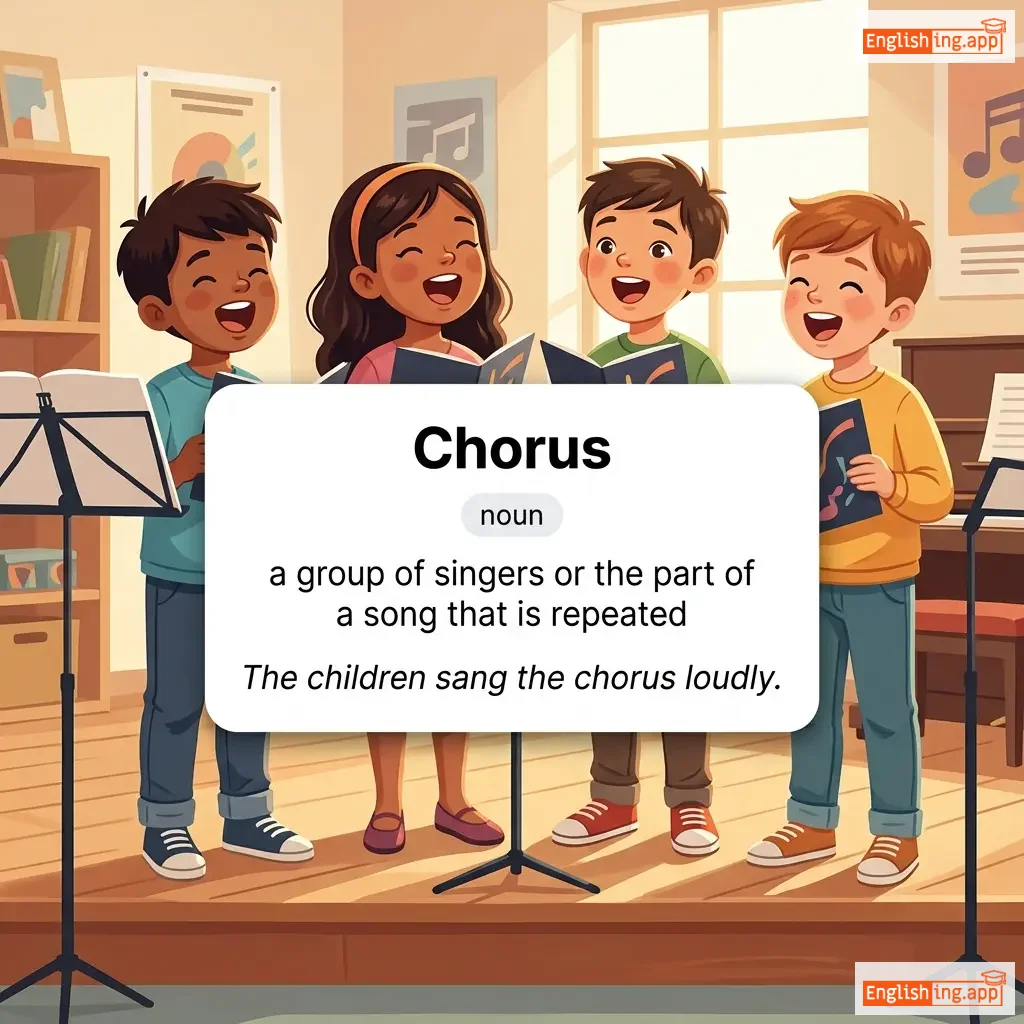
Chorus definition card — visual illustration of the meaning
noun
/ˈkɔːrəs/
chœur (groupe de chanteurs) ou refrain (partie repetee du chant) (chorus)

a group of singers or the part of a song that is repeated

"The children sang the chorus loudly."

"Les enfants ont chanté le chœur à haute voix." (Les enfants ont chante le coeur a haute voix.)
noun
/kraɪst/
Christ (Christ)

the title given to Jesus, considered the Messiah in Christianity

"Christ is central to Christian faith."

"Le Christ est au centre de la foi chrétienne." (Le Christ est au centre de la foi chretienne.)
verb
/ˈkrɪsən/
baptiser (baptizer)

to give a name to someone at baptism or to name something officially

"They christened the ship after the queen."

"Ils ont baptisé le navire après la reine." (Ils ont baptisé le navire après la reine.)
noun
/ˈkrɪsəndəm/
christendom (christendom)

the worldwide body or community of Christians

"The news spread quickly across Christendom."

"La nouvelle s'est rapidement propagée à travers le christendom." (La nouvelle s'est rapidement propagée à travers le christendom.)
noun, adjective
/ˈkrɪstʃən/
chrétien (kretien)

a person who follows the religion based on the teachings of Jesus Christ

"She is a devoted Christian who attends church every Sunday."

"Elle est une chrétienne dévouée qui va à l'église chaque dimanche." (Elle est une chretienne devouee qui va a l'eglise chaque dimanche.)
noun
/ˌkrɪstiˈænɪti/
christianisme (christianisme)

the religion based on the teachings of Jesus Christ

"Christianity has millions of followers around the world."

"Le christianisme a des millions de fidèles dans le monde entier." (Le christianisme a des millions de fideles dans le monde entier.)
noun
/ˈkrɪsməs/
Noël (Noel)

an annual festival celebrating the birth of Jesus Christ, observed on December 25

"Families gather to celebrate Christmas with joy and love."

"Les familles se rassemblent pour célébrer Noël avec joie et amour." (Les familles se rassemblent pour célébrer Noël avec joie et amour.)
adjective
/krəˈmætɪk/
chromatique (chromatique)

Relating to colors or, in music, notes outside the standard scale.

"The artist used a chromatic palette to create vibrant contrasts."

"L'artiste a utilisé une palette chromatique pour créer des contrastes vibrants." (L'artiste a utilise une palette chromatique pour creer des contrastes vibrants.)
adjective
/ˈkrɒnɪk/
chronique (kronik)

Lasting for a long time or constantly recurring, often describing illness.

"She suffers from chronic back pain."

"Elle souffre de douleurs chroniques au dos." (Elle souffre de douleurs chroniques au dos.)
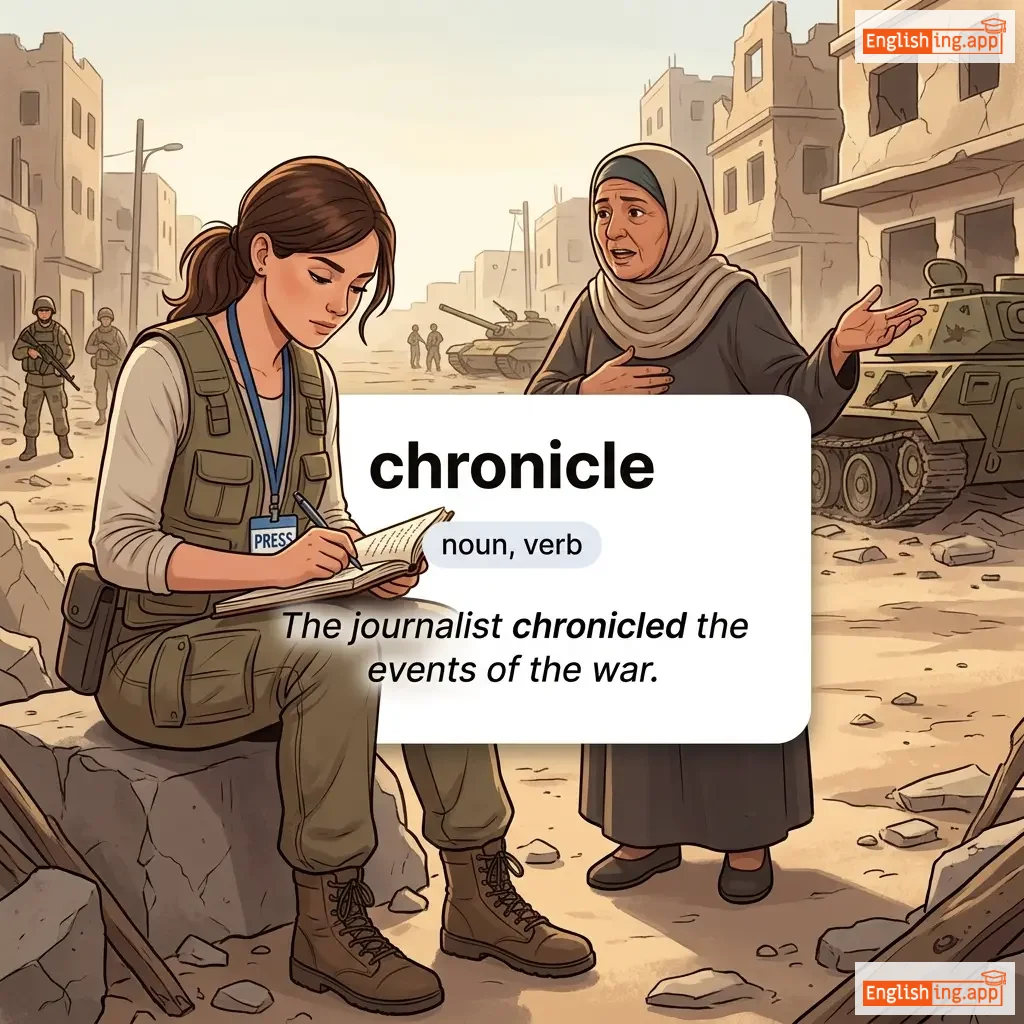
chronicle definition card — visual illustration of the meaning
noun, verb
/ˈkrɒnɪkəl/
chronique (kronik)

A factual written account of important events in order of time; to record such events.

"The journalist chronicled the events of the war."

"Le journaliste a chroniqué les événements de la guerre." (Le journaliste a chroniqué les événements de la guerre.)
adjective
/ˌkrɒnəˈlɒdʒɪkəl/
chronologique (kronologique)

Arranged in the order in which events happened.

"The events were listed in chronological order."

"Les événements ont été listés dans un ordre chronologique." (Les événements ont été listés dans un ordre chronologique.)
noun
/krəˈnɒlədʒi/
chronologie (kronologie)

The arrangement of events or dates in the order of their occurrence.

"The chronology of the dynasty was carefully studied by historians."

"La chronologie de la dynastie a été soigneusement étudiée par les historiens." (La chronologie de la dynastie a été soigneusement étudiée par les historiens.)
noun
/krəˈnɒmɪtər/
chronomètre (kronometre)

An instrument for measuring time precisely, especially used in navigation.

"The sailor relied on the chronometer to determine his position at sea."

"Le marin a compté sur le chronomètre pour déterminer sa position en mer." (Le marin a compte sur le chronometre pour determiner sa position en mer.)
adjective
/ˈtʃʌbi/
dodue (dodue)

slightly fat in a way that looks healthy and pleasant

"The baby has chubby cheeks."

"Le bébé a des joues dodues." (Le bébé a des joues dodues.)
verb
/ˈtʃʌkəl/
rire doucement (rire doucement)

To laugh quietly or to oneself.

"She chuckled at the joke her friend told."

"Elle a ri doucement à la blague que son ami a racontée." (Elle a ri doucement à la blague que son ami a racontée.)
noun
/tʃʌŋk/
morceau / tronçon (morceau / troncon)

a thick or solid piece of something

"She cut the cake into large chunks."

"Elle a coupé le gâteau en gros morceaux." (Elle a coupe le gateau en gros morceaux.)
noun
/tʃɜːrtʃ/
église (eglise)

a building used for public Christian worship

"The old church in the village was built in the 18th century."

"L'ancienne église du village a été construite au XVIIIe siècle." (L'ancienne eglise du village a ete construite au XVIIIe siecle.)
noun
/tʃɜːrl/
rustre (tchurl)

A rude, boorish, or ill-mannered person.

"The waiter was such a churl that customers left unhappy."

"Le serveur était un tel rustre que les clients sont partis mécontents." (Le serveur etait un tel rustre que les clients sont partis mecontents.)
churlish definition card — visual illustration of the meaning
adjective
/ˈtʃɜːrlɪʃ/
rude (rude)

Rude in a mean-spirited and surly way.

"It would be churlish to refuse her kind invitation."

"Ce serait impoli de refuser son aimable invitation." (Ce serait impoli de refuser son aimable invitation.)
noun
/ˈtʃɜː.nɪŋ stɪk/
bâton de barattage (baton de barattage)

a wooden stick used for stirring and churning butter, milk, or other liquids

"Grandmother used a churning stick to make fresh butter."

"La grand-mère a utilisé un bâton de barattage pour faire du beurre frais." (La grand-mere a utilise un baton de barattage pour faire du beurre frais.)
noun
/ˈsɪɡəˌrɛt/
cigarette (cigarette)

a small roll of finely cut tobacco wrapped in paper for smoking

"He lit a cigarette after dinner."

"Il a allumé une cigarette après le dîner." (Il a allumé une cigarette après le dîner.)
adjective
/ˈsɪlieɪtɪd/
ciliée (ciliée)

Having minute hairlike projections (cilia) on the surface of cells or organisms.

"The ciliated cells in the respiratory tract help move mucus out of the lungs."

"Les cellules ciliées dans le tractus respiratoire aident à déplacer le mucus hors des poumons." (Les cellules ciliées dans le tractus respiratoire aident à déplacer le mucus hors des poumons.)
noun
/ˈsɪniæst/
cinéaste (cineaste)

A film enthusiast or filmmaker; a person deeply interested in cinema.

"As a true cineast, she spends most weekends watching classic films."

"En tant que véritable cinéaste, elle passe la plupart de ses week-ends à regarder des films classiques." (En tant que veritable cineaste, elle passe la plupart de ses week-ends a regarder des films classiques.)
noun
/ˈsɪnəmə/
cinéma (cinema)

a place where films are shown to the public; the art or industry of making and showing films

"We went to the cinema to watch a new movie."

"Nous sommes allés au cinéma pour voir un nouveau film." (nous sommes alles au cinema pour voir un nouveau film)
noun
/ˈsɪnəmən/
canelle (canelle)

aromatic spice obtained from the inner bark of several tree species

"Cinnamon is often used in baking and desserts."

"La cannelle est souvent utilisée dans la pâtisserie et les desserts." (La cannelle est souvent utilisee dans la patisserie et les desserts.)
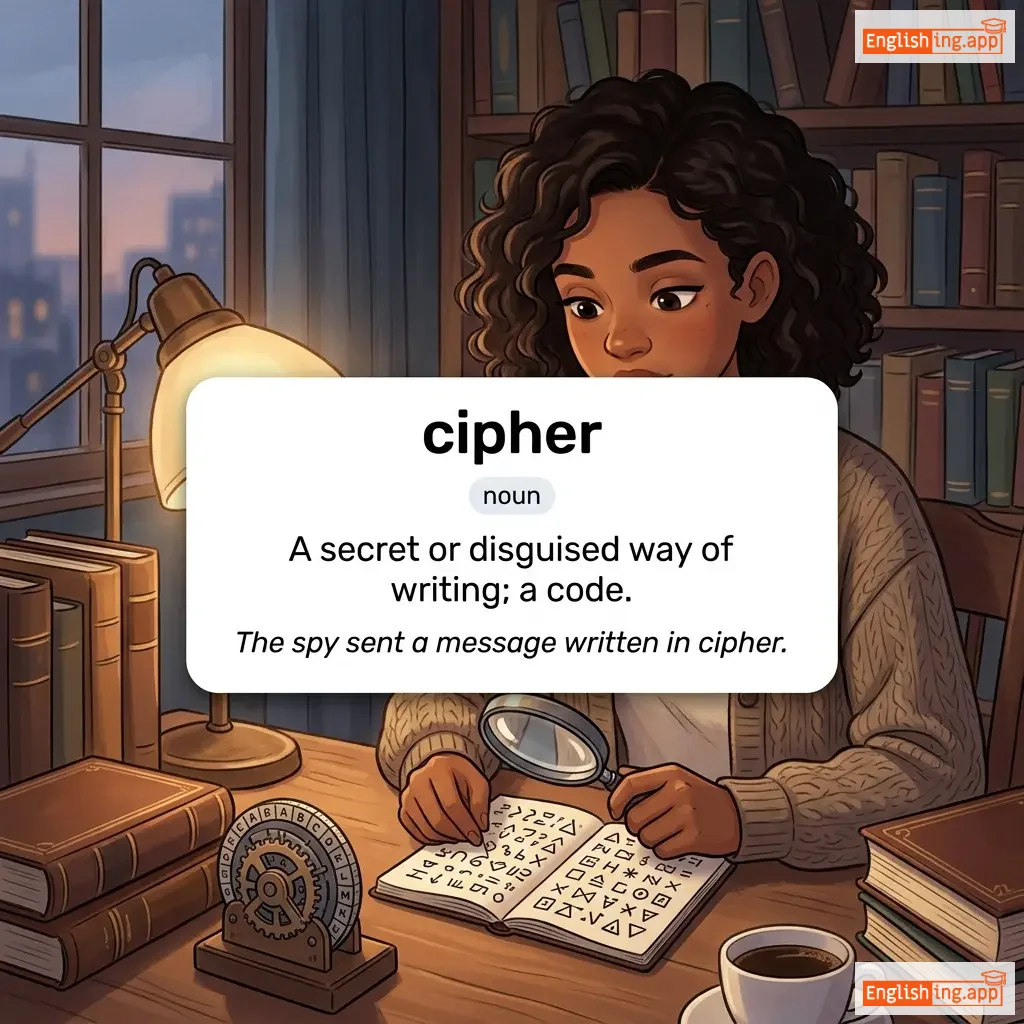
cipher definition card — visual illustration of the meaning
noun
/ˈsaɪfər/
code secret (code secret)

A secret or disguised way of writing; a code.

"The spy sent a message written in cipher."

"L'espion a envoyé un message écrit en chiffre." (L'espion a envoyé un message écrit en chiffre.)
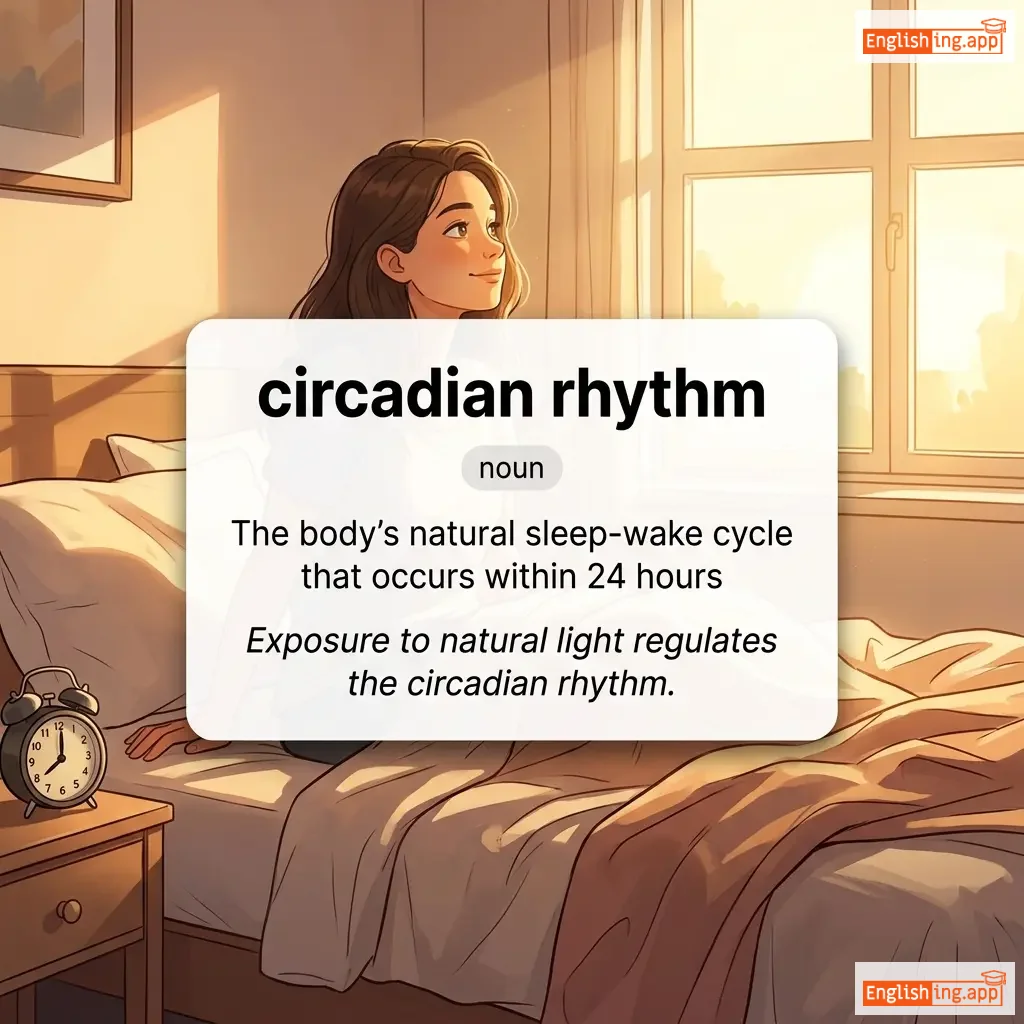
circadian rhythm definition card — visual illustration of the meaning
noun
sɜːrˈkeɪdiən ˈrɪðəm
rythme circadien (rythme circadien)

The body's natural sleep-wake cycle that occurs within 24 hours

"Exposure to natural light regulates the circadian rhythm."

"L'exposition à la lumière naturelle régule le rythme circadien." (L'exposition a la lumiere naturelle regule le rythme circadien.)
noun/verb
/ˈsɜːrkəl/
cercle (serkle)

a round shape; to move all the way around something

"The children sat in a circle."

"Les enfants étaient assis dans un cercle." (Les enfants étaient assis dans un cercle.)
noun
/ˈsɜːrklət/
diadème (serlet)

A small circular band, typically worn as an ornament on the head.

"The princess wore a golden circlet on her forehead."

"La princesse portait un diadème en or sur le front." (La princesse portait un diademe en or sur le front.)
noun
/ˈsɜːrkɪt/
circuit / voie électrique (circuit / voie electrique)

A roughly circular line, route, or movement that starts and ends at the same place; also an electrical pathway.

"The runners completed the circuit around the park."

"Les coureurs ont terminé le circuit autour du parc." (Les coureurs ont termine le circuit autour du parc.)
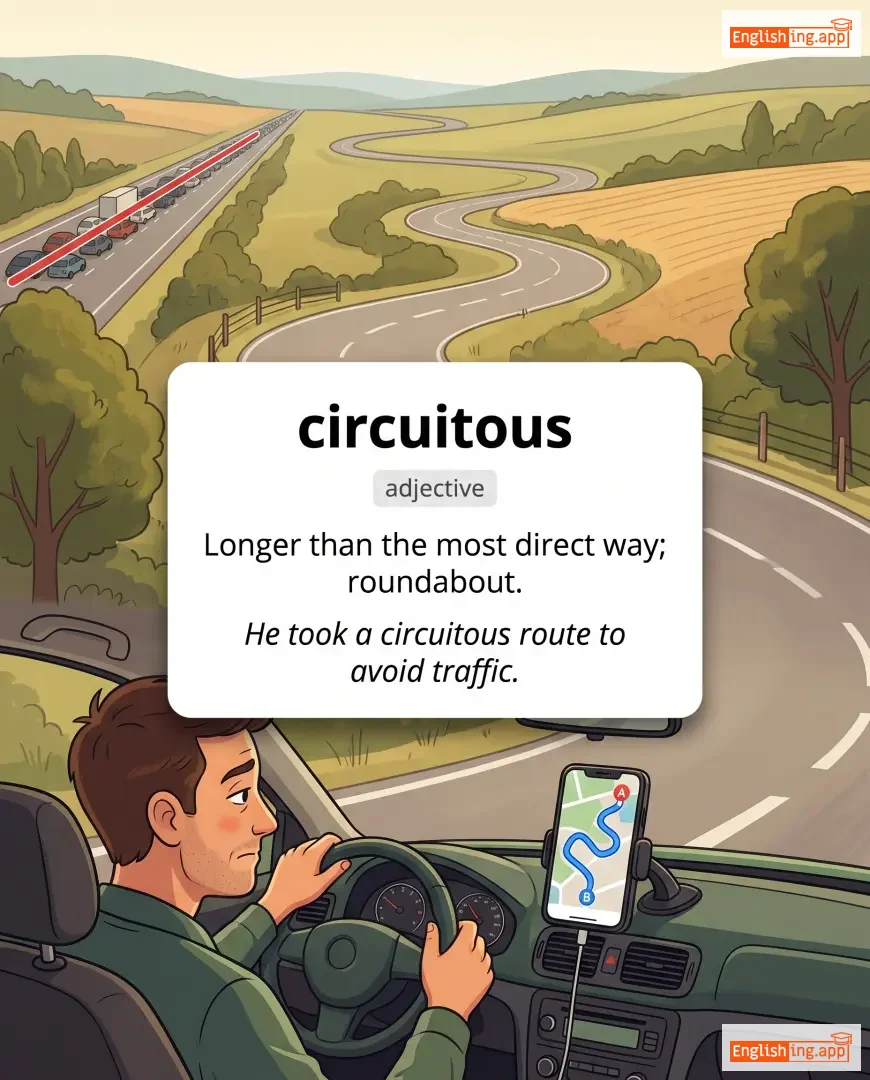
circuitous definition card — visual illustration of the meaning
adjective
/sərˈkjuːɪtəs/
route indirecte (route indirecte)

Longer than the most direct way; roundabout.

"He took a circuitous route to avoid traffic."

"Il a pris une route indirecte pour éviter le trafic." (Il a pris une route indirecte pour éviter le trafic.)
adjective
/ˈsɜːrkjələr/
circulaire (circulaire)

shaped like a circle; round in form

"The kids sat in a circular arrangement around the campfire."

"Les enfants étaient assis en disposition circulaire autour du feu de camp." (Les enfants étaient assis en disposition circulaire autour du feu de camp.)
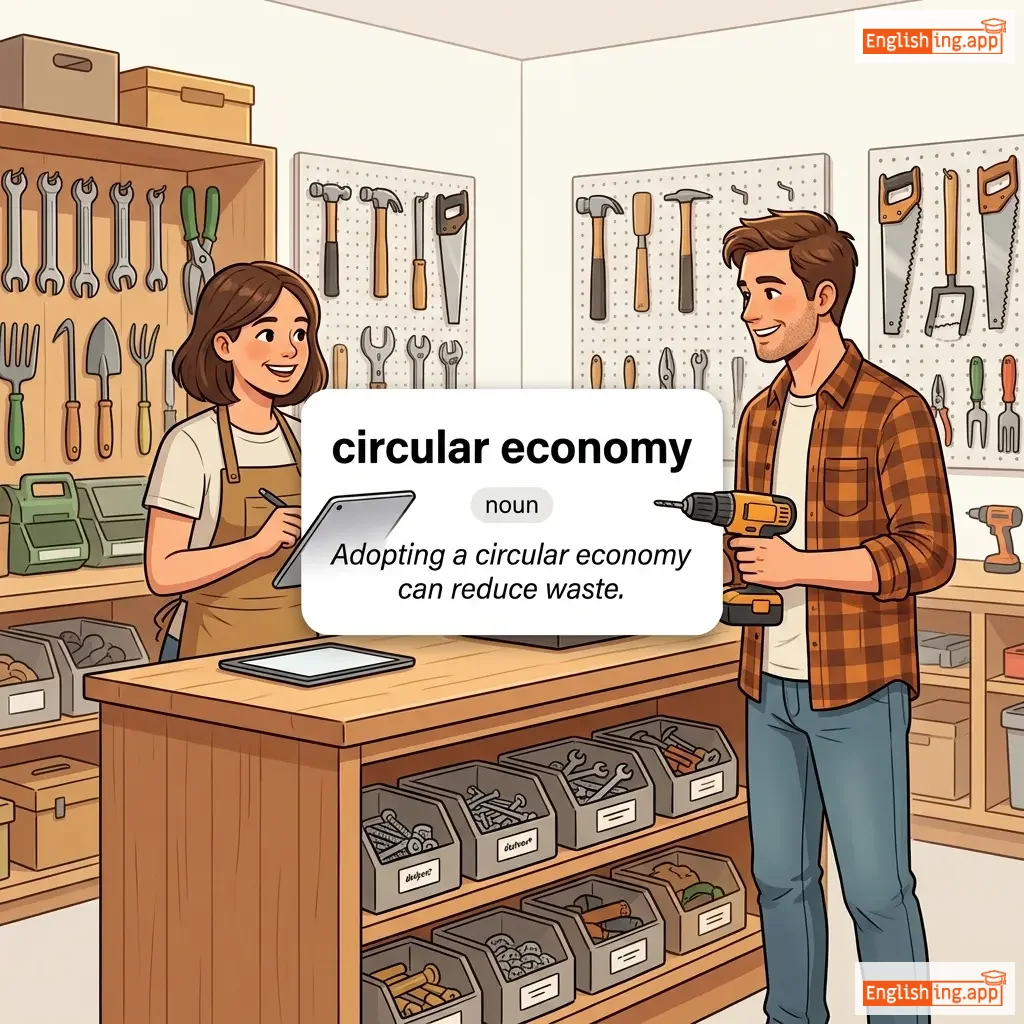
circular economy definition card — visual illustration of the meaning
noun
ˈsɜːrkjələr ɪˈkɒnəmi
économie circulaire (economi circulaire)

An economic system aimed at eliminating waste and the continual use of resources through reuse, sharing, repair, refurbishment, remanufacturing and recycling.

"Adopting a circular economy can reduce waste."

"Adopter une économie circulaire peut réduire les déchets." (Adopter une economie circulaire peut reduire les dechets.)
verb
/ˈsɜːrkjəˌleɪt/
circuler, se déplacer (circuler, se deplacer)

to move continuously or freely through a closed system or area

"Air circulated freely in the open hall."

"L'air circulait librement dans le hall ouvert." (L'air circulait librement dans le hall ouvert.)
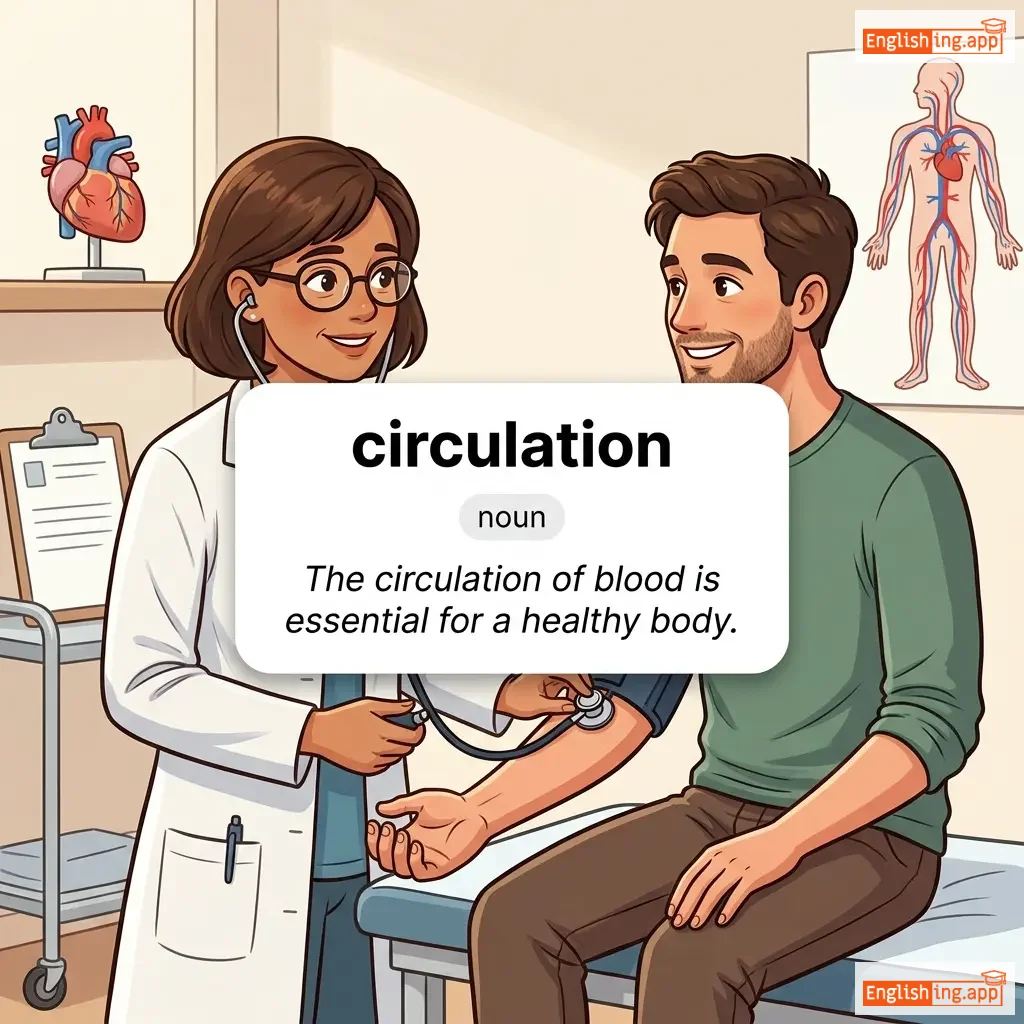
circulation definition card — visual illustration of the meaning
noun
/ˌsɜːr.kjʊˈleɪ.ʃən/
circulation (circulation)

the movement of something (like blood, air, or information) through a system or area.

"The circulation of blood is essential for a healthy body."

"La circulation sanguine est essentielle pour un corps sain." (La circulation sanguine est essentielle pour un corps sain.)
noun
/sərˈkʌmfərəns/
circonférence (circonference)

the distance around the edge of a circle

"The teacher asked us to calculate the circumference of the circle."

"Le professeur nous a demandé de calculer la circonférence du cercle." (Le professeur nous a demandé de calculer la circonférence du cercle.)
noun
/ˌsɜːrkəmləˈkjuːʃn/
circonlocution (circonlocution)

the use of many words when fewer would do, especially to avoid stating something directly

"The politician's speech was filled with circumlocution."

"Le discours du politicien était rempli de circonlocutions." (Le discours du politicien était rempli de circonlocutions.)
verb
/ˌsɜːrkəmˈnævɪɡeɪt/
faire le tour du monde (faire le tour du monde)

to travel all the way around something, especially the earth

"Magellan was the first to circumnavigate the globe."

"Magellan fut le premier à faire le tour du monde." (Magellan fut le premier à faire le tour du monde.)
verb
/ˈsɜːrkəmskraɪb/
circonscrire (circonscrire)

to limit or restrict something within boundaries

"The rules circumscribe the powers of the committee."

"Les règles circonscrivent les pouvoirs du comité." (Les règles circonscrivent les pouvoirs du comité.)
adjective
/ˈsɜːrkəmskraɪbd/
circonscrit (circonscrit)

restricted or limited in scope or freedom

"Her freedom of choice was circumscribed by social rules."

"Sa liberté de choix était circonscrite par les règles sociales." (Sa liberté de choix était circonscrite par les règles sociales.)
circumspect definition card — visual illustration of the meaning
adjective
/ˈsɜːrkəmspekt/
prudent (prudent)

careful and unwilling to take risks; cautious

"He was circumspect in his business dealings."

"Il était prudent dans ses affaires." (Il était prudent dans ses affaires.)
circumspection definition card — visual illustration of the meaning
noun
ˌsɜːkəmˈspekʃən
prudence, éviter les risques (prudence, eviter les risques)

The quality of being wary and unwilling to take risks; prudence.

"His circumspection ensured no mistakes were made."

"Sa prudence a garanti qu'aucune erreur n'a été commise." (Sa prudence a garanti qu'aucune erreur n'a ete commise.)
noun
/ˈsɜːrkəmstæns/
circonstance (circonstance)

a fact or condition connected with an event or action

"She handled the difficult circumstances bravely."

"Elle a courageusement géré les circonstances difficiles." (Elle a courageusement gere les circonstances difficiles.)
noun
/ˈsɜːrkəmstænsɪz/
circonstances (circonstances)

the conditions or facts that affect a situation

"She was forced to leave due to financial circumstances."

"Elle a été obligée de partir en raison des circonstances financières." (Elle a été obligée de partir en raison des circonstances financières.)
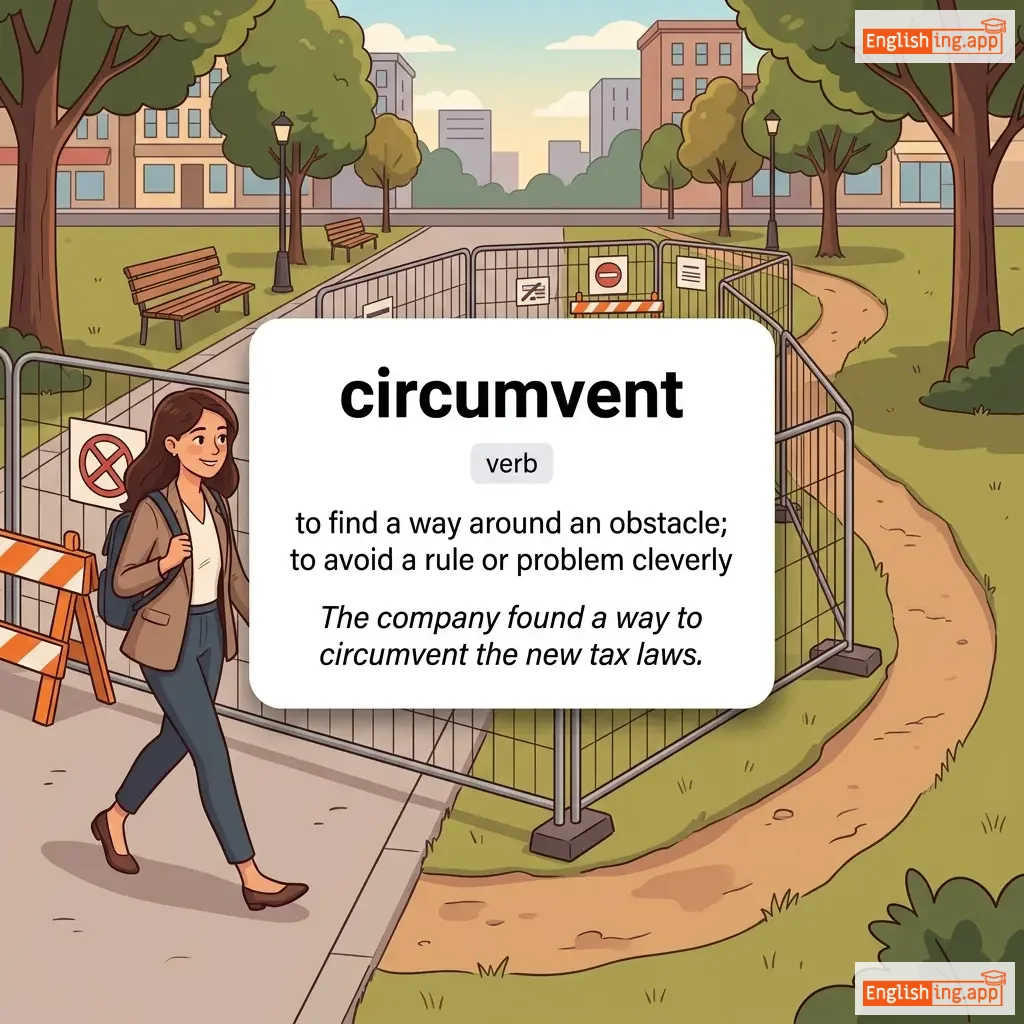
circumvent definition card — visual illustration of the meaning
verb
/ˌsɜːrkəmˈvent/
contourner (contourner)

to find a way around an obstacle; to avoid a rule or problem cleverly

"The company found a way to circumvent the new tax laws."

"L'entreprise a trouvé un moyen de contourner les nouvelles lois fiscales." (L'entreprise a trouvé un moyen de contourner les nouvelles lois fiscales.)