Vocabulaires

Découvrez, apprenez et maîtrisez le vocabulaire anglais

noun
/ˌɛərəˈstætɪks/
aérostatique (aerostatique)

The branch of physics that deals with the equilibrium of air and gases and the forces acting on bodies in them.

"Aerostatics is essential for understanding how balloons float."

"L'aérostatique est essentielle pour comprendre comment les ballons flottent." (L'aerostatique est essentielle pour comprendre koman le ballon flott.)
noun
/ˈɪəri/ or /ˈɛəri/
nid de l'aigle (nid de l'aigle)

An eagle’s nest, or a lofty, airy dwelling.

"The eagle perched proudly near its aery high on the cliff."

"L'aigle s'est perché fièrement près de son aire, en haut de la falaise." (L'aigle s'est perche fièrement près de son aire, en haut de la falaise.)
noun
/ˈiːsθiːt/ or /ˈɛsθiːt/
esthète (esthete)

A person who has a special appreciation of art and beauty.

"The aesthete admired the subtle details of the painting."

"L'esthète admirait les détails subtils de la peinture." (L'esthete admirait les details subtils de la peinture.)
Aesthetic definition card — visual illustration of the meaning
adjective
/ɛsˈθɛtɪk/
esthétique (esthetique)

concerned with beauty or the appreciation of beauty

"The room was decorated in an aesthetic style that pleased everyone."

"La pièce était décorée dans un style esthétique qui a plu à tout le monde." (La piece etait decorée dans un style esthetique qui a plu a tout le monde.)
adjective
/iːsˈθɛθɪkəl/
esthétique (esthetique)

concerned with beauty or the appreciation of beauty; related to artistic taste or appearance

"The architect focused on the aesthetical balance of the building."

"L’architecte s’est concentré sur l’équilibre esthétique du bâtiment." (L architecte s est concentre sur l equilibre esthetique du batiment)
adverb
/iːsˈθetɪkli/
esthétiquement (esthetiquement)

in a way that is concerned with beauty or visual appeal

"The building is aesthetically pleasing despite its simple design."

"Le bâtiment est esthétiquement agréable malgré son design simple." (le batiment est esthetiquement agreable malgre son design simple)
aesthetics definition card — visual illustration of the meaning
noun
esˈθet.ɪks
esthétique (esthetique)

A set of principles concerned with the nature and appreciation of beauty, especially in art and design.

"Interior design focuses on aesthetics and functionality."

"Le design d'intérieur se concentre sur l'esthétique et la fonctionnalité." (Le design d'interieur se concentre sur l'esthetique et la fonctionnalite.)
adjective
/ˈæfəbəl/
affable (affable)

friendly, easy to talk to, and pleasant in manner

"He is such an affable host that everyone feels comfortable at his parties."

"C'est un hôte tellement affable que tout le monde se sent à l'aise à ses fêtes." (C'est un hote tellement affable que tout le monde se sent a l'aise a ses fetes.)
noun
/əˈfɛər/
affaire / relation (affaire / relation)

an event, situation, or relationship, often one that is private or romantic

"The scandal became the most talked-about affair of the year."

"Le scandale est devenu l'affaire la plus commentée de l'année." (Le scandale est devenu l'affaire la plus commente de l'annee.)
verb
/əˈfɛkt/
affecter (affecter)

to influence or make a difference to something

"The weather can greatly affect our mood."

"Le temps peut grandement affecter notre humeur." (Le temps peut grandement affecter notre humeur.)
noun
/ˌæfɛkˈteɪʃən/
affectation (afektasyon)

an unnatural behavior or speech intended to impress others

"Her British accent was just an affectation to sound sophisticated."

"Son accent britannique n'était qu'une affectation destinée à paraître sophistiquée." (son accent britannique netait quune affectation destinee a paraitre sophistiquee)
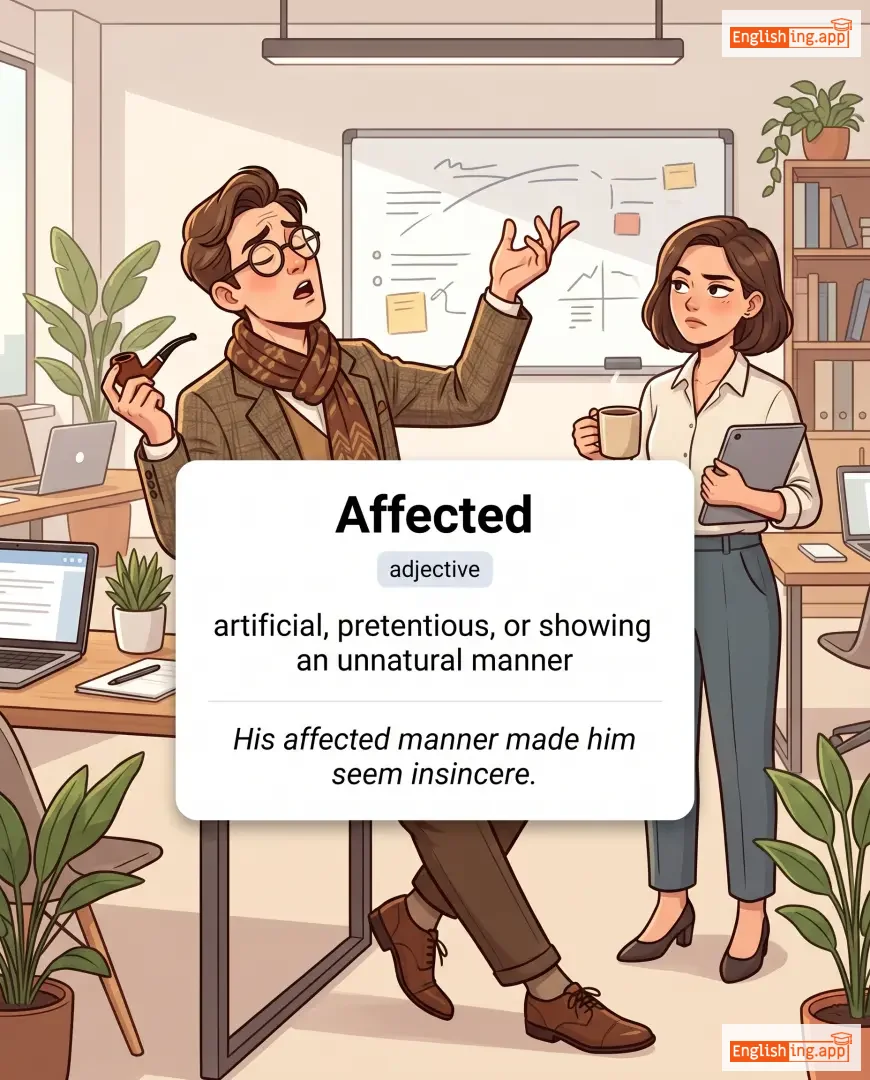
Affected definition card — visual illustration of the meaning
adjective
/əˈfɛktɪd/
affecté (affecte)

artificial, pretentious, or showing an unnatural manner

"His affected manner made him seem insincere."

"Sa manière affectée le faisait paraître insincère." (Sa maniere affectee le faisait paraitre insincere.)
noun
/əˈfɛkʃən/
affection (affection)

a gentle feeling of fondness or liking

"She showed great affection for her younger brother."

"Elle a montré une grande affection pour son frère cadet." (Elle a montre une grande affection pour son frere cadet)
adjective
/əˈfekʃənət/
affectueux; tendre; aimant; montrant de l'affection (affectueux; tendre; aimant; montrant de l'affection)

loving; caring; tender; showing affection

"She is very affectionate towards her children."

"Elle est très affectueuse envers ses enfants." (Elle est très affectueuse envers ses enfants.)
adverb
/əˈfek.ʃən.ət.li/
affectueusement (affectueusement)

in a way that shows feelings of liking or love; with fondness and care

"She hugged her grandmother affectionately."

"Elle a étreint sa grand-mère affectueusement." (Elle a etreint sa grand-mère affectueusement.)
adjective
/ˈæfərənt/
afférent (afferent)

carrying impulses toward a central organ or part, especially toward the brain or spinal cord

"Afferent nerves carry signals from the body to the brain."

"Les nerfs afférents transportent des signaux du corps vers le cerveau." (Les nerfs afférents transportent des signaux du corps vers le cerveau.)
verb
/əˈfaɪəns/
fiancer (fiancer)

to promise or pledge marriage; to formally engage

"They decided to affiance after years of friendship."

"Ils ont décidé de se fiancer après des années d’amitié." (Ils ont decide de se fiancer apres des annees damitie)
noun
/ˌæfəˈdeɪvɪt/
déclaration sous serment (declaration sous serment)

a written statement confirmed by oath or affirmation, used as evidence in court

"The witness submitted an affidavit to the court."

"Le témoin a soumis un affidavit au tribunal." (Le temoin a soumis un affidavit au tribunal.)
verb
/əˈfɪliˌeɪt/
affilier (affilier)

to officially attach or connect (a group or organization) to a larger body

"The school is affiliated with the local university."

"L'école est affiliée à l'université locale." (L'école est affiliée à l'université locale.)
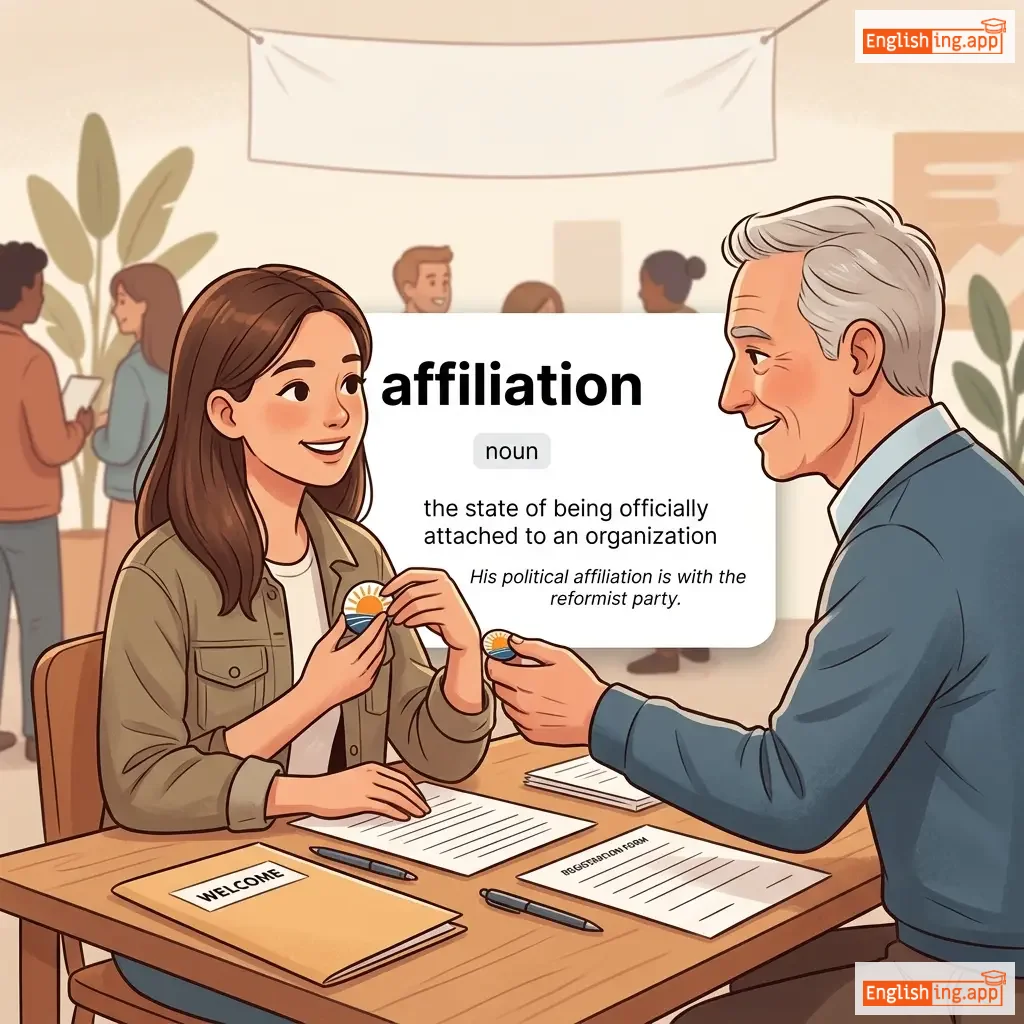
affiliation definition card — visual illustration of the meaning
noun
/əˌfɪliˈeɪʃən/
affiliation (affiliation)

the state of being officially attached to an organization

"His political affiliation is with the reformist party."

"Son affiliation politique est avec le parti réformiste." (Son affiliation politique est avec le parti reformiste.)
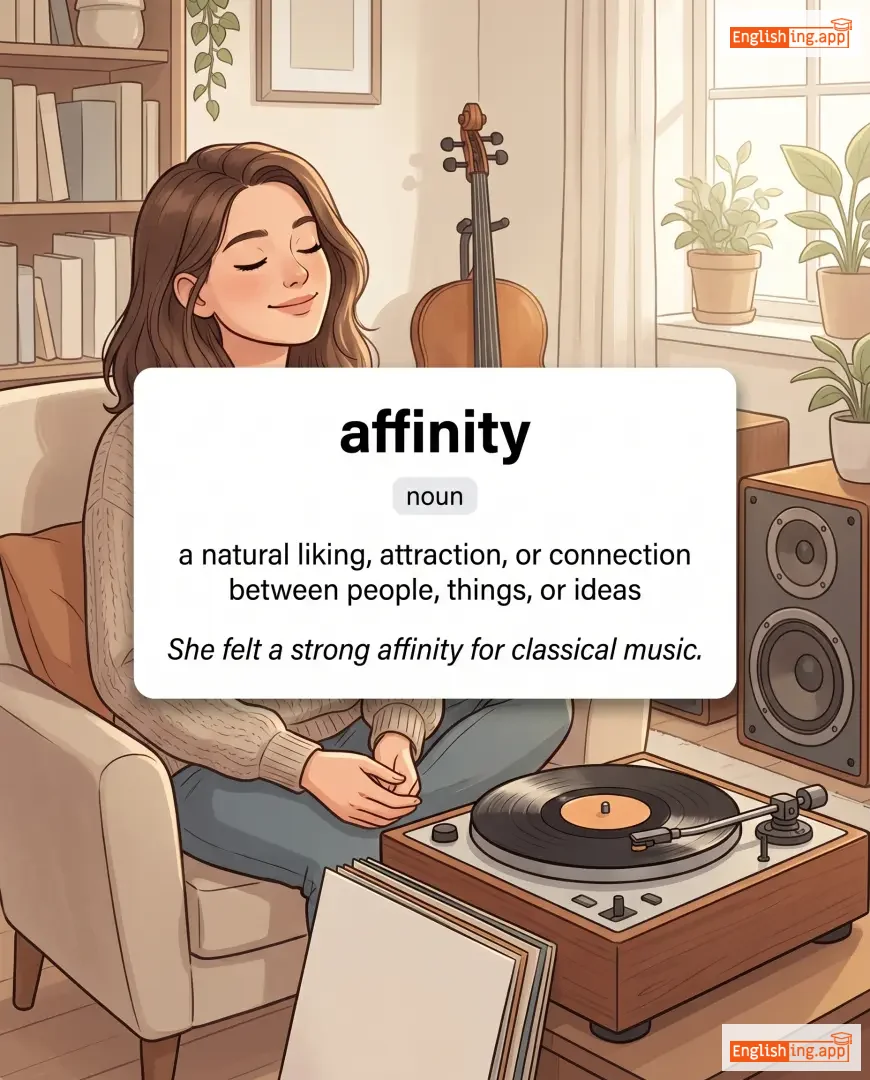
affinity definition card — visual illustration of the meaning
noun
/əˈfɪnɪti/
affinité (affinite)

a natural liking, attraction, or connection between people, things, or ideas

"She felt a strong affinity for classical music."

"Elle ressentait une forte affinité pour la musique classique." (Elle ressentait une forte affinité pour la musique classique.)
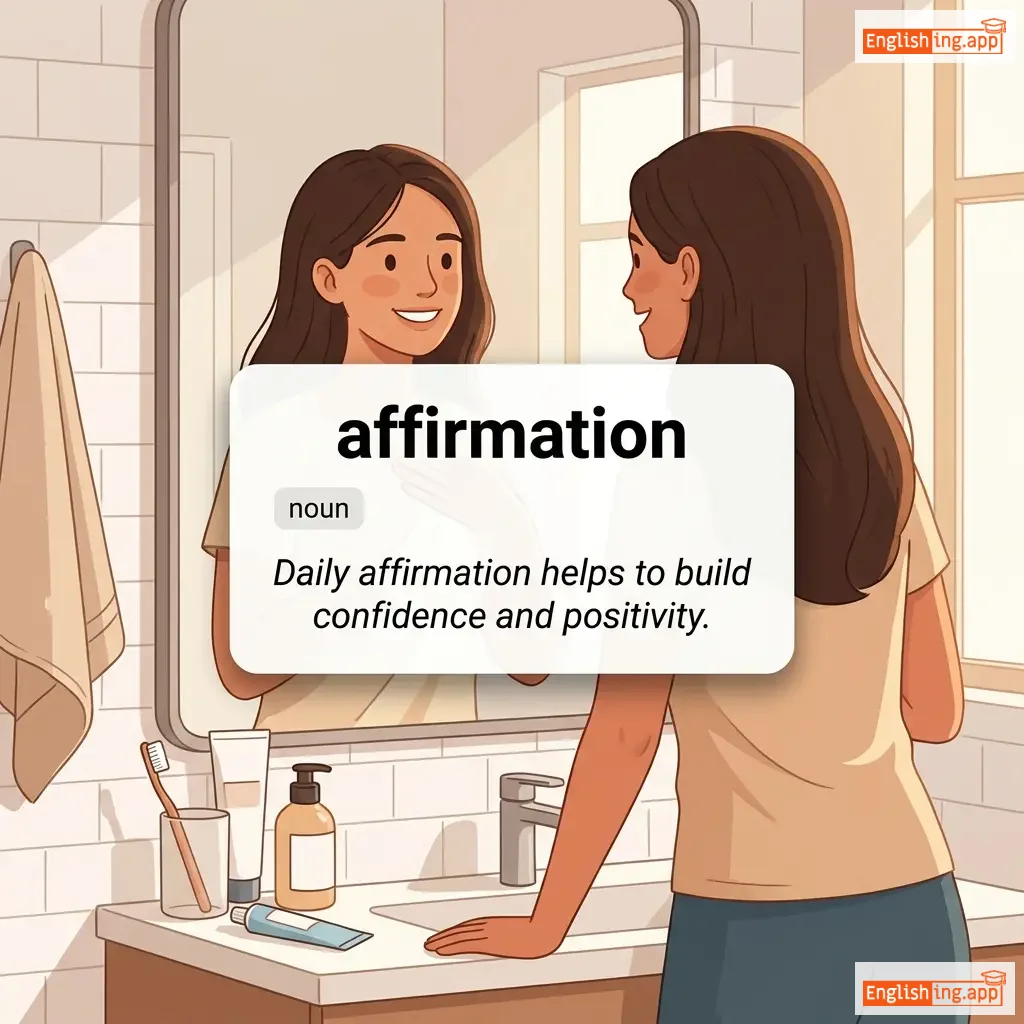
affirmation definition card — visual illustration of the meaning
noun
/ˌæfərˈmeɪʃən/
affirmation (affirmation)

the act of confirming or stating something positively; a declaration of support or belief

"Daily affirmation helps to build confidence and positivity."

"L'affirmation quotidienne aide à renforcer la confiance et la positivité." (L affirmation quotidienne aide a renforcer la confiance et la positivite)
adjective
/əˈfɜːrmətɪv/
affirmatif (affirmatif)

expressing agreement, approval, or a positive response

"She gave an affirmative answer to the proposal."

"Elle a donné une réponse affirmative à la proposition." (Elle a donné une réponse affirmative à la proposition.)
verb
/əˈfɪks/
fixer / coller (fixer / coller)

to attach or stick something firmly to another thing

"Please affix the stamp to the envelope."

"Veuillez apposer le timbre sur l'enveloppe." (Veuillez apposer le timbre sur l'enveloppe.)
noun
/əˈfleɪtəs/
inspiration divine (inspiration divine)

a sudden divine inspiration or creative impulse

"The poet wrote the verses under a sudden afflatus of inspiration."

"Le poète écrivit les vers sous une soudaine inspiration divine." (Le poete ecrivit les vers sous une soudaine inspiration divine.)
verb
/əˈflɪkt/
affliger (affliger)

to cause pain, suffering, or distress to someone or something

"Many people are afflicted by seasonal allergies."

"De nombreuses personnes sont affligées par les allergies saisonnières." (De nombreuses personnes sont affligées par les allergies saisonnières.)
noun
/əˈflɪkʃən/
affliction (affliction)

a state of pain, suffering, or distress

"Poverty is a common affliction in many parts of the world."

"La pauvreté est une affliction courante dans de nombreuses parties du monde." (La pauvrete est une affliction courante dans de nombreuses parties du monde.)
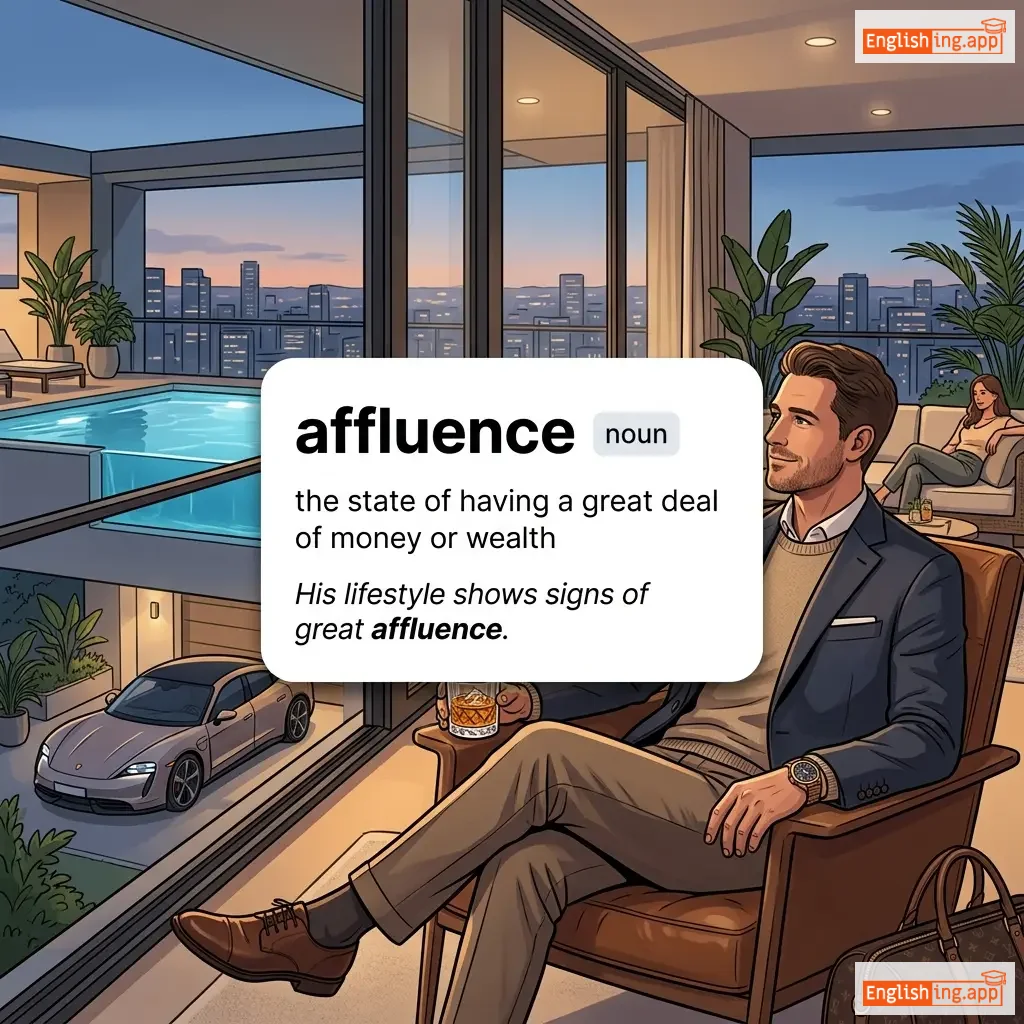
affluence definition card — visual illustration of the meaning
noun
/ˈæfluəns/
afflux (afflux)

the state of having a great deal of money or wealth

"His lifestyle shows signs of great affluence."

"Son style de vie montre des signes de grande affluence." (Son style de vie montre des signes de grande affluence.)
adjective
/ˈæfluənt/
aisé (aize)

having a great deal of money; wealthy

"She grew up in an affluent neighborhood."

"Elle a grandi dans un quartier aisé." (Elle a grandi dans un quartier aisé.)
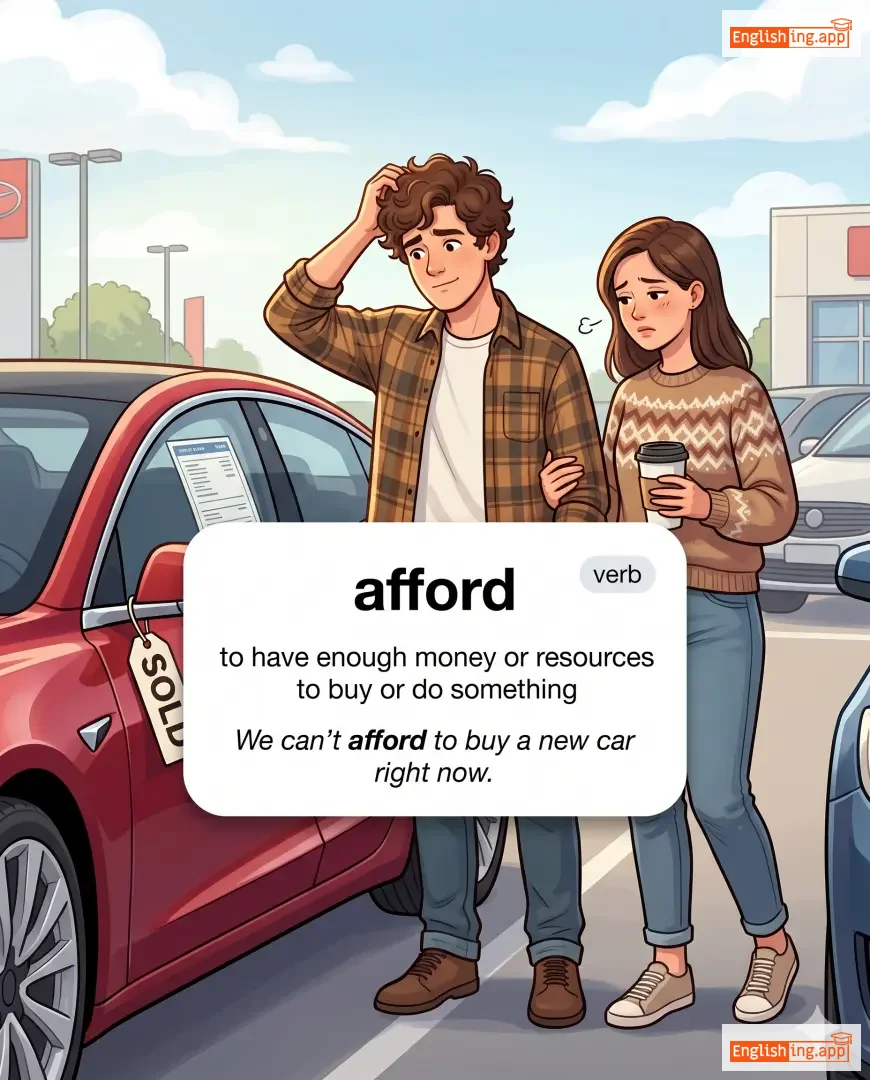
afford definition card — visual illustration of the meaning
verb
/əˈfɔːrd/
se permettre (se permettre)

to have enough money or resources to buy or do something

"We can’t afford to buy a new car right now."

"Nous ne pouvons pas nous permettre d'acheter une nouvelle voiture maintenant." (Nous ne pouvons pas nous permettre d'acheter une nouvelle voiture maintenant.)
adjective
/əˈfɔːdəbl/
abordable (abordable)

inexpensive and within one's financial means

"This restaurant offers affordable meals for families."

"Ce restaurant propose des repas abordables pour les familles." (Ce restaurant propose des repas abordables pour les familles.)
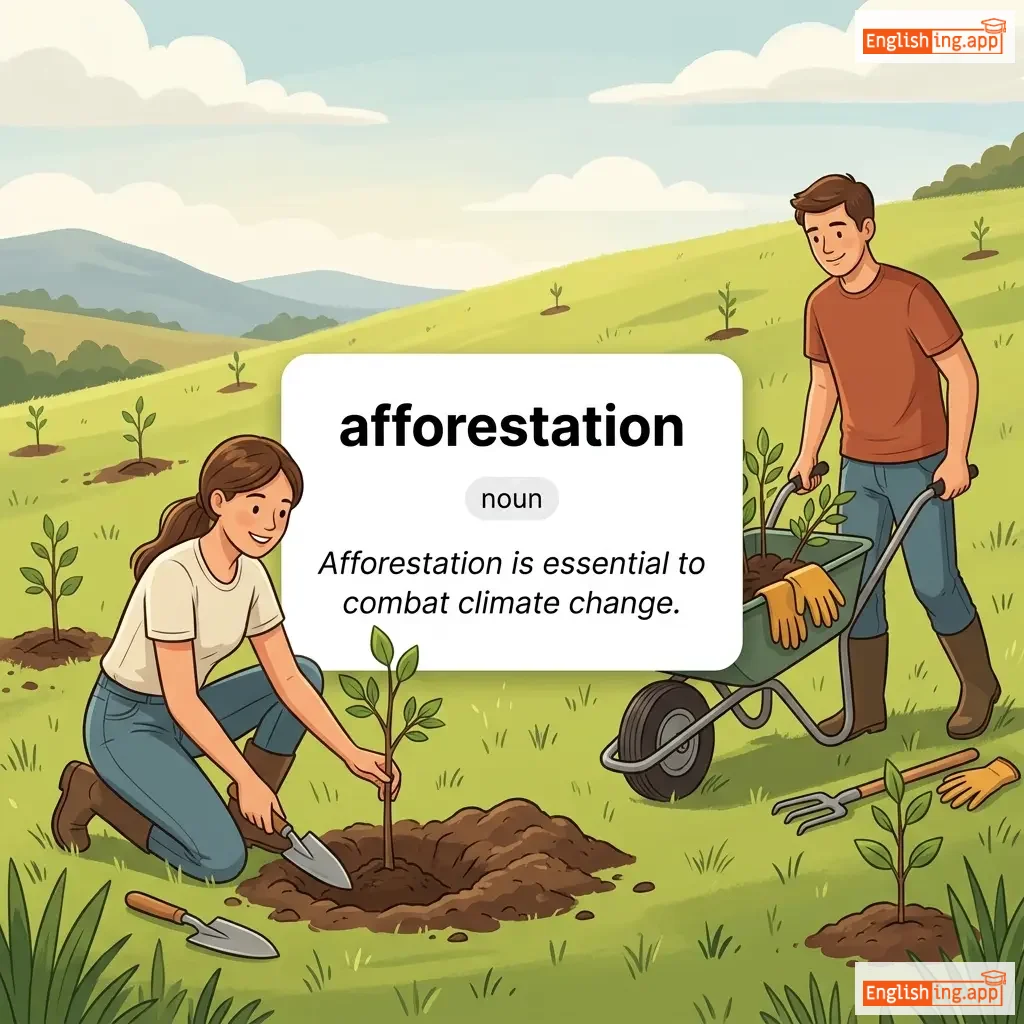
afforestation definition card — visual illustration of the meaning
noun
ˌæfɔːˈreɪʃən
reforestation (reforestation)

The process of establishing a forest, especially on land that was not recently forested.

"Afforestation is essential to combat climate change."

"La reforestation est essentielle pour lutter contre le changement climatique." (La reforestation est essentielle pour lutter contre le changement climatique.)
noun
/əˈfreɪ/
bagarre publique (bagarre publique)

A public fight or noisy disturbance that causes alarm.

"The police were called to break up an affray outside the stadium."

"La police a été appelée pour arrêter une altercation à l'extérieur du stade." (La police a ete appelee pour arreter une altercation a l'exterieur du stade.)
noun, verb
/əˈfrʌnt/
affront (affront)

An action or remark that causes outrage or offense.

"He took her criticism as a personal affront."

"Il a pris sa critique comme un affront personnel." (Il a pris sa critique comme un affront personnel.)
adjective, adverb
/əˈfʊt/
en cours (en cours)

In progress; happening or being prepared.

"There are several new projects afoot in the company."

"Il y a plusieurs nouveaux projets en cours dans l'entreprise." (Il y a plusieurs nouveaux projets en cours dans l'entreprise.)
adjective
/əˈfɔːrˌsɛd/
mentionné précédemment (mentionné précédemment)

Mentioned earlier; previously stated.

"The aforesaid conditions must be met before the contract is signed."

"Les conditions mentionnées précédemment doivent être remplies avant la signature du contrat." (Les conditions mentionnées précédemment doivent être remplies avant la signature du contrat.)
adjective
/əˈfreɪd/
effrayé (effraye)

feeling fear or anxiety; worried that something undesirable will happen

"She was afraid of the dark."

"Elle avait peur du noir." (Elle avait peur du noir.)
adverb
/əˈfrɛʃ/
à neuf (a neuf)

From the beginning, in a new way.

"After the failure, they started the project afresh."

"Après l'échec, ils ont recommencé le projet à neuf." (Apres l'echec, ils ont recommence le projet a neuf.)
adjective
/ˈæfrɪkən/
africain (afrikān)

relating to Africa or its people

"She studied African culture in university."

"Elle a étudié la culture africaine à l'université." (Elle a étudié la culture africaine à l'université.)
noun/adjective
/ˌæfrɪkən əˈmɛrɪkən/
afro-américain (afro-americain)

A person of African descent living in or originating from the United States; relating to such people.

"She is proud of her African-American heritage."

"Elle est fière de son héritage afro-américain." (Elle est fière de son héritage afro-américain.)
preposition, conjunction, adverb
/ˈæftər/
après (apres)

in the time following an event or another action

"We went for ice cream after the movie."

"Nous sommes allés manger une glace après le film." (Nous sommes alles manger une glace apres le film.)
noun
/ˈæftərˌlaɪf/
l'au-delà (loh dah lah)

Life or existence that some believe continues after physical death.

"Many cultures have different beliefs about the afterlife."

"De nombreuses cultures ont des croyances différentes sur l'au-delà." (De nombreuses cultures ont des croyances differentes sur lau dela.)
noun
/ˈɑːftərmɑːθ/
conséquences (consequences)

the consequences or aftereffects of an event or situation, especially a disastrous one

"The aftermath of the earthquake was devastating."

"Les conséquences du tremblement de terre ont été dévastatrices." (Les consequences du tremblement de terre ont ete devastatrices.)
noun
/ˌæftərˈnuːn/
après-midi (apres-midi)

The part of the day between noon and evening.

"We met in the afternoon for coffee."

"Nous nous sommes rencontrés dans l'après-midi pour un café." (Nous nous sommes rencontres dans l'apres-midi pour un cafe.)
noun
/ˈæftərˌθɔːt/

Something added or considered later than originally planned.

"The gift seemed like an afterthought rather than a genuine gesture."

adverb
/ˈɑːftərwərd/
plus tard (plus tard)

at a later or subsequent time

"She went home afterward."

"Elle est rentrée chez elle après." (Elle est rentree chez elle apres.)
adverb
/ˈɑːf.tə.wərdz/
ensuite; après; plus tard (ensuite; apres; plus tard)

at a later time; after an event or time that has already been mentioned

"We had dinner and afterwards we watched a movie."

"Nous avons dîné et après, nous avons regardé un film." (Nous avons dine et apres, nous avons regarde un film.)
adverb
/əˈɡɛn/ or /əˈɡeɪn/
encore (encore)

Once more; another time.

"She read the book again to understand it better."

"Elle a relu le livre encore pour mieux le comprendre." (Elle a relu le livre encore pour mieux le comprendre.)
preposition
/əˈɡɛnst/ or /əˈɡeɪnst/
contre (kontr)

In opposition to; contrary to; touching or resting on.

"They voted against the proposal."

"Ils ont voté contre la proposition." (Ils ont vote contre la proposition)
adjective
/əˈɡeɪp/ or /əˈɡɑːp/
bouche bée (bouche bee)

With the mouth wide open in surprise or wonder.

"She stood agape at the breathtaking view."

"Elle resta bouche bée devant la vue à couper le souffle." (Elle resta bouche bée devant la vue à couper le souffle.)