Vocabulaires

Découvrez, apprenez et maîtrisez le vocabulaire anglais

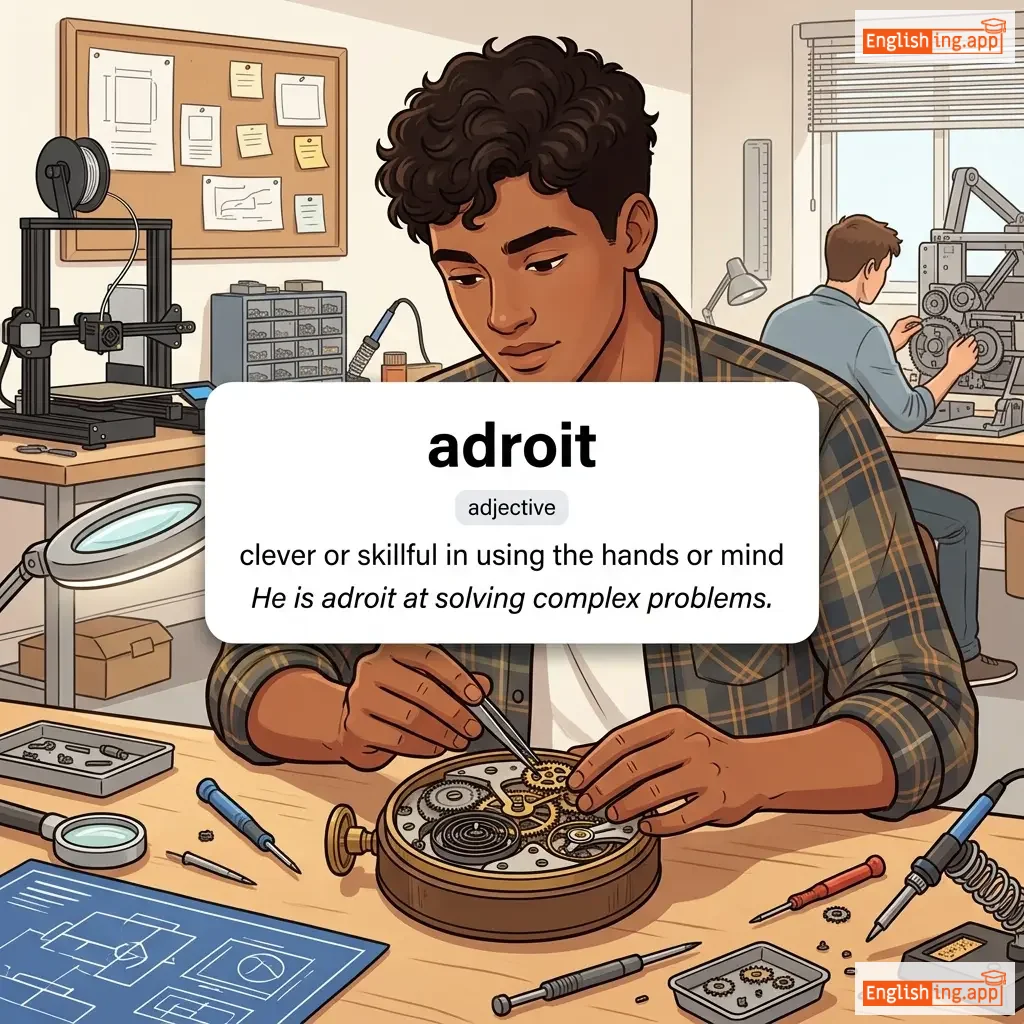
adroit definition card — visual illustration of the meaning
adjective
/əˈdrɔɪt/
habile (abile)

clever or skillful in using the hands or mind

"He is adroit at solving complex problems."

"Il est habile à résoudre des problèmes complexes." (Il est habile à résoudre des problèmes complexes.)
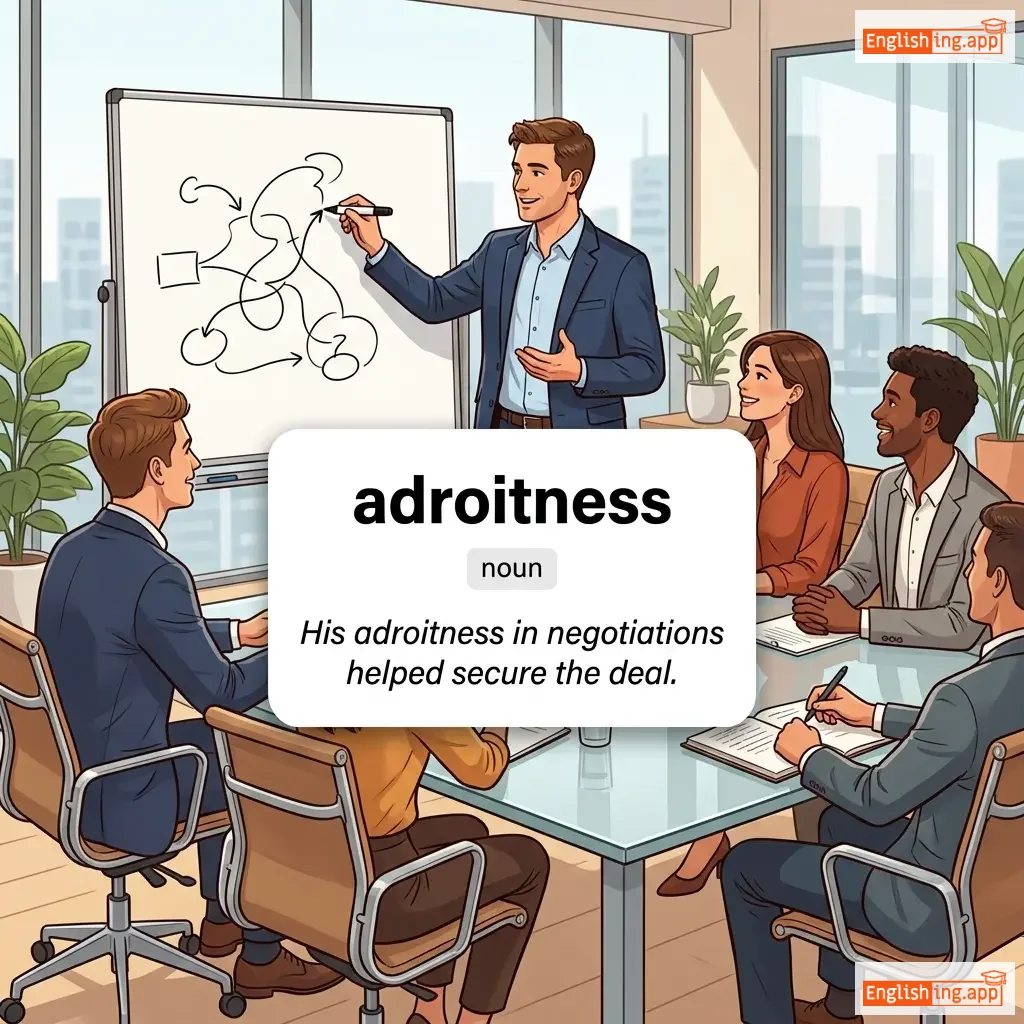
adroitness definition card — visual illustration of the meaning
noun
/əˈdrɔɪt.nəs/
adresse (adresse)

Cleverness or skill in using the hands or mind; expertness in performance or execution.

"His adroitness in negotiations helped secure the deal."

"Son adresse dans les négociations a contribué à sécuriser l'accord." (Son adresse dans les négociations a contribué à sécuriser l'accord.)
noun (plural)
/ædz/
publicités (publicites)

short for advertisements; promotional messages intended to sell products or services

"I often skip ads when watching videos online."

"Je saute souvent les publicités quand je regarde des vidéos en ligne." (je saute souvent les publicites quand je regarde des videos en ligne)
verb
/ˈædjʊˌleɪt/
aduler excessivement (aduler excessivement)

to praise or flatter excessively

"The fans adulated the actor after his performance."

"Les fans ont adulé l'acteur après sa performance." (Les fans ont adulé l'acteur après sa performance.)
noun
/ˌædjʊˈleɪʃən/
adulation excessive (adulation excessive)

excessive admiration or flattery

"The singer enjoyed the adulation of her fans."

"La chanteuse a apprécié l'adulation de ses fans." (La chanteuse a apprecie l'adulation de ses fans.)
noun
/ˈædʌlt/ or /əˈdʌlt/
adulte (adulte)

A fully grown or developed person; mature.

"Children must be accompanied by an adult."

"Les enfants doivent être accompagnés d'un adulte." (Les enfants doivent être accompagnés d'un adulte.)
noun
/əˈdʌltərənt/
adulterant (adulterant)

a substance added to something else, often food or drink, to reduce its quality or strength

"The laboratory found an adulterant in the milk samples."

"Le laboratoire a trouvé un adulterant dans les échantillons de lait." (Le laboratoire a trouve un adulterant dans les echantillons de lait.)
adulterate definition card — visual illustration of the meaning
verb
/əˈdʌltəreɪt/
adulterer (adulterer)

to make something poorer in quality by adding another substance, usually of lower quality

"The company was fined for adulterating its products with cheap chemicals."

"L'entreprise a été condamnée à une amende pour avoir adultéré ses produits avec des produits chimiques bon marché." (L'entreprise a été condamnée à une amende pour avoir adultéré ses produits avec des produits chimiques bon marché.)
adjective
/əˈdʌltəreɪtɪd/

describes food, drink, or medicine made weaker or impure by the addition of another substance

"Authorities seized adulterated drugs from the warehouse."

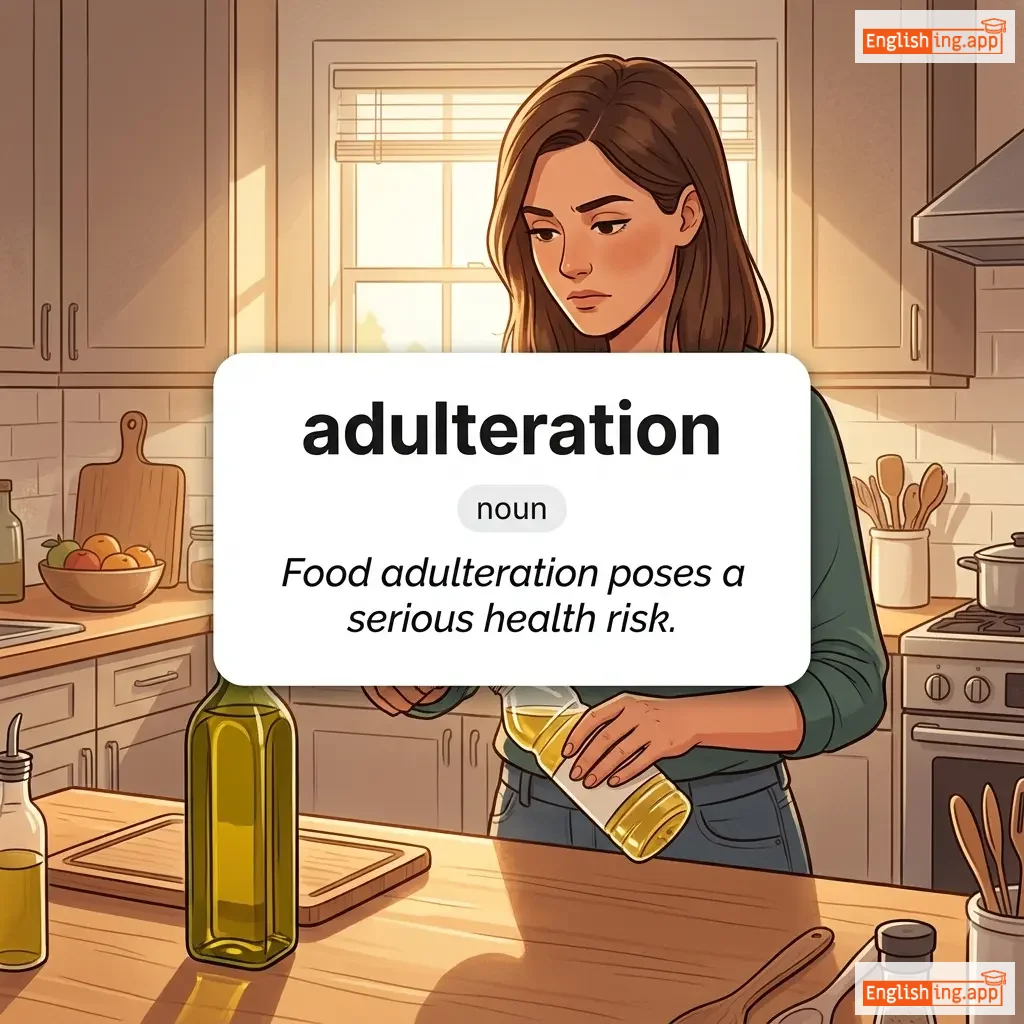
adulteration definition card — visual illustration of the meaning
noun
əˌdʌl.təˈreɪ.ʃən
adultération (adulteration)

The action of making something poorer in quality by the addition of another substance.

"Food adulteration poses a serious health risk."

"L'adultération des aliments présente un risque grave pour la santé." (L'adulteration des aliments presente un risque grave pour la sante.)
verb
/ˈæd.ʌm.breɪt/
préfigurer (prefiguré)

to foreshadow or suggest something in an unclear or indirect way

"The report adumbrates future economic challenges."

"Le rapport préfigure les défis économiques futurs." (Le rapport préfigure les défis économiques futurs.)
noun
/ˌæd.ʌmˈbreɪ.ʃən/
présage vague (presage vague)

a vague foreshadowing or symbolic representation of something

"The play offers an adumbration of the political unrest to come."

"La pièce offre un présage vague du malaise politique à venir." (La piece offre un presage vague du malaise politique a venir.)
verb
/ədˈvæns/
avancer (avancer)

to move forward or make progress

"The army advanced towards the city."

"L'armée a avancé vers la ville." (L'armé a avancé vers la ville.)
adjective
/ədˈvænst/
avancé (avancé)

highly developed or complex

"He is studying an advanced level of mathematics."

"Il étudie un niveau avancé de mathématiques." (Il étudie un niveau avancé de mathématiques.)
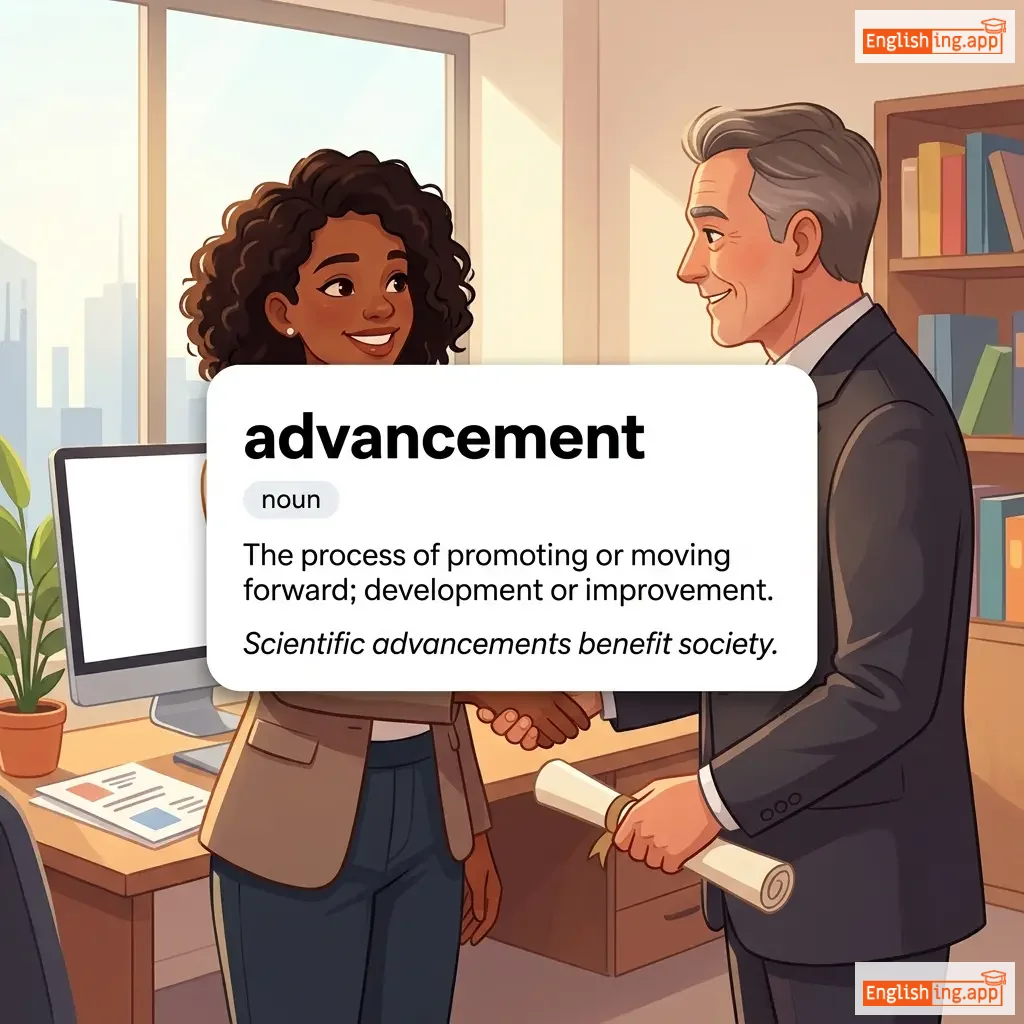
advancement definition card — visual illustration of the meaning
noun
/ədˈvɑːns.mənt/
avancement (avancement)

The process of promoting or moving forward; development or improvement.

"Scientific advancements benefit society."

"Les avancées scientifiques bénéficient à la société." (Les avancées scientifiques bénéficient à la société.)
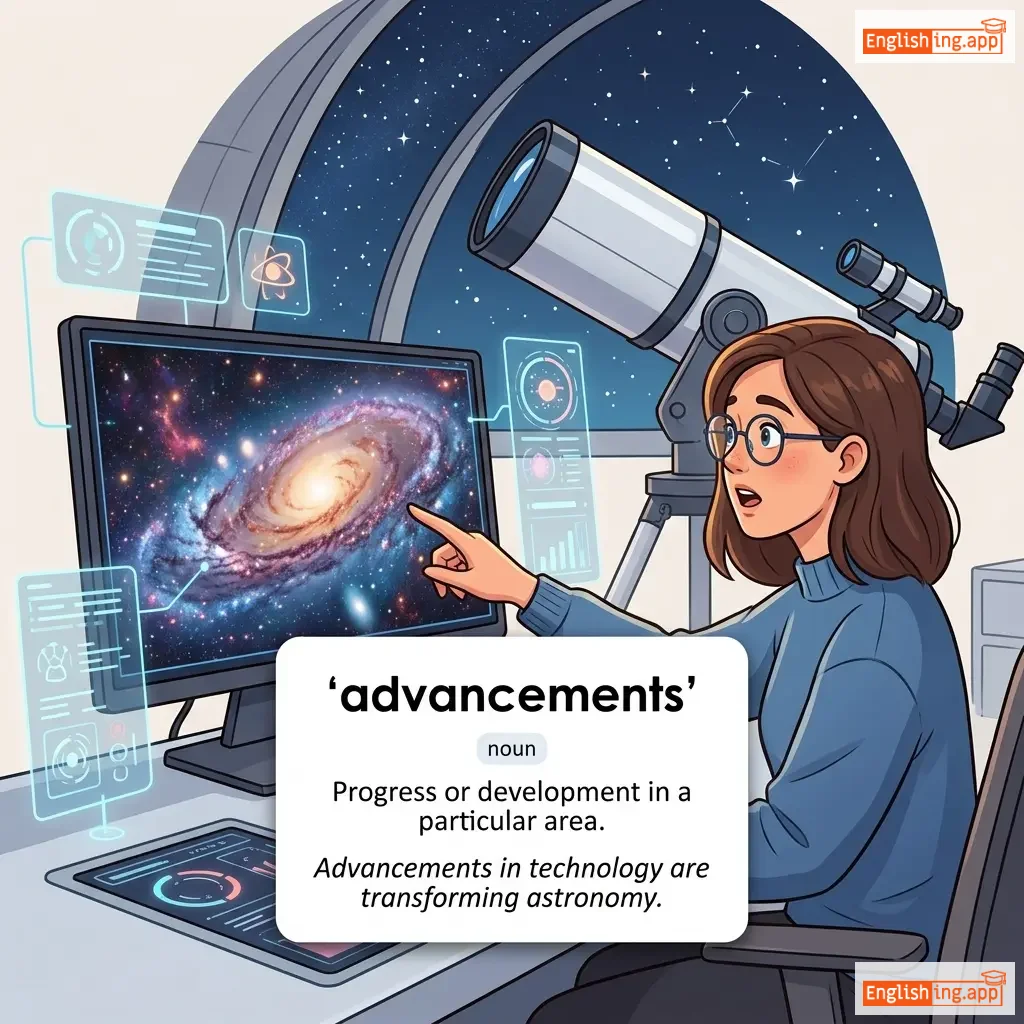
advancements definition card — visual illustration of the meaning
noun
/ədˈvɑːns.mənts/
avancées (avancées)

Progress or development in a particular area.

"Advancements in technology are transforming astronomy."

"Les avancées technologiques transforment l'astronomie." (Les avancées technologiques transforment l'astronomie.)
noun
/ədˈvæntɪdʒ/
avantage (avantage)

a condition or circumstance that puts one in a favorable position

"Having strong communication skills is a great advantage in business."

"Avoir de fortes compétences en communication est un grand avantage dans les affaires." (Avoir de fortes competences en communication est un grand avantage dans les affaires.)
adjective
/ˌædvənˈteɪdʒəs/
avantageux; favorable; rentable (avantageux; favorable; rentable)

beneficial; favorable; profitable

"This position offers advantageous opportunities for career growth."

"Ce poste offre des opportunités avantageuses pour la croissance de carrière." (Ce poste offre des opportunités avantageuses pour la croissance de carrière.)
noun
/ˈæd.vənt/
avènement (avènement)

The arrival of a notable person, thing, or event.

"The advent of the internet changed the way people communicate."

"L'avènement de l'Internet a changé la façon dont les gens communiquent." (L'avènement de l'Internet a changé la façon dont les gens communiquent.)
adjective
/ˌæd.vɛnˈtɪʃ.əs/
accidentel (accidentel)

Happening by chance or accident, not planned.

"His success was partly due to adventitious circumstances."

"Son succès était en partie dû à des circonstances accidentelles." (Son succès était en partie dû à des circonstances accidentelles.)
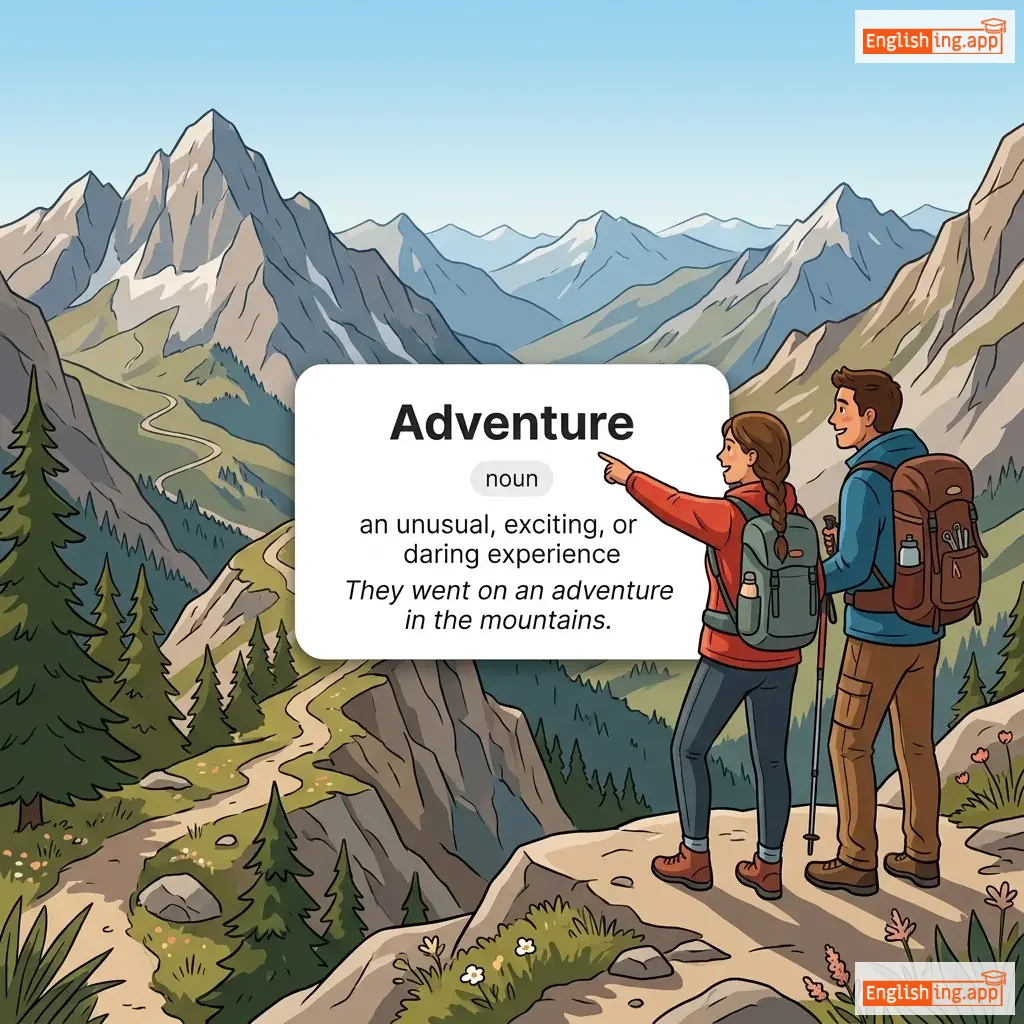
Adventure definition card — visual illustration of the meaning
noun
/ədˈvɛntʃər/
aventure (aventure)

an unusual, exciting, or daring experience

"They went on an adventure in the mountains."

"Ils sont partis en aventure dans les montagnes." (Ils sont partis en aventure dans les montagnes.)
Adventure Seekers definition card — visual illustration of the meaning
noun
ədˈvɛnʧər ˈsiːkərz
chercheurs d'aventures (chercheurs d'aventures)

People who actively look for exciting and potentially risky activities or experiences.

"Sajek Valley is a popular destination for adventure seekers."

"La vallée de Sajek est une destination populaire pour les chercheurs d'aventures." (La vallée de Sajek est une destination populaire pour les chercheurs d'aventures.)
noun
/ədˈvɛntʃərər/
aventurier (aventurier)

a person who seeks exciting, risky, or unusual experiences; someone who explores new or unknown places

"The adventurer traveled deep into the jungle in search of ancient ruins."

"L'aventurier a voyagé profondément dans la jungle à la recherche de ruines anciennes." (l aventurier a voyage profondement dans la jungle a la recherche de ruines anciennes)
adventurous definition card — visual illustration of the meaning
adjective
/ədˈventʃərəs/
aventurier; audacieux (aventurier; audacieux)

willing to take risks; seeking excitement; daring

"She is an adventurous person who loves trying new foods."

"Elle est une personne aventurière qui adore essayer de nouveaux plats." (Elle est une personne aventurière qui adore essayer de nouveaux plats.)
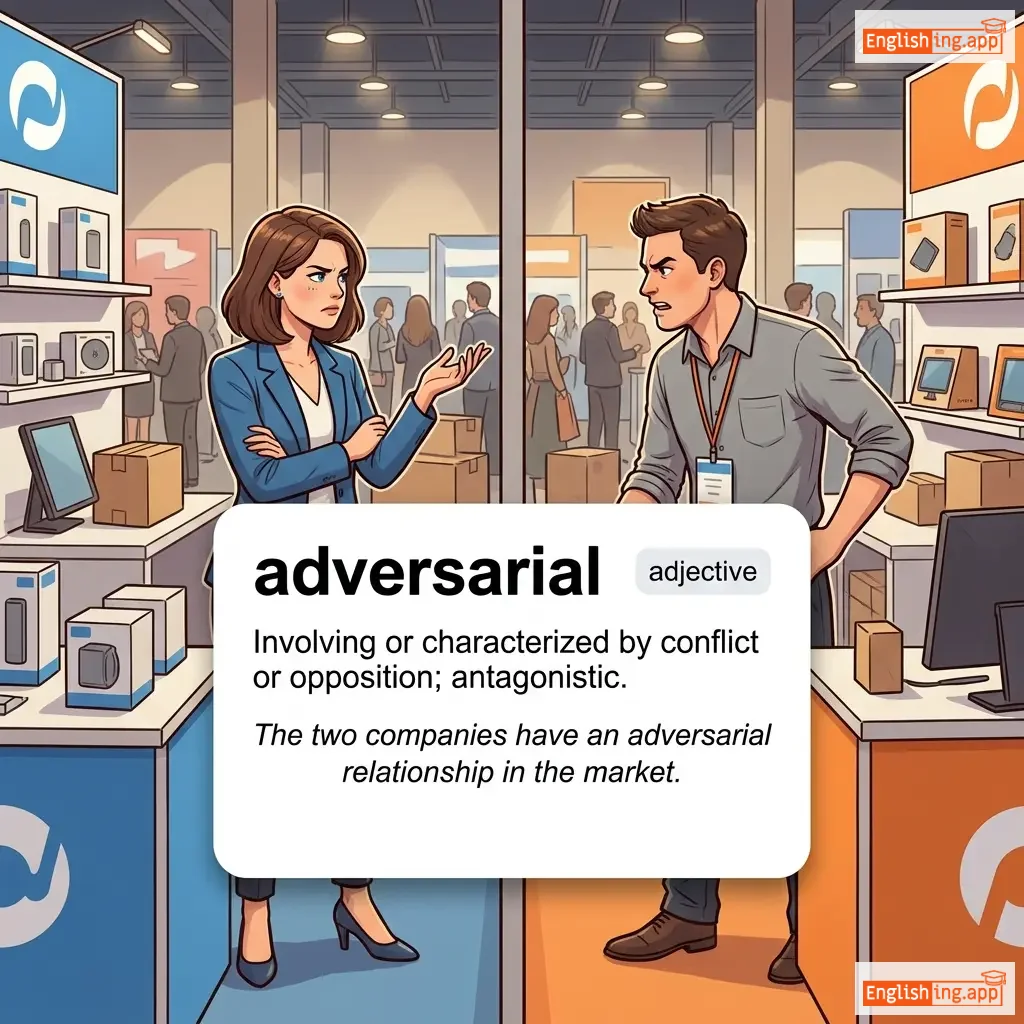
adversarial definition card — visual illustration of the meaning
adjective
/ˌæd.vɚˈser.i.əl/
antagoniste (antagoniste)

Involving or characterized by conflict or opposition; antagonistic.

"The two companies have an adversarial relationship in the market."

"Les deux entreprises ont une relation antagoniste sur le marché." (Les deux entreprises ont une relation antagoniste sur le marché.)
noun
/ˈæd.və.ser.i/
adversaire (adversaire)

One's opponent in a contest, conflict, or dispute.

"The boxer faced a strong adversary in the ring."

"Le boxeur a affronté un adversaire fort dans le ring." (Le boxeur a affronté un adversaire fort dans le ring.)
adjective
/ˈæd.vɜːs/
défavorable (adverse)

Preventing success or development; harmful or unfavorable.

"The project was delayed due to adverse weather conditions."

"Le projet a été retardé en raison de conditions météorologiques défavorables." (Le projet a ete retardé en raison de conditions meteorologiques defavorables.)
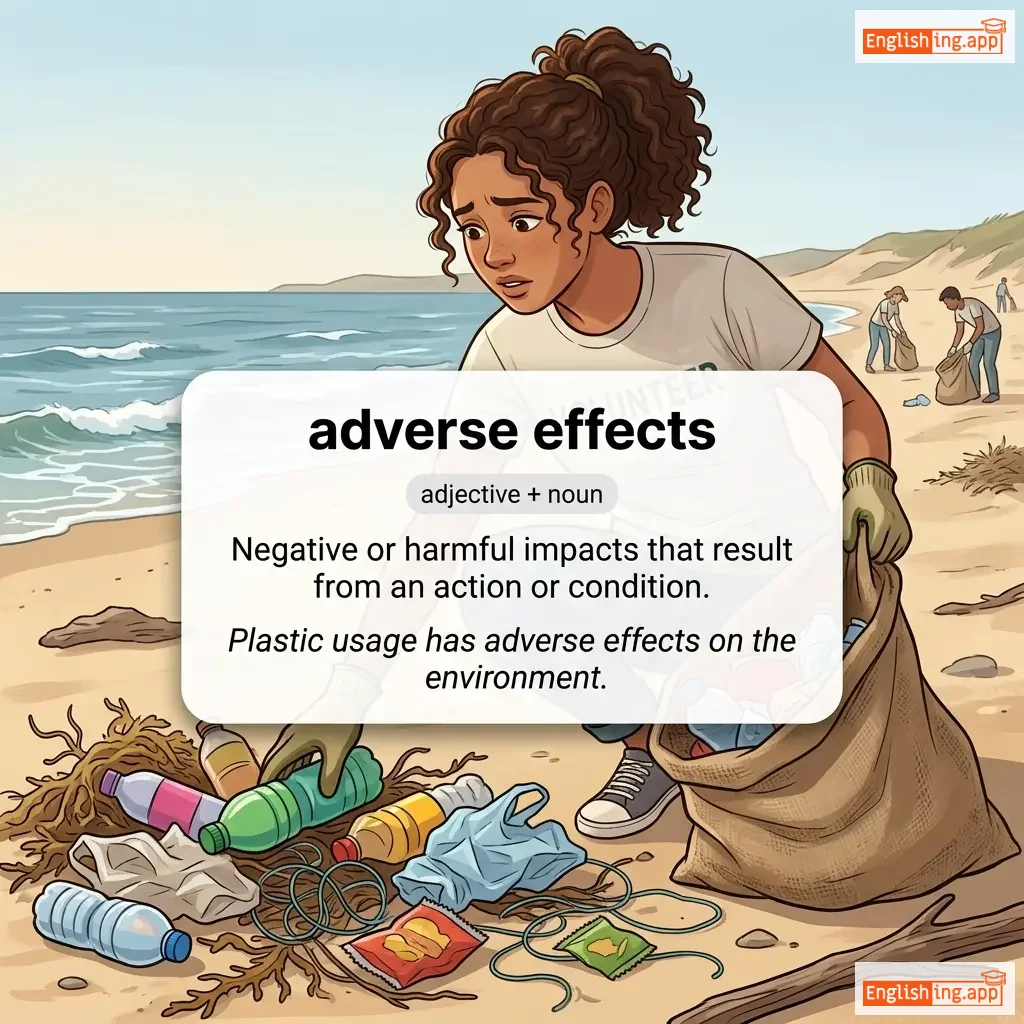
adverse effects definition card — visual illustration of the meaning
adjective + noun
ˈædvɜːrs ɪˈfekts
effets négatifs (effets négatifs)

Negative or harmful impacts that result from an action or condition.

"Plastic usage has adverse effects on the environment."

"L'utilisation du plastique a des effets négatifs sur l'environnement." (L'utilisation du plastique a des effets négatifs sur l'environnement.)
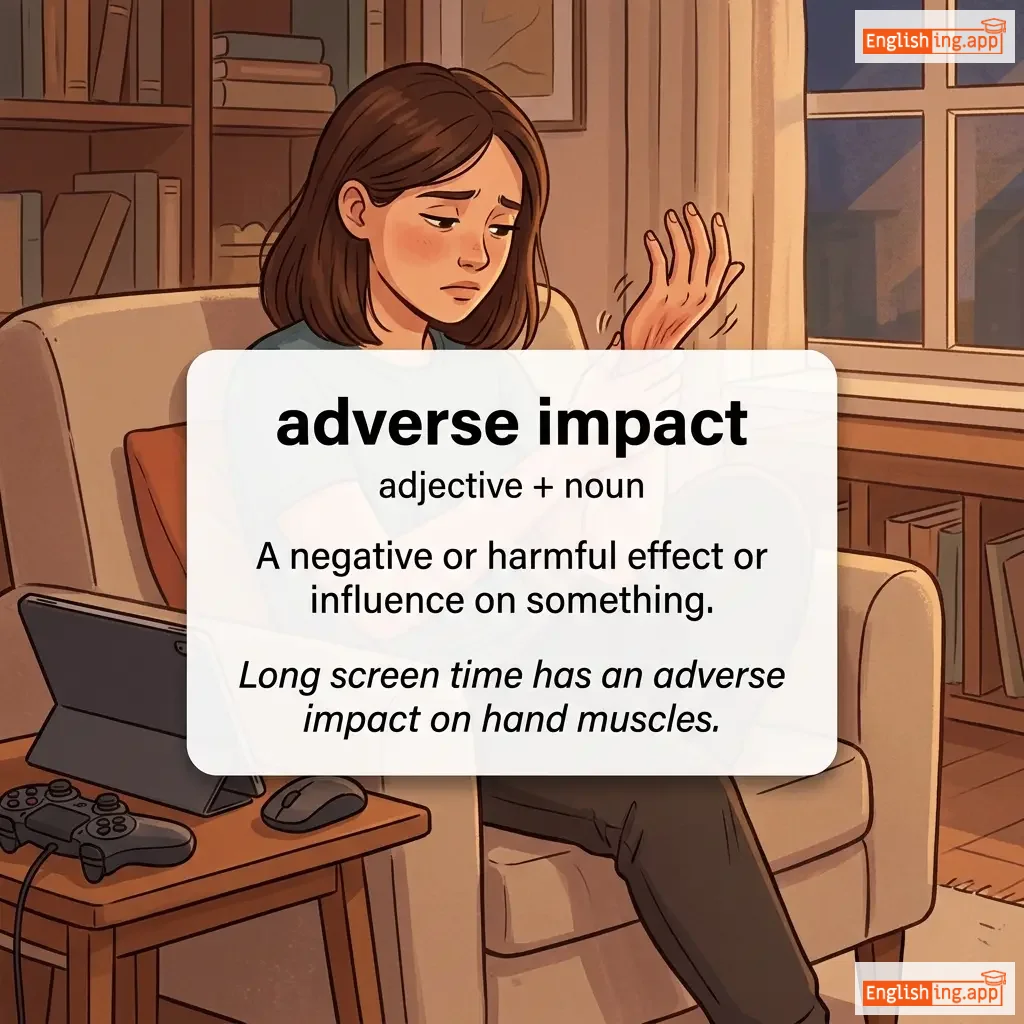
adverse impact definition card — visual illustration of the meaning
adjective + noun
অ্যাডভার্স ইমপ্যাক্ট
impact négatif (impact negatif)

A negative or harmful effect or influence on something.

"Long screen time has an adverse impact on hand muscles."

"Un long temps d'écran a un impact négatif sur les muscles des mains." (Un long temps d'écran a un impact négatif sur les muscles des mains.)
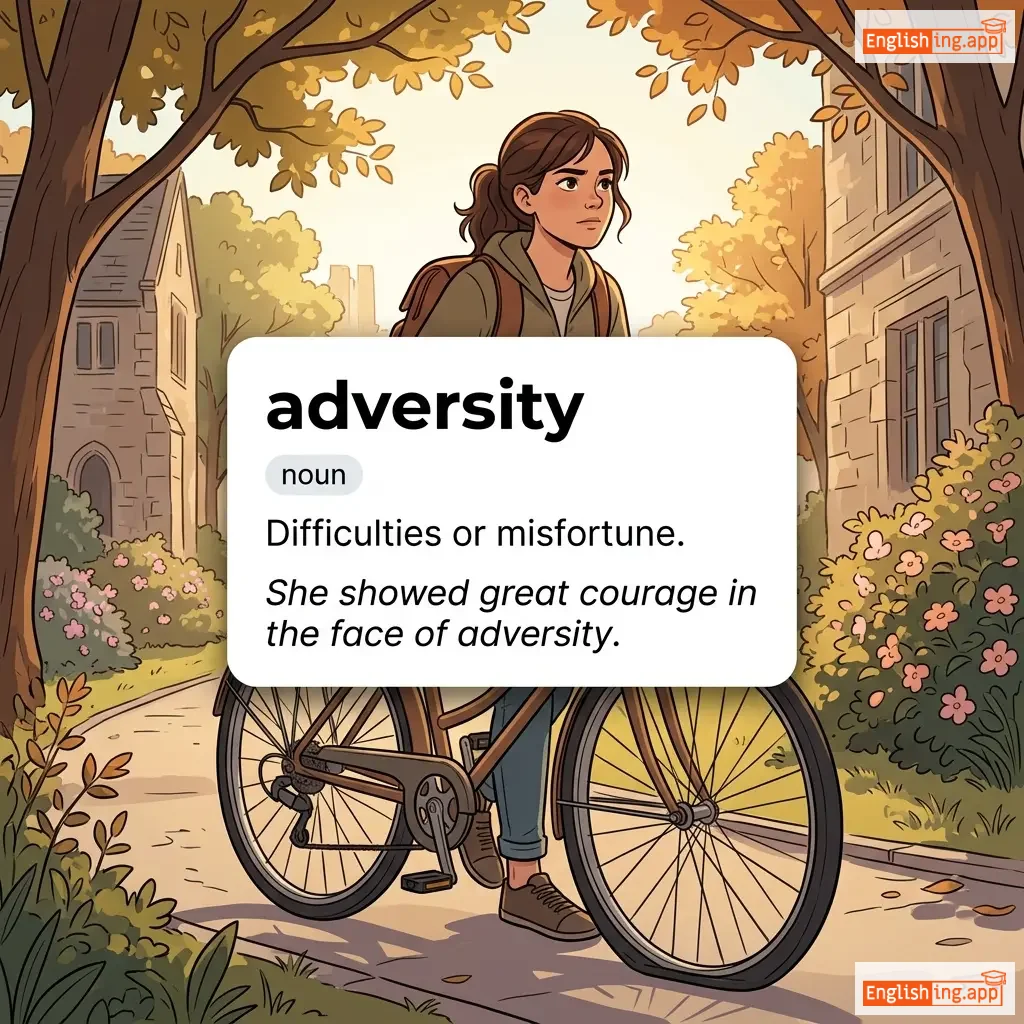
adversity definition card — visual illustration of the meaning
noun
/ədˈvɜː.sə.ti/
adversité (adversite)

Difficulties or misfortune.

"She showed great courage in the face of adversity."

"Elle a fait preuve d'un grand courage face à l'adversité." (Elle a fait preuve dun grand courage face a ladversite.)
noun, verb
/ˈædvɜːrt/
annonce (annonce)

(noun) a notice or announcement in a public medium promoting a product, service, or event; (verb) to refer to something in speaking or writing

"The company placed an advert in the newspaper for the new position."

"La société a placé une annonce dans le journal pour le nouveau poste." (La société a placé une annonce dans le journal pour le nouveau poste.)
advertise definition card — visual illustration of the meaning
verb
/ˈædvərtaɪz/
publiciter (publiciter)

to describe or draw attention to a product, service, or event in a public medium in order to promote sales or attendance

"They advertise their products on social media platforms."

"Ils font de la publicité pour leurs produits sur des plateformes de médias sociaux." (Ils font de la publicité pour leurs produits sur des plateformes de médias sociaux.)
noun
/ədˈvɜːrtɪsmənt/
publicité (publicite)

a public notice or announcement promoting a product, service, or event

"The advertisement attracted many new customers."

"La publicité a attiré de nombreux nouveaux clients." (la publicite a attire de nombreux nouveaux clients)
noun
/ˈædvərtaɪzər/
annonceur (annonceur)

a person or company that advertises a product, service, or event

"The advertiser paid millions for a Super Bowl commercial spot."

"L'annonceur a payé des millions pour un spot publicitaire au Super Bowl." (L'annonceur a payé des millions pour un spot publicitaire au Super Bowl.)
noun
/ˈædvərˌtaɪzɪŋ/
publicité (publicite)

the activity of producing advertisements for products or services

"The company spends millions on advertising every year."

"L'entreprise dépense des millions en publicité chaque année." (L'entreprise dépense des millions en publicité chaque année.)
advice definition card — visual illustration of the meaning
noun
/ədˈvaɪs/
conseil (conseil)

a suggestion or recommendation about what someone should do

"She gave me good advice about managing money."

"Elle m'a donné un bon conseil sur la gestion de l'argent." (Elle m'a donné un bon conseil sur la gestion de l'argent.)
verb
/ədˈvaɪz/
conseiller (conseiller)

to recommend what should be done; to give advice

"The doctor advised him to rest for a week."

"Le médecin lui a conseillé de se reposer pendant une semaine." (Le médecin lui a conseillé de se reposer pendant une semaine.)
noun
/ədˈvaɪzər/
conseiller (conseiller)

a person who gives advice, especially in a professional or official role

"He works as a financial adviser at a bank."

"Il travaille comme conseiller financier dans une banque." (Il travaille comme conseiller financier dans une banque.)
adjective, noun
/ədˈvaɪzəri/
consultatif (consultatif)

(adjective) having the power to give advice but not to make sure that it is followed; (noun) an official announcement containing information or a warning

"The committee serves in an advisory capacity to the board of directors."

"Le comité sert dans une capacité consultative auprès du conseil d'administration." (Le comité sert dans une capacité consultative auprès du conseil d'administration.)
noun
/ˈædvəkəsi/
défense (defense)

public support for or recommendation of a particular cause or policy

"Her advocacy for children's rights earned her international recognition."

"Sa défense des droits des enfants lui a valu une reconnaissance internationale." (Sa defense des droits des enfants lui a valu une reconnaissance internationale.)
noun, verb
/ˈædvəˌkeɪt/ (noun), /ˈædvəˌkeɪt/ or /ˈædvəˌkət/ (verb)
défenseur / avocat (defenseur / avocat)

As a noun: a person who publicly supports or recommends a cause. As a verb: to publicly recommend or support.

"She is an advocate for women's rights and often advocates for equal opportunities."

"Elle est une défenseuse des droits des femmes et plaide souvent pour l'égalité des chances." (Elle est une defenseuse des droits des femmes et plaide souvent pour l'egalité des chances.)
noun
/ˈiːdʒɪs/
protection (protection)

The protection, backing, or support of a particular person or organization.

"The project was carried out under the aegis of the United Nations."

"Le projet a été réalisé sous l'égide des Nations Unies." (Le projet a ete realise sous l'egide des Nations Unies.)
noun
/ˈiːɒn/ or /ˈiːən/
éon (eeon)

An indefinitely long period of time; an age or eternity.

"Dinosaurs roamed the Earth millions of aeons ago."

"Les dinosaures ont parcouru la Terre il y a des millions d'éons." (Dinosaurs roamed the Earth millions of aeons ago)
adjective, noun
/ˈɛəriəl/
aérien / antenne (aerien / antenne)

As an adjective: existing or happening in the air. As a noun: an antenna for receiving radio or television signals.

"The pilot performed an amazing aerial maneuver."

"Le pilote a effectué une manœuvre aérienne incroyable." (Le pilote a effectue une manoeuvre aerienne incroyable.)
noun
/ˈɛəri/
nid d'aigle (nid d'aigle)

A large nest of a bird of prey, especially an eagle, typically built high in a tree or on a cliff.

"The eagle built its aerie on the high cliff."

"L'aigle a construit son nid sur la haute falaise" (L'aigle a construit son nid sur la haute falaise)
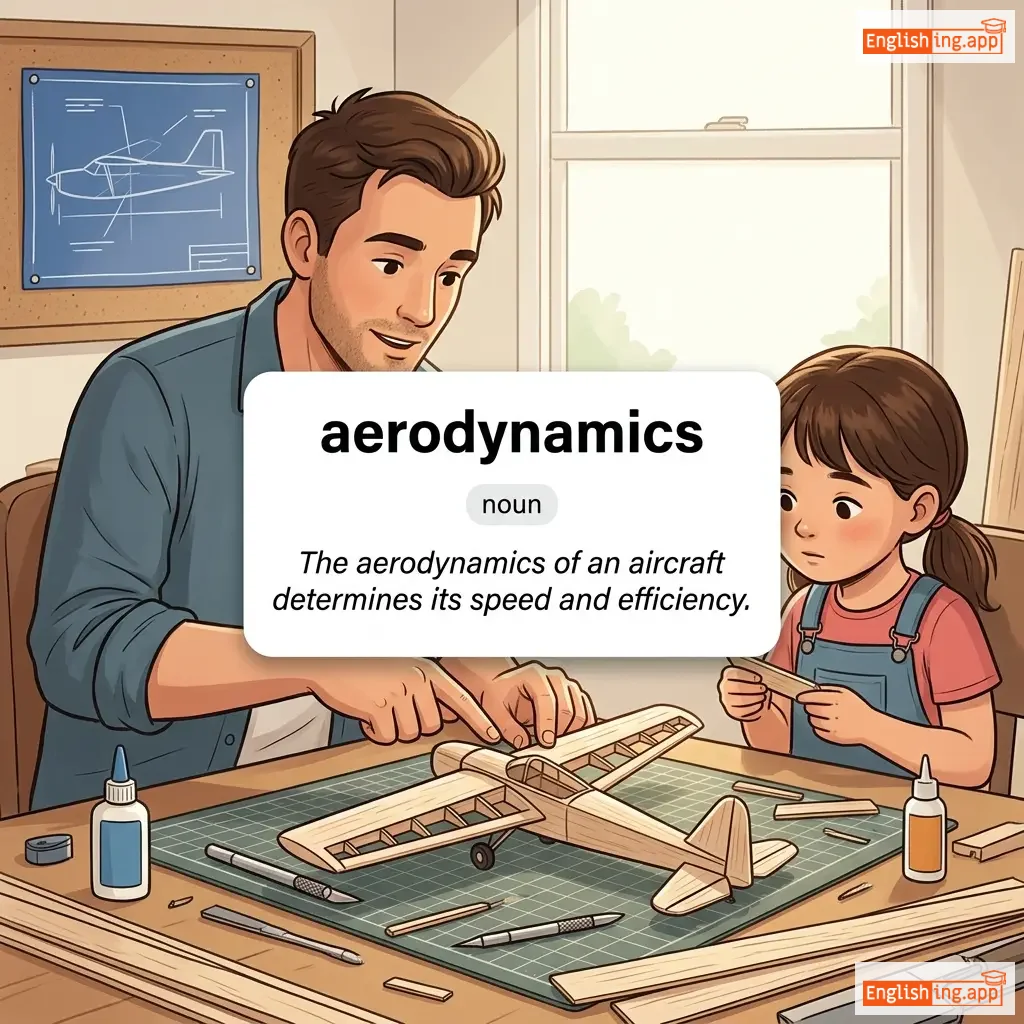
aerodynamics definition card — visual illustration of the meaning
noun
ˌeə.rəʊ.daɪˈnæm.ɪks
aérodynamique (aerodynamique)

The study of the properties of moving air and the interaction between the air and solid bodies moving through it.

"The aerodynamics of an aircraft determines its speed and efficiency."

"L'aérodynamique d'un avion détermine sa vitesse et son efficacité." (Laerodynamique dun avion determine sa vitesse et son efficacite)
noun
/ˈɛərəˌnɔːt/
aéronaute (aeronaute)

A person who travels in an airship, balloon, or other aircraft.

"The aeronaut skillfully guided the hot-air balloon across the valley."

"L'aéronaute a habilement guidé le ballon à air chaud à travers la vallée." (L'aéronaute a habilement guidé le ballon à air chaud à travers la vallée.)
noun
/ˈeə.rə.pleɪn/
avion (avion)

a powered flying vehicle with fixed wings and a weight greater than that of the air it displaces

"The aeroplane took off smoothly from the airport runway."

"L'avion a décollé en douceur de la piste de l'aéroport." (L'avion a decolle en douceur de la piste de l'aeroport)
noun
/ˈɛərəˌstæt/
aérostat (aerostat)

A lighter-than-air craft, such as a balloon, that is lifted by gas.

"The military used an aerostat for surveillance over the border."

"L'armée a utilisé un aérostat pour la surveillance de la frontière." (L'armee a utilise un aerostat pour la surveillance de la frontiere.)
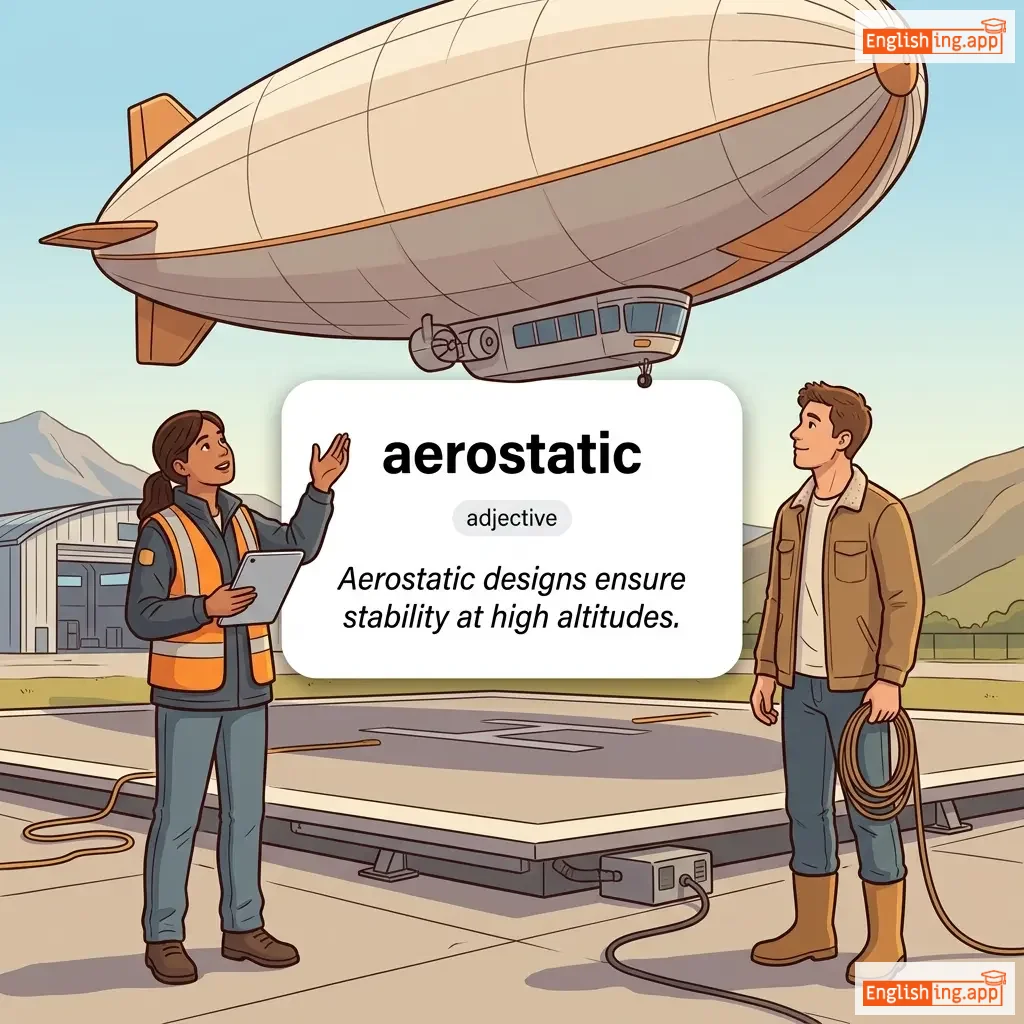
aerostatic definition card — visual illustration of the meaning
adjective
ˌeə.rəʊˈstæt.ɪk
aérostatique (aerostatique)

Relating to or involving gases (especially air) in equilibrium and the equilibrium of balloons or aircraft under the influence of such gases.

"Aerostatic designs ensure stability at high altitudes."

"Les conceptions aérostatiques assurent la stabilité à haute altitude." (Les conceptions aérostatiques assurent la stabilité à haute altitude.)