Vocabulaires

Découvrez, apprenez et maîtrisez le vocabulaire anglais

adjective
/ˌɑːrbəˈrɛsənt/
arborescent (arborescent)

having the appearance or characteristics of a tree; tree-like

"The coral had an arborescent form that resembled a miniature forest."

"Le corail avait une forme arborescente qui ressemblait à une petite forêt." (Le corail avait une forme arborescente qui ressemblait a une petite foret.)
noun
/ˌɑːrbəˈriːtəm/
arborétum (arborétum)

a place where trees, shrubs, and plants are grown for scientific study or public display

"We visited the city’s arboretum to learn about exotic trees."

"Nous avons visité l'arborétum de la ville pour en apprendre davantage sur les arbres exotiques." (Nous avons visite l'arborétum de la ville pour en apprendre davantage sur les arbres exotiques.)
noun
/ˈɑːrbərɪˌkʌltʃər/
arboriculture (arboriculture)

the cultivation and management of trees and shrubs

"He studied arboriculture to improve urban green spaces."

"Il a étudié l'arboriculture pour améliorer les espaces verts urbains." (Il a étudié l'arboriculture pour améliorer les espaces verts urbains.)
noun
/ɑːrˈkeɪd/
arcade (arked)

a covered passage with arches along one or both sides; also a place with coin-operated games

"The children spent the afternoon playing games at the arcade."

"Les enfants ont passé l'après-midi à jouer dans l'arcade." (Les enfants ont passé l'après-midi à jouer dans l'arcade.)
adjective
/ɑːrˈkeɪn/
arcane (arcane)

understood by few; mysterious or secret

"The professor’s lecture was full of arcane details that only specialists could follow."

"La conférence du professeur était pleine de détails arcanes que seuls les spécialistes pouvaient suivre." (La conférence du professeur était pleine de détails arcanes que seuls les spécialistes pouvaient suivre.)
prefix
/ɑːrtʃ-/
principal / suprême (principal / supreme)

a prefix meaning chief, principal, or extreme in rank, importance, or degree

"The word 'archenemy' uses the prefix 'arch-' to mean the main enemy."

"Le mot 'archennemi' utilise le préfixe 'arch-' pour signifier l'ennemi principal." (Le mot 'archennemi' utilise le prefixe 'arch-' pour signifier l'ennemi principal.)
noun
/ˌɑːrkiˈɑːlədʒi/
archéologie (archeologie)

the study of human history and prehistory through excavation and analysis of artifacts, monuments, and other physical remains

"She studied archaeology to learn about ancient civilizations."

"Elle a étudié l'archéologie pour en savoir plus sur les civilisations anciennes." (Elle a étudié l'archéologie pour en savoir plus sur les civilisations anciennes.)
adjective
/ɑːrˈkeɪɪk/
archaïque (arkayik)

very old or old-fashioned; belonging to an earlier time

"Some laws are considered archaic and no longer relevant."

"Certaines lois sont considérées comme archaïques et ne sont plus pertinentes." (Certaines lois sont considerees comme archaiques et ne sont plus pertinentes)
noun
/ˈɑːrkeɪˌɪzəm/
archaïsme (archaisme)

a word, expression, or style of language that is no longer in everyday use

"The poem is full of archaisms that give it an old-fashioned flavor."

"Le poème est plein d'archaïsmes qui lui donnent un goût ancien." (Le poeme est plein d'archaïsmes qui lui donnent un gout ancien.)
noun
/ˈɑːrkeɪndʒəl/
archange (arshanj)

A high-ranking angel, often considered a chief messenger or leader among angels.

"Michael is often depicted as the most powerful archangel."

"Michel est souvent représenté comme l'archange le plus puissant." (Michel est souvent represente comme l'archange le plus puissant.)
noun
/ˌɑːrtʃˈbɪʃəp/
archevêque (archeveque)

A senior bishop in charge of an archdiocese in the Christian Church.

"The archbishop delivered a sermon to thousands of people."

"L'archevêque a prononcé un sermon devant des milliers de personnes." (L'archeveque a prononce un sermon devant des milliers de personnes.)
noun
/ˌɑːrtʃˈdiːkən/
archidiacre (archidiacre)

A senior clergyman in the Christian Church ranking below a bishop.

"The archdeacon assisted the bishop in administrative duties."

"L'archidiacre a aidé l'évêque dans les tâches administratives." (L'archidiacre a aide l'eveque dans les taches administratives.)
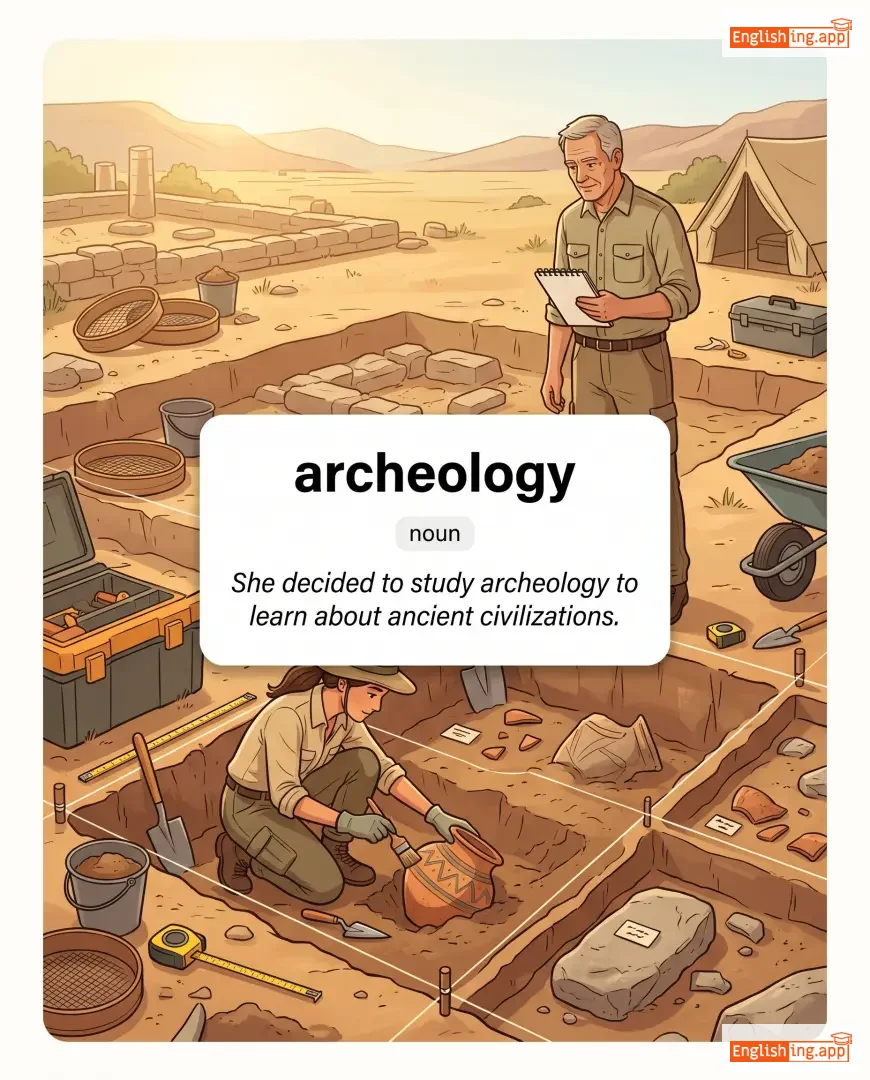
archeology definition card — visual illustration of the meaning
noun
/ˌɑːr.kiˈɑː.lə.dʒi/
archéologie (archeologie)

the study of human history and prehistory through excavation and analysis of artifacts and structures

"She decided to study archeology to learn about ancient civilizations."

"Elle a décidé d'étudier l'archéologie pour en apprendre davantage sur les civilisations anciennes." (Elle a decide d'etudier l'archeologie pour en apprendre davantage sur les civilisations anciennes.)
archetype definition card — visual illustration of the meaning
noun
/ˈɑːrkɪtaɪp/
archétype (archetype)

The original model or perfect example from which others are copied or derived.

"He is the archetype of a successful entrepreneur."

"Il est l'archétype d'un entrepreneur réussi." (Il est l'archétype d'un entrepreneur réussi.)
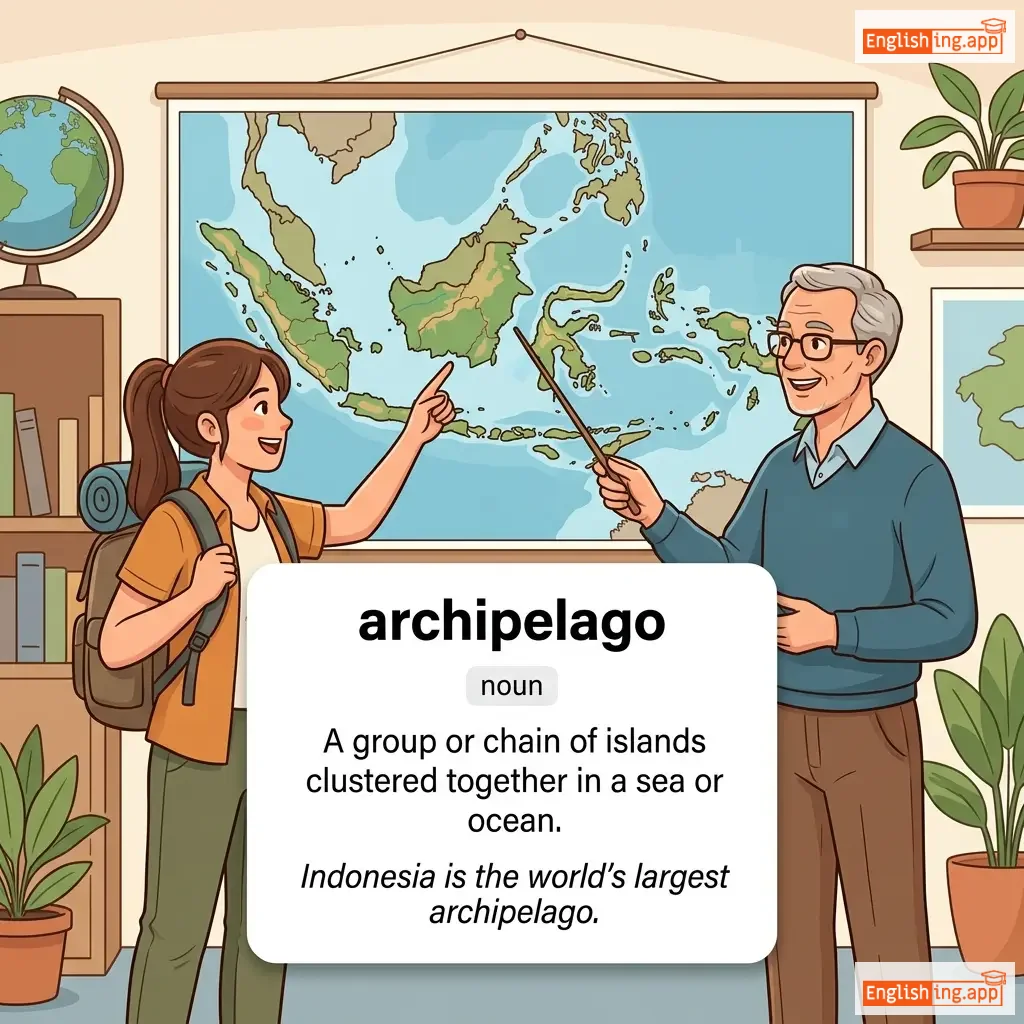
archipelago definition card — visual illustration of the meaning
noun
/ˌɑːrkəˈpɛləɡoʊ/
archipel (archipel)

A group or chain of islands clustered together in a sea or ocean.

"Indonesia is the world’s largest archipelago."

"L'Indonésie est le plus grand archipel du monde." (L'Indonésie est le plus grand archipel du monde.)
noun
/ˈɑː.kɪ.tekt/
architecte (architecte)

a person who designs buildings and oversees their construction

"The architect designed a modern office building."

"L'architecte a conçu un immeuble de bureaux moderne." (L'architecte a conçu un immeuble de bureaux moderne.)
adjective
/ˌɑːrkɪˈtɛktʃərəl/
architectural (architectural)

relating to the design and style of buildings and structures

"The city is known for its beautiful architectural designs."

"La ville est connue pour ses beaux designs architecturaux." (La ville est connue pour ses beaux designs architecturaux.)
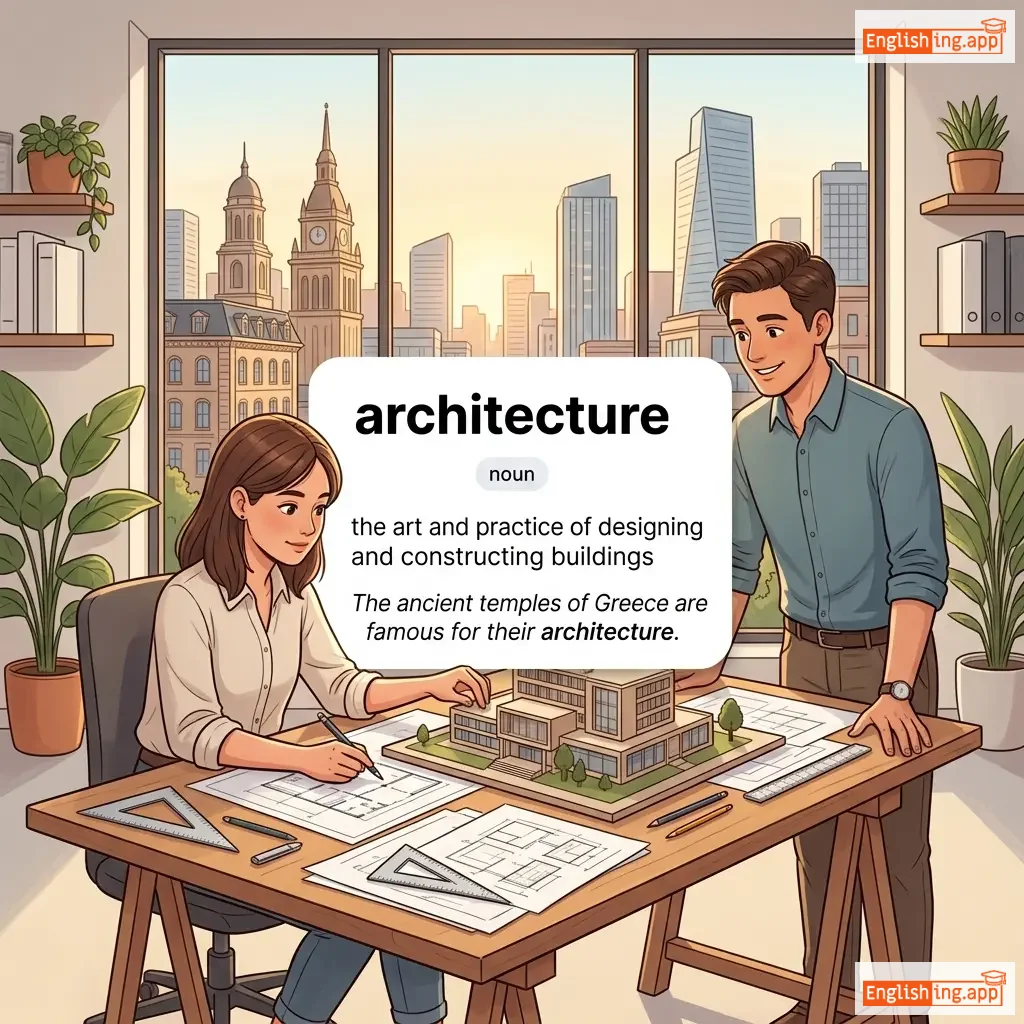
architecture definition card — visual illustration of the meaning
noun
/ˈɑːkɪˌtɛktʃər/
architecture (architecture)

the art and practice of designing and constructing buildings

"The ancient temples of Greece are famous for their architecture."

"Les anciens temples de Grèce sont célèbres pour leur architecture." (Les anciens temples de Grèce sont célèbres pour leur architecture.)
noun, verb
/ˈɑːrkaɪv/
archive (archive)

A collection of historical documents or records; to store or preserve information for future use.

"The library decided to archive all the old manuscripts."

"La bibliothèque a décidé d'archiver tous les anciens manuscrits." (La bibliotheque a decide d'archiver tous les anciens manuscrits.)
noun
/ˈɑːrkaɪvz/
archives (arkayvz)

A place or collection where historical records and documents are stored.

"She visited the national archives to research her family history."

"Elle a visité les archives nationales pour rechercher l'histoire de sa famille." (Elle a visité les archives nationales pour rechercher l'histoire de sa famille.)
adjective
/ˈɑːrdənt/
passionné, fervent (ardent)

Having or showing very strong feelings or passion.

"He is an ardent supporter of environmental protection."

"Il est un fervent défenseur de la protection de l'environnement." (Il est un fervent défenseur de la protection de l'environnement.)
ardor definition card — visual illustration of the meaning
noun
/ˈɑːrdər/
passion, enthousiasme (ardor)

Great enthusiasm or passion.

"She spoke with ardor about her new project."

"Elle parlait avec ardeur de son nouveau projet." (Elle parlait avec ardeur de son nouveau projet.)
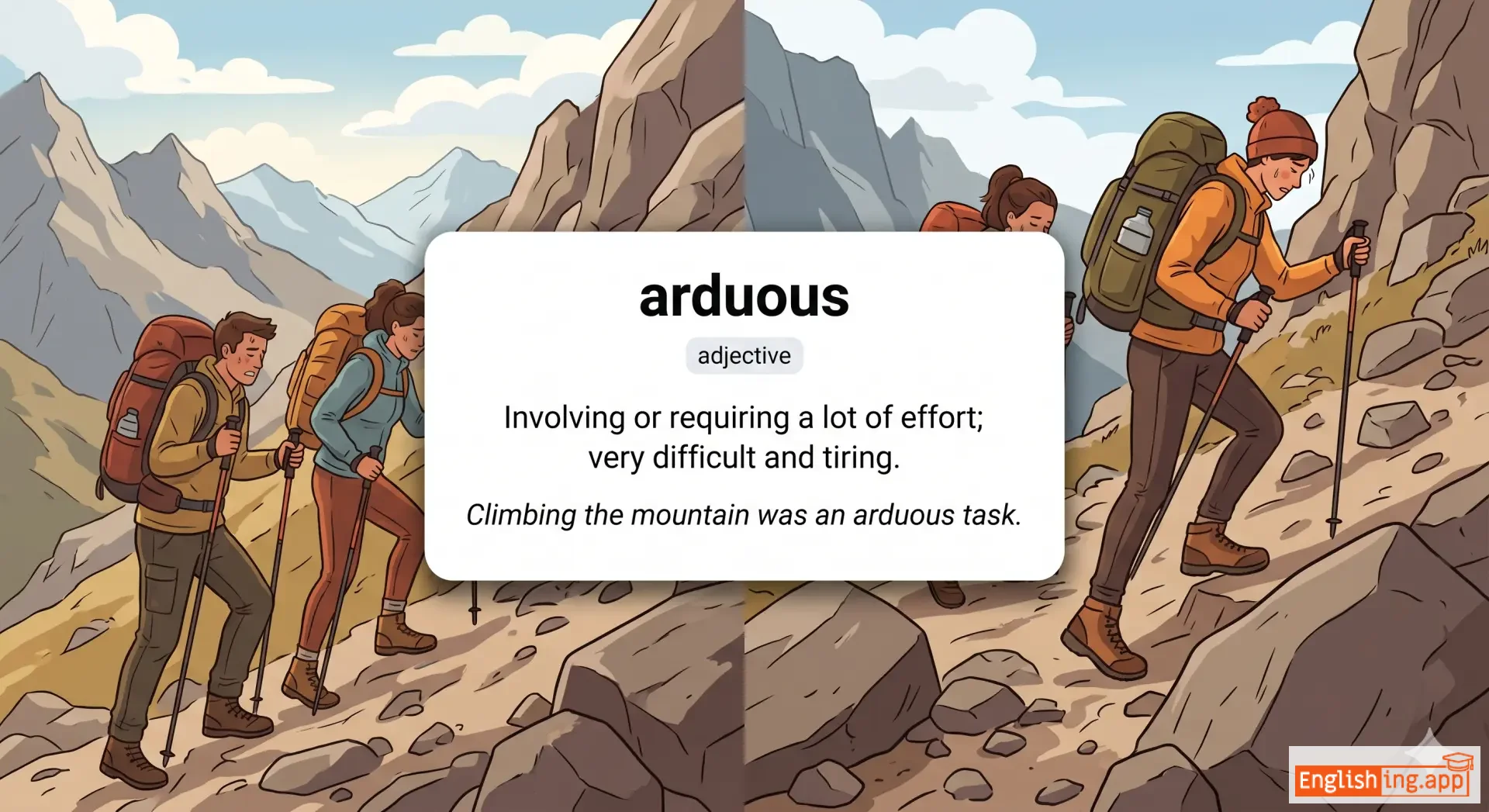
arduous definition card — visual illustration of the meaning
adjective
/ˈɑːrdʒuəs/
difficile (difficile)

Involving or requiring a lot of effort; very difficult and tiring.

"Climbing the mountain was an arduous task."

"Grimper la montagne était une tâche difficile." (Grimper la montagne était une tâche difficile.)
noun
/ˈeə.ri.ə/
zone (zone)

a particular region or space; the extent of a surface

"This area is known for its beautiful parks."

"Cette zone est connue pour ses beaux parcs." (Cette zone est connue pour ses beaux parcs.)
noun
/əˈriːnə/
terrain, scène (terrain, scene)

a large area surrounded by seats for sports, entertainment, or other events

"The basketball game will be held in the new arena downtown."

"Le match de basket-ball aura lieu dans la nouvelle arène du centre-ville." (Le match de basket-ball aura lieu dans la nouvelle arene du centre-ville.)
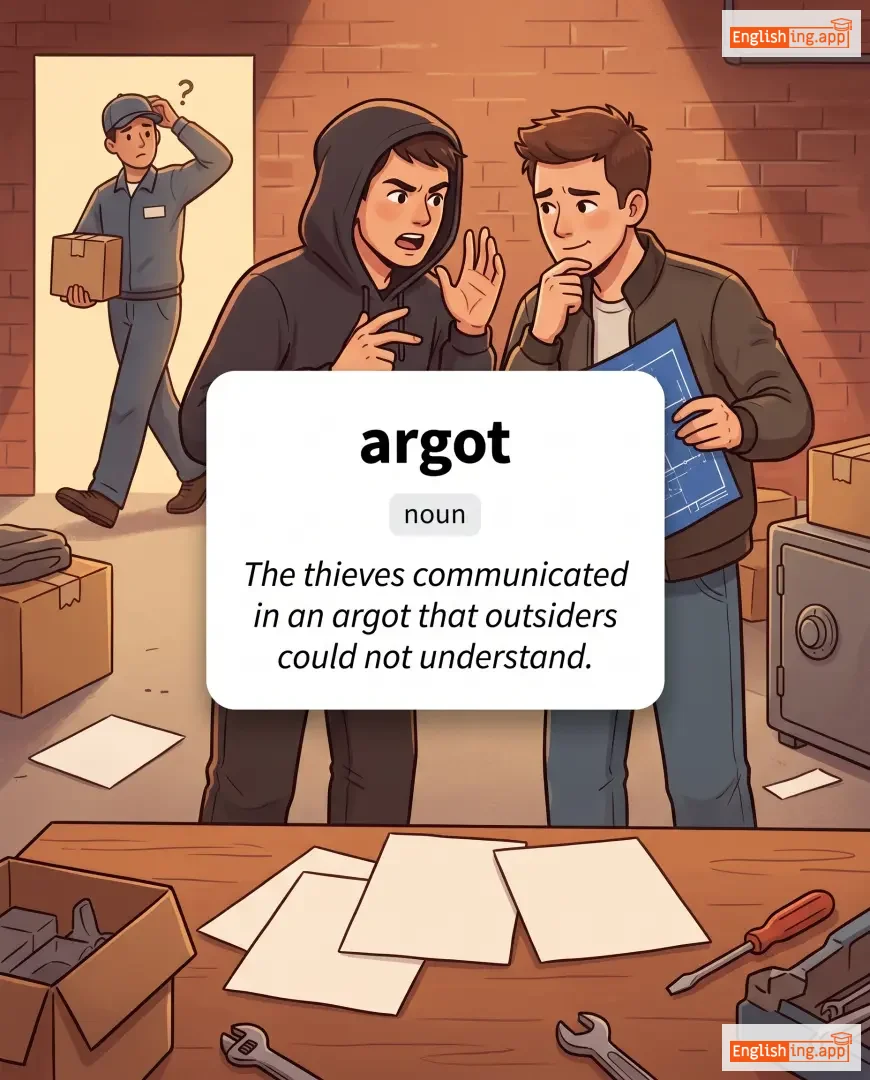
argot definition card — visual illustration of the meaning
noun
/ˈɑːrɡoʊ/
argot spécialisé (argot specialise)

the specialized vocabulary or jargon of a particular group, especially one with a common interest or occupation

"The thieves communicated in an argot that outsiders could not understand."

"Les voleurs ont communiqué dans un argot que les étrangers ne pouvaient pas comprendre." (Les voleurs ont communiqué dans un argot que les étrangers ne pouvaient pas comprendre.)
adjective
/ˈɑːrɡjuəbl/
discutable (discutable)

open to debate or discussion; not certain and capable of being argued for or against

"It is arguable that technology has improved our quality of life."

"Il est discutable que la technologie ait amélioré notre qualité de vie." (il est discutable que la technologie ait ameliore notre qualite de vie)
adverb
/ˈɑːɡjuːəbli/
sans doute (sans doute)

used to say that a statement is open to argument or is considered true by many people

"She is arguably the most talented player on the team."

"Elle est sans doute la joueuse la plus talentueuse de l’équipe." (Elle est sans doute la joueuse la plus talentueuse de l equipe)
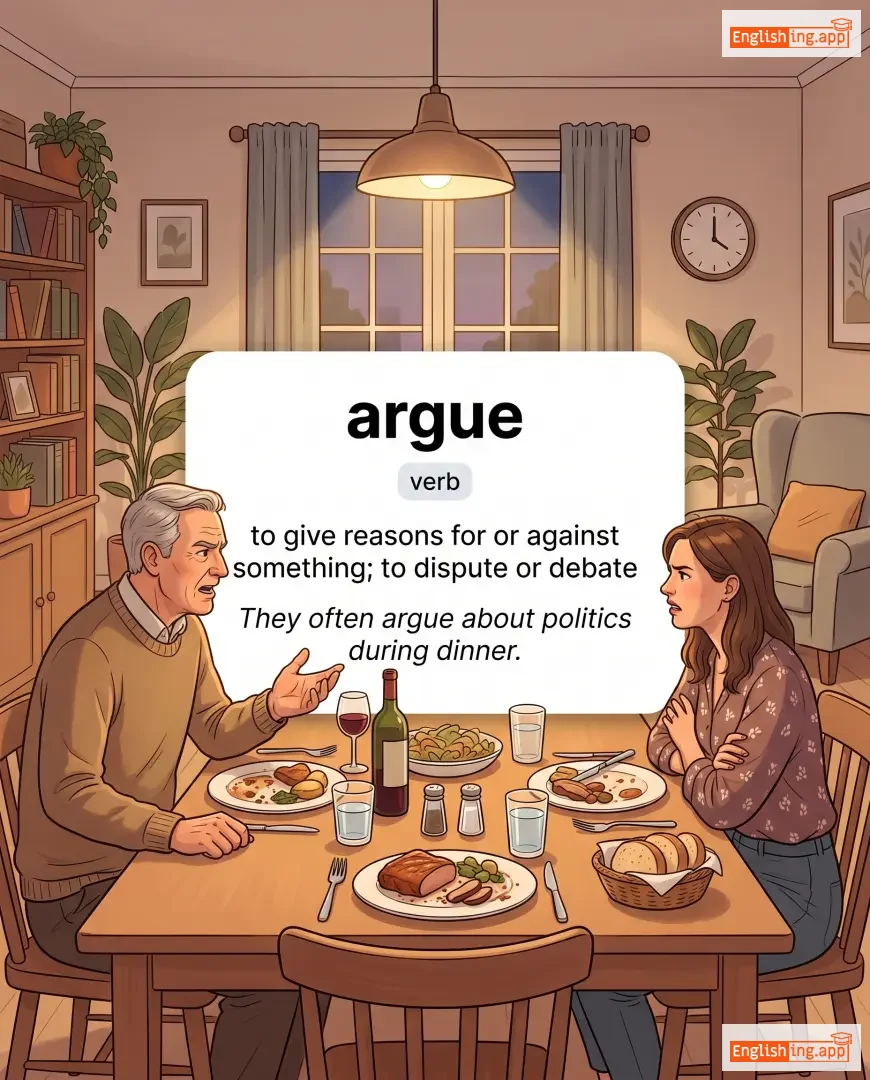
argue definition card — visual illustration of the meaning
verb
/ˈɑːrɡjuː/
disputer (disputer)

to give reasons for or against something; to dispute or debate

"They often argue about politics during dinner."

"Ils se disputent souvent sur la politique pendant le dîner." (Ils se disputent souvent sur la politique pendant le dîner.)
argument definition card — visual illustration of the meaning
noun
/ˈɑːrɡjumənt/
dispute, argument (dispute, argument)

a disagreement, or a reason given to support or oppose an idea

"They had a heated argument about money."

"Ils ont eu une dispute animée à propos de l'argent." (Ils ont eu une dispute animee a propos de l'argent.)
noun
/ˈɑːriə/
pièce vocale solo (piece vocale solo)

a solo vocal piece with instrumental accompaniment, typically in an opera

"The soprano performed a moving aria during the second act."

"La soprano a interprété une aria émouvante lors du deuxième acte." (La soprano a interprete une aria emouvante lors du deuxieme acte.)
adjective
/ˈærɪd/
aride (aride)

extremely dry; lacking in interest or excitement

"The desert is known for its arid climate."

"Le désert est connu pour son climat aride." (Le desert est connu pour son climat aride.)
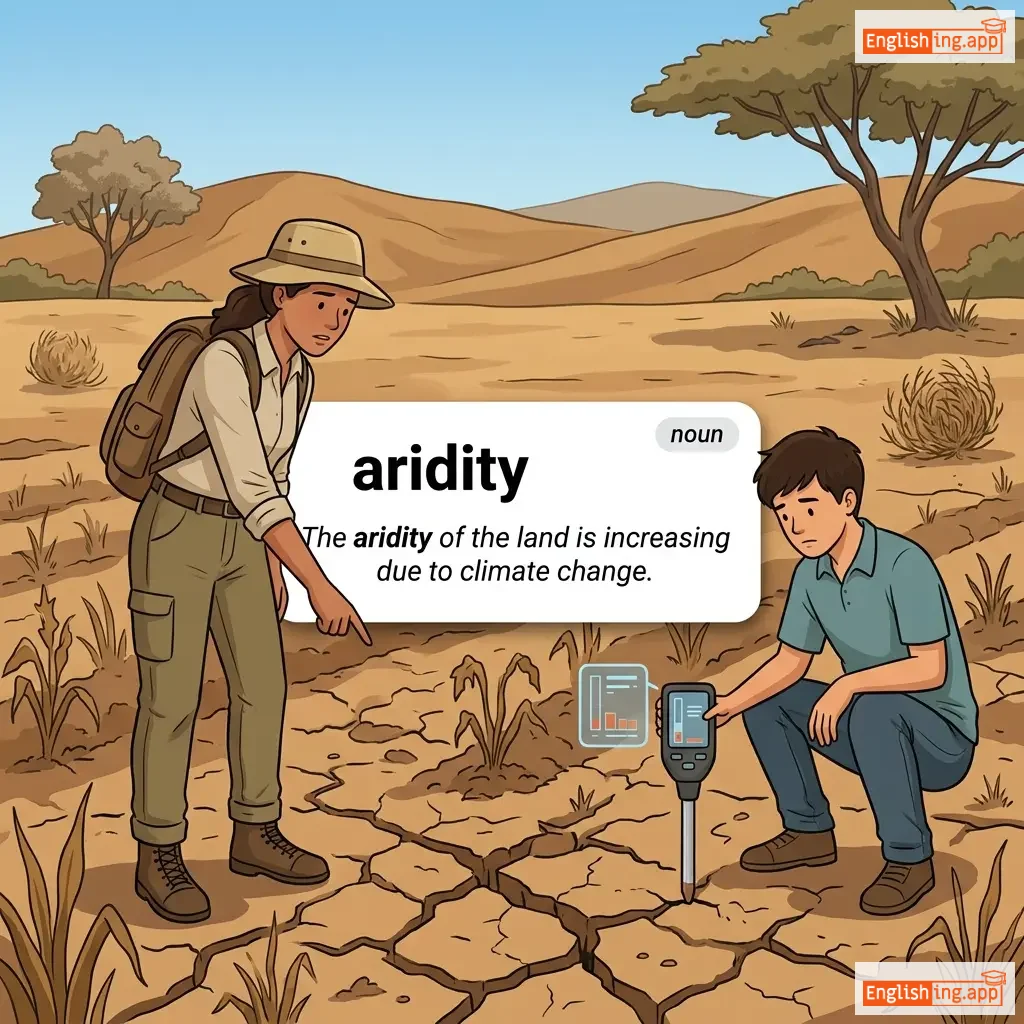
aridity definition card — visual illustration of the meaning
noun
əˈrɪd.ɪ.ti
aridité (aridite)

The state of being extremely dry, especially having insufficient rainfall to support vegetation.

"The aridity of the land is increasing due to climate change."

"L'aridité de la terre augmente en raison du changement climatique." (L'aridité de la terre augmente en raison du changement climatique.)
verb
/əˈraɪz/
survenir (survenir)

to begin to exist or to happen

"Problems may arise if you don't plan ahead."

"Des problèmes peuvent survenir si vous ne planifiez pas à l'avance." (Des problèmes peuvent survenir si vous ne planifiez pas à l'avance.)
noun
/ˌærɪˈstɑːkrəsi/
aristocratie (aristocratie)

a class of people holding exceptional rank and privileges, especially hereditary nobility

"The aristocracy often had influence over political decisions."

"L'aristocratie avait souvent une influence sur les décisions politiques." (L'aristocratie avait souvent une influence sur les décisions politiques.)
noun
/ˈærɪstəkræt/
aristocrate (aristocrate)

a member of the aristocracy; a nobleman or woman

"The aristocrat lived in a lavish mansion."

"L'aristocrate vivait dans un manoir somptueux." (L'aristocrate vivait dans un manoir somptueux.)
adjective
/ˌærɪˈstɒkrætɪk/
aristocratique; noble (aristocratique)

noble; having the manners of the upper class

"She had an aristocratic bearing that commanded respect."

"Elle avait une allure aristocratique qui imposait le respect." (Elle avait une allure aristocratique qui imposait le respect.)
noun
/ɑːrm/
bras (bras)

the part of the body from the shoulder to the hand; also a branch or division of an organization

"She broke her arm while playing football."

"Elle s'est cassée le bras en jouant au football." (Elle s'est casse le bras en jouant au football.)
noun
/ɑːrˈmɑːdə/
flotte de guerre (flotte de guerre)

A large fleet of warships.

"The Spanish Armada sailed against England in 1588."

"L'Armada espagnole a navigué contre l'Angleterre en 1588." (L'Armada espagnole a navigué contre l'Angleterre en 1588.)
adjective
/ɑːrmd/
armé (arme)

equipped with or carrying weapons

"The bank was robbed by armed men."

"La banque a été volée par des hommes armés." (La banque a été volée par des hommes armés.)
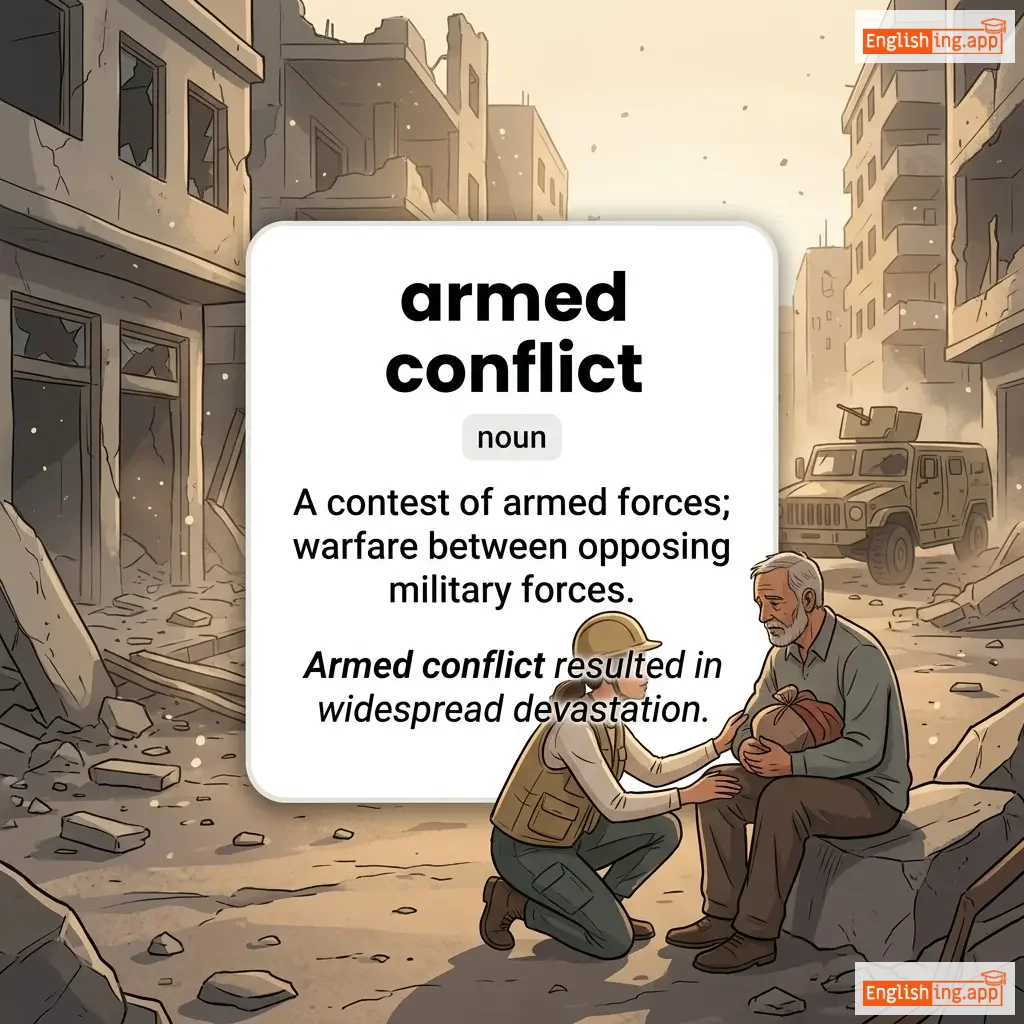
armed conflict definition card — visual illustration of the meaning
noun
ɑːmd ˈkɒn.flɪkt
conflit armé (conflit arme)

A contest of armed forces; warfare between opposing military forces.

"Armed conflict resulted in widespread devastation."

"Le conflit armé a entraîné une dévastation généralisée." (Le conflit armé a entraîné une dévastation généralisée.)
noun
/ˈɑːrmfʊl/
bras plein (bras plein)

As much as can be carried in one or both arms.

"She carried an armful of books into the library."

"Elle a porté un bras plein de livres à la bibliothèque." (Elle a porté un bras plein de livres à la bibliothèque.)
noun
/ˈɑːm.lət/
bracelet de bras (bracelet de bras)

a band worn around the upper arm as an ornament

"The traditional dancer wore golden armlets that gleamed in the spotlight."

"La danseuse traditionnelle portait des bracelets dorés qui brillaient sous les projecteurs." (La danseuse traditionnelle portait des bracelets dorés qui brillaient sous les projecteurs.)
noun
/ˈɑːrməri/
armurerie (armurerie)

A place where weapons are stored; a supply of resources or skills.

"The soldiers kept their weapons in the armory."

"Les soldats ont gardé leurs armes dans l'armurerie." (Les soldats ont gardé leurs armes dans l'armurerie.)
noun
/ˈɑːr.mər/
armure (armure)

protective covering worn by soldiers; metal plating for military vehicles

"The knight wore heavy armour to protect himself in battle."

"Le chevalier portait une armure lourde pour se protéger lors de la bataille." (Le chevalier portait une armure lourde pour se proteger lors de la bataille.)
noun
/ˈɑːrm.pɪt/
aisselle (aisselle)

the hollow area under the arm where it joins the shoulder

"He applied deodorant to his armpit."

"Il a appliqué du déodorant sur son aisselle." (Il a appliqué du déodorant sur son aisselle)
noun
/ɑːrmz/
armes / bras (armes / bras)

weapons and ammunition; or the upper limbs of the human body

"The country decided to reduce its stock of arms."

"Le pays a décidé de réduire son stock d'armes." (Le pays a decide de reduire son stock d'armes.)
noun
/ˈɑːrmi/
armée (armee)

a large organized military force trained for war

"The army protected the border from attack."

"L'armée a protégé la frontière contre l'attaque." (L'armee a protege la frontiere contre l'attaque.)
noun
/əˈroʊmə/
arôme (arome)

A pleasant, distinctive smell.

"The aroma of freshly baked bread filled the kitchen."

"L'arôme du pain fraîchement cuit remplissait la cuisine." (L'arome du pain fraichement cuit remplissait la cuisine.)
verb
/əˈdɔːrn/
orner (orner)

to decorate or add beauty to something

"The hall was adorned with flowers for the wedding."

"La salle a été ornée de fleurs pour le mariage." (La salle a ete ornee de fleurs pour le mariage.)