語彙集

英単語辞書 | 単語の意味、定義、例文

noun
/kɔːrn/
トウモロコシ (toumorokoshi)

a type of grain, often yellow, eaten as food

"They harvested corn in the summer."

"彼らは夏にトウモロコシを収穫しました。" (Karera wa natsu ni toumorokoshi o shūkaku shimashita.)
noun
/ˈkɔːrnər/
(kado)

the place where two edges or sides meet

"The store is just around the corner."

"店はちょうど角のところにあります。" (Mise wa chōdo kado no tokoro ni arimasu.)
noun
/ˈkɔːrnɪs/
コーニス (kōnisu)

an ornamental molding around the wall of a room just below the ceiling

"The elegant cornice added a classical touch to the living room."
"エレガントなコーニスはリビングルームにクラシックなタッチを加えました。" (Ereganto na kōnisu wa ribingu rūmu ni kurashikku na tacchi o kuwaemashita.)
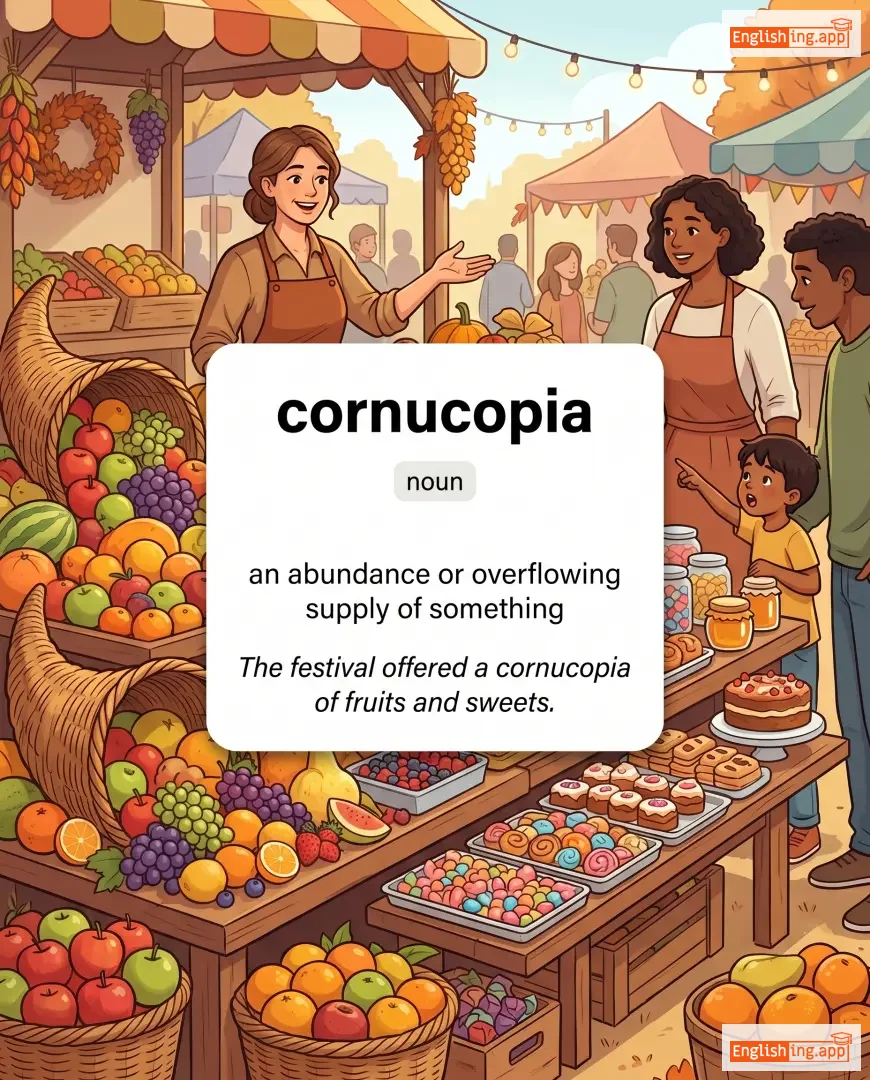
cornucopia definition card — visual illustration of the meaning
noun
/ˌkɔːrnjuˈkoʊpiə/
物事の豊富な供給または溢れんばかりの供給 (monogoto no houfu na kyoukyuu matawa afurenbakari no kyoukyuu)

an abundance or overflowing supply of something

"The festival offered a cornucopia of fruits and sweets."

"祭りでは果物とお菓子のコルヌコピアが提供されました。" (Matsuri de wa kudamono to okashi no cornucopia ga teikyou saremashita.)
noun
/kəˈrɑːləri/
直接的または自然な結果 (chokusetsuteki matawa shizenna kekka)

a direct or natural consequence or result

"One corollary of the new policy was increased public awareness."

"新しい政策の結果の一つは、公共の認識の向上でした。" (Atarashī seisaku no kekka no hitotsu wa, kōkyō no ninshiki no kōjō deshita.)
noun
/kəˈroʊnə/
王冠または王冠のような構造; また、太陽の外層大気を指すこともあります (ōkan mata wa ōkan no yō na kōzō; mata, taiyō no gaisō taiki o sasu koto mo arimasu)

a crown or crown-like structure; also refers to the outer atmosphere of the sun

"The sun's corona was visible during the total solar eclipse."

"太陽のコロナは皆既日食中に見ることができました。" (Taiyō no korona wa kaikī nisshoku-chū ni miru koto ga dekimashita.)
noun
/ˌkɒrəˈneɪʃən/
戴冠式 (taikan-shiki)

the act or ceremony of crowning a sovereign or monarch

"The coronation of the new king was attended by thousands of people."

"新しい王の戴冠式には何千人もの人々が参加しました。" (Atarashii ō no taikan-shiki ni wa nan-sen nin mo no hitobito ga sanka shimashita.)
noun
/ˈkɒrənər/
検死官 (kenshikan)

an official who investigates sudden, violent, or suspicious deaths

"The coroner determined the cause of death was natural."

"検死官は死因が自然死であると判定しました。" (Kenshikan wa shiin ga shizenshi de aru to hantei shimashita.)
noun
/ˈkɒrənɛt/
小さな王冠 (chiisana ōkan)

a small crown, especially one worn by a prince, princess, or noble

"She wore a delicate coronet on her head for the ceremony."

"彼女は式典のために頭に繊細な小さな王冠をかぶっていました。" (Kanojo wa shikiten no tame ni atama ni sensai na chiisana ōkan o kabutte imashita.)
adjective, noun
/ˈkɔːrpərəl/
伍長 (gochou)

relating to the body; a low-ranking officer in the military

"He suffered a corporal punishment for his mistake."

"彼はミスのために体罰を受けました。" (Kare wa misu no tame ni taibatsu wo ukemashita.)
adjective, noun
/ˈkɔːrpərət/
企業/コーポレートに関連する (kigyo/corporate ni kanren suru)

relating to a corporation or large company; united as a single body

"Corporate social responsibility is important for modern businesses."

"企業の社会的責任は現代のビジネスにとって重要です。" (Kigyo no shakaiteki sekinin wa gendai no bijinesu ni totte jūyō desu.)
noun
/ˌkɔːrpəˈreɪʃən/
株式会社 (kabushikigaisha)

A large company or group of companies that is legally recognized as a single entity.

"The corporation invested heavily in renewable energy projects."

"そのコーポレーションは再生可能エネルギーのプロジェクトに多額の投資を行った。" (Sono kōporēshon wa saiseikanō enerugī no purojekuto ni tagaku no tōshi o okonatta.)
adjective
/kɔːrˈpɔːriəl/
肉体的, 物質的 (nikutai-teki, busshitsu-teki)

relating to the physical body; material or tangible

"Ghosts are often described as having no corporeal form."

"幽霊はしばしば肉体的な形がないと説明されます。" (Yūrei wa shibashiba nikutai-teki na katachi ga nai to setsumei saremasu.)
noun
/kɔːr/
軍隊の部門、グループ (guntai no bumon, gurūpu)

a branch of the military or a group organized for a specific purpose

"He joined the army corps after graduation."

"彼は卒業後、軍隊の部門に参加しました。" (Kare wa sotsugyōgo, guntai no bumon ni sanka shimashita.)
noun
/kɔːrps/
遺体 (itai)

a dead body, especially of a human

"The police discovered a corpse in the abandoned house."

"警察は廃墟の家で遺体を発見しました。" (Keisatsu wa haikyo no ie de itai o hakken shimashita.)
adjective
/ˈkɔːpjʊlənt/
肥満の, 太った (himan no, futotta)

fat or obese; having a large bulky body

"The corpulent man struggled to fit into the small chair."
"その太った男性は、小さな椅子に座るのに苦労していました。" (Sono futotta dansei wa, chīsana isu ni suwaru no ni kurō shiteimashita.)
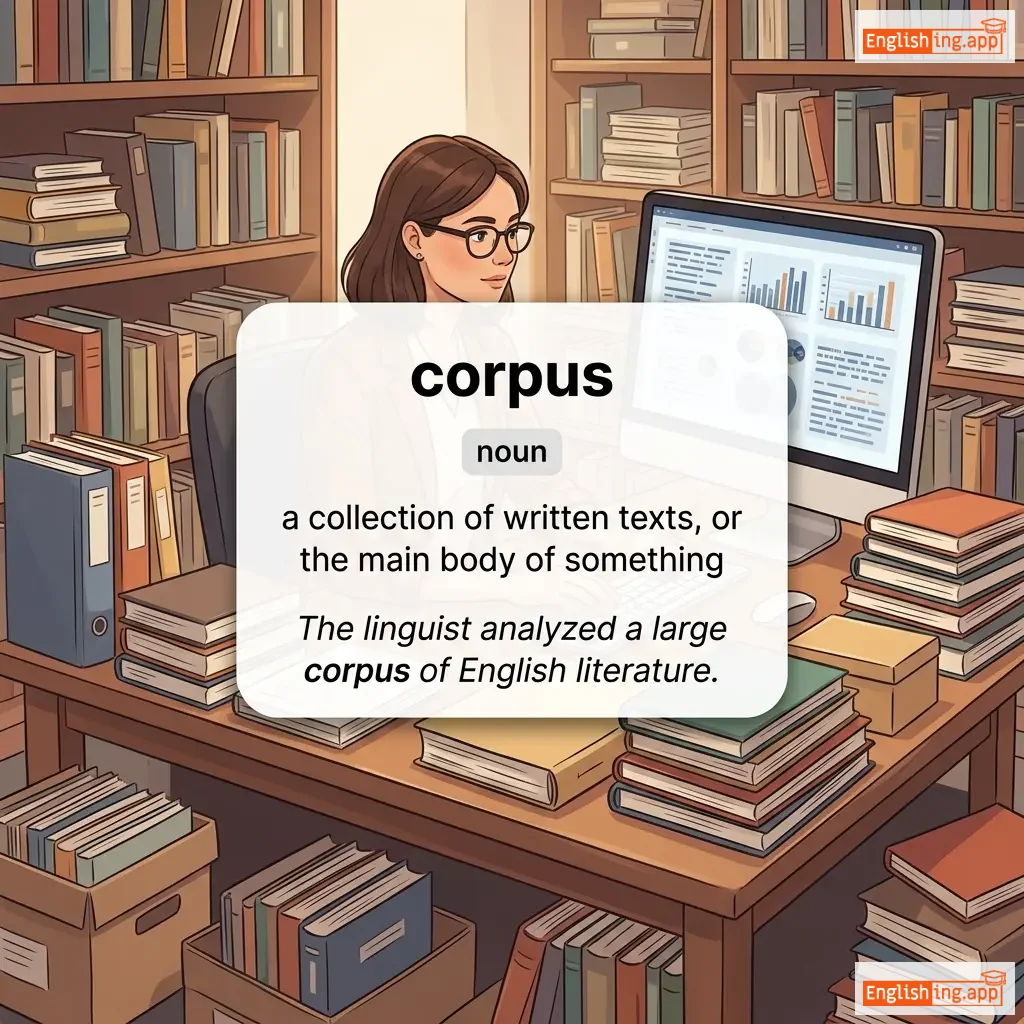
corpus definition card — visual illustration of the meaning
noun
/ˈkɔːrpəs/
コレクション、主要部分 (korekushon, shuyou bubun)

a collection of written texts, or the main body of something

"The linguist analyzed a large corpus of English literature."

"言語学者は大量の英文学コーパスを分析しました。" (Gengogakusha wa tairyo no eigobungaku kopasu o bunseki shimashita.)
noun
/ˈkɔːrpəskəl/
小さな粒子または細胞、特に赤血球 (chiisana ryuushi matawa saibou, toku ni akakeyuu)

a small particle or cell, especially a blood cell

"Red corpuscles carry oxygen throughout the body."

"赤血球は体内で酸素を運ぶ。" (Sekkekkyuu wa tainai de sanso wo hakobu.)
adjective
/kəˈrɛkt/
正しい (tadashii)

free from error; accurate

"The answer she gave was correct."

"彼女が言った答えは正しかった。" (Kanojo ga itta kotae wa tadashikatta.)
noun
/kəˈrɛkʃən/
訂正 (teisei)

the action or process of correcting something

"The teacher made a correction to the student's essay."

"教師は学生のエッセイに訂正を加えました。" (Kyōshi wa gakusei no essei ni teisei o kuwaemashita.)
adverb
/kəˈrɛktli/
正しく (tadashiku)

in a way that is true, accurate, or without mistakes

"She answered all the questions correctly."
"彼女はすべての質問に正しく答えました。" (Kanojo wa subete no shitsumon ni tadashiku kotaemashita.)
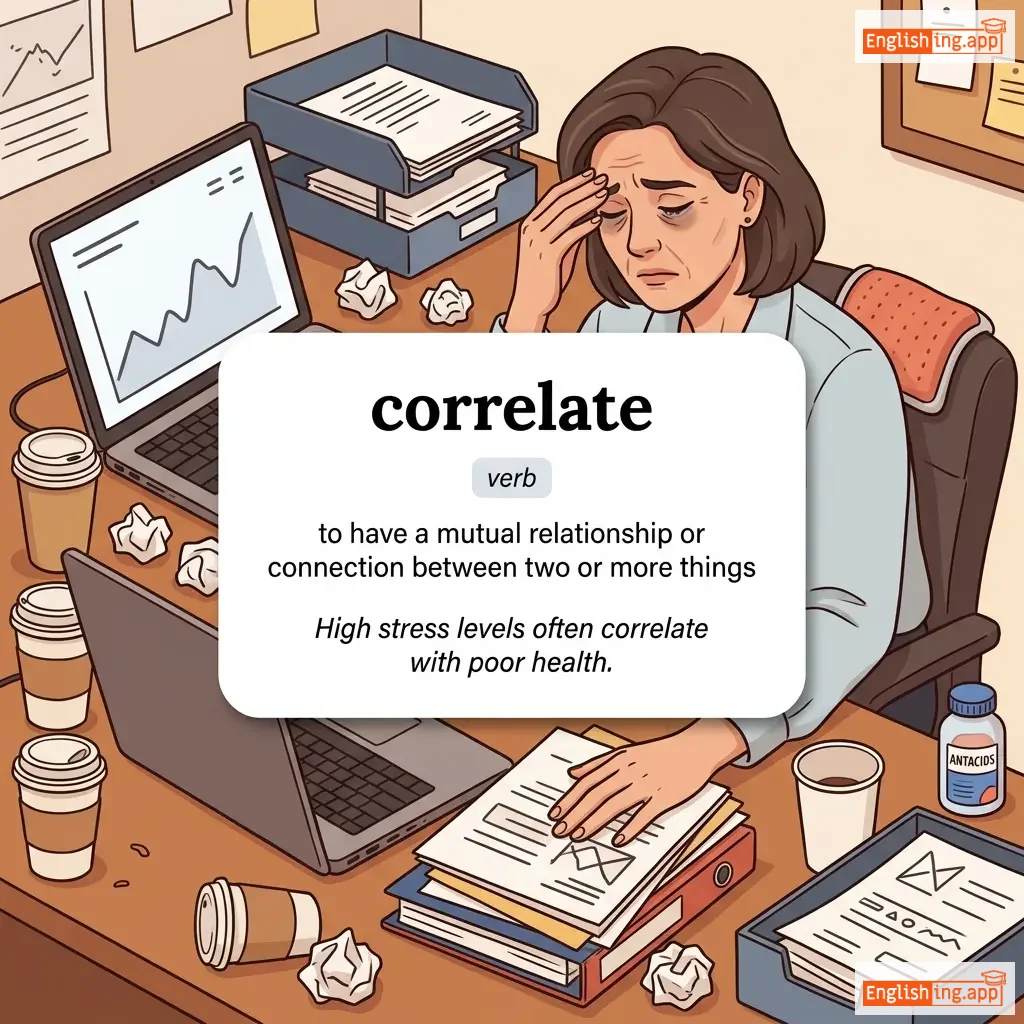
correlate definition card — visual illustration of the meaning
verb
/ˈkɒrəleɪt/
相関する (sōkan suru)

to have a mutual relationship or connection between two or more things

"High stress levels often correlate with poor health."

"高いストレスレベルは、しばしば健康の悪化と関連しています。" (Takai sutoresu reberu wa, shibashiba kenkō no akika to kanren shiteimasu.)
noun
/ˌkɒrəˈleɪʃən/
相関 (sōkan)

a mutual relationship or connection between two or more things

"Researchers found a strong correlation between diet and heart disease."

"研究者たちは、食事と心臓病との間に強い相関関係があることを発見しました。" (Kenkyū-sha-tachi wa, shokuji to shinzōbyō to no aida ni tsuyoi sōkan kankei ga aru koto o hakken shimashita.)
adjective
/kəˈrɛlətɪv/
相関的な (sōkanteki na)

having a mutual relationship; corresponding

"The increase in temperature is correlative with the melting of glaciers."

"温度の上昇は氷河の融解と関連しています。" (Ondo no jōshō wa hyōga no yūkai to kanren shiteimasu.)
verb
/kəˈrɛspɒnd/
通信する (tsuushin suru)

to communicate by exchanging letters or messages

"I correspond regularly with my old friends."

"私は定期的に古い友達と通信しています。" (Watashi wa teikitekini furui tomodachi to tsuushin shiteimasu.)
noun
/kəˈrɛspɒndəns/
通信 (tsuushin)

the exchange of letters or communication

"His correspondence with clients was always timely."

"彼のクライアントとのコレスポンデンスは常に時間通りでした。" (Kare no kuraianto to no korespondeinsu wa itsumo jikan doori deshita.)
noun
/ˌkɒrəˈspɒndənt/
通信員 (tsūshin'in)

A journalist who reports news from a particular place or on a particular subject.

"The foreign correspondent reported live from Paris."

"外国の通信員がパリからライブで報告した。" (Gaikoku no tsūshin'in ga Pari kara raibu de hōkoku shita.)
adjective
/kəˈrɛspɒndɪŋ/
対応する (taiō suru)

matching or related to something

"The corresponding page in the book explains the process in detail."

"本の対応するページは、そのプロセスを詳細に説明しています。" (Hon no taiō suru pēji wa, sono purosesu o shōsai ni setsumei shiteimasu.)
noun
/ˈkɔːrɪdɔːr/
部屋に通じる長い通路 (koridō)

a long passage in a building from which doors lead into rooms

"The students waited quietly in the corridor."

"生徒たちは廊下で静かに待っていた。" (Seito-tachi wa rōka de shizukani matte ita.)
adjective
/ˈkɒrɪdʒəbl/
修正可能 (shūsei kanō)

capable of being corrected or improved

"The student's mistakes were corrigible with practice."
"学生の誤りは練習で修正可能でした。" (Gakusei no ayamari wa renshū de shūsei kanō deshita.)
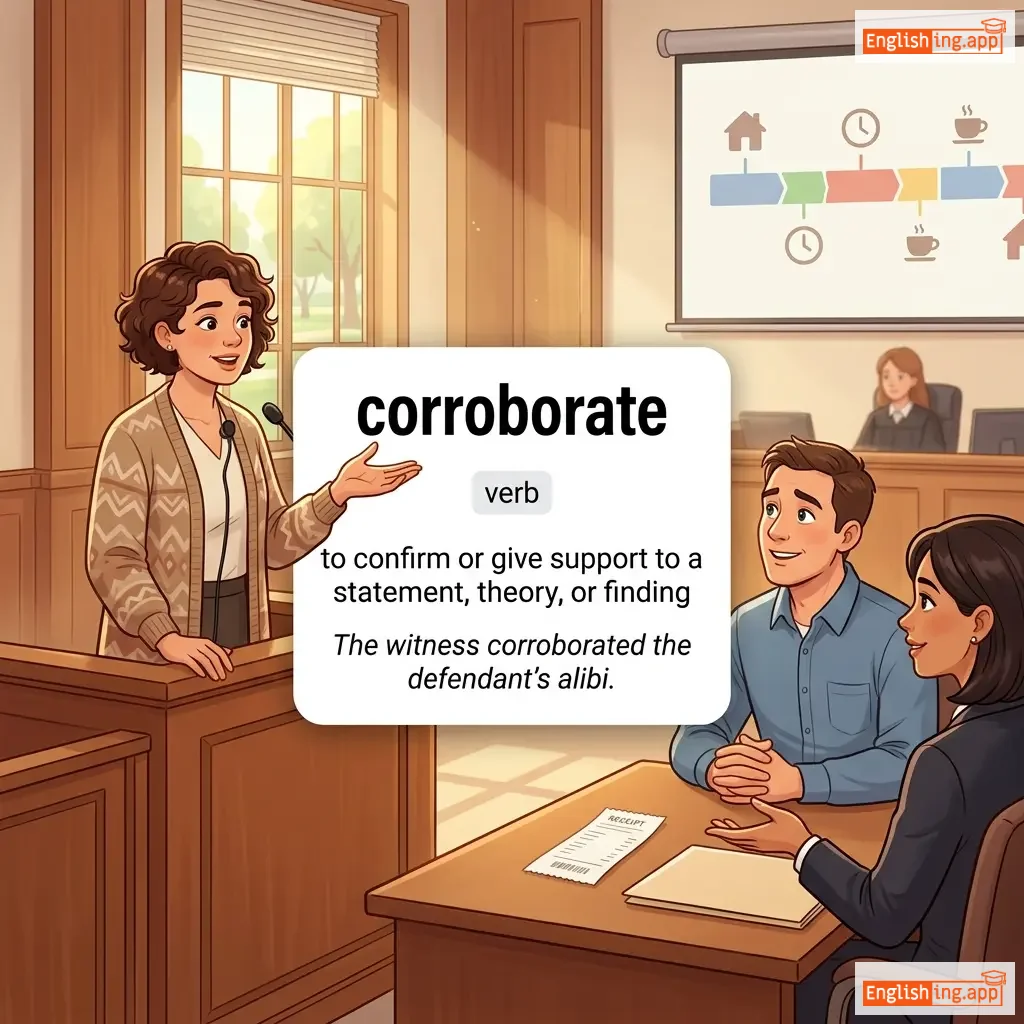
corroborate definition card — visual illustration of the meaning
verb
/kəˈrɒbəreɪt/
裏付ける (urazukeru)

to confirm or give support to a statement, theory, or finding

"The witness corroborated the defendant's alibi."

"証人は被告のアリバイを裏付けた。" (Shōnin wa hikoku no aribai wo urazuketa.)
noun
/kəˌrɒbəˈreɪʃən/
証拠 (shōko)

evidence that confirms or supports a statement, theory, or finding

"The documents provided strong corroboration of her claims."

"書類は彼女の主張を強力に裏付ける証拠を提供した。" (Shorui wa kanojo no shuchō o kyōryoku ni urazukeru shōko o teikyō shita.)
verb
/kəˈrəʊd/
腐食 (fushoku)

to gradually destroy or wear away metal or other materials through chemical action

"The iron pipes corroded over time due to exposure to water."
"鉄のパイプは水にさらされて時間が経つにつれて腐食しました。" (Tetsu no paipu wa mizu ni sarasarete jikan ga tatsu ni tsurete fushoku shimashita.)
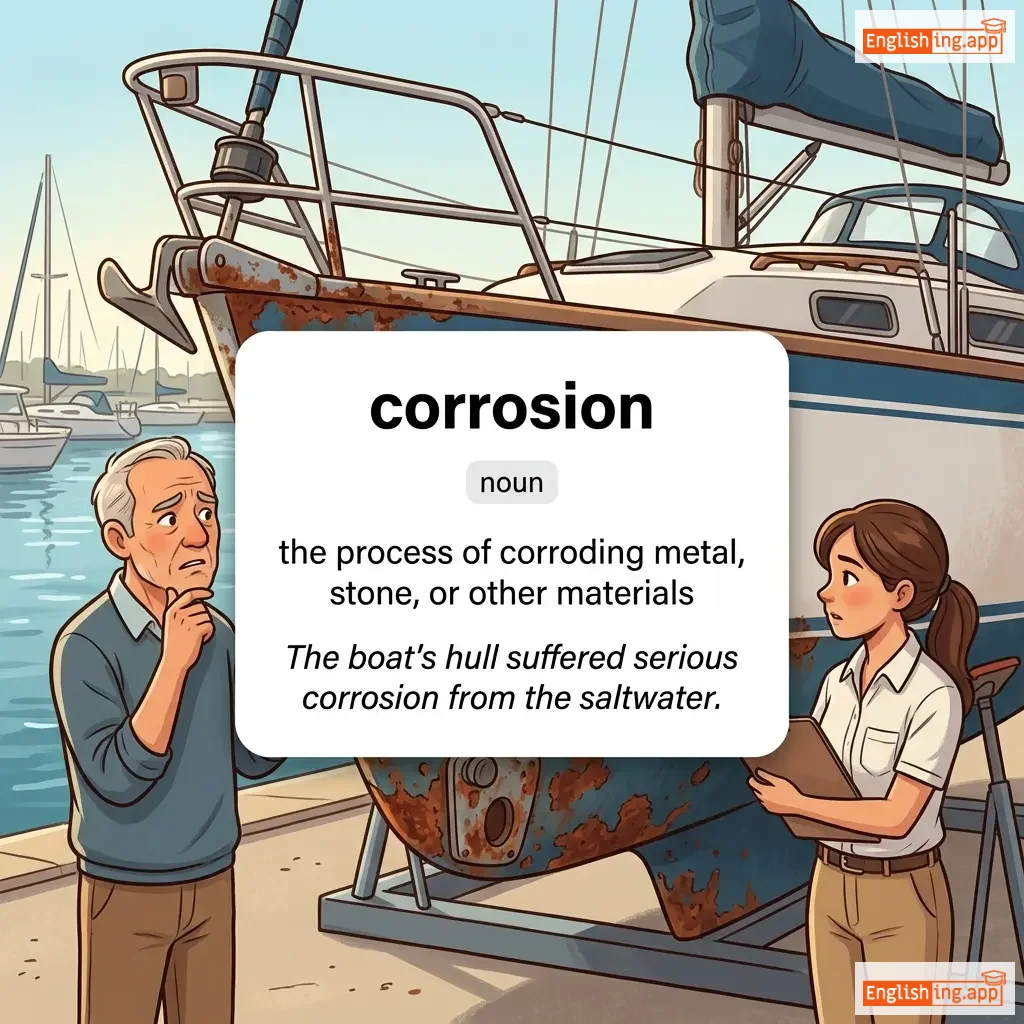
corrosion definition card — visual illustration of the meaning
noun
/kəˈrəʊʒən/
腐食, 破壊 (fushoku, hakai)

the process of corroding metal, stone, or other materials

"The boat's hull suffered serious corrosion from the saltwater."

"船の船体は塩水で深刻な腐食に見舞われました。" (Fune no sentai wa enshui de shinkoku na fushoku ni mimaware mashita.)
adjective
/kəˈrəʊsɪv/
腐食性、有害 (fushokusei, yūgai)

tending to cause corrosion; harmful or destructive to materials or people

"The chemical is highly corrosive and should be handled with care."

"この化学物質は非常に腐食性が高く、注意して取り扱う必要があります。" (Kono kagaku busshitsu wa hijō ni fushokusei ga takaku, chūi shite toriatsukau hitsuyō ga arimasu.)
adjective
/ˈkɒr.ə.ɡeɪ.tɪd/
波形または折りたたまれた (hakei mata wa oritamatareta)

shaped into ridges and grooves; wrinkled or folded

"The roof was made of corrugated metal sheets."

"屋根は波形の金属板で作られていました。" (Yane wa hokei no kinzoku ban de tsukurarete imashita.)
adjective/verb
/kəˈrʌpt/
腐敗 (fuhai)

dishonest or morally wrong; to make something impure or evil

"The politician was accused of corrupt practices."

"その政治家は腐敗行為で告発された。" (Sono seijika wa fuhai koui de kokuhatsu sareta.)
adjective
/kəˈrʌp.tə.bəl/
腐敗しやすい (fuhai shiyasui)

able to be morally or ethically corrupted

"He was known to be corruptible and often accepted bribes."

"彼は腐敗しやすいことで知られ、しばしば賄賂を受け取った。" (Kare wa fuhai shiyasui koto de shirare, shibashiba wairo o uketotta.)
noun
/kəˈrʌp.ʃən/
汚職 (osho)

dishonest or fraudulent conduct by those in power

"The government launched a campaign to fight corruption."

"政府は腐敗と戦うためにキャンペーンを開始しました。" (Seifu wa fuhai to tatakau tame ni kyanpēn o kaishi shimashita.)
noun
/ˈkɔː.seər/
海賊 (kaizoku)

a pirate, especially one operating along the Mediterranean coasts

"The corsair plundered ships along the coast."

"コルセアは海岸沿いで船を略奪した。" (Korusea wa kaiganzoi de fune o ryakudatsu shita.)
noun
/kɔːrˈteɪʒ/
葬列 (sōretsu)

a solemn procession, especially for a funeral

"A cortege of mourners followed the hearse to the cemetery."

"悲しみに沈んだ人々が葬列を引き連れて霊柩車を墓地に送った。" (Kanashimi ni shizunda hitobito ga sōretsu o hiki tsurete reikyūsha o bochi ni okutta.)
verb
/ˈkɒr.ʌ.skeɪt/
きらめく (kirameku)

to sparkle or flash brightly

"The fireworks coruscated across the night sky."

"花火は夜空に向かってきらめいた。" (Hanabi wa yozora ni mukatte kirameita.)
adjective
/kɒzˈmɛt.ɪk/
化粧品 (keshohin)

relating to beauty or appearance; intended to improve looks

"She bought a new cosmetic cream for her skin."

"彼女は肌のために新しいコスメティッククリームを買いました。" (Kanojo wa hada no tame ni atarashii kosmetikku kuriimu wo kaimashita.)
adjective
/ˈkɒz.mɪk/
宇宙的, 広大な (uchu-teki, kodai-na)

relating to the universe or cosmos; vast

"Astronomers study cosmic phenomena to understand the universe."

"天文学者たちは宇宙を理解するためにコズミック現象を研究しています。" (Tenmongakusha-tachi wa uchu o rikai suru tame ni kozumikku genshō o kenkyū shiteimasu.)
noun
/kɒzˈmɒɡ.ə.ni/
宇宙生成論 (uchū seiseiron)

the study or theory of the origin of the universe

"The book provides an overview of different cosmogonies throughout history."

"この本は歴史を通じて異なる宇宙生成論の概説を提供しています。" (Kono hon wa rekishi o tōjite kotonaru uchū seiseiron no gaisetsu o teikyō shiteimasu.)
noun
/kɒzˈmɒɡ.rə.fi/
コスモグラフィー (kosumogurafī)

the science or art of mapping the universe or cosmos

"Medieval scholars practiced cosmography to chart the stars and planets."

"中世の学者たちは、星や惑星の地図を作成するためにコスモグラフィーを実践していました。" (Chūsei no gakusha-tachi wa, hoshi ya wakusei no chizu o sakusei suru tame ni kosumogurafī o jissen shite imashita.)
cosmology definition card — visual illustration of the meaning
noun
/kɒzˈmɒlədʒi/
コスモロジー (kosumorojī)

the science of the origin and development of the universe

"She studied cosmology to understand the origins of the universe."

"彼女は宇宙の起源を理解するためにコスモロジーを学んだ。" (Kanojo wa uchū no kigen o rikai suru tame ni kosumorojī o mananda.)
adjective
/ˌkɒzməˈpɒlɪtən/
コスモポリタン (kosumoporitan)

familiar with and at ease in many different countries and cultures

"He has a cosmopolitan outlook due to his extensive travels."

"彼は広範な旅行のおかげで、コスモポリタン的な視点を持っています。" (Kare wa kōhan na ryokō no okage de, kosumoporitan-teki na shiten o motteimasu.)
noun
/ˌkɒzməˈpɒlɪtənɪzəm/
コスモポリタニズム (kosumoporitanizumu)

the ideology that all human beings belong to a single community

"Cosmopolitanism promotes respect and understanding across cultures."

"コスモポリタニズムは文化間の尊重と理解を促進します。" (Kosumoporitanizumu wa bunkakan no sonchou to rikai o sokushin shimasu.)
noun
/ˈkɒzmɒs/
宇宙 (uchū)

the universe seen as a well-ordered whole

"Astronomers study the cosmos to learn about the universe's structure."

"天文学者たちは宇宙の構造を学ぶために宇宙を研究しています。" (Tenmongakusha-tachi wa uchū no kōzō o manabu tame ni uchū o kenkyū shiteimasu.)