वोकैबुलरीज

इंग्लिश वोकैबुलरी डिस्कवर, लर्न और मास्टर करें

verb
/ˈkæstɪˌɡeɪt/
कठोर आलोचना करना (kathor alochana karna)

To criticize someone severely or to punish harshly.

"The teacher castigated the students for their poor behavior."

"टीचर ने छात्रों को उनके खराब व्यवहार के लिए कठोर आलोचना की।" (Teacher ne chhatron ko unke kharab vyavhaar ke liye kathor alochana ki.)
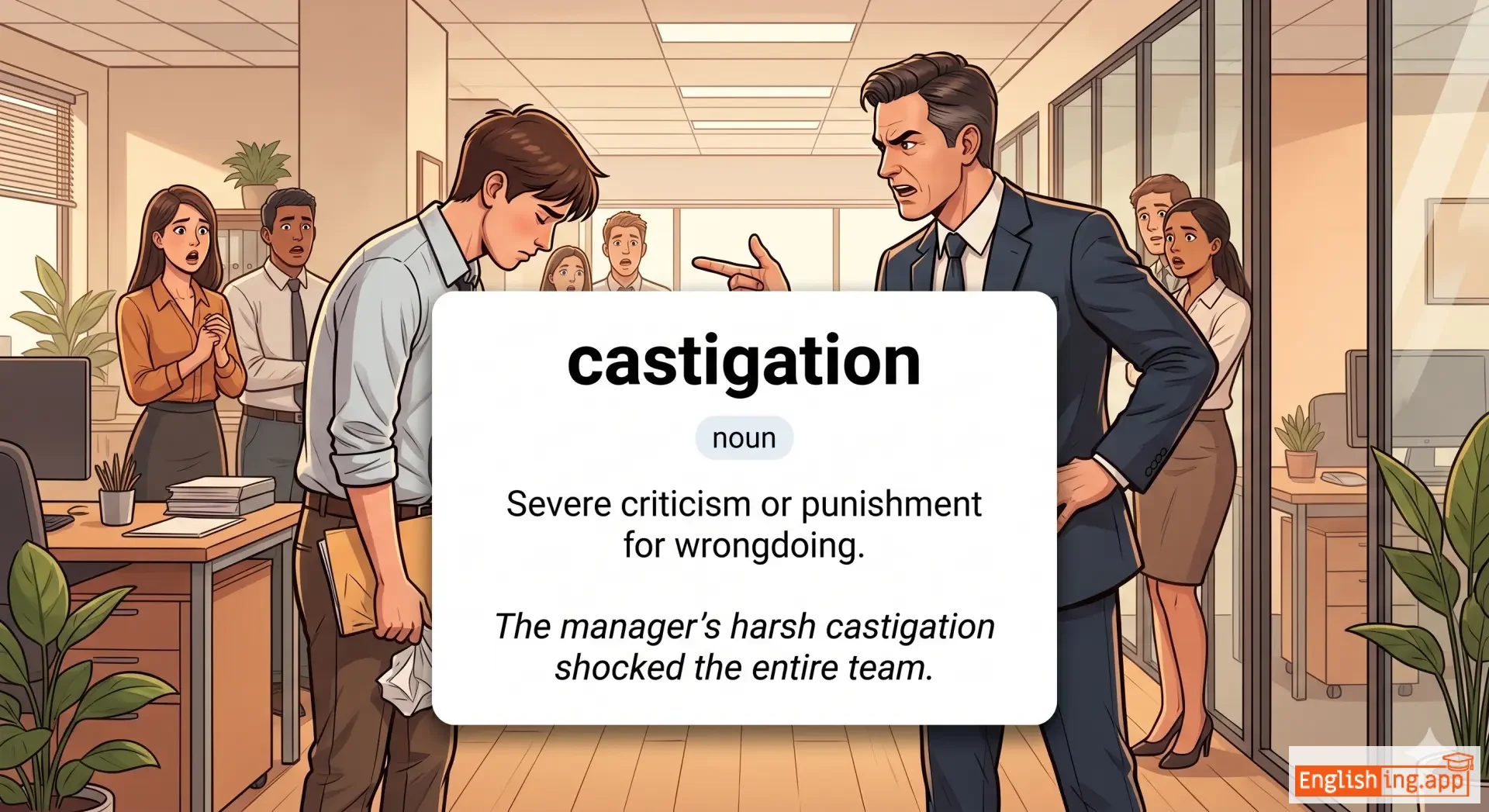
castigation definition card — visual illustration of the meaning
noun
/ˌkæstɪˈɡeɪʃən/
कड़ी आलोचना या सजा (kadi alochana ya saza)

Severe criticism or punishment for wrongdoing.

"The manager’s harsh castigation shocked the entire team."

"मैनेजर की कड़ी आलोचना ने पूरी टीम को चौंका दिया।" (Manager ki kadi alochana ne puri team ko chauka diya.)
noun
/ˈkæsəl/
किला (kila)

a large fortified building or complex of buildings, typically of the medieval period, used as a residence for nobility

"The king lived in a grand castle on the hilltop."

"राजा पहाड़ी की चोटी पर एक भव्य किले में रहते थे।" (Raja pahadi ki chhoti par ek bhavya kile mein rehte the.)
verb
/ˈkæstreɪt/
नपुंसक बनाना (napunsak banana)

To remove the testicles of a male animal or human.

"The farmer castrated the young bulls to make them easier to manage."

"किसान ने युवा बैलों को नपुंसक बनाया ताकि उन्हें प्रबंधित करना आसान हो।" (Kisan ne yuva bailon ko napunsak banaya taki unhe prabandhit karna aasan ho.)
adjective
/ˈkæʒuəl/
अनौपचारिक (anaupcharik)

Relaxed and informal in style, manner, or appearance.

"He wore casual clothes to the informal gathering."

"उसने अनौपचारिक सभा में कैजुअल कपड़े पहने।" (Usne anaupcharik sabha mein casual kapde pehne.)
adverb
/ˈkæʒ.u.ə.li/
आकस्मिक रूप से; बिना किसी तैयारी या सोच के (aaksamik roop se; bina kisi taiyari ya soch ke)

in a relaxed and informal way; without much thought or preparation

"He casually mentioned that he was leaving."

"उसने कैजुअली कहा कि वह जा रहा था।" (usne kaijuali kaha ki vah ja raha tha.)
noun
/ˈkæʒuəlti/
दुर्घटना या युद्ध में घायल या मारे गए व्यक्ति (durghatna ya yuddh mein ghayal ya maare gaye vyakti)

A person injured or killed in an accident or war.

"The accident resulted in several casualties."

"दुर्घटना में कई लोग घायल हुए।" (Durghatna mein kai log ghayal hue.)
noun
/ˈkæʒuɪstri/
कपटी तर्क (kapati tark)

The use of clever but false reasoning, especially in relation to moral questions.

"The lawyer’s argument was dismissed as mere casuistry."

"वकील का तर्क केवल कपटी तर्क के रूप में खारिज कर दिया गया था।" (Vakeel ka tark keval kapati tark ke roop mein kharij kar diya gaya tha.)
noun
/kæt/
बिल्ली (billi)

a small domesticated carnivorous mammal often kept as a pet

"The cat is sleeping on the sofa."

"बिल्ली सोफे पर सो रही है।" (Billi sofe par so rahi hai.)
noun
/ˈkæt fɪʃ/
कैटफ़िश (catfish)

a freshwater fish with whisker-like barbels around the mouth, commonly found in ponds and rivers

"Catfish is often fried and served with rice in Bengali cuisine."

"कैटफ़िश को अक्सर तला जाता है और चावल के साथ भारतीय व्यंजनों में परोसा जाता है।" (Catfish ko aksar tala jaata hai aur chawal ke saath Bhartiya vyanjon mein parosa jaata hai.)
noun
/ˌkæt ə ˈnaɪn ˌteɪlz/
नौ पूंछों वाली कोड़े (nau puncho wali kode)

A whip with nine knotted cords, historically used for punishment.

"The sailor feared the cat-o-nine-tails more than the storm at sea."

"नाविक को सागर के तूफान से ज्यादा कैट-ओ-नाइन-टेल्स का डर था।" (Navik ko sagar ke toofan se zyada cat-o-nine-tails ka dar tha.)
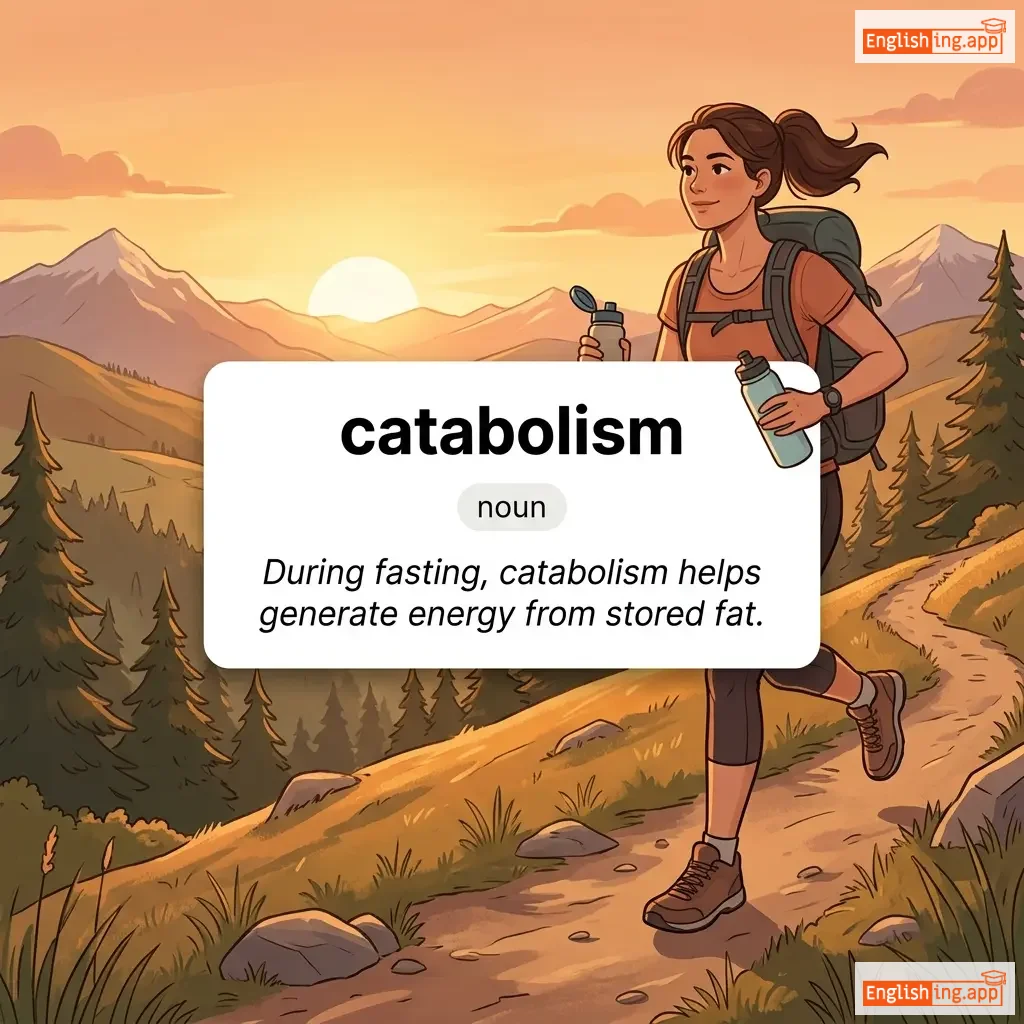
catabolism definition card — visual illustration of the meaning
noun
/kəˈtæb.ə.lɪ.zəm/
कैटाबोलिज़म (catabolism)

The breakdown of complex molecules in living organisms to form simpler ones together with the release of energy.

"During fasting, catabolism helps generate energy from stored fat."

"उपवासी अवस्था में, कैटाबोलिज़म संग्रहीत वसा से ऊर्जा उत्पन्न करने में मदद करता है।" (Upwasi avastha mein, catabolism sangrahit vasa se urja utpann karne mein madad karta hai.)
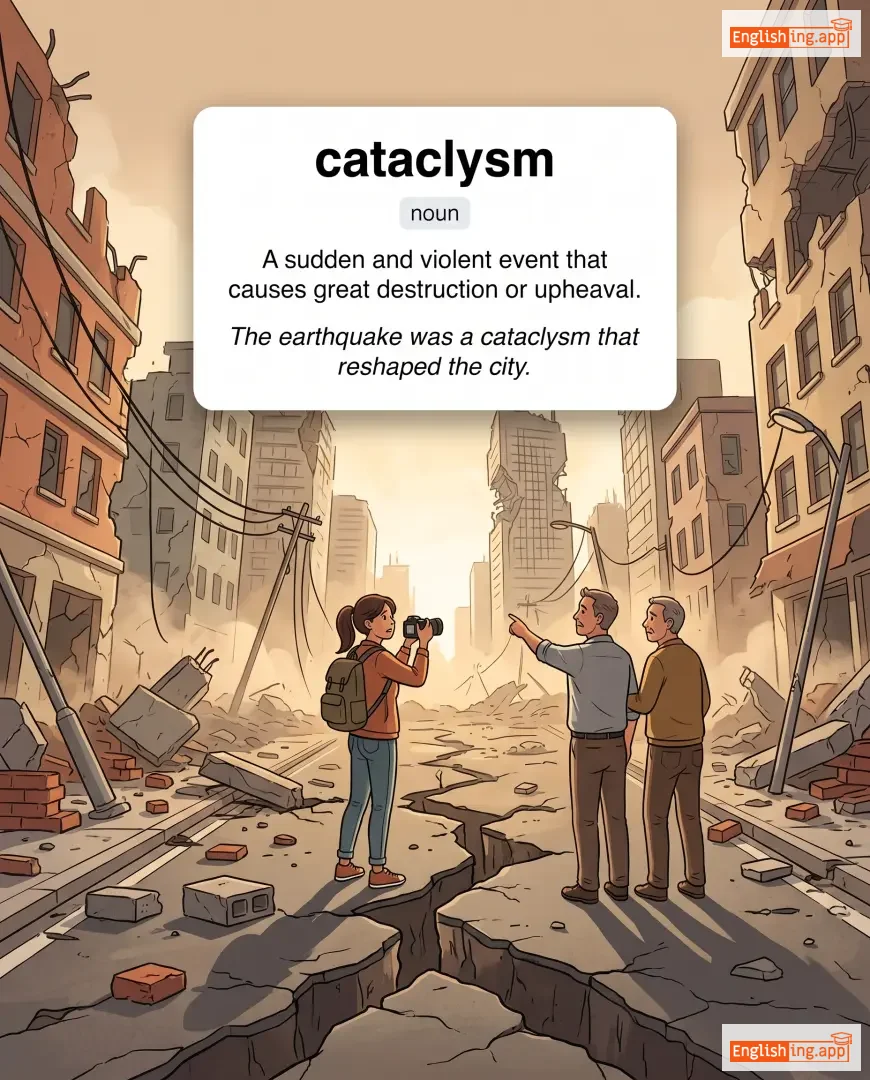
cataclysm definition card — visual illustration of the meaning
noun
/ˈkætəˌklɪzəm/
प्रलय (pralay)

A sudden and violent event that causes great destruction or upheaval.

"The earthquake was a cataclysm that reshaped the city."

"भूकंप एक प्रलय था जिसने शहर को नया रूप दिया।" (Bhookamp ek pralay tha jisne shahar ko naya roop diya.)
adjective
/ˌkætəˈklɪzmɪk/
प्रलयकारी (pralaykaari)

Relating to or denoting a violent natural event or upheaval.

"The war had cataclysmic effects on the nation's economy."

"युद्ध का देश की अर्थव्यवस्था पर प्रलयकारी प्रभाव पड़ा था।" (Yuddh ka desh ki arthvyavastha par pralaykaari prabhav pada tha.)
noun
/ˈkætəlɔːɡ/
सूची (soochi)

a complete list of items, typically arranged systematically

"The library provides an online catalog of all available books."

"पुस्तकालय सभी उपलब्ध पुस्तकों का एक ऑनलाइन कैटालॉग प्रदान करता है।" (Pustakalay sabhi uplabdh pustakon ka ek online catalog pradan karta hai.)
noun; verb
/ˈkætəlɒɡ/
सूची (soochi)

a complete list of items, typically one in alphabetical or systematic order; to make a systematic list of items

"The library decided to catalogue all new books digitally."

"पुस्तकालय ने सभी नई पुस्तकों को डिजिटल रूप से सूचीबद्ध करने का निर्णय लिया।" (pustakalay ne sabhi nai pustakon ko digital roop se soochibaddh karne ka nirnay liya)
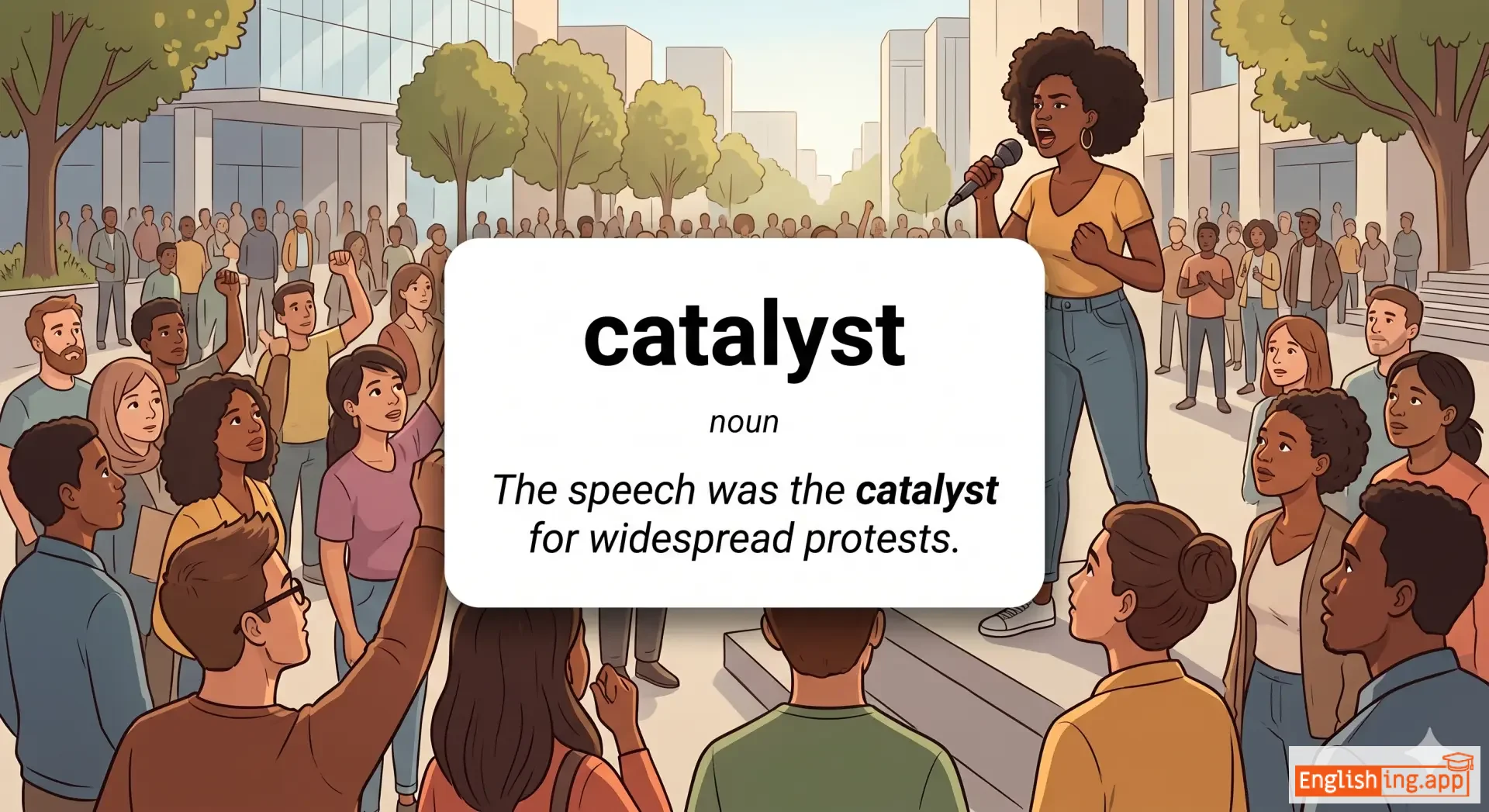
catalyst definition card — visual illustration of the meaning
noun
/ˈkætəlɪst/
प्रेरक (prerak)

Something that speeds up or causes an event or change without being changed itself.

"The speech was the catalyst for widespread protests."

"भाषण व्यापक विरोध के लिए प्रेरक बन गया था।" (Bhashan vyapak virodh ke liye prerak ban gaya tha.)
verb
/ˈkætəˌlaɪz/
प्रेरित करना (prerit karna)

To cause or accelerate a reaction or change.

"The new law catalyzed reforms across the sector."

"नया कानून पूरे क्षेत्र में सुधार को प्रेरित करता था।" (Naya kanoon poore kshetra mein sudhaar ko prerit karta tha.)
noun/verb
/ˈkætəpʌlt/
कैटापल्ट / प्रक्षिप्त करने का यंत्र (catapult / prakshipt karne ka yantra)

A device for launching objects at high speed; to hurl or launch something suddenly.

"The invention catapulted him to international fame."

"आविष्कार ने उसे अंतरराष्ट्रीय प्रसिद्धि तक कैटापल्ट कर दिया।" (Avishkar ne use antarraashtreey prasiddhi tak catapult kar diya.)
noun
/ˈkætərækt/
मोतियाबिंद / जलप्रपात (motiyaabind / jalprapat)

A medical condition causing clouding of the eye's lens; also a large waterfall.

"The old man suffered from cataracts in both eyes."

"वृद्ध व्यक्ति दोनों आँखों में मोतियाबिंद से पीड़ित था।" (Vriddh vyakti dono aankhon mein motiyabind se peedit tha.)
noun
/kəˈtæstrəfi/
आपदा (aapda)

A sudden and widespread disaster or misfortune.

"The earthquake was a catastrophe for the entire region."

"भूकंप सम्पूर्ण क्षेत्र के लिए एक आपदा था।" (Bhookamp sampoorn kshetra ke liye ek aapda tha.)
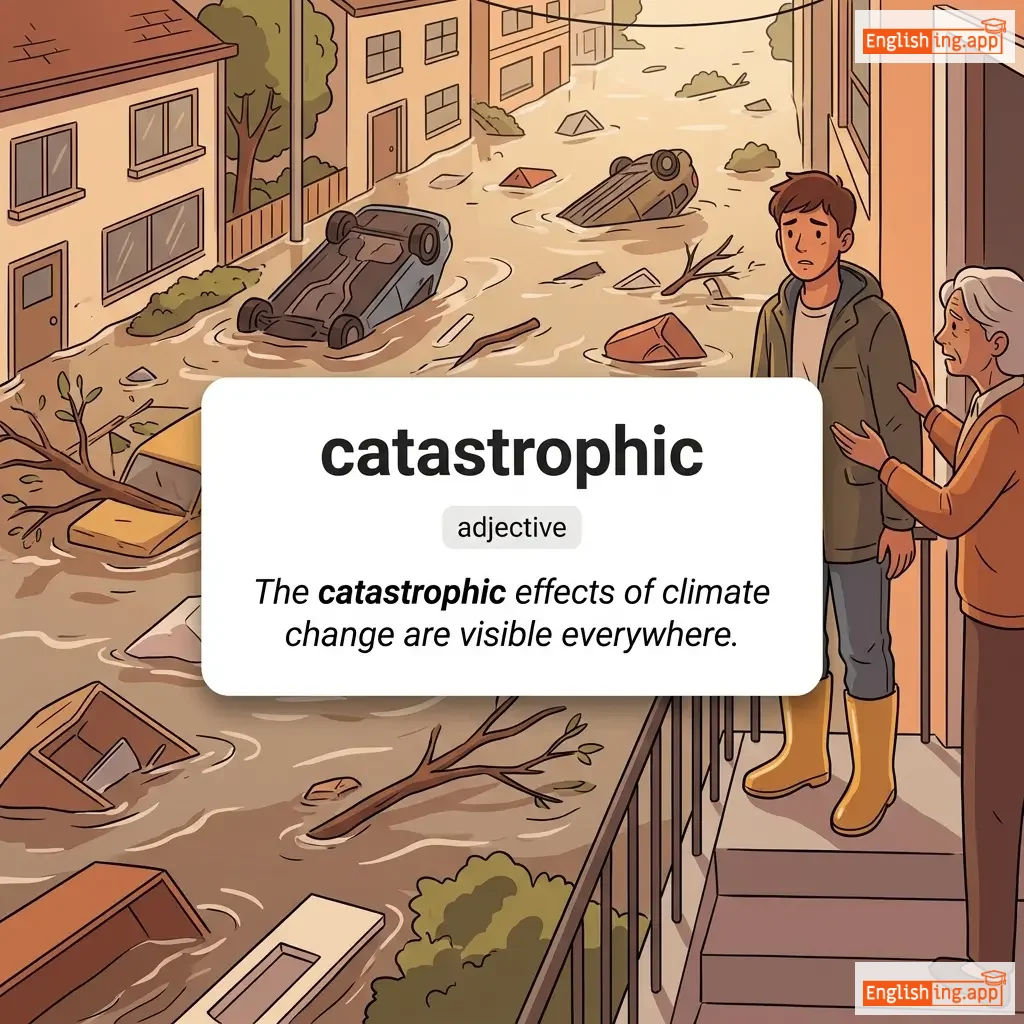
catastrophic definition card — visual illustration of the meaning
adjective
ˌkæt.əˈstrɒf.ɪk
विनाशकारी (vinashkari)

Involving or causing sudden great damage or suffering; extremely unfortunate or unsuccessful.

"The catastrophic effects of climate change are visible everywhere."

"जलवायु परिवर्तन के विनाशकारी प्रभाव हर जगह स्पष्ट हैं।" (Jalvayu parivartan ke vinashkari prabhav har jagah spasht hain.)
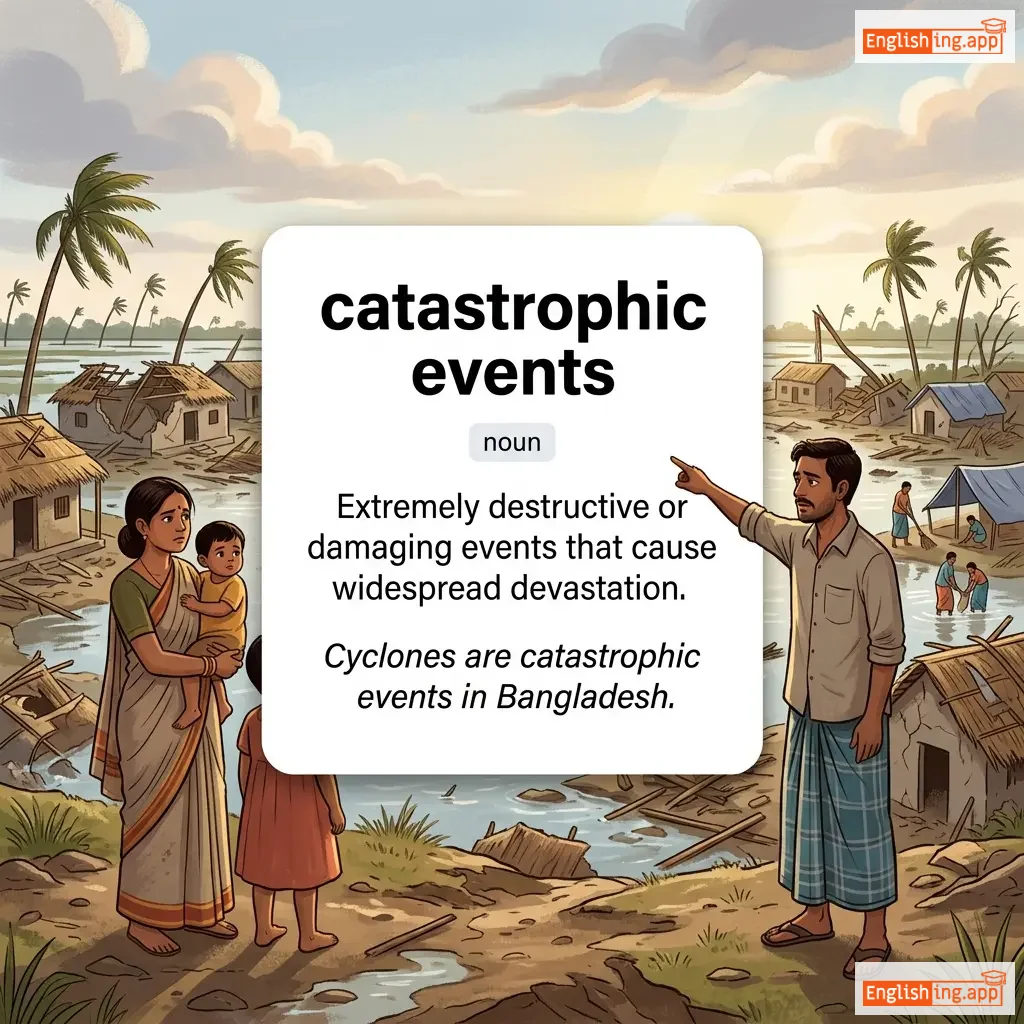
catastrophic events definition card — visual illustration of the meaning
noun
ˌkætəˈstrɒfɪk ɪˈvents
विनाशकारी घटनाएँ (vinashkari ghatnayein)

Extremely destructive or damaging events that cause widespread devastation.

"Cyclones are catastrophic events in Bangladesh."

"चक्रवात बांगलादेश में विनाशकारी घटनाएँ हैं।" (Chakrawat Bangladesh mein vinashkari ghatnayein hain.)
noun/verb
/ˈkætˌkɔːl/
यौन उत्पीड़न या असंतोष की आवाज़ (yaun utpeedan ya asantosh ki awaaz)

A loud whistle or shout of disapproval or sexual harassment directed at someone.

"The actress ignored the catcalls from the crowd."

"द एक्ट्रेस ने भीड़ से आए कैटकाल्स को नजरअंदाज कर दिया।" (D actress ne bheed se aaye catcalls ko nazarandaaz kar diya.)
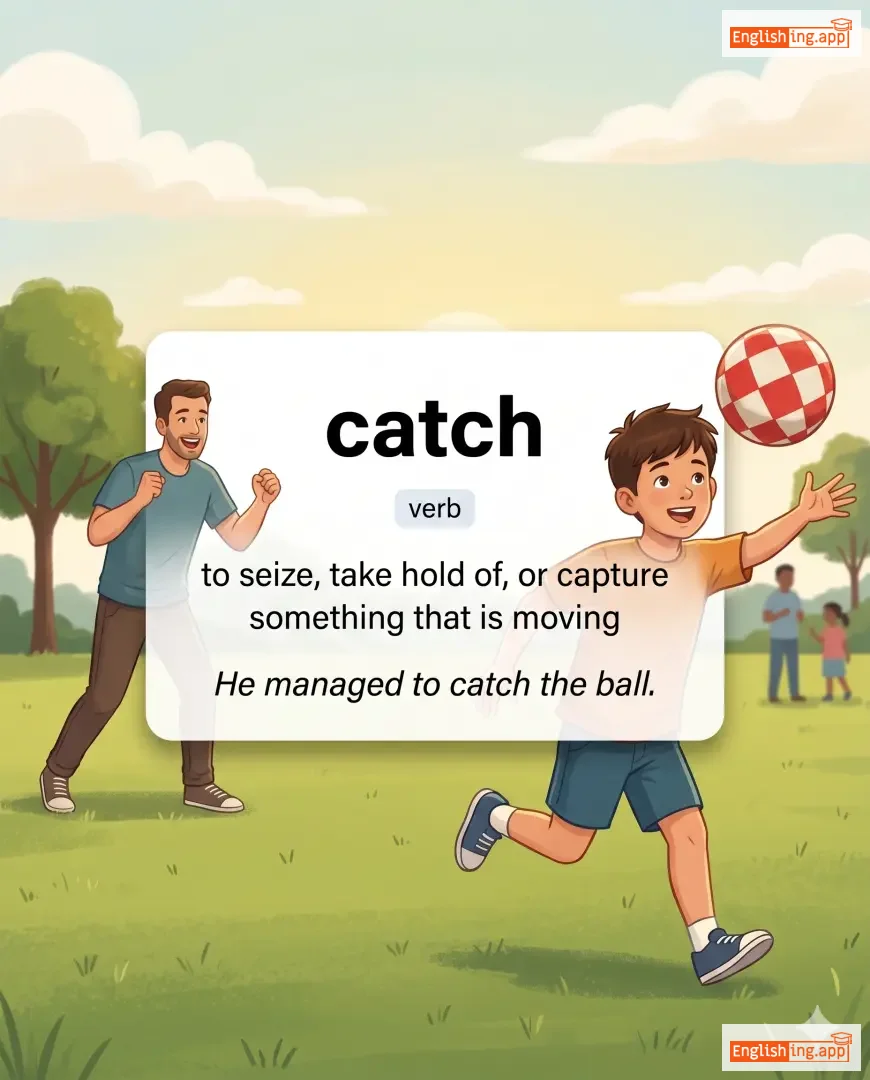
catch definition card — visual illustration of the meaning
verb
/kætʃ/
पकड़ना (pakadna)

to seize, take hold of, or capture something that is moving

"He managed to catch the ball."

"वह गेंद को पकड़ने में सफल हुआ।" (Vah gend ko pakadne mein safal hua.)
noun
/ˈkætɪˌkɪzəm/
धर्मशिक्षा (dharmashiksha)

A summary of religious principles often in the form of questions and answers; also a set of fixed questions or beliefs.

"The priest taught the children the catechism every Sunday."

"पादरी ने बच्चों को हर रविवार धर्मशिक्षा सिखाई।" (Paadri ne bachon ko har ravivaar dharmashiksha sikhayi.)
noun
/ˈkætɪtʃuː/
कैटिचू (katechu)

an extract from a tropical Asian plant, used in tanning and dyeing

"Catechu extract is commonly used in traditional medicine."

"कैटिचू अर्क पारंपरिक चिकित्सा में सामान्यतः प्रयोग किया जाता है।" (katechu ark paramparik chikitsa mein samanyatah prayog kiya jata hai.)
categorical definition card — visual illustration of the meaning
adjective
/ˌkætəˈɡɒrɪkəl/
निर्विवाद (nirvivad)

Absolute and without exception; expressed clearly and directly.

"She gave a categorical denial of the allegations."

"उसने आरोपों का निर्विवाद इनकार किया।" (Usne aaropon ka nirvivad inkaar kiya.)
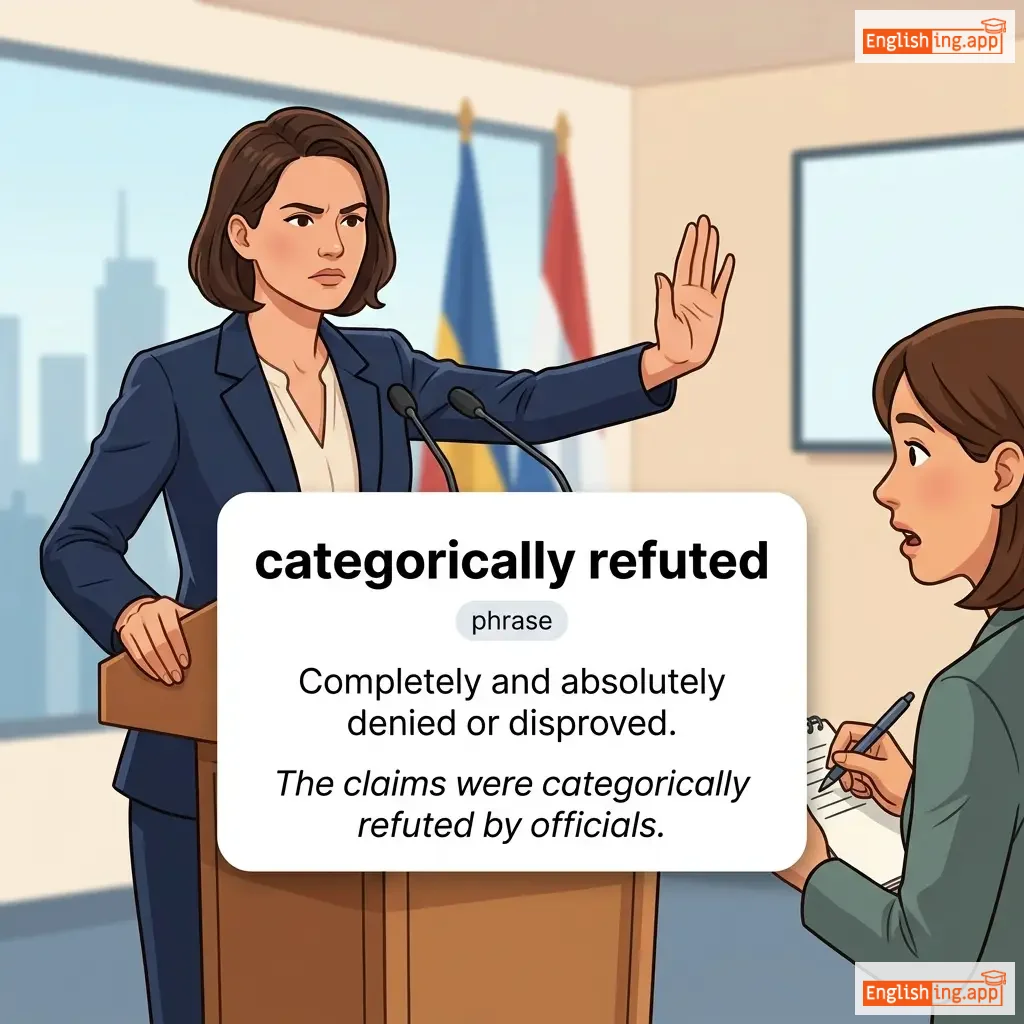
categorically refuted definition card — visual illustration of the meaning
phrase
ˌkæt.əˈɡɒr.ɪ.kəl.i rɪˈfjuː.tɪd
पूर्णतः खारिज किया गया (poornatah kharij kiya gaya)

Completely and absolutely denied or disproved.

"The claims were categorically refuted by officials."

"दावे पूरी तरह से अधिकारियों द्वारा खारिज कर दिए गए थे।" (Daave poori tarah se adhikaarion dwara kharij kar diye gaye the.)
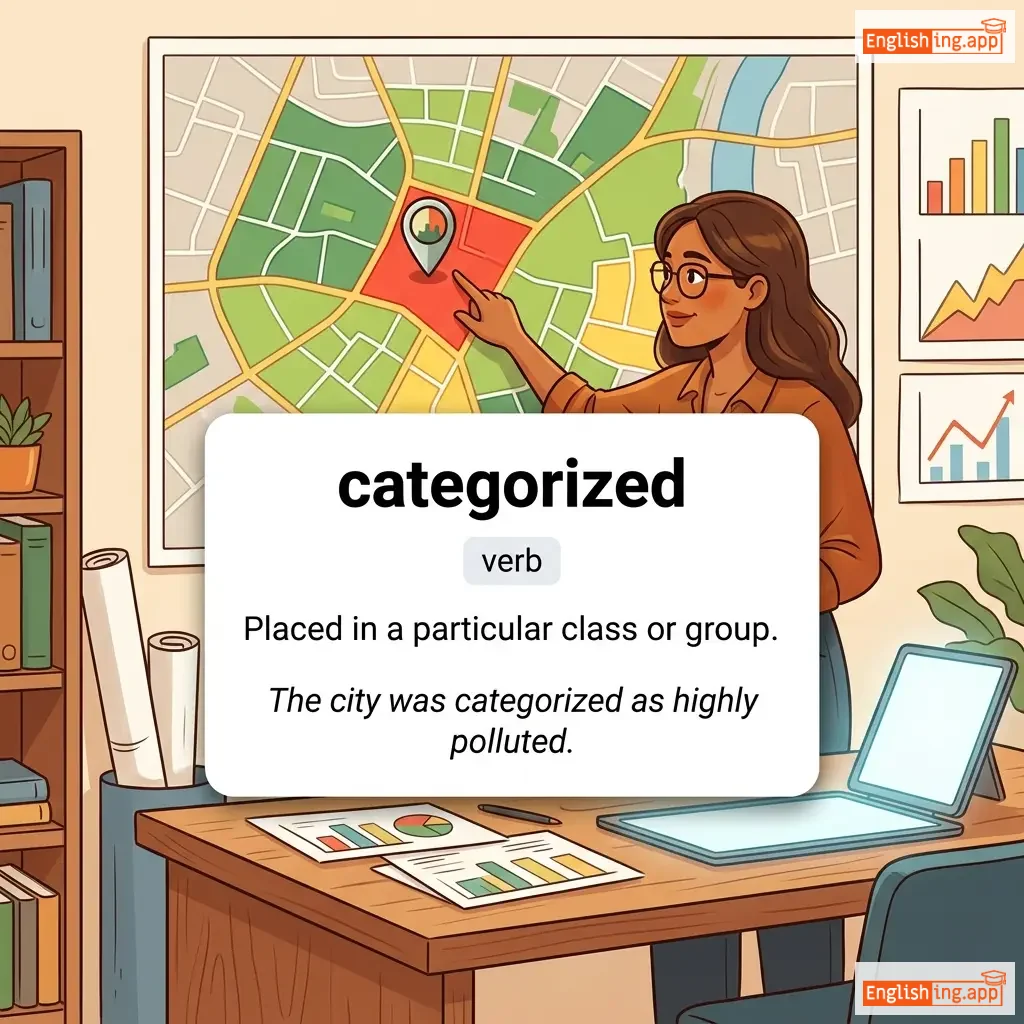
categorized definition card — visual illustration of the meaning
verb
/ˈkæt.ɪ.ɡə.raɪzd/
वर्गीकृत (vargeekrit)

Placed in a particular class or group.

"The city was categorized as highly polluted."

"शहर को अत्यधिक प्रदूषित के रूप में वर्गीकृत किया गया था।" (Shahar ko atyadhik pradushit ke roop mein vargeekrit kiya gaya tha.)
noun
/ˈkætəɡɔːri/
श्रेणी (shreni)

a class or division of things regarded as having particular shared characteristics

"Books are arranged by category in the library."

"किताबें पुस्तकालय में श्रेणी के अनुसार व्यवस्थित की जाती हैं।" (Kitabein pustakalay mein shreni ke anusaar vyavasthit ki jaati hain.)
verb
/ˈkeɪtər/
खाना परोसना (khana parosna)

To provide food, drinks, or services, usually for an event or group.

"The company catered the wedding reception."

"कंपनी ने शादी की रिसेप्शन के लिए खाना परोसा।" (Company ne shaadi ki reception ke liye khana parosa.)
noun
/ˈkæt.ər.pɪl.ər/
कटेरीला (katerila)

the larva of a butterfly or moth that feeds on plants

"The caterpillar ate all the leaves on the plant."

"कैटरपिलर ने पौधे के सारे पत्ते खा लिए।" (katerila ne podhe ke saare patte khaa liye.)
noun
/kəˈθɑːrsɪs/
उद्वेगमुक्ति (udvegmukti)

The process of releasing strong emotions, providing relief.

"Writing in her diary was a form of catharsis for her."

"उसके डायरी में लिखना उसके लिए एक प्रकार की उद्वेगमुक्ति थी।" (Uske diary mein likhna uske liye ek prakar ki udvegmukti thi.)
cathartic definition card — visual illustration of the meaning
adjective
/kəˈθɑːrtɪk/
कैथार्टिक (cathartic)

Providing psychological relief through open expression of emotions; also refers to a medicine that causes cleansing of the bowels.

"Crying can be a cathartic experience."

"रोना एक कैथार्टिक अनुभव हो सकता है।" (Rona ek cathartic anubhav ho sakta hai.)
noun
/ˈkæθoʊd/
ऋणात्मक इलेक्ट्रोड (rinatmak electrode)

The negative electrode in a device such as a battery or tube, where electrons enter.

"The cathode emits electrons in the tube."

"कैथोड ट्यूब में इलेक्ट्रॉन्स उत्सर्जित करता है।" (Cathode tube mein electrons utsarjit karta hai.)
adjective
/ˈkæθəlɪk/
कैथोलिक (kaitholik)

Including a wide variety; all-embracing; relating to the Roman Catholic Church.

"She has catholic tastes in music, enjoying everything from jazz to opera."

"वह संगीत में कैथोलिक स्वाद रखती है, जैज़ से लेकर ओपेरा तक सब कुछ आनंद लेती है।" (Wah sangeet mein kaitholik swaad rakhti hai, jazz se lekar opera tak sab kuch anand leti hai.)
noun
/kəˈθɒlɪsɪzəm/
कैथोलिक धर्म (catholic dharm)

The faith, practice, and church order of the Roman Catholic Church.

"Catholicism has a long history and rich traditions."

"कैथोलिक धर्म का एक लंबा इतिहास और समृद्ध परंपराएँ हैं।" (Catholic dharm ka ek lamba itihas aur samriddh paramparayen hain.)
noun
/ˌkæθəˈlɪsɪti/
सार्वभौमिकता, उदारता (sarvabhaumikta, udarta)

Universality; broad-mindedness; acceptance of a wide variety of things.

"Her catholicity of interests makes her a fascinating person."

"उसकी सार्वभौमिकता के कारण वह एक आकर्षक व्यक्ति बन गई है।" (Uski sarvabhaumikta ke karan vah ek akarshak vyakti ban gayi hai.)
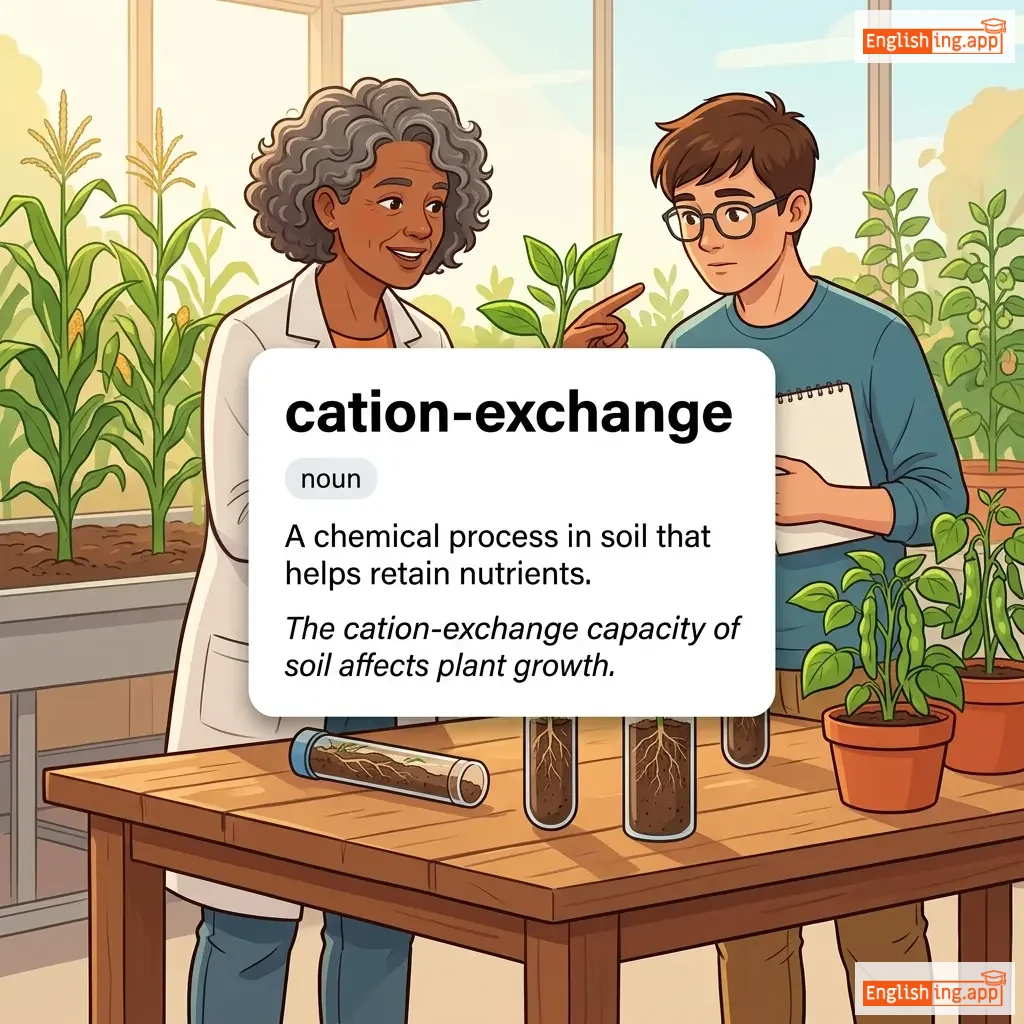
cation-exchange definition card — visual illustration of the meaning
noun
/ˈkæt.aɪ.ɒn ɪksˌtʃeɪndʒ/
कैशन-एक्सचेंज (kashionekschenj)

A chemical process in soil that helps retain nutrients.

"The cation-exchange capacity of soil affects plant growth."

"मिट्टी की कैशन-एक्सचेंज क्षमता पौधों की वृद्धि को प्रभावित करती है।" (mitti ki kashion ekschenj kapasiti paudhon ki vriddhi ko prabhavit karti hai)
noun
/ˈkæt.kɪn/
फूलमंजरी (phoolmanjari)

a drooping, often tasseled cluster of small flowers found on willow and birch trees

"The willow tree's catkins swayed gently in the spring breeze."

"विलो के पेड़ की फूलमंजरी वसंत की हल्की हवा में धीरे-धीरे झूल रही थी।" (wilo ke ped ki phoolmanjari vasant ki halki hawa mein dheere-dheere jhool rahi thi.)
noun
/ˈkætl/
सुख (sukh)

large domesticated animals such as cows and bulls that are kept on a farm for their milk, meat, or hides

"The farmer owns a herd of cattle that graze near the river."

"जब उसने पुरस्कार प्राप्त किया तो वह अपना सुख छिपा नहीं सकी।" (Jab usne puraskar prapt kiya to wah apna sukh chhupa nahi sakee.)
caucus definition card — visual illustration of the meaning
noun
/ˈkɔːkəs/
राजनीतिक बैठक (rajnaitik baithak)

A meeting of members of a political party to select candidates or decide policy.

"The party held a caucus to nominate their candidate for president."

"पार्टी ने अपने राष्ट्रपति उम्मीदवार को नामित करने के लिए एक बैठक आयोजित की।" (Party ne apne rashtrapati ummidwar ko namit karne ke liye ek baithak aayojit ki.)
noun
/ˈkɔːldrən/
बड़ा धातु का बर्तन (bada dhatu ka bartan)

A large metal pot used for cooking over an open fire; also a situation of intense activity or strong emotions.

"The witch stirred the cauldron filled with strange ingredients."

"जादूगरनी ने अजीब सामग्रियों से भरे बर्तन को हिलाया।" (Jadugarani ne ajeeb samagrion se bhare bartan ko hilaya.)
noun
/ˈkɔːlɪˌflaʊər/
गोभी (gobhi)

white vegetable with a compact head of undeveloped flower buds

"Roasted cauliflower makes a delicious and healthy side dish."

"रोस्टेड गोभी एक स्वादिष्ट और स्वस्थ साइड डिश बनाता है।" (roasted gobhi ek swadisht aur swasth side dish banata hai)
verb
/kɔːk/
दरार सील करना (darar seal karna)

to seal a crack or gap with a waterproof filler

"He caulked the window frames to stop the draft."

"उसने खिड़की के फ्रेम को ठंडी हवा को रोकने के लिए कॉक किया।" (Usne khidki ke frame ko thandi hawa ko rokne ke liye cock kiya.)
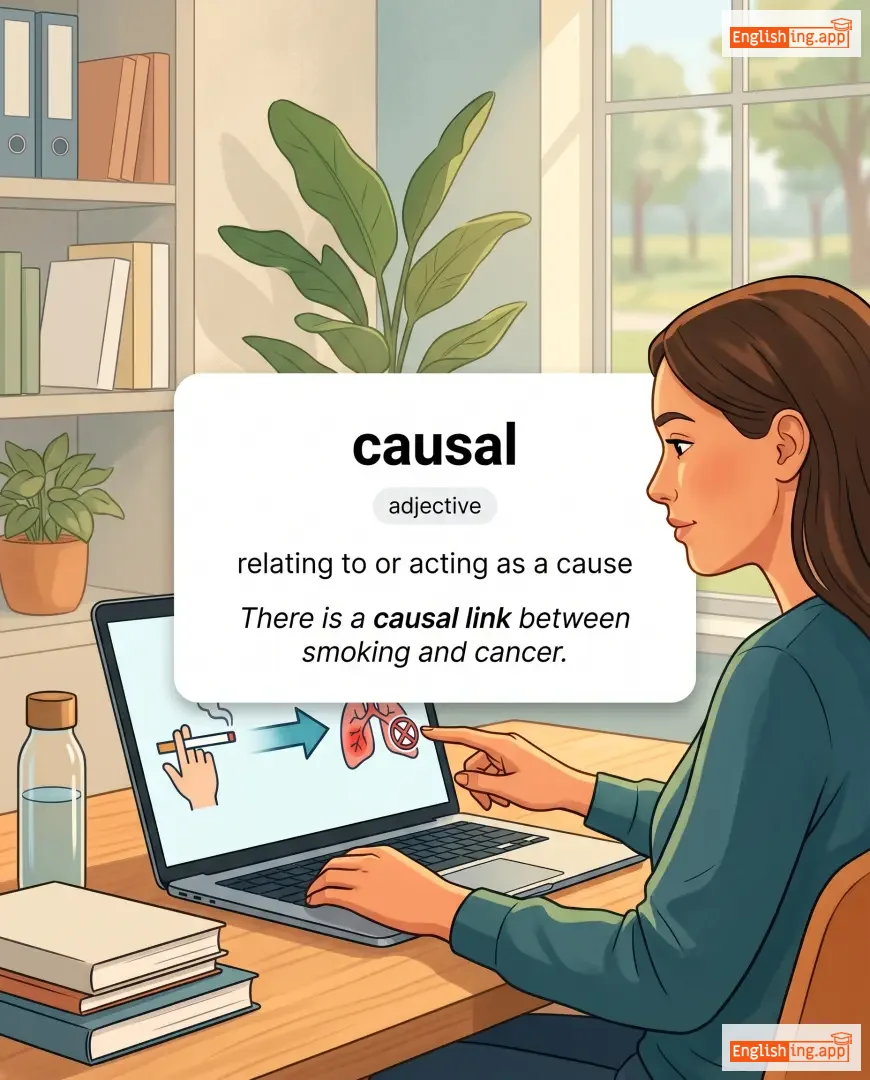
causal definition card — visual illustration of the meaning
adjective
/ˈkɔː.zəl/
कारणात्मक (kaaranatmak)

relating to or acting as a cause

"There is a causal link between smoking and cancer."

"धूम्रपान और कैंसर के बीच एक कारणात्मक संबंध है।" (Dhoomrapan aur cancer ke beech ek kaaranatmak sambandh hai.)
noun/verb
/kɔːz/
कारण / उत्पन्न करना (kaaran / utpann karna)

a person or thing that gives rise to an action, phenomenon, or condition; to make something happen

"The heavy rain caused flooding in the city."

"भारी बारिश के कारण शहर में बाढ़ आ गई।" (Bhaari baarish ke kaaran shahar mein baadh aa gayi.)
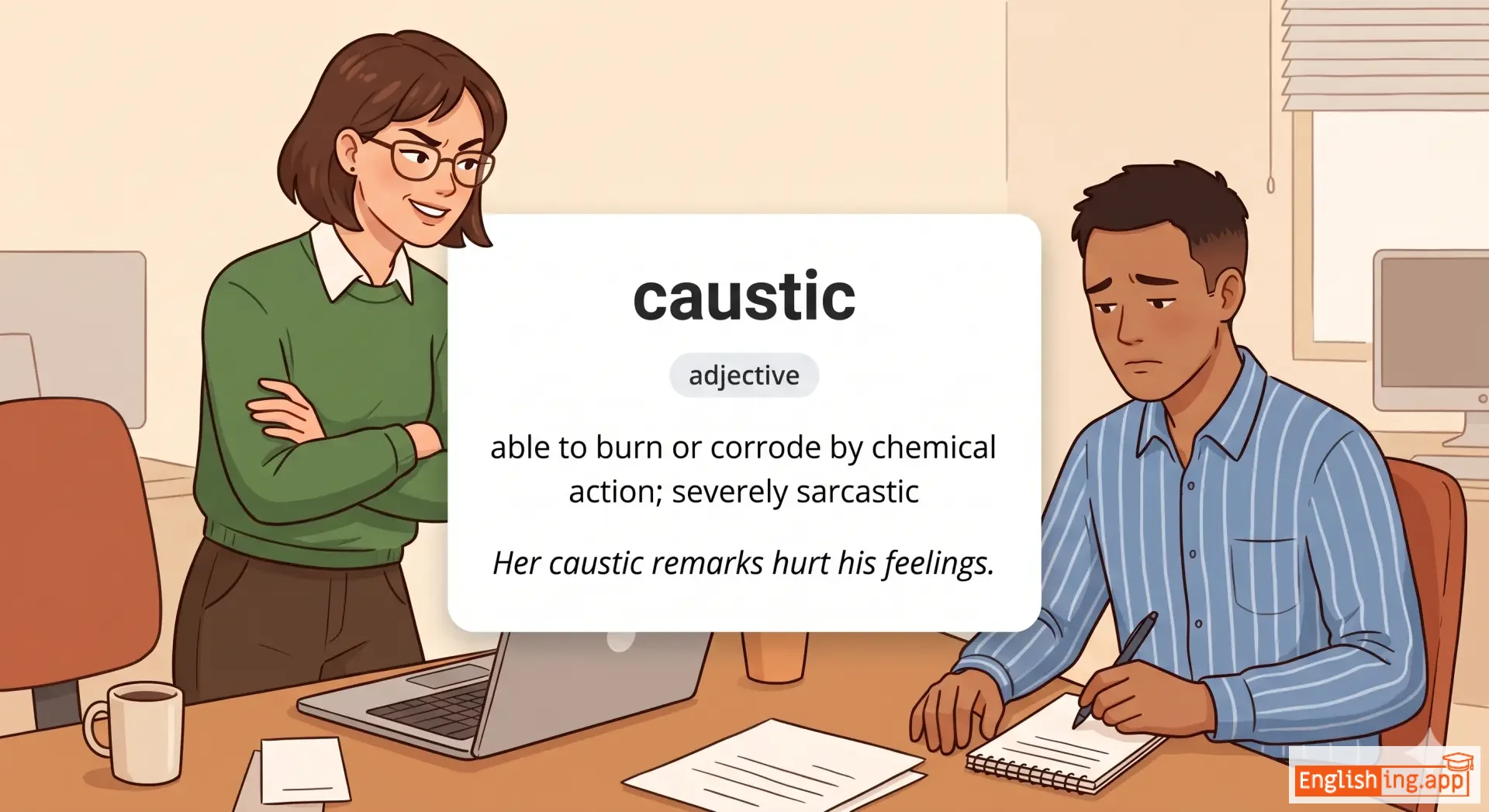
caustic definition card — visual illustration of the meaning
adjective
/ˈkɔː.stɪk/
संक्षिप्त, तीव्र व्यंग्यात्मक (kostic)

able to burn or corrode by chemical action; severely sarcastic

"Her caustic remarks hurt his feelings."

"उसकी तीव्र व्यंग्यात्मक टिप्पणियों ने उसकी भावनाओं को आहत किया।" (Uski teevra vyangyatmaka tippaniyon ne uski bhavnavo ko aahat kiya.)
verb
/ˈkɔː.tə.raɪz/
जलाने के लिए घाव को रक्तस्राव रोकने या संक्रमण रोकने के लिए (jalane ke liye ghaav ko raktasraav rokne ya sankraman rokne ke liye)

to burn tissue to stop bleeding or prevent infection

"The doctor cauterized the wound to stop the bleeding."

"डॉक्टर ने घाव को रक्तस्राव रोकने के लिए जलाया।" (Doktar ne ghaav ko raktasraav rokne ke liye jalaya.)