Vocabulaires

Découvrez, apprenez et maîtrisez le vocabulaire anglais

noun
/ˈpærɪti/
parité (parite)

the state or condition of being equal, especially in status or pay

"The campaign aims to achieve pay parity between men and women."

"La campagne vise à atteindre la parité salariale entre les hommes et les femmes." (La campagne vise à atteindre la parité salariale entre les hommes et les femmes.)
adjective
/pəˈrɪʒən/
relatif à Paris (relatif a paris)

relating to Paris or its people

"She wore a Parisian style dress at the party."

"Elle portait une robe de style parisien à la fête." (Elle portait une robe de style parisien à la fête.)
noun
/pəˈraɪə/
paria (paria)

An outcast; someone who is rejected by society or a social group.

"After the scandal, he became a social pariah."

"Après le scandale, il est devenu un paria social." (Après le scandale, il est devenu un paria social.)
noun
/ˈpærɪʃ/
paroisse (paroisse)

A local church community or the area served by a parish church.

"The parish gathered for Sunday service."

"La paroisse s'est réunie pour le service du dimanche." (La paroisse s'est réunie pour le service du dimanche.)
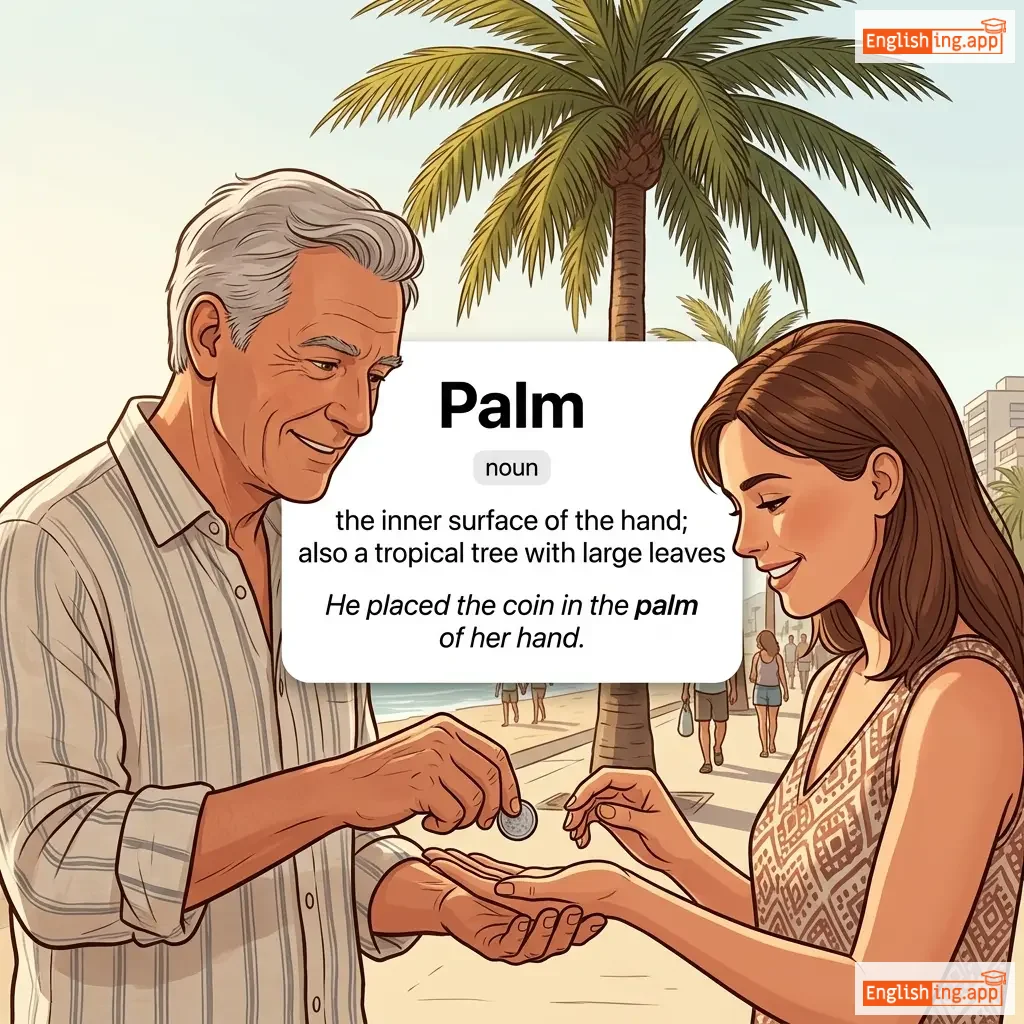
Palm definition card — visual illustration of the meaning
noun
/pɑːm/
paume de la main / palmier (paume de la main / palmier)

the inner surface of the hand; also a tropical tree with large leaves

"He placed the coin in the palm of her hand."

"Il a mis la pièce dans la paume de sa main." (Il a mis la pièce dans la paume de sa main.)
adjective
/ˈpɑːmi/
prospère / glorieux (prospère / glorieux)

prosperous, flourishing, or relating to palm trees

"He often reminisced about the palmy days of his youth."

"Il se souvenait souvent des jours prospères de sa jeunesse." (Il se souvenait souvent des jours prospères de sa jeunesse.)
adjective
/ˈpælpəbl̩/
bonheur (bonheur)

easily perceived or felt; so intense as to seem almost tangible

"There was a palpable sense of excitement in the room."

"Elle ne pouvait pas cacher son bonheur lorsqu'elle a reçu le prix." (Elle ne pouvait pas cacher son bonheur lorsqu'elle a recu le prix.)
verb
/ˈpælpɪˌteɪt/
palpiter rapidement (palpiter rapidement)

to beat rapidly and strongly, often because of fear, excitement, or illness

"Her heart began to palpitate with fear."

"Son cœur a commencé à palpiter de peur." (Son cœur a commencé à palpiter de peur.)
noun
/ˌpæl.pɪˈteɪ.ʃən/
battement de cœur rapide, fort ou irrégulier dû à l'agitation ou à une condition médicale (battement de cœur rapide, fort ou irrégulier dû à l'agitation ou à une condition médicale)

a noticeably rapid, strong, or irregular heartbeat due to agitation or medical condition

"She experienced palpitations before her job interview."

"Elle a ressenti des palpitations avant son entretien d'embauche." (Elle a ressenti des palpitations avant son entretien d'embauche.)
noun
/ˈpɔːlzi/
paralysie (paralysie)

a condition of partial or complete paralysis, often with involuntary tremors

"The patient suffered from Bell’s palsy."

"Le patient souffrait de la paralysie de Bell." (Le patient souffrait de la paralysie de Bell.)
verb
/ˈpɔːltər/
parler de manière floue, tromper (parler de manière floue, tromper)

to act insincerely or deceitfully; to equivocate or lie

"He paltered when asked about his involvement in the deal."

"Il a évité la question lorsqu'on lui a demandé son implication dans l'accord." (Il a évité la question lorsqu'on lui a demandé son implication dans l'accord.)
adjective
/ˈpɔːltri/
insignifiant, dérisoire (insignifiant, dérisoire)

small or meager; lacking in value or importance

"They offered him a paltry sum for his work."

"Ils lui ont proposé une somme dérisoire pour son travail." (Ils lui ont proposé une somme dérisoire pour son travail.)
adjective
/ˈpeɪli/
rayé (raye)

striped with different colors, usually used in heraldry

"The knight’s shield was decorated with paly stripes of red and gold."

"Le bouclier du chevalier était décoré de rayures rayées rouges et dorées." (Le bouclier du chevalier était décoré de rayures rayées rouges et dorées.)
verb
/ˈpæmpər/
gâter / dorloter (gater / dorloter)

to treat with excessive care and attention; to spoil

"Parents often pamper their first child."

"Les parents gâtent souvent leur premier enfant." (Les parents gatent souvent leur premier enfant.)
noun
/ˈpæm.flət/
prospectus (prospectus)

a small booklet or brochure containing information or arguments about a subject

"The health department distributed a pamphlet about nutrition."

"Le département de la santé a distribué un prospectus sur la nutrition." (Le departement de la sante a distribue un prospectus sur la nutrition.)
noun, verb
/ˌpæm.fləˈtɪər/
écrivain de pamphlets (ecrivain de pamphlets)

a person who writes or distributes pamphlets, often to promote a political or social cause

"In the 18th century, many pamphleteers influenced public opinion."

"Au XVIIIe siècle, de nombreux écrivains de pamphlets ont influencé l'opinion publique." (Au XVIIIe siècle, de nombreux écrivains de pamphlets ont influencé l'opinion publique.)
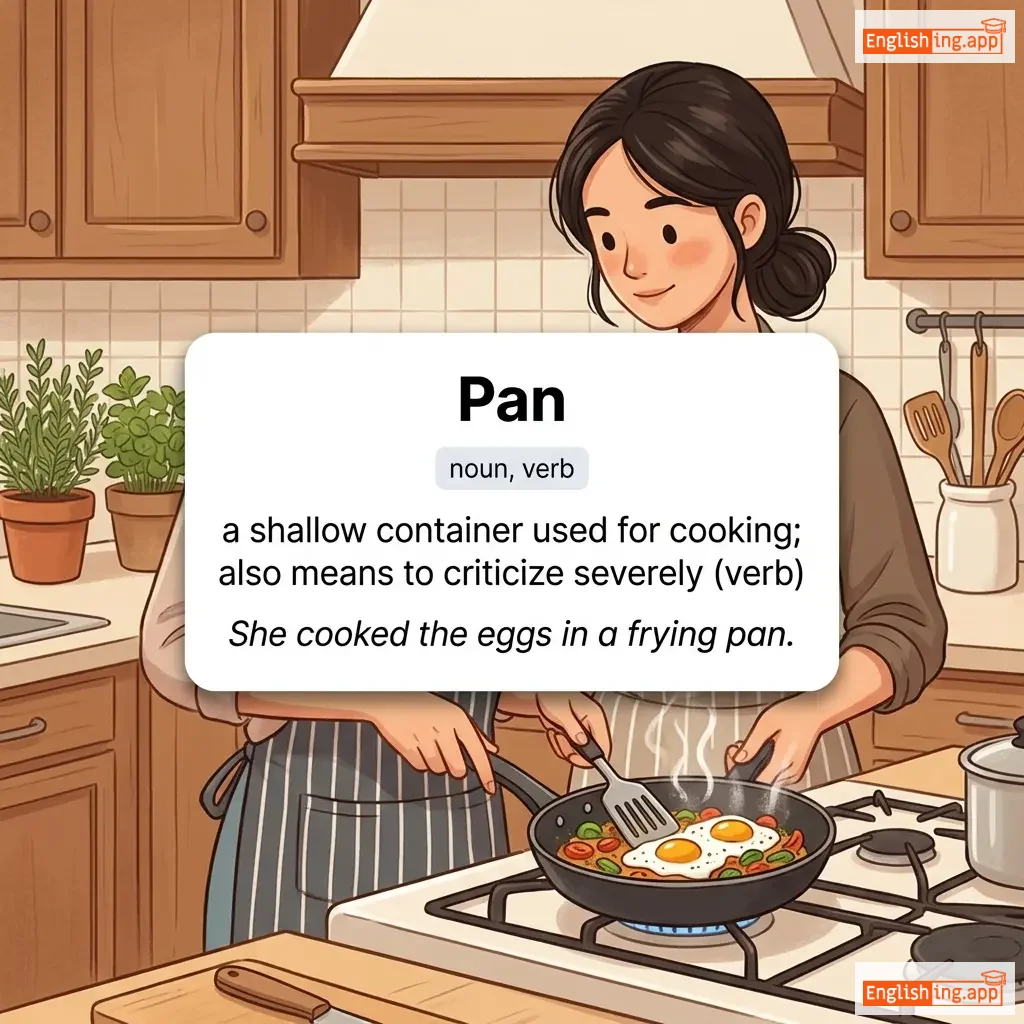
Pan definition card — visual illustration of the meaning
noun, verb
/pæn/
poêle, casserole (poele, casserole)

a shallow container used for cooking; also means to criticize severely (verb)

"She cooked the eggs in a frying pan."

"Elle a cuisiné les œufs dans une poêle." (Elle a cuisine les oeufs dans une poele.)
adjective
/ˌpæn.əˈmer.ɪ.kən/
Panaméricain (panamericain)

relating to all the countries of North, Central, and South America

"The Pan-American Games bring together athletes from across the continent."

"Les Jeux panaméricains rassemblent des athlètes de tout le continent." (Les Jeux panamericains rassemblent des athlètes de tout le continent.)
noun
/ˌpænəˈsiːə/
panacée (panasee)

A solution or remedy for all difficulties or diseases.

"Education is often seen as a panacea for social problems."

"L'éducation est souvent considérée comme une panacée pour les problèmes sociaux." (L'education est souvent consideree comme une panacee pour les problemes sociaux.)
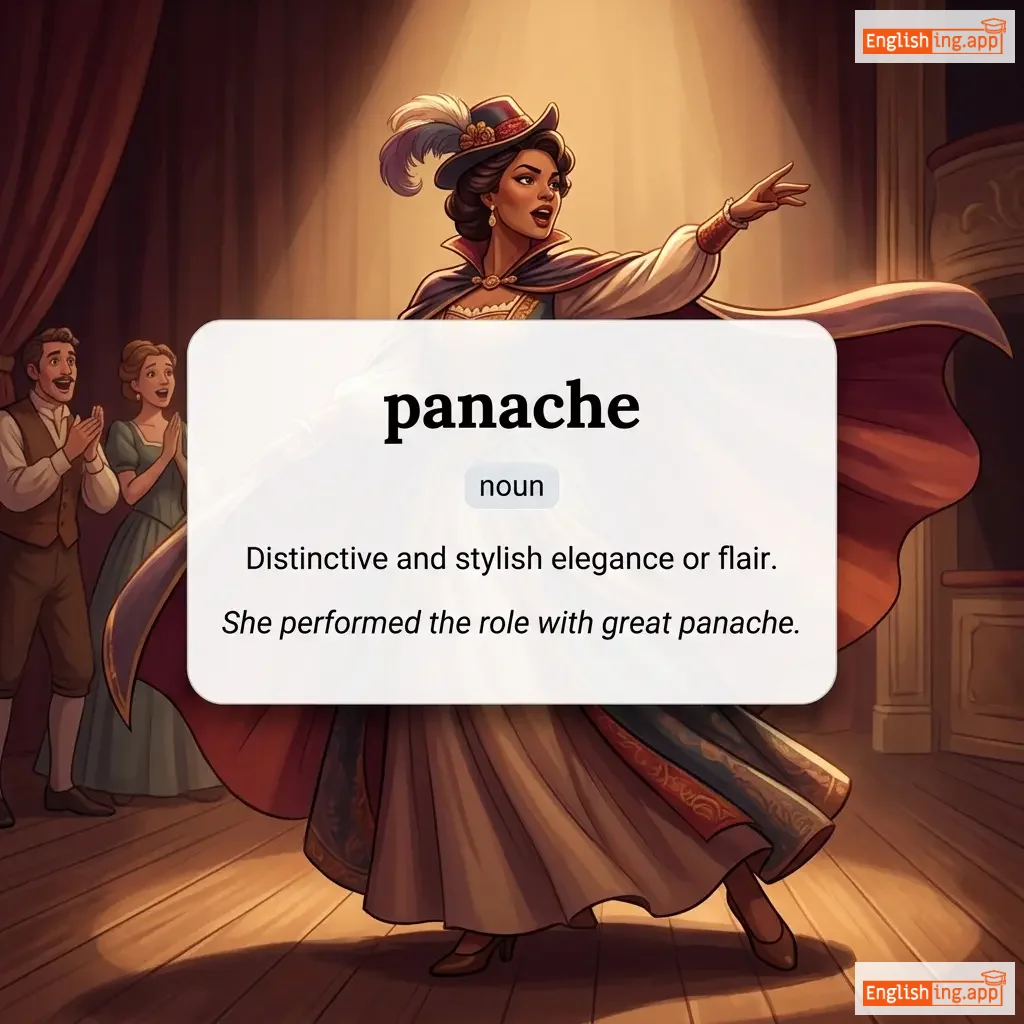
panache definition card — visual illustration of the meaning
noun
/pəˈnæʃ/
élégance distinctive (elegance distinctive)

Distinctive and stylish elegance or flair.

"She performed the role with great panache."

"Elle a joué le rôle avec beaucoup de panache." (Elle a joué le rôle avec beaucoup de panache.)
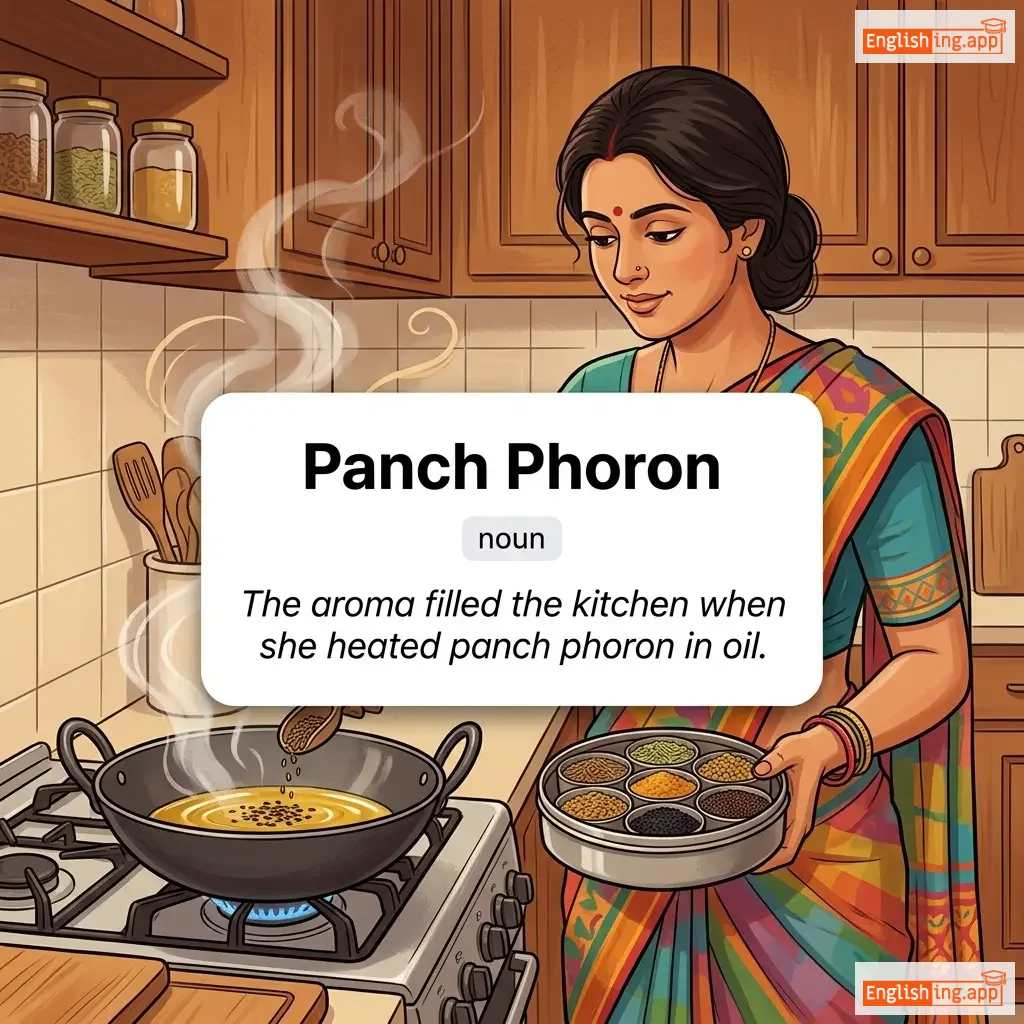
Panch Phoron definition card — visual illustration of the meaning
noun
/pʌntʃ ˈfoʊrən/
panch phoron (panch phoron)

a Bengali spice blend containing five whole spices: cumin, fennel, fenugreek, nigella, and mustard seeds

"The aroma filled the kitchen when she heated panch phoron in oil."

"L'arôme a rempli la cuisine lorsqu'elle a chauffé le panch phoron dans de l'huile." (L'arôme a rempli la cuisine lorsqu'elle a chauffé le panch phoron dans de l'huile.)
noun
/ˈpæŋkriəs/
pancréas (pancreas)

A gland in the abdomen that produces insulin and digestive enzymes.

"The pancreas plays a vital role in digestion and blood sugar regulation."

"Le pancréas joue un rôle vital dans la digestion et la régulation du sucre sanguin." (Le pancreas joue un role vital dans la digestion et la regulation du sucre sanguin.)
noun
/pænˈdɛmɪk/
pandémie (pandemie)

An outbreak of a disease that occurs on a global scale.

"The COVID-19 pandemic changed the world dramatically."

"La pandémie de COVID-19 a changé le monde de manière spectaculaire." (La pandemie de COVID-19 a change le monde de maniere spectaculaire.)
noun
/ˌpændəˈmoʊniəm/
panique (panique)

Wild and noisy disorder or confusion; uproar.

"When the concert was canceled, pandemonium broke out among the crowd."

"Lorsque le concert a été annulé, le pandémonium a éclaté parmi la foule." (Lorsque le concert a été annulé, le pandémonium a éclaté parmi la foule.)
verb
/ˈpændər/
flatter, cirer les bottes (flatter, cirer les bottes)

to indulge or exploit the weaknesses, desires, or immoral tendencies of others

"The politician was accused of pandering to voters' fears."

"Le politicien a été accusé de flatter les peurs des électeurs." (Le politicien a été accusé de flatter les peurs des électeurs.)
noun
/ˌpænəˈdʒɪrɪk/
panégyrique, éloge (panegyrique, eloge)

a formal speech or piece of writing in praise of someone or something

"The author wrote a panegyric on the bravery of the soldiers."

"L'auteur a écrit un panégyrique sur le courage des soldats." (L'auteur a écrit un panégyrique sur le courage des soldats.)
noun
/ˈpænəl/
panel, groupe de juges (panel, groupe de juges)

a group of people gathered to discuss, judge, or advise on a particular topic

"The panel of judges announced the winner of the competition."

"Le panel de juges a annoncé le gagnant de la compétition." (Le panel de juges a annoncé le gagnant de la compétition.)
noun
/pæŋ/
une douleur aiguë ou un malaise émotionnel soudain (une douleur aiguë ou un malaise émotionnel soudain)

a sudden sharp feeling of pain or emotional distress

"She felt a pang of guilt after the argument."

"Elle a ressenti un pang de culpabilité après la dispute." (Elle a ressenti un pang de culpabilité après la dispute.)
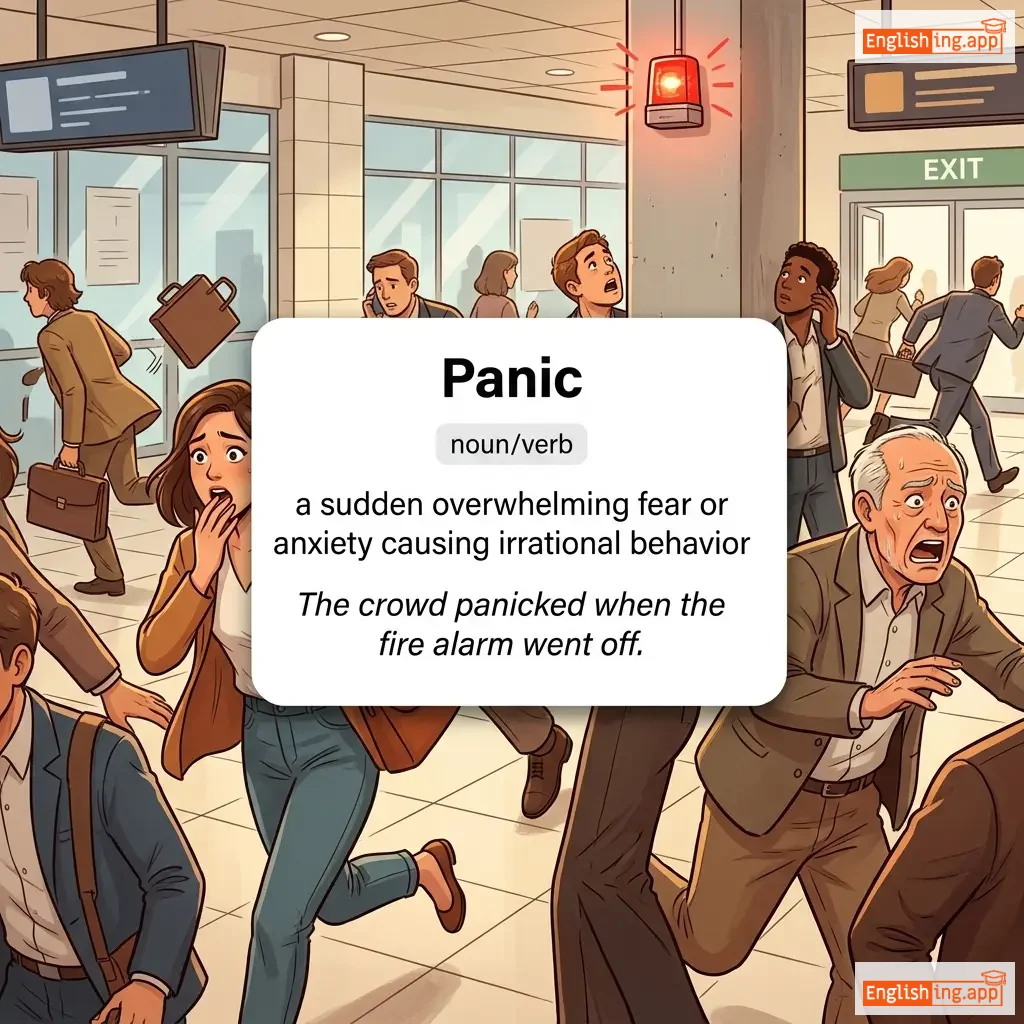
Panic definition card — visual illustration of the meaning
noun/verb
/ˈpænɪk/
bonheur (bonheur)

a sudden overwhelming fear or anxiety causing irrational behavior

"The crowd panicked when the fire alarm went off."

"Elle n'a pas pu cacher son bonheur quand elle a reçu le prix." (Elle n'a pas pu cacher son bonheur quand elle a recu le prix.)
adjective
/ˈpæn.ɪ.ki/
paniqué; anxieux et craintif (panike; anxieux et craintif)

feeling or showing panic; anxious and fearful

"The crowd became panicky when the fire alarm sounded."

"La foule est devenue paniquée lorsque l'alarme incendie a retenti." (La foule est devenue paniquée lorsque l'alarme incendie a retenti.)
/ˈpæn.ə.pli/
panoplie (panoplie)

A complete or impressive collection of things; a full set of armor.

"The museum displayed a panoply of ancient weapons."

"Le musée a présenté une panoplie d'armements anciens." (Le musée a présenté une panoplie d'armements anciens.)
noun
/ˌpæn.əˈræm.ə/
panorama (panorama)

An unbroken view of the whole region surrounding an observer.

"From the hilltop, we enjoyed a breathtaking panorama of the city."

"Depuis le sommet de la colline, nous avons apprécié un panorama époustouflant de la ville." (Depuis le sommet de la colline, nous avons apprécié un panorama époustouflant de la ville.)
adjective
/ˌpæn.əˈræm.ɪk/
vue panoramique (vue panoramique)

Giving a wide view of an extensive area in all directions.

"The hotel offers panoramic views of the ocean."

"L'hôtel offre des vues panoramiques de l'océan." (L'hôtel offre des vues panoramiques de l'océan.)
Pant definition card — visual illustration of the meaning
noun
/pænt/
pantalon (pantalon)

a piece of clothing worn from the waist down, covering both legs separately

"He wore a pair of blue pants to the party."

"Il portait un pantalon bleu à la fête." (Il portait un pantalon bleu à la fête.)
noun
/ˈpæn.θi.ɪ.zəm/
panthéisme (pantheisme)

The belief that God and the universe are identical, or that everything is a manifestation of God.

"Spinoza’s philosophy is often associated with pantheism."

"La philosophie de Spinoza est souvent associée au panthéisme." (La philosophie de Spinoza est souvent associée au panthéisme.)
noun
/ˈpæn.θi.ən/
tous les dieux, temple dédié à tous les dieux (tous les dieux, temple dédié à tous les dieux)

All the gods of a religion collectively; a building dedicated to all gods.

"The Roman Pantheon is one of the best-preserved ancient temples."

"Le Panthéon romain est l'un des temples antiques les mieux conservés." (Le Pantheon romain est l'un des temples antiques les mieux conservés.)
noun
/ˈpæntəmaɪm/
pantomime (pantomime)

A type of theatrical performance using gestures and movements without spoken words; in Britain, a musical comedy play for families performed at Christmas.

"The children enjoyed the Christmas pantomime at the local theater."

"Les enfants ont apprécié la pantomime de Noël au théâtre local." (Les enfants ont apprecie la pantomime de Noel au theatre local.)
noun
/ˈpæntəˌskoʊp/
instrument optique offrant une vue panoramique (instrument optique offrant une vue panoramique)

An optical instrument that provides a wide or panoramic view.

"The scientist used a pantoscope to observe the entire horizon."

"Le scientifique a utilisé un pantoscope pour observer tout l'horizon." (Le scientifique a utilisé un pantoscope pour observer tout l'horizon.)
noun
/ˈpæntri/
garde-manger (garde-manger)

A small room or cupboard where food, dishes, and kitchen supplies are stored.

"She stocked the pantry with fresh groceries for the week."

"Elle a rempli le garde-manger de provisions fraîches pour la semaine." (Elle a rempli le garde-manger de provisions fraîches pour la semaine.)
👨‍👧

papa (papa)

noun
/ˈpɑːpə/
papa (papa)

an informal or affectionate term for one’s father

"Papa is picking me up from school today."

"Papa vient me chercher à l’école aujourd’hui." (papa vient me chercher a lecole aujourdhui)
noun
/ˈpeɪpəsi/
papauté (papauté)

The office or authority of the Pope in the Roman Catholic Church.

"The papacy played a significant role in medieval European politics."

"La papauté a joué un rôle important dans la politique médiévale européenne." (La papauté a joué un rôle important dans la politique médiévale européenne.)
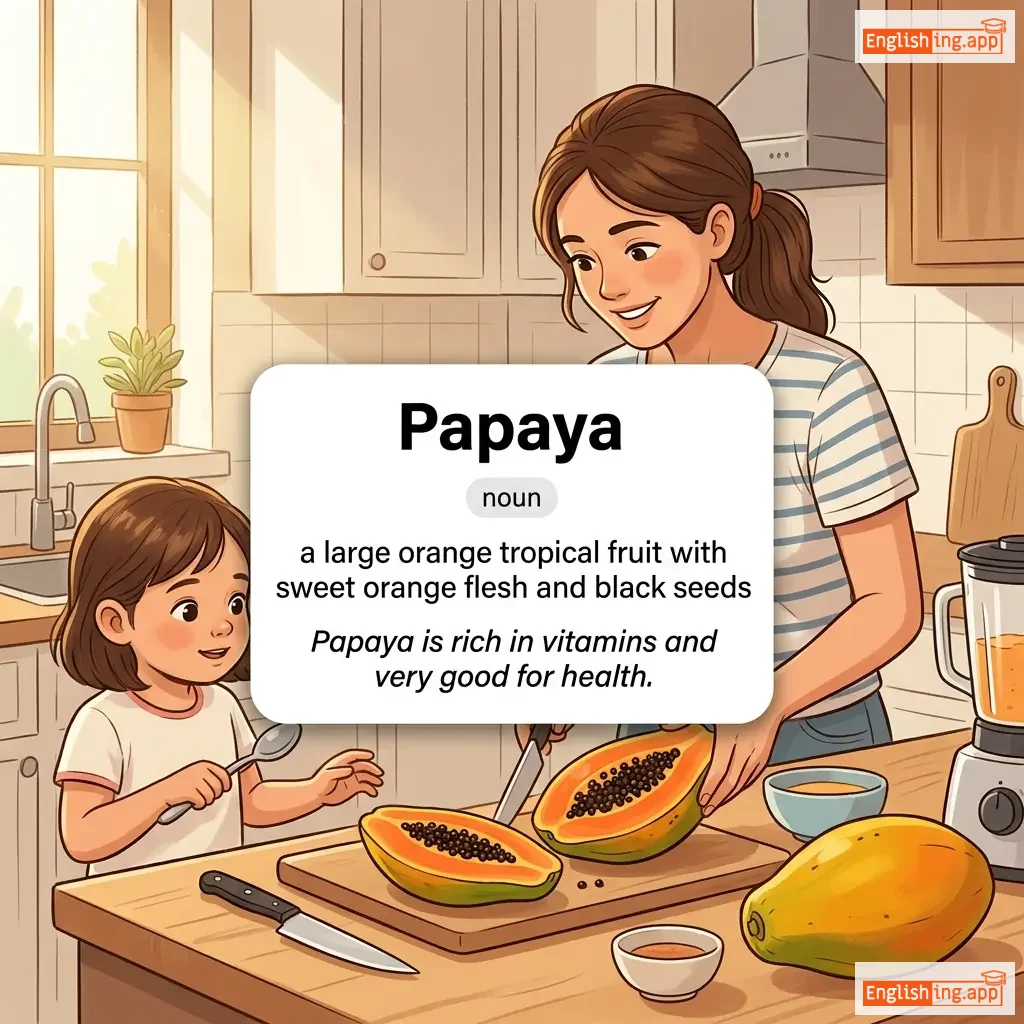
Papaya definition card — visual illustration of the meaning
noun
/pəˈpaɪə/
papaye (papaye)

a large orange tropical fruit with sweet orange flesh and black seeds

"Papaya is rich in vitamins and very good for health."

"La papaye est riche en vitamines et très bonne pour la santé." (La papaye est riche en vitamines et très bonne pour la santé.)
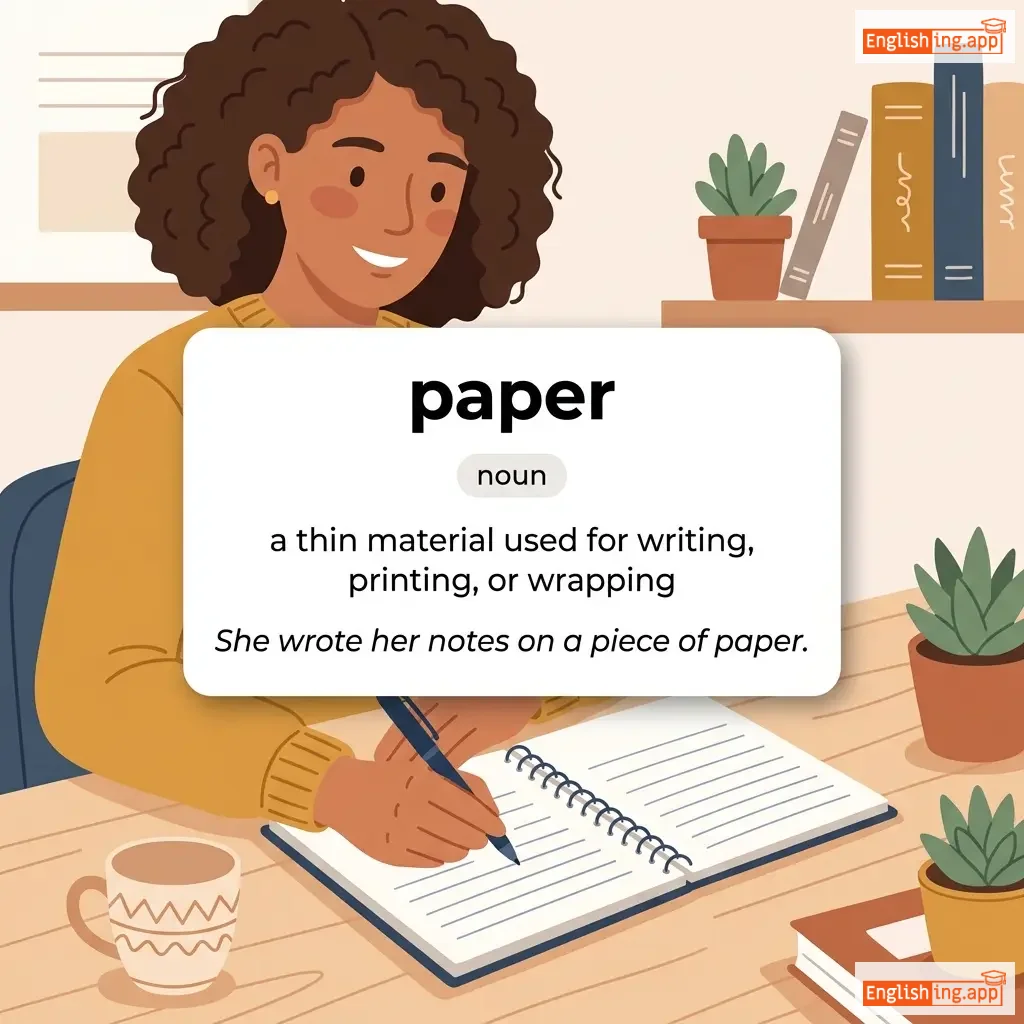
paper definition card — visual illustration of the meaning
noun
/ˈpeɪpər/
papier (papier)

a thin material used for writing, printing, or wrapping

"She wrote her notes on a piece of paper."

"Elle a écrit ses notes sur un morceau de papier." (Elle a ecrit ses notes sur un morceau de papier.)
noun
/pəˈpaɪrəs/
papyre (papyre)

An ancient writing material made from the pith of the papyrus plant; also refers to the plant itself.

"The ancient scroll was written on papyrus."

"Le rouleau ancien a été écrit sur du papyrus." (Le rouleau ancien a été écrit sur du papyrus.)
noun
/ˈpɑːrtʃmənt/
parchemin (parchemin)

a thin material made from animal skin, used in the past for writing

"The ancient manuscript was written on parchment."

"Le manuscrit ancien a été écrit sur du parchemin." (Le manuscrit ancien a été écrit sur du parchemin.)
verb
/pɑːrtʃ/
sècher (secher)

to make something extremely dry, especially by exposure to heat

"The scorching sun began to parch the fields."

"Le soleil brûlant a commencé à sécher les champs." (Le soleil brulant a commence a secher les champs.)
adjective
/pɑːrtʃt/
extrêmement assoiffé (extremement assoiffe)

extremely dry, especially because of heat or thirst

"After walking in the desert, he was parched with thirst."

"Après avoir marché dans le désert, il était extrêmement assoiffé." (Apres avoir marche dans le desert, il etait extremement assoiffe.)
noun
/ˈpɑr.səl/
colis; paquet de terrain (colis; paquet de terrain)

an object or collection of objects wrapped in paper for carrying or sending by mail; a piece of land

"The postman delivered a parcel to our door."

"Le facteur a livré un colis à notre porte." (Le facteur a livre un colis a notre porte.)
noun
/ˈpɑr.dən/
pardon; excuse; (pardon)

forgiveness; the action of forgiving or being forgiven for an error or offense

"I beg your pardon for interrupting the meeting."

"Je vous demande pardon pour avoir interrompu la réunion." (je vous demande pardon pour avoir interrompu la reunion.)
adjective
/ˈpɑːr.dən.ə.bəl/
pardonnable (pardonnable)

able to be forgiven; excusable

"His mistake was pardonable given the difficult circumstances."

"Son erreur était pardonnable étant donné les circonstances difficiles." (Son erreur était pardonnable étant donné les circonstances difficiles.)