Vocabularios

Descubra, aprenda y domine el vocabulario en inglés

adjective
/bɪˈnɪɡnənt/
benigno, bondadoso (benigno, bondadoso)

Kindly and benevolent in nature.

"The teacher’s benignant attitude made the students feel comfortable."

"La actitud benigna del maestro hizo que los estudiantes se sintieran cómodos." (La actitud benigna del maestro hizo que los estudiantes se sintieran cómodos.)
noun
/bɪˈnɪɡnəti/
benignidad, amabilidad (benignidad, amabilidad)

The quality of being kind and gentle.

"She treated everyone with benignity and respect."

"Ella trató a todos con benignidad y respeto." (Ella trato a todos con benignidad y respeto.)
noun
/ˈbɛnɪsən/
bendición (bendicion)

A blessing or benefit.

"The rain was a benison for the drought-stricken farmers."

"La lluvia fue una bendición para los agricultores afectados por la sequía." (La lluvia fue una bendicion para los agricultores afectados por la sequía.)
adjective
/bɛnt/
decidido / inclinación (decidido / inclinacion)

strongly determined or having a natural talent or inclination for something

"She is bent on becoming a successful lawyer."

"Ella está decidida a convertirse en una abogada exitosa." (Ella esta decidida a convertirse en una abogada exitosa.)
verb
/bɪˈnʌm/
adormecer (adormecer)

to make physically numb or without sensation; to make mentally dull or insensitive

"The freezing wind seemed to benumb his fingers within minutes."

"El viento helado parecía adormecerle los dedos en minutos." (El viento helado parecia adormecerle los dedos en minutos)
adjective
/ˌærəˈmætɪk/
aromático (aromatico)

Having a pleasant and distinctive smell.

"The chef used aromatic herbs to flavor the dish."

"El chef utilizó hierbas aromáticas para dar sabor al plato." (El chef utilizó hierbas aromáticas para dar sabor al plato.)
adverb, preposition
/əˈraʊnd/
alrededor (alrededor)

situated on every side; in a circular way; approximately

"There are many restaurants around the park."

"Hay muchos restaurantes alrededor del parque." (Hay muchos restaurantes alrededor del parque.)
verb
/əˈreɪn/
procesar (procesar)

to formally accuse someone in a court of law and ask them to respond to the charges

"The suspect was arraigned before the judge this morning."

"El sospechoso fue procesado ante el juez esta mañana." (El sospechoso fue procesado ante el juez esta mañana.)
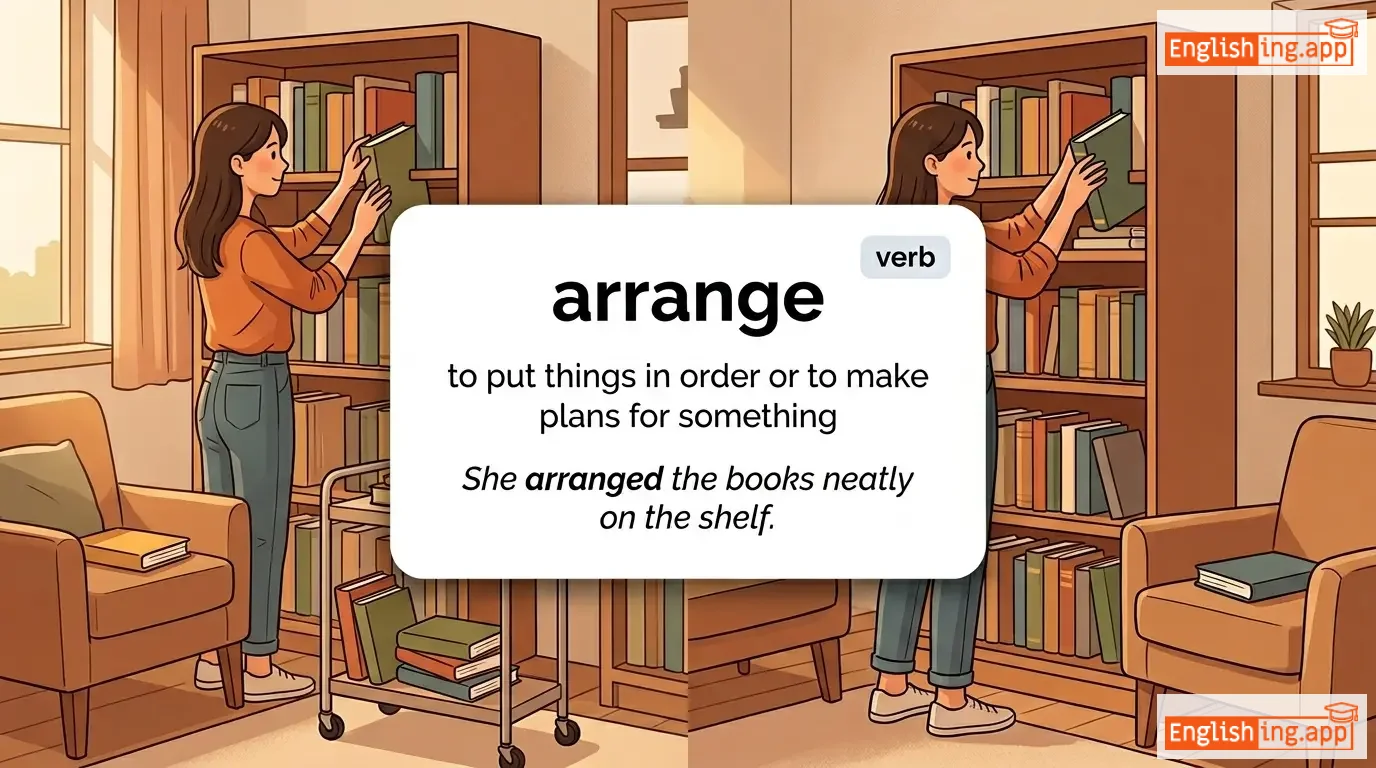
arrange definition card — visual illustration of the meaning
verb
/əˈreɪndʒ/
ordenar, organizar (ordenar, organizar)

to put things in order or to make plans for something

"She arranged the books neatly on the shelf."

"Ella organizó los libros ordenadamente en la estantería." (Ella organizó los libros ordenadamente en la estantería.)
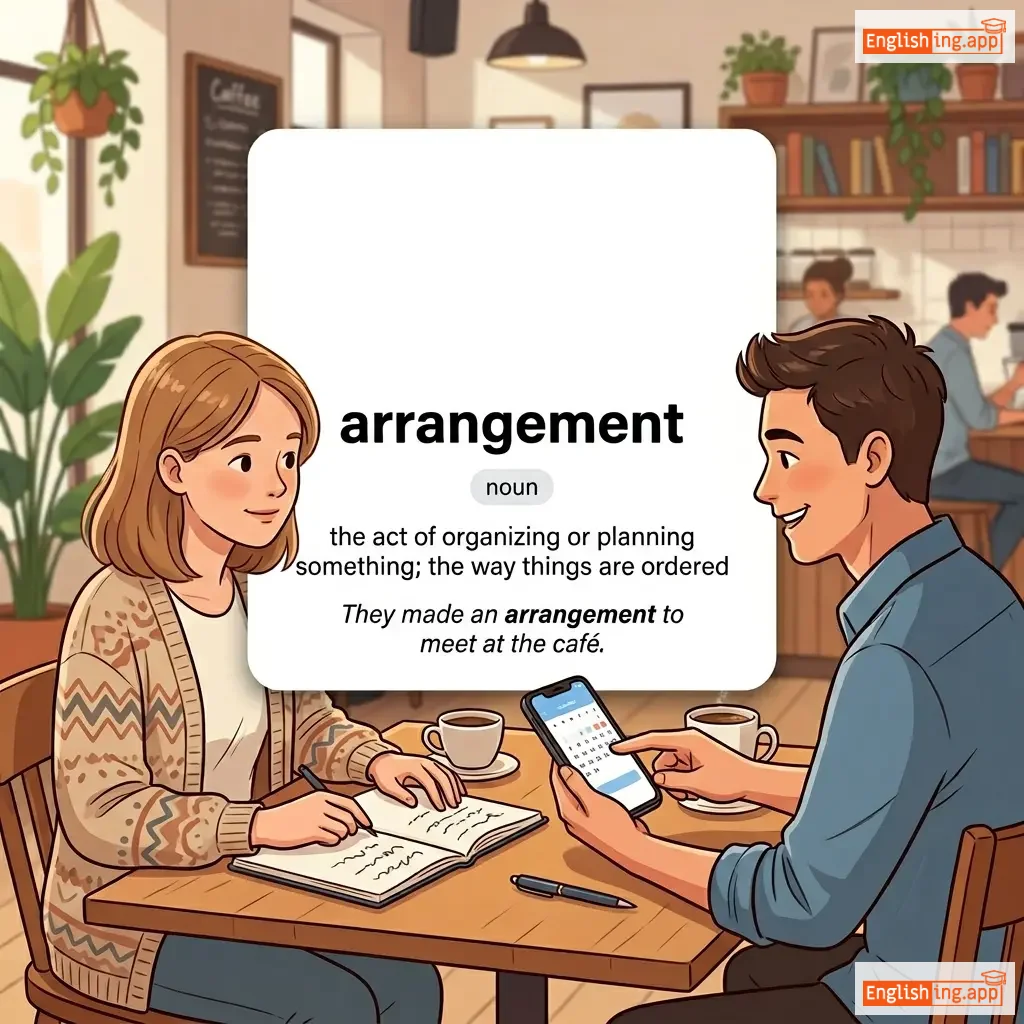
arrangement definition card — visual illustration of the meaning
noun
/əˈreɪndʒmənt/
arreglo, disposición (arreglo, disposicion)

the act of organizing or planning something; the way things are ordered

"They made an arrangement to meet at the café."

"Hicieron un arreglo para encontrarse en el café." (Hicieron un arreglo para encontrarse en el café.)
adjective
/ˈærənt/
completo, absoluto (completo, absoluto)

complete or utter (used negatively, e.g., 'arrant nonsense')

"His excuse was arrant nonsense."

"Su excusa fue una tontería absoluta." (Su excusa fue una tontería absoluta.)
noun
/əˈreɪ/
serie, exposición (serie, exposicion)

an impressive display or arrangement of things

"The shop displayed an array of colorful dresses."

"La tienda mostró una impresionante exposición de vestidos coloridos." (La tienda mostro una impresionante exposicion de vestidos coloridos.)
noun
/əˈrɪə/
deuda pendiente (deuda pendiente)

A debt or payment that is overdue and unpaid.

"He was sued for an arrear of rent."

"Fue demandado por una deuda pendiente de alquiler." (Fue demandado por una deuda pendiente de alquiler.)
noun
/əˈrɪəz/
deuda pendiente (deuda pendiente)

Money that is owed and should have been paid earlier.

"She was months in arrears with her electricity bill."

"Estaba meses en deuda con su factura de electricidad." (Estaba meses en deuda con su factura de electricidad.)
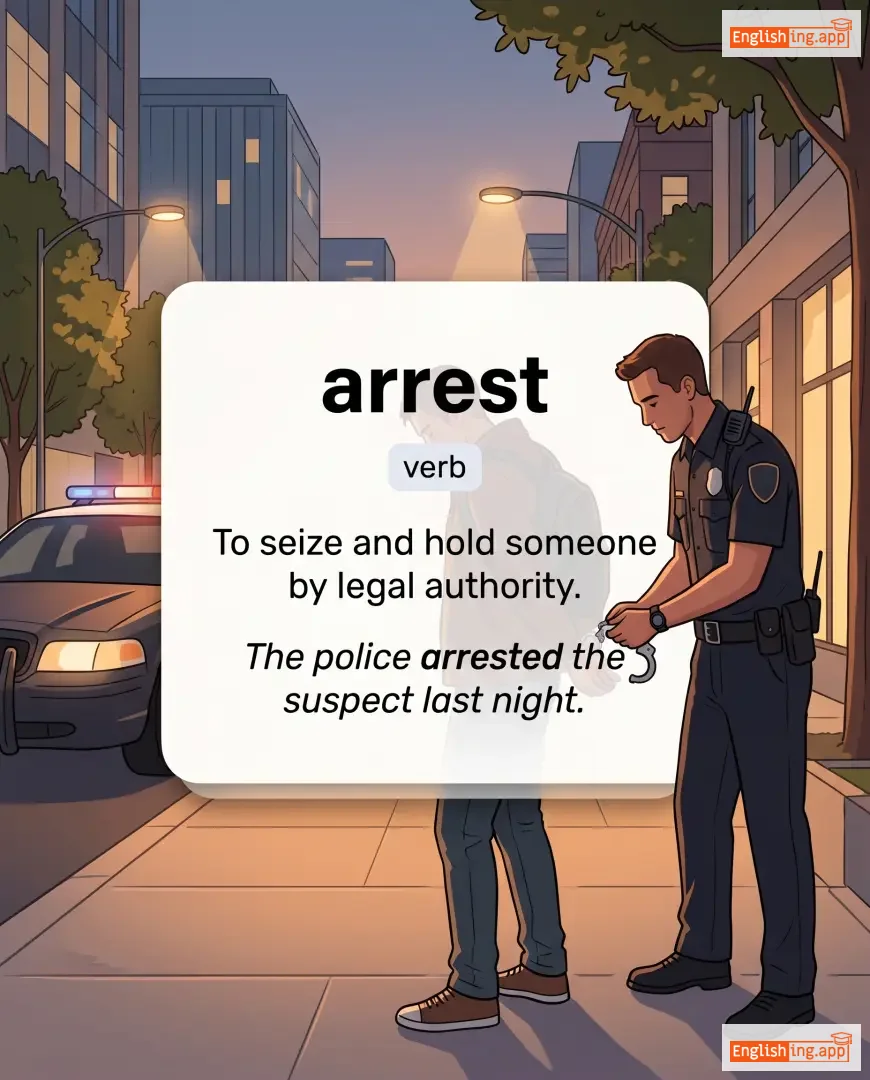
arrest definition card — visual illustration of the meaning
verb
/əˈrɛst/
detener (detener)

To seize and hold someone by legal authority.

"The police arrested the suspect last night."

"La policía arrestó al sospechoso anoche." (La policía arrestó al sospechoso anoche.)
adjective
/əˈrɛstɪŋ/
atractivo (atractivo)

Attracting attention in a striking or impressive way.

"The actress gave an arresting performance."

"La actriz dio una actuación atractiva." (La actriz dio una actuacion atractiva.)
adjective
/eɪˈrɪðmɪk/
arítmico (aritmiko)

Lacking a regular rhythm or beat.

"The patient had an arrhythmic heartbeat."

"El paciente tenía un latido cardíaco arítmico." (El paciente tenia un latido cardiaco aritmiko.)
noun
/əˈraɪvəl/
llegada (llegada)

The act of coming to a place, especially at the end of a journey.

"The train's arrival was delayed by two hours."

"La llegada del tren se retrasó dos horas." (La llegada del tren se retrasó dos horas.)
arrive definition card — visual illustration of the meaning
verb
/əˈraɪv/
llegar (llegar)

to reach a place, especially at the end of a journey

"She will arrive at the airport in the evening."

"Ella llegará al aeropuerto por la tarde." (Ella llegara al aeropuerto por la tarde.)
noun
/ˌæriˈviːst/
nueva riqueza (nueva riqueza)

A person who has recently gained wealth or status but is considered arrogant or socially unsophisticated.

"The business world is full of ambitious arrivistes."

"El mundo de los negocios está lleno de arrivistas ambiciosos." (El mundo de los negocios está lleno de arrivistas ambiciosos.)
noun
/ˈærəɡəns/
arrogancia (arrogansiya)

The quality of being overly proud and having a sense of superiority.

"His arrogance made him unpopular among his colleagues."

"Su arrogancia lo hizo impopular entre sus compañeros." (Su arrogansiya lo hizo impopular entre sus compañeros.)
adjective
/ˈærəɡənt/
arrogante (arrogante)

Having an exaggerated sense of one's own importance or abilities.

"The arrogant manager dismissed the workers' complaints."

"El gerente arrogante desestimó las quejas de los trabajadores." (El gerente arrogante desestimo las quejas de los trabajadores.)
verb
/ˈærəˌɡeɪt/
apropiarse injustamente (apropiarse injustamente)

To claim or take something without justification.

"The dictator arrogated all powers to himself."

"El dictador se apropió injustamente de todos los poderes para él mismo." (El dictador se apropió injustamente de todos los poderes para él mismo.)
noun
/ˈæroʊ/
flecha (flecha)

a thin, straight weapon with a pointed tip, shot from a bow

"The hunter shot an arrow at the target."

"El cazador disparó una flecha al objetivo." (El cazador disparó una flecha al objetivo.)
noun
/əˈrɔɪ.oʊ/
arroyo seco (arroyo seco)

A dry creek or stream bed that temporarily fills with water after heavy rain.

"After the storm, the arroyo quickly filled with rushing water."

"Después de la tormenta, el arroyo se llenó rápidamente de agua." (Despues de la tormenta, el arroyo se lleno rapidamente de agua.)
noun
/ˈɑːr.sən.əl/
arsenal (arsenal)

A collection or storage place for weapons and military equipment.

"The army kept its weapons in a secure arsenal."

"El ejército mantuvo sus armas en un arsenal seguro." (El ejercito mantuvo sus armas en un arsenal seguro.)
noun
/ɑːrt/
arte (arte)

the expression or application of human creative skill and imagination

"She studied art at the university."

"Ella estudió arte en la universidad." (Ella estudio arte en la universidad.)
noun
/ˈɑːr.tər.i/
arteria (arteria)

A blood vessel that carries blood away from the heart; also a main route or channel of communication or transport.

"The doctor explained how arteries supply blood to the body."

"El doctor explicó cómo las arterias suministran sangre al cuerpo." (El doctor explicó cómo las arterias suministran sangre al cuerpo.)
adjective
/ˈɑːrt.fəl/
astuto (astuto)

Skillful, clever, or crafty, often in a cunning way.

"She gave an artful reply that avoided the real issue."

"Ella dio una respuesta astuta que evitó el verdadero problema." (Ella dio una respuesta astuta que evitó el verdadero problema.)
adjective
/ɑːrˈθʊr.i.ən/
relacionado con Arthur (relacionado con Arthur)

Relating to the legendary King Arthur and the stories surrounding him.

"The novel is set in an Arthurian world of knights and castles."

"La novela está ambientada en un mundo artúrico de caballeros y castillos." (La novela está ambientada en un mundo artúrico de caballeros y castillos.)
noun
/ˈɑːrtɪkl/
artículo (articulo)

a piece of writing included in a newspaper, magazine, or journal

"He wrote an article about climate change."

"Escribió un artículo sobre el cambio climático." (Escribió un artículo sobre el cambio climático.)
verb/adjective
/ɑːrˈtɪkjʊlət/
articular (articular)

to express thoughts or ideas clearly; having the ability to speak fluently and clearly

"She was able to articulate her ideas during the meeting."

"Ella pudo articular sus ideas durante la reunión." (Ella pudo articular sus ideas durante la reunión.)
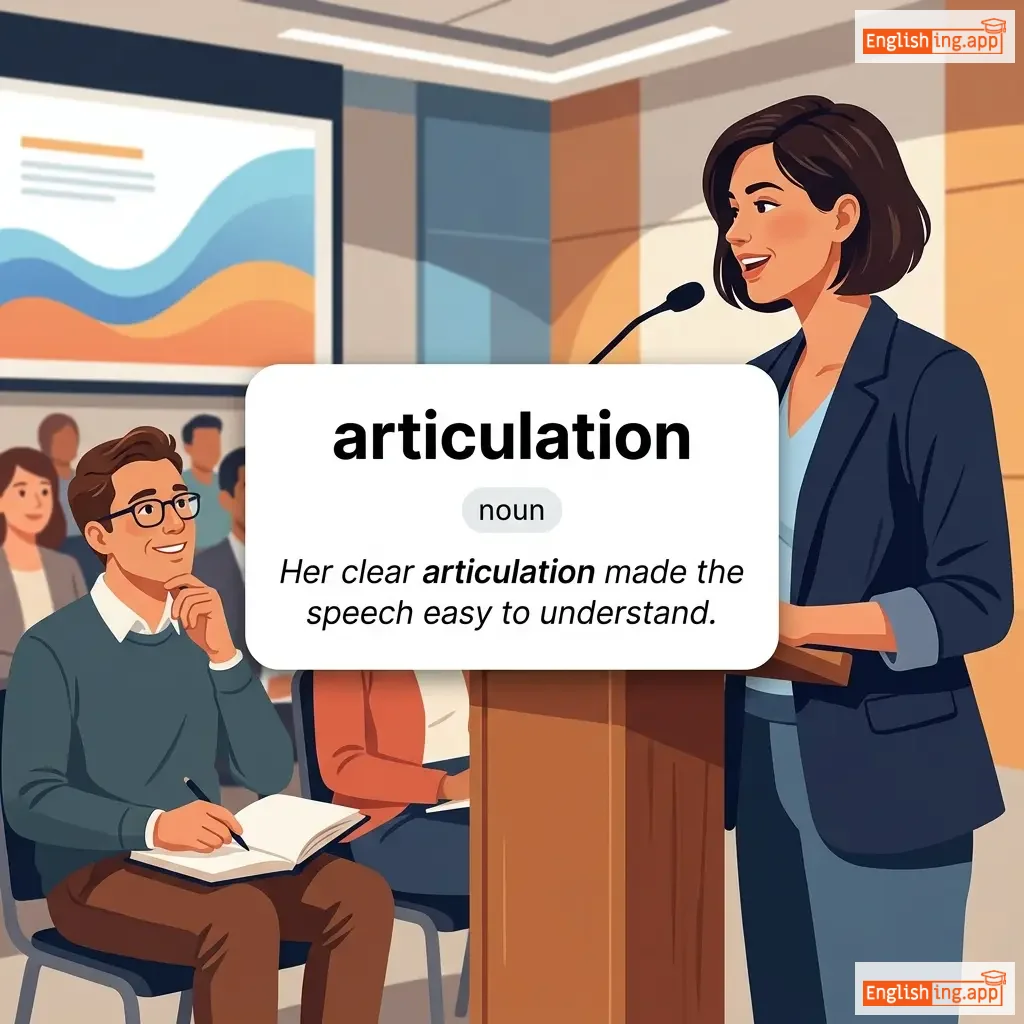
articulation definition card — visual illustration of the meaning
noun
/ɑːrˌtɪkjʊˈleɪʃən/
articulación clara (articulacion clara)

the act of expressing something clearly in speech or the way in which words are pronounced

"Her clear articulation made the speech easy to understand."

"Su clara articulación hizo que el discurso fuera fácil de entender." (Su clara articulación hizo que el discurso fuera fácil de entender.)
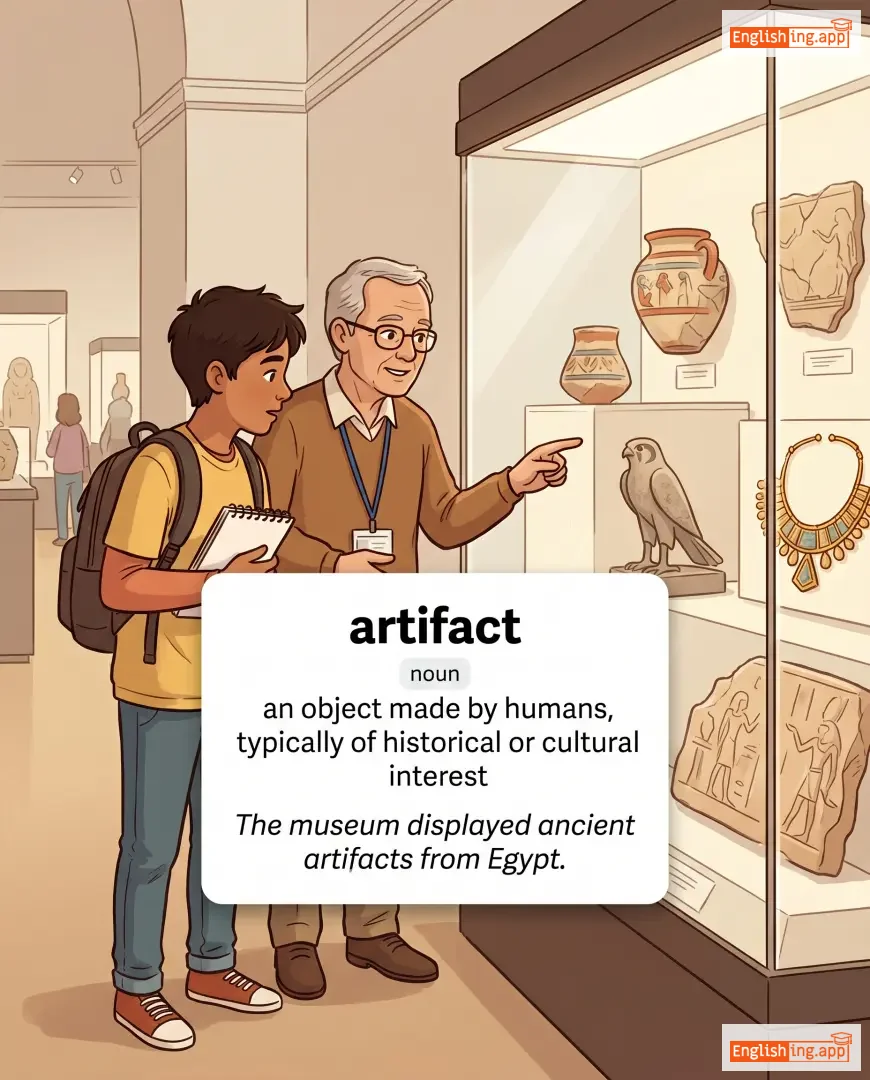
artifact definition card — visual illustration of the meaning
noun
/ˈɑːrtɪˌfækt/
artefacto (artefacto)

an object made by humans, typically of historical or cultural interest

"The museum displayed ancient artifacts from Egypt."

"El museo exhibió artefactos antiguos de Egipto." (El museo exhibió artefactos antiguos de Egipto.)
noun (plural)
/ˈɑːrtɪˌfæks/
artefactos (artefactos)

objects made by humans, often of historical or cultural importance

"Archaeologists discovered valuable artifacts in the ruins."

"Los arqueólogos descubrieron artefactos valiosos en las ruinas." (Los arqueólogos descubrieron artefactos valiosos en las ruinas.)
noun
/ˈɑːrtɪfɪs/
artificio (artificio)

clever or cunning devices or tricks used to deceive others

"The politician's charm was nothing but artifice."

"El encanto del político no era más que artificio." (El encanto del politico no era mas que artificio.)
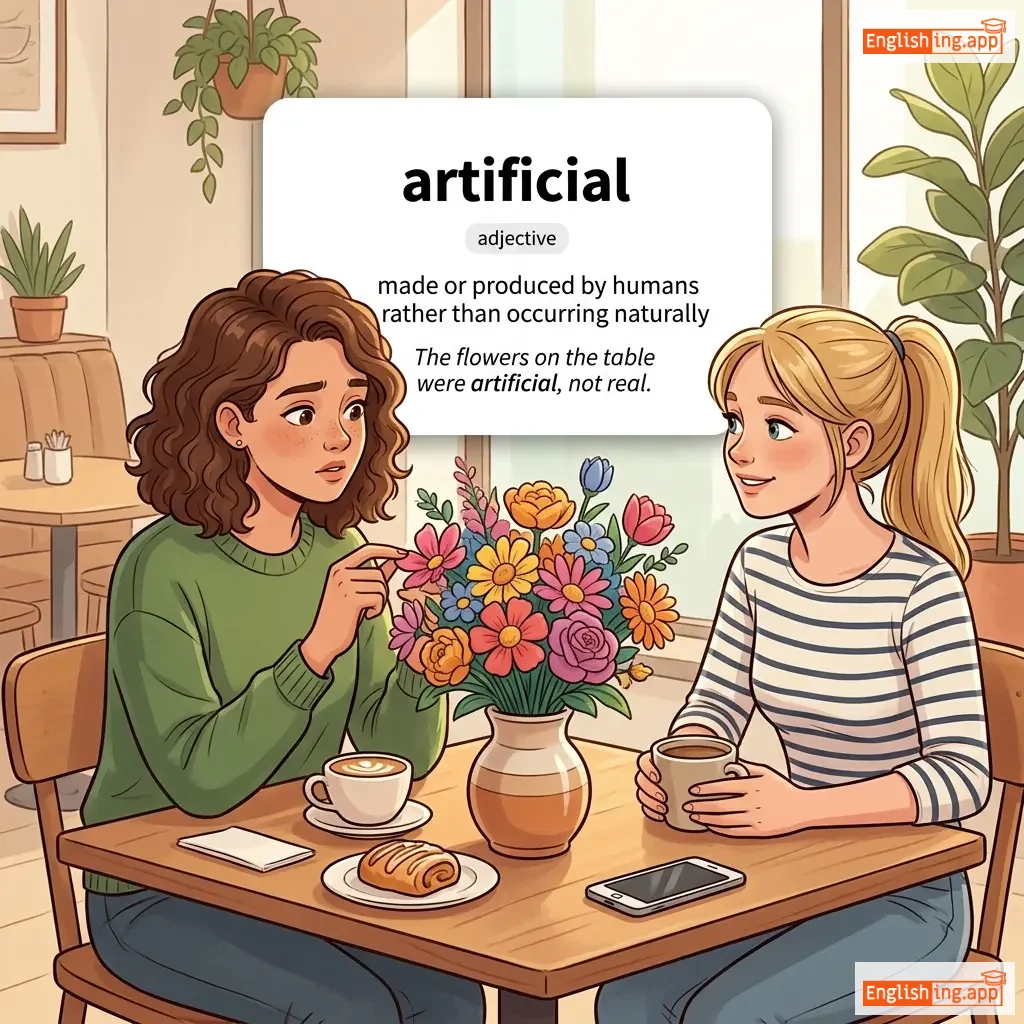
artificial definition card — visual illustration of the meaning
adjective
/ˌɑːrtɪˈfɪʃəl/
artificial (artificial)

made or produced by humans rather than occurring naturally

"The flowers on the table were artificial, not real."

"Las flores en la mesa eran artificiales, no reales." (Las flores en la mesa eran artificiales, no reales.)
artificial intelligence definition card — visual illustration of the meaning
noun
ˌɑː.tɪˈfɪʃ.əl ɪnˈtɛl.ɪ.dʒəns
inteligencia artificial (inteligencia artificial)

The simulation of human intelligence in machines that are programmed to think and learn.

"Artificial intelligence is reshaping modern industries."

"La inteligencia artificial está remodelando las industrias modernas." (La inteligencia artificial esta remodelando las industrias modernas.)
adverb
/ˌɑːrtɪˈfɪʃəli/
artificialmente; (artificialmente)

by artificial means; not naturally; in a fake manner

"The lake was artificially created for irrigation purposes."

"El lago fue creado artificialmente para fines de riego." (El lago fue creado artificialmente para fines de riego.)
noun
/ˈɑːrtɪzən/
artesano (artesano)

a skilled craftsperson who makes things by hand

"The artisan crafted a beautiful wooden chair."

"El artesano creó una hermosa silla de madera." (El artesano creó una hermosa silla de madera.)
noun
/ˈɑːr.tɪ.zən/
artesano (artesano)

a skilled craftsperson who makes things by hand

"The artisan created a beautiful wooden sculpture."

"El artesano creó una hermosa escultura de madera." (El artesano creo una hermosa escultura de madera.)
👩‍🎨

Artist (ártist)

noun
/ˈɑːrtɪst/
artista (artista)

a person who creates art, especially paintings or drawings

"The artist painted a beautiful landscape."

"El artista pintó un hermoso paisaje." (El artista pintó un hermoso paisaje.)
adjective
/ɑːrˈtɪstɪk/
artístico (artistico)

having or revealing natural creative skill

"She has an artistic sense of design."

"Ella tiene un sentido artístico del diseño." (Ella tiene un sentido artistico del diseño.)
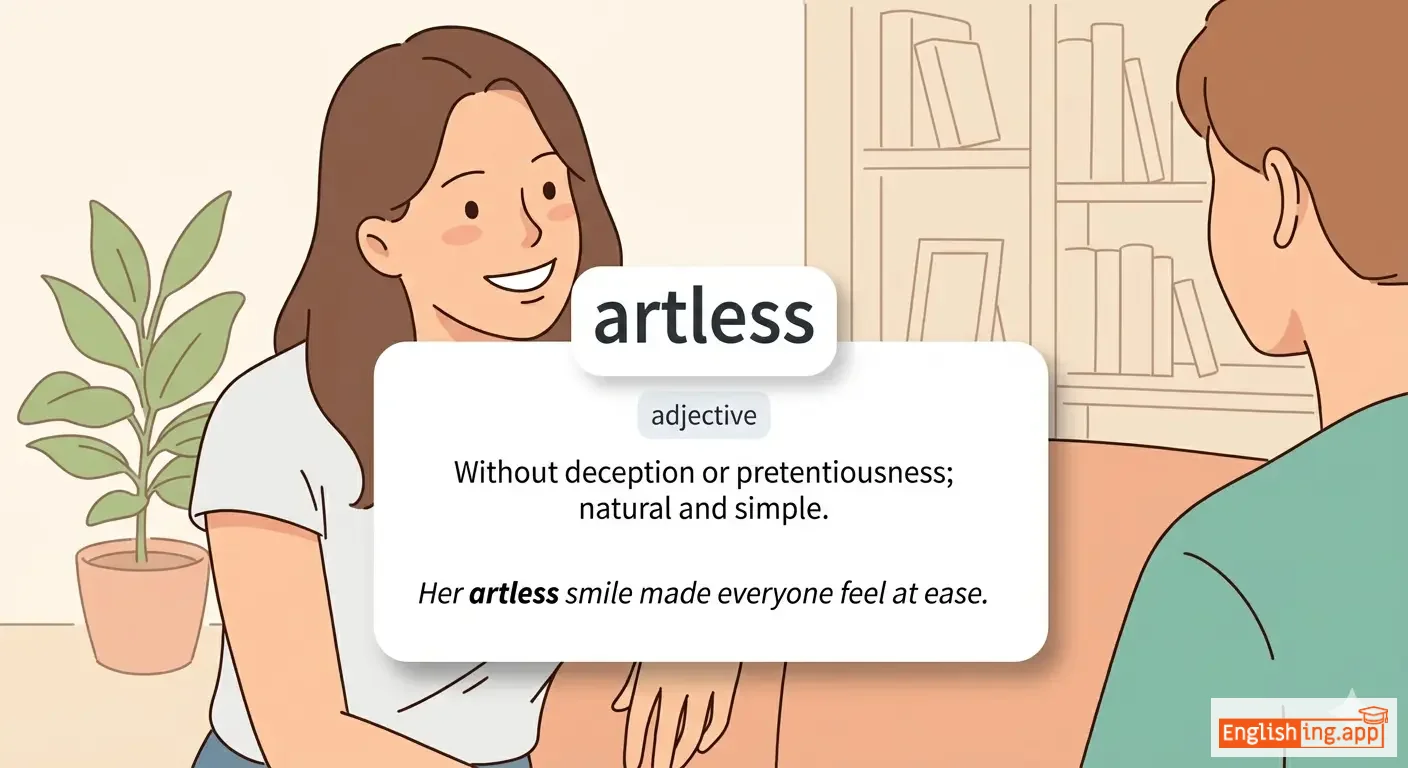
artless definition card — visual illustration of the meaning
adjective
/ˈɑːrtləs/
sencillo, natural (sencillo, natural)

Without deception or pretentiousness; natural and simple.

"Her artless smile made everyone feel at ease."

"Su sonrisa sincera hizo que todos se sintieran cómodos." (su sonrisa sincera hizo que todos se sintieran comodos.)
noun
/ˈɑːrtləsnəs/
simplicidad, naturalidad (simplicidad, naturalidad)

The quality of being natural and simple without deceit or pretension.

"Her artlessness made her beloved by all."

"Su artlessness la hizo querida por todos." (Su artlessness la hizo querida por todos.)
noun
/ˈɑːrtwɜːrk/
obra de arte (obra de arte)

a piece of art, such as a painting, sculpture, or drawing

"The gallery displayed an impressive artwork by a local artist."

"La galería exhibió una impresionante obra de arte de un artista local." (La galería exhibió una impresionante obra de arte de un artista local.)
noun
/ˈeə.rəm/
arum (arum)

a plant with large arrow-shaped leaves and a white spathe, also known as taro

"Arum leaves are commonly used in Bengali cuisine for cooking."

"Las hojas de Arum se utilizan comúnmente en la cocina india para cocinar." (Las hojas de Arum se utilizan comunmente en la cocina india para cocinar.)
conjunction, adverb, preposition
/æz/
como (como)

used to compare, to indicate the role or function of something, or to introduce clauses of time or reason

"She works as a teacher."

"Ella trabaja como profesora." (Ella trabaja como profesora.)
adverb
/æz ˈjuː.ʒu.əl/
como siempre (como siempre)

in the way that is normal or typical; customarily

"As usual, he arrived late to the meeting."

"Como siempre, llegó tarde a la reunión." (Como siempre, llego tarde a la reunion.)
noun
/ˌæs.əˈfet.ɪ.də/
asafoétida (asafoetida)

a pungent spice derived from the resin of a plant, commonly used in Indian cooking

"A pinch of asafoetida adds a distinctive flavor to the lentil curry."

"Una pizca de asafoétida añade un sabor distintivo al curry de lentejas." (Una pizca de asafoetida añade un sabor distintivo al curry de lentejas.)