वोकैबुलरीज

इंग्लिश वोकैबुलरी डिस्कवर, लर्न और मास्टर करें

adjective, verb
/sɪˈdeɪt/
शांत करना (shaant karna)

calm, quiet, and composed; or to administer a drug to make someone calm or sleep

"The nurse sedated the patient before the operation."

"नर्स ने ऑपरेशन से पहले मरीज़ को शांत करने के लिए दवा दी।" (Nurse ne operation se pehle mareez ko shaant karne ke liye dawa di.)
security definition card — visual illustration of the meaning
noun
/sɪˈkjʊərɪti/
सुरक्षा (suraksha)

the state of being free from danger or threat

"We need to improve our security measures at the airport."

"हमें हवाई अड्डे पर अपनी सुरक्षा उपायों को सुधारने की आवश्यकता है।" (Humein havai adde par apni suraksha upayon ko sudharne ki avashyakta hai.)
secure definition card — visual illustration of the meaning
verb/adjective
/sɪˈkjʊər/
सुरक्षित करना (surakshit karna)

to make safe or protect; to fix something firmly in place

"Please secure the door before you leave."

"कृपया दरवाजा बंद कर दें जब आप जाएं।" (Kripya darwaza band kar den jab aap jayein.)
adjective
/ˈsɛkjʊlər/
धर्मनिरपेक्ष (dharmnirpeksh)

not connected with religious or spiritual matters

"The country adopted a secular constitution separating religion from state affairs."

"देश ने एक धर्मनिरपेक्ष संविधान अपनाया जिसमें धर्म को राज्य से अलग किया गया है।" (Desh ne ek dharmnirpeksh sanvidhan apnaya jismein dharm ko rajya se alag kiya gaya hai.)
sector-specific definition card — visual illustration of the meaning
adjective
ˈsek.tər spəˈsɪf.ɪk
क्षेत्र-विशिष्ट (kshetra-vishisht)

Relating to or designed for a particular sector or industry.

"Sector-specific policies attract targeted investments."

"क्षेत्र-विशिष्ट नीतियाँ लक्षित निवेश आकर्षित करती हैं।" (Kshetra-vishisht neetiyan lakshit nivesh akarshit karti hain.)
noun
/ˈsɛktər/
क्षेत्र (kshetra)

a distinct part or area of an economy, society, or industry

"The technology sector is growing rapidly."

"प्रौद्योगिकी क्षेत्र तेजी से बढ़ रहा है।" (Praudyogiki kshetra tezi se badh raha hai.)
noun
/ˈsɛkʃən/
खंड (khand)

a distinct part or subdivision of something larger

"This section of the report needs further review."

"रिपोर्ट का यह खंड और अधिक समीक्षा की आवश्यकता है।" (Report ka yah khand aur adhik samiksha ki avashyakta hai.)
adjective
/sɛkˈtɛəriən/
संप्रदायिक (sampradaik)

relating to or characterized by the differences between sects, often leading to conflict

"The region has been troubled by sectarian violence for decades."

"इस क्षेत्र में दशकों से सम्प्रदायिक हिंसा से परेशानी है।" (Is kshetr mein dashko se sampradaik hinsa se pareshani hai.)
noun
/sɛkt/
संप्रदाय (sampraday)

a subgroup of a larger religious or political group, often with differing beliefs

"The group split into different sects due to doctrinal differences."

"समूह सिद्धांतगत भिन्नताओं के कारण विभिन्न संप्रदायों में विभाजित हो गया।" (Samuh siddhantgat bhinnataon ke karan vibhinn sampradayon mein vibhajit ho gaya.)
adverb
/ˈsiː.krət.li/
गुप्त रूप से (gupt roop se)

in a way that is hidden or not known by others

"She secretly planned a surprise party for her friend."

"उसने चुपके से अपने दोस्त के लिए एक सरप्राइज पार्टी की योजना बनाई।" (Usne chupke se apne dost ke liye ek surprise party ki yojana banai.)
noun
/sɪˈkriː.ʃən/
स्राव; उत्सर्जन (sraav; utsarjan)

a process by which substances are produced and discharged from a cell or gland

"Insulin secretion is crucial for blood sugar regulation."

"इंसुलिन स्राव रक्त शर्करा नियंत्रण के लिए महत्वपूर्ण है।" (insulin sraav rakt shorkara niyantran ke liye mahatvapurn hai)
secrete definition card — visual illustration of the meaning
verb
/sɪˈkriːt/
स्राव करना (sraav karna)

to produce and release a substance from a cell, gland, or organ

"The pancreas secretes insulin to regulate blood sugar levels."

"अग्न्याशय रक्त शर्करा स्तर को नियंत्रित करने के लिए इंसुलिन स्राव करता है।" (Agnyashay rakt shakkara sttar ko niyantrit karne ke liye insulin sraav karta hai.)
noun
/ˈsɛkrəteri/
सचिव (sekretari)

a person employed to handle correspondence and manage routine tasks for an individual or organization

"The secretary scheduled the meeting for tomorrow."

"सचिव ने कल बैठक निर्धारित की।" (sachiv ne kal baithak nirdharit ki)
secret definition card — visual illustration of the meaning
noun
/ˈsiːkrət/
राज़ (sikret)

something that is kept or meant to be kept unknown or unseen by others

"He told me a secret about his childhood."

"उसने अपने बचपन के बारे में मुझे एक राज़ बताया।" (usne apne bachpan ke baare mein mujhe ek raaz bataya.)
noun
/ˈsiːkrəsi/
गोपनीयता (gopniyta)

The action of keeping something secret or the state of being kept secret.

"The negotiations were conducted in complete secrecy."

"बातचीत पूरी गोपनीयता में की गई थी।" (Baatcheet poori gopniyta mein ki gayi thi.)
adverb
/ˈsekəndli/
दूसरे स्थान पर (doosre sthan par)

Used to introduce the second point in a list of arguments or ideas.

"Firstly, we need funding; secondly, we need a strong team."

"पहले, हमें फंडिंग की आवश्यकता है; सेकंडली, हमें एक मजबूत टीम की आवश्यकता है।" (Pehle, humein funding ki avashyakta hai; secondly, humein ek majboot team ki avashyakta hai.)
adjective
/ˈsekənderi/
मामूली (mamuli)

Less important than something else; derived from or dependent on something primary.

"Safety is our primary concern, while speed is only secondary."

"सुरक्षा हमारी प्राथमिक चिंता है, जबकि गति केवल मामूली है।" (Suraksha hamari prathamik chinta hai, jabki gati keval mamuli hai.)
adjective
/ˌsekənd ˈreɪt/
दूसरे दर्जे का (doosre darje ka)

Of mediocre or inferior quality.

"The movie was entertaining but clearly second-rate compared to the original."

"फिल्म मनोरंजक थी, लेकिन मूल के मुकाबले स्पष्ट रूप से दूसरे दर्जे की थी।" (Film manoranjak thi, lekin mool ke mukable spasht roop se doosre darje ki thi.)
⏱️

second

noun
/ˈsekənd/

a unit of time equal to one sixtieth of a minute; also the position after first

"He finished the race in second place."

noun
/sɪˈkluːʒən/
एकांत (ekant)

The state of being private, away from other people.

"She spent the weekend in complete seclusion in her cabin."

"उसने अपने कैबिन में पूरी तरह से एकांत में सप्ताहांत बिताया।" (Usne apne cabin mein puri tarah se ekant mein saptahant bitaya.)
adjective
/sɪˈkluːdɪd/
अलग-थलग (alagd-thalag)

Placed apart from other people or things; private and quiet.

"They spent their vacation in a secluded beach house."

"उन्होंने अपनी छुट्टियां एक शांत और दूरस्थ बीच हाउस में बिताई।" (Unhone apni chhutiyaan ek shaant aur doorasth beach house mein bitaayi.)
verb
/sɪˈkluːd/
अलग रखना (alag rakhna)

To keep someone away from other people; to isolate.

"The monk chose to seclude himself in the mountains."

"भिक्षु ने पहाड़ों में खुद को अलग रखने का चुनाव किया।" (Bhikshu ne pahadon mein khud ko alag rakhne ka chunav kiya.)
verb
/sɪˈsiːd/
अलग होना (alag hona)

To formally withdraw from a political or organizational union.

"Several states threatened to secede from the union."

"कई राज्यों ने संघ से अलग होने की धमकी दी थी।" (Kai rajyon ne sangh se alag hone ki dhamki di thi.)
noun
/sɪˈsɛʃən/
विच्छेदन (vichchedan)

The action of formally withdrawing from membership of a federation or body.

"The secession of the southern states led to the Civil War."

"दक्षिणी राज्यों का विभाजन अमेरिकी गृहयुद्ध का कारण बना।" (Dakshini rajyon ka vibhajan ameriki grihyudh ka karan bana.)
noun
/ˈskɜː.vi/
स्कर्वी रोग (skorvi rog)

A disease caused by a deficiency of vitamin C, leading to weakness, gum disease, and bleeding.

"Sailors often suffered from scurvy during long sea voyages without fresh fruits."

"लंबी समुद्री यात्राओं के दौरान ताजे फल के बिना नाविक अक्सर स्कर्वी रोग से ग्रस्त हो जाते थे।" (Lambi samudri yatraon ke dauran taje phal ke bina navik aksar skorvi roge se grast ho jate the.)
verb
/ˈskʌt.əl/
खुशी (khushi)

To run hurriedly with short, quick steps; or to deliberately sink a ship.

"The children scuttled back to their seats when the teacher entered."

"वह पुरस्कार प्राप्त करते समय अपनी खुशी नहीं छुपा सकी।" (Wah puraskaar prapt karte samay apni khushi nahi chhupa sakee.)
noun
/saɪð/
दाढ़ी काटने वाला औजार (daadhi kaatne wala auzaar)

A tool with a long curved blade used for cutting grass or grain.

"The farmer sharpened his scythe before harvesting the wheat."

"किसान ने गेहूं की कटाई से पहले अपनी साइथ को धार दिया।" (Kisaan ne gehu ki katai se pehle apni saith ko dhaar diya.)
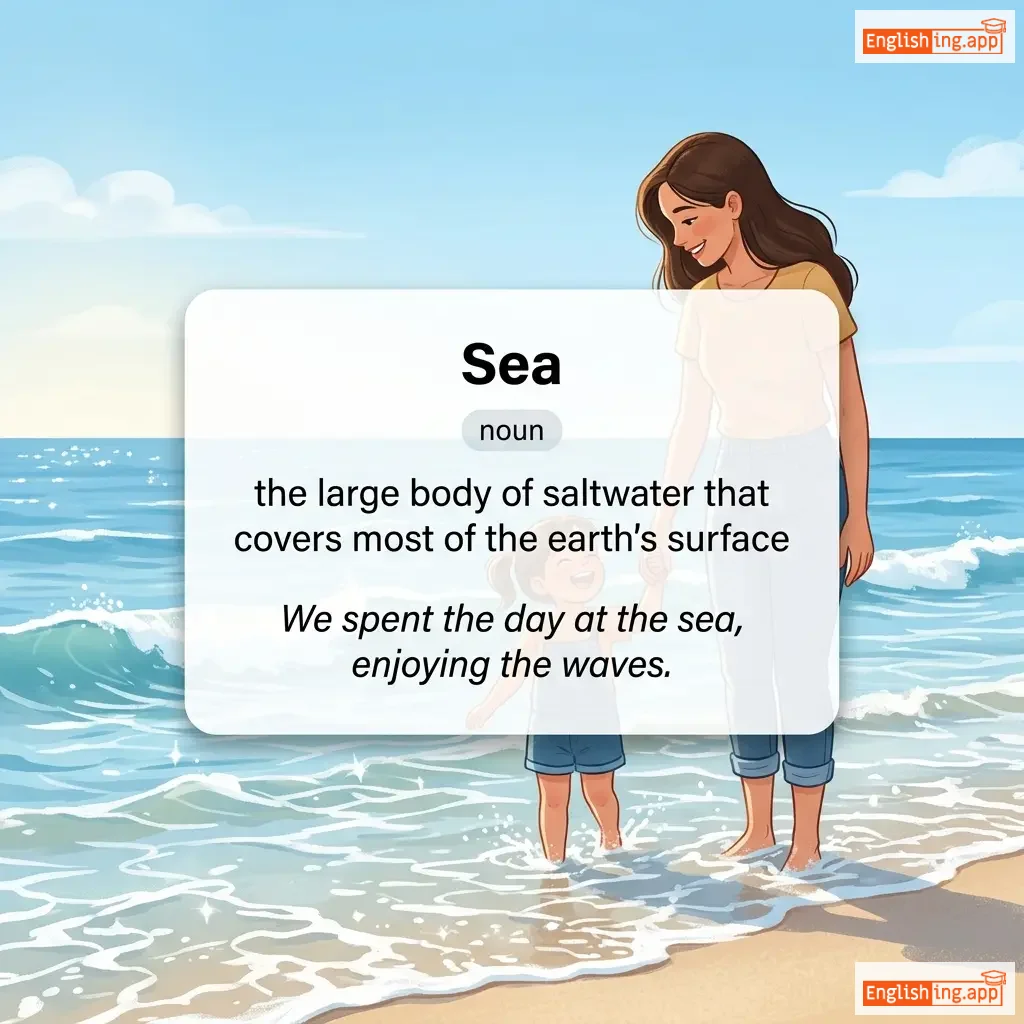
Sea definition card — visual illustration of the meaning
noun
/siː/
समुद्र (samudra)

the large body of saltwater that covers most of the earth's surface

"We spent the day at the sea, enjoying the waves."

"हमने समुद्र में दिन बिताया, लहरों का आनंद लिया।" (Hamne samudra mein din bitaya, lehron ka anand liya.)
noun
/ˈsiː.hɔːrs/
समुद्री घोड़ा (samudri ghoda)

a small marine fish with segmented bony armor, an upright posture, and a curled prehensile tail

"The seahorse gracefully floated among the coral reefs."

"समुद्री घोड़ा प्रवाल भित्तियों के बीच gracefully तैरता हुआ।" (samudri ghoda praval bhittiyon ke beech gracefully tairta hua)
verb
/siːl/
सील करना, बंद करना (seel karna, band karna)

to close or secure something tightly or officially confirm something

"He sealed the envelope before sending the letter."

"उसने पत्र भेजने से पहले लिफाफे को सील किया।" (Usne patra bhejne se pehle lifaafe ko seel kiya.)
sealing definition card — visual illustration of the meaning
verb
ˈsiːlɪŋ
सील करना, बंद करना (seel karna, band karna)

The action of closing or blocking something to prevent entry or escape.

"Sealing cracks in the walls can prevent pests from entering."

"दीवारों में दरारों को सील करना कीटों को प्रवेश करने से रोक सकता है।" (Deewaron mein dararon ko seel karna keeton ko pravesh karne se rok sakta hai.)
noun
/ˈsiː.mən/
नौसैनिक (nausainik)

a person who works on a ship; sailor

"The experienced seaman navigated the ship through the storm."

"अनुभवी नौसैनिक ने तूफान के बीच जहाज को नेविगेट किया।" (anubhavi nausainik ne toofan ke beech jahaj ko navigate kiya.)
seamless definition card — visual illustration of the meaning
adjective
/ˈsiːmləs/
निर्बाध (nirbaadh)

Smooth and continuous, with no apparent gaps or spaces between one part and the next.

"The seamless integration of the two systems improved efficiency and reduced errors."

"दो सिस्टमों का निर्बाध एकीकरण दक्षता में सुधार और त्रुटियों को कम करता है।" (Do systems ka nirbaadh ekikaran dakshata mein sudhaar aur trutiyon ko kam karta hai.)
adjective
/ˈsiːmi/
नीच, कलंकीत (neech, kalankit)

Morally degraded, unpleasant, or sordid.

"The novel reveals the seamy side of city life."

"उपन्यास शहर के जीवन के नीच पक्ष को प्रकट करता है।" (Upanyas shaher ke jeevan ke neech paksh ko prakat karta hai.)
noun
/ˈseɪɑːns/
सत्र (satra)

A meeting where people attempt to communicate with the spirits of the dead.

"They held a seance to contact their late grandmother."

"उन्होंने अपनी दिवंगत दादी से संपर्क करने के लिए एक सत्र आयोजित किया।" (Unhone apni divangat daadi se sampark karne ke liye ek satra aayojit kiya.)
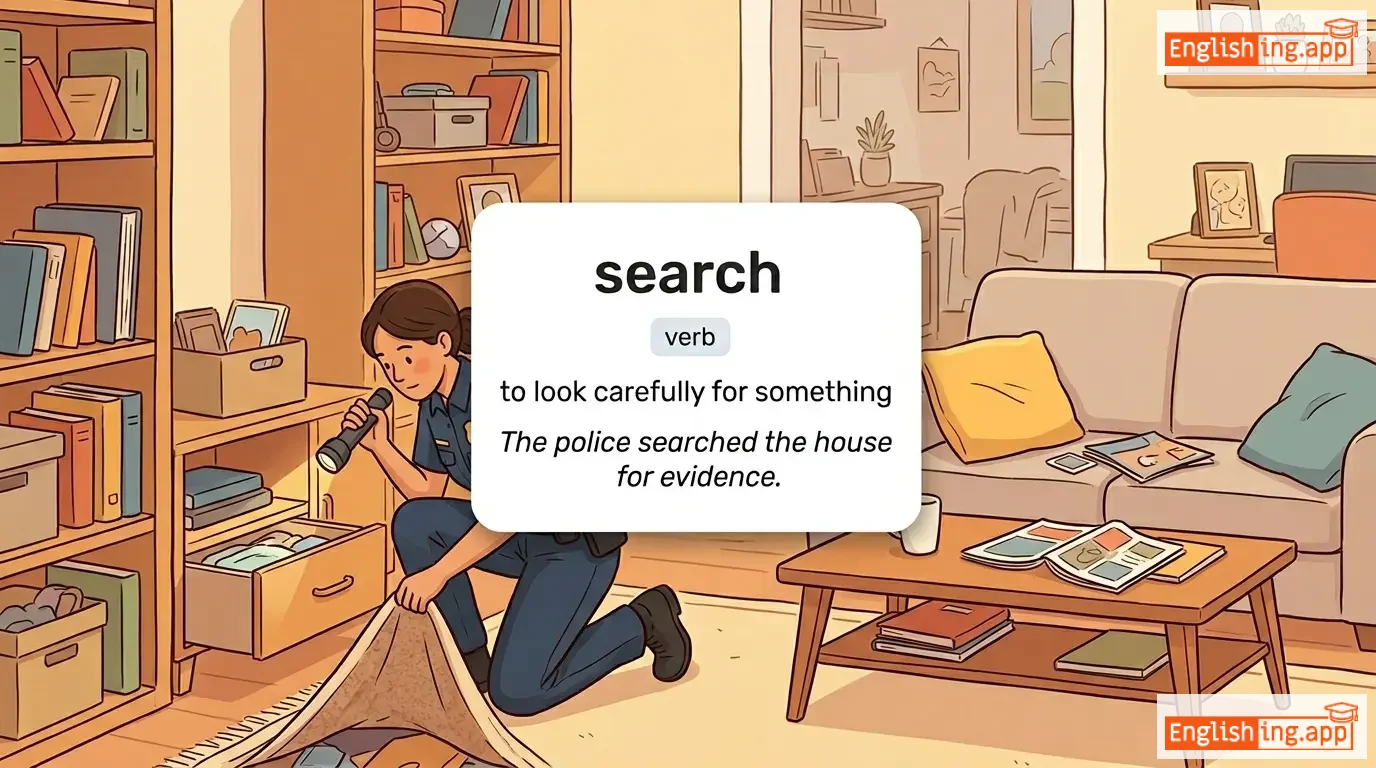
search definition card — visual illustration of the meaning
verb
/sɜːrtʃ/
खोजना (khujna)

to look carefully for something

"The police searched the house for evidence."

"पुलिस ने सबूत के लिए घर की तलाशी ली।" (Police ne saboot ke liye ghar ki talashi li.)
verb
/sɪr/
सियर करना (sear karna)

To burn or scorch the surface of something with intense heat.

"The chef seared the steak to lock in the flavor."

"शेफ ने स्वाद को लॉक करने के लिए स्टेक को सियर किया।" (Shef ne swad ko lock karne ke liye steak ko sear kiya.)
noun
/ˈsiːkənt/
सीकेंट रेखा (secent rekha)

A straight line that intersects a curve at two or more points.

"In geometry, a secant cuts the circle at two distinct points."

"ज्यामिति में, एक सीकेंट रेखा वृत्त को दो अलग-अलग बिंदुओं पर काटती है।" (Jyaamiti mein, ek secant rekha vrutt ko do alag-alag binduon par kaatati hai.)
adjective
/sɪˈbeɪʃəs/
सीबम संबंधित (seebam sambandhit)

Relating to or secreting sebum, an oily substance from the skin.

"Acne is often caused by overactive sebaceous glands."

"मुँहासे अक्सर अधिक सक्रिय सीबेसियस ग्रंथियों के कारण होते हैं।" (Munhase aksar adhik sakriya sebeshius granthiyon ke karan hote hain.)
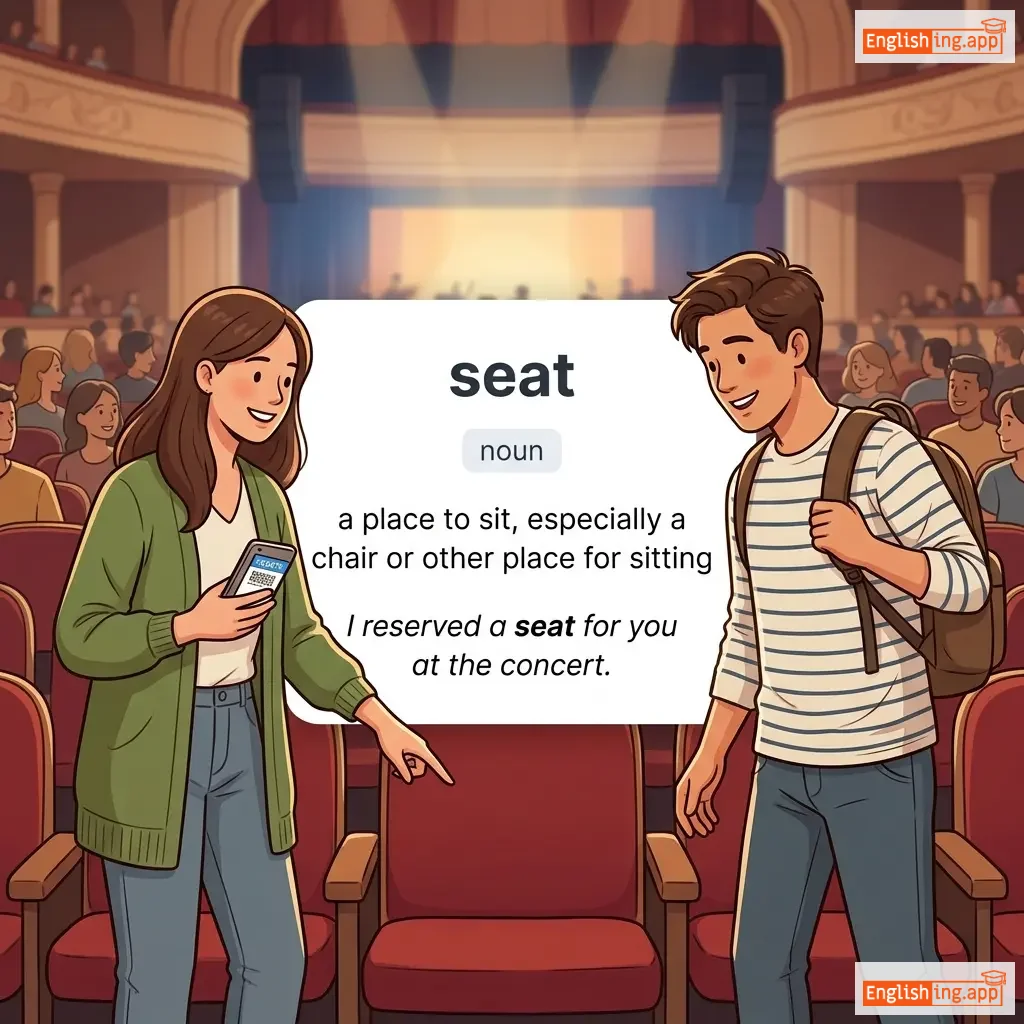
seat definition card — visual illustration of the meaning
noun
/siːt/
सीट (seet)

a place to sit, especially a chair or other place for sitting

"I reserved a seat for you at the concert."

"मैंने आपके लिए कॉन्सर्ट में एक सीट आरक्षित की।" (Maine aapke liye concert mein ek seat aarakshit ki.)
adjective/verb
/ˈsiːzənd/
अनुभवी / मसालेदार (anubhavi / masaledar)

Experienced in a particular activity; also, flavored with spices.

"She is a seasoned teacher with over 20 years of experience."

"वह 20 वर्षों के अनुभव वाली एक अनुभवी शिक्षिका हैं।" (Wah 20 varshon ke anubhav wali ek anubhavi shikshika hain.)
seasonal vegetables definition card — visual illustration of the meaning
noun
ˈsiːzənəl ˈvedʒtəbəlz
मौसमी सब्जियाँ (mausami sabziyan)

Vegetables that grow during specific seasons or times of the year

"Seasonal vegetables grow abundantly in winter."

"मौसमी सब्जियाँ सर्दियों में प्रचुर मात्रा में उगती हैं।" (mausami sabziyan sardiyon mein prachur matra mein ugti hain)
adjective
/ˈsiːzənəbl/
मौसम के अनुसार (mausam ke anusar)

Appropriate to the time of year or season.

"We had seasonable weather for autumn."

"हमारे पास शरद ऋतु के लिए उपयुक्त मौसम था।" (Hamare paas sharad ritu ke liye upyukt mausam tha.)
adjective
/ˈsiːzənl/
मौसमी (mausami)

Relating to or dependent on a particular season.

"Seasonal fruits are available in the market."

"सीज़नल फल बाजार में उपलब्ध होते हैं।" (Seeznal phal bazar mein uplabdh hote hain.)
adverb
/ˈsɜːrtʃɪŋli/
खोजी नज़र से (khoji nazar se)

In a way that seems to look for hidden meanings or truth.

"She looked at him searchingly, hoping for an honest answer."

"उसने उसे खोजी नज़र से देखा, एक ईमानदार जवाब की उम्मीद करते हुए।" (Usne use khoji nazar se dekha, ek imandaar jawab ki ummid karte huye.)
season definition card — visual illustration of the meaning
noun/verb
/ˈsiːzən/
ऋतु / मसाला डालना (ritu / masala dalna)

One of the four periods of the year characterized by specific weather conditions; also, to add flavor to food.

"Spring is my favorite season of the year."

"वसंत मेरे पसंदीदा ऋतु है।" (Vasant mere pasandeeda ritu hai.)
noun
/ˈsiːskeɪp/
समुद्रदृश्य (samudradarshya)

A view or painting of the sea.

"The artist painted a beautiful seascape at sunset."

"कलाकार ने सूर्यास्त के समय एक सुंदर समुद्रदृश्य बनाया।" (Kalakar ne suryast ke samay ek sundar samudradarshya banaya.)
verb
/rɪˈvɜːrbəreɪt/
गूंजना (goonjna)

To echo repeatedly or have continuing effects.

"The sound of the explosion reverberated through the valley."

"विस्फोट की आवाज़ घाटी में गूंज उठी।" (Visfot ki aawaz ghaati mein goonj uthi.)
verb
/rɪˈvɪər/
गहरी इज़्ज़त करना (gahari izzat karna)

To deeply respect or admire someone or something.

"The students revered their teacher for his wisdom."

"छात्रों ने अपने शिक्षक को उनकी बुद्धिमत्ता के लिए गहरी इज़्ज़त दी।" (Chhatron ne apne shikshak ko unki buddhimatta ke liye gahari izzat di.)
noun
/ˈrɛvərəns/
गहरी श्रद्धा (gari shraddha)

deep respect for someone or something

"The students showed reverence to their teacher."

"छात्रों ने अपने शिक्षक के प्रति श्रद्धा दिखायी।" (Chhatron ne apne shikshak ke prati shraddha dikhayi.)