Vocabulaires

Découvrez, apprenez et maîtrisez le vocabulaire anglais

verb
/məˈnuː.vər/
manœuvrer (maneuver)

To move skillfully or carefully; to guide or manipulate into a desired position.

"The driver skillfully manoeuvered the car through the narrow street."

"Le conducteur a habilement manœuvré la voiture dans la rue étroite." (Le conducteur a habilement manoeuvre la voiture dans la rue etroite.)
noun
/ˈmænər/
manoir (manoir)

A large country house with lands; the main house of an estate.

"The old manor stood proudly on the hill for centuries."

"Le vieux manoir se tenait fièrement sur la colline pendant des siècles." (Le vieux manoir se tenait fièrement sur la colline pendant des siècles.)
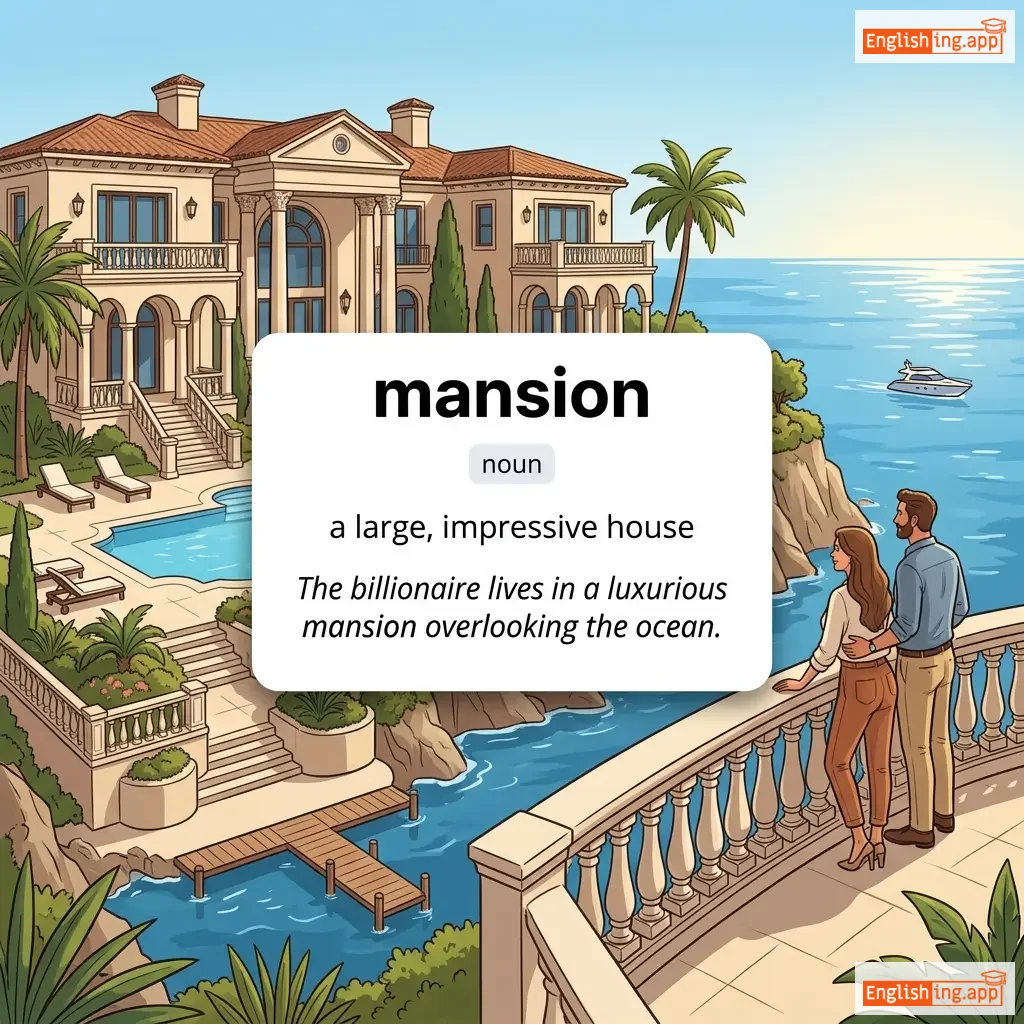
mansion definition card — visual illustration of the meaning
noun
/ˈmænʃən/
bonheur (bonheur)

a large, impressive house

"The billionaire lives in a luxurious mansion overlooking the ocean."

"Elle n'a pas pu cacher son bonheur quand elle a reçu le prix." (Elle n'a pas pu cacher son bonheur quand elle a reçu le prix.)
noun
/ˈmæntl̩/
étagère au-dessus de la cheminée (etagere au-dessus de la cheminee)

A shelf above a fireplace, often used for decoration.

"She placed family photos on the mantel above the fireplace."

"Elle a posé des photos de famille sur l'étagère au-dessus de la cheminée." (Elle a pose des photos de famille sur l'etagere au-dessus de la cheminee.)
noun
/ˈmæntl̩/
manteau, responsabilité (manteau, responsabilite)

A cloak or covering; also the layer of the earth between the crust and the core.

"The leader assumed the mantle of responsibility."

"Le leader a pris le manteau de la responsabilité." (Le leader a pris le manteau de la responsabilite.)
noun
/ˈmænjuəl/
manuel (manuel)

a handbook or guide that provides instructions on how to do or operate something

"You should read the user manual before setting up the device."

"Vous devez lire le manuel de l'utilisateur avant de configurer l'appareil." (Vous devez lire le manuel de l'utilisateur avant de configurer l'appareil.)
adverb
/ˈmæn.ju.ə.li/
manuellement; avec un effort physique; (manuellement; avec un effort physique)

by hand; using physical effort rather than machines

"The data was entered manually into the system."

"Les données ont été saisies manuellement dans le système." (Les donnees ont ete saisies manuellement dans le systeme.)
manufacture definition card — visual illustration of the meaning
verb
/ˌmænɪˈfæktʃər/
fabriquer (fabriquer)

to make something in large quantities using machinery

"The company manufactures high-quality electronics."

"L'entreprise fabrique des produits électroniques de haute qualité." (L'entreprise fabrique des produits électroniques de haute qualité.)
noun
/ˌmænjəˈfæktʃərər/
fabricant (fabricant)

A person or company that makes goods in large quantities.

"The manufacturer produces cars for the global market."

"Le fabricant produit des voitures pour le marché mondial." (Le fabricant produit des voitures pour le marché mondial.)
noun
/ˌmænjəˈfæktʃərɪŋ/
fabrication (fabrication)

the process of making products on a large scale using machinery

"The country is investing heavily in the manufacturing sector."

"Le pays investit massivement dans le secteur de la fabrication." (Le pays investit massivement dans le secteur de la fabrication.)
noun
/ˌmænjəˈmɪʃən/
émancipation des esclaves (emansipasion de esklav)

The act of a slave owner freeing their slaves.

"The manumission of the slaves marked a turning point in history."

"L'émancipation des esclaves a marqué un tournant dans l'histoire." (L'émancipation des esclaves a marqué un tournant dans l'histoire.)
verb
/ˌmæn.juˈmɪt/
libérer de l'esclavage (libérer de l'esclavage)

to release from slavery or servitude; to set free

"The landowner decided to manumit his slaves."

"Le propriétaire a décidé de libérer ses esclaves." (Le propriétaire a décidé de libérer ses esclaves.)
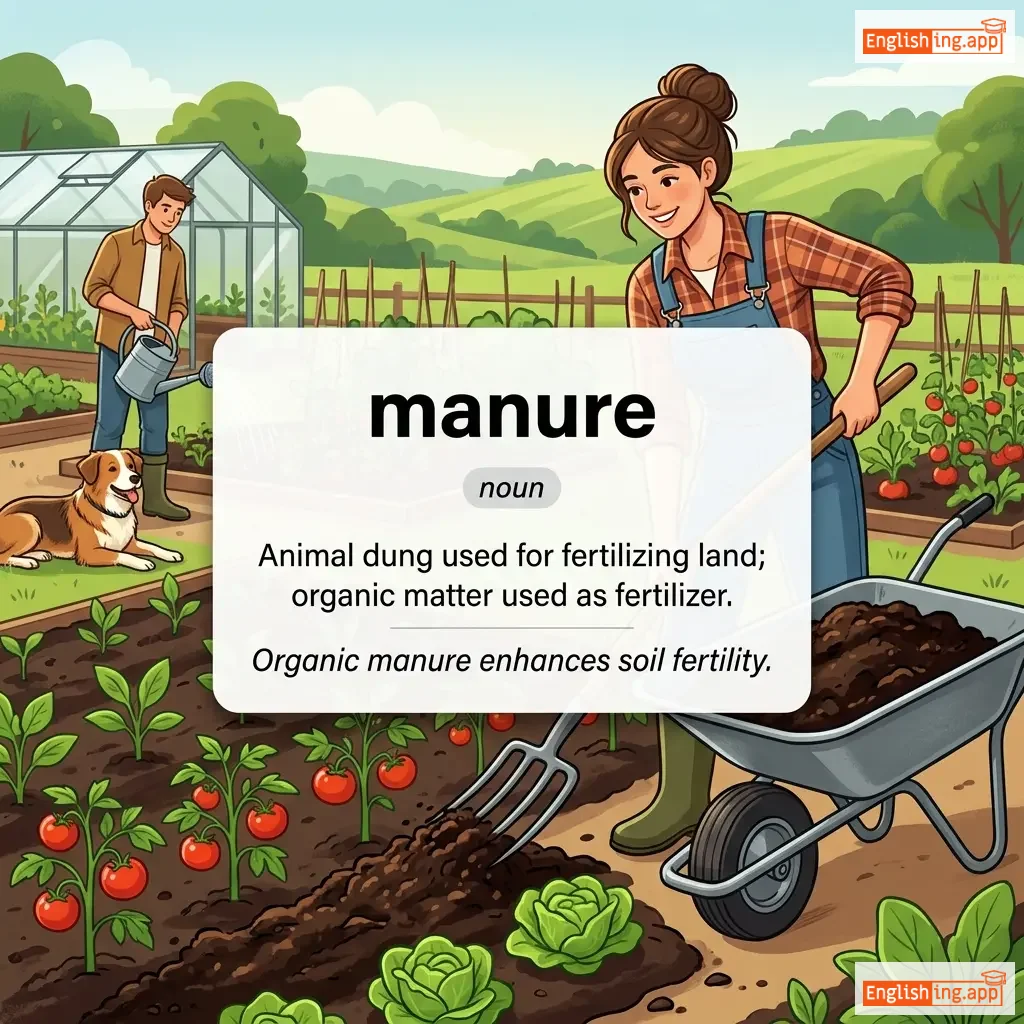
manure definition card — visual illustration of the meaning
noun
məˈnjʊər
fumier, engrais organique (fumier, engrais organique)

Animal dung used for fertilizing land; organic matter used as fertilizer.

"Organic manure enhances soil fertility."

"Le fumier organique améliore la fertilité du sol." (Le fumier organique améliore la fertilité du sol.)
noun
/ˈmæn.juˌskrɪpt/
manuscrit (manuscrit)

a handwritten or typed document, especially a writer’s draft before publication

"The author submitted her manuscript to the publisher."

"L'auteure a soumis son manuscrit à l'éditeur." (L'auteure a soumis son manuscrit a l'editeur.)
adjective
/ˈmɛni/
beaucoup (beaucoup)

a large number of

"Many students attended the lecture."

"Beaucoup d'étudiants ont assisté à la conférence." (Beaucoup d'étudiants ont assisté à la conférence.)
🗺️

map (map)

noun
/mæp/
carte (kar-te)

a drawing that shows the features of an area of land or sea

"He studied the map before starting his journey."

"Il a étudié la carte avant de commencer son voyage." (Il a etudie la carte avant de commencer son voyage.)
verb
/mɑːr/
abîmer (abimer)

to spoil or damage the appearance or quality of something

"The scratch will mar the beauty of the painting."

"La rayure abîmera la beauté de la peinture." (La rayure abîmera la beauté de la peinture.)
🏃‍♀️

marathon (marathon)

noun
/ˈmærəθən/
marathon (marathon)

a long-distance running race, typically 42.195 kilometers (26.2 miles)

"She completed the marathon in under four hours."

"Elle a terminé le marathon en moins de quatre heures." (Elle a termine le marathon en moins de quatre heures.)
verb
/məˈrɔːd/
piller (piller)

to roam in search of things to steal or attack

"The bandits marauded through the village at night."

"Les bandits ont pillé le village la nuit." (Les bandits ont pillé le village la nuit.)
noun
/məˈrɔː.dər/
pillard (pillarde)

a person who roams around in search of things to steal or people to attack

"Villagers feared the marauders who raided their homes."

"Les villageois craignaient les pillards qui attaquaient leurs maisons." (Les villageois craignaient les pillards qui attaquaient leurs maisons.)
noun
/ˈmɑːrbəl/
bonheur (bonheur)

a hard, smooth stone used in building and sculpture, often white with colored lines

"The floor of the palace was made of white marble."

"Elle n'a pas pu cacher son bonheur lorsqu'elle a reçu le prix." (Elle n'a pas pu cacher son bonheur lorsqu'elle a recu le prix.)
🚶‍♂️

March (marche)

verb
/mɑːrtʃ/
marcher (marcher)

to walk in a regular, rhythmic way, often in step with others; to proceed with determination

"The soldiers marched across the field."

"Les soldats ont marché à travers le champ." (Les soldats ont marché à travers le champ.)
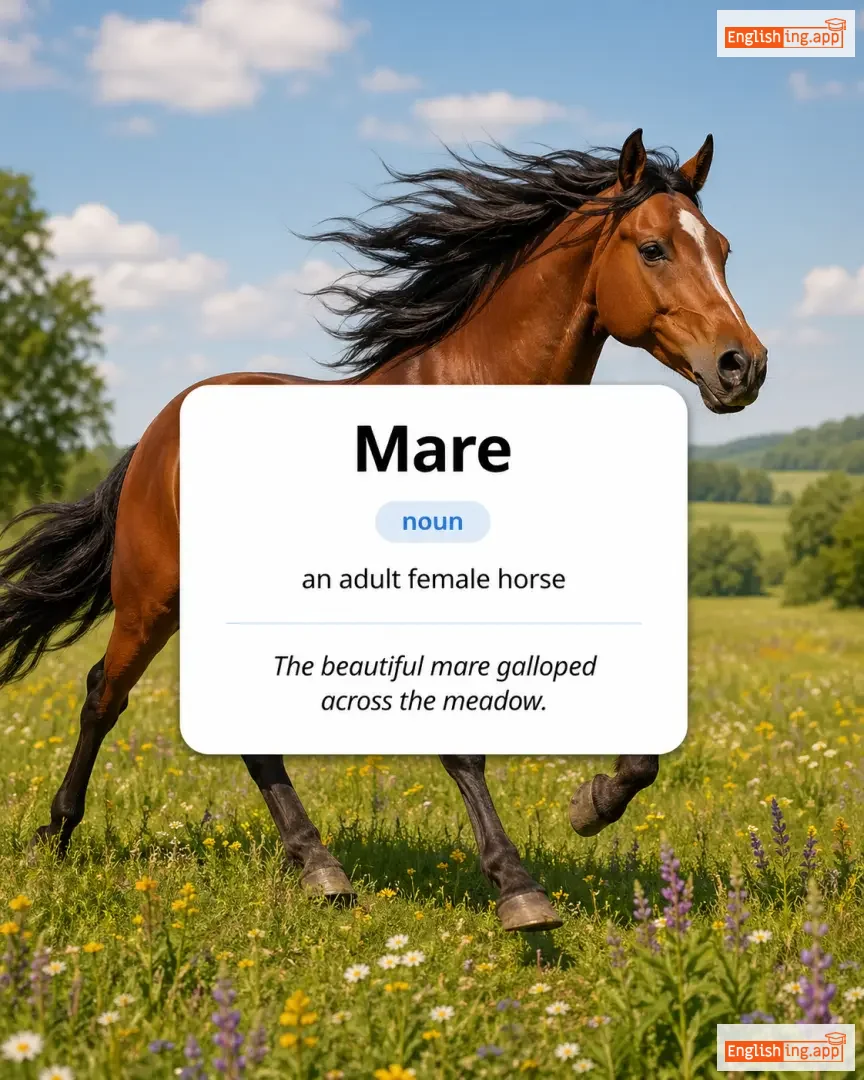
Mare definition card — visual illustration of the meaning
noun
/meər/
jument (jument)

an adult female horse

"The beautiful mare galloped across the meadow."

"La belle jument galopait à travers le pré." (La belle jument galopait à travers le pré.)
noun
/ˈmɑːrdʒɪn/
marge, limite, frontière (marge, limite, frontiere)

The edge or border of something; the amount by which something is won or falls short.

"The company increased its profit margin last year."

"L'entreprise a augmenté sa marge bénéficiaire l'année dernière." (L'entreprise a augmente sa marge beneficiaire l'annee derniere.)
adjective
/ˈmɑːrdʒɪnəl/
marginal, insignifiant, peu important (marginal, insignifiant, peu important)

Relating to or at the edge; small or insignificant in amount or importance.

"He made only a marginal improvement in his grades."

"Il a fait seulement une amélioration marginale dans ses notes." (Il a fait seulement une amelioration marginale dans ses notes.)
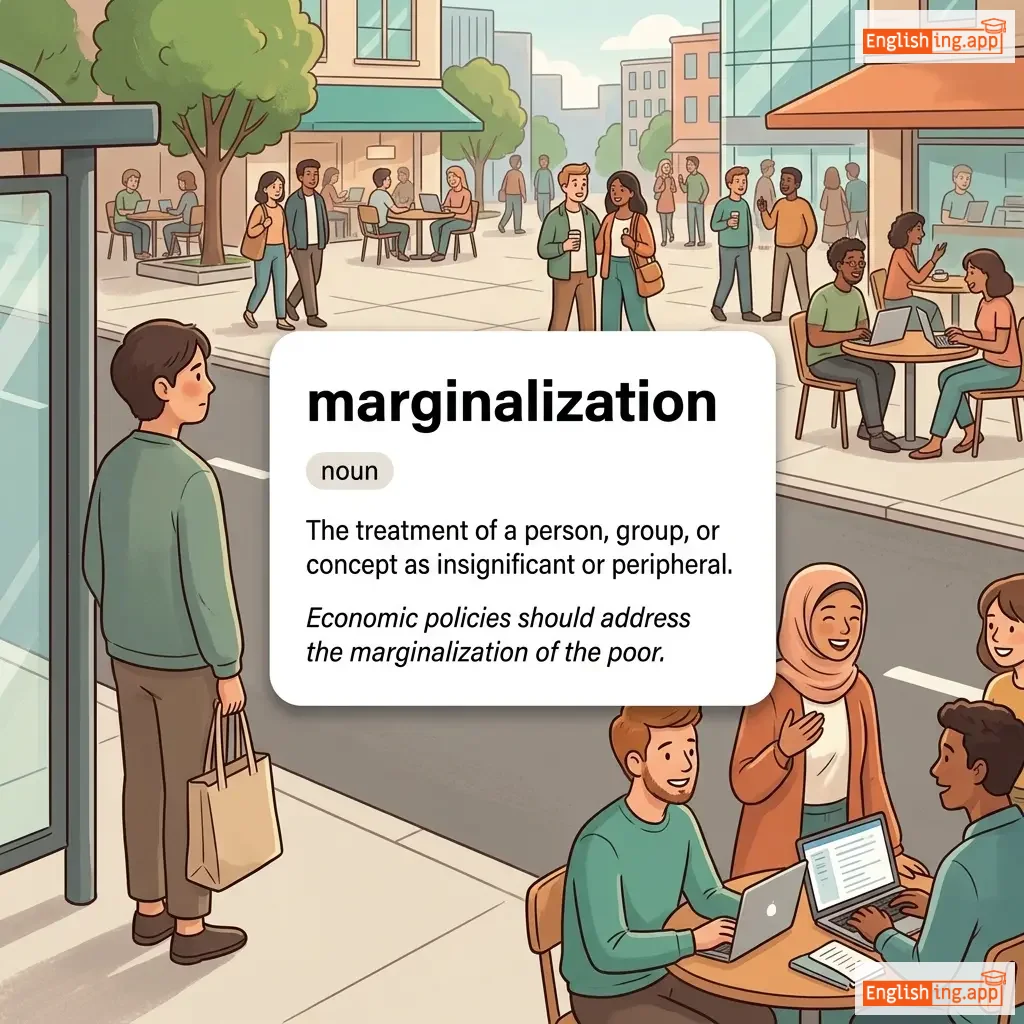
marginalization definition card — visual illustration of the meaning
noun
ˌmɑːr.dʒɪ.nəl.aɪˈzeɪ.ʃən
marginalisation (marginalisation)

The treatment of a person, group, or concept as insignificant or peripheral.

"Economic policies should address the marginalization of the poor."

"Les politiques économiques devraient aborder la marginalisation des pauvres." (Les politiques economiques devraient aborder la marginalisation des pauvres.)
verb
/ˈmɑːrdʒɪnəlaɪz/
marginaliser, mettre à l'écart (marginaliser, mettre à l'écart)

To treat a person or group as unimportant or insignificant.

"The policy marginalized minority communities."

"La politique a marginalisé les communautés minoritaires." (La politique a marginalisé les communautés minoritaires.)
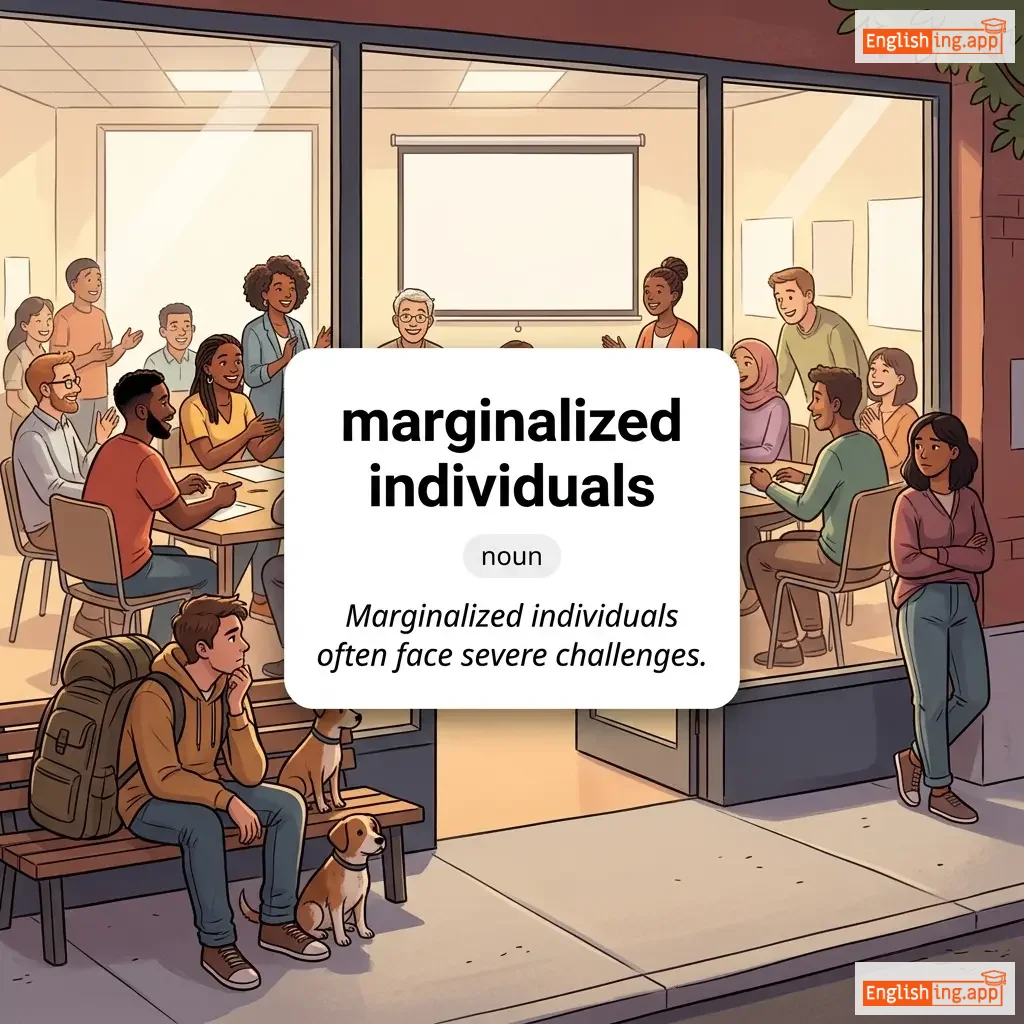
marginalized individuals definition card — visual illustration of the meaning
noun
ˈmɑːrdʒɪnəlaɪzd ˌɪndɪˈvɪdʒuəlz
individus marginalisés (individus marginalisés)

People who are treated as insignificant or peripheral to society, often excluded from mainstream social, economic, or political activities.

"Marginalized individuals often face severe challenges."

"Les individus marginalisés font souvent face à des défis graves." (Les individus marginalisés font souvent face à des défis graves.)
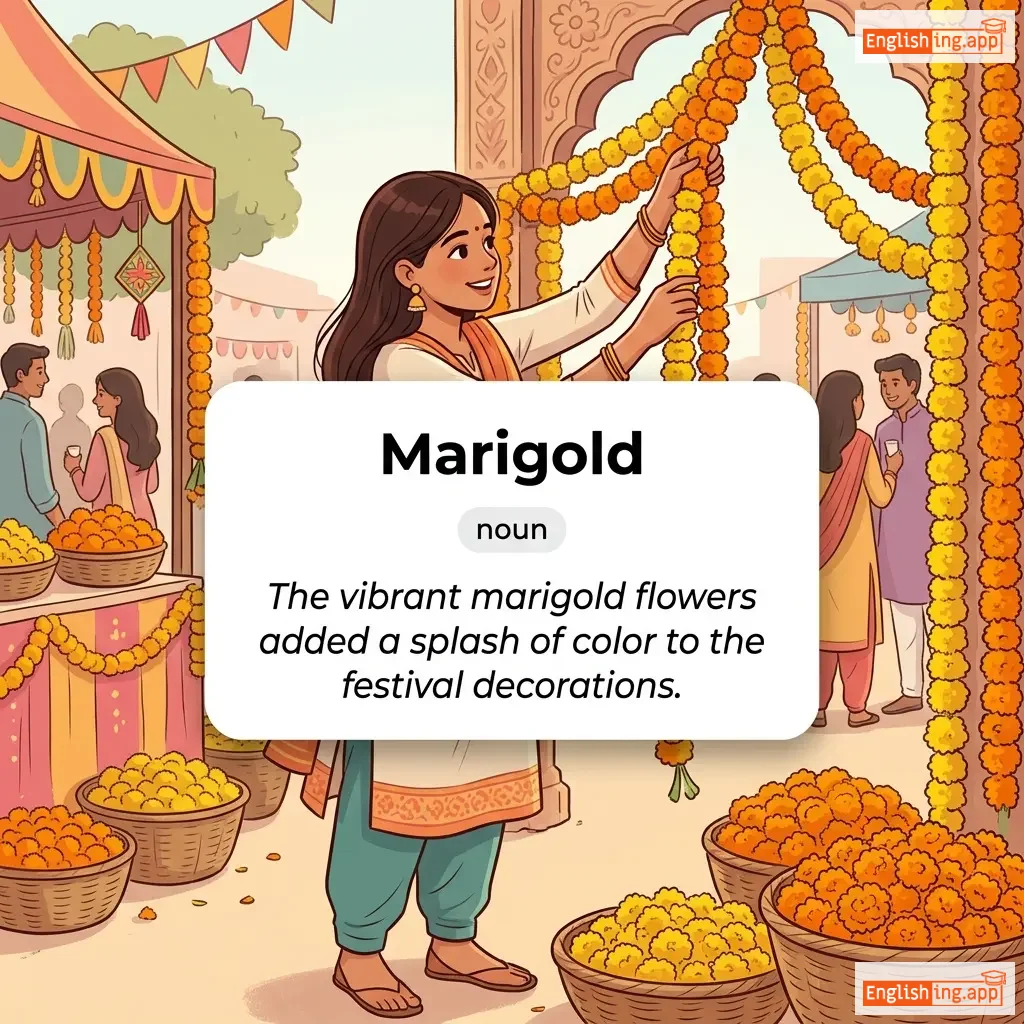
Marigold definition card — visual illustration of the meaning
noun
/ˈmɛrɪɡoʊld/
souci (soosi)

a bright orange or yellow flower of the daisy family, often used in gardens and ceremonies

"The vibrant marigold flowers added a splash of color to the festival decorations."

"Les fleurs de souci éclatantes ont apporté une touche de couleur aux décorations du festival." (Les fleurs de souci eclatantes ont apporte une touche de couleur aux decorations du festival)
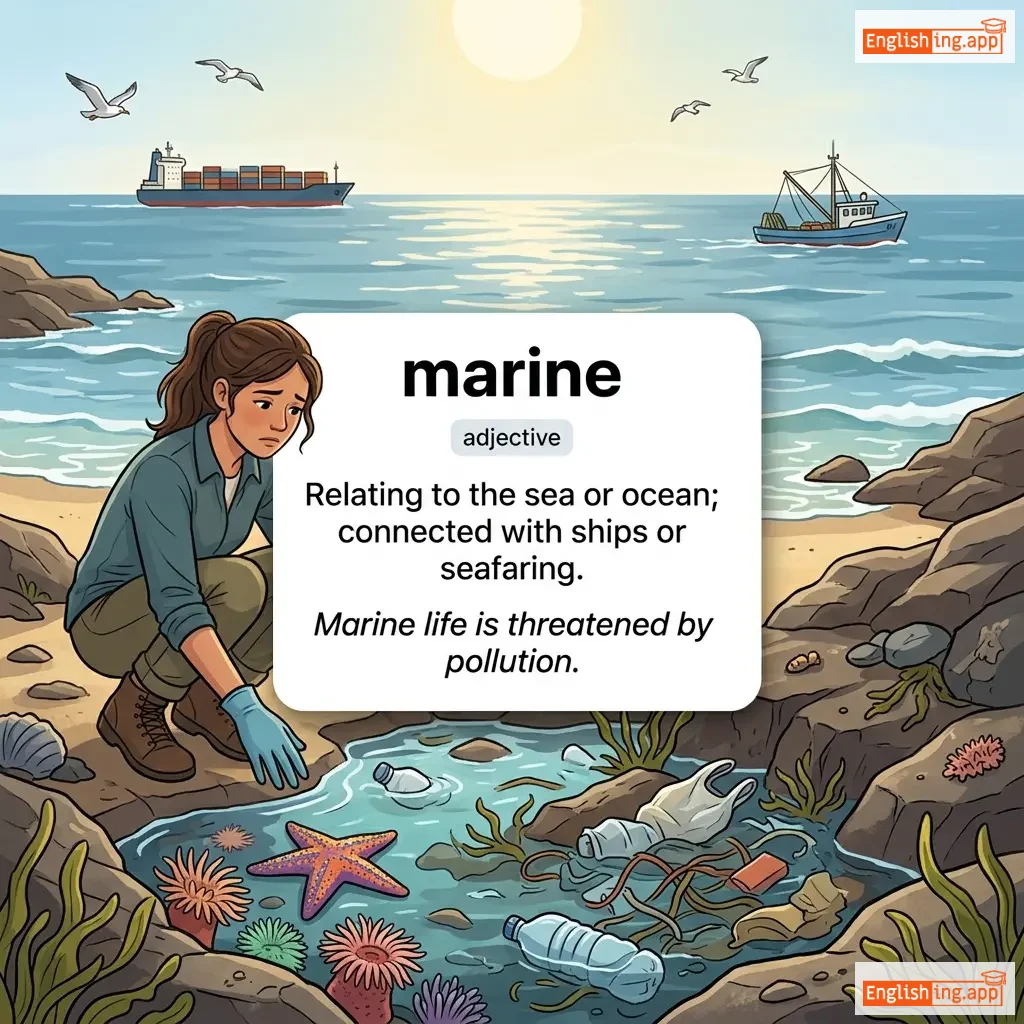
marine definition card — visual illustration of the meaning
adjective
/məˈriːn/
marin (marin)

Relating to the sea or ocean; connected with ships or seafaring.

"Marine life is threatened by pollution."

"La vie marine est menacée par la pollution." (La vie marine est menacée par la pollution.)
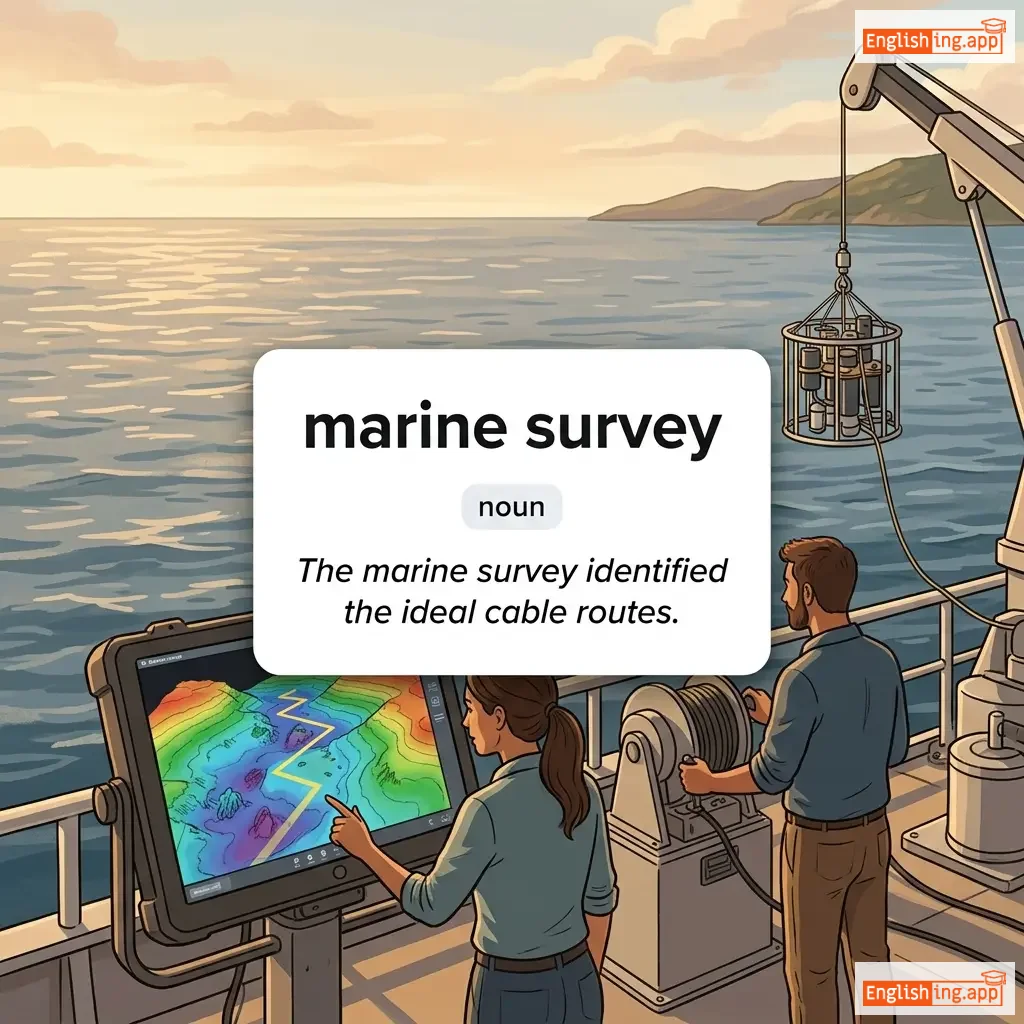
marine survey definition card — visual illustration of the meaning
noun
məˈriːn ˈsɜː.veɪ
étude marine. enquête sous-marine. (etude marine. enqueté sous-marine.)

A systematic examination of the sea, seabed, and underwater features for the purpose of making maps or gathering other information.

"The marine survey identified the ideal cable routes."

"L'enquête marine a identifié les itinéraires idéaux pour les câbles." (L'enquete marine a identifie les itineraires ideaux pour les cables.)
adjective
/ˈmɑːrvələs/
merveilleux; extraordinaire; stupéfiant (merveilleux; extraordinaire; stupefiant)

extremely good; wonderful; causing great wonder

"The view from the mountain was marvellous."

"La vue depuis la montagne était merveilleuse." (La vue depuis la montagne était merveilleuse.)
verb
/ˈmɑːrʃəl/
organiser (organiser)

To arrange or organize people, events, or resources in an orderly way.

"The teacher marshaled the students for the field trip."

"Le professeur a organisé les élèves pour la sortie scolaire." (Le professeur a organisé les élèves pour la sortie scolaire.)
noun
/mɑːrˈsuːpiəl/
mammifère qui porte et nourrit ses petits dans une poche (mammifere qui porte et nourrit ses petits dans une poche)

A type of mammal that carries and nourishes its young in a pouch, like kangaroos and koalas.

"The kangaroo is a well-known marsupial."

"Le kangourou est un marsupial bien connu." (Le kangourou est un marsupial bien connu.)
adjective
/ˈmɑːrʃəl/
militaire (militaire)

Related to war, soldiers, or military life.

"The country imposed martial law during the crisis."

"Le pays a imposé la loi martiale pendant la crise." (Le pays a impose la loi martiale pendant la crise.)
adjective, noun
/ˈmɑːrʃən/
martien (martien)

Related to the planet Mars; or an imaginary being from Mars.

"The movie showed a Martian visiting Earth."

"Le film montrait un martien visitant la Terre." (Le film montrait un martien visitant la Terre.)
noun
/ˈmɑːr.tɪn/
martinet (martinet)

small swift-flying bird that catches insects on the wing

"The martin built its nest under the bridge."

"Le martinet a construit son nid sous le pont." (Le martinet a construit son nid sous le pont.)
noun
/ˌmɑːrtəˈnɛt/
un tyran (un tyran)

A strict disciplinarian who demands rigid adherence to rules.

"The new manager was such a martinet that even minor infractions were punished."

"Le nouveau gestionnaire était un martinet au point que même les infractions mineures étaient punies." (Le nouveau gestionnaire était un martinet au point que même les infractions mineures étaient punies.)
noun
/ˈmɑːrtər/
martyr (martyr)

A person who suffers or dies for their beliefs or cause.

"He was hailed as a martyr for defending his faith."

"Il a été acclamé comme un martyr pour avoir défendu sa foi." (Il a été acclamé comme un martyr pour avoir défendu sa foi.)
noun
/ˈmɑːrtərdəm/
martyre (martyre)

The suffering or death of a martyr.

"His martyrdom inspired many to fight for justice."

"Son martyre a inspiré beaucoup de gens à se battre pour la justice." (Son martyre a inspiré beaucoup de gens à se battre pour la justice.)
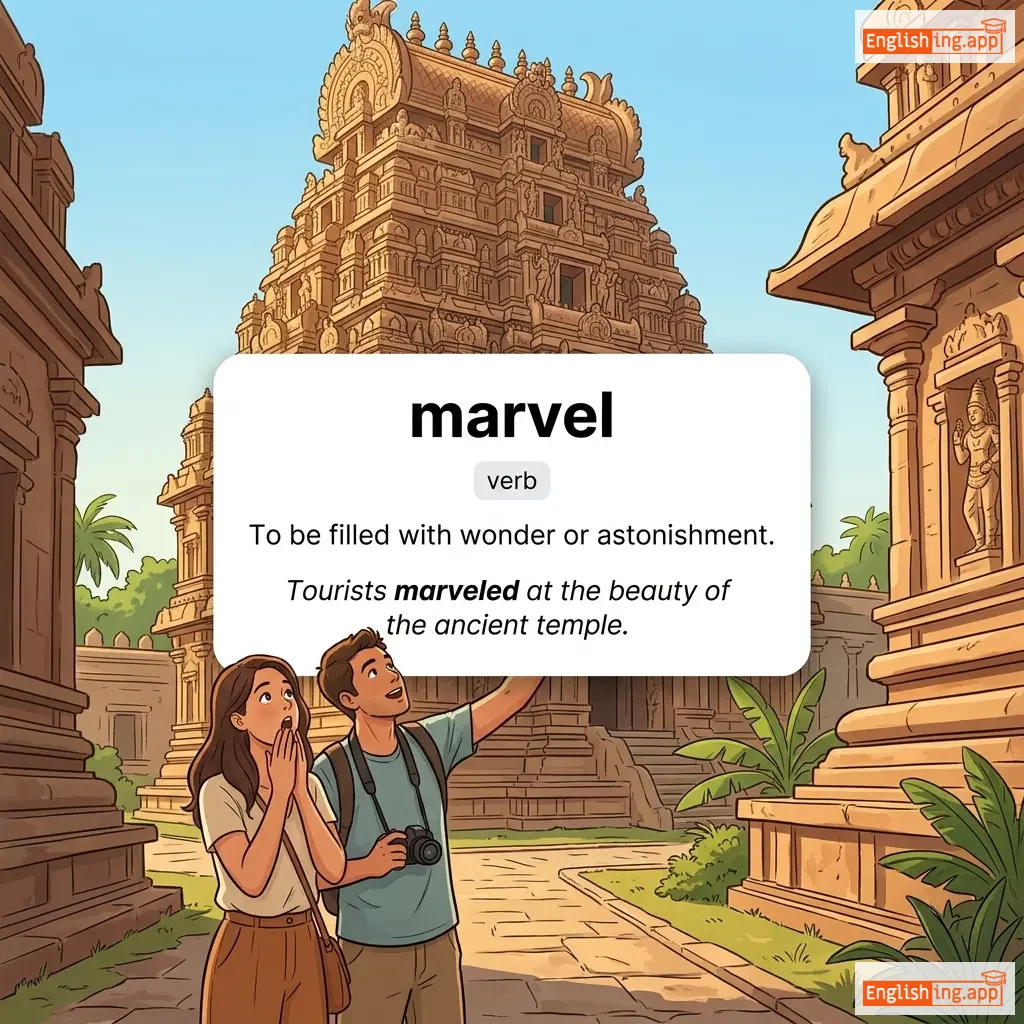
marvel definition card — visual illustration of the meaning
verb
/ˈmɑːrvl/
s'émerveiller (se emerveiller)

To be filled with wonder or astonishment.

"Tourists marveled at the beauty of the ancient temple."

"Les touristes se sont émerveillés de la beauté du temple ancien." (Les touristes se sont emerveilles de la beaute du temple ancien.)
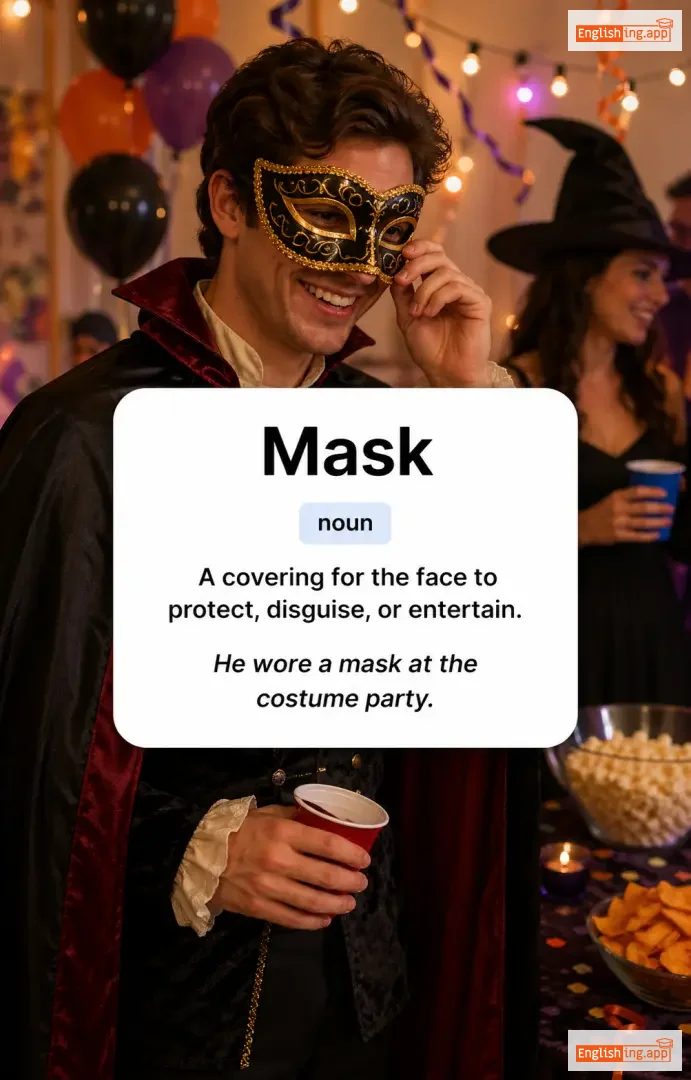
Mask definition card — visual illustration of the meaning
noun
/mæsk/
masque (masque)

A covering for the face to protect, disguise, or entertain.

"He wore a mask at the costume party."

"Il portait un masque à la fête costumée." (Il portait un masque à la fête costumée.)
adjective
/ˈmærɪtəl/
conjugal (conjugal)

Relating to marriage or the relationship between husband and wife.

"They sought counseling to resolve their marital issues."

"Ils ont cherché des conseils pour résoudre leurs problèmes conjugaux." (Ils ont cherché des conseils pour résoudre leurs problèmes conjugaux.)
noun
/ˈmeɪsən/
maçon (maçon)

a person skilled in building with stone, brick, or concrete

"The mason carefully laid the bricks for the new house."

"Le maçon a soigneusement posé les briques pour la nouvelle maison." (Le maçon a soigneusement posé les briques pour la nouvelle maison.)
noun
/ˈmæsəkɪst/
masochiste (masokiste)

a person who derives pleasure from their own pain or humiliation

"He was called a masochist for enjoying tough challenges."

"Il a été appelé masochiste pour apprécier les défis difficiles." (Il a été appelé masochiste pour apprécier les défis difficiles.)
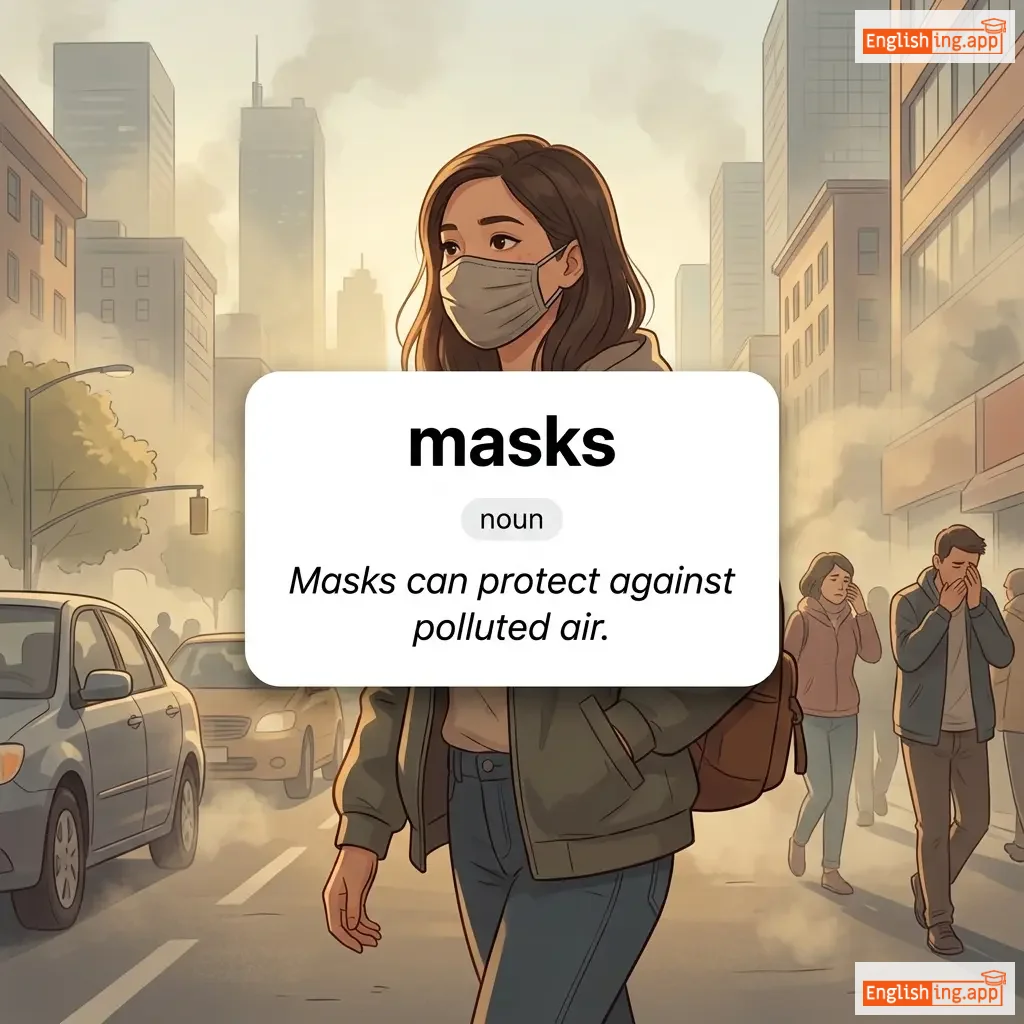
masks definition card — visual illustration of the meaning
noun
/mɑːsks/
masque (masque)

Coverings for all or part of the face, worn as a disguise, for protection, or for medical reasons.

"Masks can protect against polluted air."

"Les masques peuvent protéger contre l'air pollué." (Les masques peuvent protéger contre l'air pollué.)
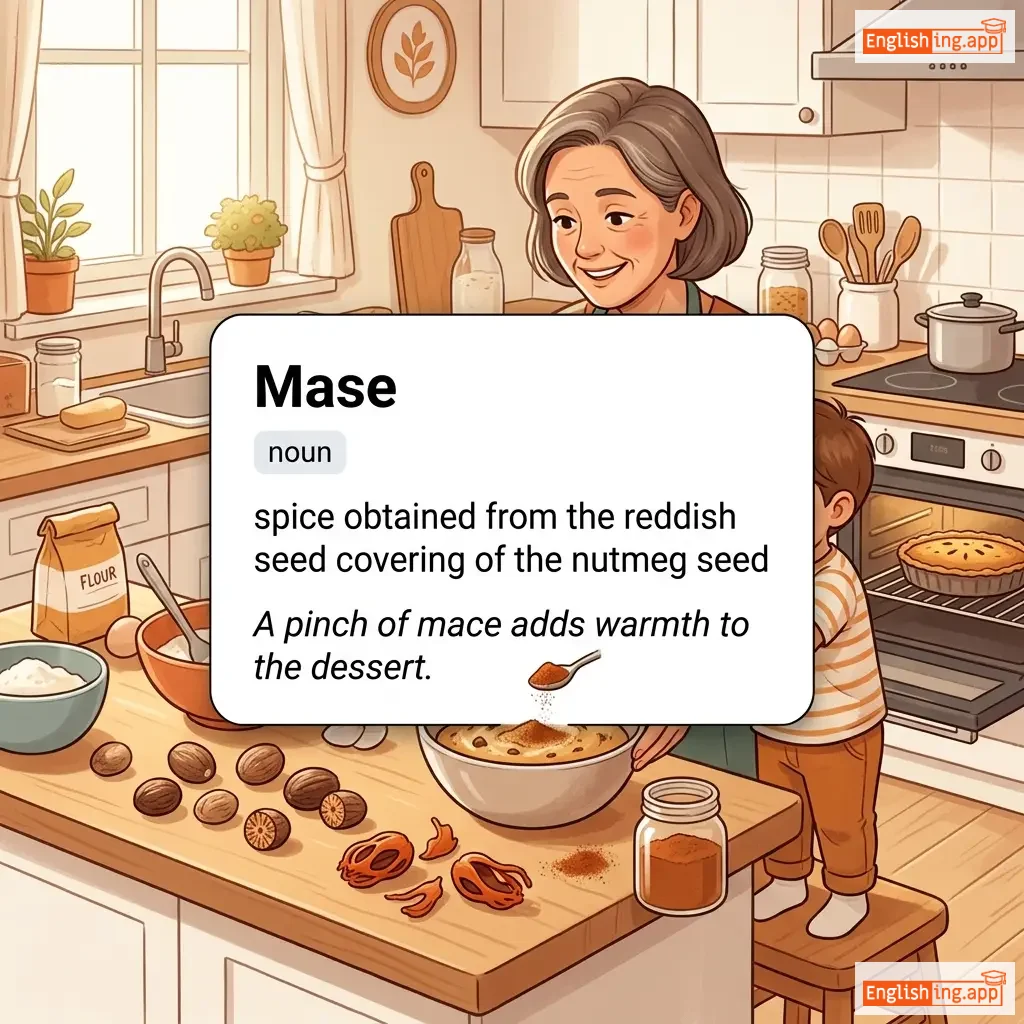
Mase definition card — visual illustration of the meaning
noun
/meɪs/
muscade (muskaad)

spice obtained from the reddish seed covering of the nutmeg seed

"A pinch of mace adds warmth to the dessert."

"Une pincée de muscade ajoute de la chaleur au dessert." (Une pincee de muscade ajoute de la chaleur au dessert.)
adjective
/ˈmɑːrvələs/
merveilleux (merveilleux)

Causing great wonder or delight; extraordinary.

"She gave a marvelous performance on stage."

"Elle a donné une performance merveilleuse sur scène." (Elle a donné une performance merveilleuse sur scène.)
adjective
/ˈmæskjəlɪn/
masculin (masculin)

having qualities traditionally associated with men

"He has a deep, masculine voice."

"Il a une voix profonde et masculine." (Il a une voix profonde et masculine.)
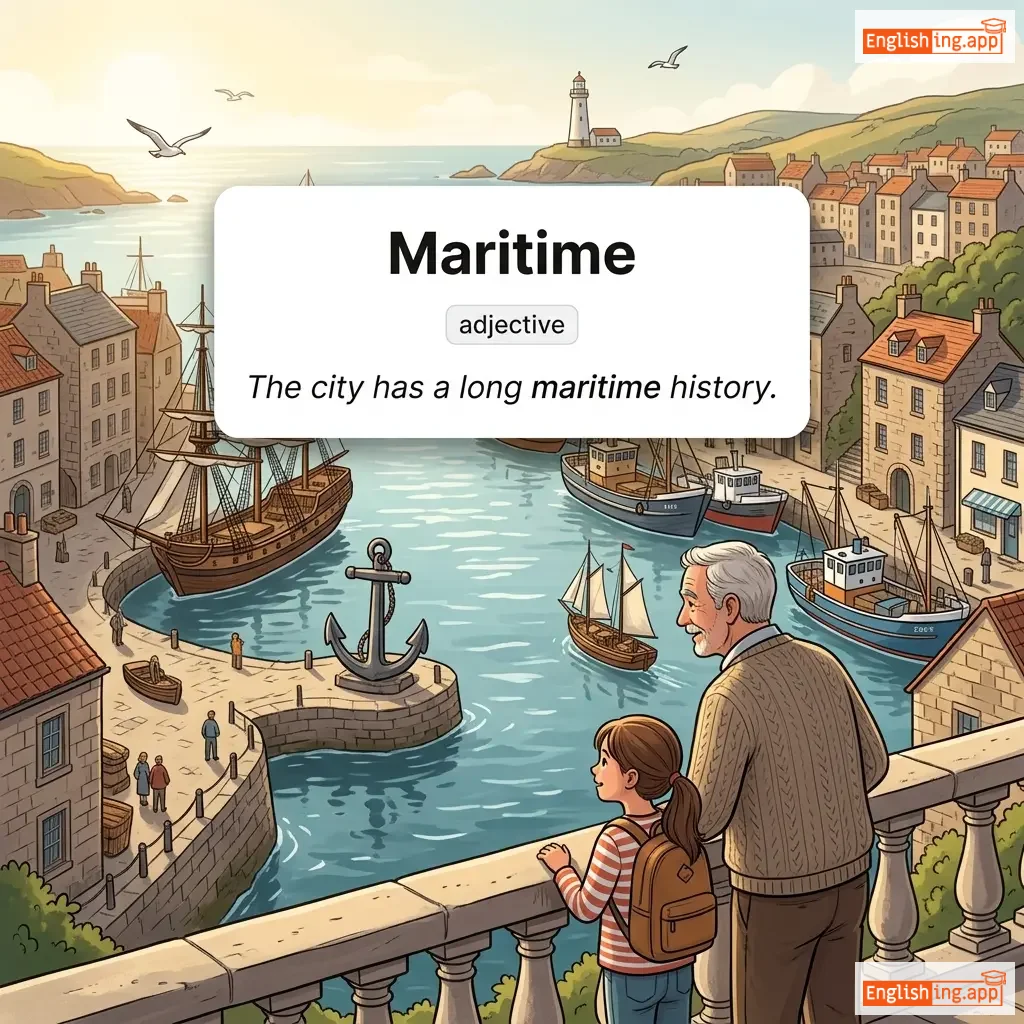
Maritime definition card — visual illustration of the meaning
adjective
/ˈmærɪˌtaɪm/
maritime (maritime)

connected with the sea, especially in relation to seafaring, shipping, or naval matters

"The city has a long maritime history."

"La ville a une longue histoire maritime." (La ville a une longue histoire maritime.)