Словари

Словарь английского языка | Значения слов, определения и примеры

noun
/ˌɪnstəˈbɪləti/
нестабильность (nestabilnost)

lack of stability or balance; tendency to change, fail, or collapse easily

"Political instability has slowed economic growth in the region."

"Политическая нестабильность замедлила экономический рост в регионе." (Politicheskaya nestabilnost zamedlila ekonomicheskiy rost v regione)
adjective
/ɪnˈsteɪbəl/
нестабильный (nestabilnyi)

not stable; liable to change, collapse, or fail; lacking firmness or reliability

"The instable political situation worried foreign investors."

"Нестабильная политическая ситуация обеспокоила иностранных инвесторов." (Nestabilnaya politicheskaya situatsiya obespokoila inostrannykh investorov)
install definition card — visual illustration of the meaning
verb
/ɪnˈstɔːl/
устанавливать (ustanavlivat')

To place or fix equipment or software so it is ready for use.

"He installed the new software on his computer."

"Он установил новое программное обеспечение на свой компьютер." (On ustanovil novoe programnoe obespechenie na svoi komp'yuter.)
installation definition card — visual illustration of the meaning
noun
/ˌɪnstəˈleɪʃən/
инсталляция (installyatsiya)

the act or process of putting something in position and making it ready for use

"The installation of the new software took less than an hour."

"Установка нового программного обеспечения заняла меньше часа." (Ustanovka novogo programmnogo obespecheniya zanyala men'she chasa.)
noun
/ˈɪnstəns/
пример (primer)

An example or single occurrence of something.

"This is just one instance of his generosity."

"Это всего лишь пример его щедрости." (Eto vsego lish' primer ego shchedrosti.)
instant definition card — visual illustration of the meaning
noun/adjective
/ˈɪnstənt/
мгновенный (mgnovennyy)

A very short period of time; happening immediately.

"He replied in an instant without hesitation."

"Он ответил мгновенно, не раздумывая." (On otvetil mgnovenno, ne razdumivaya.)
adjective
/ˌɪnstənˈteɪniəs/
мгновенный (mgnovennyi)

Happening immediately, without any delay.

"The change in temperature was almost instantaneous."

"Изменение температуры было почти мгновенным." (Izmenenie temperatury bylo pochti mgnovennym.)
adverb
/ˈɪnstəntli/
мгновенно (mgnovenno)

immediately, without any delay

"He replied instantly to the message."

"Он мгновенно ответил на сообщение." (On mgnovenno otvetil na soobshchenie.)
verb
/ɪnˈsteɪt/
назначать (naznachat)

To set up in position, office, or authority.

"The board decided to instate her as the new director."

"Совет решил назначить её новым директором." (Sovet reshil naznačit' yeyu novym direktorom.)
adverb
/ɪnˈstɛd/
вместо (vmesto)

As an alternative or substitute.

"She didn’t buy the dress; instead, she chose a pair of shoes."

"Она не купила платье; вместо этого она выбрала пару туфель." (Ona ne kupila plat'ye; vmesto etogo ona vybrala paru tufel'.)
verb
/ˈɪnstɪˌɡeɪt/
подстрекать (podstrekat')

To bring about or initiate an action, often something negative.

"He was accused of instigating the riot."

"Его обвинили в подстрекательстве к бунту." (Ego obvinili v podstrekatel'stve k buntu.)
noun
/ˈɪnstɪˌɡeɪtər/
подстрекатель (podstrekatel')

A person who brings about or initiates something, usually something bad.

"The police identified him as the instigator of the violence."

"Полиция идентифицировала его как подстрекателя насилия." (Politsiya identifitsirovala ego kak podstrekatelya nasiliya.)
verb
/ɪnˈstɪl/
внедрять (vnedryat')

to gradually but firmly establish an idea, attitude, or habit in someone's mind

"Parents try to instill good values in their children."

"Родители пытаются привить своим детям хорошие ценности." (Roditeli pytayutsya privity' svoim detyam khoroshie tsennosti.)
noun
/ˈɪnstɪŋkt/
инстинкт (instinkt)

A natural way of behaving or reacting that does not require learning.

"Birds build nests by instinct."

"Птицы строят гнезда по инстинкту." (Ptitsy stroyat gnezda po instinktu.)
instinctive definition card — visual illustration of the meaning
adjective
/ɪnˈstɪŋk.tɪv/
инстинктивный, естественный, автоматический (instinktivnyy, yestestvennyy, avtoamaticheskiy)

Based on instinct; done without conscious thought; natural and automatic.

"His instinctive reaction saved his life."

"Его инстинктивная реакция спасла его жизнь." (Yego instinktivnaya reaktsiya spasla yego zhizn'.)
noun, verb
/ˈɪnstɪˌtjuːt/
институт (institut)

as a noun, an organization founded for a specific purpose; as a verb, to establish or initiate

"The university decided to institute new rules for the library."

"Университет решил ввести новые правила для библиотеки." (Universitet reshil vvesti novye pravila dlya biblioteki.)
institution definition card — visual illustration of the meaning
noun
/ˌɪnstɪˈtjuːʃən/
институт (institut)

an established organization, especially one dedicated to education, public service, or a particular purpose

"The hospital is a respected institution in the community."

"Больница — это уважаемая институция в сообществе." (Bol'nitsa — eto uvazhajemaya institutsiya v soobshchestve.)
adjective
/ˌɪnstɪˈtjuːʃənl/
институциональный (institutsional'nyy)

Relating to an organization or established practice.

"The government made several institutional reforms in education."

"Правительство провело несколько институциональных реформ в образовании." (Pravitel'stvo provelo neskol'ko institutsional'nykh reform v obrazovanii.)
verb
/ˌɪnstɪˈtjuːʃənəlaɪz/
институционализировать (institutsionalizirovat)

to establish something as a formal institution, custom, or practice

"The government seeks to institutionalize environmental protection."

"Правительство стремится институционализировать охрану окружающей среды." (Pravitel'stvo stremitsya institutsionalizirovat' okhranu okruzhayushchey sredu.)
instruct definition card — visual illustration of the meaning
verb
/ɪnˈstrʌkt/
инструктировать, обучать (instruvirovat, obuchat)

to tell or teach someone how to do something

"The teacher instructed the students to complete the assignment."

"Учитель инструктировал студентов выполнить задание." (Uchitel' instruhiroval studentov vypolnit' zadanie.)
noun
/ɪnˈstrʌkʃən/
инструкция (instrukciya)

Detailed information telling how something should be done or operated.

"Please read the instruction carefully before using the machine."

"Пожалуйста, внимательно прочитайте инструкцию перед использованием машины." (Pozhaluysta, vnimatel'no prochitayte instrukciyu pered ispol'zovaniem mashiny.)
adjective
/ɪnˈstrʌkʃənəl/
обучающий (obuchayushchiy)

providing knowledge or information; intended to teach

"The website offers many instructional videos for beginners."

"Этот сайт предлагает множество обучающих видео для начинающих." (Etot sayt predlagaet mnozhestvo obuchayushchikh video dlya nachinayushchikh.)
noun
/ɪnˈstrʌkʃənz/
инструкции (instruktsii)

Detailed information on how something should be done or operated.

"Please follow the instructions on the box."

"Пожалуйста, следуйте инструкциям на коробке." (Pozhaluysta, sleduyte instruktsiyam na korobke.)
adjective
/ɪnˈstrʌktɪv/
познавательный (poznavatel'nyy)

useful and informative; providing knowledge or instruction

"The lecture was highly instructive and engaging."

"Лекция была очень познавательной и увлекательной." (Lektsiya byla ochen' poznavatel'noy i uvlekatelnoy.)
noun
/ɪnˈstrʌktər/
инструктор (instruktor)

A person who teaches a subject or skill.

"The driving instructor was very patient with new learners."

"Инструктор по вождению был очень терпелив с новыми учениками." (Instruktor po vozhdeniyu byl ochen' terpeliv s novymi uchenikami.)
instrument definition card — visual illustration of the meaning
noun
/ˈɪnstrəmənt/
инструмент (instrument)

A tool or device used for a particular purpose, especially for scientific or musical work.

"The doctor used a special instrument during the surgery."

"Врач использовал специальный инструмент во время операции." (Vrach ispol'zoval spetsial'nyy instrument vo vremya operatsii.)
instrumental definition card — visual illustration of the meaning
adjective
/ˌɪnstrʊˈmɛntəl/
инструментальный (instrumental'nyy)

serving as an instrument or means to an end; helpful or useful

"His instrumental role in the project was vital to its success."

"Его инструментальная роль в проекте была решающей для его успеха." (Ego instrumental'naya rol' v proyekte byla reshayushchiyey dlya ego uspekha.)
noun
/ˌɪn.strəˈmɛn.təl.ɪst/
инструменталист (instrumentalist)

A person who plays a musical instrument.

"The instrumentalist played a beautiful solo on the violin."

"Инструменталист сыграл красивое соло на скрипке." (Instrumentalist sygral krasivoe solo na skripke.)
adjective
/ˌɪn.səˈbɔːr.dɪ.nət/
неподчинённый (nepodchinyonny)

Defiant of authority; disobedient to orders.

"The insubordinate employee refused to follow the manager's instructions."

"Неподчинённый сотрудник отказался следовать указаниям менеджера." (Nepodchinyonnyy sotrudnik otkazalsya sleduyushchij ukazaniyam menedzhera.)
noun
/ˌɪn.səˌbɔːr.dɪˈneɪ.ʃən/
неповиновение (nepovinovenie)

Defiance of authority; refusal to obey orders.

"The soldier was punished for insubordination during the mission."

"Солдат был наказан за неповиновение во время миссии." (Soldat byl nakazan za nepovinovenie vo vremya missii.)
adjective
/ˌɪn.səbˈstæn.ʃəl/
незначительный (neznachitel'nyy)

Lacking strength, substance, or solidity.

"The evidence provided was insubstantial and unconvincing."

"Предоставленные доказательства были незначительными и неубедительными." (Predostavlennye dokazatel'stva byli neznachitel'nymi i neubeditel'nymi.)
adjective
/ɪnˈsʌf.ər.ə.bəl/
невыносимый (nevyinoseemiy)

Too extreme to bear; intolerable.

"The heat during the summer was insufferable."

"Жара летом была невыносимой." (Zharaa letom byla nevynosimoy.)
noun
/ˌɪnsəˈfɪʃənsi/
недостаточность (nedostatochnost)

The state of not being enough or not being adequate.

"The project failed due to the insufficiency of funds."

"Проект провалился из-за недостаточности средств." (Proyekt provalilsya iz-za nedostatochnosti sredstv.)
adjective
/ˌɪnsəˈfɪʃənt/
недостаточный (nedostatocnyj)

Not enough; inadequate.

"His explanation was insufficient to clear the confusion."

"Его объяснение было недостаточным, чтобы прояснить путаницу." (Ego ob'jasnenie bylo nedostatochnym, chtoby projasnit' putanicu.)
adjective
/ˈɪnsjələr/
ограниченный, островной (ogranichennyy, ostrovnoy)

Narrow-minded, isolated, or relating to an island.

"The community was criticized for its insular attitudes toward outsiders."
"Сообщество было подвергнуто критике за свои инсулярные отношения к чужакам." (Soobshchestvo bylo podvergnuto kritike za svoi insulyarnye otnosheniya k chuzhakam.)
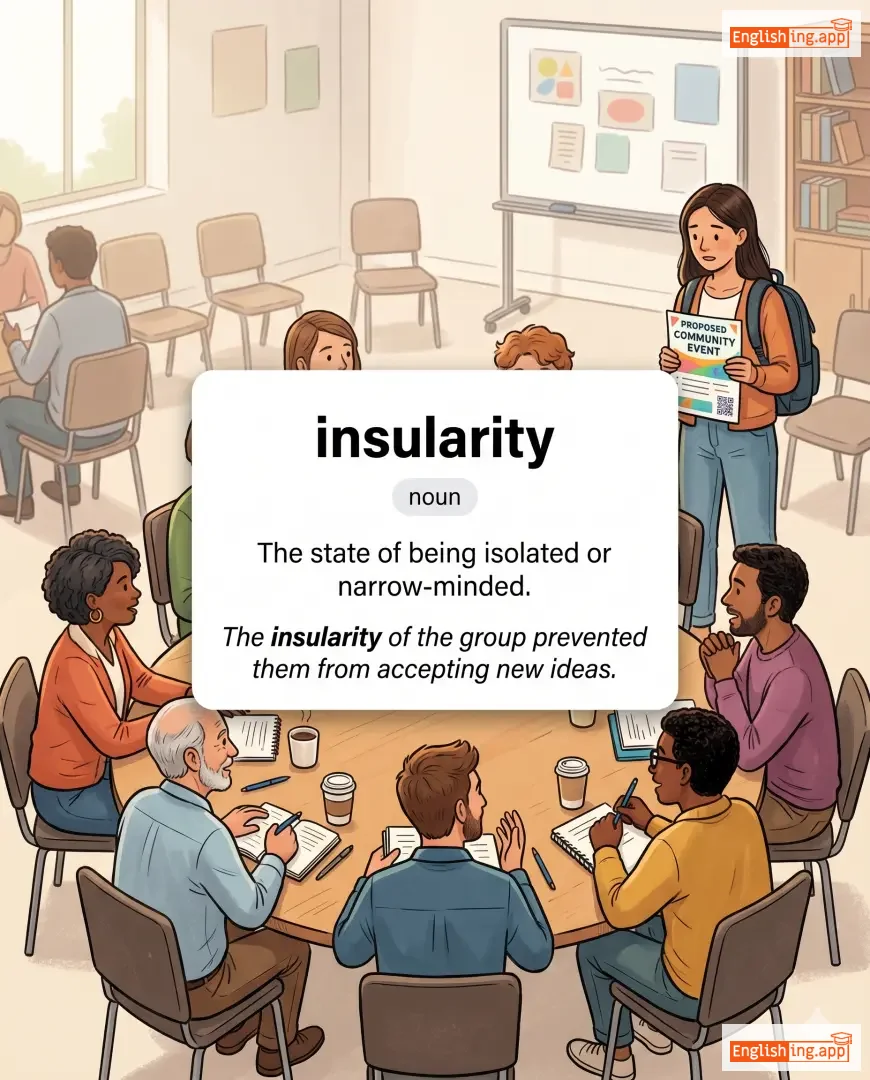
insularity definition card — visual illustration of the meaning
noun
/ˌɪnsjəˈlærəti/
инсулярность (insulyarnost)

The state of being isolated or narrow-minded.

"The insularity of the group prevented them from accepting new ideas."

"Инсулярность группы помешала им принять новые идеи." (Insulyarnost gruppy pomeshala im prinyat' novye idei.)
verb
/ˈɪnsjuleɪt/
изолировать (izolirovat)

To protect something by covering it, especially to prevent heat, sound, or electricity from escaping or entering.

"The house was insulated to reduce heating costs."

"Дом был изолирован для снижения отопительных расходов." (Dom byl izolirovan dlya snizheniya otepitel'nykh raskhodov.)
insulation definition card — visual illustration of the meaning
noun
ˌɪnsjʊˈleɪʃən
изоляция (izolyatsiya)

Material used to prevent heat, sound, or electricity from being transmitted from one area to another.

"Insulation of food storage areas can prevent pests from entering."

"Изоляция зон хранения продуктов может предотвратить проникновение вредителей." (Izolyatsiya zon khraneniya produktov mozhet predotvratit' proniknoveniye vreditelyey.)
insult definition card — visual illustration of the meaning
verb
/ˈɪnsʌlt/
оскорбить (oskorbit')

to speak to or treat someone with disrespect or scorn

"He insulted her by calling her lazy in front of everyone."

"Он оскорбил её, назвав её ленивой перед всеми." (On oskorbil yeyo, nazvav yeyo lenivoy pered vsemi.)
insuperable definition card — visual illustration of the meaning
adjective
/ɪnˈsuːpərəbl/
непреодолимый (nepreodolimyy)

Impossible to overcome or surpass.

"The team faced insuperable challenges during the expedition."

"Команда столкнулась с непреодолимыми трудностями во время экспедиции." (Komanda stolknulas' s nepreodolimymi trudnostyami vo vremya ekspeditsii.)
adjective
/ˌɪnsəˈpɔːrtəbl̩/
невыносимый (nevynosimy)

Too extreme or difficult to be endured.

"The heat was insupportable during the long journey."

"Жара была невыносимой во время долгого путешествия." (Zhara byla nevynosimoy vo vremya dolgogo puteshestviya.)
adjective
/ˌɪnsəˈprɛsəbl/
неудержимый (neudyerzhimyy)

That cannot be suppressed or restrained.

"She had an insuppressible urge to laugh during the ceremony."

"У неё было неудержимое желание смеяться во время церемонии." (U nee bylo neuderzhimoe zhelanie smeyat'sya vo vremya tseremonii.)
noun
/ɪnˈʃʊərəns/
страхование (strakhovaniye)

An arrangement by which a company provides compensation for loss, damage, or illness in return for a premium.

"He bought health insurance to cover medical expenses."

"Он купил медицинскую страховку для покрытия медицинских расходов." (On kupil meditsinskuyu strakhovku dlya pokrytiya meditsinskikh raskhodov.)
insure definition card — visual illustration of the meaning
verb
/ɪnˈʃʊr/
застраховать, защитить (zastrakhovat, zashchitit)

to arrange for compensation in case of loss or damage, typically by taking out insurance

"You should insure your car against theft or accidents."

"Вы должны застраховать свою машину от кражи или аварий." (Vy dolzhny zastrakhovat svoyu mashinu ot krazhi ili avariy.)
noun
/ɪnˈsɜːrdʒəns/
восстание (vostanie)

An act of rebellion or uprising against authority.

"The government struggled to contain the growing insurgence."

"Правительство боролось с растущим восстанием." (Pravitel'stvo borolos' s rastushchim vostaniem.)
noun
/ɪnˈsɜːrdʒənt/
повстанец (povstanets)

A person who rises in revolt against authority or government.

"The army arrested several insurgents after the attack."

"Армия арестовала нескольких повстанцев после атаки." (Armiya arestovala neskol'kikh povstantsev posle ataki.)
adjective
/ˌɪnsərˈmaʊntəbl/
непреодолимый (nepreodolimy)

Too great to be overcome.

"The explorers faced insurmountable odds in the desert."

"Исследователи столкнулись с непреодолимыми трудностями в пустыне." (Issledovateli stolknulis s nepreodolimymi trudnostyami v pustyne.)
noun
/ˌɪnsəˈrɛkʃən/
восстание (vostanie)

A violent uprising against an authority or government.

"The army was called in to suppress the insurrection."

"Армия была вызвана для подавления восстания." (Armiya byla vyzvana dlya podavleniya vostaniya.)
adjective
/ɪnˈtækt/
целый (tsely)

Remaining whole, complete, and undamaged.

"Despite the storm, the old house remained intact."

"Несмотря на шторм, старый дом остался целым." (Nesmotrya na shtorm, staryy dom ostalsya tselym.)
noun
/ˈɪnˌteɪk/
потребление (potreblenie)

the process of taking something in, especially food or drink

"He monitored his daily intake of calories to maintain a healthy diet."

"Он контролировал свое ежедневное потребление калорий, чтобы поддерживать здоровую диету." (On kontroliroval svoyo ezhednevnoe potreblenie kaloriy, chtoby podderzhivat' zdorovuyu dietu.)