Словари

Словарь английского языка | Значения слов, определения и примеры

noun
/ˈkɒnfɪdænt/
доверенное лицо (doveryennoe litso)

A person with whom one shares a secret or private matter, trusting them not to repeat it.

"She found a true confidant in her childhood friend."

"Она нашла настоящего доверенного человека в своем друге детства." (Ona nashla nastoyashchego doveryennogo cheloveka v svoem druge detstva.)
noun
/ˌkɒnfɪˈdɑːnt/
доверенная подруга (doveryennaya podruga)

A woman with whom one shares a secret or private matter, trusting her not to repeat it.

"The queen’s maid became her most trusted confidante."

"Слуга королевы стала ее самой доверенной подругой." (Sluga korolevy stala yeye samoy doveryennoy podrugoy.)
verb
/kənˈfaɪd/

To tell someone about a secret or private matter while trusting them not to repeat it.

"He confided his worries to his best friend."

noun
/ˈkɒnfɪdəns/
уверенность (uveryennost)

The feeling or belief that one can rely on someone or something; firm trust or self-assurance.

"She spoke with great confidence during the meeting."

"Она говорила с большой уверенностью на встрече." (Ona govorila s bol'shoy uverennost'yu na vstreche.)
adjective
/ˈkɒnfɪdənt/
уверенный (uverennyy)

feeling or showing certainty about something; having self-assurance

"She was confident about her ability to succeed."

"Она была уверена в своей способности преуспеть." (Ona byla uverena v svoey sposobnosti preuspet'.)
adjective
/ˌkɒnfɪˈdɛnʃl/
конфиденциальный (konfidentsial'nyi)

intended to be kept secret or private

"The lawyer shared confidential documents with her client."

"Адвокат поделился конфиденциальными документами со своим клиентом." (Advokat podelilsya konfidentsial'nymi dokumentami so svoim klientom.)
confidentiality definition card — visual illustration of the meaning
noun
ˌkɒn.fɪ.den.ʃiˈæl.ɪ.ti
конфиденциальность (konfidentsial'nost')

The state of keeping or being kept secret or private

"Confidentiality is crucial in data security."

"Конфиденциальность критична для безопасности данных." (Konfidentsial'nost' kritichna dlya bezopasnosti dannykh.)
adverb
/ˌkɒnfɪˈdenʃəli/
конфиденциально (konfidentsialno)

in a confidential manner; secretly; privately

"The information was shared confidentially between the two managers."

"Информация была передана конфиденциально между двумя менеджерами." (Informatsiya byla peredana konfidentsialno mezhdu dvumya menedzherami.)
noun
/kənˌfɪɡəˈreɪʃən/
конфигурация (konfiguratsiya)

an arrangement of parts or elements in a particular form or structure

"The configuration of the system needs to be adjusted for better performance."
"Конфигурация системы должна быть настроена для лучшей производительности." (Konfiguratsiya sistemy dolzhna byt' nastroena dlya luchshey proizvoditel'nosti.)
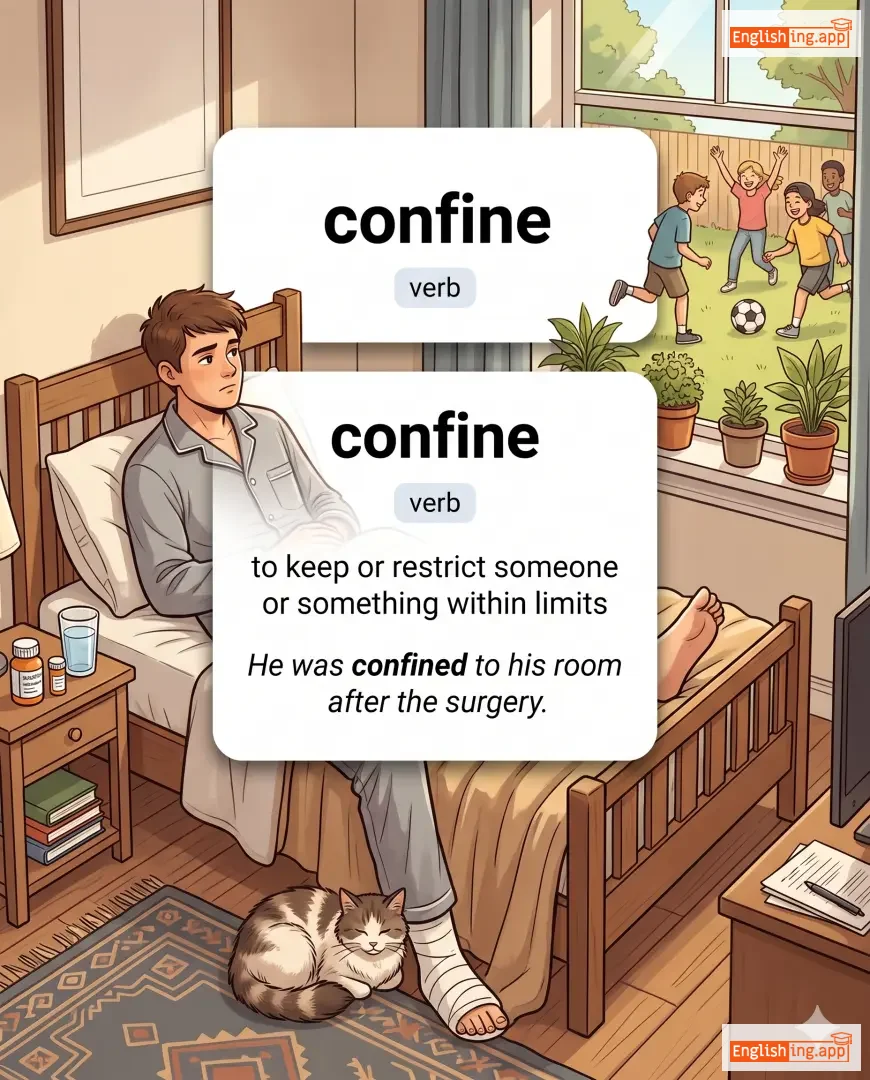
confine definition card — visual illustration of the meaning
verb
/kənˈfaɪn/
ограничить (ogranichit)

to keep or restrict someone or something within limits

"He was confined to his room after the surgery."

"Он был ограничен в своей комнате после операции." (On byl ogranichen v svoey komnate posle operatsii.)
noun
/kənˈfaɪnmənt/
заключение (zaklyucheniye)

the state of being confined or restricted

"The prisoner endured years of confinement."

"Заключённый выдержал годы заключения." (Zaklyuchyonnyy vyderzhal gody zaklyucheniya.)
verb
/kənˈfɜːrm/
подтверждать (podtverzhdat')

to establish the truth, accuracy, or validity of something

"The hotel will confirm your reservation by email."

"Отель подтвердит ваш заказ по электронной почте." (Otel' podtverdit vash zakaz po elektronnoj pochete.)
noun
/kənˌfɜːˈmeɪʃən/
подтверждение (podtverzhdeniye)

the action of confirming something or the state of being confirmed

"She received a confirmation email for her appointment."

"Она получила электронное письмо с подтверждением о своем назначении." (Ona poluchila elektronnoe pismo s podtverzhdeniem o svoem naznachenii.)
verb
/ˈkɒnfɪskeɪt/
конфисковать (konfiskovat)

to take something away officially, often as a punishment

"The teacher confiscated the student's phone during class."

"Учитель конфисковал телефон ученика во время урока." (Uchitel konfiskoval telefon uchnika vo vremya uroka)
noun
/ˌkɒnfləˈɡreɪʃən/
опечатка (от 'conflagration') (opichatka (ot 'conflagration'))

This is a common misspelling of 'conflagration', which means a large, destructive fire.

"The term 'conflagaration' is often incorrectly used instead of 'conflagration'."

"Термин 'conflagaration' часто используется неправильно вместо 'conflagration'." (Termin 'conflagaration' chasto ispol'zuetsya nepravil'no vmesto 'conflagration'.)
noun
/ˌkɒnfləˈɡreɪʃən/
большой разрушительный пожар (bol'shoy razrushitel'nyy pozhar)

A large, destructive fire that destroys a great deal of land or property.

"The forest was devastated by a massive conflagration that lasted for days."

"Лес был разрушен огромным пожаром, который продолжался несколько дней." (Les byl razrushen ogromnym pozharom, kotoryy prodolzhalsya neskol'ko dney.)
verb
/kənˈfleɪt/
сливать / объединять (slivat / ob'yedinyat)

To combine two or more things, often confusingly, into one.

"The article tends to conflate facts with opinions."

"Статья склонна смешивать факты с мнениями." (Stat'ya sklonna smeshivat' fakty s mneniyami.)
noun
/ˈkɒnflɪkt/
конфликт (konflikt)

A serious disagreement or argument, often a prolonged one.

"The two countries are trying to resolve the conflict through negotiations."

"Две страны пытаются разрешить конфликт через переговоры." (Dve strany pytayutsya razreshit' konflikt cherez peregovory.)
conflict resolution definition card — visual illustration of the meaning
noun
/ˈkɒn.flɪkt ˌrez.əˈluː.ʃən/
разрешение конфликта (razreshenie konflikta)

The process of finding peaceful solutions to disputes or disagreements between parties.

"Conflict resolution is vital for global peace."
"Разрешение конфликтов жизненно важно для глобального мира." (Razreshenie konfliktov zhizn'ennogo vazhno dlya global'nogo mira.)
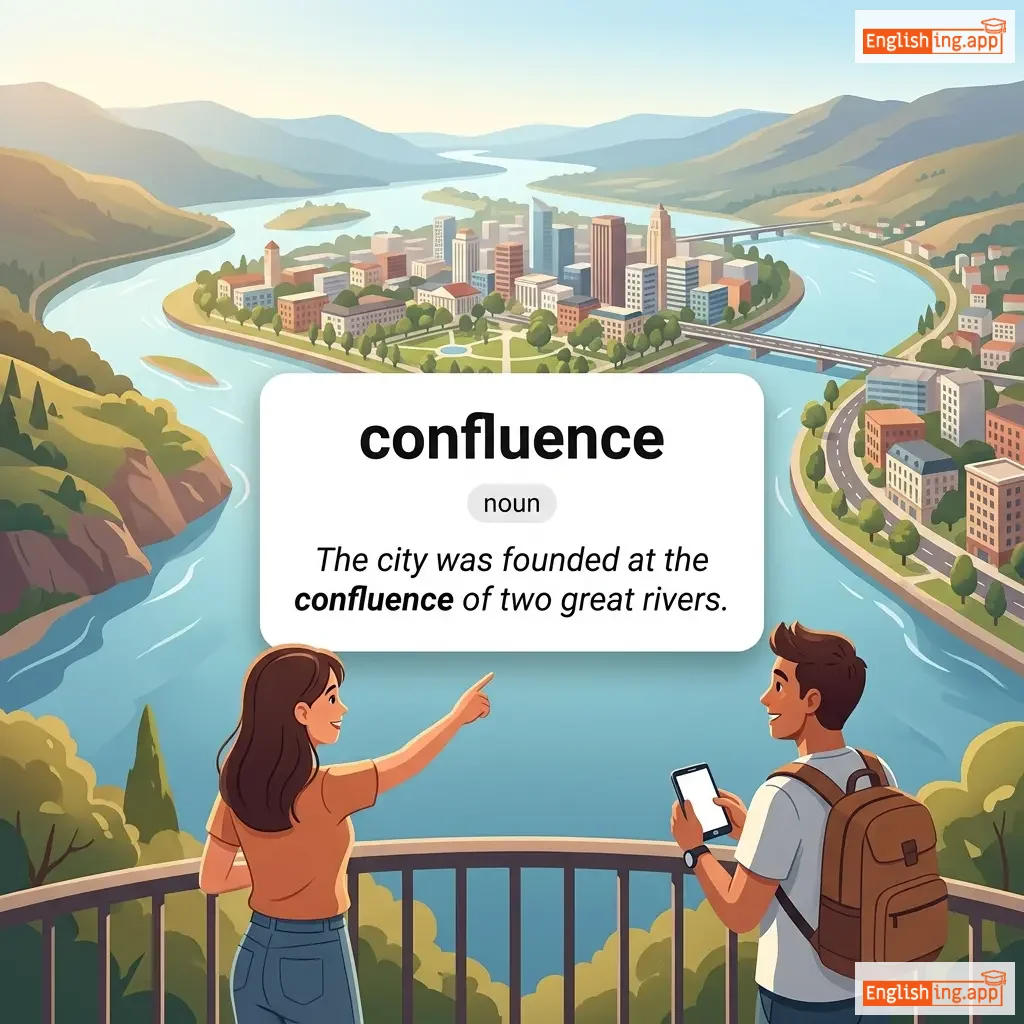
confluence definition card — visual illustration of the meaning
noun
/ˈkɒnfluəns/
слияние (sliyaniye)

The junction of two rivers; also a situation where people or things come together.

"The city was founded at the confluence of two great rivers."

"Город был основан на слиянии двух великих рек." (Gorod byl osnovan na sliyanie dvukh velikikh rek.)
adjective
/ˈkɒnfluənt/
сливающийся (slivayushchijsya)

Flowing together or merging; coming together at one point.

"The confluent streams formed a mighty river."

"Сливающееся ручьи образовали мощную реку." (Slivayushchiesya ruch'yi obrazovali moshchnuyu reku.)
verb
/kənˈfɔːrm/
соблюдать (soblyudat')

To comply with rules, standards, or laws.

"Students must conform to the school regulations."

"Студенты должны соблюдать школьные правила." (Studenty dolzhny soblyudat' shkol'nye pravyla.)
adjective
/kənˈfɔːrməbl/
соответствующий (sootvetstvuyushchiy)

Capable of being adapted or consistent with something; compliant.

"His actions were conformable to the rules of the institution."

"Его действия соответствовали правилам учреждения." (yego deystviya sootvetstvovali pravilam uchrezhdeniya.)
noun
/kənˈfɔːrməns/
соответствие (sootvetstvie)

The act of conforming to a rule, standard, or law.

"The product was tested for conformance with safety standards."

"Продукт был протестирован на соответствие стандартам безопасности." (Produkt byl protestirovan na sootvetstviye standartam bezopasnosti.)
noun
/ˌkɑːnfɔːrˈmeɪʃən/
конформация (konformaciya)

The shape, structure, or arrangement of something.

"The scientist studied the molecular conformation of the protein."

"Ученый изучал молекулярную конфигурацию белка." (Ucheny izuchal molekulyarnuyu konformaciyu belka.)
noun
/kənˈfɔːrmɪst/
конформист (konformist)

A person who uncritically conforms to established practices or standards.

"She was labeled a conformist for always following the crowd."

"Ее называли конформисткой, потому что она всегда следовала за толпой." (Yeyo nazyvali konformistkoy, potomu chto ona vsegda sleduyala za tolpoy.)
conformity definition card — visual illustration of the meaning
noun
/kənˈfɔːrməti/
соответствие (sootvetstvie)

Compliance with standards, rules, or laws; behavior in accordance with social norms.

"The students were praised for their conformity to the school regulations."

"Студенты были похвалены за свое соответствие школьным правилам." (Studenty byli pokhvaleny za svoe sootvetstvie shkol'nym pravilam.)
confound definition card — visual illustration of the meaning
verb
/kənˈfaʊnd/

to confuse or surprise someone, often by acting against their expectations

"The magician's trick seemed to confound the entire audience."

verb
/kənˈfrʌnt/
противостоять (protivostoyat)

to face someone or something directly, especially in a challenge or conflict

"She had to confront her fears before making the speech."

"Ей пришлось столкнуться с своими страхами перед тем, как выступить с речью." (Yey prishlos' stolknutsya s svoimi strakhami pered tem, kak vystupit' s rech'yu.)
noun
/ˌkɒnfrʌnˈteɪʃən/
конфронтация (konfrontatsiya)

A hostile or argumentative meeting or situation between opposing parties.

"The protest led to a confrontation with the police."

"Протест привел к конфронтации с полицией." (Protest privel k konfrontacii s policej.)
verb
/kənˈfjuːz/
смущать (smushchat)

To make someone unable to think clearly; to bewilder.

"The complex instructions confused the students."

"Сложные инструкции запутали студентов." (Slozhnye instruktsii zaputali studentov.)
adjective
/kənˈfjuːzd/
смущённый (smushchyonnyy)

unable to think clearly; uncertain or puzzled

"She felt confused by the complicated instructions."

"Она была смущена сложными инструкциями." (ona byla smushchyena slozhnymi instruktsiyami)
adjective
/kənˈfjuːzɪŋ/
запутывающий (zaputyvayushchiy)

causing someone to be unable to think clearly or understand; difficult to comprehend

"The instructions were confusing and hard to follow."

"Инструкции были запутывающими и трудными для понимания." (Instruktsii byli zaputyvayushchimi i trudnymi dlya ponimaniya)
noun
/kənˈfjuːʒən/
замешательство (zamechatel'stvo)

a state of being bewildered or unclear in one’s mind

"The sudden change in schedule caused a lot of confusion."

"Внезапное изменение расписания вызвало много замешательства." (Vnezapnoe izmenenie raspisaniya vyzvalo mnogo zamechatel'stva.)
verb
/kənˈdʒiːl/
застывать (zastyvat)

to become thick or solid, especially from cooling

"The soup began to congeal after being left on the table."
"Суп начал застывать, когда его оставили на столе." (Sup nachal zastyvat, kogda ego ostavili na stole.)
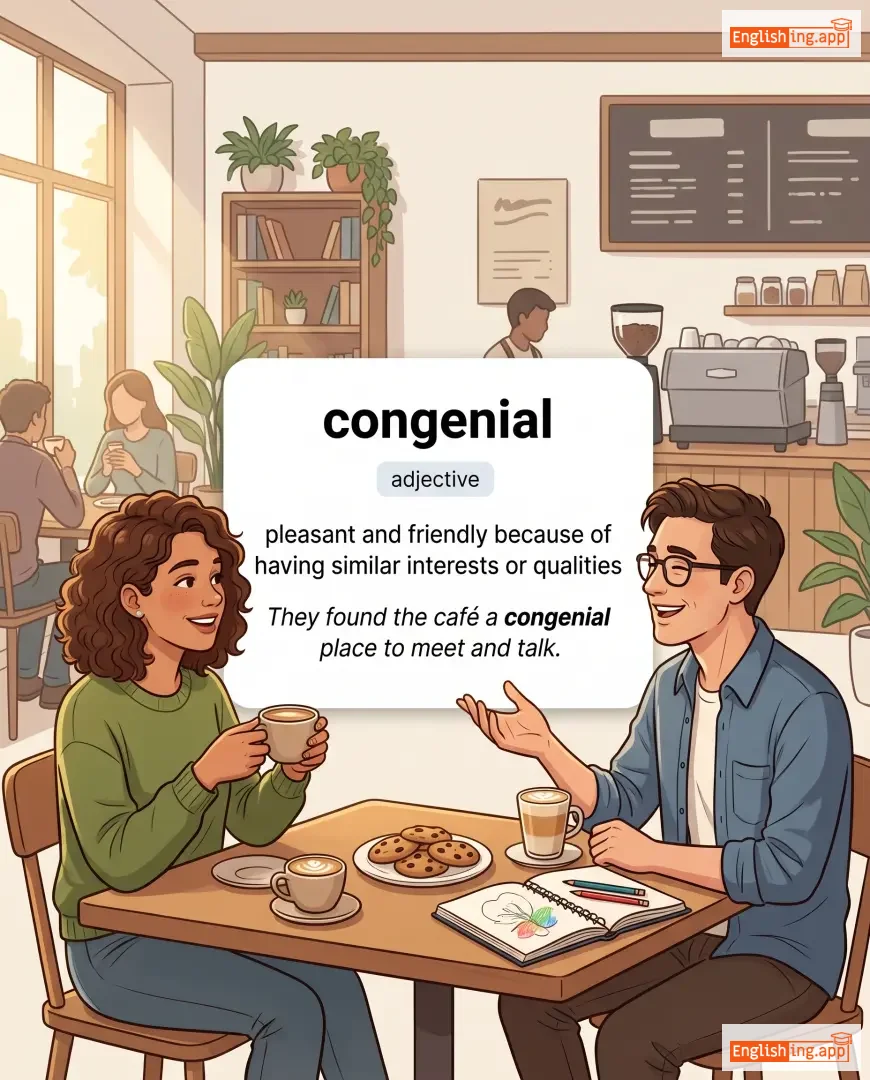
congenial definition card — visual illustration of the meaning
adjective
/kənˈdʒiːniəl/
приветливый (privetlivyy)

pleasant and friendly because of having similar interests or qualities

"They found the café a congenial place to meet and talk."

"Они нашли кафе приятным местом для встреч и бесед." (Oni nashli kafe priyatnym mestom dlya vstrech i besed.)
congeniality definition card — visual illustration of the meaning
noun
/kənˌdʒiː.niˈæl.ə.t̬i/
дружелюбие (druzhelyubie)

The quality of being pleasant, friendly, and easy to talk to.

"His congeniality makes him popular among friends."

"Его дружелюбие делает его популярным среди друзей." (Yego druzhelyubie delayet ego populyarnym sredi druzey.)
adjective
/kənˈdʒenɪtl/
врожденный (vrozhdennyy)

existing from birth, usually describing a disease or condition

"The child was born with a congenital heart defect."

"Ребенок родился с врожденным пороком сердца." (Rebenok rodilsya s vrozhdennym porokom serdtsa.)
verb
/kənˈdʒɛst/
перегружать (peregruzhat)

To block or overcrowd a space, making movement or flow difficult.

"Heavy traffic can congest the city streets during rush hour."

"Плотное движение может перегрузить улицы города в часы пик." (Plotnoe dvizheneie mozhet peregruzit' ulitsy goroda v chasy pik.)
adjective
/kənˈdʒɛstɪd/
перегруженный (peregruzhennyi)

Blocked up with too much traffic or crowding.

"The road was congested during rush hour."
"Дорога была перегружена в час пик." (Doroga byla peregruzhena v chas pik.)
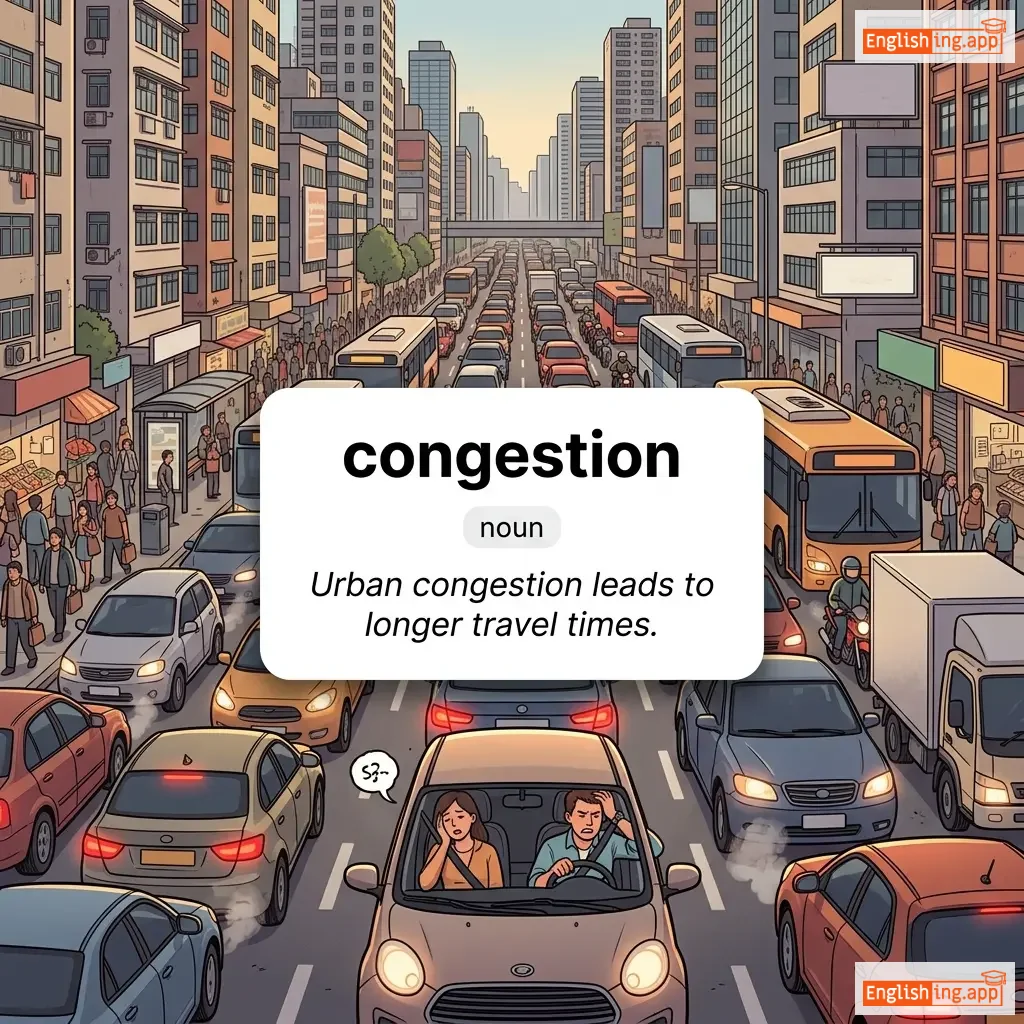
congestion definition card — visual illustration of the meaning
noun
/kənˈdʒes.tʃən/
пробки или избыточная толпа (probki ili izbytochnaya tolpa)

Traffic jam or overcrowded condition in roads or areas where there is excessive presence of vehicles or people.

"Urban congestion leads to longer travel times."
"Городская загруженность приводит к более длительному времени в пути." (Gorodskaya zagruzhennost privodit k bolee dlitel'nomu vremeni v puti.)
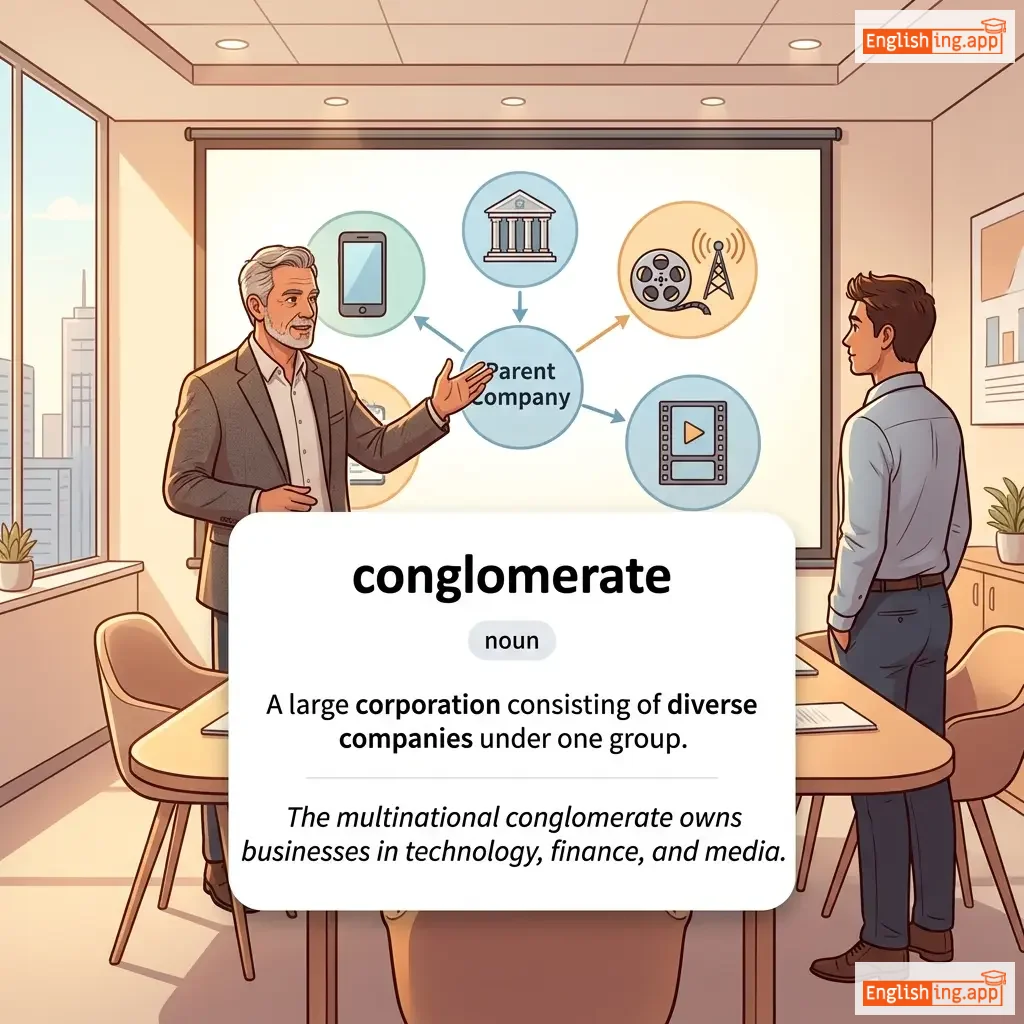
conglomerate definition card — visual illustration of the meaning
noun
/kənˈɡlɒmərət/
крупная корпорация, состоящая из разных компаний (krupnaya korporatsiya, sostoyashchaya iz raznykh kompanii)

A large corporation consisting of diverse companies under one group.

"The multinational conglomerate owns businesses in technology, finance, and media."

"Многонациональный конгломерат владеет бизнесом в области технологий, финансов и медиа." (Mnogonatsional'nyy konglomerat vladeet biznesom v oblasti tekhnologiy, finansov i media.)
noun
/kənˌɡlɒməˈreɪʃən/
конгломерат (konglomeraht)

A collection or mixture of different things grouped together.

"The market is a conglomeration of small shops and food stalls."

"Рынок — это конгломерат маленьких магазинов и продовольственных лавок." (Rynok — eto konglomeraht malenkikh magazinov i prodovol'stvennykh lavok.)
verb
/kənˈɡrætʃʊleɪt/
поздравить (pozdravit')

to praise someone for an achievement or for a special occasion

"I want to congratulate you on your promotion."

"Я хочу поздравить тебя с повышением." (Ya khochu pozdravit' tebya s povysheniem.)
noun
/kənˌɡrætʃəˈleɪʃən/
поздравление (pozdravlenie)

an expression of praise or joy for someone’s achievement or good fortune

"She sent a congratulation to her friend on winning the award."

"Она отправила поздравление подруге с победой в конкурсе." (ona otpravila pozdravlenie podruge s pobedoi v konkurse)
noun
/kənˌɡrætʃ.əˈleɪ.ʃənz/
поздравления (pozdravleniya)

words expressing praise for an achievement or good wishes on a special occasion

"Congratulations on your promotion! You really deserved this success."
"Поздравляю с повышением! Ты действительно заслужил этот успех." (Pozdravlyayu s povysheniem! Ty deystvitel'no zasluzhil etot uspek.)
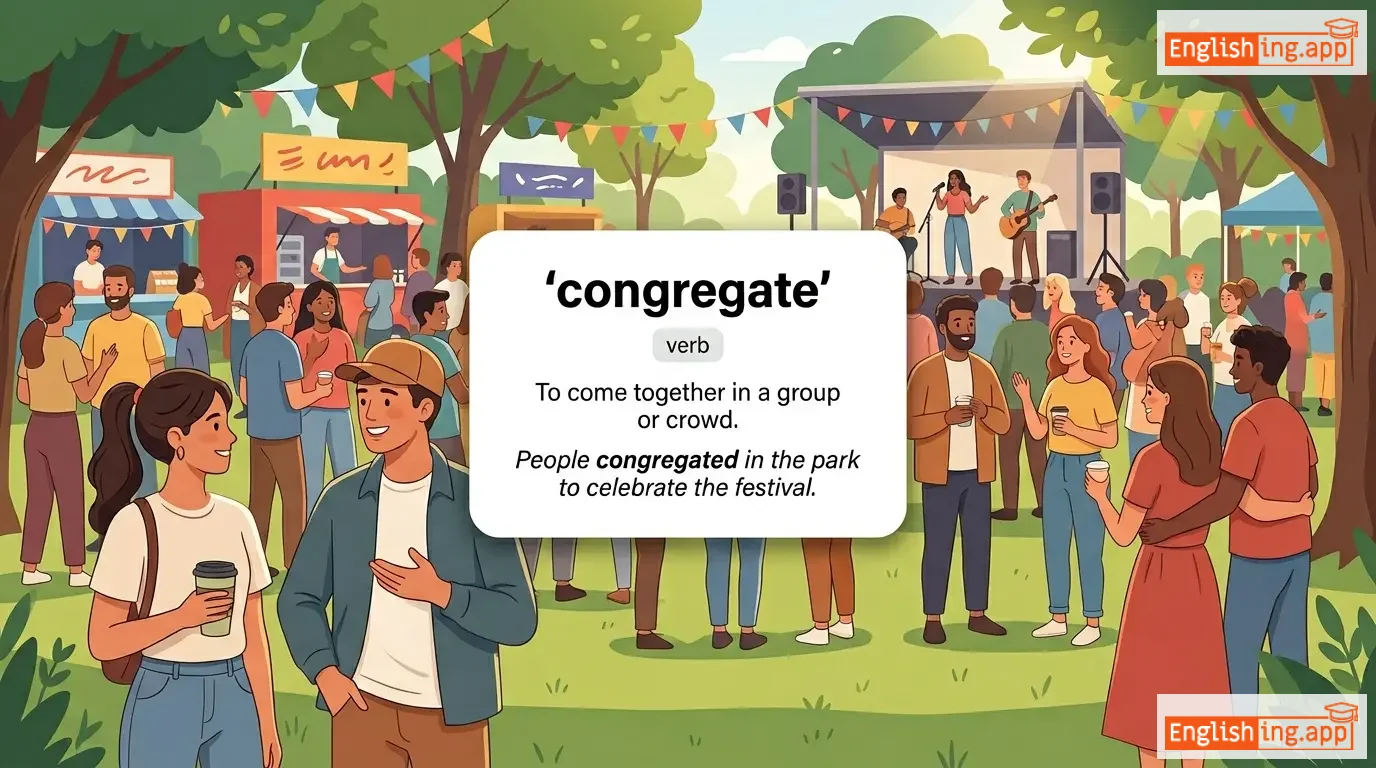
congregate definition card — visual illustration of the meaning
verb
/ˈkɒŋɡrɪˌɡeɪt/
собираться (sobirat'sya)

To come together in a group or crowd.

"People congregated in the park to celebrate the festival."

"Люди собрались в парке, чтобы отпраздновать фестиваль." (Lyudi sobralis' v parke, chtoby otprazdnovat' festival'.)
noun
/ˌkɒŋɡrɪˈɡeɪʃən/
община (obshchina)

a group of people assembled for religious worship or a common purpose

"The congregation gathered to hear the sermon."

"Община собралась, чтобы послушать проповедь." (Obshchina sobralas, chtoby poslushat' propoved'.)
noun
/ˈkɒŋɡrɛs/
конгресс (kongress)

a formal meeting or assembly, especially of representatives for discussion

"The international congress on climate change will be held next year."

"Международный конгресс по изменению климата состоится в следующем году." (Mezhdunarodnyy kongress po izmeneniyu klimata sostoyitsya v sleduyushchem godu.)
adjective
/kənˈɡrɛʃənl/
конгрессуальный (kongressual'nyy)

relating to a congress, especially the US Congress

"The bill received strong congressional support."

"Законопроект получил сильную поддержку от Конгресса." (Zakonoproekt poluchil sil'nuyu podderzhku ot Kongressa.)