वोकैबुलरीज

इंग्लिश वोकैबुलरी डिस्कवर, लर्न और मास्टर करें

noun
/sɪˈtɑːr/
सितार (sitar)

a traditional Indian stringed musical instrument with a long neck and resonating body

"The sitar creates beautiful ragas in Indian classical music."

"सितार भारतीय शास्त्रीय संगीत में सुंदर राग उत्पन्न करता है।" (sitar bhartiya shastriya sangeet mein sundar raag utpann karta hai)
noun
/saɪt/
स्थान (sthan)

a location or place, often used for a specific purpose, such as a construction site or a website

"The construction site is ready for the next phase of the project."

"निर्माण स्थल अगली परियोजना चरण के लिए तैयार है।" (Nirman sthal agli pariyojna charan ke liye tayar hai.)
adjective
/ˈsɪtʃueɪtɪd/
स्थित (sthit)

located in a particular place or position

"The hotel is situated near the beach."

"होटल समुद्र तट के पास स्थित है।" (Hotel samudra tat ke paas sthit hai.)
noun
/ˌsɪtʃʊˈeɪʃən/
स्थिति (stithi)

a set of circumstances or state of affairs at a particular time

"The situation at work became difficult after the new policies were introduced."

"नए नीतियों के लागू होने के बाद कार्यस्थल की स्थिति कठिन हो गई।" (Naye neetiyon ke laagu hone ke baad karyasthal ki sthiti kathin ho gayi.)
noun
/sɪks/
छह (chhah)

the number 6

"There are six apples on the table."

"टेबल पर छह सेब हैं।" (Tebal par chhah seb hain.)
adjective
/sɪksθ/
छठा (chhatha)

coming after the fifth in order, position, or rank

"He finished the race in sixth place."

"वह दौड़ में छठे स्थान पर समाप्त हुआ।" (Vah daud mein chhathe sthan par samaapt hua.)
noun
/saɪz/
आकार (aakaar)

the physical dimensions, proportions, or magnitude of something

"This shirt is too small in size for me."

"यह शर्ट मेरे लिए आकार में बहुत छोटी है।" (Yeh shirt mere liye aakaar mein bahut chhoti hai.)
noun
/ˈskɛlɪtən/
कंकाल (kankal)

The internal framework of bones that supports the body of a human or animal.

"The teacher showed the students a human skeleton in the biology class."

"शिक्षक ने जीवविज्ञान की कक्षा में छात्रों को मानव कंकाल दिखाया।" (Shikshak ne jeevvigyan ki kaksha mein chhatron ko manav kankal dikhaya.)
skeptic definition card — visual illustration of the meaning
noun
/ˈskɛptɪk/
संशयवादी (sanshayvadi)

A person who doubts or questions accepted beliefs or claims.

"The scientist was a skeptic of theories without solid evidence."

"विज्ञानी सिद्धांतों पर संदेहवादी थे जब तक ठोस प्रमाण नहीं थे।" (Vigyani siddhanton par sandehvadi the jab tak thos praman nahi the.)
adjective
/ˈskɛptɪkəl/
संदेहपूर्ण (sandehpurn)

not easily convinced; having doubts or reservations

"She was skeptical about the new plan."

"वह नए योजना को लेकर संदेहपूर्ण थी।" (Wah naye yojana ko lekar sandehpurn thi.)
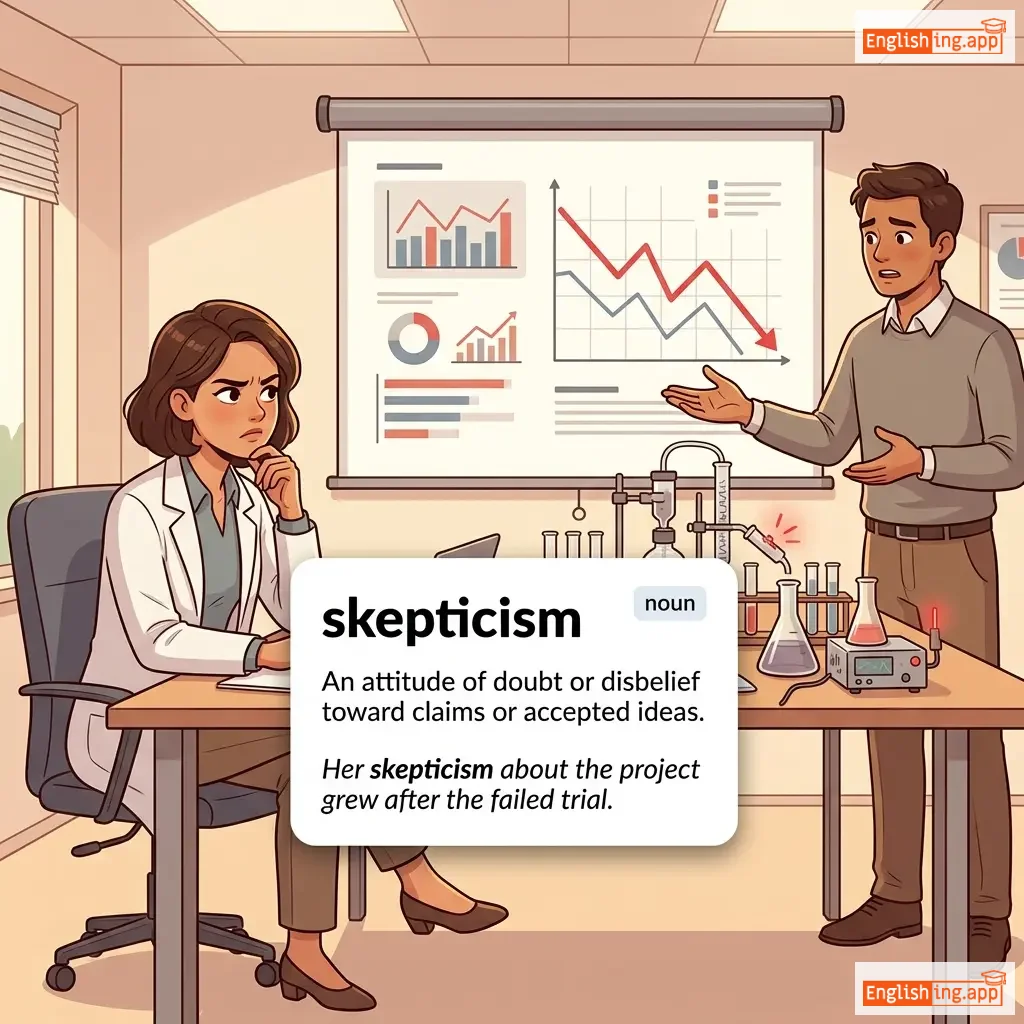
skepticism definition card — visual illustration of the meaning
noun
/ˈskɛptɪˌsɪzəm/
संशयवाद (sanshayvad)

An attitude of doubt or disbelief toward claims or accepted ideas.

"Her skepticism about the project grew after the failed trial."

"परियोजना के बारे में उसका संशयवाद विफल परीक्षण के बाद बढ़ गया।" (Pariyojana ke baare mein uska sanshayvad vifal parikshan ke baad badh gaya.)
noun
/skɛtʃ/
रूपरेखा (rooprekha)

a simple, rough drawing or outline

"He made a quick sketch of the landscape."

"उसने परिदृश्य का एक त्वरित रूपरेखा बनाई।" (Usne paridrishya ka ek tvarit rooprekha banayi.)
adjective
/ˈskɛtʃi/
अधूरा (adhura)

not thorough or detailed; suspicious or unsafe

"The details of the project were still sketchy."

"प्रोजेक्ट के विवरण अभी भी अधूरे थे।" (Project ke vivaran abhi bhi adhure the.)
verb
/skiː/
स्की करना (ski karna)

to glide over snow on skis

"We went skiing in the Alps last winter."

"हम पिछले सर्दी में आल्प्स में स्की करने गए थे।" (Hum pichle sardi mein Alps mein ski karne gaye the.)
noun
/skɪf/
छोटा नाव (chhota naav)

a small, light boat usually for one person

"The fisherman paddled his skiff across the lake."

"मछुआरे ने अपनी छोटी नाव को झील के पार पैडल किया।" (Machhuaare ne apni chhoti naav ko jheel ke paar pedal kiya.)
adjective
/ˈskɪlfʊl/
कुशल; निपुण; माहिर (kushal; nipun; maahir)

having or showing skill; expert and accomplished

"The skilful surgeon performed the operation with great precision."

"कुशल सर्जन ने ऑपरेशन को उच्च सटीकता के साथ किया।" (kushal surgeon ne operation ko uchch sathikta ke saath kiya.)
adverb
/ˈskɪl.fəl.i/
कुशलता से (kushalta se)

in a way that shows ability and training; expertly

"She skilfully painted the portrait in just two hours."

"वह दो घंटे में कुशलता से चित्रकारी करती है।" (vah do ghante mein kushalta se chitrakari karti hai)
noun
/skɪl/
कौशल (kaushal)

the ability to do something well through training or experience

"Her skill in painting impressed everyone."

"पेंटिंग में उसकी कौशल ने सभी को प्रभावित किया।" (Painting mein uski kaushal ne sabhi ko prabhavit kiya.)
adjective
/skɪld/
कुशल (kushal)

having the ability, experience, or training to do something well

"She is a highly skilled surgeon with years of experience."

"वह कई वर्षों के अनुभव के साथ एक उच्च कुशल सर्जन है।" (Vah kai varshon ke anubhav ke saath ek uchch kushal surgeon hai.)
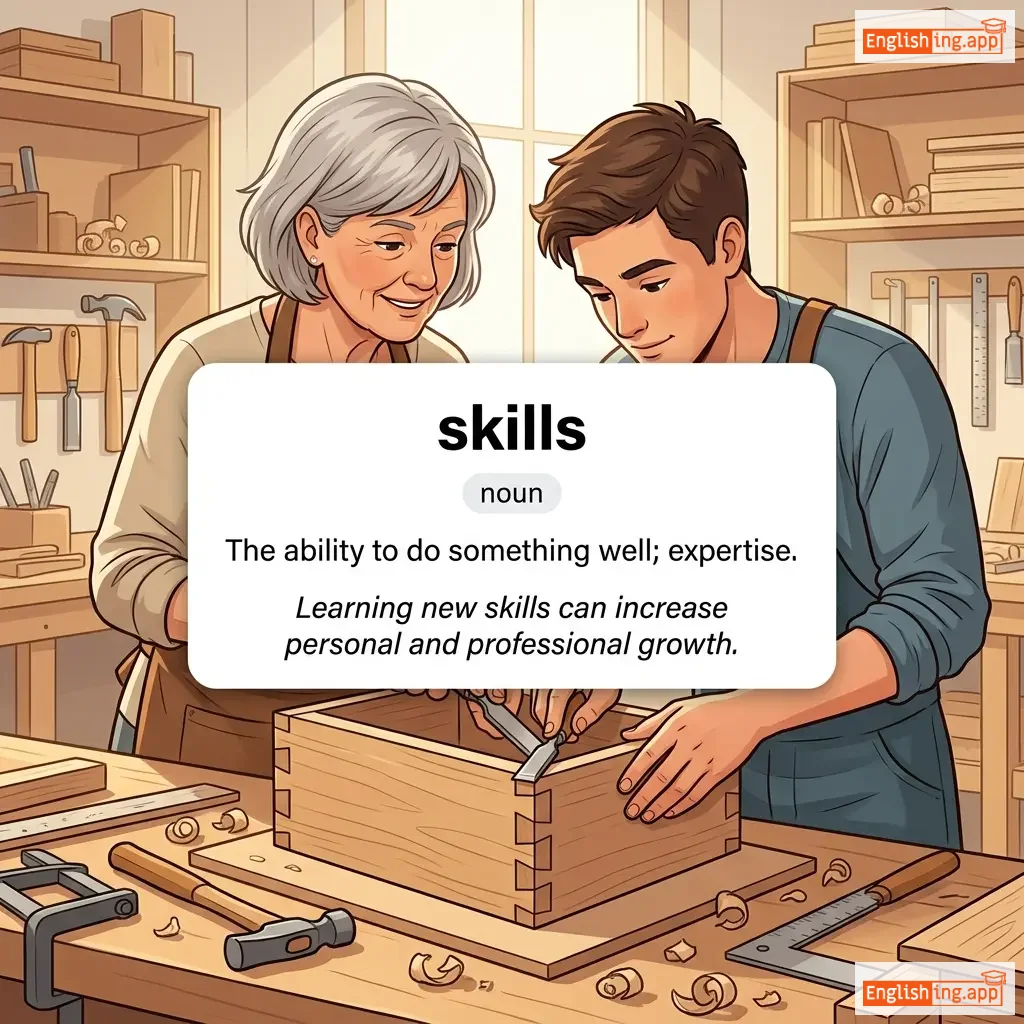
skills definition card — visual illustration of the meaning
noun
/skɪlz/
कौशल (kaushal)

The ability to do something well; expertise.

"Learning new skills can increase personal and professional growth."

"नए स्किल्स सीखने से व्यक्तिगत और पेशेवर विकास बढ़ सकता है।" (Naye skills seekhne se vyaktigat aur peshewar vikas badh sakta hai.)
verb
/skɪm/
जल्दी से देखना (jaldi se dekhna)

to move quickly over a surface or to read something quickly

"She skimmed through the report before the meeting."

"उसने बैठक से पहले रिपोर्ट को जल्दी से स्किम किया।" (Usne baithak se pehle report ko jaldi se skim kiya.)
verb
/skɪmp/
कंजूसी करना (kanjoosi karna)

to use less of something than is necessary in order to save money or effort

"Don’t skimp on quality when buying a new laptop."

"नए लैपटॉप को खरीदते समय गुणवत्ता पर कंजूसी मत करो।" (Naye laptop ko kharidte samay gunwatta par kanjoosi mat karo.)
noun
/skɪn/
त्वचा (tvacha)

the outer layer of the body

"She has fair skin and bright blue eyes."

"उसकी त्वचा हल्की रंग की और आंखें नीली हैं।" (Uski tvacha halki rang ki aur aankhein neeli hain.)
noun
/ˈskɪnˌflɪnt/
कंजूस (kanjoos)

a person who spends as little money as possible; a miser

"The landlord was such a skinflint that he never repaired anything."

"मालिक इतना कंजूस था कि उसने कभी कुछ मरम्मत नहीं की।" (maalik itna kanjoos tha ki usne kabhi kuch marammat nahin ki.)
adjective
/ˈskɪni/
पतला; दुबला; हड्डी दिखाई देने वाला (patla; dubla; haddi dikhai dene wala)

very thin; having little flesh or fat on the body

"The skinny cat looked like it hadn't eaten for days."

"पतला बिल्ली ऐसा लग रहा था जैसे उसने कई दिनों से खाना नहीं खाया हो।" (patla billi aisa lag raha tha jaise usne kai dinon se khana nahi khaya ho.)
verb
/skɪp/
छोड़ना (chhodna)

to omit or pass over something; to move lightly or quickly

"He decided to skip breakfast and go straight to work."

"उसने नाश्ता छोड़ने और सीधे काम पर जाने का फैसला किया।" (Usne nashta chhodne aur seedhe kaam par jaane ka faisla kiya.)
noun/verb
/ˈskɜːrmɪʃ/
झगड़ा (jhagda)

a small or brief fight between groups of soldiers; to engage in such a fight

"The soldiers got into a skirmish near the border."

"सैनिक सीमा के पास एक झगड़े में फंस गए।" (Sainik seema ke paas ek jhagde mein fans gaye.)
noun/verb
/skɜːrt/
स्कर्ट (skart)

a piece of clothing that hangs from the waist; to go around the edge of something

"She wore a red skirt to the party."

"उसने पार्टी में लाल स्कर्ट पहनी।" (Usne party mein lal skirt pehni.)
noun
/skɪt/
छोटा नाटक (chota natak)

a short, humorous performance or piece of writing

"The students performed a funny skit at the event."

"छात्रों ने कार्यक्रम में एक मजेदार स्किट प्रस्तुत किया।" (Chhatron ne karyakram mein ek mazedar skit prastut kiya.)
adjective
/ˈskɪtɪʃ/
घबराया हुआ (ghabraya hua)

easily frightened or nervous; unpredictable

"The horse was too skittish to ride."

"घोड़ा सवारी करने के लिए बहुत घबराया हुआ था।" (Ghoda sawari karne ke liye bahut ghabraya hua tha.)
noun
/skʌlˈdʌɡəri/
धोखाधड़ी (dhokhadhadi)

underhanded or dishonest behavior

"The politician was accused of financial skulduggery."

"राजनेता पर वित्तीय धोखाधड़ी का आरोप था।" (Rajnetā par vittīya dhokhādhaṛī kā ārop thā.)
verb
/skʌlk/
गुपचुप चलना (gupchup chalna)

to move or hide secretly, often because you are planning something bad or are feeling guilty

"He tried to skulk in the shadows to avoid being seen."

"वह छाया में छिपने की कोशिश कर रहा था ताकि उसे देखा न जा सके।" (Wah chhaya mein chhipne ki koshish kar raha tha taaki use dekha na ja sake.)
noun
/skʌl/
खोपड़ी (khopdi)

the bony structure that forms the head and protects the brain

"The archaeologists found an ancient human skull."

"पुरातत्वविदों ने एक प्राचीन मानव खोपड़ी पाई।" (Puratatvavidhon ne ek prachin manav khopdi pai.)
noun
/ˌskʌlˈdʌɡəri/
धोखाधड़ी (dhokhadhadi)

dishonest behavior or activities, often done secretly

"The election was full of political skullduggery."

"चुनाव राजनीतिक धोखाधड़ी से भरा हुआ था।" (Chunav raajnaitik dhokhadhadi se bhara hua tha.)
noun
/skaɪ/
आसमान (aasmaan)

the expanse of air over the Earth, often appearing blue

"The sky was clear and the sun was shining brightly."

"आसमान साफ़ था और सूरज तेज़ चमक रहा था।" (aasmaan saaf tha aur sooraj tez chamak raha tha)
adjective
/skaɪ bluː/
आसमानी-नीला (aasmaani-neela)

a bright blue color like that of a clear sky

"Her sky-blue eyes sparkled in the sunlight."

"उसकी आसमानी-नीली आँखें सूरज की रोशनी में चमक रही थीं।" (Uski aasmaani-neeli aankhen sooraj ki roshni mein chamak rahi thi.)
noun
/ˈskaɪ.lɑːrk/
आसमान में ऊँचा उड़ने वाला चिड़ीया (aasmaan mein uncha udne waala chidiya)

a small brown bird known for singing while flying high in the sky

"The skylark sang beautifully as it soared above the meadow."

"आसमान में उड़ते हुए स्काईलार्क ने खूबसूरती से गाया, जैसे वह घास के मैदान के ऊपर उड़ रहा हो।" (aasmaan mein udte hue sky-lark ne khoobsurti se gaya, jaise vah ghaas ke maidan ke upar ud raha ho)
noun
/ˈskaɪˌskreɪpər/
आसमान छूने वाली इमारत (aasmaan chhoone waali imaarat)

a very tall building of many stories

"The new skyscraper dominates the city's skyline."

"नई आकाश छूने वाली इमारत शहर के स्काईलाइन पर हावी है।" (nayi aasmaan chhoone waali imaarat shahar ke skyline par haavi hai.)
noun
/slæb/
स्लैब (slab)

a large, thick, flat piece of stone, concrete, or other hard material

"The workers laid a concrete slab for the foundation."

"श्रमिकों ने नींव के लिए एक कंक्रीट स्लैब रखा।" (da shramikon ne neev ke liye ek kongkrit slab rakha.)
adjective
/slæk/
ढीला (dhila)

not tight, firm, or busy; lacking tension or activity

"Business is slack during the rainy season."

"वर्षा के मौसम में व्यापार मंदा होता है।" (Varsha ke mausam mein vyapar manda hota hai.)
verb
/ˈslækən/
ढीला करना (dheela karna)

to make or become less tight, less active, or slower

"The driver slackened his speed as he approached the village."

"ड्राइवर ने गाँव के पास आते समय अपनी गति स्लैकन कर दी।" (Driver ne gaon ke paas aate samay apni gati slacken kar di.)
noun
/slæɡ/
धातु का अवशेष (dhatu ka avshesh)

Stony waste matter separated from metals during the smelting process.

"The factory dumped the slag near the river."

"कारख़ाने ने नदी के पास स्लैग फेंका।" (Karkhane ne nadi ke paas slag phenka.)
verb
/sleɪk/
प्यास बुझाना (pyaas bujhna)

To satisfy thirst or desire.

"She drank cold water to slake her thirst."

"वह अपनी प्यास बुझाने के लिए ठंडा पानी पी रही थी।" (Vah apni pyaas bujhane ke liye thanda paani pee rahi thi.)
verb
/slæm/
धक्का देना (dhakka dena)

to close or hit something with great force

"He slammed the door angrily after the argument."

"तर्क के बाद उसने गुस्से में दरवाजा जोर से बंद कर दिया।" (Tark ke baad usne gusse mein darwaza zor se band kar diya.)
noun
/ˈslændər/
झूठी बात (jhoothi baat)

The action of making false spoken statements damaging to a person's reputation.

"He sued the newspaper for slander."

"उसने अखबार पर मानहानि का मुकदमा दायर किया।" (Usne akhbaar par maanhaani ka mukadma daayr kiya.)
noun
/slæŋ/
गाली-गलौज की भाषा; स्लैंग (gaali-galauz ki bhasha; slang)

very informal language that is usually spoken rather than written

"The teenagers used slang that their parents couldn't understand."

"किशोरों ने उस स्लैंग का इस्तेमाल किया जिसे उनके माता-पिता समझ नहीं पाए।" (Kishoron ne us slang ka istemal kiya jise unke mata-pita samajh nahi paaye.)
noun, verb
/slænt/
झुका हुआ या पक्षपाती दृष्टिकोण (jhuka hua ya pakshapati drishtikon)

A particular point of view; to slope or lean in a particular direction.

"The article had a political slant."

"लेख में एक राजनीतिक झुकाव था।" (lekh mein ek rajneetik jhukav tha.)
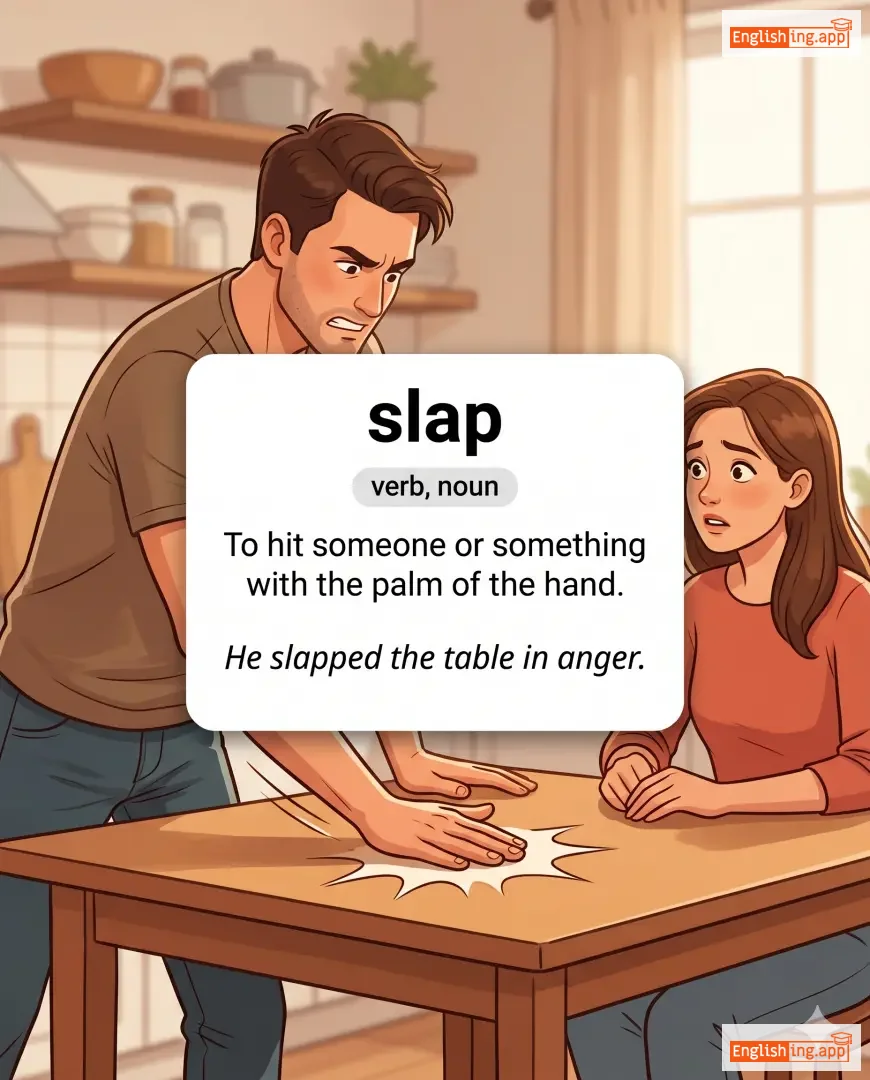
slap definition card — visual illustration of the meaning
verb, noun
/slæp/
थप्पड़ मारना (thappad marna)

To hit someone or something with the palm of the hand.

"He slapped the table in anger."

"उसने गुस्से में टेबल पर थप्पड़ मारा।" (Usne gusse mein table par thappad maara.)
adjective
/ˈslæp.dæʃ/
लापरवाह (laparwah)

done too quickly and carelessly; hasty and careless

"The report was written in a slapdash manner, full of errors."

"रिपोर्ट लापरवाही से लिखी गई थी, जिसमें बहुत सारी गलतियाँ थीं।" (Report laparwahi se likhi gayi thi, jismein bahut saari galtiyan thin.)
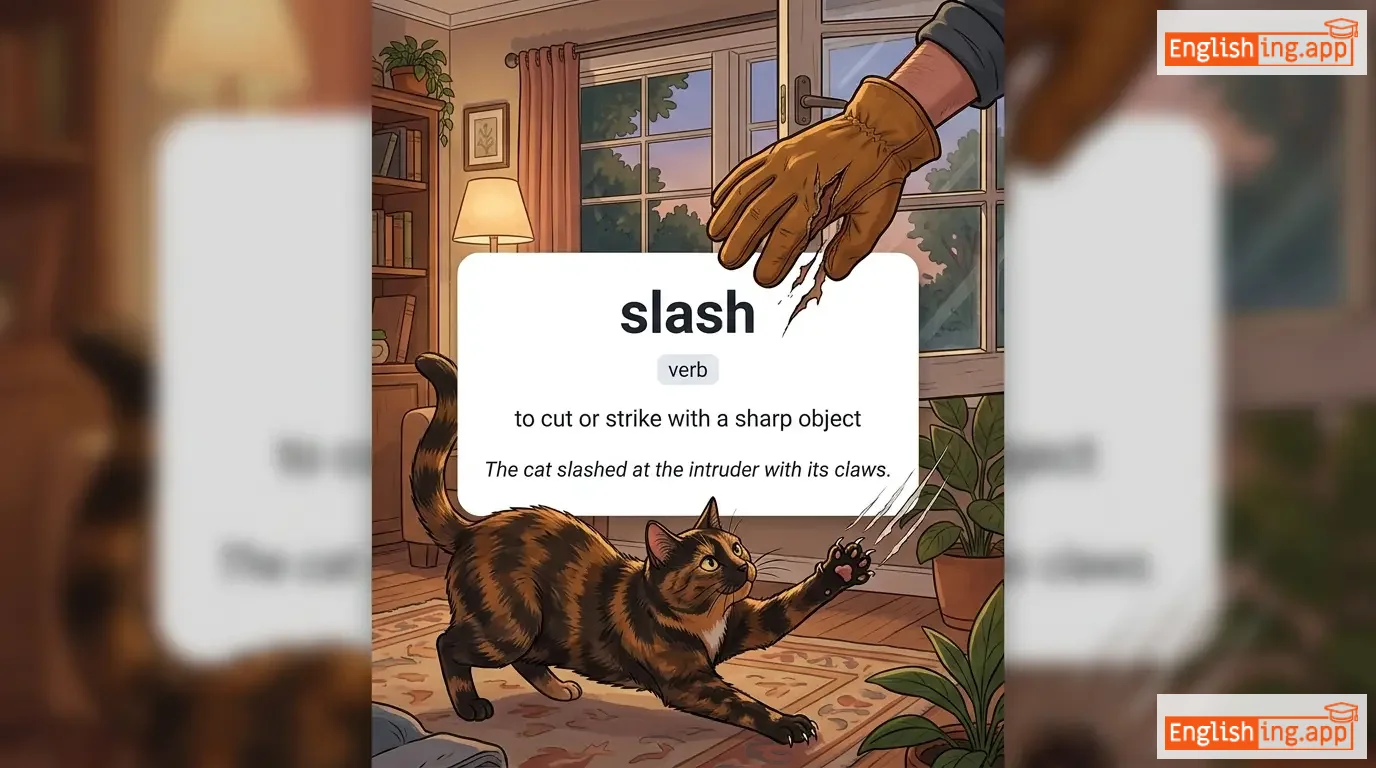
slash definition card — visual illustration of the meaning
verb
/slæʃ/
काटना (katna)

to cut or strike with a sharp object

"The cat slashed at the intruder with its claws."

"बिल्ली ने अपने पंजों से आक्रमणकारी पर हमला किया।" (Billi ne apne panjon se aakramankari par hamla kiya.)