वोकैबुलरीज

इंग्लिश वोकैबुलरी डिस्कवर, लर्न और मास्टर करें

noun/adjective
/ˈɪnstənt/
क्षणिक (kshanik)

A very short period of time; happening immediately.

"He replied in an instant without hesitation."

"उसने बिना झिझक के एक क्षण में उत्तर दिया।" (Usne bina jhijhak ke ek kshan mein uttar diya.)
adjective
/ˌɪnstənˈteɪniəs/
तत्काल (tatkaal)

Happening immediately, without any delay.

"The change in temperature was almost instantaneous."

"तापमान में बदलाव लगभग तत्काल था।" (Taapmaan mein badlaav lagbhag tatkaal tha.)
adverb
/ˈɪnstəntli/
तुरंत (turant)

immediately, without any delay

"He replied instantly to the message."

"उसने संदेश का तुरंत उत्तर दिया।" (Usne sandesh ka turant uttar diya.)
verb
/ɪnˈsteɪt/
पद पर नियुक्त करना (pad par niyukt karna)

To set up in position, office, or authority.

"The board decided to instate her as the new director."

"बोर्ड ने उसे नए निदेशक के रूप में इंस्टेट करने का निर्णय लिया।" (Board ne use naye nideshak ke roop mein instate karne ka nirnay liya.)
adverb
/ɪnˈstɛd/
इसके बजाय (iske bajaye)

As an alternative or substitute.

"She didn’t buy the dress; instead, she chose a pair of shoes."

"वह ड्रेस नहीं खरीदी; इसके बजाय, उसने एक जोड़ी जूते चुने।" (vah dress nahin khareedi; iske bajaye, usne ek jodi joote chune.)
verb
/ˈɪnstɪˌɡeɪt/
उकसाना (uksana)

To bring about or initiate an action, often something negative.

"He was accused of instigating the riot."

"उसे दंगे को उकसाने का आरोप लगा था।" (Use dange ko uksane ka aarop laga tha.)
noun
/ˈɪnstɪˌɡeɪtər/
उकसानेवाला (uksanewala)

A person who brings about or initiates something, usually something bad.

"The police identified him as the instigator of the violence."

"पुलिस ने उसे हिंसा का उकसानेवाला माना।" (Police ne use hinsa ka uksanewala mana.)
verb
/ɪnˈstɪl/
स्थापित करना (sthapit karna)

to gradually but firmly establish an idea, attitude, or habit in someone's mind

"Parents try to instill good values in their children."

"माता-पिता अपने बच्चों में अच्छे मूल्य स्थापित करने की कोशिश करते हैं।" (Mata-pita apne bachchon mein achhe moolya sthapit karne ki koshish karte hain.)
noun
/ˈɪnstɪŋkt/
स्वाभाविक प्रवृत्ति (swabhavik pravritti)

A natural way of behaving or reacting that does not require learning.

"Birds build nests by instinct."

"पक्षी स्वाभाविक प्रवृत्ति से घोंसला बनाते हैं।" (Pakshi swabhavik pravritti se ghosla banate hain.)
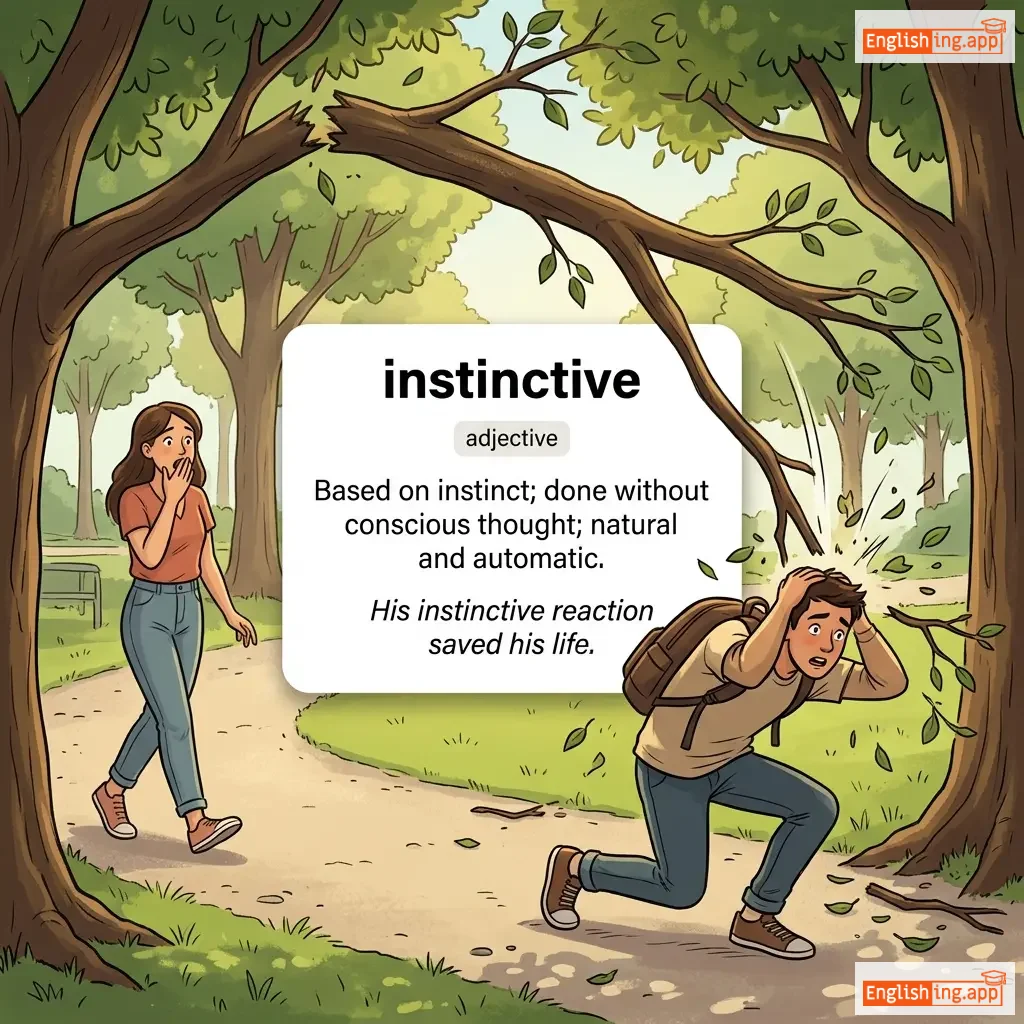
instinctive definition card — visual illustration of the meaning
adjective
/ɪnˈstɪŋk.tɪv/
स्वाभाविक, सहज, स्वनिर्भर (swabhavik, sahaj, swanirbhar)

Based on instinct; done without conscious thought; natural and automatic.

"His instinctive reaction saved his life."

"उसकी स्वाभाविक प्रतिक्रिया ने उसकी जान बचाई।" (Uski swabhavik pratikriya ne uski jaan bachayi.)
noun, verb
/ˈɪnstɪˌtjuːt/
संस्थान (sansthan)

as a noun, an organization founded for a specific purpose; as a verb, to establish or initiate

"The university decided to institute new rules for the library."

"विश्वविद्यालय ने लाइब्रेरी के लिए नए नियम लागू करने का निर्णय लिया।" (Vishwavidyalay ne library ke liye naye niyam lagu karne ka nirnay liya.)
institution definition card — visual illustration of the meaning
noun
/ˌɪnstɪˈtjuːʃən/
संस्थान (sansthan)

an established organization, especially one dedicated to education, public service, or a particular purpose

"The hospital is a respected institution in the community."

"अस्पताल समुदाय में एक सम्मानित संस्थान है।" (Aspataal samudaay mein ek sammaanit sansthan hai.)
adjective
/ˌɪnstɪˈtjuːʃənl/
संस्थागत (sansthagat)

Relating to an organization or established practice.

"The government made several institutional reforms in education."

"सरकार ने शिक्षा में कई संस्थागत सुधार किए।" (Sarkar ne shiksha mein kai sansthagat sudhaar kiye.)
verb
/ˌɪnstɪˈtjuːʃənəlaɪz/
संस्थागत रूप देना (sansthagat roop dena)

to establish something as a formal institution, custom, or practice

"The government seeks to institutionalize environmental protection."

"सरकार पर्यावरण सुरक्षा को संस्थागत रूप से लागू करने का प्रयास करती है।" (Sarkar paryavaran suraksha ko sansthagat roop se lagu karne ka prayas karti hai.)
instruct definition card — visual illustration of the meaning
verb
/ɪnˈstrʌkt/
निर्देश देना, सिखाना (nirdesh dena, sikhana)

to tell or teach someone how to do something

"The teacher instructed the students to complete the assignment."

"अध्यापक ने छात्रों को असाइनमेंट पूरा करने का निर्देश दिया।" (Adhyapak ne chhatron ko assignment pura karne ka nirdesh diya.)
noun
/ɪnˈstrʌkʃən/
निर्देश (nirdesh)

Detailed information telling how something should be done or operated.

"Please read the instruction carefully before using the machine."

"कृपया मशीन का उपयोग करने से पहले निर्देशों को ध्यान से पढ़ें।" (kripya machine ka upyog karne se pehle nirdeshon ko dhyaan se padhein.)
adjective
/ɪnˈstrʌkʃənəl/
शिक्षणात्मक (shikshanatmak)

providing knowledge or information; intended to teach

"The website offers many instructional videos for beginners."

"वेबसाइट शुरुआती लोगों के लिए कई शिक्षणात्मक वीडियो प्रदान करती है।" (Website shuruaati logon ke liye kai shikshanatmak video pradan karti hai.)
noun
/ɪnˈstrʌkʃənz/
निर्देश (nirdesh)

Detailed information on how something should be done or operated.

"Please follow the instructions on the box."

"कृपया बॉक्स पर दिए गए निर्देशों का पालन करें।" (kripya box par diye gaye nirdeshon ka paalan karein.)
adjective
/ɪnˈstrʌktɪv/
शैक्षिक (shaikshik)

useful and informative; providing knowledge or instruction

"The lecture was highly instructive and engaging."

"व्याख्यान अत्यधिक शैक्षिक और आकर्षक था।" (Vyakhyan atyadhik shaikshik aur aakarshak tha.)
noun
/ɪnˈstrʌktər/
प्रशिक्षक (prashikshak)

A person who teaches a subject or skill.

"The driving instructor was very patient with new learners."

"ड्राइविंग प्रशिक्षक नए छात्रों के साथ बहुत धैर्यवान था।" (Driving prashikshak naye chhatron ke saath bahut dhairyavaan tha.)
noun
/ˈɪnstrəmənt/
यंत्र (yantra)

A tool or device used for a particular purpose, especially for scientific or musical work.

"The doctor used a special instrument during the surgery."

"चिकित्सक ने सर्जरी के दौरान एक विशेष यंत्र का उपयोग किया।" (Chikitsak ne surgery ke dauran ek vishesh yantra ka upyog kiya.)
instrumental definition card — visual illustration of the meaning
adjective
/ˌɪnstrʊˈmɛntəl/
महत्वपूर्ण (mahatvapoorn)

serving as an instrument or means to an end; helpful or useful

"His instrumental role in the project was vital to its success."

"परियोजना में उसकी महत्वपूर्ण भूमिका सफलता के लिए आवश्यक थी।" (Pariyojana mein uski mahatvapoorn bhumika safalta ke liye avashyak thi.)
noun
/ˌɪn.strəˈmɛn.təl.ɪst/
वाद्य यंत्री (vaadya yantri)

A person who plays a musical instrument.

"The instrumentalist played a beautiful solo on the violin."

"वाद्य यंत्री ने वायलिन पर एक सुंदर एकल प्रदर्शन किया।" (Vaadya yantri ne violin par ek sundar ekal pradarshan kiya.)
adjective
/ˌɪn.səˈbɔːr.dɪ.nət/
अधीनस्थ न होना (adhinasth na hona)

Defiant of authority; disobedient to orders.

"The insubordinate employee refused to follow the manager's instructions."

"अधीनस्थ कर्मचारी ने प्रबंधक के निर्देशों का पालन करने से इनकार कर दिया।" (Adhinasth karyakarta ne prabandhak ke nirdeshon ka paalan karne se inkaar kar diya.)
noun
/ˌɪn.səˌbɔːr.dɪˈneɪ.ʃən/
अवज्ञा (avignya)

Defiance of authority; refusal to obey orders.

"The soldier was punished for insubordination during the mission."

"मिशन के दौरान अवज्ञा के लिए सैनिक को सजा दी गई।" (Mission ke dauran avignya ke liye sainik ko saza di gayi.)
adjective
/ˌɪn.səbˈstæn.ʃəl/
अस्थिर (asthir)

Lacking strength, substance, or solidity.

"The evidence provided was insubstantial and unconvincing."

"दिया गया सबूत अस्थिर और अविश्वसनीय था।" (Diya gaya saboot asthir aur avishwasniya tha.)
adjective
/ɪnˈsʌf.ər.ə.bəl/
असहनीय (asahniya)

Too extreme to bear; intolerable.

"The heat during the summer was insufferable."

"गर्मी गर्मी के दौरान असहनीय थी।" (garmi garmi ke dauran asahniya thi.)
noun
/ˌɪnsəˈfɪʃənsi/
अपर्याप्तता (aparyaptata)

The state of not being enough or not being adequate.

"The project failed due to the insufficiency of funds."

"परियोजना निधि की अपर्याप्तता के कारण विफल हो गई।" (pariyojna nidhi ki aparyaptata ke karan viphal ho gayi.)
adjective
/ˌɪnsəˈfɪʃənt/
अपर्याप्त (aparyapt)

Not enough; inadequate.

"His explanation was insufficient to clear the confusion."

"उसकी व्याख्या भ्रम को दूर करने के लिए अपर्याप्त थी।" (uski vyakhya bhram ko door karne ke liye aparyapt thi.)
adjective
/ˈɪnsjələr/
संकीर्णमना, द्वीपसंबंधी (sankeernamana, dweepsambandhi)

Narrow-minded, isolated, or relating to an island.

"The community was criticized for its insular attitudes toward outsiders."

"समुदाय को बाहरी लोगों के प्रति अपनी संकीर्णमना दृष्टिकोण के लिए आलोचना की गई थी।" (samuday ko baahari logon ke prati apni sankeernamana drishtikon ke liye alochana ki gayi thi.)
insularity definition card — visual illustration of the meaning
noun
/ˌɪnsjəˈlærəti/
संकीर्णता (sankirnta)

The state of being isolated or narrow-minded.

"The insularity of the group prevented them from accepting new ideas."

"ग्रुप की संकीर्णता ने उन्हें नए विचारों को स्वीकारने से रोक दिया।" (grup ki sankirnta ne unhein naye vicharon ko svikarna se rok diya.)
verb
/ˈɪnsjuleɪt/
इन्सुलेट करना (insulet karna)

To protect something by covering it, especially to prevent heat, sound, or electricity from escaping or entering.

"The house was insulated to reduce heating costs."

"घर को हीटिंग खर्च कम करने के लिए इन्सुलेट किया गया था।" (ghar ko heating kharch kam karne ke liye insulet kiya gaya tha.)
insulation definition card — visual illustration of the meaning
noun
ˌɪnsjʊˈleɪʃən
इन्सुलेशन (insulation)

Material used to prevent heat, sound, or electricity from being transmitted from one area to another.

"Insulation of food storage areas can prevent pests from entering."

"खाद्य भंडारण क्षेत्रों का इन्सुलेशन कीटों को प्रवेश करने से रोक सकता है।" (Khadya bhandaran kshetron ka insulation keeton ko pravesh karne se rok sakta hai.)
insult definition card — visual illustration of the meaning
verb
/ˈɪnsʌlt/
अपमान करना (apmān karnā)

to speak to or treat someone with disrespect or scorn

"He insulted her by calling her lazy in front of everyone."

"उसने उसे सबके सामने आलसी कहकर अपमान किया।" (Usne use sabke sāmanē ālsī kehkar apmān kiyā.)
insuperable definition card — visual illustration of the meaning
adjective
/ɪnˈsuːpərəbl/
अजेय (ajey)

Impossible to overcome or surpass.

"The team faced insuperable challenges during the expedition."

"टीम ने अभियान के दौरान अजेय चुनौतियों का सामना किया।" (Team ne abhiyan ke dauran ajey chunautiyon ka samna kiya.)
adjective
/ˌɪnsəˈpɔːrtəbl̩/
असहनीय (asahniya)

Too extreme or difficult to be endured.

"The heat was insupportable during the long journey."

"लंबी यात्रा के दौरान गर्मी असहनीय थी।" (Lambi yatra ke dauran garmi asahniya thi.)
adjective
/ˌɪnsəˈprɛsəbl/
अवरोधनीय (avrodhniya)

That cannot be suppressed or restrained.

"She had an insuppressible urge to laugh during the ceremony."

"उसे समारोह के दौरान हंसने की अवरोधनीय इच्छा हो रही थी।" (Use samaroho ke dauran hansne ki avrodhniya ichcha ho rahi thi.)
noun
/ɪnˈʃʊərəns/
बीमा (bima)

An arrangement by which a company provides compensation for loss, damage, or illness in return for a premium.

"He bought health insurance to cover medical expenses."

"उसने चिकित्सा खर्च कवर करने के लिए स्वास्थ्य बीमा खरीदी।" (Usne chikitsa kharch cover karne ke liye swasthya bima khareedi.)
insure definition card — visual illustration of the meaning
verb
/ɪnˈʃʊr/
बीमा करना, सुरक्षित करना (bima karna, surakshit karna)

to arrange for compensation in case of loss or damage, typically by taking out insurance

"You should insure your car against theft or accidents."

"तुम्हें अपनी कार को चोरी या दुर्घटनाओं से बचाने के लिए इन्श्योर करना चाहिए।" (Tumhe apni car ko chori ya durghaton se bachane ke liye inshyor karna chahiye.)
noun
/ɪnˈsɜːrdʒəns/
विद्रोह (vidroh)

An act of rebellion or uprising against authority.

"The government struggled to contain the growing insurgence."

"सरकार को बढ़ते हुए विद्रोह को नियंत्रित करने में कठिनाई हो रही थी।" (Sarkar ko badhte hue vidroh ko niyantrit karne mein kathinai ho rahi thi.)
noun
/ɪnˈsɜːrdʒənt/
विद्रोही (vidrohi)

A person who rises in revolt against authority or government.

"The army arrested several insurgents after the attack."

"सेना ने हमले के बाद कई विद्रोहियों को गिरफ्तार किया।" (Sena ne hamle ke baad kai vidrohiyon ko giraftaar kiya.)
adjective
/ˌɪnsərˈmaʊntəbl/
अतिरिक्त (atirikt)

Too great to be overcome.

"The explorers faced insurmountable odds in the desert."

"अन्वेषकों को रेगिस्तान में अभेद्य बाधाओं का सामना करना पड़ा।" (Anveshako ko registan mein abhedya baadhayon ka saamna karna pada.)
noun
/ˌɪnsəˈrɛkʃən/
विद्रोह (vidroh)

A violent uprising against an authority or government.

"The army was called in to suppress the insurrection."

"सेना को विद्रोह को दबाने के लिए बुलाया गया था।" (Sena ko vidroh ko dabane ke liye bulaya gaya tha.)
adjective
/ɪnˈtækt/
अखंड (akhand)

Remaining whole, complete, and undamaged.

"Despite the storm, the old house remained intact."

"तूफान के बावजूद, पुराना घर अखंड बना रहा।" (Toofan ke bawajood, purana ghar akhand bana raha.)
noun
/ˈɪnˌteɪk/
इंटेक (intek)

the process of taking something in, especially food or drink

"He monitored his daily intake of calories to maintain a healthy diet."

"उसने अपने दैनिक कैलोरी इंटेक की निगरानी की ताकि एक स्वस्थ आहार बनाए रखा जा सके।" (Usne apne dainik kaeloree intek ki nigraani ki taaki ek swasth aahaar banaye rakha ja sake.)
intangible definition card — visual illustration of the meaning
adjective
/ɪnˈtændʒəbl/
अमूर्त (amurt)

Unable to be touched or grasped; not having a physical presence.

"Trust is an intangible quality in relationships."

"विश्वास रिश्तों में एक अमूर्त गुण है।" (Vishwas rishteon mein ek amurt gun hai.)
integral definition card — visual illustration of the meaning
adjective
/ˈɪntɪɡrəl/ or /ɪnˈtɛɡrəl/
अविभाज्य (avibhajya)

Necessary and important as a part of a whole.

"Honesty is an integral part of good leadership."

"ईमानदारी अच्छे नेतृत्व का अविभाज्य हिस्सा है।" (Imandari achhe netritva ka avibhajya hissa hai.)
verb
/ˈɪntɪɡreɪt/
एकीकृत करना (ekikrit karna)

To combine or bring together into a unified whole.

"The new system integrates data from multiple sources."

"नया सिस्टम विभिन्न स्रोतों से डेटा को एकीकृत करता है।" (Naya system vibhinn sroton se data ko ekikrit karta hai.)
integrated definition card — visual illustration of the meaning
adjective
/ˈɪntɪɡreɪtɪd/
एकीकृत (ekikrit)

combined or united to form a whole; including all parts or people equally

"The company offers an integrated system for managing all business operations."

"कंपनी सभी व्यापार संचालन को प्रबंधित करने के लिए एकीकृत प्रणाली प्रदान करती है।" (Company sabhi vyapar sanchaalan ko prabandhit karne ke liye ekikrit pranali pradan karti hai.)
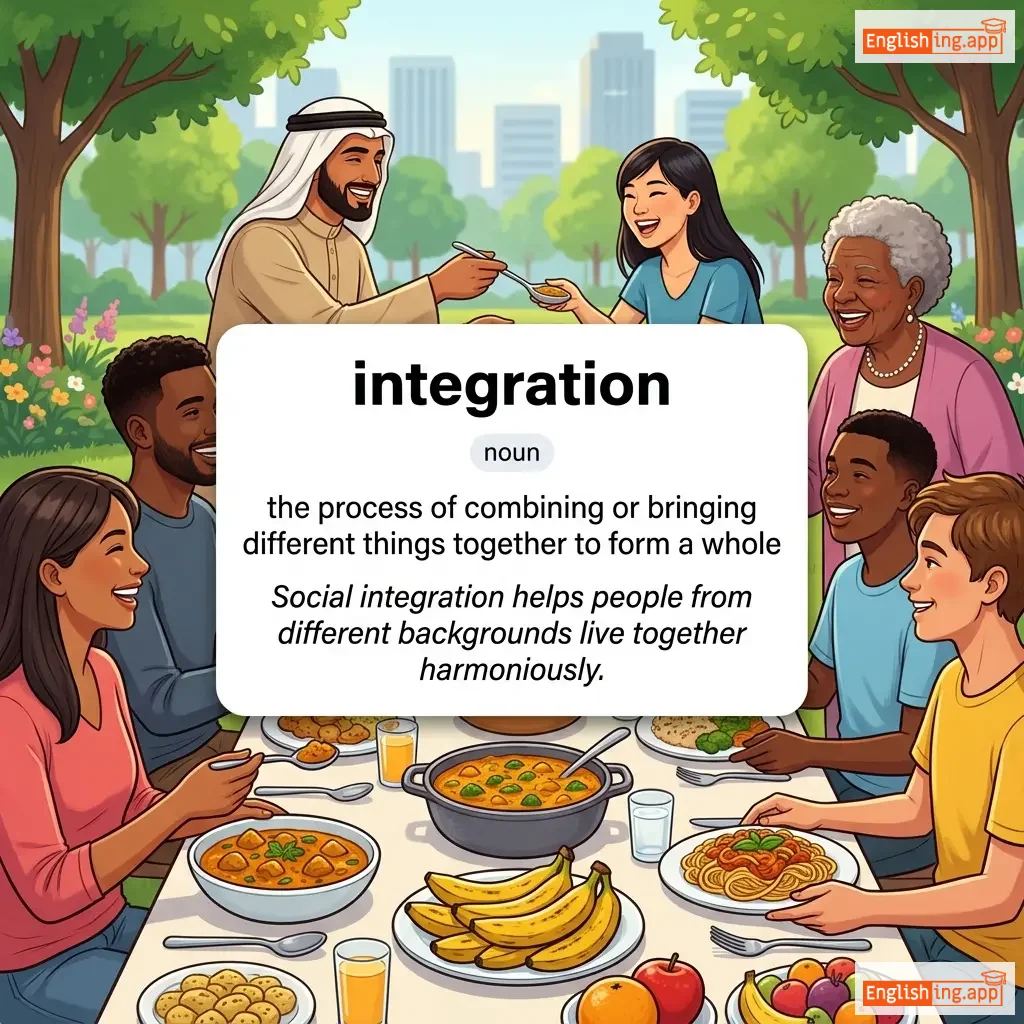
integration definition card — visual illustration of the meaning
noun
/ˌɪntɪˈɡreɪʃən/
एकीकरण (ekikaran)

the process of combining or bringing different things together to form a whole

"Social integration helps people from different backgrounds live together harmoniously."

"सामाजिक एकीकरण विभिन्न पृष्ठभूमियों से आए लोगों को सामंजस्यपूर्ण तरीके से एक साथ रहने में मदद करता है।" (Samajik ekikaran vibhinn prishthabhumi se aaye logon ko samanjasyapurn tareeke se ek saath rehne mein madad karta hai.)