वोकैबुलरीज

इंग्लिश वोकैबुलरी डिस्कवर, लर्न और मास्टर करें

adverb
/ˈɡrædʒuəli/
धीरे-धीरे (dheere dheere)

Slowly and steadily, taking place step by step.

"She gradually improved her English over the year."

"वह साल भर में धीरे-धीरे अपनी अंग्रेज़ी सुधार रही थी।" (Woh saal bhar mein dheere-dheere apni angrezi sudhaar rahi thi.)
noun, verb
/ˈɡrædʒuət/ (noun), /ˈɡrædʒueɪt/ (verb)
स्नातक (snatak)

As a noun: a person who has completed a course of study; As a verb: to complete a course of study successfully.

"She will graduate from university next year."

"वह अगले साल विश्वविद्यालय से स्नातक करेगी।" (vah agle saal vishwavidyalay se snatak karegi.)
adjective
/ˈɡrædʒuˌeɪtɪd/
स्नातक / स्तरबद्ध (snatak / starrabdh)

Arranged in steps, levels, or stages; having completed a course of study and received a degree

"The scientist used a graduated cylinder to measure the liquid precisely."

"वैज्ञानिक ने तरल को सटीक रूप से मापने के लिए एक ग्रैजुएटेड सिलिंडर का उपयोग किया।" (Vaigyanik ne taral ko sathik roop se maapne ke liye ek graduated cylinder ka upyog kiya.)
noun
/ˌɡrædʒ.uˈeɪ.ʃən/
खुशी (khushi)

the act of receiving a degree or diploma after completing a course of study

"Her parents attended her graduation ceremony with pride."

"उसे पुरस्कार मिलने पर अपनी खुशी छिपाना मुश्किल था।" (Use puraskar milne par apni khushi chhupana mushkil tha.)
noun
/ɡrəˈfiː.ti/
दीवारों पर लिखे गए शब्द या चित्र (diwaron par likhe gaye shabd ya chitra)

writing or drawings scribbled, scratched, or sprayed illicitly on a wall or other surface in a public place

"The subway walls were covered with colorful graffiti created by local street artists."

"सबवे की दीवारों को स्थानीय सड़क कलाकारों द्वारा बनाई गई रंगीन ग्रैफ़िटी से ढका गया था।" (subve ki diwaaroon ko sthaniy sadak kalaakaron dwara banayi gayi rangeen graffiti se dhaka gaya tha)
noun/verb
/ɡræft/
ग्राफ्ट / घूस (graft / ghoos)

To join or insert a part of one plant or tissue into another; also refers to corruption or bribery

"The surgeon performed a skin graft to treat the burn victim."

"सर्जन ने जलने के शिकार को इलाज करने के लिए त्वचा का ग्राफ्ट किया।" (Sarjan ne jalne ke shikar ko ilaaj karne ke liye tvacha ka graft kiya.)
noun
/ɡreɪn/
अनाज (anaaj)

a small hard seed of a cereal plant such as wheat or rice; a tiny particle of a substance

"A grain of rice fell off the plate."

"चावल का एक दाना प्लेट से गिर गया।" (chawal ka ek dana plet se gir gaya.)
noun
/ɡræm/
चना (chana)

chickpea; a leguminous plant and its edible seed

"She cooked gram curry for lunch today."

"उसने आज दोपहर के भोजन के लिए चने की करी बनाई।" (usne aaj dopahar ke bhojan ke liye chane ki kari banayi.)
noun
/ˈɡræmər/
व्याकरण (vyakaran)

the system and structure of a language, including rules for syntax, morphology, and usage

"She studied grammar to improve her writing skills."

"उसने अपनी लेखन क्षमता सुधारने के लिए व्याकरण पढ़ा।" (usne apni lekhan kshamata sudharne ke liye vyakaran padha)
noun
/ˈɡrænəri/
अनाज का गोदाम (anaaj ka godaam)

A storehouse for grain; a region that produces a large amount of grain

"The farmers stored their harvest in the village granary."

"किसानों ने अपने फसल को गांव के अनाज के गोदाम में संग्रहित किया।" (Kisano ne apne fasal ko gaon ke anaaj ke godaam mein sangrahit kiya.)
adjective
/ɡrænd/
शानदार (shandaar)

magnificent and impressive in appearance, size, or style

"They stayed at a grand hotel in Paris."

"वे पेरिस में एक शानदार होटल में ठहरे थे।" (Ve Paris mein ek shandaar hotel mein thahre the.)
noun
/ˈɡrænd.tʃaɪld/
पोता या पोती (pota ya poti)

the child of one's son or daughter

"They love spending time with their grandchild on weekends."

"वे सप्ताहांत में अपने पोते या पोती के साथ समय बिताना पसंद करते हैं।" (Ve saptahant mein apne pote ya poti ke saath samay bitana pasand karte hain.)
noun
/ˈɡræn(d)ˌdɔːtər/
पोती (poti)

the daughter of one’s son or daughter

"Her granddaughter visits her every weekend."

"उसकी पोती हर सप्ताहांत उससे मिलने आती है।" (uski poti har saptahant usse milne aati hai)
Grandeur definition card — visual illustration of the meaning
noun
/ˈɡrændʒər/
महिमा (maheema)

Impressive beauty, scale, or magnificence

"The grandeur of the palace left the visitors speechless."

"महल की महिमा ने आगंतुकों को हैरान कर दिया।" (mahal ki maheema ne aagantukon ko hairaan kar diya.)
noun
/ˈɡrændˌfɑːðər/
दादा / नाना (dada / nana)

the father of one's father or mother

"My grandfather tells us stories every evening."

"मेरा दादा हमें हर शाम कहानियाँ सुनाता है।" (Mera dada humein har shaam kahaniyan sunata hai.)
noun
/ˈɡrændɪləkwəns/
घमंडपूर्ण भाषा (ghamandpurn bhasha)

Pompous or extravagant language, style, or manner, often intended to impress

"The politician’s speech was full of empty grandiloquence."

"राजनेता का भाषण खाली घमंडपूर्ण शब्दों से भरा हुआ था।" (Rajneta ka bhashan khaali ghamandpurn shabdon se bhara hua tha.)
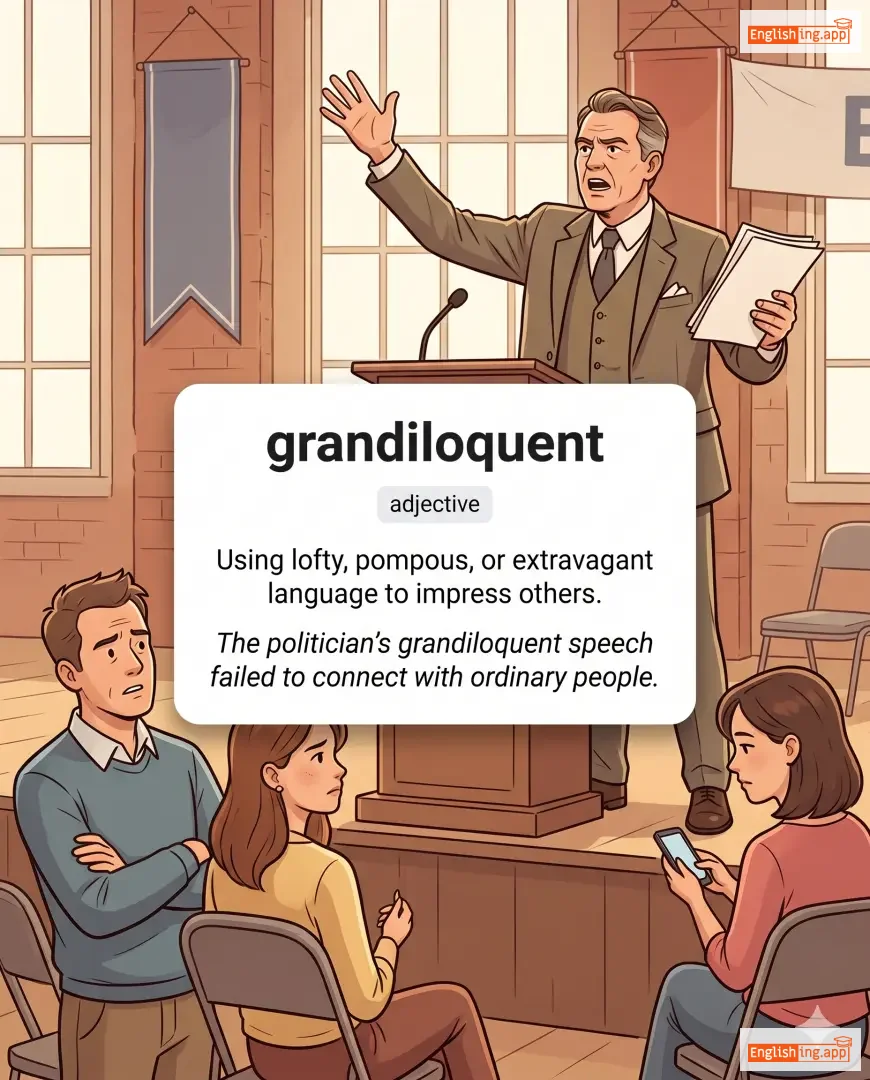
grandiloquent definition card — visual illustration of the meaning
adjective
/ɡrænˈdɪləkwənt/
उत्कृष्ट भाषा (utkrisht bhasha)

Using lofty, pompous, or extravagant language to impress others.

"The politician’s grandiloquent speech failed to connect with ordinary people."

"राजनीतिज्ञ का उत्कृष्ट भाषण आम लोगों से जुड़ने में विफल रहा।" (Rajnitik ka utkrisht bhashan aam logon se judne mein viphall raha.)
adjective
/ˈɡrændioʊs/
भव्य (bhavya)

Impressive or magnificent in appearance or style, often pretentiously so.

"He had grandiose plans of building a futuristic city in the desert."

"उसके पास रेगिस्तान में एक भविष्यवादी शहर बनाने के भव्य योजनाएँ थीं।" (Uske paas registan mein ek bhavishyavadi shaher banane ke bhavya yojnaayein thin.)
noun
/ˈɡrændˌmʌðər/
दादी / नानी (dadi / nani)

the mother of one's father or mother

"My grandmother makes delicious cakes."

"मेरी दादी स्वादिष्ट केक बनाती हैं।" (meri dadi swadisht kek banati hain.)
noun
/ˈɡrændˌpeə.rənt/
दादी-नानी या दादा-नाना (dadi-nani ya dada-nana)

the parent of one's father or mother

"My grandparents live in a small village near the hills."

"मेरे दादी-नानी एक छोटे से गांव में रहते हैं जो पहाड़ों के पास है।" (Mere dadi-nani ek chhote se gaon mein rehte hain jo pahadon ke paas hai.)
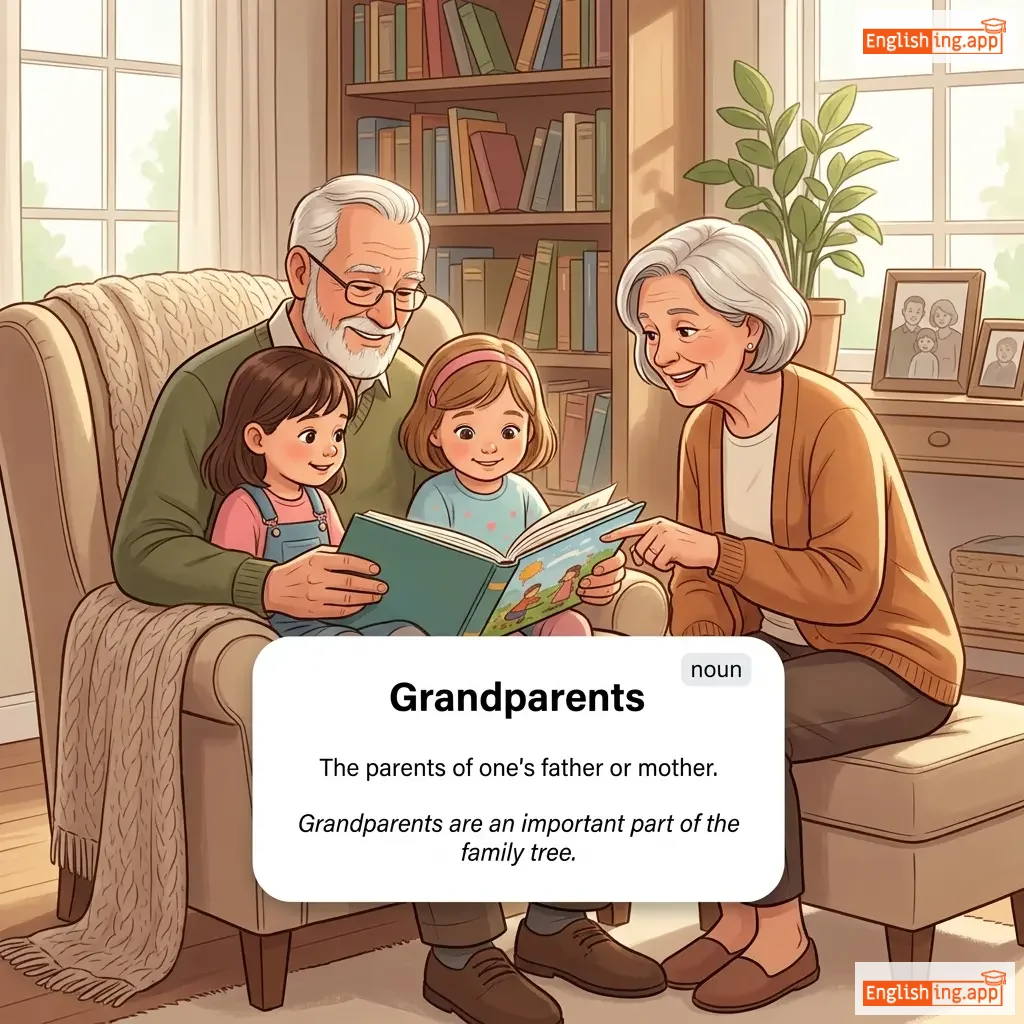
Grandparents definition card — visual illustration of the meaning
noun
ˈɡrænˌpɛrənts
दादी-नाना या दादा-दादी (daadee-naanaa ya daadaa-daadee)

The parents of one's father or mother.

"Grandparents are an important part of the family tree."

"दादी-नाना या दादा-दादी परिवार के महत्वपूर्ण हिस्से होते हैं।" (Daadee-naanaa ya daadaa-daadee parivaar ke mahatvapurn hisse hote hain.)
noun
/ˈɡrændsʌn/
पोता (pota)

the son of one's son or daughter

"His grandson visits him every weekend."

"उसका पोता हर सप्ताहांत उससे मिलने आता है।" (uska pota har saptahant usse milne aata hai)
verb
/ˈɡrændstænd/
ध्यान आकर्षित करने के लिए शो करने के तरीके से व्यवहार करना (dhyan akarshit karne ke liye show karne ke tareeke se vyavhaar karna)

To seek attention or applause by behaving or speaking in a showy way.

"The actor was accused of grandstanding during the charity event."

"चैरिटी इवेंट में अभिनेता पर ग्रैंडस्टैंडिंग का आरोप लगा था।" (Charity event mein abhinetaa par grandstanding ka aarop laga tha.)
grant definition card — visual illustration of the meaning
verb
/ɡrænt/
प्रदान करना (pradan karna)

To give or allow something, usually in an official or formal way.

"The university granted him a scholarship for his excellent results."

"विश्वविद्यालय ने उसे उसकी उत्कृष्ट परिणामों के लिए एक छात्रवृत्ति प्रदान की।" (Vishwavidyalay ne use uski utkrist parinaamon ke liye ek chhatravritti pradan ki.)
noun
/ɡrænˈtiː/
ग्रांटी (grantee)

A person or organization that receives a grant or benefit.

"The grantee must submit a progress report every six months."

"ग्रांटी को हर छह महीने में एक प्रगति रिपोर्ट प्रस्तुत करनी चाहिए।" (Grantee ko har chhah mahine mein ek pragati report prastut karni chahiye.)
noun
/ˈɡræn.tɔːr/
दानदाता (danadata)

A person or entity that makes a grant or transfers property or rights to another.

"The grantor transferred the property rights to the nonprofit organization."

"दानदाता ने संपत्ति अधिकार गैर-लाभकारी संगठन को स्थानांतरित कर दिए।" (Danadata ne sampatti adhikar gair-labhkari sangathan ko sthantarit kar diye.)
adjective
/ˈɡræn.jʊ.lər/
अनाज जैसा (anaaj jaisa)

Consisting of small grains or particles; detailed and specific.

"The report provided a granular analysis of the market data."

"रिपोर्ट ने बाजार डेटा का एक विस्तारपूर्ण विश्लेषण प्रदान किया।" (Report ne bazaar data ka ek vistaarpoorv vishleshan pradan kiya.)
verb
/ˈɡræn.jʊ.leɪt/
दानेदार बनाना (danedar banana)

To form or cause to form into grains or small particles.

"The sugar began to granulate as it cooled."

"चीनी ठंडी होने पर दानेदार होने लगती है।" (Cheeni thandi hone par danedar hone lagti hai.)
noun
/ˈɡræn.juːl/
कणिका (kanika)

A small compact particle of a substance.

"Each granule of salt sparkled under the sunlight."

"हर नमक का कण सूर्य की रोशनी में चमक रहा था।" (Har namak ka kan sury ki roshni mein chamak raha tha.)
noun
/ɡreɪp/
अंगूर (angoor)

a small, round fruit that grows in clusters on vines and is used to make wine or eaten as food

"She picked a bunch of grapes from the vine."

"उसने बेल से अंगूर का गुच्छा तोड़ा।" (Usne bel se angur ka guchcha toda.)
noun
/ɡreɪps/
अंगूर (angoor)

small round fruits that grow in clusters on vines; used to make wine

"She bought a bunch of grapes from the market."

"उसने बाजार से अंगूर का गुच्छा खरीदा।" (Usne bazaar se angur ka guchha khareeda.)
adjective
/ˈɡræf.ɪk/
ग्राफ़िक (graphic)

Relating to visual art, especially involving drawing, design, or vivid description.

"The movie contained graphic scenes of violence."

"मूवी में हिंसा के ग्राफ़िक दृश्य थे।" (Movie mein hinsa ke graphic drishya the.)
noun
/ˈɡræfɪks/
ग्राफिक्स (graphics)

visual images, designs, or drawings used to convey information or artistic expression

"The website uses stunning graphics to attract visitors."

"वेबसाइट आगंतुकों को आकर्षित करने के लिए शानदार ग्राफिक्स का उपयोग करती है।" (website aagantukon ko aakarshit karne ke liye shandaar graphics ka upyog karti hai.)
noun
/ˈɡræfaɪt/
ग्रैफाइट (graphite)

a soft, black form of carbon used in pencils and as a lubricant

"The artist sketched the portrait using a graphite pencil."

"कलाकार ने ग्रैफाइट पेंसिल से चित्र खींचा।" (Kalakar ne graphite pencil se chitra kheenchha.)
verb
/ˈɡræpəl/
संघर्ष करना, जूझना (sangharsh karna, jujhna)

to struggle or wrestle with something, often a problem or opponent

"The company is grappling with financial difficulties."

"कंपनी वित्तीय समस्याओं से जूझ रही है।" (Company vittiya samasyaon se jujh rahi hai.)
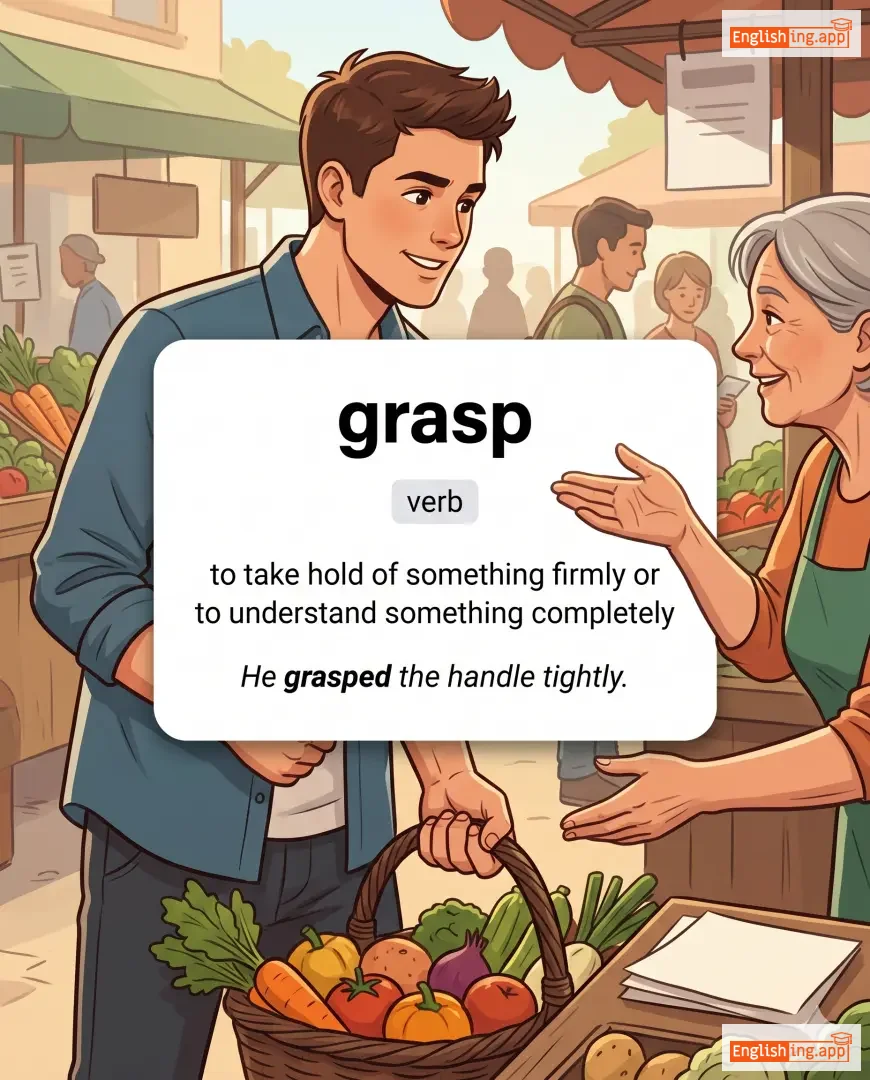
grasp definition card — visual illustration of the meaning
verb
/ɡrɑːsp/
मजबूती से पकड़ना या पूरी तरह से समझना (majbooti se pakadna ya puri tarah se samajhna)

to take hold of something firmly or to understand something completely

"He grasped the handle tightly."

"उसने हैंडल को मजबूती से पकड़ा।" (Usne handle ko majbooti se pakda.)
verb/adjective
/ˈɡræspɪŋ/
मजबूती से पकड़ना / लालची (majbooti se pakadna / laalchi)

Holding firmly; or (as an adjective) excessively greedy.

"The child was grasping her mother’s hand tightly."

"बच्चा अपनी मां का हाथ मजबूती से पकड़ रहा था।" (Baccha apni maan ka haath majbooti se pakad raha tha.)
noun
/ɡræs/
खुशी (khushi)

plants with narrow green leaves, often covering the ground in fields or gardens

"Children are playing on the grass."

"जब उसे पुरस्कार मिला तो वह अपनी खुशी नहीं छिपा पाई।" (Jab use puraskar mila to vah apni khushi nahin chhupa pai.)
noun
/ˈɡræs.hɒp.ər/
टिड्डा (tiddā)

a jumping insect with long hind legs that feeds on grass and plants

"The grasshopper jumped from one leaf to another."

"टिड्डा एक पत्ते से दूसरे पत्ते पर कूद गया।" (Tiddā ek patte se doosre patte par kood gayā.)
adjective
/ˈɡræs.i/
घासदार (ghaasdaar)

covered with grass; resembling grass in color; green like grass

"The grassy field stretched as far as the eye could see."

"घास से ढके मैदान की सीमा तक नजर जाती थी." (ghaas se dhake maidan ki seema tak najar jaati thi)
verb
/ɡreɪt/
कुचलना, चिढ़ाना (kuchalna, chidhana)

to shred food into small pieces using a grater; to irritate or annoy

"She grated the cheese for the pasta dish."

"उसने पास्ता डिश के लिए पनीर ग्रेट किया।" (Usne pasta dish ke liye paneer grate kiya.)
adjective
/ˈɡreɪtfəl/
आभारी (aabhari)

feeling or showing thanks for something or someone

"I am grateful for your help."

"मैं आपकी मदद के लिए आभारी हूँ।" (Main aapki madad ke liye aabhari hoon.)
noun
/ˈɡreɪt.fəl.nəs/
आभार (aabhaar)

the quality of being thankful; readiness to show appreciation for kindness

"She expressed her gratefulness to the doctors who saved her life."

"उसने उन डॉक्टरों के प्रति अपनी आभार व्यक्त किया जिन्होंने उसकी जान बचाई।" (Usne un doktoron ke prati apni aabhaar vyakt kiya jinhone uski jaan bachayi.)
noun
/ˈɡreɪ.tər/
कद्दूकस (kaddookas)

a kitchen utensil with a rough surface for grating food into small pieces

"Use the grater to grate cheese for the pizza."

"पिज़ा के लिए पनीर कद्दूकस करने के लिए कद्दूकस का उपयोग करें।" (piza ke liye paneer kaddookas karne ke liye kaddookas ka upyog karein.)
gratification definition card — visual illustration of the meaning
noun
/ˌɡrætɪfɪˈkeɪʃən/
संतुष्टि, तृप्ति (santushti, tripti)

the feeling of pleasure or satisfaction when something is achieved or received

"She felt great gratification after completing the project."

"उसने परियोजना पूरा करने के बाद गहरी तृप्ति महसूस की।" (Usne pariyojna poora karne ke baad gehri tripti mahsus ki.)
verb
/ˈɡrætɪfaɪ/
संतुष्ट करना, खुश करना (santusht karna, khush karna)

to give pleasure or satisfaction to someone

"It gratified him to know his work was appreciated."

"उसका काम सराहा गया, जिससे उसे संतोष हुआ।" (Uska kaam saraha gaya, jisse use santosh hua.)
adjective, noun
/ˈɡreɪtɪŋ/
कर्कश ध्वनि / लोहे की जाली (karkash dhvani / lohe ki jaali)

Harsh and unpleasant to the senses, especially sound; a framework of bars covering an opening.

"The teacher's grating voice made it hard to concentrate."

"शिक्षक की कर्कश आवाज़ पर ध्यान केंद्रित करना कठिन था।" (Shikshak ki karkash awaaz par dhyaan kendrit karna kathin tha.)
adverb, adjective
/ˈɡrætɪs/ or /ˈɡreɪtɪs/
निःशुल्क (nishulk)

Without charge; free of cost.

"The drinks at the event were provided gratis."

"इवेंट में ड्रिंक्स निःशुल्क प्रदान किए गए थे।" (Event mein drinks nishulk pradan kiye gaye the.)
gratitude definition card — visual illustration of the meaning
noun
/ˈɡrætɪˌtjuːd/
कृतज्ञता (kritajnyata)

The quality of being thankful; readiness to show appreciation for and return kindness.

"She expressed her gratitude to the team for their support."

"उसने टीम के समर्थन के लिए अपनी कृतज्ञता व्यक्त की।" (Usne team ke samarthan ke liye apni kritajnyata vyakt ki.)
adjective
/ɡrəˈtjuːɪtəs/
अनावश्यक (anavashyak)

Unnecessary, unwarranted, or given freely without reason or cause.

"The movie was criticized for its gratuitous violence."

"फिल्म को इसके अनावश्यक हिंसा के लिए आलोचना की गई थी" (Film ko iske anavashyak hinsa ke liye alochana ki gayi thi)