Vocabulaires

Découvrez, apprenez et maîtrisez le vocabulaire anglais

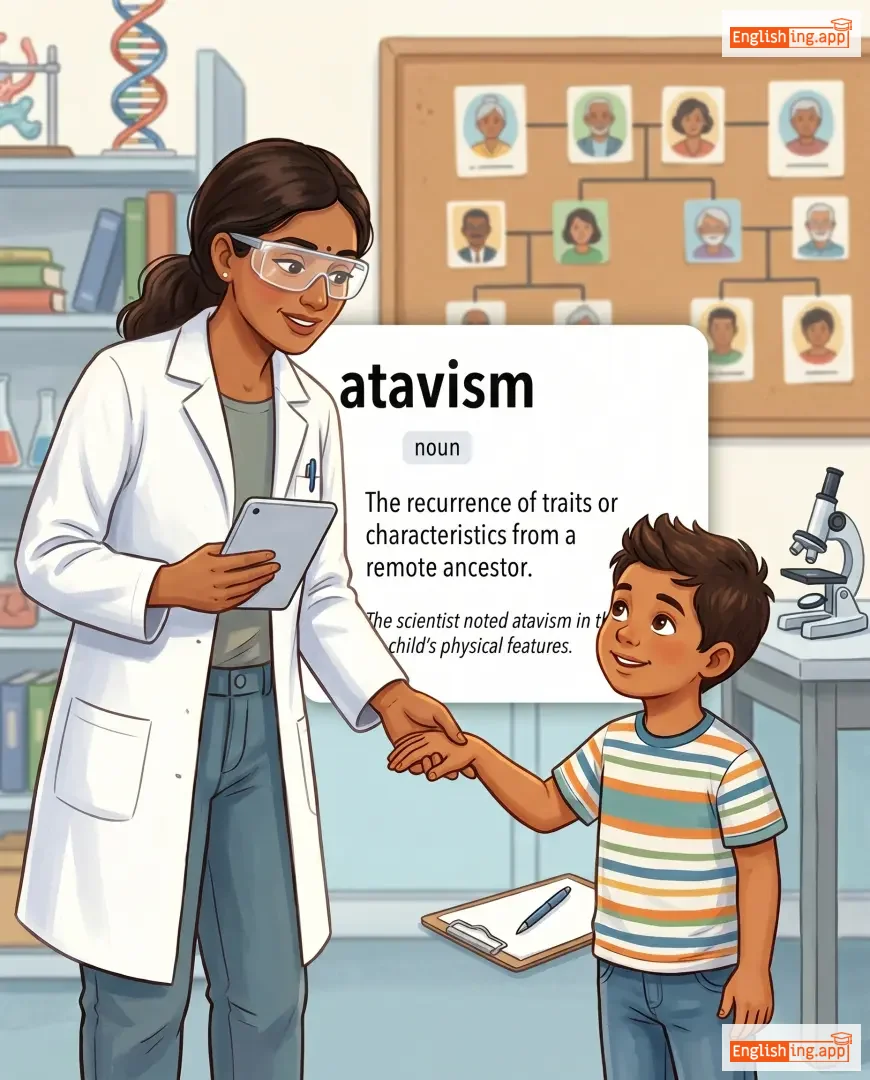
atavism definition card — visual illustration of the meaning
noun
/ˈætəvɪzəm/
atavisme (atavisme)

The recurrence of traits or characteristics from a remote ancestor.

"The scientist noted atavism in the child’s physical features."

"Le scientifique a noté de l'atavisme dans les caractéristiques physiques de l'enfant." (Le scientifique a noté de l'atavisme dans les caractéristiques physiques de l'enfant.)
noun
/ˌætəlˈjeɪ/
atelier (studio d'un artiste ou designer) (atelier (studio d'un artiste ou designer))

A workshop or studio, especially for an artist or designer.

"The painter invited us to his atelier to view his new collection."

"Le peintre nous a invités à son atelier pour voir sa nouvelle collection." (Le peintre nous a invités à son atelier pour voir sa nouvelle collection.)
noun
/ˈeɪθiɪzəm/
athéisme (atheisme)

The belief that there is no God or gods.

"He declared his atheism openly despite social pressure."

"Il a déclaré son athéisme ouvertement malgré la pression sociale." (Il a déclaré son athéisme ouvertement malgré la pression sociale.)
adjective
/ˌeɪθiˈɪstɪk/
athéiste (atheiste)

Relating to or characteristic of atheists or atheism.

"She grew up in an atheistic household with no religious rituals."

"Elle a grandi dans une maison athée sans rituels religieux." (Elle a grandi dans une maison athée sans rituels religieux.)
adjective
/əˈθɜːrst/
asif, avideux (asif, avideux)

Very eager or desirous for something.

"The explorer was athirst for adventure."

"L'explorateur était asif d'aventure." (L'explorateur était asif d'aventure.)
noun
/ˈæθliːt/
athlète (athlete)

a person who is trained or skilled in physical exercises, sports, or games requiring strength, agility, or stamina

"The athlete trained hard for the upcoming Olympic Games."

"L'athlète s'est entraîné dur pour les prochains Jeux Olympiques." (L'athlete s'est entraine dur pour les prochains Jeux Olympiques.)
adjective
/æθˈlɛtɪk/
athlétique, robuste (atletique, robuste)

physically strong, fit, and active; related to athletes or sports

"She has an athletic body because she exercises regularly."

"Elle a un corps athlétique parce qu'elle fait de l'exercice régulièrement." (Elle a un corps athletique parce qu'elle fait de l'exercice regulierement.)
adverb
/əˈθwɔːrt/
en travers, en opposition (en travers, en opposition)

Across or in opposition to something.

"A fallen tree lay athwart the road, blocking traffic."

"Un arbre tombé était allongé en travers de la route, bloquant la circulation." (Un arbre tombe etait allonge en travers de la route, bloquant la circulation.)
noun
/ˈætməsfɪər/
atmosphère (atmosfere)

the layer of gases surrounding the Earth; the mood or feeling of a place

"The restaurant had a warm and welcoming atmosphere."

"Le restaurant avait une atmosphère chaleureuse et accueillante." (Le restaurant avait une atmosphère chaleureuse et accueillante.)
adjective
/əˈtɒm.ɪk/
atomique (atomik)

relating to atoms or atomic energy; extremely small

"The atomic structure of hydrogen is the simplest."

"La structure atomique de l'hydrogène est la plus simple." (La structure atomique de l'hydrogene est la plus simple.)
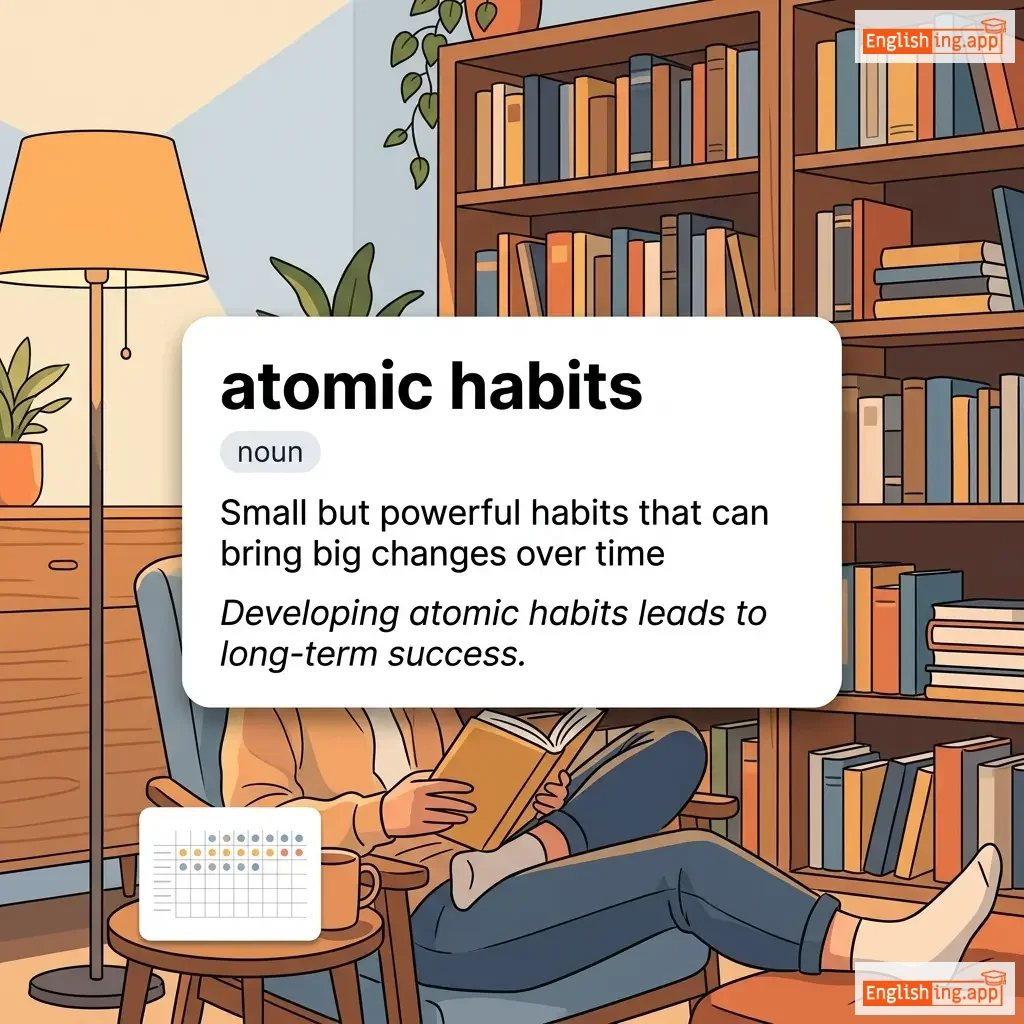
atomic habits definition card — visual illustration of the meaning
noun
/əˈtɒm.ɪk ˈhæb.ɪts/
habitudes atomiques (habitudes atomiques)

Small but powerful habits that can bring big changes over time

"Developing atomic habits leads to long-term success."

"Développer des habitudes atomiques mène à un succès à long terme." (Developper des habitudes atomiques mene a un succes a long terme.)
noun
/ˈætəmaɪzər/
atomiseur (atomiseur)

A device that sprays liquid into a fine mist.

"She used an atomizer to apply the perfume evenly."

"Elle a utilisé un atomiseur pour appliquer le parfum uniformément." (Elle a utilisé un atomiseur pour appliquer le parfum uniformément.)
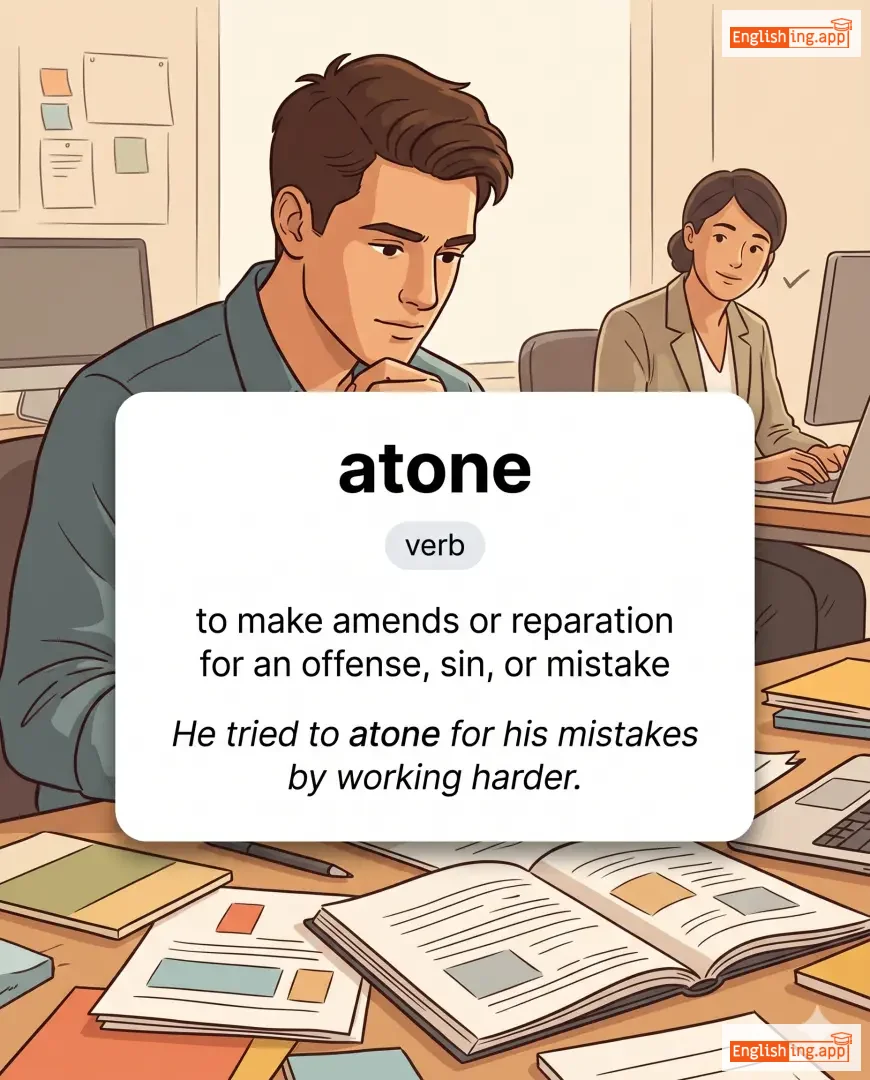
atone definition card — visual illustration of the meaning
verb
/əˈtoʊn/
expiation (expiation)

to make amends or reparation for an offense, sin, or mistake

"He tried to atone for his mistakes by working harder."

"Il a essayé de réparer ses erreurs en travaillant plus dur." (Il a essaye de reparer ses erreurs en travaillant plus dur.)
noun
/əˈtoʊnmənt/
expiation (expiation)

the act of making amends for a wrong, sin, or injury

"The festival was celebrated as a day of atonement."

"Le festival a été célébré comme un jour d'expiation." (Le festival a ete celebre comme un jour d'expiation.)
preposition
/əˈtɒp/
au sommet (au sommet)

on the top of something

"A flag was placed atop the tower."

"Un drapeau a été placé au sommet de la tour." (Un drapeau a été placé au sommet de la tour.)
adjective
/əˈtroʊʃəs/
atroce (atrose)

extremely bad, unpleasant, or cruel

"The prisoners were kept in atrocious conditions."

"Les prisonniers étaient maintenus dans des conditions atroces." (Les prisonniers étaient maintenus dans des conditions atroces.)
adverb
/əˈtroʊʃəsli/
atrocement (atrocement)

in a very cruel, shocking, or extremely bad manner

"The service at the restaurant was atrociously slow."

"Le service du restaurant était atrocement lent." (Le service du restaurant etait atrocement lent)
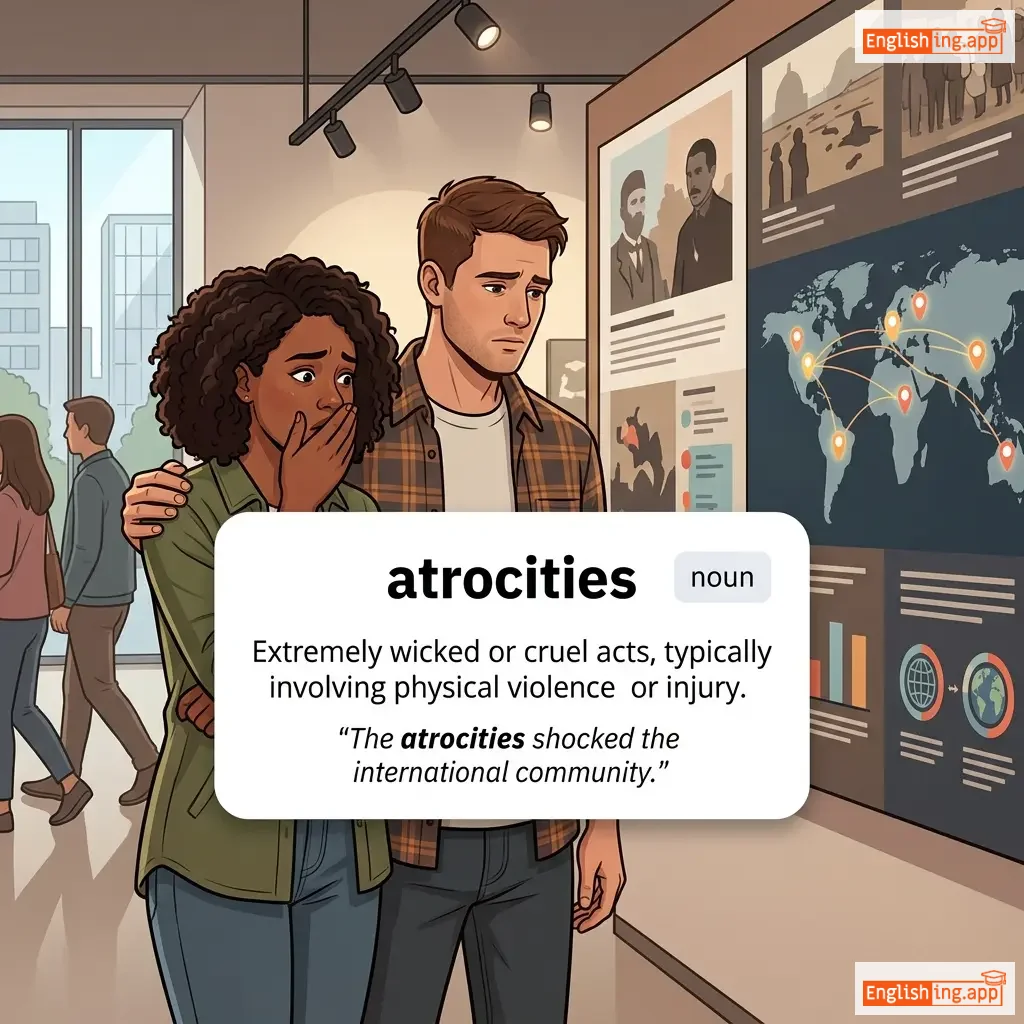
atrocities definition card — visual illustration of the meaning
noun
əˈtrɒs.ɪ.tiz
atrocités (atrocites)

Extremely wicked or cruel acts, typically involving physical violence or injury.

"The atrocities shocked the international community."

"Les atrocités ont choqué la communauté internationale." (Les atrocités ont choqué la communauté internationale.)
noun
/əˈtrɑːsəti/
atrocité (atrocité)

an extremely cruel or violent act, often involving physical violence

"The world condemned the atrocity committed against civilians."

"Le monde a condamné l'atrocité commise contre les civils." (Le monde a condamné l'atrocité commise contre les civils.)
noun/verb
/ˈætrəfi/
atrophie (atrophie)

a decrease in size or wasting away of a body part, tissue, or ability due to lack of use

"Without regular exercise, muscles may atrophy over time."

"Sans exercice régulier, les muscles peuvent s'atrophier avec le temps." (Sans exercice régulier, les muscles peuvent s'atrophier avec le temps.)
verb
/əˈtætʃ/
joindre (joindre)

to join or fasten something to another thing

"Please attach the document to the email before sending."

"Veuillez joindre le document à l'e-mail avant de l'envoyer." (Veuillez joindre le document à l'e-mail avant de l'envoyer.)
noun
/ˌætəˈʃeɪ/
attaché diplomatique (attache diplomatique)

A person officially assigned to the staff of a diplomatic mission, often with a specific area of responsibility.

"The cultural attache organized an art exhibition in the embassy."

"L'attaché culturel a organisé une exposition d'art à l'ambassade." (L'attache culturel a organise une exposition d'art a l'ambassade.)
adjective
/əˈtætʃt/
joint (joint)

joined or fastened to something; emotionally connected or fond of someone or something

"The file is attached to the email."

"Le fichier est joint à l’e-mail." (Le fichier est joint a l email)
noun
/əˈtæʧmənt/
attachement (attachement)

a strong feeling of affection or connection

"The attachment he felt to his hometown was undeniable."

"L'attachement qu'il ressentait pour sa ville natale était incontestable." (L'attachement qu'il ressentait pour sa ville natale était incontestable.)
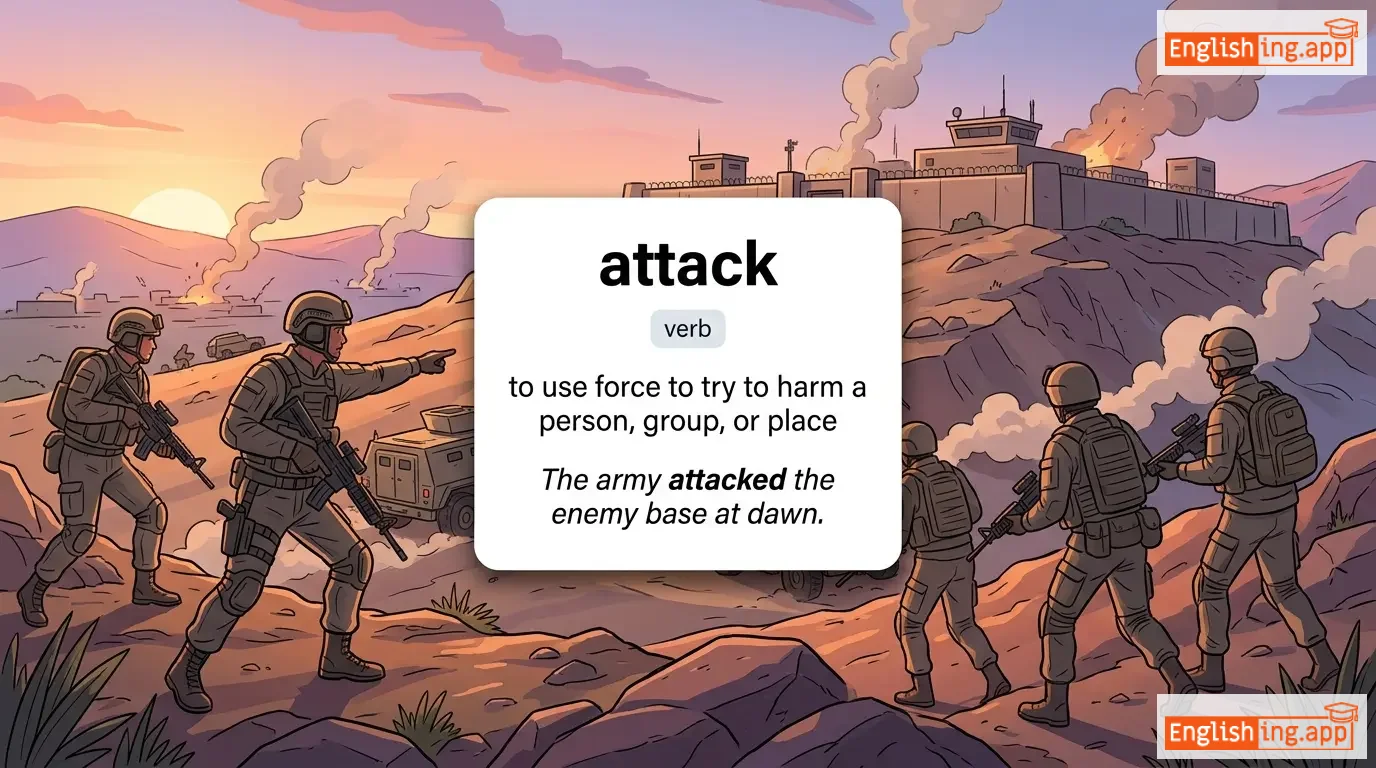
attack definition card — visual illustration of the meaning
verb
/əˈtæk/
attaquer (attaquer)

to use force to try to harm a person, group, or place

"The army attacked the enemy base at dawn."

"L'armée a attaqué la base ennemie à l'aube." (L'armée a attaqué la base ennemie à l'aube.)
verb
/əˈtækt/
a attaqué (a attaque)

physically or verbally assaulted someone or something; launched an aggressive action against a target

"The soldiers attacked the enemy at dawn."

"Les soldats ont attaqué l’ennemi à l’aube." (les soldats ont attaque l ennemi a l aube)
verb
/əˈteɪn/
atteindre (atteindre)

to achieve or reach something

"She worked hard to attain her goals."

"Elle a travaillé dur pour atteindre ses objectifs." (Elle a travaille dur pour atteindre ses objectifs.)
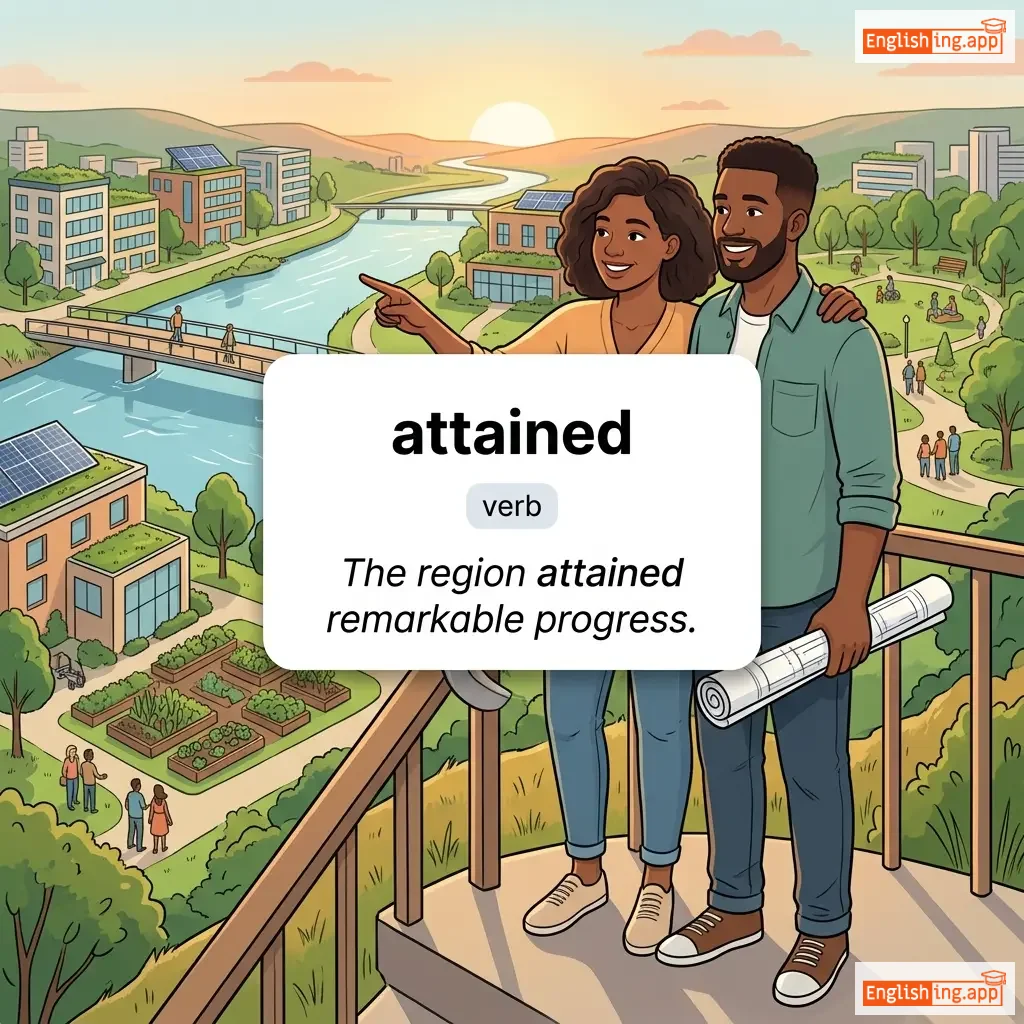
attained definition card — visual illustration of the meaning
verb
əˈteɪnd
atteint (atteint)

Succeeded in achieving (something that one desires and has worked for); reached a specified age, size, or amount.

"The region attained remarkable progress."

"La région a atteint des progrès remarquables." (La region a atteint des progrès remarquables.)
verb
/əˈtɛmpt/
tentative (tentative)

to make an effort to achieve or complete something difficult

"He attempted to climb the mountain despite the bad weather."

"Il a tenté de gravir la montagne malgré le mauvais temps." (Il a tenté de gravir la montagne malgré le mauvais temps.)
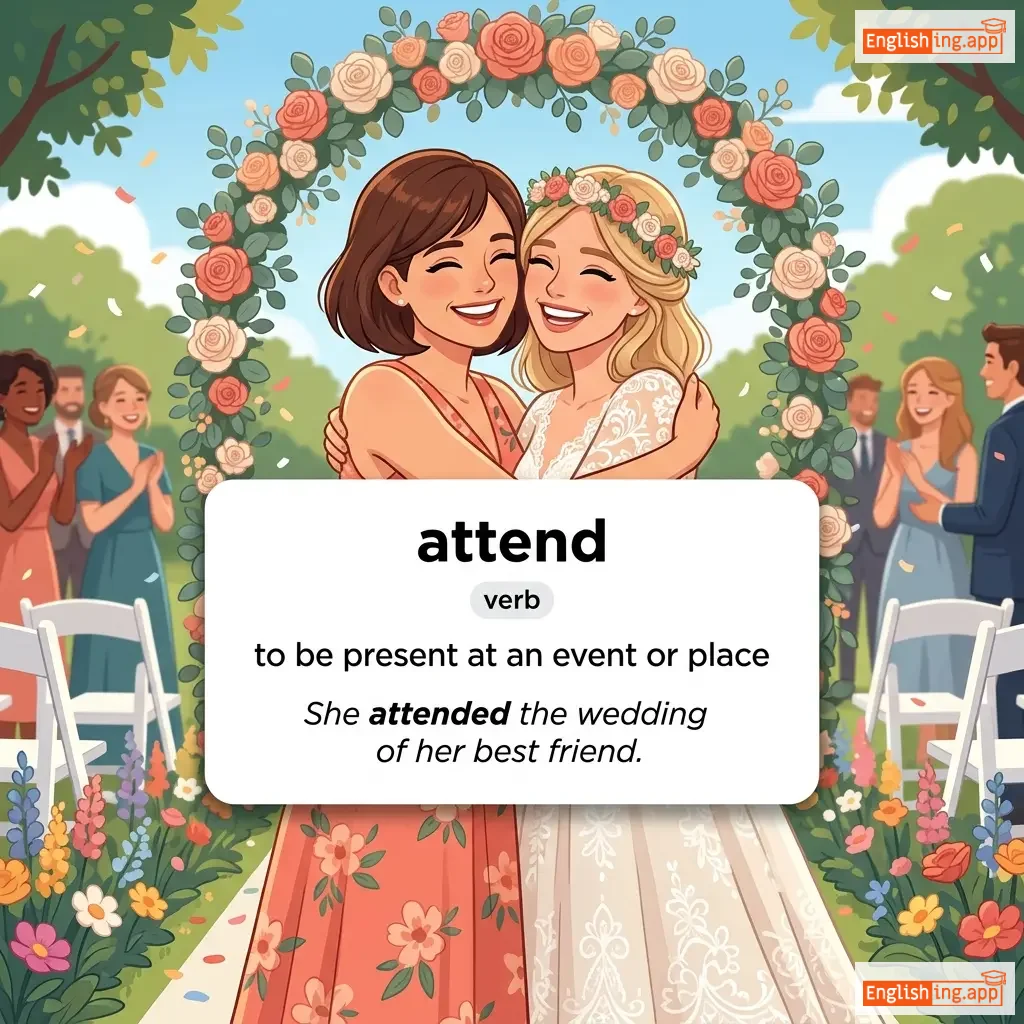
attend definition card — visual illustration of the meaning
verb
/əˈtɛnd/
assister (assister)

to be present at an event or place

"She attended the wedding of her best friend."

"Elle a assisté au mariage de sa meilleure amie." (Elle a assisté au mariage de sa meilleure amie.)
noun
/əˈtɛndəns/
présence (presence)

the act of being present at a place or event

"The teacher checked the students’ attendance every morning."

"L'enseignant vérifiait la présence des étudiants chaque matin." (L'enseignant vérifiait la présence des étudiants chaque matin.)
noun
/əˈtɛnʃən/
attention (attention)

the act of focusing on something or someone

"The teacher asked for the students' attention."

"L'enseignant a demandé l'attention des élèves." (L'enseignant a demandé l'attention des élèves.)
adjective
/əˈtɛntɪv/
attentif (attentif)

Paying close attention to something or someone; being considerate and alert.

"The teacher praised the students for being attentive during the lesson."

"L'enseignant a félicité les élèves pour avoir été attentifs pendant la leçon." (L'enseignant a felicité les élèves pour avoir été attentifs pendant la leçon.)
adverb
/əˈten.tɪv.li/
attentivement (attentivement)

with careful attention; in a focused manner

"She listened attentively to her teacher's instructions."

"Elle écouta attentivement les instructions de son professeur." (El ekuta attentivement le instruksyons də son profesœr.)
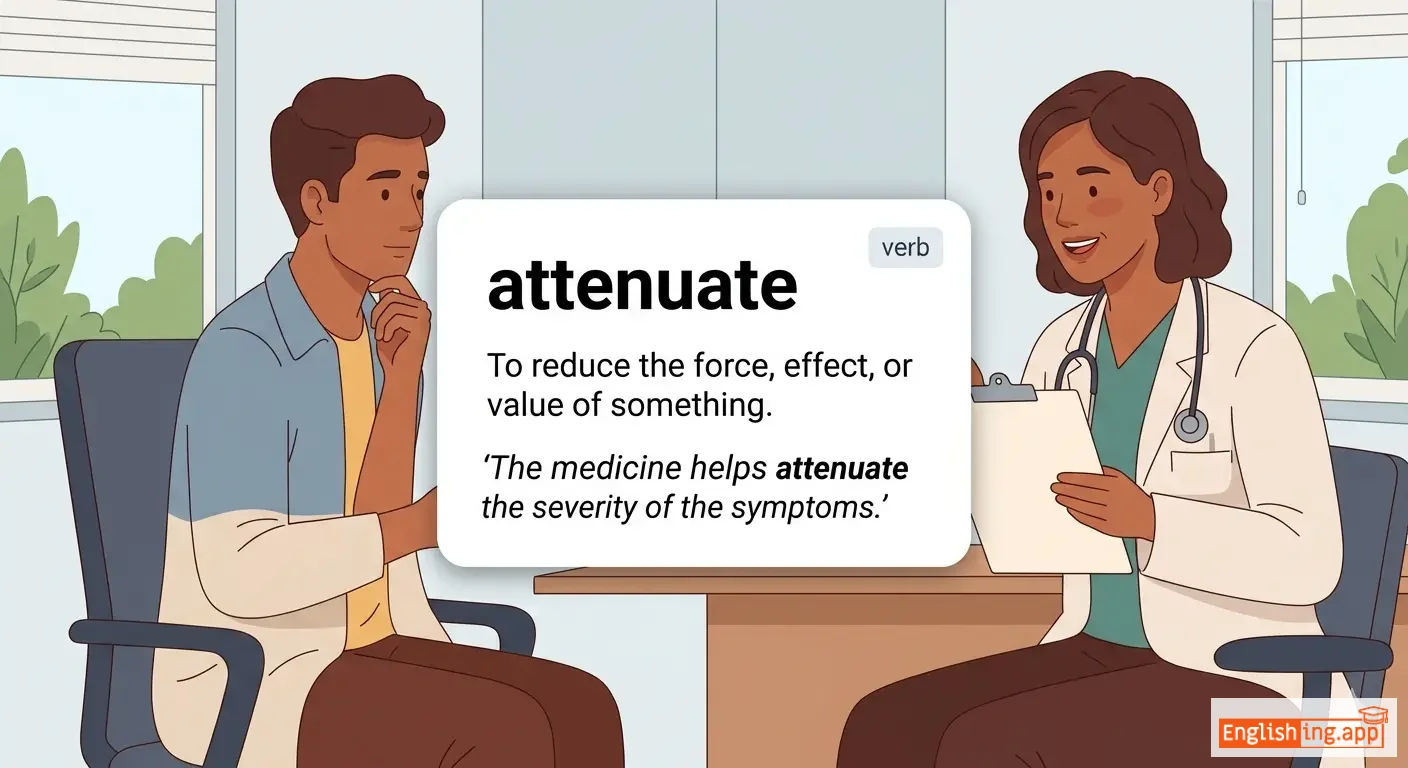
attenuate definition card — visual illustration of the meaning
verb
/əˈtɛnjueɪt/
atténuer (atenuer)

To reduce the force, effect, or value of something.

"The medicine helps attenuate the severity of the symptoms."

"Le médicament aide à atténuer la gravité des symptômes." (Le médicament aide à atténuer la gravité des symptômes.)
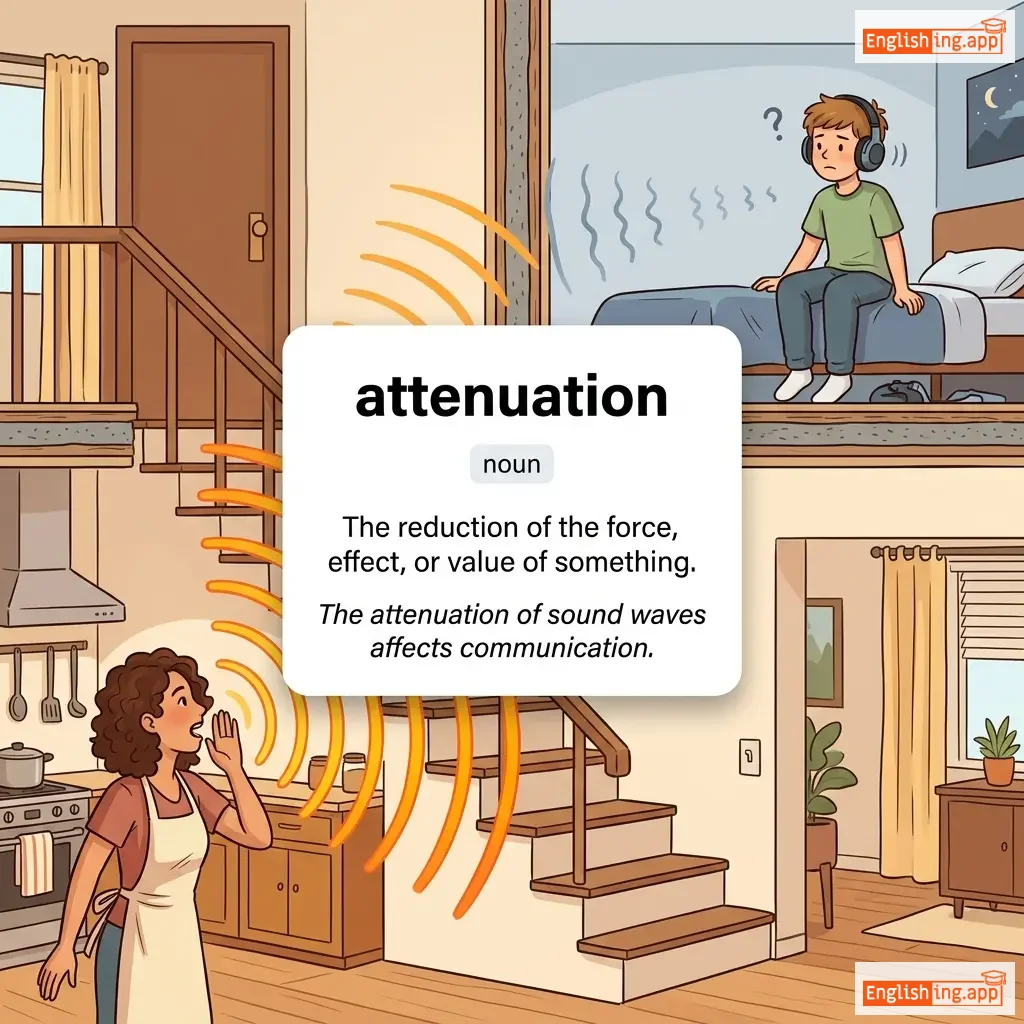
attenuation definition card — visual illustration of the meaning
noun
əˌten.juˈeɪ.ʃən
atténuation, réduction, affaiblissement (attenuation, reduction, affaiblissement)

The reduction of the force, effect, or value of something.

"The attenuation of sound waves affects communication."

"L'atténuation des ondes sonores affecte la communication." (L'atténuation des ondes sonores affecte la communication.)
verb
/əˈtɛst/
attester (attester)

To provide or serve as clear evidence of; to confirm or certify the truth of something.

"The witness attested to the accuracy of the report."

"Le témoin a attesté de l'exactitude du rapport." (Le témoin a attesté de l'exactitude du rapport.)
noun
/əˈtaɪər/
vêtement (vetement)

Clothing, especially formal or elegant wear.

"She wore traditional attire at the wedding ceremony."

"Elle portait un vêtement traditionnel lors de la cérémonie du mariage." (Elle portait un vetement traditionnel lors de la ceremonie du mariage.)
noun
/ˈætɪˌtjuːd/

A settled way of thinking or feeling about someone or something, often reflected in behavior.

"Her positive attitude helped her overcome many challenges."

noun
/əˈtɜːrni/
avocat (avocat)

a person who practices law; a lawyer

"She hired an attorney to represent her in court."

"Elle a engagé un avocat pour la représenter au tribunal." (Elle a engage un avocat pour la representer au tribunal.)
noun
/əˌtɜːni ˈdʒɛnərəl/
procureur général (procureur general)

The chief legal officer of a state or country.

"The attorney-general announced new reforms to strengthen justice."

"Le procureur général a annoncé de nouvelles réformes pour renforcer la justice." (Le procureur général a annoncé de nouvelles réformes pour renforcer la justice.)
verb
/əˈtrækt/
attirer (attirer)

to cause someone to have interest or draw something towards

"The flowers attract bees with their bright colors."

"Les fleurs attirent les abeilles avec leurs couleurs vives." (Les fleurs attirent les abeilles avec leurs couleurs vives.)
verb (past tense / past participle)
/əˈtræktɪd/
attiré (attire)

felt interest or liking toward someone or something; was drawn by appeal or force

"She was attracted to the idea of studying abroad."

"Elle était attirée par l’idée d’étudier à l’étranger." (elle etait attiree par lidee detudier a letranger)
noun
/əˈtrækʃən/
attraction (attraction)

something that draws attention, interest, or enjoyment

"The Eiffel Tower is a major tourist attraction in Paris."

"La Tour Eiffel est une grande attraction touristique à Paris." (La Tour Eiffel est une grande attraction touristique a Paris.)
adjective
/əˈtræktɪv/
attrayant (atra-yã)

pleasing or appealing to the senses or mind; having qualities that arouse interest or admiration

"The attractive design of the house caught everyone's attention."

"Le design attrayant de la maison a attiré l'attention de tous." (Le dizain atrayant de la mèzon a attira l’atansyon de tou.)
adverb
/əˈtræktɪvli/
de manière attrayante (de maniere attrayante)

in a pleasing or appealing way; in a manner that draws interest or admiration

"The room was attractively decorated with soft lights and plants."

"La pièce était décorée de manière attrayante avec des lumières douces et des plantes." (La piece etait decoree de maniere attrayante avec des lumieres douces et des plantes)
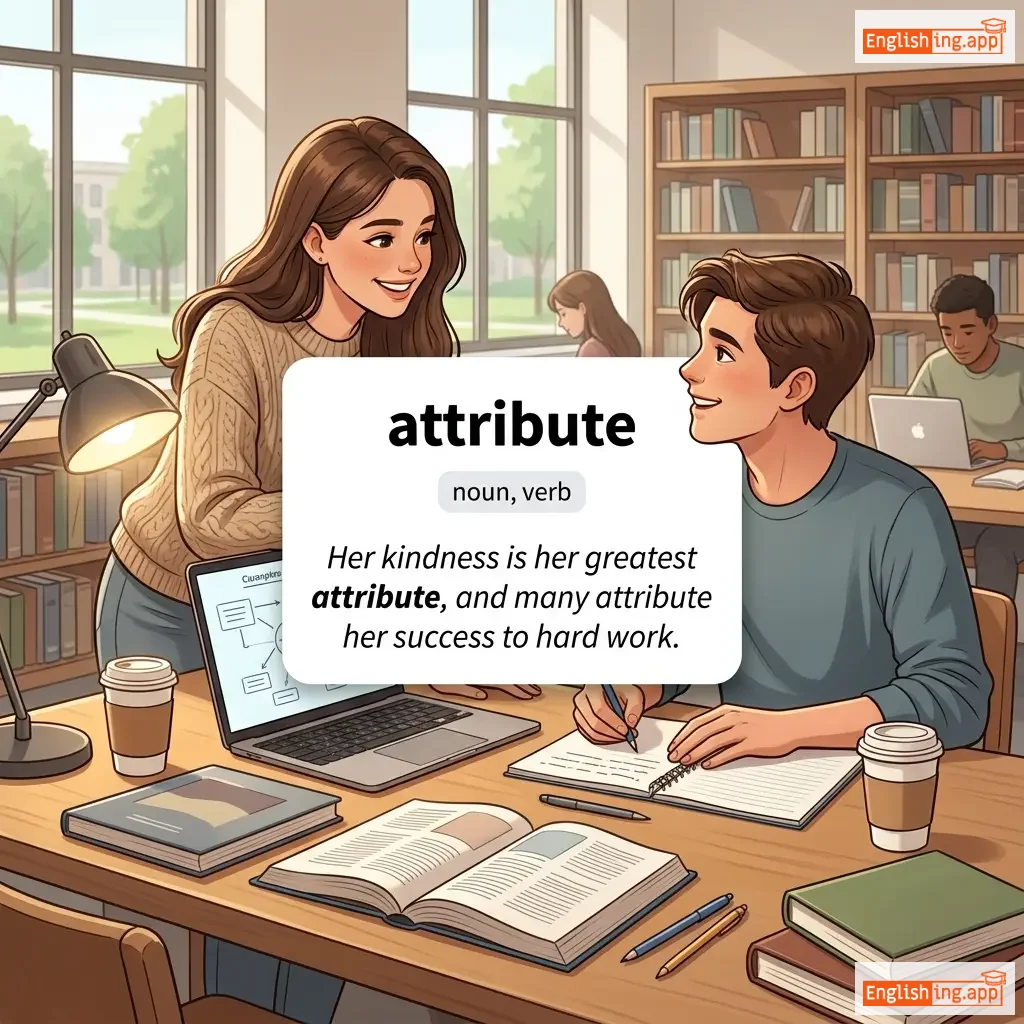
attribute definition card — visual illustration of the meaning
noun, verb
/ˈætrɪˌbjuːt/ (noun), /əˈtrɪbjuːt/ (verb)
attribut / attribuer (attribut / attribuer)

As a noun: a quality or characteristic of someone or something. As a verb: to regard something as being caused by someone or something.

"Her kindness is her greatest attribute, and many attribute her success to hard work."

"Sa gentillesse est son plus grand attribut, et beaucoup attribuent son succès au travail acharné." (Sa gentillesse est son plus grand attribut, et beaucoup attribuent son succès au travail acharné.)
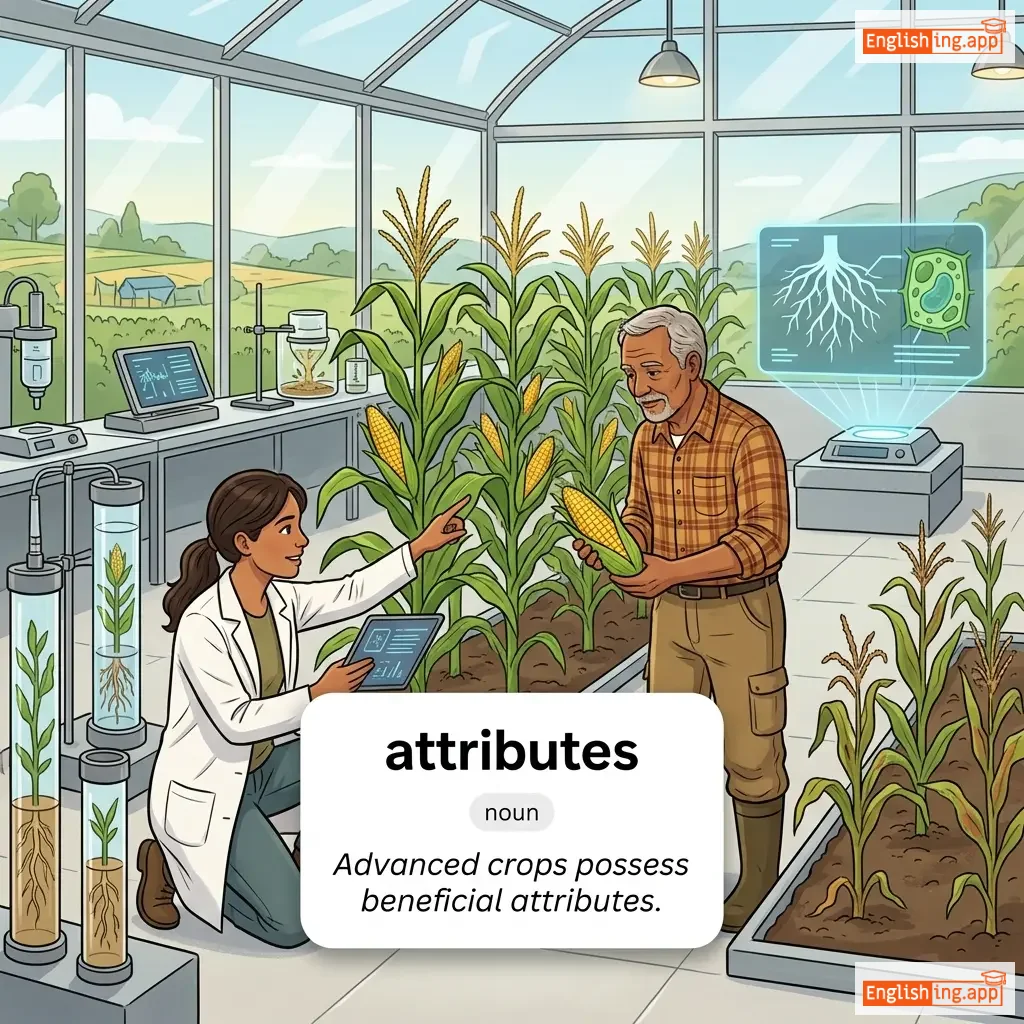
attributes definition card — visual illustration of the meaning
noun
ˈæt.rɪ.bjuːts
attributs (attributs)

A quality or feature regarded as a characteristic or inherent part of someone or something.

"Advanced crops possess beneficial attributes."

"Les cultures avancées possèdent des attributs bénéfiques." (Les cultures avancées possèdent des attributs bénéfiques.)
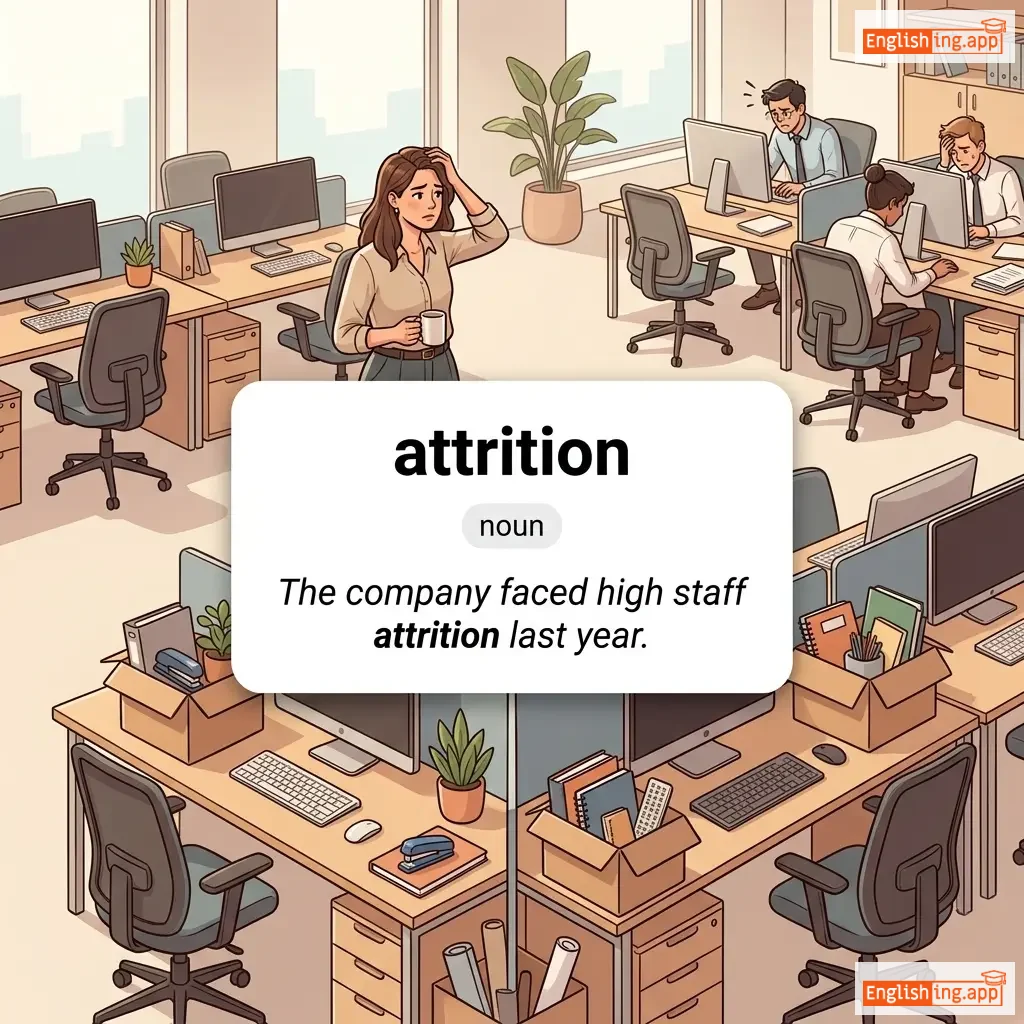
attrition definition card — visual illustration of the meaning
noun
/əˈtrɪʃən/
réduction progressive (reduction progressive)

The gradual reduction in the number or strength of something, often due to constant stress, conflict, or loss.

"The company faced high staff attrition last year."

"L'entreprise a fait face à une forte attrition du personnel l'année dernière." (L'entreprise a fait face à une forte attrition du personnel l'annee derniere.)
verb
/əˈtjuːn/
accorder (accorder)

to make someone or something aware of or responsive to something; to adjust or harmonize

"She quickly attuned herself to the needs of her new team."

"Elle s’est rapidement accordée aux besoins de sa nouvelle équipe." (Elle s est rapidement accordee aux besoins de sa nouvelle equipe)